To develop a smart indigenous sleeping bag with active heating
property for cold climates
Shishir Tyagi and Chetan Mahajan
Wool Research Association, Thane
Abstract: Sleeping bag is made of three layer systems where inner layer is made of Micro filament polyester fabric with chemical treatment to enhance its wicking properties; middle layer is made of PU Nylon fabric for enhanced abrasion resistance & breathability with water repellence. The middle layer is constructed with different combination of non woven made of Round Polyester, Angora, wool fibres and their blends. The temperature regulated active heating system is also inserted with middle layer inside the sleeping bag. Performance of 3 layers of sleeping bag is assessed w.r.to breathability, water repellence, water absorbency, thermal insulation properties.
Keywords: sleeping bag, outer layer, inner layer, middle layer, heating system
I. INTRODUCTION
A sleeping bag is a protective "bag" for a person to sleep in, similar to a blanket that can be closed with a zipper and functions as a bed while camping, hiking, hill-walking or climbing. Its primary purpose is to entrap dead air thus, provide warmth and thermal insulation. Sleeping bags are used at high altitudes in extremely cold weather [1,2,3]. It also protects against wind chill, precipitation, rain etc. Efficacy of sleeping bag is termed as Comfort Temperature which gives the range of temperatures at which the user gets full night’s sleep without experiencing cold which usually is defined as an upper and lower limit of temperature [4,5]. Conventional market available,
Sleeping bags are generally three layer system where outer layer and inner layer are made of polyester and cotton/polyester respectively while middle layer is a sandwich layer made of polyester batting and is responsible for thermal insulation of bag. In this paper, a sleeping bag with enhanced wicking property, superior water proof & breathability has been developed. Apart from this, active heating system is also embedded to enhance the overall thermal insulation of sleeping bag.
II. EXPERIMENTAL
2.1 Material
The microfilament Polyester fabric and Nylon fabrics were purchased from local supplier M/s Global trading company, Mumbai and the chemicals for enhancing wicking property was sourced from Archroma India Private Limited. The Hot melt PU adhesives were sourced from Jowat SE Germany.
2.2 Development of different layers of sleeping bag Methods
Details of fabrics used as inner & outer layer are given below.
2.2.1 Inner layer of sleeping bag i.e microfilament polyester
2.2.2 Chemical treatment of inner layer: The following recipes of chemical treatment for wicking property improvement followed by Pad –dry-cure method curing at 130 ° C for 3 minutes are given below:
Treatment Hydroperm* SRHA liq. (gpl) pH Padding pick up (%)
1 15 6-6.5 50
2 20 6-6.5 50
3 30 6-6.5 50
4 60 6-6.5 50
*Archroma product
2.3 Outer layer- Nylon fabric
The outer layer nylon fabric comprises the following parameters:
SN Parameters Value
1 Nominal count of yarn 80 denier
2 Ends/cm 52
3 Picks/cm 36
4 Warp cover factor 9.21
5 Weft cover factor 9.21
6 Fabric cover factor 15
7 Fabric grams per square meter (GSM),max 90
2.4 Water proof & breathable coating of PU on Outer layer (nylon fabric) of sleeping bag
With PU chemicals different recipe of breathable coating were formulated for optimization of breathability & water repellnce properties. The coating treatment was given on Slot die based Hotmelt Laminating & Coating machine (Make: HipMitsu, Italy) for different trials are given below:-
Sample ID Chemical coating (GSM)
Untreated Nil
Treatment -1 5
Treatment -2 10
Treatment -3 15
S.N Fabric parameters Measurement value
1 Nominal count of yarn 85 denier
2 Ends/cm 55
3 Picks/cm 32
4 Warp cover factor 16.4
5 Weft cover factor 13.02
6 Fabric cover factor 21.7
International Journal of Modern Trends in Engineering and Research (IJMTER)
Volume: 5, Issue: 12, [December– 2018]ISSN (Online):2349–9745 ; ISSN (Print):2393-8161
2.5 Fibres used as a non woven in middle layer
Fibre used Linear density
(denier)
Fibre staple
length(mm)
Tenacity cN/d Breaking
extension %
Round Polyester 6 64 3.87 51
Angora 3 denier (18 micron)
45 1.61 40
Wool 5.37 denier (24 micron)
70 2.80 43
The polyester non woven samples were made from parallel-laid web through needle punching density of 150 punches/inch2. Since the machine used was of capacity of 15 punches/inch2, hence web was passed 10 times through the machine in order to get 150 punches/inch2.
2.6 Constructional details of experimental non woven fabric samples
Fabric code Fibre type Nominal fabric weight
(g/m2)
Needling punching density (Punches/inch2)
RP1 Round polyester 200 150
RP2 Round polyester 250 150
RP3 Round polyester 450 150
A1 Angora 150 150
A2 Angora 200 150
A3 Angora 300 150
AW1 Angora/Wool 150 150
AW2 Angora/Wool 200 150
AW3 Angora/Wool 300 150
RP1, RP2 and RP3 are non-woven of Round polyester having GSM 200, 250 and 450 respectively A1, A2 and A3 are non-woven of 100% angora having GSM 150, 200 and 300 respectively
AW1, AW2 and AW3 are non-woven of angora/wool 70/30 blend having GSM 150, 200 and 300 respectively
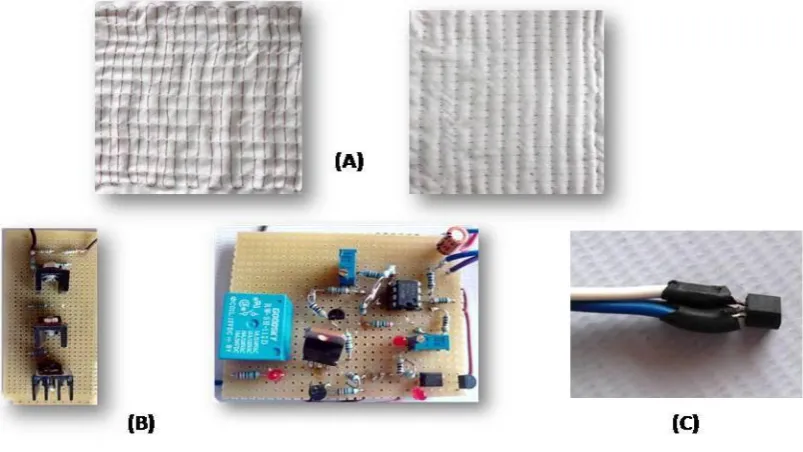
2.7Flexible heating panel
2.7.1 Heating element & Development of heating element
Fig no. 1 A. Flexible heating fabric, B. Thermostat, and C. Temperature sensor
III. RESULTS AND DISCUSSION 3.1 Testing results
3.1.1 Absorbency testing for microfilament polyester fabric (inner layer)
Sample treatments S.N Absorbency
time(Second)
Avg. Absorbency time(Second)
untreated
1 41 42.33
2 40
3 46
15gpl (treatment-1) 1 18 18
2 18
3 18
20gpl (treatment-2) 1 13 12.67
2 13
3 12
30gpl (treatment-3) 1 13 12.67
2 12
3 13
60 gpl (treatment-4) 1 13 13
2 12
3 14
3.1.2 Absorbency testing for polyester fabric
International Journal of Modern Trends in Engineering and Research (IJMTER)
Volume: 5, Issue: 12, [December– 2018]ISSN (Online):2349–9745 ; ISSN (Print):2393-8161
(Graph-1 shows relation between different chemical treated fabrics with absorbency time in seconds)
3.2 Testing of outer layer properties
3.2.1 Breathability testing of coated nylon fabric.
The breathable coating treated nylon fabric was tested for cup test method of breathability testing.
Sample ID Breathability testing
(gm/m2 /24 hours)
Untreated 456
Treatment -1 368
Treatment -2 363
Treatment -3 352
3.2.2 Breathability of PU coated nylon fabric
3.2.3 Spray testing /Water repellencyof PU coated nylon fabric.
The PU coated nylon fabric was tested for spray testing.
Sample ID Spray testing rating
Untreated 0
Treatment -1 50
Treatment -2 80
Treatment -3 100
3.2.4 Spray testing /Water repellency of outer layer
Spray testing was done to evaluate the water resistance capacity of the treated breathable fabric. The above mentioned different types of breathable fabrics were tested for water repellence properties. The following graph shows the relation between coated sample and its spray testing rating. The spray testing ratings are graded from 0 to 100. Rating 0 means not water repellent and 100 rating means excellent water repellent. In the following graph, it is seen that untreated fabric is not water repellent and have 0 rating. Treatment -3 gives highest water repellency properties than others. Treatment -1 gives 50 rating which is poorest among coated fabrics. Therefore, treatment-3 provides best results for outer layer nylon fabric.
(Graph-3 shows the relation between spray testing rating of outer layer with different coating recipes)
3.3 Testing of thermal insulation properties of 3 layer system ( i.e outer layer + inner layer + middle layer) with and without heating system
Three layers were tested using Dry Guarded Hot Plate as per ASTM D1518 Standard Test Method for Thermal Transmittance of Textile Materials.
S.No.
Fabric code
Middle layer non woven (Fibre type)
Nominal weight of 3 layers
(g/m2)
Thermal insulation value of 3 layers without heating system
(Tog)
Thermal insulation value of 3 layers with
heating system
(Tog)
International Journal of Modern Trends in Engineering and Research (IJMTER)
Volume: 5, Issue: 12, [December– 2018]ISSN (Online):2349–9745 ; ISSN (Print):2393-8161
2 FRP2 Round polyester 430 3.56 4.02
3 FRP3 Round polyester 630 4.46 5.11
4 FA1 Angora (100%) 350 3.54 4.74
5 FA2 Angora (100%) 380 4.78 5.90
6 FA3 Angora (100%) 480 5.35 6.88
7
FAW1 Angora/Wool (70/30) 330 3.21 4.47
8
FAW2 Angora/Wool (70/30) 380 4.45 5.68
9 FAW3 Angora/Wool (70/30) 480 5.01 6.59
10 F(RP3 +A3) Round polyester + Angora (100%)
930 9.38 10.98
11 F(RP3 +AW3) Round polyester + Angora/Wool (70/30)
930 9.03 10.56
FRP1, FRP2 and FRP3 are three layers having middle layer of non-woven of Round polyester having GSM 200, 250 and 450 respectively
FA1, FA2 and FA3 are three layers having middle layer of non-woven of 100% angora having GSM 150, 200 and 300 respectively
FAW1, FAW2 and FAW3 are three layers having middle layer of non-woven of angora/wool 70/30 blend having GSM 150, 200 and 300 respectively
F(RP3 +A3) and F(RP3 +AW3) are three layers having middle layer of combination of non-woven of RP3/A3 and RP3/AW3 respectively
IV. Conclusion
In the research project, sleeping bag is fabricated by utilising of Three layers were with optimum components.
The inner layer made of microfilament polyester chemical treated of Treatment-2 (i.e 20gpl conc.) & outer layer made of Nylon with PU coating of Treatment-3 (i.e 15 GSM ) have given optimum results for water absorbency and breathability & water spray test respectively.
The middle layer is used as a Combination of nonwoven layer of round polyester and angora/wool (70/30). A Flexible heating panel circuit with rechargeable DC power battery operates at voltage 15.7 V and 6 amperes current is used as active heating system which is combined with middle layer and sandwiched between inner and outer layer in sleeping bag. The combined GSM of three layers were 930 with thermal insulation value (TOG) of sleeping bag is 9.03 which can be easily increased in range of 10-11 by turning on the heating system. The developed sleeping bag will be suitable to work at -150C temperature zone.
REFERENCES
1. Goldman R. F. Biomedical effects of sleeping systems in Handbook on clothing: Biomedical effects of military clothing and equipment systems 2nd edn (eds. Goldman R. F. & Kampmann B.) Ch. 6b, 1–8 (International Society for Environmental Ergonomics, 2007).
2. ISO 11079 Ergonomics of the thermal environment-determination and interpretation of cold stress when using required clothing insulation (IREQ) and local cooling effects. (International Organization for Standardization, 2007).
3. Isik H. Design and construction of thermoelectric footwear heating system for illness feet. J. Med. Syst. 29, 627– 631 (2005).
4. Johnson R. Pick the best sleeping bag. Outdoor Life 211, 132 (2004).