Author for correspondence:
1Dept. of Civil Engineering, Excel Engineering College.
Volume-5 Issue-3
International Journal of Intellectual Advancements
and Research in Engineering Computations
Experimental study on properties of concrete by partial replacement of
fine aggregate with bottom ash
Mr. Mohan Rajaa.M
1*, Ms.D.Mythili
2ABSTRACT
Concrete is the most widely used artificial construction material in the World and it is second to water as the most utilized substance on the planet. A Tremendous infrastructure development has taken place in the country (Throughout the world) and making of the concrete for higher strengths and higher durability to cater to the requirements are significant.
Admixtures are the chemical compounds in concrete other than Cement, water, fine aggregate and coarse aggregate and mineral additives that are added to the concrete immediately before or during mixing to modify the Properties of the concrete. The addition of the admixture will improve the Properties of the concrete and also it should be taken care that it should not adversely affect the performance of the concrete. By the addition of Admixtures, the workability of the concrete is improved, the durability and Strength of the concrete is improved, the initial setting time of the concrete is increased and sometimes it retards the initial setting time of the concrete etc.
Based on the literature review, it was observed that the admixtures Such as bottom ash, etc., put in Combination, will give better high performance and multi component concrete which can be used in the most adverse conditions. And based on various and Repeated trials, it was observed that by the replacement of the admixtures in The following Prepared and laboratory tests have been performed to determine the various Important properties of the concrete. The importance of the various Admixtures such as bottom ash. The optimum percentage of admixtures that gave Good mechanical and durability properties results based on trial and error method was selected
INTRODUCTION
Concrete is a material synonymous with strength and longevity. It has emerged as the dominant construction material for the infrastructure needs of the twenty-first century. In addition to being durable [1], concrete is easily prepared and fabricated from readily available constituents and is therefore widely used in all types of structural systems [2]. The challenge for the civil engineering community in the near future is to realize projects in harmony with the concept of sustainable development and this involves the use of high performance materials and products manufactured at reasonable cost with the lowest possible environmental impact [3]. Energy is the main backbone of modern civilization of the world over, and the electric Power from thermal power stations is a major source of energy, in the form of
electricity [4]. In India, over 70% of electricity generated in India, is by combustion of fossil fuels [5-7], out of which nearly 61% is produced by coal-fired plants. This results in the production of roughly 100 ton of ash. Most of the ash has to be disposed off either dry, or wet to an open area available near the plant or by grounding both the fly ash and bottom ash and mixing it with water and pumping into artificial lagoon or dumping yards. This causes the pollution in water bodies and loss of productive land [8-10].
CONSTRUCTION AND DEMOLITION
WASTES
Construction and demolition waste is generated whenever any construction/demolition activity takes place, such as, building roads, bridges,
Copyrights © International Journal of Intellectual Advancements and Research in Engineering Computations, flyover, subway, remodelling etc. It consists mostly
of inert and non-biodegradable material such as concrete, plaster, metal, wood, plastics etc. While retrievable items such as bricks, wood, metal, titles are recycled, the concrete and masonry waste, accounting for more than 50% of the waste from construction and demolition activities, are not being currently recycled in India. Recycling of concrete and masonry waste is, however, being done abroad in countries like U.K., USA, France, Denmark, Germany and Japan. Concrete and masonry waste can be recycled by sorting, crushing and sieving into recycled aggregate.
C&D waste needs to be focused upon in view of The potential to save natural resources
Its bulk which is carried over long distances for just dumping
Its occupying significant space at landfill sites Its presence spoils processing of biodegradable
as well as recyclable waste
Many developed countries have been recycling C&D waste and using it for construction works. In Scotland about 63% of the C&D waste was recycled in 2000.The Government there is working out specifications and code of practice for recycling
of C&D waste. U.K uses 49-52% of the C&D wastes and Australia reuses 54% of the wastes generated. Belgium has a higher recycling rate (87%) and uses majority of C&D for recycling purposes. Japan is one of the pioneer countries that recycle C&D waste.85 million tonnes of C&D waste was generated in 2000, of which 95% of concrete was crushed and reused.
In India, there is not much development in this field. In the international experiences sited above, there is considerable emphasis on recycling of C&D in India.
RECYCLED COARSE AGGREGATE
(RCA)
The requirements of natural aggregates are not only required to fulfill the demand for the upcoming projects, but also are the needs of the extensive repairs or replacements required for the existing infrastructure and dilapidated buildings built few decades back. The use of Recycled Coarse Aggregate can fill a part of this gap. Figure shows recycled aggregate.
Recycled Aggregate
Works on recycling have emphasized that if old concrete has to be used in second generation concrete, the product should adhere to the required compressive strength. Literature survey reveals that compressive strength primarily depends upon adhered mortar, water absorption, Los Angeles abrasion, size of aggregates, and strength of parent concrete, age of curing and ratio of replacement,
Copyrights © International Journal of Intellectual Advancements and Research in Engineering Computations,
Recycled coarse aggregate
Since the recycled aggregates has the potential to replace natural resources and in the process address the issue of sustainability and environmental degradation many countries outside India have been using the product satisfactorily. However this requires upgrading the waste material to normal standards and reducing it to proper size to attain the desirable properties. Works have shown that aggregates from different sources, exhibit different engineering properties. Aggregates also are the key ingredients in concrete making up 70-80% of volume in concrete and dictating the strength and density relationship. Hence using recycled concrete as aggregate will require checking the quality of the aggregates, since they are collected from different sources, grades of concrete and age. Works on recycled concrete have emphasized that the basic material properties, such as shape, texture, specific gravity, absorption, moisture content, permeability, strength characteristics, deleterious substance, resistance to freeze–thaw, etc., need to be thoroughly evaluated before it is used to produce concrete. Aggregate‟s properties greatly affect the properties of a concrete. It would also be necessary to assess the effect of recycled material on final concrete and work out optimum composition of recycled aggregate to produce concrete of desirable quality. These materials proved to be excessively detrimental to concrete’s performance. The main causes for this weak performance of RFA were the low particle’s density, and high water absorption capacity, that hinders the mixing.
MINERAL ADMIXTURES
Bottom ash
Bottom ash is part of the non-combustible residue of combustion in a furnace or incinerator. In an industrial context, it usually refers to coal combustion and comprises traces of combustibles embedded in forming clinkers and sticking to hot side walls of a coal-burning furnace during its operation. The portion of the ash that escapes up the chimney or stack is, however, referred to as fly ash. The clinkers fall by themselves into the bottom hopper of a coal-burning furnace and are cooled.
Bottom ash generation process
Copyrights © International Journal of Intellectual Advancements and Research in Engineering Computations, environmental benefits. Existing dry ash handling
systems include: MAC Ash Cooler System, DAP Dry Ash Processor, DRYCON system, and Vibratory Ash Extractor. Bottom ash may be used as raw alternative material, replacing earth or sand or aggregates, for example in road construction and in cement kilns (clinker production). A noticeable other use is as growing medium in horticulture (usually after sieving).
Silica fume
Silica fume is a byproduct of producing silicon metal or ferrosilicon alloys. One of the most beneficial uses for silica fume is in concrete. Because of its chemical and physical properties, it is a very reactive pozzolan. Concrete containing silica fume can have very high strength and can be very durable.
Fly ash
Fly ash, is one of the coal combustion products, composed of the fine particles that are driven out of the boiler with the flue gases. Ash that falls in the bottom of the boiler is called bottom ash. In modern coal-fired power plants, fly ash is generally captured by electrostatic precipitators or other particle filtration equipment before the flue gases reach the chimneys. Together with bottom ash removed from the bottom of the boiler, it is known as coal ash. Depending upon the source and makeup of the coal being burned, the components of fly ash vary considerably, but all fly ash includes substantial amount SiO2 (both amorphous and crystalline), aluminium oxide (Al2O3) and calcium oxide (CaO), the main mineral compounds in coal-bearing rock strata.
MATERIAL
STUDY
AND
MIX
DESIGN
Effective production of high strength concrete is achieved by carefully selecting, controlling and proportioning all ingredients. In order to achieve high strength concrete, optimum proportion must be selected, considering the characteristics of cementitious materials, aggregate quality, paste proportion, aggregate paste interaction and meticulous care in mixing and handling. Following are the details of the materials used in this investigation and its properties.
Cement
Cement is the most important ingredient in concrete. One of the important criteria for the selection of cement is its ability to produce improved microstructure in concrete. Cement OPC of 53 Grade locally available is used in this investigation. The Cement is tested for various properties as per the IS: 4031–1988 and found to be confirming to various specifications of IS: 12269– 1987.
METHODOLOGY
FOR
OBTAINING
RECYCLED COARSE AGGREGATE
To cast nominal mix (1:1.5:3) cubes of 150mm, 100 no‟s to produce Construction and Demolition (C&D) waste.
After 28 days curing, the specimen were crushed to failure using compression testing machine and the broken concrete is re-processed for recycling into RCA based concrete.
Processing involved subjecting C&D waste to Los Angele‟s machine, sieving, washing and sun drying.
Test cubes of 150 mm based concrete were cast for nominal mix proportion of 1:1.5:3, with w/c = 0.5. The recycled aggregates were all water soaked for 24 hours before being used, except the cement slurry coated case, wherein soaking in cement slurry was done for 24 hours.
The specimen of RCA concrete is tested after 28 days of curing.
The specimen of RCA concrete blended with silica fume, fly ash, and GGBS are tested after 28 days and 56 days of curing.
Mixing method
Copyrights © International Journal of Intellectual Advancements and Research in Engineering Computations, for 24 hours in water prior to mixing. The RCA
was taken out after 24 hours of soaking and allowed for air drying of 30 minutes before the mixing. This prevented further absorption of water by the RCA. It helped to attain the workability of moderate level without plasticizers.
Slump tests
Initial experiments are conducted to get a slump of at least 75 -100 mm without super plasticizers. Standard slump cone apparatus is used for measuring the value of slump. During the slump
tests it was found that the workability of fresh concrete made with 100% replacement of RCA had slump value close to zero mm. With increase in percentage of RCA in concrete the workability was getting lower and lower. This was mainly due to the high absorption rate (2.7%) of the RCA as compared to the fresh coarse aggregate (0.5%). Adding water to compensate for this absorption was not a good option as exact amount could not be ascertained. So it was decided to soak the RCA for 24 hours before use so that it does not absorb water during the process of mixing.
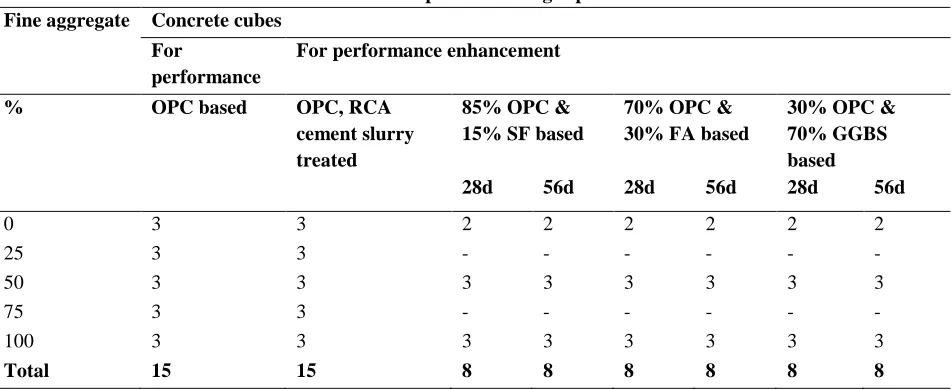
Table 3.16 shows a test matrix for compressive strength performance and enhancement. Fine aggregate Concrete cubes
For
performance
For performance enhancement
% OPC based OPC, RCA
cement slurry treated
85% OPC & 15% SF based
70% OPC & 30% FA based
30% OPC & 70% GGBS based
28d 56d 28d 56d 28d 56d
0 3 3 2 2 2 2 2 2
25 3 3 - - - -
50 3 3 3 3 3 3 3 3
75 3 3 - - - -
100 3 3 3 3 3 3 3 3
Total 15 15 8 8 8 8 8 8
The mix proportions of the OPC concrete used is shown in Table 3.17. The water cement ratio was
taken as 0.5. Mixes were with 0%, 25%, 50%, 75%, and 100% RCA by weight.
Mix proportion per cubic meter for OPC based concrete
Fine aggregate C FA CA RCA W
(%) (kg) (kg) (kg) (kg) (kg) 0 400 600 1200 - 200 25 400 600 900 300 200 50 400 600 600 600 200 75 400 600 300 900 200 100 400 600 0 1200 200
Similar test matrix were used for other four performance enhancement techniques attempted. However the dosage of chemical admixture (CONPLAST SP 430) has been suitably used to give workability slump range of 75-100 mm. The details of chemical admixture dosages for various compositions are as follows;
OPC based concrete with 24hrs soaked RCA- 0 ml/kg of cement for all replacement levels of RCA.
OPC based but RCA treated in cement slurry- RCA 0% - 0 ml/kg, 25% - 0 ml/kg, 50% - 0 ml/kg. 75% - 4 ml/kg and 100% - 8 ml/kg.
Copyrights © International Journal of Intellectual Advancements and Research in Engineering Computations, OPC – 70% and FA- 30% blended concrete- RCA
0% - 0 ml/kg, 50% - 0 ml/kg. and 100% - 0 ml/kg.
OPC – 30% and GGBS -70% blended concrete- RCA 0% - 0 ml/kg, 50% - 6 ml/kg. and 100% - 6 ml/kg.
Methodology for obtaining recycled fine
aggregate
The same material, from which RCA has been extracted, is passed through 4.75 mm sieve, is washed and sun dried. The fractions finer than 600μ are removed for the reason explained earlier, but substituted with either river sand or IOT fractions.
RFA mortar blended with river sand and iron ore tailings with nominal mix (1:3), cubes of
50cm2 with recycled fine aggregate in proportions 0%, 50%, 100%, 3 no‟s each, by weight are cast.
RFA concrete blended with river sand and iron ore tailings with nominal mix with nominal mix (1:1.5:3), cubes of 150mm x 150mm x 150mm, w/c ratio 0.5 with recycled concrete aggregates in proportions of 0%, 50%, 100% 3 no‟s each, by weight were cast.
Experiments were planned to test the compressive strength of River sand, RFA based river sand and RFA based IOT, mortar cubes for 3, 7, and 28 days of curing in water. Table 3.18 shows the test matrix for testing compressive strength of different mortar compositions.
Test matrix for compressive strength of mortar cube
Fine aggregate 3 Day 7 Day 28Day
All River Sand 3 3 3 RFA & River Sand Fines 3 3 3 RFA & IOT Fines 3 3 3
Experiments were planned to test the compressive strength of River sand, RFA based river sand and RFA based IOT, based concrete
cubes for 28 days of curing in water. Table 3.19 shows the test matrix for testing compressive strength of concrete.
Test matrix for compressive strength of concrete cubes
Fine aggregate adopted 28Day
All River Sand 3 RFA & River Sand Fines 3 RFA & IOT Fines 3
COMPRESSIVE STRENGTH
Strength of concrete is the most important, although other characteristic may also be critical and cannot be neglected. Strength is an important indicator of quality because strength is directly related to the structure of hardened cement paste. Even though strength is not a direct measure of durability or dimensional stability, it has a strong relationship with the water to cement ratio of the concrete, which in turn influences durability, dimensional stability and other properties of concrete.
The strength measured in concrete depends on some factors including the age, degree of
hydration, rate of loading, method of testing, specimen geometry, and the properties and proportions of the constituent materials. Mostly, concrete strength improves with the increase of age. The strength of saturated specimen may have lower strength than dry specimen. Compressive strength measured in impact loading will be higher than that in a normal rate of loading. Cube specimen may result higher strength than cylinder specimen. The properties of constituent materials such as the quality of aggregate, the quality of cement paste, and the bond between aggregate and cement paste, influence the strength of concrete.
Copyrights © International Journal of Intellectual Advancements and Research in Engineering Computations, &56 day strengths in the case of SF, FA and GGBS
blended concretes. The testing of the cubes was
done in a 200T capacity compression testing machine.
Testing of cubes for compressive strength
RESULTS AND DISCUSSION
The result of the tests performed on recycled concrete includes the variation in compressive strength by two performance enhancement techniques to achieve the strength of recycled concrete to be equal to or more than the strength of no recycled aggregate concrete.
Compressive strength testing of all specimen were carried out as per IS: 516-1959. The load was applied without shock at a rate of 140 kg/cm2/min. A set of three cubes were tested for all six mixes, for each percentage of replacement. Average of three specimen were taken, provided the individual
variation in strength 50 was not more than ±15% of the average, and the results were tabulated and interpreted.
Performance of RCA Based Concrete
The results of the compressive tests for OPC specimen are shown in the table below. It can be noticed that the compressive strength of the cubes goes on decreasing as the percentage of the RCA replacement gets This can be attributed to the less bonding between the RCA and the mortar as it is having the old mortar sticking to it.
Compressive strength results for different proportions of RCA RCA
(%)
Wt of cubes (Kg)
Failure load (kN)
Compressive strength (N/mm2)
Average compressive strength (N/mm2)
Control mix 0
8.343 470 20.89 21.07
8.564 460 21.44
8.425 470 20.89
25 8.316 440 19.56 20.1
8.458 440 19.56
8.413 450 20.0
50 8.228 420 18.67 18.5
8.393 410 18.22
Copyrights © International Journal of Intellectual Advancements and Research in Engineering Computations,
75 8.336 390 17.33 17.5
8.402 390 17.33
8.455 400 17.78
100 8.373 360 16.00 16.3
8.358 370 16.44
8.345 370 16.44
Note: RCA used have been soaked in water for 24 hours
Compressive strength (MPa) variation with RCA for OPC based mixes
Nearly 20% decrease in strength is observed for 100% RCA based concrete. Attempts were made to achieve strengths of 100% RCA based concrete either equal to or more than that for the case of 0% RCA based concrete, with the following two approaches:
Use of cement slurry coated RCA
Experiments were planned to study the performance enhancement of cement slurry treated RCA based concrete
Compressive strength results for cement slurry treated RCA based concrete
RCA %
Wt of cubes (Kg)
Failure load (kN)
Compressive strength (N/mm2)
Avg compressive strength
(N/mm2)
Normalized 28d compressive strength (N/mm2)
0 8.343 470 20.89 20.7 1
8.439 460 20.44 8.425 470 20.89 25 8.287 520 23.11
23.1
1.12 8.194 530 23.56
8.229 510 22.67
50 8.124 510 22.67 22.8 1.10
Copyrights © International Journal of Intellectual Advancements and Research in Engineering Computations,
75 8.336 510 22.67 22.4 1.08
8.402 500 22.22 8.455 500 22.22
100 8.328 500 22.22 22.4 1.08
8.365 510 22.67 8.365 500 22.22
Compressive strength results for cement slurry treated RCA based concrete
It is clear from Fig. 4.2, that this method of RCA treatment is very effective as strength achieved for RCA based concrete is equal to or more than that for no RCA based concrete or Normal Aggregate Concrete (NAC), for all levels of RCA replacement.
Adopting 15% OPC replacement by silica
fume
Following tables present the results of compressive strength of RCA based concrete for 28days and 56 days of curing.
28 day compressive strength results for silica fume blended concrete
RCA (%)
Weight of cubes (Kg)
Failure load (kN)
Compressive strength (N/mm2)
Average 28dcompressive strength (N/mm2)
Normalized 28d compressive strength (N/mm2)
Control mix 0
8.343 470 20.89 20.7 1
8.439 460 20.44 8.425 470 20.89
50 8.318 450 20.0 20.4 .99
8.426 470 20.9 8.290 460 20.4
100 8.336 470 20.9 20.7 1
8.345 470 20.9 8.405 460 20.4
56 day compressive strength results for silica fume blended concrete
1
1.12 1.1
1.08 1.08
Normalised 28 day compressive strength
Copyrights © International Journal of Intellectual Advancements and Research in Engineering Computations, RCA
(%)
Weight of cubes (Kg)
Failure load (kN)
Compressive strength (N/mm2)
Average 56dcompressive strength (N/mm2)
Normalized 56d
compressive strength
(N/mm2)
Control mix 0
8.345 460 20.44
20.9 1
8.429 470 20.89 8.355 480 21.30
50
8.349 490 21.8
21.3 1.02
8.405 480 21.3 8.295 470 20.9
100
8.305 490 21.8
21.9 1.05
8.419 500 22.2 8.396 490 21.8
Normalized compressive strength results for silica fume blended RCA based concrete
It is clearly seen that for both levels of RCA usage i.e., 50% and 100% replacement to NCA, the obtained 56 days strength is higher than that for NCA based concrete.
CONCLUSIONS
Bottom ash can be used as an effective replacement of natural sand.
In the compressive strength bottom ash replaced concrete shows good results compared with the normal conventional concrete.
The average maximum compressive strength obtained is 31.5 N/mm2 in 28 days and is found to be 3.96% more than the conventional concrete.
The average maximum split tensile strength obtained is 3.34 N/mm2 and is found to be 4.3% more than the conventional concrete. The average maximum flexural strength
obtained is 3.35 N/mm2 and is found to be 3.3% more than the conventional concrete.
The maximum ultimate load by the coventional beam is 59.5KN and the bottom ash concrete beam withstands a maximum of 61 KN. In the durability property study the weight loss
due to acid, suplahte and chloride are more in conventional concrete than the bottom ash concrete. Also the strength decreases in the conventional concrete than in the bottom ash concrete,
The ductility factor of the bottom ash concrete beam is 1.06 times larger compared to the conventional beam.
The energy absorption capacity of the bottom ash concrete beam is greater than that of the conventional beam.
As the degree of processing gets better and better the RA tends to be closer to NA. Hence RA after processing shows better results than unprocessed RA.
Copyrights © International Journal of Intellectual Advancements and Research in Engineering Computations, RCA could be incorporated into many concrete
structures with proper processing and treatment. However, RCA that has an unknown origin should be tested to ensure that the RCA was not from a structure that was suffering from alkali-silica reaction, alkali-aggregate reaction, sulphate attack, or some other harmful reaction. Such RCA could affect the strength and durability of the concrete and may be harmful.
A maximum reduction of about 21% was noticed in compressive strength when the entire natural coarse aggregate was replaced with RA.
The two methods adopted to enhance performance of RCA based concrete have given favourable result, so as to consume/use 100% recycled coarse aggregate in concrete. For the cases of blended concrete with SF, curing period of 56 days is a must.
REFERENCE
[1]. Abhishek Jain,Nazrul Islam, Use of fly-ash as partial replacement of sand in cement mortar, International Journal of Innovative Research in Science, Engineering and Technology, 2(5), 2013, 1323-1332.
[2]. A.K.Padmini, K.Ramamurthy, M.S.Mathews, Influence of parent concrete on the properties of recycled aggregate concrete. Construction and Building Materials, 23, 2009, 829-836.
[3]. Akash Rao, Kumar N. Jha, SudhirMisra, Use of aggregate from recycled construction and demolition waste in concrete, Resources Conservation and Recycling, 50, 2007, 71-81.
[4]. Ashraf M. Wagih, Hossam Z. El-Karmoty , Magda Ebid , Samir H. Okba, Recycled construction and demolition concrete waste as aggregate for structural concrete, HBRC Journal , 9, 2013, 193–200.
[5]. Arivalagan S, Sustainable studies on concrete with GGBS as a replacement material in cement, Jordan Journal of Civil Engineering, 8(3), 2014, 263-270.
[6]. Bibhuti Bhusan, Mukharjee, Sudhirkumar V. Barai, Influence of Nano-Silica on the properties of recycled aggregate concrete, Construction and Building Materials, 55, 2014, 29–37.
[7]. Boyd S E, Limpenny D S, Rees H L, Cooper K M, The effects of marine sand and gravel extraction on the macrobenthos at a commercial dredging site (6 years of dredging), ICES Journal of Marine Science, 62(2), 2005, 145-162.
[8]. Debabrata Pradhan, D. Dutta, Influence of silica fume on normal concrete, International Journal of Engineering Research and Applications, 3(5), 2013, 79-82.
[9]. Evangelista L, De Brito J, Mechanical properties of concrete made with fine recycled concrete aggregates, Cement and Concrete Composites, 29(5), 2007, 397-401.