Volume-5 Issue-1
International Journal of Intellectual Advancements
and Research in Engineering Computations
Accumulative speed using context based adaptive binary
arithmetic coding in real world video firmness
**Haridhash.K, **Manoj kannan.K,
**Selvakannan.M, **Udayakumar.M,
**students, Department of Electronics and
Communication Engineering, Maharaja
Engineering College, Avinashi.
Email:[email protected]
*Gopalakrishnasamy.A,
*Assistant professor, Department of Electronics
and Communication Engineering, Maharaja
Engineering College, Avinashi.
Email:[email protected]
ABSTRACT
The ultimate goal of video source coding is bit-rate reduction for storage and transmission by exploring both statistical and subjective redundancies and to encode a “minimum set” of information using coding techniques. The performance of video compression techniques depends on the amount of reduction in complexity computation and efficiency contained in the image data as well as on the actual compression techniques used for M-coding. To achieve this, we combine the probability estimation based on the VP9 technique with approximation of Multiplication. Approximately that proposed algorithm is faster and better compression efficiency compared to the various coder in the CABAC entropy coding scheme.
KEYWORDS: Video compression, CABAC, standards, VP9, JCT-VC, MPEG.
1. INTRODUCTION
1.1 VP9 ENCODER
The VP9 bit stream format and its corresponding
encoder were released by Google Inc. Per June 12,
2013. The VP9 encoder has a two-pass run option,
similarly to x264, which results in the improved
rate-distortion performance, and which was also
used in our experiments, as further explained in the
next section. Major milestones in the evolution of
video coding standards are the well-known
H.262/MPEG-2 Video and H.264/MPEG-4
Advanced Video Coding (AVC) standards, the
development of which was coordinated by the
ITU-T Video Coding Experts Group (VCEG) and the
ISO/IEC Moving Pictures Expert Group (MPEG).
The first version of the
H.264/MPEG-AVC standard (and its reference software JM ) was
developed in the period between 1999 and 2003 to
satisfy the growing need for higher coding
efficiency, especially with regard to
standard-definition TV and video transmission over low data
rate channels. As a result, the H.264/MPEG-AVC
standard successfully achieved an increase of about
50% in coding efficiency compared to its
predecessor H.262/MPEG-2 Video.
H.264/MPEG-AVC was designed for both low- and high bit-rate
video coding in order to accommodate the
increasing diversification of transport layers and
storage media. In turn, this gave rise to a wide
variety of H.264/MPEGAVC-based products and
services. Throughout sub sequent stages of
development, additional efforts were made (mainly
from 2003 to 2009) for further improving the
coding efficiency as well as for integrating
additional functionalities and features into the
design of H.264/MPEGAVC by means of the
so-called Fidelity Range Extensions (FREXT) with its
prominent Highprofile, the Scalable Video Coding
(SVC) extension and finally, the Multiview Video
Coding (MVC) extension. As already noted above,
H.264/MPEG-AVC provided significant bit-rate
savings compared to H.262/MPEG-2 Video.
However, both video coding standards, at least
their first editions, were not initially designed for
High Definition (HD) and Ultra High-Definition
(UHD) video content, the demand for which is
expected to dramatically increase in the near future
(Note that the term UHD often refers to both
3840x2160 (4K) or 7680x4320 (8K) resolutions in
terms of lama samples). As a consequence, ITU-T
VCEG and ISO/IEC MPEG established a Joint
Collaborative Team on Video Coding (JCT-VC)
and issued a joint call for proposals (CFP) on video
coding technology in 2010. In response to this CFP,
a lot of proposals were submitted both from
representatives of industry and academia, which in
turn led to an intensive development of the
so-called High-Efficiency Video Coding (HEVC)
standard during the next two and the half years.
The first edition of HEVC was officially finalized
in January 2013, and after that, the final aligned
specification was approved by ITU-T as
Recommendation H.265 and by ISO/IEC as
MPEG-H.
1.2 HM REFERENCE SOFTWARE CONFIGURATION
For the HM reference software encoder a Random
Access (RA) configuration was selected, since it
provides better results in term of coding efficiency
compared to the Low Delay configuration. The
Group of Picture (GOP) size was set to 8 pictures,
and the Intra Period was set to 24, 32, 56, and 64
pictures for 24, 30, 50, and 60 fps video contents,
respectively. Also, Hierarchical B pictures were
used with a Quantization Parameter (QP) increase
of 1 (i.e., the quantization step size increase of
12%) between each temporal level. Also, the
coding order was set to 0, 8, 4, 2, 1, 3, 6, 5, and 7.
It is noted that the above test conditions were
selected similarly to the test conditions presented
for selecting additional encoding parameters, the
authors used the “CFG 16” configuration, which
was presented in which was proven to be optimal
both from coding efficiency and computational
complexity points of view.
2. ADAPTIVE BINARY ARITHMETIC CODING
Arithmetic coding has attracted a growing
attention in the past few years. It is an effective
mode of coding and it is one of the very important
algorithms in all image and video compression
standards such as JPEG, JPEG-2000 and
H.264/AVC, HEVC, Dirac. The algorithm is not
only a lossless data compression method but also a
type of entropy encoding. Only a lossless data
compression method but also a type of entropy
encoding. The Arithmetic coder used in these
standards which is multiplication free adaptive
binary arithmetic coder with bit-renormalization
and look-up tables used for multiplication
approximation and probability estimation.
A basic idea about arithmetic coding uses
a single floating point instead of string of input
symbols so that it can be obtain a more efficient
compression. The method is representing the
encoded infor ation as an interva etween rea
information, and indicating a longer information
needs more number binary.
As a common requirement for all these
applications, there is need for a fast and efficient
binary arithmetic coding scheme. Efficient
implementations in arithmetic coding both in
hardware and software, however are not only
required in the application domains of image and
video coding but also in the data compression
scheme needs high throughputs of arithmetic codes.
2.1 VIDEO COMPRESSION
In video the amount of data is exorbitant. Image
coding seeks to make the communication and /or
storage image data manageable. Communication
resources, for example have limited bandwidth.
This is especially true in wireless communication
media. Wireless handsets presented a example of
the difficult environment for implementation of
video data communication. Modern example of a
video encoding approaches include MPEG-4 and
H.264.The major video coding standard directly
preceding the VP9 was H.264/MPEG-4 advanced
video coding. It is widely used for many
application, including video content acquisition,
camcorders. It also used in real time conversational
application such as video chat, video compressing
and CCTV footage.
3. SELECTED ENCODER IMPLEMENTATIONS
In this section, a brief overview of the selected
representative encoders is presented. A.
H.264/MPEG-AVC Encoder for evaluating
H.264/MPEG-AVC, an open H.264/MPEGAVC
encoder implementation - the x264 encoder was
selected. The first version of the x264 encoder was
released in 2006, and since then, it has proven to be
very fast, efficient, and reliable. Particularly, due to
its flexible trade-off between coding efficiency and
computational complexity, it was widely adopted in
many network-based applications. Currently, the
x264 video encoder is considered to be one of the
most popular encoders for
H.264/MPEG-AVC-based video coding .The x264 encoder has a
two-pass run option, which refers to a multi-two-pass rate
control. At the first pass, a file with the detailed
statistic data about every input frame is generated.
In turn, at the second pass, this information is used
to improve the encoder rate-distortion performance.
According to employing the abovementioned
two-pass run, an average of about 7% decrease in bit
rate is achieved for the same video quality (this
itrate decrease was a so approved in authors’
initial experiments). Therefore, the authors found
the x264 encoder to be one of the best
representatives of publicly available
H.264/MPEG-AVC-based encoding implementations.
Particularly, the authors used the latest version of
the x264 encoder, i e , the “r2334” version, which
was released on May 2013.
3.1 VIRTUAL SLIDING WINDOW These algorithm is mainly used for a
synchronization of bit rates. The adaptive
mechanism for estimating the probability of once at
the output of binary non-stationary source. The
alternative adaptive mechanism in Context- Based
Adaptive Binary Arithmetic Coding (CABAC). An
entropy coding scheme of H.264/AVC standard for
video compression. The VSW method has
integrated into an open source codec supporting
H.264/AVC standard. These method is easy to
implementation and does not require extra memory
storage. The few condition wants to avoid for
implementing the VSW algorithm, the condition
were random value generation and floating point
operation. The value of CABAC adaptation
mechanism of average bit rate is 0.1 to 5.5% can be
obtain. These method has more useful for
implementing a digital signal processing. In
common case the binary sources corresponding to
Statistical properties of these sources can
vary a great deal. This fact makes the problem of
choosing window length for each source very
significant. For stationary memoryless sources
window length expansion increases probability
estimation precision and improves compression
rate. For arbitrary source window length expansion
may reduce estimation precision optimal window
length selection is a complex problem because
statistical properties of sources corresponding to
context models are unknown a priori. The simple
heuristic algorithm of window length selection is
proposed. The proposed “virtua s iding window”
ethod for pro a i ity of one’s estimation is a
development of ISW method. Like ISW, VSW
ethod approxi ates work of “s iding window”
algorithm but does not require to store the window
in memory. An additional advantage of VSW is
avoiding random value generation for state
modifications. Methods similar to VSW were
proposed in other works but distinguishing feature
of VSW is integer implementation. As compared
to probability estimation technique used in
CABAC, the suggested method allows to obtain
better compression rate. The compression gain is
reached by assigning to different context models
specific window lengths selected by statistical
properties of corresponding source. Implementation
of VSW method is not more complex than CABAC
implementation. Moreover, VSW implementation
on DSP has additional advantage. It does not need
to store transition table for FSM used for
modification of probability estimation.
4. CONTEXT MODEL SELECTION A context model is a probability model for one or
more bins of the binarized symbol. This model may
be chosen from a selection of available models
depending on the statistics of recently-coded data
symbols. The context model stores the probability
of each bin being 1 or 0.
5. ARITHMETIC ENCODING
An arithmetic coder encodes each bin according to
the selected probability model. Note that there are
just two sub-ranges for each bin (corresponding to
0 and 1).Bjøntegaard-Delta Bit-Rate Measurements
as rate-distortion (R-D) performance assessment,
the authors used a Bjøntegaard-Delta bit-rate
(BD-BR) measurement method for calculating average
bit-rate differences between R-D curves for the
same objective quality (e.g., for the same
PSNRYUV values) [26], where negative BD-BR
values indicate actual bit-ratesavings. The authors
used R-D curves of the combined luma (Y) and
Chroma (U, V) components, while the combined
PSNRYUV value were calculated as a weighted
sum of the PSNR values per each picture of each
individual component, As a result, using the
combined PSNRYUV and bit-rate values as an
input to the BD-BR measurement method enables
to determine a single average difference in bit-rate
that considers the trade-offs between luma and
Chroma component fidelity.
TABLE 5.1 ANALYSIS OF PARAMETER USING IN VP9
6. EXPERIMENTAL SET UP
Vp9 is customized for video resolutions beyond
high-definition video (UHD) and also enables
lossless compression.vp9 supports HDR video
Hybrid Log Gamma (HLG) and Perceptual
Quantizer (PQ).
CODING OPTION CHOSEN PARAMETER Encoder version HM10.0
Reference frames 4 R/D optimization Enabled
GOP 8
Hierarchical encoding Enabled Intra period 1 sec DE blocking Filter Enabled Asymmetric Motion
Portioning(AMP)
Enabled
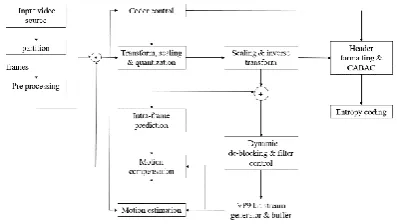
FIGURE 6.1 BLOCK DIAGRAM OF VP9 ENCODER
6.1 VIDEO ACQUISITION
Source of the video sequence which is output in a
digital form. The acquisition process may
temporally and locally compressed by the
following processes
6.2 PRE-PROCESSING
Operations on the raw uncompressed video source
material such as trimming, colour format
conversion, colour correction, or de-noising.
6.3 TRANSFORM CODING
Transform coding is used to convert spatial image
pixel values to transform coefficient values. Since
this is a linear process and no information is lost,
the number of coefficients produced is equal to the
number of pixels transformed.
6.4 QUANTIZATION
It is involved in the image and video compression
for truncate the data.it is lossless compression used
in a video coding technique. When the number of
discrete symbols in a given stream is reduced, the
stream becomes more compressible
.
6.5 INTRA-FRAME PREDICTION The term intra-frame coding refers to the fact that
the various lossless and lossy compression
techniques are performed relative to information
that is contained only within the current frame, and
not relative to any other frame in the video
sequence. In other words, no temporal processing is
performed outside of the current picture or frame.
Non-intra coding techniques are extensions to these
basics. It turns out that this block diagram is very
similar to that of a JPEG still image video encoder,
with only slight implementation detail differences.
6.6 MOTION ESTIMATION
The motion estimation stage operates on a prediction block level and is only part of the
encoder. The estimator takes the current prediction
ock to e used and tries to find the est atching
area in an available reference picture. The
determination of what the best match would be is
subject to the employed cost criterion. A traditional
search method is to shift the current prediction
block over a search area around the collocated
block position in the reference picture, and to
determine the cost criterion for each position, see
the illustration.
6.7 DEBLOCKING FILTER
It is a video filter applied to decoded compressed
video to improve visual quality and prediction
performance by smoothing the sharp edges which
can form between macroblocks when block coding
techniques are used. The filter aims to improve the
appearance of decoded pictures. It is a part of the
specification for both the SMPTE VC-1 codec and
the ITU H.264 (ISO MPEG-4 AVC) codec
FIGURE 6.7.1 R-D CURVES AND CORRESPONDING BIT-RATE SAVING
TABLE 6.7.2 COMPARISON TABLE FOR VP9 VS HEVC, AVC
7. CONCLUSION
A performance comparison of
H.265/MPEG-HEVC, VP9, and H.264/MPEG-AVC encoders was
presented. According to the experimental results,
the coding efficiency of VP9 was shown to be
inferior to both H.264/MPEG-AVC and
H.265/MPEG-HEVC with an average bit-rate
overhead at the same objective quality of 8.4% and
79.4%, respectively. Also, it was shown that
theVP9 encoding times are larger by a factor more
than 100 compared to those of the x264 encoder.
REFERENCE
[1] Generic Coding of Moving Pictures and
Associated Audio Information - Part 2: Video,
1994: ITU-T and ISO/IEC JTC 1.
[2] T. Wiegand, G.J. Sullivan, G. Bjontegaard, and
A. Luthra, "Overview of the H.264/AVC video
coding standard," Circuits and Systems for Video
Technology, IEEE Transactions on , vol.13, no.7,
pp.560-576, Jul. 2003.
[3] H.264/AVC Software Coordination, JM
Reference Software, Online:
http://iphome.hhi.de/suehring/tml
[4] B Bross, “An overview of the next generation
High Efficiency Video Coding (HEVC),” in “Next
Generation Mo i e Broadcasting”, (ed David
Gómez-Barquero), CRC Press, 2013.
[5] ITU-T, Recommendation H.265 (04/13), Series
H: Audiovisual and Multimedia Systems,
Infrastructure of audiovisual services – Coding of
Moving Video, High Efficiency Video Coding,
Online:
http://www.itu.int/rec/T-REC-H.265-201304-I