R E S E A R C H
Open Access
Robust pathway-based multi-omics data
integration using directed random walks
for survival prediction in multiple cancer
studies
So Yeon Kim
1, Hyun-Hwan Jeong
2,3, Jaesik Kim
1, Jeong-Hyeon Moon
1and Kyung-Ah Sohn
1*Abstract
Background:Integrating the rich information from multi-omics data has been a popular approach to survival prediction and bio-marker identification for several cancer studies. To facilitate the integrative analysis of multiple genomic profiles, several studies have suggested utilizing pathway information rather than using individual genomic profiles.
Methods:We have recently proposed an integrative directed random walk-based method utilizing pathway
information (iDRW) for more robust and effective genomic feature extraction. In this study, we applied iDRW to multiple genomic profiles for two different cancers, and designed a directed gene-gene graph which reflects the interaction between gene expression and copy number data. In the experiments, the performances of the iDRW method and four state-of-the-art pathway-based methods were compared using a survival prediction model which classifies samples into two survival groups.
Results:The results show that the integrative analysis guided by pathway information not only improves prediction performance, but also provides better biological insights into the top pathways and genes prioritized by the model in both the neuroblastoma and the breast cancer datasets. The pathways and genes selected by the iDRW method were shown to be related to the corresponding cancers.
Conclusions:In this study, we demonstrated the effectiveness of a directed random walk-based multi-omics data integration method applied to gene expression and copy number data for both breast cancer and neuroblastoma datasets. We revamped a directed gene-gene graph considering the impact of copy number variation on gene expression and redefined the weight initialization and gene-scoring method. The benchmark result for iDRW with four pathway-based methods demonstrated that the iDRW method improved survival prediction performance and jointly identified cancer-related pathways and genes for two different cancer datasets.
Reviewers:This article was reviewed by Helena Molina-Abril and Marta Hidalgo.
Keywords:Multi-omics, Integrative analysis, Random walk, Pathway-based analysis, Breast cancer, Neuroblastoma
© The Author(s). 2019Open AccessThis article is distributed under the terms of the Creative Commons Attribution 4.0 International License (http://creativecommons.org/licenses/by/4.0/), which permits unrestricted use, distribution, and reproduction in any medium, provided you give appropriate credit to the original author(s) and the source, provide a link to the Creative Commons license, and indicate if changes were made. The Creative Commons Public Domain Dedication waiver (http://creativecommons.org/publicdomain/zero/1.0/) applies to the data made available in this article, unless otherwise stated. * Correspondence:[email protected]
1Department of Computer Engineering, Ajou University, Suwon 16499, South
Korea
Background
For a better understanding of the biological basis of cancer and precise prediction of survival for cancer patients, inte-grative analysis of multi-omics data has been addressed in
many studies [1–3]. Most integrative approaches used in
cancer studies have focused on integrating multiple types of genomic data rather than using single omics profile. The use of multi-omics data has been valuable in its appli-cation to many different cancer types and it is necessary to reveal the underlying complex nature of biological mechanisms by analyzing human genomes at multiple genomic levels. To effectively combine different levels of omics data, several studies have led to the development of novel multi-omics data integration algorithms in order to predict phenotypic outcomes precisely and to discover
biologically meaningful information [4–11]. Among
re-cently proposed data integration methods, we focused pri-marily on network-based methods which can incorporate interactions between genes. Most network-based methods have focused on incorporating pathway or subtype infor-mation rather than using individual genomic features in
different types of cancer datasets [9–18]. In this respect,
pathway-based methods have been proposed for the iden-tification of important genes within pathways.
To incorporate pathway information, Guo et al. [16]
computed two summary measures to capture the path-way activity: the arithmetic mean and the median of the gene expression values of pathway member genes. They achieved better cancer classification performance
and improved biological interpretability. Lee et al. [12]
proposed a disease classification method based on way activities inferred for each patient. For each path-way, these authors summarized activity levels with condition-responsive genes (the pathway member genes whose combined expression show optimal discriminative power for the disease phenotype) by combining normal-ized z-transformed scores of genes (z-score method). A pathway level analysis of gene expression (PLAGE) measures the pathway activity profiles of a set of genes in each pathway, which are derived from a vector of the singular value decomposition of the given gene set
[14]. PLAGE identified several biologically meaningful
pathways using gene expression data from a study of type 2 diabetes and the effects of smoking on airway epithelia. Other pathway activity inference approaches have been proposed based on probabilistic inference for
better cancer classification [13, 15, 17, 18]. PLAGE and
the z-score method incorporate pathway information and transformed single genomic profiles into pathway profiles. However, they simply consider a pathway as a set of genes, and interactions between genes are not considered. Some pathway-based methods utilizing gene signatures or topological information utilizing gene in-teractions on a gene-gene graph have been studied.
A denoising algorithm based on relevance network topology (DART) integrates existing pathways with gene expression data by deriving perturbation signatures which reflect gene contributions in each pathway to
ob-tain reliable molecular pathway activity predictions [10].
This work also showed that the encoded hub genes in
expression correlation networks represent reliable
markers of pathway activity in clinical tumor specimens. To consider the topological importance of the genes in the pathways that can be highly associated with diseases,
Liu et al. [9, 11] proposed a directed random walk
(DRW)-based pathway inference method to identify topologically important genes and pathways by weight-ing the genes in a gene-gene network. Although the DRW method only used gene expression data, this ap-proach has also been applied to the integration of gene expression and metabolite data on a gene-metabolite
graph, guided by pathway information [9]. However,
those existing pathway-based methods, including DART and DRW, have limitations in that they only target a sin-gle genomic profile, generally obtained from gene expression data. In order to reflect the combined effect of different types of genomic profiles, we have previously proposed an integrative pathway-based method as an ex-tension of the DRW method for multi-omics data
(iDRW) [6]. In our previous research, we constructed an
integrated gene-gene graph using gene expression and methylation profiles, and showed that the proposed method improved the survival prediction performance for breast cancer patients. We also showed that joint analysis of the methylation features and gene expression profiles can identify breast cancer-specific pathways.
One limitation of the iDRW method lies in the lack of analysis of other types of genomic profiles for different cancer studies. In the iDRW method, the gene expres-sion and methylation data of breast cancer patients were studied. As copy number variants (CNVs) have shown a
significant impact on gene expression [19], an
under-standing of the influence of CNVs on gene expression and clinical phenotypes in humans can contribute to a better understanding of disease. In this study, we investi-gated the impact of CNVs on gene expression for two different cancer types: breast cancer and neuroblastoma, utilizing the iDRW method.
The main contributions of this study are as follows. First, we revamped a directed gene-gene interaction graph which reflects the interaction between gene ex-pression and copy number alteration. Considering differ-ent data distributions of gene expression and copy number data, we defined the weight initialization and scoring of genes for each genomic profile. We then per-formed benchmarking of iDRW with four
state-of-th-e-art pathway-based approaches (PLAGE, z-score,
copy number alteration data and using a single genomic profile as a baseline for two different cancers. We show that the proposed method contributes to an improved survival prediction performance for both breast cancer and neuroblastoma datasets, despite heterogeneity in the data., We also jointly analyze multiple genomic profiles for two different cancer types in the integrated gene-gene graph by visualizing the gene-gene interaction network and identifying biologically meaningful path-ways and genes. The overall process of the proposed
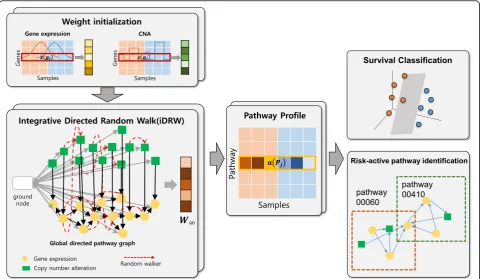
framework is illustrated in Fig.1.
Methods
Dataset
mRNA expression data and copy number alterations data of breast cancer patients were obtained from the
METABRIC dataset [20]. mRNA expression data were
obtained as Illumina Human v3 microarrays with log-intensity levels. DNA copy number alterations were obtained and calls are made after normal contamination correction and copy number variation removal using
thresholds. These values were: −2 = homozygous
dele-tion;−1 = hemizygous deletion; 0 = neutral / no change;
1 = gain; and 2 = high level amplification. 24,368 and 22,544 genes of the gene expression data and the puta-tive copy number alterations from the overlapping 1904 samples were used. 313 missing values of gene expres-sion profiles and copy numbers data were imputed as
the median of the corresponding patients’data. The
pa-tients were categorized as having good (> 10 years) or
poor (≤ 10 years) group with respect to their survival
days. The cutoff of 10 years was arrived as being the me-dian survival days of 1904 samples. We excluded 256 samples in which the survival was less than 10 years and reported as living. In total, 908 samples of the good and 740 samples of the poor group were used out of 1648 samples. We normalized the expression values of the mRNA gene expression data so that the mean was 0 and standard deviation was 1.
In the Neuroblastoma dataset, gene expression profile and copy number data were obtained from GSE49711
[21–23] from the GEO database [24]. Gene expression
profiles of RNA sequencing for 60,586 genes and copy number data for 22,692 genes were obtained from the overlapping 144 samples. Raw microarray data from Microarray-based Comparative Genomic Hybridization (aCGH) were preprocessed using the rCGH
R/Biocon-ductor package [25] with default parameter settings,
using the circular binary segmentation algorithm (CBS)
[26] and then converting into DNA copy number table
over genes. The missing values for each profile were im-puted using the median value of the corresponding
pa-tients’data, and we excluded 331 genes which had more
than half of the missing values. Finally, we divided 144
patients: 38 samples into the good group and 105 sam-ples into the poor group, according to the predefined binary class label for overall survival days as provided by
GSE62564 [27].
Pathway-based integrated gene-gene graph construction
To integrate pathway information on multiple genomic profiles, we utilized an integrative directed random walk-based pathway activity inference method (iDRW) for two different types of omics data. To apply the iDRW method, we redesigned a directed gene-gene graph for gene expression and copy number data. We first collected the whole set of human pathways and the
corresponding gene sets from the KEGG database [28].
Interactions between genes were defined in the
gene-gene graph guided by the pathway information
using the R KEGGgraph package [29]. Finally, an
inte-grated directed gene-gene graph was constructed, con-sisting of 7390 nodes and 58,426 edges from 327 human pathways. Details about the construction method of the
global directed graph are provided in [11]. To integrate
gene expression and copy number alterations data on the graph, we included all edges within each gene ex-pression profile. To consider the impact of copy number
alteration on gene expression [30], we only assigned
dir-ectional edges to the overlapping genes from copy num-ber to gene expression data, and all edges between genes of copy number data were excluded. As two or more copies can be occurred in genes, directed edges can be assigned between genes in copy number alteration data and multiple genes in gene expression data in the inte-grated graph.
Integrative directed random walk-based method (iDRW)
We applied the iDRW method to the pathway-based gene-gene interaction graph constructed from gene expression and copy number data. In the algorithm a
random walk is performed on the integrated
gene-gene graph for each cancer dataset. For each
profile, the initial weight vector of the genes W0 was
assigned as:
W0¼−log wgþϵ
Wtþ1¼ð1−rÞMTWtþrW0
where wg is the weight of the gene g in the integrated
gene-gene graph, and ϵ= 2.2e−16. As the iDRW method
is specifically designed for gene expression profiles and methylation features, the weight initialization scheme was modified to reflect the distribution of each profile. For the breast cancer dataset, the weight of the gene is
thep-value from either a two-tailedt-test for the mRNA
expression profile or a χ2-test of independence for copy
the copy numbers are discrete values. Aχ2-test of inpendence is a nonparametric statistical test used to de-termine if the two or more classifications of the samples are independent or not, and can be applied only to
discrete data [31]. In the neuroblastoma data, the
p-value of RNA-Seq genes were measured by DESeq2,
which is a state-of-the-art technique for the differential analysis of gene expression based on a negative binomial
distribution for RNA-Seq data [32]. The weight vector
for each gene is normalized to be between 0 and 1, and
W0is L1-normalized to a unit vector.
A random walker starts on a source node sand
tran-sits to a randomly selected neighbor or returns to the
source node s with a restart probability r at each time
step t. The weight vector Wt is iteratively updated at
time step t and is guaranteed to converge to a steady
state W∞ when ∣Wt+ 1−Wt∣ < 10−
10
, as shown in the
DRW method [11]. M is a row-normalized adjacency
matrix of the integrated gene-gene graph. We set the
re-start probability r to 0.7, which is default value of the
DRW method, as it was previously shown that the per-formance of the DRW method is not sensitive to varia-tions inr[11].
For aj-th pathwayPjcontainingnjdifferential genes ð
g1;g2;…;gnjÞ whose p-value (wg) is < 0.05, the pathway
activity is defined as:
a Pj ¼
Xnj
i¼1
W∞ gi score gi z gi
ffiffiffiffiffiffiffiffiffiffiffiffiffiffiffiffiffiffiffiffiffiffiffiffiffiffiffiffiffiffi Xnj
i¼1
W∞ gi
2
s
where W∞(gi) is the weight of gene gi from the DRW
method, z(gi) is the normalized expression vector of gi
across overall samples, and score(gi) is either a log2fold
change from the DESeq2 analysis for a RNA-Seq gene, or a sign(tscore(gi)) where tscore(gi) is a t-value from
two-tailed t-test statistics for a mRNA expression gene.
The sign of a t-value indicates the direction of the
significant difference in sample group means. For copy
number data, we scored each gene by mean(CNA(gi
)-poor)−mean(CNA(gi)good) where CNA(gi)poor and CNA
(-gi)goodare the copy numbers of genes in the samples for
the poor or good groups, reflecting the mean difference
between the two groups. The score(gi) represents how
much the values of gene gi have changed between
groups of samples. More details of the DRW method and the pathway activity inference method are provided
in [9]. For each pathway, the pathway activity is
com-puted from the gene expression and copy number values for each sample, which corresponds to a pathway profile.
Pathway feature selection and survival prediction
To select important pathway features, 327 human
path-ways were ranked by their p-values from the t-test of
pathway activities across samples. The top-k pathway
features across samples were used as an input to a
classi-fication model. For each model, the hyper-parameter k
was empirically set to the optimal one which shows the
best classification performance with varyingkbetween 5
and 50 in increments of five.
For the final survival prediction, a logistic regression model was applied. The regression model classifies the samples into either the good or the poor groups. The classification performances are measured using accuracy, precision, recall, and F-1 scores. Accuracy is a ratio of correctly predicted observation to the total observations. Precision is the ratio of correctly predicted positive ob-servations to the total predicted positive obob-servations. Recall (Sensitivity) is the ratio of correctly predicted positive observations to the all observations in actual class. F-1 Score is the weighted average of precision and recall. While accuracy intuitively measures how correctly the model classifies the samples into two survival groups, precision or recall takes the costs of false posi-tives and false negaposi-tives into account. When class distri-bution is uneven, the performance of classification model should be measured with precision and recall. In our experiments, we used accuracy as a performance measure, and we also validated with precision, recall and F1-score for further experiments.
Performance evaluation
In breast cancer data, we evaluated the classification per-formance with 5-fold cross-validation. We divided the whole samples into five folds. The classification model was trained using four folds and validated using the remaining fold. The entire process was repeated 50 times and then we assessed the accuracy, precision, re-call and F-1 score after the entire 250 iterations, using
the selected top-k pathway features as a final
classifica-tion performance. As the number of samples in neuro-blastoma data is imbalanced and not enough to perform 5-fold cross-validation, we evaluated the classification performance using a leave-one-out cross-validation, which leaves one sample as a validation set and trains a classification model with remaining samples for each iteration.
To investigate the utility of the iDRW method using breast cancer and neuroblastoma datasets, we compared
iDRW with four state-of-the-art pathway-based
methods: PLAGE, z-score, DART, and DRW. PLAGE and the z-score method were implemented using the R
GSVA package with default settings [33]. In the
pathway-based methods. In order to ensure a fair
com-parison, the top-k pathway features selection and the
classification performance evaluation of the four
pathway-based methods and the iDRW method were conducted as stated above. As a baseline, we evaluated the classification performance with single gene
expres-sion profile. The top-k genes which are ranked by wg
which are theirp-values from a statistical test were used
to train the classification model.
To demonstrate the robustness of the proposed model, the models are tested with different hyper-parameter
value settings for k. We also assessed classification
per-formances for varying training data size. In this
experi-ment, the parameterkis set to the optimal one for each
method.
Results
iDRW improves survival prediction performance compared to other pathway-based approaches
We assessed the survival prediction performances using four pathway-based methods with a single gene sion profile and the iDRW method on the gene expres-sion profile and copy number data both in breast cancer
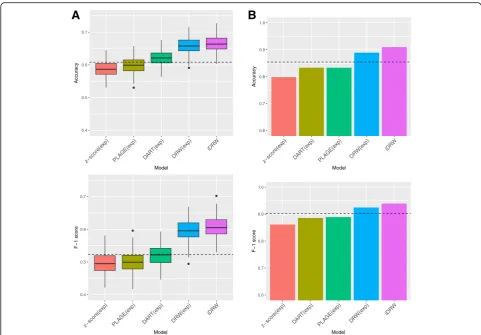
and neuroblastoma patients. Figure2a shows the
predic-tion performances after 50 repeats of 5-fold
cross-validation. Performances were measured using ac-curacy and F-1 score. We note that the classification performances of neuroblastoma data were evaluated
with leave-one-out cross-validation since the sample size
is extremely small, as shown in Fig. 2b. We compared
the classification performances of the iDRW method with four state-of-the-art pathway-based approaches: PLAGE, z-score, DART and the DRW method. The four pathway-based approaches are implemented using gene expression profiles only, and the iDRW method is per-formed on the combined gene expression and copy number data. As a baseline, the classification perform-ance of a single gene expression profile is shown as a
dotted horizontal line. We used the top-kpathway
fea-tures across samples as an input to the classification
model, and the optimal value of k is set to that which
shows the best classification accuracy for each method.
The optimal parameter k for each model is denoted at
x-axis label. When single gene expression profile was used, the top-50 gene features in breast cancer data or top-10 genes in neuroblastoma data were used.
Although the performances of the z-score and PLAGE were worse than those of the gene expression profile, the performances were improved when DART, DRW and iDRW utilizing the pathway information were used. In particular, DRW-based methods contribute to an enhance classification performance in both cancer datasets investi-gated. This research demonstrates that DRW-based ap-proaches which utilizes topological information of genes on a pathway-based integrated graph is a more effective way of inferring pathway activities than other methods.
The iDRW method on the combined feature data per-formed the best amongst all of the other methods used despite the heterogeneity in gene expression and copy number data. These results demonstrate that the iDRW method successfully represented the combined effects of multiple genomic profiles on a pathway-based integrated graph both in breast cancer and neuroblastoma data.
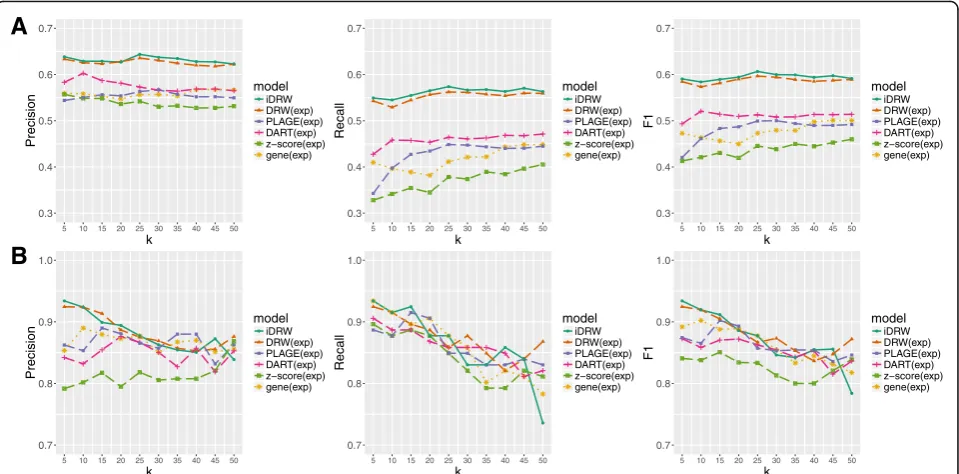
We evaluated the classification performances with
top-kpathway features for each model with values of k
varying from 5 to 50 in increments of five with respect to precision, recall and F-1 score for breast cancer data
(Fig. 3a) and for neuroblastoma data (Fig. 3b). In breast
cancer data, we observe that DRW-based approaches show higher accuracy and more stable performance with
respect to the change in k. DART infers pathway
activ-ities using genes encoding hubs in expression correlation networks and shows better performances than other benchmark pathway-based approaches. As z-score and PLAGE measure pathway activity profiles by summariz-ing scores of gene sets for each pathway, prediction
performances tend to increase with more number of fea-tures. When taking both precision and recall into ac-count, the results revealed that DRW-based pathway activity profiles lead to a more stable performance and less sensitive result to the number of features compared to other pathway-based approaches. It indicates that top-ranked 10 to 25 pathways and corresponding signifi-cant genes obtained from DRW-based pathway activity profiles represent meaningful markers enough to train the classification model. In case of neuroblastoma
data-set (Fig.3b), the performances of the all the methods are
more sensitive to the change ofk. This appears to be
be-cause the neuroblastoma dataset is relatively small and hence it becomes more critical to choose the optimal hyper-parameter value. It is observed that around the
optimal values of k, the performances of DRW-based
methods are substantially better than the others.
Figure4shows the performance behavior with respect
to the data size variation by using 70 to 100% of the en-tire samples in the experiments. For example, when 70%
0.4 0.5 0.6 0.7
z−score(e xp)
PLA GE(e
xp)
DAR T(exp)
DRW(e xp)
iDR W
Model
Accur
acy
0.4 0.5 0.6 0.7
z−score(e xp)
PLA GE(e
xp)
DAR T(e
xp)
DRW(
exp) iDRW
Model
F−1 score
0.6 0.7 0.8 0.9 1.0
z−score( exp)
DAR T(exp)
PLAGE(e xp)
DRW(e xp)
iDR W
Model
Accur
acy
0.6 0.7 0.8 0.9 1.0
z−score( exp)
DART (exp)
PLA GE(e
xp)
DRW(e xp)
iDR W
Model
F−1 score
A
B
of samples in breast cancer dataset were used, we ran-domly sampled 1153 out of 1648 samples, which are then used for 5-fold cross validation. The experiments are performed only with breast cancer data due to ex-tremely small size of the neuroblastoma dataset. The neuroblastoma dataset has 144 samples as a whole and further reduction in the training data size may not lead to meaningful performance results. And the actual dif-ference in the number of used samples in 70 and 100% setting is also small, so we only experimented with breast cancer samples.
Performances were measured in terms of precision,
re-call and F-1 score with the optimal value of k. We
ob-serve that the performances of DRW-based approaches were superior to other pathway-based approaches and single gene expression profile by showing that those of
DRW and iDRW showed more stable and better perfor-mances across varying data sizes. When the recall is considered, the performances of pathway profiles ob-tained from z-score, PLAGE and DART were worse than the one from single gene expression profile. As the genes in gene expression profile were weighted by their
statis-tical significance values and top-k genes were selected
that yielded the best classification accuracy, it seems to contribute to the higher performance than other
ap-proaches of z-score, PLAGE and DART which don’t use
statistical difference information of two survival groups.
iDRW identifies cancer-associated pathways and genes
The iDRW method has the advantage in that we can jointly identify genes which are differentially expressed or have differential changes in copy number in the 0.3
0.4 0.5 0.6 0.7
5 10 15 20 25 30 35 40 45 50
k Precision model iDRW DRW(exp) PLAGE(exp) DART(exp) z−score(exp) gene(exp) 0.3 0.4 0.5 0.6 0.7
5 10 15 20 25 30 35 40 45 50
k Recall model iDRW DRW(exp) PLAGE(exp) DART(exp) z−score(exp) gene(exp) 0.3 0.4 0.5 0.6 0.7
5 10 15 20 25 30 35 40 45 50
k F1 model iDRW DRW(exp) PLAGE(exp) DART(exp) z−score(exp) gene(exp) 0.7 0.8 0.9 1.0
5 10 15 20 25 30 35 40 45 50
k Precision model iDRW DRW(exp) PLAGE(exp) DART(exp) z−score(exp) gene(exp) 0.7 0.8 0.9 1.0
5 10 15 20 25 30 35 40 45 50
k Recall model iDRW DRW(exp) PLAGE(exp) DART(exp) z−score(exp) gene(exp) 0.7 0.8 0.9 1.0
5 10 15 20 25 30 35 40 45 50
k F1 model iDRW DRW(exp) PLAGE(exp) DART(exp) z−score(exp) gene(exp)
A
B
Fig. 3Classification performances of the iDRW method and four pathway-based methods with varying values ofkfor breast cancer (a) and neuroblastoma data (b). Classification performances with top-kpathway features are shown for each model with varyingk= 5, 10,…, 45, 50. Performance is measured using precision, recall and F-1 score after 50 repeats of five-fold cross-validation in breast cancer data (a) and leave-one-out cross-validation in neuroblastoma data (b)
0.4 0.5 0.6 0.7
1153 (70%) 1318 (80%) 1483 (90%) 1648 (100%)
n Precision model iDRW DRW(exp) PLAGE(exp) DART(exp) z−score(exp) gene(exp) 0.4 0.5 0.6 0.7
1153 (70%) 1318 (80%) 1483 (90%) 1648 (100%)
n Recall model iDRW DRW(exp) PLAGE(exp) DART(exp) z−score(exp) gene(exp) 0.4 0.5 0.6 0.7
1153 (70%) 1318 (80%) 1483 (90%) 1648 (100%)
n F1 model iDRW DRW(exp) PLAGE(exp) DART(exp) z−score(exp) gene(exp)
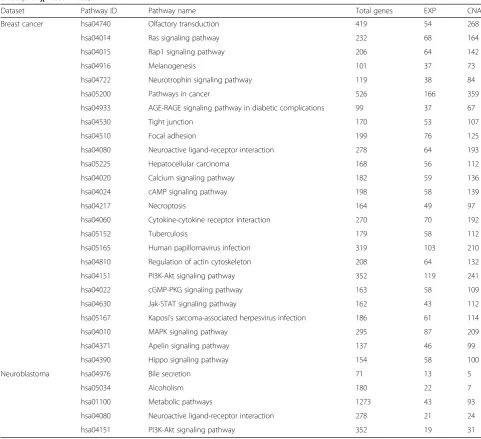
top-ranked pathway features. Table1shows the selected
top-k pathways and corresponding gene sets ranked by
the iDRW method from gene expression and copy
num-ber data in breast cancer (k= 25) and neuroblastoma
data (k= 5). The total number of genes and significant
genes from the gene expression and copy number data are shown for each pathway. The significant genes from the gene expression and copy number data are those
genes whose p-value of a significant test is lower than
0.05.
Hanahan and Weinberg have established six biological capabilities which are acquired during tumor generation: sustaining proliferative signaling; evading growth sup-pressors; activating invasion and metastasis; enabling
replicative immortality; inducing angiogenesis; and
resisting cell death [34]. We found that some of the
top-25 ranked pathways in breast cancer data are related to at least one of six functions, such as the Ras signaling pathway (KEGG ID: hsa04740), Necroptosis (KEGG ID: hsa04217), Regulation of actin cytoskeleton (KEGG ID: hsa04810), and the PI3K-Akt signaling pathway (KEGG
ID: hsa04151) [34]. Olfactory receptors are known to act
on cell migration, proliferation, and secretion in a variety of human tissues, and function as biomarkers for breast
cancer [35], which indicates a relationship between the
top-ranked pathway, the olfactory transduction pathway (KEGG ID: hsa04740) and breast cancer. In particular, the expression of Olfactory Receptor Family 2 Subfamily
Table 1Top-kpathways ranked by the iDRW method in breast cancer (k= 25) and neuroblastoma data (k= 5). For each pathway,
total number of genes, significant genes from gene expression (EXP) and copy number data (CNA) are shown (p-value oft-test / DESeq2 orχ2-test < 0.05)
Dataset Pathway ID Pathway name Total genes EXP CNA
Breast cancer hsa04740 Olfactory transduction 419 54 268
hsa04014 Ras signaling pathway 232 68 164
hsa04015 Rap1 signaling pathway 206 64 142
hsa04916 Melanogenesis 101 37 73
hsa04722 Neurotrophin signaling pathway 119 38 84
hsa05200 Pathways in cancer 526 166 359
hsa04933 AGE-RAGE signaling pathway in diabetic complications 99 37 67
hsa04530 Tight junction 170 53 107
hsa04510 Focal adhesion 199 76 125
hsa04080 Neuroactive ligand-receptor interaction 278 64 193
hsa05225 Hepatocellular carcinoma 168 56 112
hsa04020 Calcium signaling pathway 182 59 136
hsa04024 cAMP signaling pathway 198 58 139
hsa04217 Necroptosis 164 49 97
hsa04060 Cytokine-cytokine receptor interaction 270 70 192
hsa05152 Tuberculosis 179 58 112
hsa05165 Human papillomavirus infection 319 103 210
hsa04810 Regulation of actin cytoskeleton 208 64 132
hsa04151 PI3K-Akt signaling pathway 352 119 241
hsa04022 cGMP-PKG signaling pathway 163 58 109
hsa04630 Jak-STAT signaling pathway 162 43 112
hsa05167 Kaposi’s sarcoma-associated herpesvirus infection 186 61 114
hsa04010 MAPK signaling pathway 295 87 209
hsa04371 Apelin signaling pathway 137 46 99
hsa04390 Hippo signaling pathway 154 58 100
Neuroblastoma hsa04976 Bile secretion 71 13 5
hsa05034 Alcoholism 180 22 7
hsa01100 Metabolic pathways 1273 43 93
hsa04080 Neuroactive ligand-receptor interaction 278 21 24
B Member 6 (OR2B6), which is a differentially expressed gene, was detected in most breast carcinoma tissues
[36]. The development of cancer is closely linked to viral
infection, and breast cancer is known to be associated with viruses of the herpesvirus, polyomavirus, and
retro-virus families [37]. This information indicates that
Hu-man papillomavirus infection (KEGG ID: hsa05165) and
Kaposi’s sarcoma-associated herpesvirus infection
(KEGG ID: hsa05167) are related to breast cancer [38].
Thus, we assume that the top-ranked pathways can play a crucial role on breast cancer mechanism and differen-tiate survival groups of patients.
The top five pathways involved in neuroblastoma were identified using the iDRW method. Several previous
stud-ies suggested that top five pathways in Table1are relevant
to neuroblastoma. For example, an in vitro research pro-ject suggested a mechanism underlying a potent and se-lective anti-tumor effect of lithocholic bile acid in
neuroblastoma cells [39], which shows the relation
be-tween the bile secretion pathway (KEGG ID: hsa04976) and the neuroblastoma. Alcoholism pathway (KEGG ID:
hsa05034) includes the reaction to ethanol in a
dopamin-ergic neuron [40]. Several studies have shown that the
level of Urinary catecholamine metabolites including vanillylmandelic acid (VMA), homovanillic acid (HVA)
and dopamine are elevated in neuroblastoma patients [41,
42]. Furthermore, the neuroactive ligand-receptor
inter-action pathway (KEGG ID: hsa04080) and metabolic
path-ways (KEGG ID: hsa01100) are associated with
neuroblastoma, since neuroblastoma occurs in nerve tis-sue and changes in metabolism are common phenomena
in cancer [34]. We found some evidences that the
PI3K-Akt signaling pathway (KEGG ID: hsa04151) aids in
the pro-survival of neuroblastoma [43–45]. Based on these
findings, we hypothesized that the top five pathways can be associated with neuroblastoma and can be crucial fea-tures for distinguishing between two survival groups.
The pathways and genes are jointly analyzed in the gene-gene network
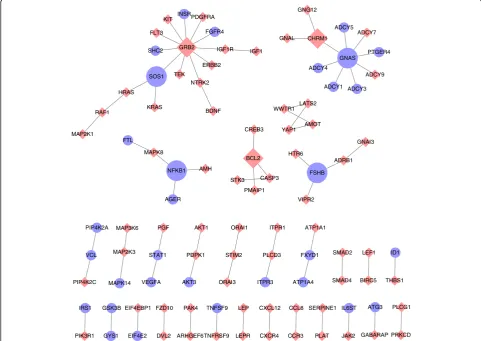
The interactions between significant genes in the top-25
pathways in the breast cancer dataset (Table 1) are
CHRM1
ADCY1
ADCY9 ADCY7 ADCY5
ADCY3 ADCY4
PTGER4 GNAS
ERBB2
NTRK2 TEK SOS1
BDNF
NFKB1
PMAIP1 CASP3 CREB3
BCL2 AMH
AGER
STK3
FSHB LATS2
ADRB1 YAP1
WWTR1
GNAI3
VIPR2 HTR6
AMOT INSR
KIT PDGFRA
FLT3 FGFR4
GRB2
SHC2 IGF1R IGF1
GNG12
GNAL
MAP2K1
FTL RAF1
MAPK8 KRAS HRAS
GYS1 MAP3K6
PIK3R1
MAPK14 VCL
PIP4K2C PIP4K2A
GSK3B IRS1
MAP2K3
CCR3 PLAT JAK2 GABARAP
CXCR4 PRKCD
SMAD4 SMAD2
THBS1 BIRC5
LEF1 ID1
TNFSF9 EIF4EBP1
ARHGEF6 PAK4
TNFRSF9 LEPR DVL2
EIF4E2
FZD10 LEP
PLCD3
ATP1A1
ORAI3
ITPR1
ITPR3 ATP1A4 STIM2
ORAI1
FXYD1
AKT3 AKT1
VEGFA PGF
STAT1 PDPK1
CXCL12 CCL8 SERPINE1 IL6ST ATG3 PLCG1
visualized in the gene-gene network shown in Fig. 5. The gene-gene network of neuroblastoma is not shown, as the number of edges between genes in the top five pathways were few. The hub genes whose degree in the network is equal or greater than three play a crucial role in pathways selected by the iDRW method. Several stud-ies have identified relationships between the survival of breast cancer patients and the hub genes in the network: specifically the GNAS complex locus (GNAS), growth factor receptor bound protein 2 (GRB2), follicle stimu-lating Hormone Subunit Beta (FSHB), Cholinergic Re-ceptor Muscarinic 1 (CHRM1), SOS Ras/Rac Guanine Nucleotide Exchange Factor 1 (SOS1), Nuclear Factor Kappa B Subunit 1 (NFKB1), and the BCL2 Apoptosis Regulator (BCL2). It has been reported that the amplifi-cation of GNAS may contribute to the pathogenesis of breast cancer and is associated with the survival of
pa-tients with invasive breast carcinoma [46, 47]. In
addition, GRB2 and SOS1 have been reported to be overexpressed in breast cancer tissues compared with
normal tissues [48,49].
Discussions
In this study, we demonstrated the effectiveness of DRW-based approaches and the interaction effects be-tween multiple genomic profiles on the integrated graph. However, the results in neuroblastoma samples showed a
different tendency and didn’t confirm clear performance
improvement of DRW-based approaches with increasing
k. We found that statistically significant expressed genes
in neuroblastoma data are relatively small compared to in copy number alterations data and those in breast cancer
data as shown in Table1. iDRW performed random walk
process on the integrated graph which reflects the impact of copy number genes on gene expression and DRW reflected interactions between genes from gene expression data. Other pathway-based approaches: z-score, PLAGE and DART were implemented using gene expression pro-file. Therefore, there is a possibility that the effect of gene expression profile and the impact of copy number alter-ations on gene expression on the graph can be under-mined. As the clear tendency was not shown due to the extremely small sample size in neuroblastoma data, we can reduce the limitations when more samples were ob-tained or other genomic profiles can be utilized as well as gene expression and copy number alterations data. In fu-ture works, the clear criteria of dividing two survival groups are needed or it can be extended to the survival analysis by training regression model which predicts the actual survival days of patient samples.
Conclusions
In this study, the effectiveness of a directed random walk-based multi-omics data integration method was
investigated and analyzed using datasets incorporating gene expression and copy number alterations for two different cancer datasets. To integrate the gene expres-sion and copy number alteration data, we first con-structed a directed gene-gene graph representing the impact of copy number variants on gene expression by defining weight initializations and gene scoring measures for each genomic profile. To demonstrate the utility of
the iDRW method, the performances of four
state-of-the-art pathway-based methods: PLAGE,
z-score, DART and DRW were compared with the sur-vival prediction model which classifies samples into two survival groups. The results demonstrate that the iDRW method, which utilizes the interactions between genes on an integrated gene-gene graph, produced the best classification performance for both breast cancer and neuroblastoma data. It shows that the integrated gene-gene graph successfully reflected the combined ef-fect of gene expression and copy number alterations data, guided by pathway information for both cancer datasets. From a joint analysis of multiple genomic pro-files, the iDRW method can identify biologically mean-ingful pathways and genes highly related to the cancer under investigation. We also visualized the gene-gene in-teractions between gene expression, and copy number alterations data in the integrated gene-gene graph for both the breast cancer and neuroblastoma datasets.
Reviewers’comments
Reviewer’s report 1: Helena Molina-Abril
Reviewer summary
In this paper the authors apply their previously devel-oped method iDRW on multiple genomic profiles for two different cancers and redesign a directed gene gene graph which reflects the interaction between gene ex-pression and copy number data. They also compare the iDRW method with other pathway-based methods for a survival prediction model which classifies samples into two survival groups.
Reviewer recommendations to authors
In my opinion the paper needs some language correc-tions (english quality) as well as some methodological corrections before being published.
Author’s response: We have carefully proofread our manuscript and revised grammatical errors and unclear sentences.
Further explanations of some concrete points need to be addressed. Data sources as well as preprocessing is
too briefly explained. For instance, mRNA data
normalization and the imputation method for the neuro-blastoma dataset is not mentioned.
CAMDA 2018 data integration challenge in “Dataset” section of “Methods”. Explanations of data preprocessing such as mRNA data normalization, aCGH microarray raw data processing, and median imputation method for the neuroblastoma data are also included.
The generation of an integrated directed gene-gene graph is vaguely described as well as the KEGG pathway selection (327?). Authors should give a clearer explan-ation of this process.
Author’s response:We have added a new sub-section “Pathway-based integrated gene-gene graph construction” in“Methods” to provide a more detailed and clearer ex-planation of how the integrated graph is constructed to reflect the interactions between gene expression and copy number alterations. As the total number of human path-ways we obtained in KEGG database is 327, we also re-vised the description of how the pathways and corresponding gene sets were collected more clearly.
The use of t-test of chisquared test values for initial weights is not sufficiently reasoned.
Author’s response: We used two tailed t-test for mRNA expression data, chi-squared test of independence for copy number data, and DESeq2 measure for RNA-Seq data to consider the different data distribu-tions. We added clear explanations of each statistical test and weight initialization of genes with equations in sec-tion “Integrative directed random walk-based method (iDRW)”in“Methods”. We also added more explanations of gene scoring measures for each genomic profile when pathway activity inference is performed.
Accuracy is not an appropriate performance measure for imbalanced data sets. Please change that.
Author’s response: Considering the reviewer’s
valu-able suggestion, we evaluated the performance with pre-cision, recall and F-1 score in addition to accuracy, and added a description of each performance measure in sec-tion “Pathway feature selection and survival prediction” of “Methods”. In Fig. 2, the classification performances were evaluated in terms of accuracy and F-1 score for both cancer datasets. In addition, we performed add-itional experiments to investigate the performance behav-ior with respect to changes in the parameter k (Fig. 3) and the number of samples (Fig.4) using precision, recall and F-1 score.
I’m also concerned about the logistic regression model.
No testing data has been used for validation, and there-fore classification results might be too optimistic.
Author’s response:To evaluate the classification per-formance in breast cancer data as an example, we have performed 5-fold cross-validation which divided the whole samples into five folds and used four folds as training data and the remaining fold as validation data. We repeated the entire 5-fold cross-validation process 50 times and obtained the average performance of 250
iterations as a final classification performance. The de-scriptions of cross-validation process are described in the first paragraph of section “classification performance evaluation”in“Methods”.
Feature selection, does not seem to be included within the learning process, which may lead to biased results.
Author’s response: For feature selection, we first ranked pathway features using their statistical signifi-cance and then determined the optimal number of top-k ranked feature set which yields the best cross validation accuracy. For a clear explanation of this process, we re-vised the first paragraph of section“Pathway feature se-lection and survival prediction” and “Performance evaluation”in“Methods”.
In general, the paper is based on a previously pub-lished method, but applied to a new dataset. It is not sufficiently clear what is its substantial contribution and novelty.
Author’s response: We clarified the main contribu-tions of this study to differentiate our method from the previously published method in the last paragraph of “Background”and in“Conclusions”. In the current paper, we proposed an integrated gene-gene graph construction method reflecting interactions between copy number al-terations and gene expression data for two different can-cer types. We also demonstrated improved prediction performance by a comparative analysis of iDRW with four state-of-the-art pathway-based approaches. By visu-alizing the gene-gene interaction network on the com-bined profiles, we could jointly analyze multiple genomic profiles on the integrated gene-gene graph, and we could also identify biologically meaningful pathways and genes.
Abbreviations should be first mentioned with its corre-sponding name (see for instance Array comparative gen-omic hybridization (aCGH)
Author’s response:We added the full name of all ab-breviations including aCGH throughout the entire manu-script and we also listed them in“List of abbreviations”.
Reviewer’s report 2: Marta Hidalgo
Reviewer summary
Integration of different types of genomic data is a major open problem. This paper presents a new method for survival prediction through the integration of gene expression and copy number data in a pathway model. It also presents the comparison of the performance of the described model with other 4 pathways methods in terms of prediction of survival groups. In general the paper is well written, although some paragraphs and sentences are somehow not clear enough. In particular, it should be explained with more detail how the integra-tion is performed. Also some language improvements should be addressed before publication.
MINOR RECOMMENDATIONS: The major concern that I find is that although integration is one of the key points of the method, called iDRW, and the one new feature with respect to the DRW method on which it is based, the explanation of how this integration is per-formed is not clear enough.
Author’s response: As the reviewer pointed out, the integration method of gene expression copy number data based on a gene-gene graph guided by the pathway infor-mation is one of the main contributions. We have in-cluded a detailed and clearer explanation of how the integrated graph is constructed to reflect the interactions between gene expression and copy number alterations data in a new sub-section “Pathway-based integrated gene-gene graph construction”in“Methods”.
Also, I would appreciate a mention to the kind of data used by the other methods: are they also accepting both gene expression and copy number data? If not, then an explanation of why these methods are appropriate to be compared with iDRW should be given.
Author’s response:The existing pathway activity in-ference methods focused on how to effectively incorpor-ate pathway information into genomic analysis and they were implemented to handle only single genomic profile. In this respect, the iDRW method has been proposed for combining multiple genomic profiles on an integrated gene-gene graph constructed by pathway information. Therefore, we used gene expression profile for four pathway-based methods: z-score, PLAGE, DART and DRW method, and gene expression and copy number data for iDRW method in this study. We added further explanations of each pathway-based method and iDRW method in “Background”. We stated that only iDRW method were implemented by incorporating gene expression and copy number data in section “iDRW improves survival prediction per-formance compared to other pathway-based ap-proaches” in “Results”.
Sentences to be revised:
- Fourth sentence in the last paragraph of
“Background”.
- Second sentence in first paragraph of section“Results
and discussion”, subsection“Integrative analysis...”.
- First sentence in first paragraph of section “Results
and discussion”, subsection“iDRW identifies...”.
Spelling typos:
- When defining the initial weights, after W_0 should say“are”.
- In sign (tscore(g_i)), should it be sign (score(g_i))?
- Before “More details of the DRW method...” should
be a“.”.
- First sentence in first paragraph of section “Results
and discussion”, subsection “iDRW identifies...”, “
differ-ential”should be“differentially”.
- Second sentence of second paragraph in the same
section, “some of top-25” should be “some of the
top-25”.
- Last sentence in the same paragraph,“crucial role of
breast cancer”should be“crucial role on breast cancer”.
- Fifth sentence in next paragraph,“and dopamine
ele-vated”should be“and dopamine are elevated”.
Author’s response: We revised all the unclear sen-tences as the reviewer suggested and thoroughly proof-read the entire manuscript. We appreciate the reviewer’s kind corrections and suggestions.
Abbreviations
aCGH:Microarray-based comparative genomic hybridization; CBS: Circular binary segmentation algorithm; CNVs: Copy number variants; DRW: Directed random walk
Acknowledgements
We gratefully acknowledge the CAMDA organizers for all the support for the CAMDA 2018 challenge and providing datasets available.
Funding
This research was supported by Basic Science Research Program [NRF-2016R1D1A1B03933875] and under the framework of international cooperation program [NRF-2018K2A9A1A01090545] managed by the National Research Foundation of Korea.
Availability of data and materials
All the datasets used in this study are provided from the CAMDA 2018 Challenge (http://camda.info/).
Authors’contributions
SK, HJ, JK, JM and KS designed the study. SK, HJ, JK and JM implemented the idea and performed the experiments. SK, HJ, JK, JM and KS developed the idea and performed the analysis. SK, HJ, JK, JM and KS wrote the paper. All authors read and approved the final manuscript.
Ethics approval and consent to participate
Not applicable.
Consent for publication
Not applicable.
Competing interests
The authors declare that they have no competing interests.
Publisher’s Note
Springer Nature remains neutral with regard to jurisdictional claims in published maps and institutional affiliations.
Author details
1
Department of Computer Engineering, Ajou University, Suwon 16499, South Korea.2Department of Molecular and Human Genetics, Baylor College of
Medicine, Houston, TX 77030, USA.3Jan and Dan Duncan Neurological Research Institute, Texas Children’s Hospital, Houston, TX 77030, USA.
Received: 16 October 2018 Accepted: 10 April 2019
References
1. Huang S, Chaudhary K, Garmire LX. More is better: recent progress in multi-omics data integration methods. Front Genet. 2017;8:84.
2. Xie B, Yuan Z, Yang Y, Sun Z, Zhou S, Fang X. MOBCdb: a comprehensive database integrating multi-omics data on breast cancer for precision medicine. Breast Cancer Res Treat. 2018;169(3):625–32.
4. Jeong H-h, Leem S, Wee K, Sohn K-A. Integrative network analysis for survival-associated gene-gene interactions across multiple genomic profiles in ovarian cancer. J Ovarian Res. 2015;8(1):42.
5. Kim D, Shin H, Sohn KA, Verma A, Ritchie MD, Kim JH. Incorporating inter-relationships between different levels of genomic data into cancer clinical outcome prediction. Methods. 2014;67(3):344–53.
6. Kim SY, Kim TR, Jeong H-H, Sohn K-A. Integrative pathway-based survival prediction utilizing the interaction between gene expression and DNA methylation in breast cancer. BMC Med Genet. 2018;11:68.
7. Vangimalla RR, Jeong HH, Sohn KA. Integrative regression network for genomic association study. BMC Med Genet. 2016;9(Suppl 1):31. 8. Wang S, Jeong H-h, Kim D, Wee K, Park H-S, Kim S-H, Sohn K-A. Integrative
information theoretic network analysis for genome-wide association study of aspirin exacerbated respiratory disease in Korean population. BMC Med Genet. 2017;10(1):31.
9. Liu W, Bai X, Liu Y, Wang W, Han J, Wang Q, Xu Y, Zhang C, Zhang S, Li X, et al. Topologically inferring pathway activity toward precise cancer classification via integrating genomic and metabolomic data: prostate cancer as a case. Sci Rep. 2015;5:13192.
10. Jiao Y, Lawler K, Patel GS, Purushotham A, Jones AF, Grigoriadis A, Tutt A, Ng T, Teschendorff AE. DART: Denoising algorithm based on relevance network topology improves molecular pathway activity inference. BMC Bioinformatics. 2011;12:403.
11. Liu W, Li C, Xu Y, Yang H, Yao Q, Han J, Shang D, Zhang C, Su F, Li X, et al. Topologically inferring risk-active pathways toward precise cancer classification by directed random walk. Bioinformatics. 2013;29(17):2169–77. 12. Lee E, Chuang HY, Kim JW, Ideker T, Lee D. Inferring pathway activity
toward precise disease classification. PLoS Comput Biol. 2008;4(11): e1000217.
13. Su J, Yoon BJ, Dougherty ER. Accurate and reliable cancer classification based on probabilistic inference of pathway activity. PLoS One. 2009;4(12):e8161. 14. Tomfohr J, Lu J, Kepler TB. Pathway level analysis of gene expression using
singular value decomposition. BMC Bioinformatics. 2005;6:225.
15. Vaske CJ, Benz SC, Sanborn JZ, Earl D, Szeto C, Zhu J, Haussler D, Stuart JM. Inference of patient-specific pathway activities from multi-dimensional cancer genomics data using PARADIGM. Bioinformatics. 2010;26(12):i237–45. 16. Guo Z, Zhang T, Li X, Wang Q, Xu J, Yu H, Zhu J, Wang H, Wang C, Topol EJ,
et al. Towards precise classification of cancers based on robust gene functional expression profiles. BMC Bioinformatics. 2005;6:58.
17. Efroni S, Schaefer CF, Buetow KH. Identification of key processes underlying Cancer phenotypes using biologic pathway analysis. PLoS One. 2007;2(5):e425. 18. Khunlertgit N, Yoon B-J. Identification of robust pathway markers for Cancer through rank-based pathway activity inference. Adv Bioinforma. 2013;2013:8. 19. van Nas A, Ingram-Drake L, Wang S, Orozco LD, Lusis AJ, Pellegrini M,
Cokus SJ, Ghazalpour A, Araujo JA, Che N. Copy number variation influences gene expression and metabolic traits in mice. Hum Mol Genet. 2009;18(21):4118–29.
20. Pereira B, Chin SF, Rueda OM, Vollan HK, Provenzano E, Bardwell HA, Pugh M, Jones L, Russell R, Sammut SJ, et al. The somatic mutation profiles of 2,433 breast cancers refines their genomic and transcriptomic landscapes. Nat Commun. 2016;7:11479.
21. Consortium SM-I. A comprehensive assessment of RNA-seq accuracy, reproducibility and information content by the sequencing quality control consortium. Nat Biotechnol. 2014;32(9):903–14.
22. Munro SA, Lund SP, Pine PS, Binder H, Clevert DA, Conesa A, Dopazo J, Fasold M, Hochreiter S, Hong H, et al. Assessing technical performance in differential gene expression experiments with external spike-in RNA control ratio mixtures. Nat Commun. 2014;5:5125.
23. Wang C, Gong B, Bushel PR, Thierry-Mieg J, Thierry-Mieg D, Xu J, Fang H, Hong H, Shen J, Su Z, et al. The concordance between RNA-seq and microarray data depends on chemical treatment and transcript abundance. Nat Biotechnol. 2014;32(9):926–32.
24. Edgar R, Domrachev M, Lash AE. Gene expression omnibus: NCBI gene expression and hybridization array data repository. Nucleic Acids Res. 2002; 30(1):207–10.
25. Commo F, Guinney J, Ferte C, Bot B, Lefebvre C, Soria JC, Andre F. rCGH: a comprehensive array-based genomic profile platform for precision medicine. Bioinformatics. 2016;32(9):1402–4.
26. Olshen AB, Venkatraman ES, Lucito R, Wigler M. Circular binary segmentation for the analysis of array-based DNA copy number data. Biostatistics. 2004;5(4):557–72.
27. Su Z, Fang H, Hong H, Shi L, Zhang W, Zhang W, Zhang Y, Dong Z, Lancashire LJ, Bessarabova M, et al. An investigation of biomarkers derived from legacy microarray data for their utility in the RNA-seq era. Genome Biol. 2014;15(12):523.
28. Kanehisa M, Goto S. KEGG: Kyoto encyclopedia of genes and genomes. Nucleic Acids Res. 2000;28(1):27–30.
29. Zhang JD, Wiemann S. KEGGgraph: a graph approach to KEGG PATHWAY in R and bioconductor. Bioinformatics. 2009;25(11):1470–1.
30. Gamazon ER, Stranger BE. The impact of human copy number variation on gene expression. Brief Funct Genomics. 2015;14(5):352–7.
31. Maxwell AE. Analysing qualitative data. London: Chapman and Hall; 1961. 32. Love MI, Huber W, Anders S. Moderated estimation of fold change and
dispersion for RNA-seq data with DESeq2. Genome Biol. 2014;15(12):550. 33. Hänzelmann S, Castelo R, Guinney J. GSVA: gene set variation analysis for
microarray and RNA-Seq data. BMC Bioinformatics. 2013;14(1):7. 34. Hanahan D, Weinberg RA. Hallmarks of cancer: the next generation. Cell.
2011;144(5):646–74.
35. Sanz G, Leray I, Dewaele A, Sobilo J, Lerondel S, Bouet S, Grebert D, Monnerie R, Pajot-Augy E, Mir LM. Promotion of cancer cell invasiveness and metastasis emergence caused by olfactory receptor stimulation. PLoS One. 2014;9(1):e85110.
36. Weber L, Massberg D, Becker C, Altmuller J, Ubrig B, Bonatz G, Wolk G, Philippou S, Tannapfel A, Hatt H, et al. Olfactory receptors as biomarkers in human breast carcinoma tissues. Front Oncol. 2018;8:33.
37. Alibek K, Kakpenova A, Mussabekova A, Sypabekova M, Karatayeva N. Role of viruses in the development of breast cancer. Infect Agent Cancer. 2013;8:32. 38. Wang T, Chang P, Wang L, Yao Q, Guo W, Chen J, Yan T, Cao C. The role of
human papillomavirus infection in breast cancer. Med Oncol. 2012;29(1):48–55. 39. Goldberg AA, Beach A, Davies GF, Harkness TA, Leblanc A, Titorenko VI.
Lithocholic bile acid selectively kills neuroblastoma cells, while sparing normal neuronal cells. Oncotarget. 2011;2(10):761–82.
40. Spanagel R. Alcoholism: a systems approach from molecular physiology to addictive behavior. Physiol Rev. 2009;89(2):649–705.
41. Verly IRN, van Kuilenburg ABP, Abeling NGGM, Goorden SMI, Fiocco M, Vaz FM, van Noesel MM, Zwaan CM, Kaspers GL, Merks JHM, et al.
Catecholamines profiles at diagnosis: increased diagnostic sensitivity and correlation with biological and clinical features in neuroblastoma patients. Eur J Cancer. 2017;72:235–43.
42. Strenger V, Kerbl R, Dornbusch HJ, Ladenstein R, Ambros PF, Ambros IM, Urban C. Diagnostic and prognostic impact of urinary catecholamines in neuroblastoma patients. Pediatr Blood Cancer. 2007;48(5):504–9. 43. Fulda S. The PI3K/Akt/mTOR pathway as therapeutic target in
neuroblastoma. Curr Cancer Drug Targets. 2009;9(6):729–37.
44. Gomez-Villafuertes R, Garcia-Huerta P, Diaz-Hernandez JI, Miras-Portugal MT. PI3K/Akt signaling pathway triggers P2X7 receptor expression as a pro-survival factor of neuroblastoma cells under limiting growth conditions. Sci Rep. 2015;5:18417.
45. Tian X, Zhou D, Chen L, Tian Y, Zhong B, Cao Y, Dong Q, Zhou M, Yan J, Wang Y, et al. Polo-like kinase 4 mediates epithelial-mesenchymal transition in neuroblastoma via PI3K/Akt signaling pathway. Cell Death Dis. 2018;9(2):54. 46. Garcia-Murillas I, Sharpe R, Pearson A, Campbell J, Natrajan R, Ashworth A,
Turner NC. An siRNA screen identifies the GNAS locus as a driver in 20q amplified breast cancer. Oncogene. 2013;33:2478.
47. Otterbach F, Callies R, Frey UH, Schmitz KJ, Wreczycki C, Kimmig R, Siffert W, Schmid KW. The T393C polymorphism in the gene GNAS1 of G protein is associated with survival of patients with invasive breast carcinoma. Breast Cancer Res Treat. 2007;105(3):311–7.
48. Zhang Y, Xu G, Liu G, Ye Y, Zhang C, Fan C, Wang H, Cai H, Xiao R, Huang Z, et al. miR-411-5p inhibits proliferation and metastasis of breast cancer cell via targeting GRB2. Biochem Biophys Res Commun. 2016;476(4):607–13. 49. Pandey P, Kharbanda S, Kufe D. Association of the DF3/MUC1 breast Cancer