INTRODUCTION
One of the most common respiratory diseases in horses is recurrent airway obstruction (RAO). The term derived from human medicine Chronic Obstructive Pulmonary Disease (COPD), has not been used since the late 1990s. This disease is encountered in horses older than 7 years, that are kept in stables, standing on straw bedding and fed poor-quality hay (1). So far, no breed predisposition to the disease has been found; however, genetic background should be taken into account, as more frequent cases of the disease have been described in certain breeding lines.
PATHOGENESIS
The development of the disease involves two types of allergic reactions: type I in an initial stage and type III in a later stage (2). Airway inflammation in horses predisposed to RAO is caused by inhalation
ABSTRACT
Clinical Review
EQUINE RECURRENT AIRWAY OBSTRUCTION
Artur Nied
ź
wied
ź
Department of Internal Diseases with Clinic for Horses, Dogs and Cats,
Faculty of Veterinary Medicine, Wroc
ł
aw University of Environmental and Life Sciences
Pl. Grunwaldzki 47, 50-366 Wroc
ł
aw, Poland
Received 23 June 2014; Accepted 11 July 2014
Equine Recurrent Airway Obstruction (RAO), also known as heaves or broken wind, is one of the most common disease in middle-aged horses. Inflammation of the airway is inducted by organic dust exposure. This disease is characterized by neutrophilic inflammation, bronchospasm, excessive mucus production and pathologic changes in the bronchiolar walls. Clinical signs are resolved in 3-4 weeks after environmental changes. Horses suffering from RAO are susceptible to allergens throughout their lives, therefore they should be properly managed. In therapy the most importanthing is to eliminate dust exposure, administration of corticosteroids and use bronchodilators to improve pulmonary function.
Key words: RAO, horses, heaves
Corresponding author: Artur Niedźwiedź, PhD
E-mail address: [email protected]
Present address: Department of Internal Diseases Faculty of Veterinary Medicine, Wrocław University of Environmental and Life Sciences
Pl. Grunwaldzki 47, 50-366 Wrocław, Poland
Phone: +48501272377
Copyright: © 2014 Niedźwiedź A. This is an open-access article published under the terms of the Creative Commons Attribution License which permits unrestricted use, distribution, and reproduction in any medium, provided the original author and source are credited. Competing Interests: The authors have declared that no competing interests exist.
Available Online First: 12 August 2014 http://dx.doi.org/10.14432/j.macvetrev.2014.08.019
of organic pollutants contained in dust, the largest source of which are hay and bedding. Endotoxins, dust mites and fungal spores contained in the dust, such as Feaniarecti virgula,Aspergillus fumigatus,
Thermoactinomyces vulgaris, on entering the airways activate inflammatory cytokine production and neutrophil influx into the lumen of the bronchi (3). When an animal is led from the pasture to the stable and exposed to allergens, inflammatory changes occur within 6-8 hours. As inflammation develops, lower respiratory tract stricture increases. Inflammatory mediators are responsible for bronchoconstriction that causes both smooth muscle contraction acting on their cholinergic endings, as well as a large amount of mucus to accumulate in the bronchi as a result of goblet cells hyperplasia (Fig. 1). The mucus is denser and less transparent than that produced under physiological conditions. This makes it difficult to remove secretions and leads to prolonged retention in the airway lumen. Reconstruction of the bronchial walls involves both acute (intercellular edema) and chronic (smooth muscle hypertrophy, peribronchial fibrosis) changes (4). Changes in the airway wall are due to chronic processes and the lower effectiveness of the therapy and often make it impossible to return the animal to its normal condition.
Although the condition has an allergic background, eosinophils do not play a significant role in the pathogenesis of RAO.
CLINICAL SYMPTOMS
The initial stage of RAO is difficult to diagnose. Non-specific symptoms in the form of single coughing attacks may suggest a number of other diseases. At a later stage, the frequency of the dry cough, often paroxysmal in nature, increases.
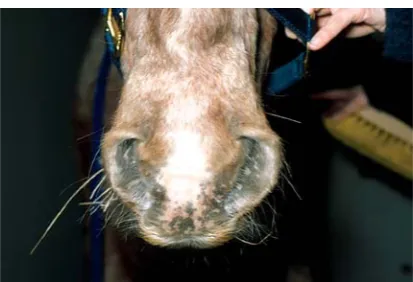
RAO exacerbation is manifested by an increase in the respiratory rate, a frequent cough, nostril dilatation, mucosal nasal discharge and exercise intolerance (Fig. 2). Severe symptoms usually occur
during exercise or are associated with an increase in the amount of dust in the air (e.g. while cleaning the stable or feeding hay). In horses suffering from chronic disease, a two-phase process of exhaling supported by the abdominal muscles is observed. This results in hypertrophy of the external abdominal oblique muscle, which manifests itself as a so-called “heave line” (Fig. 3).
In advanced untreated cases, the intake of food by the horse can be reduced, which leads to weight loss and devastation of the animal’s organism. At the same time, a pale coloration of the mucous membranes or, in extreme cases, cyanosis may appear. In the area of the foreskin or mammary gland congestive edema is observed, and exhalation is accompanied by a pushing of the anus. Each time the animal is used for work it causes fatigue disproportionate to the effort.
Figure 1. The bronchoconstriction with large amount of mucus accumulated in the bronchi as a result of goblet cells hyperplasia
Figure 2. Nostril dilatation and mucosal nasal discharge in RAO
Figure 3. Hypertrophy of the external abdominal oblique muscle which manifests itself as a so-called “heave line”
In a horse at rest, auscultation of the lungs in the early stages of the disease will not reveal any pathological changes. During the effort test, wheezing and rattling coming from the peripheral lung can be heard.
DIAGNOSTICS
The diagnosis of advanced RAO involves mainly a history and characteristic clinical signs. In the early stage of the disease additional tests are required. A blood test is helpful in excluding pneumonia and other infectious diseases, because in the course of RAO blood parameters do not deviate from the reference values (5).
Radiological examination (X-ray) of the lung is helpful in a differential diagnosis. It is used to rule out other diseases of the lower respiratory tract. Lesions imaged using an X-ray are not pathognomonic for RAO, while on a radiograph only fibrosis of the lung parenchyma can be seen. By using a bronchoscope, tracheal wall congestion, tracheal bifurcation (bifurcatio tracheae) and residual mucous can be confirmed (1, 7).
An examination evaluating the severity of lesions and their susceptibility to therapy is the determination of the acid-base balance of arterial blood. The most decisive parameters are the partial pressure of oxygen (PaO2) and carbon dioxide (PaCO2). PaO2 falls a lot below 80 mmHg in animals with the initial form of the disease and up to 50 mmHg in horses with advanced RAO. PaCO2 usually does not deviate from the reference value or is slightly elevated (5).
For RAO staging, the author correlates clinical (CS) and endoscopic (ES) scores in horses with RAO (Table 1).
TREATMENT
Modification of the environment
The best method of treatment of recurrent airway obstruction in horses is a modification of the environment, which leads to a decrease in air aeroallergens. Pharmacological therapy of RAO includes treatment with glucocorticoids and bronchodilators. This procedure should involve both horses with advanced disease, as well as animals with a slight exacerbation of clinical symptoms. Pharmacological treatment without environmental modification is not effective (8).
Parameter 0 1 2 3 4 5
Clinical assessmenta
Cough score None
Coughs at specific times of day (feeding/ exercising/making
beds)
Frequent cough with periods of no
coughing
Very frequent cough
Nostril fl are None
Flares during inspiration (returns to normal
at end inspiration)
Flares in inspiration and exhalation (slight movement can still be
seen)
Flares in inspiration and expiration (no
movement can be seen)
Abdominal lift None Slight flattening ofventral flank
Obvious abdominal flattening and ‘‘heave line’’ extending no more than half way between the cubital joint and tuber coxae
Obvious abdominal lift and ’’heave line’’ extending beyond
halfway between the cubital joint and
tuber coxae
Airway endoscopyb
Mucus accumulation
None, clean
Little, multiple small blobs
Moderate, larger blobs
Marked, confluent or stream-forming
Large, pool-forming
Extreme, profuse amounts
Mucus color None,
clean Colorless White Thick White Yellow
Thick Yellow
Mucus localization and stickiness
None,
clean 1/2 Ventral 2/3 Lateral 3/4 Dorsal Threading Threading
Mucus apparent viscosity
None,
clean Very fluid Fluid Intermediate Viscous
Very viscous Table 1. Modified clinical staging of RAO in horses according to Tilley et al. (17)
Drug Drug family Dose Notes
Dexamethasone Corticosteroid 0,05-0,1 mg/kg
q24h
p.o.,
i.v., i.m.
Reduces airway obstruction and inflammation within 3 to 7 days, with clinical benefit evident for up to 7 days.
Prednisolone Corticosteroid 2,2 mg/kg
q24h
p.o. Expensive. Good absorption form gastrointestinal tract.
Triamcinolone Corticosteroid 0,09 mg/kg i.m. Single dose relieves lower airway obstruction for up to 4 weeks. Results in adrenal suppression for up to 6 weeks.
Beclomethasone Corticosteroid 500-1500 μg/ horse
q12 h
inhalation Clinical improvement is apparent approx. 24 hours after initiation of therapy.
Fluticasone Corticosteroid 2000 μg/
horse
q12h
inhalation Expensive. Most potent with the advantage of the lowest adreno suppressive effects. Highly lipophilic, resulting in the longest pulmonary residence time.
Ipratropium bromide
Anticholinergic 210-360 μg/ horse
q6h
inhalation Improves pulmonary function by 50% within 1 hour, duration of effect is approx. 4 to 6 hours.
Albuterol β2-agonist 360-720 μg/
horse
q3h
inhalation Rescue therapy. Improves pulmonary function by 70% within 5 minutes of administration.
Clenbuterol β2- agonist 0,8-3,2 μg/kg
q12h
p.o.,
i.v.
IV (low dose only). Very effective.
Salmeterol β2- b2-agonist 60-210 μg/ horse
q 8h
inhalation Improves pulmonary function within 60 minutes of administration, with efficacy lasting for up to 8 hours.
Table 2. Drugs commonly used in RAO treatment
The best solution is year-round maintenance of the animal in pasture. This is possible in almost every climate, because horses can withstand temperatures down to -30ºC without any health consequences. Only during frosts should they be provided with a winter shelter and fed high quality food. Remission of clinical symptoms is noticed after about 3-4 weeks from the time of moving the horse from the stable to the pasture (9,10). Repeated contact with the stable environment should then be avoided, because even a few minutes’ of exposure to the contaminants contained therein may cause a recurrence of the disease. If the therapy is unsuccessful, it should be carefully checked whether horses are being maintained in accordance with the recommendations. It often happens that the horses are brought into the stables at night or during feeding.
If for some reasons the owner is not able to provide an animal with such conditions, the treatment should be carried out within the stable. Since the feed is one of the main sources of dust, special attention should be paid to its quality. If it is not possible to provide adequate quality hay, it should be soaked before use in water and put in a hay net. Merely sprinkling it is not enough, because the water quickly evaporates from the surface and does not penetrate into the deeper layers (11). A good, but expensive solution is keeping the hay in silos or feeding a complete pelleted hay. However, in the former case the horse owner needs to use the appropriate silos due to the high sensitivity of horses to botulism.
To improve the conditions of maintenance, it is necessary to change the type of bedding. Keeping the horse on straw, which is most commonly used,
significantly increases the amount of dust in the stable. Sawdust, peat, paper or cardboard can be used as straw replacements. This increases the cost of maintenance; however, it brings good results. The factor that has a major impact on air quality in the stable is ventilation. Five air changes per hour in the stable are sufficient to significantly reduce the amount of dust in the air (12).
Modifying the environment must involve the entire stable to be effective. This is the only way that, in cooperation with pharmacological therapy, respiratory system functions may improve sufficiently to allow the horse to live normally.
Pharmacological therapy
RAO treatment involves the simultaneous use of corticosteroids and bronchodilators (Table 2). Steroids reduce airway inflammation and bronchodilators improve bronchial airfl ow. Bronchodilators are not recommended for use as the sole therapy, because they do not exert any anti-inflammatory activity. Due to the synergistic effect of these drugs and the possibility of side effects, one should not exceed the recommended dose (13).
Non-steroidal anti-inflammatory drugs (NSAIDs) and antihistamines are not applicable in the treatment of RAO.
Corticosteroids may be administered systemically or inhaled. The first solution is cheaper and simpler to be implemented, but long-term use entails the risk of iatrogenic Cushing’s syndrome. Systemic drugs are generally recommended for horses with severe respiratory ailments, since in these cases inhalants have limited access to the airways. In cases with mild symptoms, it is recommended to use corticosteroids inhaled using a special inhalation masks (Equine AeroMask or Equine Haler). Drugs used via inhalation act directly on the lower respiratory tract, which means that their doses are not high. Such treatment is very effective and usually there are no side effects, but this increases the cost of treatment (14,15).
Short-acting, inhaled bronchodilators are used in severe, life-threatening cases. Properly applied, they improve breathing as soon as 5 minutes after administration and their effect is maintained for about one hour. Long-acting bronchodilators are used for the prevention of exercise-induced bronchospasm or that from contact with a dusty stable environment (16). It should be noted, however, that the rules and regulations used in the majority of equestrian competitions and shows do not allow the use of these drugs before taking part in competition.
CONCLUSION
The prognosis for RAO is only good if the disease is diagnosed early, the appropriate treatment is introduced and the owner can provide the animal with an environment devoid of sensitizing allergens. On starting treatment, one should also take into account the high cost and long-term nature of the therapy and the possibility of the recurrence of the disease in the case of horse exposure to an adverse environment. Adequate conditions will enable the normal use of the animal for many years.
REFERENCES
1. Davis, E., Rush B.R. (2002). Equine recurrent airway obstruction: pathogenesis, diagnosis and patient management. Vet Clin North Am Equine Pract, 18: 453-467.
http://dx.doi.org/10.1016/S0749-0739(02)00026-3 PMid:12516928
2. Halliwell, R.E., McGorum, B.C., Irving, P., Dixon, P.M. (1993). Local and systemic antibody production in horses affected with chronic obstructive pulmonary disease. Vet Immunol Immunopathol, 38: 201-215. PMid: 8291200
3. Bureau, F., Bonizzi, G., Kirschvink, N. (2000). Correlation between nuclear factor-kB activity in bronchial brushing samples and lung dysfunction in an animal model of asthma. Am J Respir Crit Care Med, 161: 1314-1321.
http://dx.doi.org/10.1164/ajrccm.161.4.9907010 PMid:10764329
4. Lavoie, J.P., Maghni, K., Desnoyers, M., Taha, R., Martin, J.G., Hamid, Q.A. (2001). Neutrophilic airway inflammation in horses with heaves is characterized by a Th2-type cytokine profile. Am J Respir Crit Care Med. 164: 1410-1413.
http://dx.doi.org/10.1164/ajrccm.164.8.2012091 PMid:11704587
5. Léguillette R. (2003). Recurrent airway obstruction-heaves. Vet Clin North Am Equine Pract, 1: 63-86. PMid:12747662
6. Fernandez, N.J., Hecker, K.G., Gilroy, C.V., Warren, A.L., Léguillette, R. (2013). Reliability of 400-cell and 5-field leukocyte differential counts for equine bronchoalveolar lavage fluid. Vet Clin Pathol, 1: 92-98.
Please cite this article as: Niedźwiedź A. Equine recurrent airway obstruction. Mac Vet Rev 2014; 37(2): 115-120.
http://dx.doi.org/10.14432/j.macvetrev.2014.08.019
7. Dixon, P.M., Railton, D.I., McGorum, BC. (1995). Equine pulmonary disease: a case control study of 300 referred cases: part 3. Ancillary diagnostics findings. Equine Vet J, 27: 428-435.
http://dx.doi.org/10.1111/j.2042-3306.1995.tb04423.x PMid:8565939
8. Leclere, M., Lavoie-Lamoureux, A., Lavoie, J.P. (2011). Heaves, an asthma-like disease of horses. Respirology, 7: 1027-1046.
http://dx.doi.org/10.1111/j.1440-1843.2011.02033.x PMid:21824219
9. Thomson J.R., McPherson E.A. (1983). Chronic obstructive pulmonary disease in the horse. Part 2: Therapy. Equine Vet J, 15: 207-210.
http://dx.doi.org/10.1111/j.2042-3306.1983.tb01766.x PMid:6411459
10. Thomson J.R., McPherson E.A. (1984). Effects of environmental control on pulmonary function of horses affected with chronic obstructive pulmonary disease. Equine Vet J, 16: 35-38.
http://dx.doi.org/10.1111/j.2042-3306.1984.tb01845.x PMid:6714203
11. Woods, P.S., Robinson, N.E., Swanson, M.C., Reed C.E., Broadstone, R.V., Derksen, F.J. (1993). Airborne dust and aeroallergen concentration in a horse stable under two different management systems. Equine Vet J, 25: 208-213.
http://dx.doi.org/10.1111/j.2042-3306.1993.tb02945.x PMid:8508749
12. McGorum, B.C., Dixon, P.M., Halliwell, R.E.W. (1993). Response of horses affected with chronic obstructive pulmonary disease to inhalation challenge with mould antigens. Equine Vet J, 25: 261–267.
http://dx.doi.org/10.1111/j.2042-3306.1993.tb02960.x PMid:8354208
13. Jackson, C.A., Berney, C., Jefcoat, A.M., Robinson, N.E. (2000). Environment and prednisone interactions in the treatment of recurrent airway obstruction (heaves). Equine Vet J, 5: 432-438.
14. Lavoie, J.P. (2001). Update on equine therapeutics: inhalation therapy for equine heaves. Compend Contin Educ Pract Vet, 23: 475-477.
15. Robinson, N.E., Jackson, C., Jefcoat, A., Berney, C., Peroni, D., Derksen, F.J. (2002). Efficacy of three corticosteroids for the treatment of recurrent airway obstruction (heaves). Equine Vet J, 34: 17-22. http://dx.doi.org/10.2746/042516402776181105 PMid:11817547
16. Robinson, N.E., Berney, C., Eberhart, S., deFeijter- Rupp, H.L., Jefcoat, A.M., Cornelisse, C.J., Gerber, V.M., Derksen, F.J. (2003). Coughing, mucus accumulation, airway obstruction, and airway inflammation in control horses and horses affected with recurrent airway obstruction. Am J Vet Res, 64: 550-557.
http://dx.doi.org/10.2460/ajvr.2003.64.550 PMid:12755293
17. Tilley, P., Sales Luis, J.P., Branco Ferreira, M. (2012). Correlation and discriminant analysis between clinical, endoscopic, thoracic X-ray and bronchoalveolar lavage fluid cytology scores, for staging horses with recurrent airway obstruction (RAO). Res Vet Sci, 93:1006-1014.