RESEARCH
Development and characterization
of novel microsatellite markers for the Common
Pheasant (
Phasianus colchicus
) using RAD-seq
Biao Wang, Xuan Xie, Simin Liu, Xuejing Wang, Hong Pang and Yang Liu
*Abstract
Background: The Common Pheasant (Phasianus colchicus) Linnaeus, 1758 is the most widespread pheasant in the world and widely introduced as a game bird. Increasing needs for conservation genetics and management of both wild and captive populations require permanent genetic resources, such as polymorphic microsatellites in order to genotype individuals and populations.
Methods: In this study, 7598 novel polymorphic microsatellites for the Common Pheasant were isolated using a RAD-seq approach at an Illumina high-throughput sequencing platform. A panel of ten novel microsatellites and three existing ones from the chicken genome were multiplexed and genotyped on a set of 90 individuals of Com-mon Pheasants (representing nine subspecies and ten individuals each) and 10 individuals of the Green Pheasant (P. versicolor).
Results: These 13 microsatellites exhibited moderate to high levels of polymorphism, with the number of alleles per locus ranging from 2 to 8 and expected heterozygosities from 0.049 to 0.905. The first analysis of the genetic structure of subspecies/populations using a Bayesian clustering approach, implemented in STRUCTURE, showed two genetic clusters, corresponding to both the Green and the Common Pheasant, with further evidence of subpopulation struc-turing within the Common Pheasants.
Conclusion: These markers are useful genetic tools for sustainable uses and evolutionary studies in these two Pha-sianus pheasants and probably other closely related game birds.
Keywords: Population structure, Game bird, Restocking, RAD-seq, Hybridization
© The Author(s) 2017. This article is distributed under the terms of the Creative Commons Attribution 4.0 International License (http://creativecommons.org/licenses/by/4.0/), which permits unrestricted use, distribution, and reproduction in any medium, provided you give appropriate credit to the original author(s) and the source, provide a link to the Creative Commons license, and indicate if changes were made. The Creative Commons Public Domain Dedication waiver (http://creativecommons.org/ publicdomain/zero/1.0/) applies to the data made available in this article, unless otherwise stated.
Background
The Common Pheasant (Phasianus colchicus) Linnaeus, 1758 is the most widespread pheasant in the world with a natural, geographic range spanning in temperate to sub-tropical regions of the Palearctic realm (Johnsgard 1999). This species exhibits a high-level of intra-specific differen-tiation in plumage coloration and patterns in males. Thirty subspecies forming five subspecies groups were defined mainly based on geographically distributed affinities and morphological characters (Cramp and Simmons 1980; Johnsgard 1999; Madge and McGowan 2002). The five
subspecies groups are as follows: (1) the colchicus group (Black-necked Pheasants, west and south of the Caspian Sea, including the subspecies persicus, talischensis, colchi-cus and septentrionalis); (2) the principalis-chrysomelas group (White-winged Pheasants in Central Asia, includ-ing the subspecies principalis, zarudnyi, chrysomelas,
bianchii, zerafschanicus and shawii); (3) the tarimen-sis group (Tarim Pheasant, tarimensis in Tarim Basin in southeastern Xinjiang, China); (4) the mongolicus group (Kirghiz Pheasants in northern Xinjiang, China and east-ern Kazakhstan, comprising mongolicus and turcestani-cus) and (5) the most subspecies-rich group, the torquatus group (Grey-rumped Pheasants, mostly found in China, containing 17 subspecies: decollatus, satscheuensis, pal-lasi, suehschanensis, torquatus, kiangsuensis, rothschildi,
Open Access
*Correspondence: [email protected]
karpowi, strauchi, elegans, vlangalii, hagenbecki, edzinen-sis, alaschanicus, sohokhotensis, takatsukasae and formos-anus) (Madge and McGowan 2002).
The Common Pheasant has a long history of captiv-ity and being introduced as a common game species in western Europe, North America and Australia (Hill and Robertson 1988; Johnsgard 1999). This species deserves conservation management and sustainable use for sev-eral reasons. First of all, because natural populations of the Common Pheasant have been dramatically declin-ing due to the loss of its natural habitats, huntdeclin-ing and other anthropogenic disturbances (Sotherton 1998), restocking of this bird is increasingly needed. For exam-ple, native habitat loss due to reclamation for agriculture caused a population decline in the subspecies principa-lis and persiscus in Iran (Solokha 1994). The subspe-cies turcestanicus is probably extinct now as a result of the aridification of the Aral Sea (Lepage 2007). As well, hybridized decendents between local subspecies and ex situ subspecies, due to artificial introduction of cap-tive birds for hunting purposes, are evident in the wild (Braasch et al. 2011). Even worse is likely to occur, in so far as Common Pheasants in the wild may inter-breed with a commercial, captive inter-breed, the so-called “seven-color wild pheasant” which is a hybridized race between the Common Pheasant and its sister species, endemic to the Japan archipelagos, the Green Pheas-ant (Phasianus versicolor). For all these reasons genetic pollution in the wild Common Pheasant gene pool may occur. Last but not least, some range-restricted subspe-cies of the Common Pheasants inhabit isolated range and extreme environments such as arid regions, islands and mountains which preserve unique phenotypes and geno-types for future conservation and stocking (Braasch et al. 2011; Kayvanfar et al. 2017). For example, the formosa-nus subspecies of the Common Pheasant is endemic to Taiwan; other subspecies hagenbecki, alaschanicus and
tarimensis are isolated and have adapted to semi-desert conditions (Johnsgard 1999). These conservation and management issues require evaluation using conser-vation approaches in genetics. Developing permanent genetic resources, such as autosomal microsatellites are of critical importance.
Microsatellites, also known as simple sequence repeats (SSRs), are a preferred type of markers in conservation genetics (Sunnucks 2000). Because of their heritable mode, SSRs usually have a higher mutation rate than that of mitochondrial and nuclear intronic markers and rep-resent a very useful tool to genotype individuals and thus allow the quantifications of intraspecific genetic diversity, population structure and gene flow (Selkoe and Toonen 2006). Applications of SSRs are also reliable because of their relatively great abundance in genomes, high level of
genetic polymorphism, co-dominant inheritance mode, analytical simplicity and repeatability of results across laboratories. So far, no species-specific microsatellites are available for the Common Pheasant although a previous study showed that cross-amplification of a very limited number of SSRs from other closely related Phasianinae species should be applicable for Common Pheasants (Baratti et al. 2001).
Recent advances in next generation sequencing (NGS) technologies enable the generation of large number of sequences efficiently and cost-effectively (reviewed in Ekblom and Galindo 2011). In addition, the so-called “Restriction-site Associated DNA” (RAD) method was consequently developed as a reliable means for genome complexity reduction (Baird et al. 2008). The concept is based on acquiring the sequence adjacent to a set of particular restriction enzyme recognition sites and then obtain sequences (RAD-seq) by NGS technology. Appli-cation of the RAD method, using the Illumina platform, has the advantage that it generates relatively long paired-end sequencing reads (100–150 bp), is cost-effective and sufficient to develop SSRs (Castoe et al. 2012). Another advantage is that a RAD-seq does not require a refer-ence genome to be available and allows de novo assembly (Willing et al. 2011).
In this study we developed a set of autosomal microsat-ellites for the Common Pheasant using RAD-seq. We fur-ther designed multiplex PCR sets and tested for genetic polymorphism in a selected panel of 10 selected SSRs, which provide a tool for conservation genetic and studies of the evolution in the Common Pheasant.
Methods
To conduct RAD sequencing, we collected fresh tis-sues and blood samples from 60 individuals comprising seven subspecies in China (strauchi, vlangalii, kiangsuen-sis, karpowi, torquatus, elegans and tarimensis). Sample size for each subspecies varied between four to ten indi-vidual birds. Total genomic DNA was extracted using a QIAquick DNeasy kit (Qiagen, Hilden, Germany) follow-ing the manufacturer’s instructions.
The raw data of 60 individuals have been processed by deleting adapter sequences and subsequently remov-ing the reads, of which the rate of low quality (quality value ≤5 E) is more than or equal to 50%. All reads were then assigned to the individuals by the ambiguous bar-codes and the specific recognition site (GWCC). Reads without a unique barcode and specific sequence were discarded. Final read length was trimmed to 82 nucleo-tides (minimum length). Then, the first four samples with high sequencing quality were selected to assemble the reference scaffolds. The assembly was performed using SOAPdenovo (Li et al. 2010), with scaffolds larger than 150 bp retained.
The collected polymorphic information of raw data from the 60 individuals was used to identify microsatel-lites by screening the sequence data for di-, tri-, tetra- and penta-nucleotide motifs with a minimum of ten repeats each. We applied MSATCOMMANDER 1.0.8 (Faircloth 2008) interfaces with the PRIMER3 software (http://bioinfo.ut.ee/primer3/), to allow the design of primers while minimizing potential structural or func-tional defects. The MSATCOMMANDER program was modified to ensure that the flanking region between the microsatellite and primer sequence would generate an amplicon size in the range of 100–250 bp, inclusive of the lengths of both primers (Brandt et al. 2014). After these procedures we randomly selected a panel of 30 novel di-nucleotide markers, together with five microsatellite markers isolated from the chicken genome (Baratti et al. 2001). We designed SSR primers using the online pro-gram Primer 3 (http://sourceforge.net/projects/primer3). We continued to verify genetic polymorphism of the developed candidate microsatellites, by using another sample set, comprising 90 individuals from nine subspe-cies in China (vlangalii, satscheuensis, strauchi, elegans,
decollatus, torquatus, kiangsuensis, karpowi and pallasi). We also included captive individuals of the Green Pheas-ant, a sister species of the Common Pheasant distributed in the Japanese archipelago. Sample size for each subspe-cies/species was restricted to ten individuals, allowing for unbiased comparisons of genetic polymorphism. Overall, we included 100 individuals for further analyses. Total genomic DNA was extracted using the same protocol with the samples for RAD-seq.
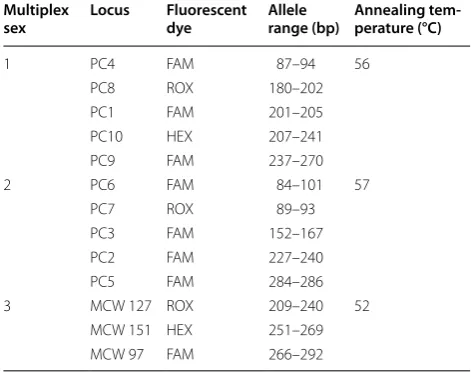
We checked their polymorphism on 2.5% agarose gels. In the end, ten novel and three extant markers with poly-morphic signals were retained (Table 1). The selected 13 loci were further arranged into three PCR multiplex sets (Table 2) and each forward primer was labeled with a fluorescent dye. Each amplification was carried out in a 10-µL reaction volume containing 5 µL of PCR mix (QIAGEN Multiplex Kit), 1 µL of a primer mix and 1 µL of template DNA. The PCR conditions were as follows:
initial denaturation at 95 °C for 5 min, followed by 35 cycles of denaturation at 94 °C for 30 s, annealing at 58 °C for 45 s and at 72 °C for 90 s and a final extension at 72 °C for 10 min. Products were isolated and detected on an ABI Prism 3730XL Genetic Analyzer (Applied Biosys-tems, service provided by Invitrogen, Shanghai, China). Fragment lengths were checked in comparison to an internal standard size (GeneScanTM-600LIZ, Applied Biosystems), using GeneMarker software v.2.2 (Soft Genetic).
For each microsatellite locus, we calculated the num-ber of alleles (NA), observed (HO) and the expected heterozygosities (HE), as well as the polymorphism infor-mation content (PIC) with CERVUS v.3 (Kalinowski et al. 2007). Deviations from the Hardy–Weinberg equilibrium (HWE) and genotypic equilibrium between loci were tested with the same program. Significance levels were adjusted for multiple testing using the Bonferroni proce-dure (Rice 1989) if necessary.
In order to explore the detectability of population structures by the novel microsatellite set, we further identified the number of genetic clusters (K) among the 90 common and 10 Green Pheasants, using the Bayesian admixture model with the correlated allele frequencies option implemented in STRUCTURE v.2.3.4 (Pritchard et al. 2000; Falush et al. 2003). We performed one million Markov chain Monte Carlo (MCMC) repetitions and a burn-in of 200,000 repetitions with ten independent runs each for K = 1–7. The most likely number of genetic clus-ters was determined on the basis of the ad hoc statistics described in Evanno et al. (2005) using the STRUCTURE Harvester v.0.6.8 (Earl 2011).
Results
About 127.98 G bases of raw data were generated for all the pooling lanes. After the raw data had been processed, about 123.27 G bases of clean data were retained. Then all reads with ambiguous barcodes were trimmed and about 114.91 G bases of clean data were kept for downstream analysis. The assembly generated 744,632 scaffolds larger than 150 bp, with a total length of 157 Mb. The average length was 211 bp with the largest of 1225 bp. The N50 statistic of the assembly was 254 bp. The microsatellite detection generated 7598 markers with 6419 di-nucleo-tide repeats, 766 tri-nucleodi-nucleo-tide repeats, 352 tetra-nucleo-tide repeats and 61 penta-nucleotetra-nucleo-tide repeats (Additional file 1: Table S1). These data were further used for analysis of the population genome.
The HO values ranged from 0.03 to 0.98 and those of HE from 0.049 to 0.905. The polymorphic information con-tent (PIC) ranged between 0.048–0.893, with seven out of eleven loci having a PIC value around or above 0.50. In addition, we successfully amplified all 13 microsatellites with our 10 Green Pheasant samples. However, only six (PC6, PC8, PC9, MCW 97, MCW127 and MCW151) out of 13 loci showed polymorphism in the Green Pheasants.
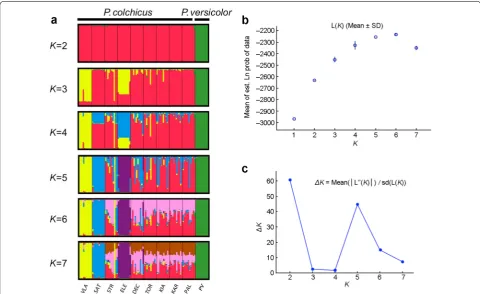
The Bayesian clustering approach implemented in STRUCTURE suggested two genetic clusters (Fig. 1) as the most likely scenario based on the Evanno’s method. The means of the posterior probability, Ln P (D) (±SD)
for different number of genetic groups (K), increased between K = 1–7 (Fig. 1b). The ∆K statistic reached a
peak when K = 2 (Fig. 1c), suggesting that the result of
two genetic clusters was the most likely scenario. This corresponds to the subdivision between the common and green pheasants. However, we also obtained a smaller peak when K = 5 (Fig. 1c) which most likely reflects a
Table 1 Characteristics of 13 microsatellites in a sample set of 90 individuals of the Common Pheasant (Phasianus colchi-cus)
The number of alleles (NA), observed (HO) and the expected heterozygosities (HE), as well as the polymorphism information content (PIC) were estimated for each locus
Locus Primer sequence Repeat motif Annealing
temperature (°C) Size range (bp) NA HO HE PIC
PC 1 F: AGCACATCACAGTGCTTTGAGC (AT)5 58 201–205 4.2 0.440 0.680 0.635
R: TTTGCTCAGGAAAAGAAAATAAAGACA
PC 2 F: AAAAAGCTCATTTGCTGTGGAA (AT)10 56 227–240 3.4 0.460 0.707 0.672
R: TCTTTGTCTTCACCCTCATGGA
PC 3 F: GAGGGTAGAGAGAAACAGGTGTTGA (CA)7 57 152–167 7.6 0.620 0.886 0.871
R: GAGGTAATCTCTCACTGCTGATTGG
PC 4 F: TTCCAAAAGCATATCCCAGAGC (AC)7 58 87–94 1.6 0.110 0.274 0.254 R: TAAGATAGCCCATCCTTTGGGG
PC 5 F: TGACCACTACAGTTTCCCATTCTTC (CT)8 57 284–286 4.4 0.540 0.801 0.777
R: AGATCTTCAGTAGCTCTTGGAACACA
PC 6 F: ACGGTCAGTAAGCATGTACCCC (TG)10 57 84–101 6 0.500 0.763 0.701
R: AGCAGTCAATGGAGAGCAGGTT
PC 7 F: GGCTGTCCTTTTAGCTACAGCAG (AT)13 57 89–93 7.8 0.830 0.905 0.893 R: CATCATCAAGAAGCATTGCAAAA
PC 8 F: GACCTCTGTCATTGGTTTTGGA (TG)14 56 180–202 1.3 0.030 0.049 0.048
R: TATGATTGTGAACAGCTGCCAA
PC 9 F: AATGGGAACTTTTTCAGGGACAA (AC)14 58 237–270 2.8 0.310 0.559 0.504
R: TTTGAAGTTGGTGGGACTCCAT
PC 10 F: GCTGCAAATCTCCTTAGCTCCA (TG)16 58 207–242 11 0.579 0.905 0.869
R: GGAGCAACAGTGGGAGAAGAAA
MCW 97 F: GGAGAGCATCTGCCTTCCTAG (AT)8C(AT)6C(AT)10C 50 266–292 2.1 0.980 0.512 0.389
R: TGGTCTTCCAGTCTATGGTAG
MCW 127 F: TGCAATAAGAGAAGGTAAGGTC (TA)7 50 209–240 2.0 0.290 0.478 0.397
R: GAGTTCAGCAGGAATGGGATG
MCW 151 F: CATGCTGTGATACTACAATTCC (CA)8 50 251–269 2.8 0.370 0.618 0.588
R: AACATCCTGGAGTTTGGGAAG
Table 2 Characteristics of three multiplex sets used in genotyping of the Common Pheasant (Phasianus colchi-cus)
Multiplex
sex Locus Fluorescent dye Allele range (bp) Annealing tem-perature (°C)
1 PC4 FAM 87–94 56 PC8 ROX 180–202 PC1 FAM 201–205 PC10 HEX 207–241 PC9 FAM 237–270 2 PC6 FAM 84–101 57
PC7 ROX 89–93 PC3 FAM 152–167 PC2 FAM 227–240 PC5 FAM 284–286 3 MCW 127 ROX 209–240 52
further population subdivision within Common Pheas-ants. We plotted the assignment of genetic clusters when
K = 2–7 and found that the subspecies elegans, vlangalii
and satscheuensis represented distinctive genetic clusters in contrast with the remaining subspecies (Fig. 1a).
Discussion
Microsatellites are commonly used genetic markers in evolutionary, behavioral and conservation genetics due to their relatively high level of polymorphism and repeatability in genotyping. In a given species, micro-satellite markers can be isolated and developed from scratch using methods such as magnetic beads (e.g. Wang et al. 2009) or by applying cross-species amplifica-tion using existing markers from closely related species (e.g. Dawson et al. 2010; Gu et al. 2012). The recent fast development of NGS has drastically promoted discover-ies of novel microsatellites by using more cost-effective and less time-consuming strategies. Unlike laboratory-biased traditional methods, these approaches provide a massive amount of DNA sequencing reads as resources
used for microsatellite detection by bioinformatic pipe-lines. Our results identified ten novel microsatellites in the Common Pheasant using an Illumina paired-end RAD sequencing strategy. Apart from RAD-seq, other sequencing strategies such as RNA-seq (e.g. Wang et al. 2012) and whole genome re-sequencing (e.g. Yang et al. 2015) have been consistently applied depending on the purpose of the research and on a budget.
We designed a panel of 13 multiplexed microsatel-lite markers that provided considerable polymorphic information to study population genetic structuring in common and green pheasants. In the Common Pheas-ant, the number of alleles ranged from 2 to 8, which is considered to be medium to high polymorphism (Bot-stein et al. 1980). However we found that seven loci in the green pheasants were monomorphic, probably owing to low level genetic diversity. The Green Pheasant has a smaller population and restricted range in its geographi-cal distribution, compared to the wide ranging Common Pheasant. Another possibility is that, since only ten cap-tive individuals of the Green Pheasant were included in
Fig. 1 a Population structuring of Common and Green Pheasants inferred from STRUCTURE that used admixture model with correlated allele frequencies when K= 1–7. Each line represents an individual and the length of each color represents the possibility of the individual assigned into a given genetic cluster. The abbreviation stands for subspecies of Common Pheasant (VLA: vlangalii, SAT: satscheuensis, STR: strauchi, ELE: elegans, DEC:
decollatus, TOR: torquatus, KIA: kiangsuensis, KAR: karpowi, PAL: pallasi, PV: Green Pheasant). b Although the means of the posterior probability Ln P
the analysis, more tests with an enlarged sample set are likely required.
Using these novel microsatellites, we found a major genetic differentiation between the common and green pheasants. These two sister species of the genus Pha-sianus diverged about 2.8 million years ago based on a mitogenomic study by Li et al. (2015). We found further genetic population subdivisions within nine subspecies of the Common Pheasant in China. While no substantial genetic differentiation within the six subspecies in east-ern China (decollatus, torquatus, kiangsuensis, karpowi,
pallasi and strauchi), the three subspecies vlangalii, sats-cheuensis and elegans formed distinctive genetic clusters. These results corroborate the phylogeographic relation-ships revealed by mtDNA and nuclear intron data in an earlier study (Kayvanfar et al. 2017). In eastern China, subspecies are parapatric and their boundaries geneti-cally vigorous, which is probably due to low genetic diver-gence and frequent gene flow. When it comes to western China, most subspecies are allopatric and their bounda-ries are distinct, probably indicating long-term isolation. However these first results are based only on subspecies within the torquatus group (Grey-rumped Pheasants). Samples of subspecies from the western Palearctic are needed to obtain a complete picture of population struc-turing within the Common Pheasant.
We can conclude that this novel set of microsatellites has proved to be useful for population genetics and con-servation implications in the Common Pheasant as well as its sister species the Green Pheasant. As well, this study provides a checklist of 7598 candidate microsat-ellites (Additional file 1: Table S1) that can be used for genetic linkage mapping in the Common Pheasant and are probably useful to design markers for other closely related and endangered pheasant species (e.g. Chrysolo-phus, Lophura, Crossoptilon, Syrmaticus) (Gu et al. 2012).
Authors’ contributions
BW, HP, YL designed the experiments. XX, SL, XW performed molecular genetic laboratory works and BW, SL carried out data analysis. BW and YL wrote the manuscript. All authors read and approved the final manuscript.
Acknowledgements
This work was supported by the National Natural Science Foundation of China (No. 31572251) to YL and a grant from the China Postdoctoral Science Foundation (No. 2016M590834) to BW. We thank the following persons who kindly provided samples or assisted with sampling: Edouard Jelen, Zheng-wang Zhang, Cheng-Te Yao, Gombobaatar Sundev, Noritaka Ichida, Jong-Ryol Chong and Jun Gou.
Additional file
Additional file 1: Table S1. Primer sequences, repeat motifs and annealing temperatures for 7598 microsatellite markers developed for the Common Pheasant (Phasianus colchicus).
Competing interests
The authors declare that they have no competing interests.
Ethical standards
The experiments complied with the current laws of China. All the animal operations were approved by the Institutional Ethical Committee of Animal Experimentation of Sun Yat-sen University and strictly complied with the ethi-cal conditions by the Chinese Animal Welfare Act (20090606).
Received: 1 September 2016 Accepted: 10 January 2017
References
Baird NA, Etter PD, Atwood TS, Currey MC, Shiver AL, Lewis ZA, Selker EU, Cresko WA, Johnson EA. Rapid SNP discovery and genetic mapping using sequenced RAD markers. PLoS ONE. 2008;3:e3376.
Baratti M, Alberti A, Groenen M, Veenendaal T, Fulgheri FD. Polymorphic micro-satellites developed by cross-species amplifications in common pheasant breeds. Anim Genet. 2001;32:222–5.
Botstein D, White RL, Skolnick M, Davis RW. Construction of a genetic linkage map in man using restriction fragment length polymorphisms. Am J Hum Genet. 1980;32:314–31.
Braasch T, Pes T, Michel S, Jacken H. The subspecies of the common pheasant Phasianus colchicus in the wild and captivity. Int J Galliformes Conserv. 2011;2:6–13.
Brandt JR, de Groot P, Zhao K, Dyck MG, Boag PT, Roca AL. Development of nineteen polymorphic microsatellite loci in the threatened polar bear (Ursus maritimus) using next generation sequencing. Conserv Genet Resour. 2014;6:59–61.
Castoe TA, Poole AW, de Koning APJ, Jones KL, Tomback DF, Oyler-McCance SJ, Fike JA, Lance SL, Streicher JW, Smith EN, Pollock DD. Rapid microsatellite identification from Illumina paired-end genomic sequencing in two birds and a snake. PLoS ONE. 2012;7:e30953.
Cramp S, Simmons KEL. The birds of the western Palearctic: vol. 2: hawks to bustards. Oxford: Oxford University Press; 1980.
Dawson DA, Horsburgh GJ, Kupper C, Stewart IR, Ball AD, Durrant KL, Hansson B, Bacon I, Bird S, Klein Á, Krupa AP, Lee J-W, Martín-Gálvez D, Simeoni M, Smith G, Spurgin LG, Burke T. New methods to identify conserved micro-satellite loci and develop primer sets of high cross-species utility—as demonstrated for birds. Mol Ecol Res. 2010;10:475–94.
Earl DA. Structure harvester v0.6.8. http://users.soe.ucsc.edu/~dearl/software/ struct_harvest/ (2011).
Ekblom R, Galindo J. Applications of next generation sequencing in molecular ecology of non-model organisms. Heredity. 2011;107:1–15.
Evanno G, Regnaut S, Goudet J. Detecting the number of clusters of indi-viduals using the software STRUCTURE: a simulation study. Mol Ecol. 2005;14:2611–20.
Faircloth BC. Msatcommander: detection of microsatellite repeat arrays and automated, locus-specific primer design. Mol Ecol Resour. 2008;8:92–4. Falush D, Stephens M, Pritchard J. Inference of population structure using
multilocus genotype data: linked loci and correlated allele frequencies. Genetics. 2003;164:1567–87.
Gu LY, Liu Y, Wang N, Zhang ZW. A panel of polymorphic microsatellites in the Blue Eared Pheasant (Crossoptilon auritum) developed by cross-species amplification. Chin Birds. 2012;3:103–7.
Hill D, Robertson P. The pheasant: ecology, management and conservation. Oxford: BSP Professional; 1988.
Johnsgard PA. The pheasants of the world: biology and natural history. Wash-ington, DC: Smithsonian Institution Press; 1999.
Kalinowski ST, Taper ML, Marshall TC. Revising how the computer program CERVUS accommodates genotyping error increases success in paternity assignment. Mol Ecol. 2007;16:1099–106.
Kayvanfar N, Aliabadian M, Niu XJ, Zhang ZW, Liu Y. Phylogeography of common pheasant, Phasianus colchinus (Aves: Galliformes). Ibis. 2017;. doi:10.1111/ibi.12455.
• We accept pre-submission inquiries
• Our selector tool helps you to find the most relevant journal
• We provide round the clock customer support
• Convenient online submission
• Thorough peer review
• Inclusion in PubMed and all major indexing services
• Maximum visibility for your research
Submit your manuscript at www.biomedcentral.com/submit
Submit your next manuscript to BioMed Central
and we will help you at every step:
Li R, Zhu H, Ruan J, Qian W, Fang X, Shi Z, Li Y, Li S, Shan G, Kristiansen K, Li S, Yang H, Wang J, Wang J. De novo assembly of human genomes with massively parallel short read sequencing. Genome Res. 2010;20:265–72. Li X, Huang Y, Lei F. Comparative mitochondrial genomics and phylogenetic relationships of the Crossoptilon species (Phasianidae, Galliformes). BMC Genomics. 2015;16:1.
Madge S, McGowan P. Pheasants, partridges and grouse: a guide to the pheas-ants, quails, grouse, guineafowl, buttonquails, and sandgrouse of the world. Princeton: Princeton University Press; 2002.
Pritchard JK, Stephens M, Donnelly P. Inference of population structure using multilocus genotype data. Genetics. 2000;155:945–59.
Rice WR. Analyzing tables of statistical tests. Evolution. 1989;43:223–5. Selkoe KA, Toonen RJ. Microsatellites for ecologists: a practical guide to using
and evaluating microsatellite markers. Ecol Lett. 2006;9:615–29. Solokha AV. On the evolution of pheasant (Phasianus colchicus L.) in Middle
Asia. In: Fet V, Atamuradov KI, editors. Biogeography and ecology of Turkmenistan. Dordrecht: Springer; 1994. p. 295–306.
Sotherton NW. Land use changes and the decline of farmland wildlife: an appraisal of the set-aside approach. Biol Conserv. 1998;83:259–68.
Sunnucks P. Efficient genetic markers for population biology. Trends Ecol Evol. 2000;15:199–203.
Wang B, Ekblom R, Castoe TA, Jones EP, Kozma R, Bongcam-Rudloff E, Pollock DD, Höglund J. Transcriptome sequencing of black grouse (Tetrao tetrix) for immune gene discovery and microsatellite development. Open Biol. 2012;2:120054.
Wang N, Liu Y, Zhang ZW. Characterization of nine microsatellite loci for a globally vulnerable species, Reeves’s Pheasant (Syrmaticus reevesii). Con-serv Genet. 2009;10:1511–4.
Willing EM, Hoffmann M, Klein JD, Weigel D, Dreyer C. Paired-end RAD-seq for de novo assembly and marker design without available reference. Bioinformatics. 2011;27:2187–93.