R E S E A R C H
Open Access
Module detection in complex networks using
integer optimisation
Gang Xu
1, Laura Bennett
2, Lazaros G Papageorgiou
1, Sophia Tsoka
2*Abstract
Background:The detection ofmodules or community structureis widely used to reveal the underlying properties of complex networks in biology, as well as physical and social sciences. Since the adoption of modularity as a measure of network topological properties, several methodologies for the discovery of community structure based on modularity maximisation have been developed. However, satisfactory partitions of large graphs with modest computational resources are particularly challenging due to the NP-hard nature of the related optimisation problem. Furthermore, it has been suggested that optimising the modularity metric can reach a resolution limit whereby the algorithm fails to detect smaller communities than a specific size in large networks.
Results:We present a novel solution approach to identify community structure in large complex networks and address resolution limitations in module detection. The proposed algorithm employs modularity to express network community structure and it is based on mixed integer optimisation models. The solution procedure is extended through an iterative procedure to diminish effects that tend to agglomerate smaller modules (resolution limitations).
Conclusions:A comprehensive comparative analysis of methodologies for module detection based on modularity maximisation shows that our approach outperforms previously reported methods. Furthermore, in contrast to previous reports, we propose a strategy to handle resolution limitations in modularity maximisation. Overall, we illustrate ways to improve existing methodologies for community structure identification so as to increase its efficiency and applicability.
Background
Networks - i.e. groups of entities (nodes or vertices) pairs of which are linked through a form of common property (edges or links) - have formed an efficient representation framework for a variety of complex sys-tems such as social groupings and internet connectivity [1]. The analysis of biological data in systems biology studies through the formalisms of network theory have received particular attention recently, due to the poten-tial benefits that such methodologies can confer in mining the intricate relationships in metabolic networks [2-4], signaling pathways [5], gene regulatory networks [6] or other forms of protein interactions [7]. In general, the abstractions offered by graph theory representations
(i) facilitate the analysis of network performance, (ii) provide a unifying framework for comparisons of features across different systems and (iii) assist the mathematical characterisation of system properties and dynamics.
Topological properties of networks are particularly important in revealing the organisational principles of nodes within the context of the entire system [8].
Com-munity structuresormodules are defined when a larger
density of links exists within a specific part of the net-work than outside it [9]. Each of such modules can be regarded as a discrete entity whose function or proper-ties are in some way separable from other modules. Modular structure underlies (i) the adaptability of a sys-tem to new conditions [10] and (ii) the robustness (or conversely the vulnerability) of the system to external attack or other form of change in topological features [11,12]. The analysis of pairwise or even longer-range relationships in networks can reveal how preferential * Correspondence: [email protected]
2Centre for Bioinformatics, Department of Informatics, School of Natural and Mathematical Sciences, King’s College London, Strand, London, WC2R 2LS, UK
Full list of author information is available at the end of the article
attachment of new nodes influences community struc-ture [13,14], giving rise to small-world or scale-free architectures [15].
In light of the above, the detection of modules and the analysis of community structure in networks has the potential to reveal the design principles of complex tems and provide important insights into how such sys-tems are organised, how they evolve and how their components interact. For example, in biological net-works, the analysis of enzyme connectedness may reveal participation in the same biological pathway, and module detection in protein interactions reflects protein function type or evolutionary properties [3,7,16]. Importantly, the characterisation of gene products with previously unknown functional properties through community detection has the potential to aid function assignment. Recent reviews have reported on the community detec-tion problem in comprehensive manner [17,18].
The two major avenues to detect community structure have been graph partitioning [19,20] and hierarchical clustering methods [16,20-23]. Major disadvantage in the case of graph partitioning is the absence of a termi-nation criterion in the bisection process, while in hier-archical clustering there is no clear indication of where the tree should be split to yield the optimal partitioning. Such shortcomings result in either sub-optimal parti-tioning or unsatisfactory implementations for large net-works. In addition to graph partitioning and hierarchical methods, which are particularly suitable for standard partitioning (each node belongs to a single community), other methodologies exist to detect overlapping commu-nities as nodes may belong to several commucommu-nities, for example, the clique percolation method, [24].
An important breakthrough in the community detec-tion problem has taken the form of a quantitative mea-sure to express the quality of community presence, namelymodularity. Network modularity is defined as the fraction of all edges that lie within communities minus the expected value of the same quantity in a graph in which the vertices have the same degrees but edges are placed randomly [25-27]. Usually, in our experience, net-work modularity values of around 0.4-0.8 indicate strong community presence. Use of the modularity metric has transformed the community structure identification pro-blem into an optimisation task where community struc-tures can be determined by maximising the network modularity through various optimisation techniques [25]. As modularity optimisation is NP-hard [28,29], effi-cient algorithms to find the maximum modularity values are unlikely to exist. Therefore, most approaches employ heuristics that aim at finding near-optimal solutions with modest computational cost. Crucial considerations in assessing the performance of modularity optimisation approaches are: (i) the scale and optimality handled by
modularity optimisation methods and (ii) the resolution limit problem for small-size modules in large networks.
First, there seems to be a trade-off between network size and optimality achieved through modularity optimi-sation. Specifically, methods that guarantee global opti-mal solutions for modularity maximisation are able to operate only in small to medium-sized networks [30]. Divisive algorithms [25] were found to be prohibitively computationally expensive for large networks. On the other hand, methods that can be used on large net-works, such as stochastic optimisation through simu-lated annealing [3,31] and extremal optimisation [32], may yield sub-optimal solutions and so may suffer poor performance. In our own work, we have previously reported a rigorous mixed integer quadratic program-ming (MIQP) formulation to optimise the modularity metric with a set of linear constraints and mixed binary/ continuous optimisation variables [30]. Due to the con-vexity properties of the model, global optimal solutions are achieved through the standard branch-and-bound procedure with commercial optimisation solvers, but use of this optimisation framework is limited to small-medium scale networks due to NP-hardness.
Second, doubts have been raised over the use of mod-ularity optimisation for community detection recently, due to the observation that such procedures can reach a resolution limit [33]. This effect essentially implies that modules smaller than a specific scale are not detected, as the optimisation process combines smaller commu-nities into larger ones in order to achieve better modu-larity. Some remedial procedures have been suggested through re-optimising each module [33,34], tuning a resolution parameter [35], or implementing quantitative measures other than modularity [36].
Here, we aim to enhance the application of mathema-tical programming to community structure identification by: (i) developing an efficient methodology for module detection that is capable of handling large size networks and (ii) incorporating strategies for dealing systemati-cally with the problem of a resolution limit in module detection through modularity optimisation approaches. Below, a two-stage solution approach for community identification using mathematical programming is described, the resolution limit in modularity optimisa-tion is addressed via the introducoptimisa-tion of an iterative pro-cedure and the applicability of the proposed approaches is demonstrated through a number of network examples and comparisons with literature.
Methods
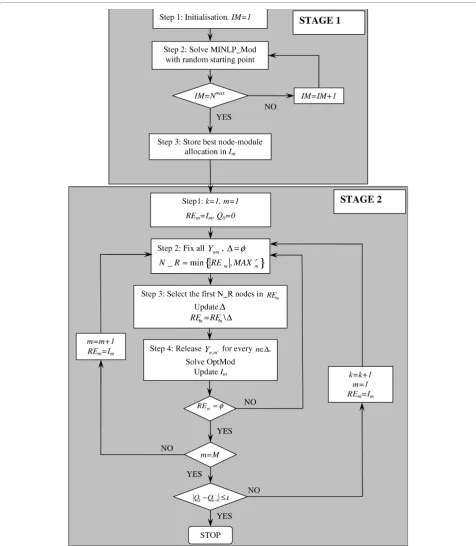
obtain a feasible solution efficiently. An initial partition with a good modularity value is selected from a set of MINLP solutions with random starting points. Second, the solution obtained in the first stage is improved through an iterative optimisation procedure employing a model that we have developed previously and was pro-ven efficient in detecting communities in small to med-ium size networks through a global maximum of the modularity metric (OptMod, [30]). Overall, the iMod approach that combines the two aforementioned stages is intended to extend the use of mathematical program-ming methodologies to larger-size networks. A sche-matic representation of the iMod computational procedure, combining MINLP_Mod and OptMod, is shown in Figure 1.
Stage 1: Initial network partition
Given a network with Nnodes andL edges, the modu-larity metric,Q, of a network partitioned intoM com-munities is represented as:
Q L L D L m m m = − ⎛ ⎝⎜ ⎞ ⎠⎟ ⎡ ⎣ ⎢ ⎢ ⎤ ⎦ ⎥ ⎥
∑
2 2 (1)where Lm denotes the number of links in modulem and Dm is the degree of all nodes in module m. The modularity metric,Q, measures the difference between the fraction of links within communities and the expected fraction values when links are allocated ran-domly [25,26]. The objective function employed here is the maximisation of the network modularity metric shown in equation (1).
First, each node is allocated to exactly one module:
Ynm n
m
∑
=1 ∀ (2)whereYnm is a binary variable taking the value of1 if nodenis allocated to modulem;0otherwise.
As previously defined, Dmis equal to the sum of the degrees of nodes allocated to modulem:
Dm dn Ynm m
n
=
∑
⋅ ∀ (3)A link will be allocated to module monly when both nodes associated with it are also in module m. There-fore, the total number of links in module m, Lm, is defined by the following nonlinear equality:
Lm Ynm Y m
e n e CN em n n = ⋅ ∀ > ∈
∑
∑
(4)whereCNnis the set of nodeseconnected to noden. Overall, the resulting MINLP model (MINLP_Mod) for determining community structures based on the modularity metric maximisation is formulated as:
Maximise
Subject to: Constraint
:Q L
L D L m m m = − ⎛ ⎝⎜ ⎞ ⎠⎟ ⎡ ⎣ ⎢ ⎢ ⎤ ⎦ ⎥ ⎥
∑
2 2 ss (2-4) (5)Lm,Dm≥0 ∀m (6)
Ynm∈
{ }
0 1, (7)Since global optimality of non-convex MINLP models cannot be guaranteed, different initial solutions are tested and the partition with the largest value ofQ, is chosen as the best division from the set of candidate solutions. MINLP_Mod is performed for a given number of runs,Nmax, from random initial points and the node-module allocation with the maximum modularity value is stored and denoted by setIm. Using Nmax= 100 pro-vides a good representation of solution space.
Stage 2: Iterative improvement of network partition Having selected a node-module association with maxi-mum modularity from the previous stage (i.e.Im), mod-ule allocation may be improved further through an iterative fixing and releasing scheme. The general idea is to solve a reduced MIQP formulation of modularity optimisation that was previously proposed in [28]. Most of the Ynmvariables are fixed, which reduces the num-ber of variables, thus resulting in a more tractable model. Sets of nodes are released in the sense that they are free to be re-allocated to a different module in sub-sequent executions of the MIQP model.
This stage initially adopts the node-module allocation obtained from stage 1 by fixing all the relevantYnm bin-ary variables in Im to the value of one. For the first module, the set of nodes in the module is denoted as
REmand the set of nodes to be released (or‘un-fixed’) is denoted asΔ, where the size ofΔis N_R, a value chosen according to criteria described below. The reduced MIQP (OptMod) is solved (for details see [30]), with all nodes inΔreleased and all other nodes fixed.Imis then updated with the solution from the reduced MIQP.
modularity value is reported for two successive major iterations.
Comparing the single-level MIQP model, OptMod, to the reduced MIQP models as implemented here, the lat-ter strategy involves fewer variables and constraints and
reduced MIQP models, while no improvements have been observed when solving reduced MINLP models iteratively.
To avoid releasing too many nodes so that the reduced OptMod model is still difficult to solve, the maximum number of released nodes for module m,
MAXmr , is set to:
MAX U
Aver
mr
m
= (8)
whereAvermdenotes the average degree in modulem without considering the inter-module links andU is a user-defined parameter. Here, we used a value of U = 200 which was shown to provide satisfactory results for all examples studied. As a result, the actual number of released nodes, N_R, will be the smaller value between
MAXmr and the number of remaining nodes to be released inREm(i.e. N_R=min{REm ,MAXmr}).
In other words, if the number of nodes in module m
is greater than MAXmr , the firstN_Rnodes,Δ, in mod-ule mwill be released and the reduced MIQP solved.Im is updated andREmbecomesREm|Δ. If the updatedREm is still greater than MAXmr , a further set of nodes of size N_Ris released, otherwise all remaining nodes are released. The reduced MIQP is solved once again and
ImandREmupdated accordingly. This is repeated until all nodes in the module have been released at one point and the procedure moves on to the next module. In order to determine the set of N_Rnodes to be released in modules, we use a simple rule by first sorting nodes with non-decreasing indices and then assigning higher priority to nodes with smaller indices.
The above scheme is applied to all modules detected during Stage 1, with the sequential order of the modules maintained throughout the whole procedure. Future research can investigate the effect of changing the sequence of module reallocation, the appropriate selec-tion of MAXmr and node prioritisation. Figure 1 illus-trates the entire module detection strategy, iMod, encompassing Stages 1 and 2 of the mathematical pro-gramming algorithm reported above.
Procedure to address resolution limitations
Although the modularity metric has been widely accepted as a standard measure to quantify the commu-nity composition in networks and detect modules, reso-lution limit problems can hinder its application. Such effects entail the failure of modularity optimisation to detect modules smaller than a scale which depends on the size of the network and the degree of inter-connect-edness of the modules, as the algorithm tends to merge small modules to achieve larger modularity values [33,37,38]. Methodologies that aim to overcome
resolution limits can provide deeper insights into finer structures of modules in complex networks and a more accurate depiction of community structure on the basis of the modularity measure.
In this section, we report a solution procedure (ResMod) that allows smaller modules that may not be detected in the initial modularity optimisation to become apparent. First, the two-stage approach for module detection, iMod, is applied to the whole network to obtain a partition into several modules. In order to determine if these modules comprise smaller modules, each module is considered as a disjoint subnetwork, ignoring links with other modules, and iMod is then applied once to each subnetwork.
The partition of the subnetwork into smaller modules is accepted as part of the community structure of the original network if its modularity as a disconnected entity (i.e. only considering the links involved in the subnetwork) is greater than an enforced threshold. If the partition of the subnetwork yields a value less than this threshold, the new decomposition is not accepted and the subnetwork remains intact as a community of the original network.
Here, a threshold of value of 0.3 is adopted as a repre-sentative community structure indicator, in accordance to previous reports [25,26,33,34]. This criterion is imple-mented to avoid over-partitioning that may hinder method applicability. We should note here that this implementation of a single and unvarying threshold to determine whether partitioning is required may not be enough to capture cases where random graphs (or parti-tions obtained by chance) have a modularity higher than 0.3. Ideally, this criterion should be complemented with an estimate of the statistical significance of the modular-ity achieved (see [4,34]) to ensure that this value is above a fluctuation margin. However, in practice, even this coarse-grained approach to resolution limitation problems seems to work well in proposing finer com-munity structures for common complex networks and it is a good first step into research for improving modular-ity maximisation methods.
Results and Discussion
ResMod is subsequently used on the partitioned net-works to resolve resolution and identify finer modular structures that may be present. A comprehensive com-parison of our approach to other module detection methodologies was performed and is discussed below to illustrate significant improvements over previous approaches.
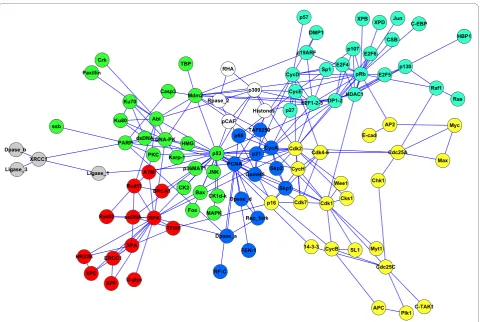
A number of networks identified from the literature serve as test cases to showcase the efficiency of the computational methodology. Table 1 summarises all networks considered, their sizes and indicative results of the methodologies tested. Overall, nine examples were used with varying sizes, in terms of total number of nodes and links. These cases are inspired from social or biological relationships and represent well-studied cases in network analysis and related algorithm development.
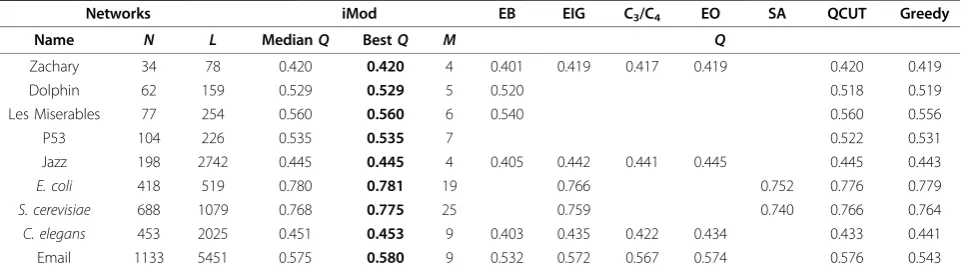
Networks describing social interactions in our study are (in ascending number of nodes): the Zachary net-work of social relationships in an American university club [42], the communications among dolphins con-structed through a field study [43,44], relations among roles in the novel Les Miserables [45], a network of jazz musicians as described through their recordings [46] and a university network of email communication [47]. Biological networks assessed are: the p53 protein inter-action network [11], the transcriptional network of the bacteriumEscherichia coli [48], the transcriptional net-work of the yeast Saccharomyces cerevisiae[49] and the network of metabolic reactions of the nematode Caenor-habditis elegans[50]. Figure 2 shows the network repre-sentation of p53 protein interactions, with colours indicating modules as detected by iMod.
Our methodologies for community detection and reso-lution limitations are compared against the most widely used approaches that employ modularity maximisation. Here, a brief account of such previously developed algo-rithms is given, together with reference to the original
publications for more details on the main properties of each algorithm.
An algorithm based on edge-betweenness (EB) [25] that involves the iterative removal of edges with the highest
betweennessscore to split the network into communities has been one of the very first attempts to use modularity maximisation for module detection. The eigenvector approach (EIG) was later proposed by the same group, where network modularity was rewritten as eigenvectors of a modularity matrix and lead to a spectral algorithm for community detection [9]. Edge-betweenness has recently been extended through the use of edge weights defined by the edge-clustering coefficient (C3/C4) to improve module detections [51]. Popular optimisation methodologies have been proposed as efficient means to achieve modularity maximisation, namely extremal optimisation (EO) [32] and simulated annealing (SA) [33]. Recently, heuristic algorithms have been proposed, i.e. one that relies on spectral graph partitioning and local search (QCUT) [34] and a greedy method for iterative grouping of nodes into communities (Greedy) [52]. Both of these methods show good performance compared to previous approaches. For Greedy and QCUT, we used the relevant software to eval-uate modules and estimate the resulting modularity. For all other methods, the reported results are taken from the relevant published papers.
Extensive comparisons of performance across all above methodologies show that iMod achieved network parti-tions with the highest modularity (Table 1). Consistently better performance was noted for iMod throughout all examples studied. It is important to mention that even small improvements in modularity can differentiate between good and exceptional methods, as has been noted previously [9].
For the example of the p53 network (Figure 2), mod-ules were mapped onto KEGG pathways and pathway enrichment was calculated against the human genome Table 1 Computational results comparing the performance of modularity optimisation methodologies across several network examples
Networks iMod EB EIG C3/C4 EO SA QCUT Greedy
Name N L MedianQ BestQ M Q
Zachary 34 78 0.420 0.420 4 0.401 0.419 0.417 0.419 0.420 0.419
Dolphin 62 159 0.529 0.529 5 0.520 0.518 0.519
Les Miserables 77 254 0.560 0.560 6 0.540 0.560 0.556
P53 104 226 0.535 0.535 7 0.522 0.531
Jazz 198 2742 0.445 0.445 4 0.405 0.442 0.441 0.445 0.445 0.443
E. coli 418 519 0.780 0.781 19 0.766 0.752 0.776 0.779
S. cerevisiae 688 1079 0.768 0.775 25 0.759 0.740 0.766 0.764
C. elegans 453 2025 0.451 0.453 9 0.403 0.435 0.422 0.434 0.433 0.441
Email 1133 5451 0.575 0.580 9 0.532 0.572 0.567 0.574 0.576 0.543
Best modularity achieved across all methodologies and network examples is denoted in bold.
through SubpathwayMiner [53]. We compared enriched pathways for the iMod and Greedy partitions and, even for small differences in community structures detected, more pathways were significantly enriched in the iMod partition. Even though clearly more work is need along these lines, this is an early indication that module detec-tion through iMod may be more meaningful biologically. Comparative analyses are hindered to some extent by missing values in Table 1, as different network examples were assessed through each of the reported methodolo-gies. For instance, the p53 example has been implemen-ted in three methods (iMod, QCUT and Greedy), the Dolphin and Les Miserables networks were considered by four methodologies (iMod, EB, QCUT and Greedy),
the E. coli and S. cerevisiae by five (iMod, EIG, SA,
QCUT and Greedy) and the remaining four networks have been tested by different combinations of seven methodologies out of eight community detection algo-rithms considered in total. Such missing values indicate an impediment in related comparison efforts and it is suggested that the definition of network examples as standards, where algorithm development and evaluation can be benchmarked, is needed in order to facilitate and improve comparative analyses [54]. However, it should
also be noted that this is one of the most comprehensive comparisons of module detection methodologies employing modularity maximisation, to our knowledge.
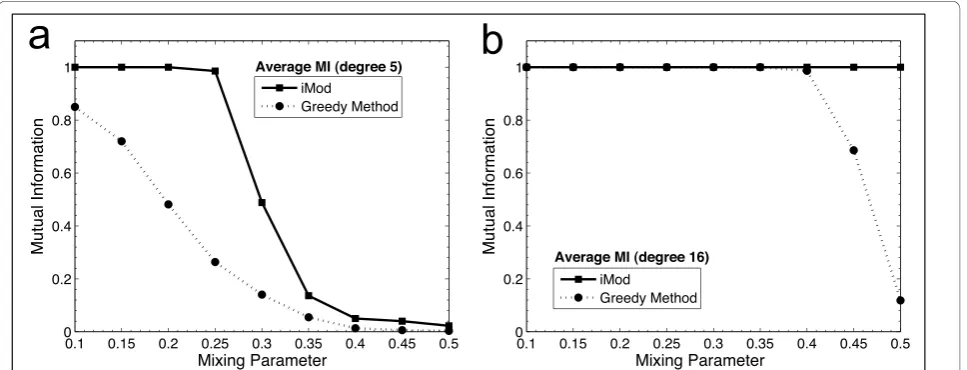
Benchmarking was also extended to simulated net-works to illustrate the efficiency of iMod. A large num-ber of artificial networks with known community structure was generated, as described previously [25]. These synthetic networks comprise 128 nodes and are partitioned into four communities of 32 nodes with degree equal to 16. In addition, we considered the case where degree was set equal to 5, as this represented a more realistic estimate of the average node degree in real networks (see Table 1). The mixing parameter, μ, i.e. the fraction of all links in a particular module that end outside this module, was varied from 0.1 to 0.5. Increasing the mixing parameter makes the modules of the ‘true’community structure less well defined and the communities less easily detected. Testing for a mixing parameter greater than 0.5 was not deemed necessary, as it would contradict the definition of community structure, where more intra-community links than inter-community links should exist.
which was the next best performing method from the comparison reported in Table 1. The mutual informa-tion measure [55] was used to illustrate the agreement between the known and detected community structures, i.e. mutual information ranges from 0 (for dissimilar) to 1 for identical community structures. We generated 100 synthetic networks for each mixing parameter examined, each of these was analysed with iMod and the Greedy method, and the average mutual information was calcu-lated. Figures 3a and 3b report the mutual information plotted against the mixing parameter for the synthetic networks to illustrate how close these methods were in revealing the known community structure.
Overall, iMod performed better for all examples tested. For node degree equal to 16, iMod and the Greedy method manage to retrieve the exact partition for all values of μ up to 0.35. Thereafter, iMod outper-forms the Greedy method by continuing to extract the exact partition whereas the Greedy method’s perfor-mance declines rapidly. In the case of degree equal to 5, iMod still achieves higher similarity to the known struc-ture than the Greedy method for all values of μ.
Detection of resolution limitations
Improved community structures are not achieved solely through maximisation of modularity; further refinement by addressing resolution limits of modularity maximisa-tion is critically important. Network modules obtained with the iMod algorithm were further partitioned as described in the ResMod procedure, ignoring all inter-module links, as outlined above.
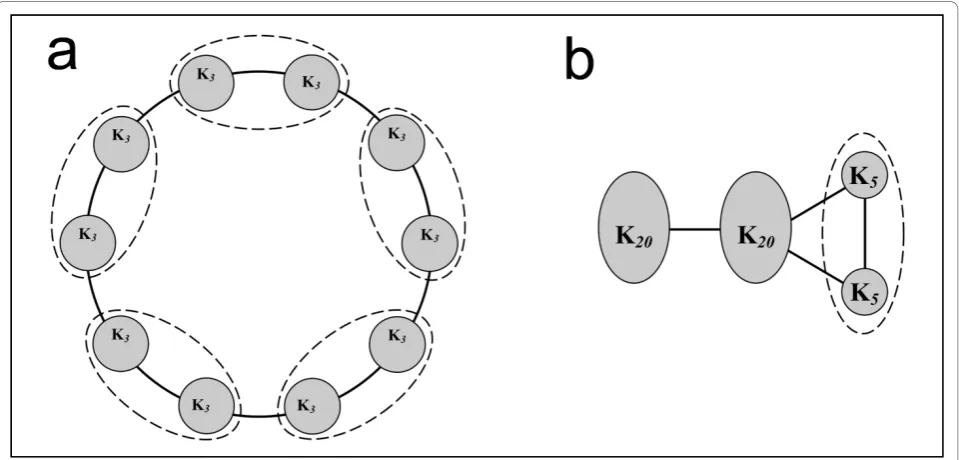
To illustrate how the proposed methodology can be used to overcome resolution limitations, two synthetic examples from the literature [33] are used, as they represent particularly challenging cases in module detec-tion. These network examples are shown in figures 4a and 4b and summarised in Table 2. Both synthetic examples are rather extreme cases in terms of their topological properties and serve to verify the accurate detection of community structure where resolution lim-itations may pose significant problems. These are dis-cussed in detail below.
The first example is a ring-shaped network composed of 10 identical complete graphs of three nodes each, represented by circles inter-connected by the minimal number of links (Figure 4a). This graph is an example of maximal modularity, since modularity converges to one as the number of complete graphs reaches infinity [33,56]. Modularity maximisation using iMod initially suggests the existence of 5 modules, in accordance to other approaches [33]. Through implementation of ResMod to correct for resolution limits by optimising each of the five communities further without consider-ing the inter-module links, the two smaller groups within each module become apparent and the total number of modules is correctly identified as ten.
The second synthetic example comprises four groups of nodes (y-shaped, Figure 4b). Each group, denoted by a circle, consists of completely connected graphs: the two leftmost groups comprise 20 nodes and the two on the right consist of 5 nodes each [33]. Methods that per-form modularity maximisation tend to merge the two
smallest groups to yield the highest possible modularity value at the cost of an inaccurate detection of underly-ing community structure. Partitionunderly-ing the network through iMod and optimising each module through ResMod yields the accurate number of four modules and the network is partitioned correctly.
In real networks, improved module structures have been detected for the dolphin, p53,E. coliandS. cerevi-siae networks, while no improvement has been detected for the remaining examples. Excluding the dolphin net-work, where a marginal increase to the number of mod-ules was observed after ResMod, all larger size networks have shown a significant increment to the number of modules proposed after the treatment for resolution. As indicated in Table 3, the number of modules more than doubled in the p53 and yeast networks and the same quantity was four-fold higher in the E. coli and C.
eleganscases. Such wide differences clearly confirm that accurate module detection is particularly challenging in large networks where resolution problems are more pronounced.
Another computational methodology that accounts for resolution limitations is the use of simulated annealing (SA) for modularity maximisation, where simulated annealing is applied to each detected module to find out whether any sub-modules can be identified [33]. In comparison, theE. colinetwork was partitioned into 79 modules with a modularity of 0.675 with ResMod, com-pared to 76 modules with modularity of 0.661 in SA. Figure 4Benchmarking of the procedure to address resolution limitations. (a) Ring-shaped network, each circle denotes identical complete graphs (subgraphs of three nodes, K3). Subgraphs are connected with the minimum number of edges, as shown. Dotted lines indicate modules detected through modularity maximisation without correcting for resolution (iMod). After accounting for resolution limitations (ResMod), each complete graph is identified as a separate module, revealing the correct community structure of ten modules. (b) Y-shaped network comprising of complete subgraphs with twenty and five nodes (K20, K5respectively), linked as shown. Resolution limitations in modularity maximisation lead to merging the two smallest subgraphs, thus yielding three modules. The ResMod algorithm can correctly identify all four modules present.
Table 2 Computational results for modularity
optimisation and resolution limits in simulated network examples
Networks iMod ResMod
Name N L MedianQ BestQ M Q_Reso M
Ring 30 40 0.6750 0.6750 5 0.6500 10 Y-shape 50 40 0.5426 0.5426 3 0.5416 4
Median and best modularity values (Q) are reported after module detection with iMod (out of ten runs) and after accounting for resolution problems with ResMod (Q_Reso).
Table 3 Computational results for module detection without correction for resolution problems (iMod) and after accounting for resolution (ResMod)
Network iMod ResMod
Name Q M Q M
Zachary 0.420 4 0.420 4
Dolphin 0.529 5 0.504 7
Les Miserables 0.560 6 0.560 6
P53 0.535 7 0.469 16
Jazz 0.445 4 0.445 4
E. coli 0.781 19 0.675 79
S. cerevisiae 0.775 25 0.693 66
C. elegans 0.453 9 0.366 44
For the yeast network, ResMod achieves 66 modules with modularity of 0.693, as opposed to 57 modules with a total community modularity of 0.677 in SA. In both cases, ResMod succeeded in further dividing a higher number of modules while still achieving parti-tions with better overall modularity scores. Furthermore, another possible advantage of the methodology pre-sented here is an explicit account to avoid over-partitioning, through implementation of the threshold value. However, further work is planned in the future to address: (i) quality control measures in module discov-ery to assess whether the detected community structure reflects phenotypic properties well, and (ii) further development of measures to avoid over-partitioning when accounting for resolution problems.
Conclusions
Community structure identification through modularity maximisation is hindered by (i) the NP-hard properties of the related optimisation problem and (ii) the resolu-tion limitaresolu-tions introduced through the modularity mea-sure. We have previously reported the detection of community structure in small to medium networks through a mixed integer quadratic programming proce-dure that guarantees global optimal solutions for modu-larity maximisation [30]. Here, we extend this work to tackle large size networks through an iterative optimisa-tion procedure that performs well as evidenced through comparative analyses. As a further improvement, we also report methodological details of identifying and addressing resolution limitations, thus retrieving a more accurate representation of community structure from data.
Despite significant advances in the area of module detection through modularity optimisation, it is impor-tant to mention some caveats. First, modularity may not be the most appropriate measure of topological network features, as it can introduce limitations in practical applications [33,57]. Alternative measures have been proposed [36] and will be studied in future work in terms of their ability to enhance module detection. It is worth noting that solution procedures presented here are generic and can be implemented with any mathema-tical expression of community presence other than modularity.
Furthermore, the use of coarse-grained topological features as a means to represent a complex network may not always be sufficient in delineating the intricate relationships and phenotypic properties of the system at hand. For example, in biological networks modularity is a phenomenon linked to a varying contribution of evo-lutionary inheritance of features, genome organisation properties and functional attributes [8]. Enriched net-work abstractions (e.g. edge weight and directionality),
development of more accurate fitness functions (for example to capture cooperation effects [58]), as well as methodologies incorporating dynamic features can all contribute to future advances.
Network theory and related computational approaches have significantly enhanced our ability to offer deep insights into the principles governing complex systems. Analysis of protein interactions has shed light into mechanisms of disease [59-61], the association of genetic to phenotypic properties [7,62] and biological species [2]. In this respect, the role of an accurate computational procedure to reveal the relations between the structure and functions in complex systems is important. Meth-odologies that allow communities to be detected both optimally and unambiguously, such as the ones presented in this paper, can greatly assist in this direction.
Acknowledgements
The authors thank Mark Newman (Zachary, dolphin, Les Miserables, Metabolic and Email datasets, http://www-personal.umich.edu/~mejn/ netdata/) and Uri Alon (E. coliandS. cerevisiaedatasets, http://www. weizmann.ac.il/mcb/UriAlon) for providing datasets and Prof Christos Ouzounis for comments. GX acknowledges financial support from ORSAS (Overseas Research Students Awards Scheme) and the Centre for Process Systems Engineering. LB thanks the School of Physical Sciences and Engineering and the Systems Biomedicine Graduate program for financial support.
Author details
1Centre for Process Systems Engineering, Department of Chemical Engineering, University College London, Torrington Place, London, WC1E 7JE, UK.2Centre for Bioinformatics, Department of Informatics, School of Natural and Mathematical Sciences, King’s College London, Strand, London, WC2R 2LS, UK.
Authors’contributions
GX, LGP and ST designed research, GX and LB performed research, GX, LB, LGP and ST analysed data, GX, LGP and ST wrote the paper.
Competing interests
The authors declare that they have no competing interests.
Received: 27 April 2010 Accepted: 12 November 2010 Published: 12 November 2010
References
1. Barabasi AL, Albert R:Emergence of scaling in random networks.Science
1999,286:509-512.
2. Spirin V, Gelfand MS, Mironov AA, Mirny LA:A metabolic network in the evolutionary context: multiscale structure and modularity.Proc Natl Acad Sci USA2006,103:8774-8779.
3. Guimera R, Amaral LAN:Functional cartography of complex metabolic networks.Nature2005,433:895-900.
4. Sales-Pardo M, Guimera R, Moreira AA, Amaral LA:Extracting the hierarchical organization of complex systems.Proc Natl Acad Sci USA
2007,104:15224-15229.
5. Milo R, Itzkovitz S, Kashtan N, Levitt R, Shen-Orr S, Ayzenshtat I, Sheffer M, Alon U:Superfamilies of evolved and designed networks.Science2004, 303:1538-1542.
6. Grunwald S, Speer A, Ackermann J, Koch I:Petri net modelling of gene regulation of the Duchenne muscular dystrophy.Biosystems2008, 92:189-205.
8. Ravasz E, Somera AL, Mongru DA, Oltvai ZN, Barabasi AL:Hierarchical Organization of Modularity in Metabolic Networks.Science2002, 297:1551-1555.
9. Newman MEJ:Modularity and community structure in networks.Proc Natl Acad Sci USA2006,103:8577-8582.
10. Tamames J, Moya A, Valencia A:Modular organization in the reductive evolution of protein-protein interaction networks.Genome Biol2007,8: R94.
11. Dartnell L, Simeonidis E, Hubank M, Tsoka S, Bogle ID, Papageorgiou LG: Robustness of the p53 network and biological hackers.FEBS Lett2005, 579:3037-3042.
12. Albert R, Jeong H, Barabasi AL:Error and attack tolerance of complex networks.Nature2000,406:378-382.
13. Koonin EV, Wolf YI, Karev GP:The structure of the protein universe and genome evolution.Nature2002,420:218-223.
14. Kunin V, Pereira-Leal JB, Ouzounis CA:Functional Evolution of the Yeast Protein Interaction Network.Molecular Biology and Evolution2004, 21:1171-1176.
15. Newman MEJ:The structure of scientific collaboration networks.Proc Natl Acad Sci USA2001,98:404-409.
16. Holme P, Huss M, Jeong H:Subnetwork hierarchies of biochemical pathways.Bioinformatics2003,19:532-538.
17. Fortunato S, Castellano C:Community structure in graphs.Encyclopedia of Complexity and System Science2008, arXiv:0712.2716.
18. Fortunato S:Community detection in graphs.Physics Reports2010, 486:75-174.
19. Garey MR, Johnson DS:Computers and Intractability: A Guide to the Theory of NP-CompletenessSan Francisco: W.H.Freeman & Co Ltd; 1979.
20. Boccaletti S, Latora V, Moreno Y, Chavez M, Hwang DU:Complex networks: Structure and dynamics.Physics Reports2006,424:175-308.
21. Rives AW, Galitski T:Modular organization of cellular networks.Proc Natl Acad Sci USA2003,100:1128-1133.
22. Gustafsson M, Hornquist M, Lombardi A:Comparison and validation of community structures in complex networks.Physica A2006,367:559-576. 23. Grafahrend-Belau E, Schreiber F, Heiner M, Sackmann A, Junker BH,
Grunwald S, Speer A, Winder K, Koch I:Modularization of biochemical networks based on classification of Petri net t-invariants.BMC Bioinformatics2008,9:90.
24. Palla G, Derenyi I, Farkas I, Vicsek T:Uncovering the overlapping community structure of complex networks in nature and society.Nature
2005,435:814-818.
25. Newman MEJ, Girvan M:Finding and evaluating community structure in networks.Phys Rev E2004,69:026113.
26. Newman MEJ:Fast algorithm for detecting community structure in networks.Phys Rev E2004,69:066133.
27. Girvan M, Newman MEJ:Community structure in social and biological networks.Proc Natl Acad Sci USA2002,99:7821-7826.
28. Brandes U, Delling D, Gaertler M, Gorke R, Hoefer M, Nikoloski Z:On Modularity Clustering.IEEE Transactions on Knowledge and Data Engineering2008,20:172-188.
29. Cafieri S, Hansen P, Liberti L:Edge ratio and community structure in networks.Phys Rev E2010,81:026105.
30. Xu G, Tsoka S, Papageorgiou LG:Finding community structures in complex networks using mixed integer optimisation.Eur Phys J B2007, 60:231-239.
31. Medus A, Acuna G, Dorso CO:Detection of community structures in networks via global optimization.Physica A2005,358:593-604. 32. Duch J, Arenas A:Community detection in complex networks using
extremal optimization.Phys Rev E2005,72:027104-027200.
33. Fortunato S, Barthelemy M:Resolution limit in community detection.Proc Natl Acad Sci USA2007,104:36-41.
34. Ruan J, Zhang W:Identifying network communities with a high resolution.Phys Rev E2008,77:016104.
35. Arenas A, Fernandez A, Gomez S:Analysis of the structure of complex networks at different resolution levels.New Journal of Physics2008, 10:053039.
36. Li Z, Zhang S, Wang RS, Zhang XS, Chen L:Quantitative function for community detection.Phys Rev E2008,77:036109.
37. Reichardt J, Bornholdt S:Detecting Fuzzy Community Structures in Complex Networks with a Potts Model.Phys Rev Lett2004,93:218701.
38. Kumpula JM, Saramaki J, Kaski K, Kertesz J:Limited resolution in complex network community detection with Potts model approach.Eur Phys J B
2007,56:41-45.
39. Brooke A, Kendrick D, Meeraus A, Raman R:GAMS: A user’s guide
Washington, DC: GAMS Development Corp; 2003.
40. The GAMS SBB solver.[http://www.gams.com/dd/docs/solvers/sbb.pdf]. 41. ILOG:ILOG CPLEX10.0 User’s Manual.2006.
42. Zachary WW:An information flow model for conflict and fission in small groups.J Anthropol Res1977,33:452-473.
43. Lusseau D:The emergent properties of a dolphin social network.Biology Letters2003,270:S186-S188.
44. Lusseau D, Schneider K, Boisseau OJ, Haase P, Slooten E, Dawson SM:The bottlenose dolphin community of Doubtful Sound features a large proportion of long-lasting associations. Can geographic isolation explain this unique trait?Behavioral Ecology and Sociobiology2003,54:396-405. 45. Knuth DE:The Stanford graphbase: a platform for combinatorial computing
Reading, MA: Addison-Wesley; 1993.
46. Gleiser PM, Danon L:Community Structure in Jazz.Advances in Complex Systems2003,6:565-574.
47. Guimera R, Danon L, Diaz-Guilera A, Giralt F, Arenas A:Self-similar community structure in a network of human interactions.Phys Rev E
2003,68:065103.
48. Shen-Orr SS, Milo R, Mangan S, Alon U:Network motifs in the transcriptional regulation network ofEscherichia coli.Nat Genet2002, 31:64-68.
49. Milo R, Shen-Orr S, Itzkovitz S, Kashtan N, Chklovskii D, Alon U:Network motifs: simple building blocks of complex networks.Science2002, 298:824-827.
50. Jeong H, Tombor B, Albert R, Oltvai ZN, Barabasi AL:The large-scale organization of metabolic networks.Nature2000,407:651-654. 51. Xiang J, Hu K, Tang Y:A class of improved algorithms for detecting
communities in complex networks.Physica A2008,387:3327-3334. 52. Blondel VD, Guillaume JL, Lambiotte R, Lefebvre E:Fast unfolding of
communities in large networks.J Stat Mech2008, P10008.
53. Li C, Li X, Miao Y, Wang Q, Jiang W, Xu C, Li J, Han J, Zhang F, Gong B, Xu L:SubpathwayMiner: a software package for flexible identification of pathways.Nucleic Acids Res2009,37:e131.
54. Lancichinetti A, Fortunato S, Radicchi F:Benchmark graphs for testing community detection algorithms.Phys Rev E2008,78:046110. 55. Lancichinetti A, Fortunato S, Kertesz J:Detecting the overlapping and
hierarchical community structure in complex networks.New Journal of Physics2009,11:033015.
56. Danon L, Diaz-Guilera A, Duch J, Arenas A:Comparing community structure identification.J Stat Mech2005, P09008.
57. Rosvall M, Bergstrom CT:An information-theoretic framework for resolving community structure in complex networks.Proc Natl Acad Sci USA2007,104:7327-7331.
58. Lozano S, Arenas A, Sanchez A:Mesoscopic structure conditions the emergence of cooperation on social networks.PLoS One2008,3:e1892. 59. Taylor IW, Linding R, Warde-Farley D, Liu Y, Pesquita C, Faria D, Bull S,
Pawson T, Morris Q, Wrana JL:Dynamic modularity in protein interaction networks predicts breast cancer outcome.Nat Biotechnol2009, 27:199-204.
60. Jiang X, Liu B, Jiang J, Zhao H, Fan M, Zhang J, Fan Z, Jiang T:Modularity in the genetic disease-phenotype network.FEBS Lett2008,582:2549-2554. 61. Lee DS, Park J, Kay KA, Christakis NA, Oltvai ZN, Barabasi AL:The
implications of human metabolic network topology for disease comorbidity.Proc Natl Acad Sci USA2008,105:9880-9885. 62. Slonim N, Elemento O, Tavazoie S:Ab initio genotype-phenotype
association reveals intrinsic modularity in genetic networks.Mol Syst Biol
2006,2, 2006 0005.
doi:10.1186/1748-7188-5-36
Cite this article as:Xuet al.:Module detection in complex networks