VANUATU EDUCATION SECTOR STRATEGY
2007 – 2016
Built on Partnership to Achieve
Self-Reliance Through Education
Incorporating the Ministry of Education Corporate Plan
and Medium-Term Expenditure Framework for
2007 - 2009
December 2006
“Everyone has the right to education. Education shall be free, at least in the elementary and fundamental stages. Elementary education shall be compulsory. Technical and professional education shall be made generally available and higher education shall be
equally accessible to all on the basis of merit.”
Table of Contents
Page
1. Introduction 3
2. Overview of the Sector 5
2.1 The Setting 5
2.2 Infrastructure and Services 6
2.3 Structure of the MoE 7
2.4 Current Development Programs 8
3. Vision, Mission, Goals, Cross-Cutting Issues, and Values 13
4. Issues, Challenges and Constraints 16
5. Policies and Strategies 19
5.1 Sector Policies and Indicators 19
5.2 Key Strategies for Implementation 22
6. Key Programs for the Medium-Term 30
6.1 Priority Programs 30
6.2 Inter-sectoral Linkages 31
6.3 Elements of Uncertainty in the Program 32
Appendices:
Issues and Constraints 33 Proposed New Models of Komuniti Skuls, Basic Education Schools
Secondary Colleges, Vanuatu Polytechnic 38
Pacific Definitions of Literacy, Numeracy, and Life Skills 40
1. Introduction
Welcome to the Vanuatu Education Sector Strategy (VESS) report. This Strategy was approved by the Development Committee of Officials and the Council of Ministers. Work will begin on implementing selected VESS initiatives in 2007. This will allow time to continue the work on more fully costed workplans and to prepare VESS 2008 – 2017 for submission through the normal GoV planning and budget processes, and for donors to assess VESS and consider how they can pool funds into a long-term sector-wide approach commencing in 2008.
The VESS builds on the strengths of previous plans but also moves into a new future where ni-Vanuatu people take fuller control of the development agenda for education. The theme of self-reliance is important, as the key objective of the education sector and the way of working within the Ministry of Education. The VESS is also a vigorous reaffirmation of the right to education. Without a minimum level of education, people have difficulty in exercising their civil,
political, economic and social rights. Education is the key to protecting our culture and identity and to developing individuals, communities, and the productive sectors.
VESS will provide the new, authoritative plan to guide the directions and development of the Education Sector. This is because:
VESS is home-grown – it has been conceived and is owned by ni-Vanuatu. Every effort has been made to engage stakeholders, including students, teachers, administrators, parents, chiefs, provincial governments, women’s groups, churches, education authorities, business and industry, other
Government agencies, and politicians. Over the last nine months, there have been consultations at school, provincial and national levels, culminating in the first Vanuatu Education Summit in November. Recommendations from the National Summit have been incorporated into this final draft. Other Summit recommendations will be presented to the National CRP Summit in 2007.
VESS addresses some longer-term policy and performance issues (described by the Education Summit master of ceremonies as previously “tabu”). These “bigfala issues” include the dual education system, bi-lingualism, literacy and languages of instruction, compulsory basic education, the quality of teaching, the relevance of curriculum, decentralization to the provinces and school communities, and safe and healthy school facilities for our children.
The Strategy is based on facts and research. DoE staff undertook a comprehensive analysis of existing data and reports about Vanuatu
education, and research on international sound practice and lessons learned in other developing countries and in the region. This analysis also identified information gaps which are currently being addressed through a national school census. Together, this will provide baseline data against which progress in achieving VESS can be measured.
agreements to improve aid effectiveness. It is also part of the GoV’s
commitment to moving to medium term strategic and expenditure frameworks. It takes a longer-term view across the sector but it also tries to identify the key priorities, which we can realistically hope to address in the next three years.
The VESS takes an integrated view of what can be achieved through a better use of existing GoV resources and the support of donors and development partners. The Ministry of Education has committed itself to leading these Education SWAp processes, driving the reform and strengthening of the Education Sector, and working more closely with GoV agencies and donors. During the process of developing the VESS, it has become clear that we have a lot to be proud of in the strengths of our education system and the selflessness and inspiration of many of our teachers and education leaders. Our efforts are achieved in partnership with and the support of parents, communities, Education Authorities, civil society, and the private sector. These partnerships are central to our planning. VESS is based on an important re-commitment to the importance of partnerships in managing and strengthening the education sector.
A lot has been achieved in the last nine months. In presenting this VESS report, it is also recognized that the costings and work plans are not as fully developed or as sophisticated as many donors prefer under advisor-driven projects, but they are improved and credible compared to earlier drafts. Similarly, it is recognized that donors expect more information on the government’s past, current and future investment in education. Our finance and policy staff have made good progress, and DESP and DoF are willing to help. But more time is needed. We have had very little external assistance compared to most SWAps. While it was tempting to bring in overseas advisors to complete this work, we were concerned not to undermine local ownership. Work will continue to build up local capacities in these areas and to reach agreements with donors to our requests for the kind of additional technical assistance we believe we need.
Education is one of the most effective tools societies have to enable people to contribute and to share in the benefits of sustainable economic and social development. Education is a basic human right. Education reform requires a long-term commitment and also some quick results.
We invite you to join us on this critical journey.
The Honourable Joe Natuman Daniel Lamoureux
2. Overview of the Sector
2.1 The SettingThe Education Sector comprises:
Over 500 schools, 797 kindergartens, and several national institutions which, under the leadership of school committees and councils and the support of parent-teacher associations, deliver education services to over 65,000 students.
The sub-sectors of early childhood education, primary education, secondary education, technical vocational education and training (TVET), distance education, and tertiary education.
National services such as teacher training, curriculum, examinations, and the national scholarships office.
National advisory groups such as the National Education Commission and the National Education Advisory Council.
The Teaching Service Commission.
Education Authorities, notably the churches which are registered to manage some schools.
The Department of Education and six Provincial Education Offices and their Boards which provide overall leadership, management, monitoring and evaluation of the sector.
The MoE is the largest service deliverer and employer in Vanuatu. On behalf of the GoV, it is responsible for delivering the education aspects of the Millennium Development Goals and international agreements such as Education for All and respect for the rights of children. This includes the GoV’s commitment to
achieving universal primary completion (UPC), improving literacy, and to
developing skills for the productive sectors (rural and urban). The MoE faces the challenges of responding to a fast growing population, and growing demands and expectations from parents and students and communities, and from the formal economy. The MoE is the largest and most complex of the Ministries, with
services delivered across Vanuatu. This brings with it the special challenges and costs of supporting and monitoring services and school infrastructure to rural and remote areas.
The MoE has recently been asked to take leadership for the development of a national Human Resource Development (HRD) Plan. This is welcomed as it will provide strategic direction for the scholarship programs and enable us to better align courses and curriculum and decision-making with the development of Vanuatu’s productive sectors. The MoE is the vehicle for GoV engagement with the University of the South Pacific (USP).
and to encourage and support NGOs, civil society, and other agencies to share some of the responsibilities and costs of education services.
2.2 Infrastructure and Services
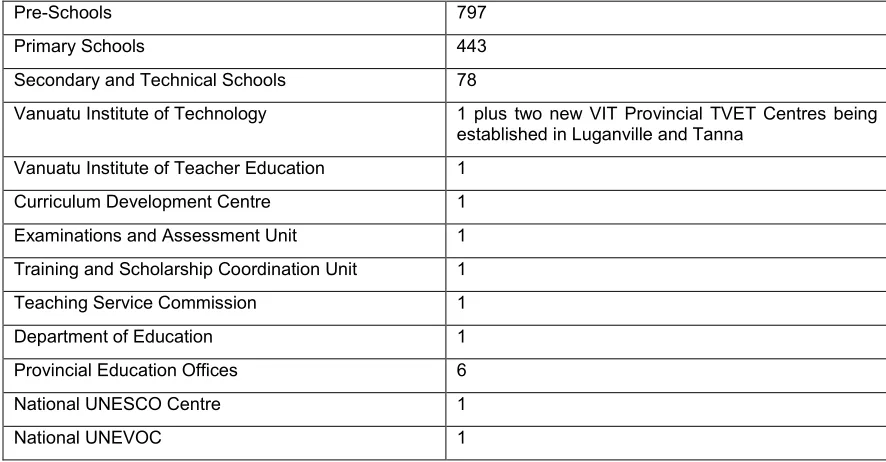
In cooperation with the Education Authorities and other agencies, the MoE has responsibilities for the following facilities:
Table No. One: Infrastructure in the Education Sector
Pre-Schools 797
Primary Schools 443 Secondary and Technical Schools 78
Vanuatu Institute of Technology 1 plus two new VIT Provincial TVET Centres being established in Luganville and Tanna
Vanuatu Institute of Teacher Education 1 Curriculum Development Centre 1 Examinations and Assessment Unit 1 Training and Scholarship Coordination Unit 1 Teaching Service Commission 1 Department of Education 1 Provincial Education Offices 6 National UNESCO Centre 1 National UNEVOC 1
The number of pre-schools and schools varies from year to year as they are opened and closed by their owners. 44.2% of schools are on customary land, 27% are GoV-owned, 12% are owned by other agencies, and no data is currently available for the remainder. Land disputes create problems for some schools. The key services and products provided are:
Teaching and learning services
Development, maintenance, printing and distribution of national curriculum and associated learning materials
School-based assessment, national examinations, student selection processes, and regional benchmarking
Teacher recruitment, deployment, pre-service, in-service, and supervision
Financial and auditing services
School construction, maintenance and repair, and furnishings
Procurement and distribution of school stationery and equipment
Registration of education authorities and schools
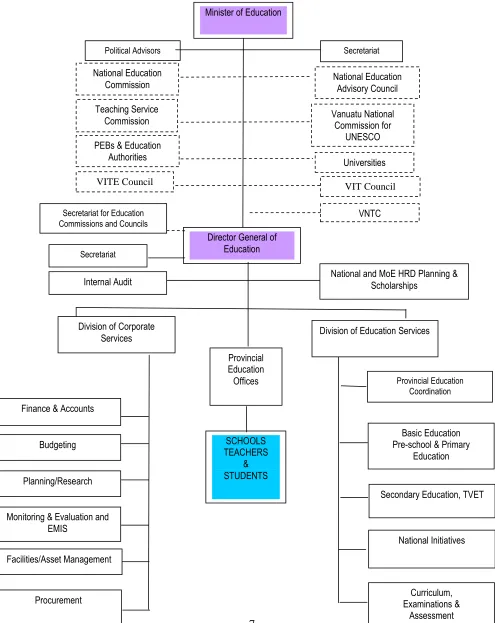
7 2.3 Structure of the Ministry of Education
Fig. 1 An Overview of the Revised Structure of Education
Minister of Education
Political Advisors Secretariat
Director General of Education
Division of Education Services Division of Corporate
Services
Provincial Education Coordination
Curriculum, Examinations &
Assessment
Examinations & Basic Education Pre-school & Primary
Education
Secondary Education, TVET Planning/Research
Monitoring & Evaluation and EMIS
Finance & Accounts
Facilities/Asset Management
National and MoE HRD Planning & Scholarships
Procurement Budgeting
National Education Commission
Teaching Service Commission
VIT Council
National Education Advisory Council
Vanuatu National Commission for
UNESCO
VITE Council
Secretariat
National Initiatives PEBs & Education
Authorities
SCHOOLS TEACHERS
& STUDENTS Internal Audit
Universities
VNTC Secretariat for Education
Commissions and Councils
This restructure of the Ministry of Education was approved on the 14th March 2007 by the Public Service Commission. The proposed new structure is consistent with the VESS. Key tasks and resources will be progressively decentralized from the Department of Education in Vila to the six Provincial Education Offices. The five Director positions will be reduced to two and a new HRD Unit will be established, headed up by a Principal Education Officer. It is hoped that these three senior positions will be advertised and recruited by August, and that most other positions will be resolved by end of the year.
2.4 Current Development Programs
An analysis of funding available in the Education Sector shows that:
On an annual basis, the GoV provides around 1.9 billion vatu to the Education Sector. In relative terms this is around 23% of total GoV expenditure and around 5.6% of GDP.
Whilst this is generous comparative to other Pacific Island Countries, almost 90% of these funds are expended on salaries and associated costs. There are insufficient funds for core services such as books, clean water and sanitation in schools, training of pre-school teachers, school maintenance.
Since Independence, the development of the Education Sector has been essentially and generously funded and driven by donors and development partners, and international advisors.
There has been insufficient harmonization or coordination of these donor activities. As a consequence the Education Sector has been developed around the different agendas and parallel offices and systems of donors, rather than around a GoV national education sector strategy. The time and energies of education staff have been consumed by responding to donor projects and advisor needs, and local ownership, self-reliance, and trust has been lessened. There continues to be duplication and waste.
Funds have been managed by donor project teams and advisors, not pooled or available to the MoE as part of budgetary support.
Despite the generous support of the Gov and donors, key strategic targets are not being delivered. This includes, for example, the achievement of universal primary education, improved levels of literacy, and safe drinking water and sanitation in schools.
and MoE systems and under MoE management. Section six of this VESS will focus on a new direction for the Education Sector Development Program.
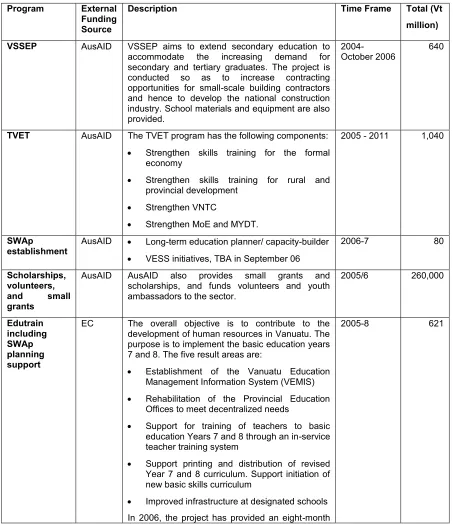
The table below provides a summary of the current development program in Education, all of which is donor-funded. The funds are estimates based on the best information available from donors and the MoE’s records. As most of the funds are not in the form of direct budgetary aid, it is difficult for the MoE to track this support accurately.
Table No. Two: Current Development Programs
Program External
Funding Source
Description Time Frame Total (Vt
million)
VSSEP AusAID VSSEP aims to extend secondary education to
accommodate the increasing demand for secondary and tertiary graduates. The project is conducted so as to increase contracting opportunities for small-scale building contractors and hence to develop the national construction industry. School materials and equipment are also provided.
2004-October 2006 640
TVET AusAID The TVET program has the following components:
Strengthen skills training for the formal economy
Strengthen skills training for rural and provincial development
Strengthen VNTC
Strengthen MoE and MYDT.
2005 - 2011 1,040
SWAp
establishment AusAID Long-term education planner/ capacity-builder
VESS initiatives, TBA in September 06
2006-7 80
Scholarships, volunteers,
and small
grants
AusAID AusAID also provides small grants and scholarships, and funds volunteers and youth ambassadors to the sector.
2005/6 260,000
Edutrain including SWAp planning support
EC The overall objective is to contribute to the development of human resources in Vanuatu. The purpose is to implement the basic education years 7 and 8. The five result areas are:
Establishment of the Vanuatu Education Management Information System (VEMIS)
Rehabilitation of the Provincial Education Offices to meet decentralized needs
Support for training of teachers to basic education Years 7 and 8 through an in-service teacher training system
Support printing and distribution of revised Year 7 and 8 curriculum. Support initiation of new basic skills curriculum
Improved infrastructure at designated schools In 2006, the project has provided an eight-month
Technical Advisor to assist the Director-General with SWAp and VESS planning.
VATET EC The VATET Project aims to strengthen the tourism
and hospitality sector through the construction of a national tourism and hospitality centre at VIT and the strengthening of the curriculum, teachers, industry links, and rural programs.
2004-7 354.5
SERP EC Includes a component to establish, promote and
strengthen internal audit and to strengthen financial control within the MoE and the education sector.
2005-6 21.45
Education Assistance Program and SWAp
establishment
NZAID The goal of the EAP is to assist the Vanuatu GoV to sustainably improve the quality of teaching and learning in primary and junior secondary education. The objectives are to provide the Vanuatu MoE with advice, assistance and technical expertise to enable the support and development of:
Key personnel in the education sector
Curricula, educational materials and examinations
English language materials and training
Book Flood initiative
Review of VITE
VEMIS software development
In 2005, NZAID sponsored a whole of GoV study tour to the Solomon Islands to explore the Education SWAp. In 2006, funds were provided for the provincial, school and national VESS consultations.
2003 – June
2007 365
NZAID Scholarships and small grants
NZAID also assists through its small grants and
scholarship schemes. 150.5
PASEV Project France The PASEV project assists with a computerized management information system (OPAD) for colleges and associated training in its use. It also supports the professionalism of six national teacher trainers.
2003-6 19.5
Various, including SWAp
establishment
France Support to administrative and executive staff of the Lycee Antoine de Bouganville; annual grant and scholarships to the Lycee Francais de Port Vila,
Support to French as Foreign Language Teaching through teacher training and materials
Grants to VITE under the Vanuatu and New Caledonia Cooperation Agreement
Grants to VIT and scholarships to New Caledonia vocational Lycees
Grant funding and scholarships
Some TA/ teachers, including TA to the Director-General
Funds and TA for national school census as part of the SWAp and research for the VESS
Appui au Sector Educatif
France
and AFD Strengthening and responding to education priorities jointly identified from the VESS. 2006 - 2010 350
SWAp
establishment World Bank/ EFA FTI
Provision of international education costing specialist
Offer of a short-term international education planner
2006 – 7
Various maths, music, and PE, and volunteers
Japan Japan provides assistance in:
Volunteers, and a volunteer coordinator
Strengthening of primary maths teaching, through teacher training, teacher manuals and train the trainers
A small grants scheme for classroom construction and furnishings in 2005
Ongoing/ occasion al
Unknown
Child friendly
and child
protection programs
UNICEF Assistance is provided through:
The child-friendly school pilot on Tanna
Supporting training for Pre-School
Coordinators and field activities and improve model kindies in 6 provinces
Child Protection program in three provinces, including public awareness activities and production of materials
Maths, music, and PE volunteers in primary schools 21.7 Primary Education Improvement Project (PEIP)
PRIDE Distance learning policy.
Providing a local consultant on language policy options.
Develop and pilot an open and distance learning system, reforming the 2 year VITE curriculum for primary education teachers into a school-based, distance learning mode.
Contribute to VEMIS by procuring and piloting technology for the direct entry of data at provincial level and reviewing and improving the school survey templates.
2006 --7 13.5
Leftemap RTC
Strengthening
Peace
Corps Partnership to train and provide field-based support for early childhood literacy teachers and develop diagnostic assessments, local materials (with EduTrain support)
Partnership to strengthen RTCs.
2005 -11 Unknown
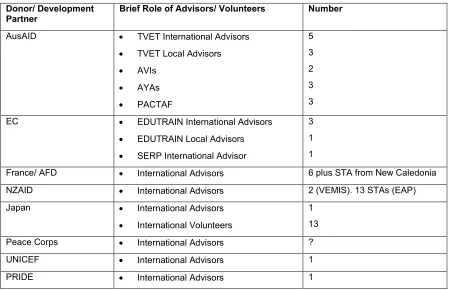
the number of donor advisors and volunteers operating in different parts of the education sector.
Table No. Three: Advisors and Volunteers in the Education Sector in 2006/7 Donor/ Development
Partner Brief Role of Advisors/ Volunteers Number
AusAID TVET International Advisors
TVET Local Advisors
AVIs
AYAs
PACTAF
5 3 2 3 3
EC EDUTRAIN International Advisors
EDUTRAIN Local Advisors
SERP International Advisor
3 1 1
France/ AFD International Advisors 6 plus STA from New Caledonia NZAID International Advisors 2 (VEMIS). 13 STAs (EAP) Japan International Advisors
International Volunteers
3. Vision, Mission, Goals and Values
3.1 Vision
Our vision is for a caring education system which provides every young person with the lifelong skills, values, and confidence to be self-reliant and to contribute to the development of Vanuatu, and which works in partnership with all
stakeholders to provide well-managed schools.
3.2 Mission
Our mission is to provide student-centered education that is accessible, relevant, sustainable, responsive, and of good quality, to guarantee every young person:
Pre-school and basic education to year 8, including literacy, numeracy, life skills, and livelihood skills, respect for our history and culture, and respect for human rights;
Expanded opportunities for secondary, technical, tertiary and higher education;
Support for parents and communities to participate in and manage their schools;
A well-managed and accountable education system which focuses on building the human resources of Vanuatu, improving learning, living, and working opportunities, and enabling young people to contribute to the productive sectors in both rural and urban areas.
3.3 Student Outcomes at the End of Basic Education
All students who successfully complete Year 8 will be able to contribute to development within their family and community and be able to continue their education or return to education at a later date. They will have:
Literacy
o In vernacular, and
o Be able to communicate in English and French
Numeracy; and
Life Skills
o Traditional knowledge and skills
o Health and nutrition
o Basic self-confidence and discipline
o Practical skills for sustainable development and rural living
including food security
3.4 Student Outcomes at the end of Secondary and TVET
All students who successfully complete Year 12 or higher will be able to gain employment in the formal economy or in public and community service, develop self-employment and income-generation opportunities, and/or continue on to higher education, through skills in
Communication and fluency in vernacular, English and French
Mathematics and science
Enterprise and business skills
Computers and information technology
Self-confidence and self management and lifelong learning
A good understanding of the world of work, career and course choices, and specific skills as identified in the National HRD Plan to contribute to the productive sectors
3.5 Student Outcomes at the End of Higher Education
Students who successfully complete a diploma, a degree, or a post degree program, will be able to gain employment in the formal economy and public service. With experience and regular updating of their skills, they will be able to secure promotion, move into management and government positions, and develop new schemes and opportunities for economic and social development
3.6 Goals 2007 - 2016
1. Achieve universal primary education completion, strengthen literacy, languages, and numeracy, and develop a national pre-school curriculum and pre-school teacher training program
2. Continue to expand and improve affordable bi-lingual secondary, technical, and higher education which meets national and international standards.
3. Provide more relevant and accessible curriculum, materials and assessment systems
4. Provide qualified, productive and well-supported teachers for every school and strengthen the professional competence of teachers
5. Bring the education, management and facilities of every school up to a sustainable minimum standard, able to provide a safe and caring learning environment, and continuously improving its services
7. Strengthen partnerships at national, provincial and local levels, and empower school communities
3.7 Cross-Cutting Issues
Access and equity: targeted measures to address inequities in access and achievements, and a special focus on women, poverty alleviation, rural and remote areas, people with disabilities, and young people in urban settlements.
Communication and involvement: an approach based on improving communication and participation across the sector.
Sustainability and the Vanuatu way: respect for language, culture, history and indigenous knowledge. Local solutions for local problems through building self-reliance and aid effectiveness.
3.8 Values
Students and schools first
Transparency, fairness, equity, and respect
Professionalism and accountability, focused on results
Grounded in the best of Ni-Vanuatu culture and open to the knowledge of the world
4. Issues, Challenges and Constraints
The MoE has identified a range of issues that should be addressed over the longer-term to 2016. These issues should not be used to undermine the
achievements and commitment of the MoE and many hard-working teachers and administrators. Through the SWAp the Ministry has learned the value of frank and open discussion of problems. This enables agreement on the issues and a shared commitment to identifying appropriate solutions. The full list of issues is included as a table in appendix one. A summary is provided here, focusing on the priorities to be addressed in 2007 - 2009.
4.1 Four Key Challenges
Given the limited resources and capacity available to improve the education sector, it is important to take a strategic approach and to focus on a small number of priority issues. For the 2007 – 2009 time period, the four priority issues that will be addressed are:
The MDGs of universal primary education completion and literacy goals which, under present arrangements are not likely to be achieved in Vanuatu, combined with resolution of the issue of the language(s) of instruction and a strategy to achieve bi-lingual schools.
Strengthening education quality and relevance through improved teacher professional competence, appropriate curriculum, more books and learning materials, and better school facilities.
Greater focus in the secondary and TVET education levels through the development of a national Human Resource Development Plan, support for the productive sectors, and more equitable access.
Increased efficiencies and partnerships in the system through capacity building at the institutional and school community levels, decentralization, mergers and closures of unsustainable schools and units, and revised financial allocations.
needs to be speeded up. At the other end of the spectrum, insufficient provision of opportunities for adult literacy and parenting programs has a negative impact on literacy rates and life skills for the over-15 age group.
The quality and relevance of education also presents substantial challenges. We need to do more to engage teachers in the strengthening of the education sector. They are the key agents for change and quality. The professional competence of teachers needs to be strengthened and their productivity increased, while concerns about the effectiveness of the Teaching Service Commission as an employer and the poor state of teacher housing must be addressed. Teacher pre-service is too expensive. There are too many unqualified teachers. Rural and remote teachers are disadvantaged in their access to in-service and support. The unlawful use of corporal punishment must be stopped. Other institutional matters that impact on the quality of education, such as the need to separate teacher support and supervision from audit and compliance functions, also need to be addressed. A major effort is needed to open up and strengthen the processes of curriculum development to ensure that the curriculum is relevant and balanced. The separation of curriculum and examination structures, needs to be rationalised and these functions strengthened. Schools facilities do not currently meet minimum standards. Maintenance and upgrading of school facilities is a big and expensive challenge. Most schools have no adequate water supply, power source, no phone radio fax or transport. There are acute shortages of learning materials such as books, stationery, and basic equipment and tools. School communities, school councils and committees, parent-teacher associations, and principals and teachers need to be empowered to effectively manage their schools as student-centred caring and accountable institutions.
A related issue is that many donors are interpreting international agreements to limit their assistance to basic education. The GoV’s national planning (and all our consultations) also gives priority to training for the productive sectors. VESS gives priority to basic education but also includes targeted assistance to post basic education that contributes to the productive sectors and economic growth. A range of institutional matters needs to be addressed to increase efficiencies and capacities in the education system. Currently, the education sector is too centralised and typified by an urban bias. School administration and support, and teacher placement and discipline need to be decentralized. This must be accompanied by the reallocation of funding and resources from the DoE. Provincial Education Offices and Education Authorities need to be strengthened. Many schools are too small and poorly located. Salaries consume over 90% of education funding. Student:teacher ratios are low, repeat and absenteeism rates are too high, and students are not receiving the teaching contact hours required under national policy and international minimum standards. Unit costs are high. More sustainable and affordable school models need to be explored. At the national level, mergers are also required to achieve more affordable and sustainable models. There is much that can be done to improve information sharing and raise public awareness about the importance of education and key education issues. An effective Vanuatu Education Management Information System (VEMIS) must be established as a matter of urgency. VEMIS will need assistance from other goV departments to improve the reliability of population data and projections. There are other whole of Government issues which further impede school capacities and inefficiencies, including insufficient financial delegations from the Department of Finance, and poor and expensive communication and transport infrastructures.
5. Policies and Strategies
“Education shall be directed to the full development of the human personality and to the strengthening of respect for human rights and fundamental freedoms. It shall promote understanding, tolerance, and friendship amongst all nations, religious groups… for the
maintenance of peace.” Article 26 Universal Declaration of Human Rights
5.1 Sector Policies and Strategies
Vanuatu has placed a high priority on education. The sub-title of the new Priorities and Action Agenda (PAA) 2006 – 2010 is: An educated, healthy and wealthy Vanuatu. The national vision is:
By 2015 Vanuatu will have achieved a significant increase in real per capita incomes, along with a steady growth in levels of employment. Within the region, Vanuatu will be among the leading countries in achieving the Millennium Development Goals in education, health,
environmental management, and other key social indicators. Public sector reforms will have raised standards of governance, levels of productivity in the civil service, and will have resulted in higher standards of service and managerial accountability. Through continuing structural reform, Vanuatu will have established an effective, enabling environment to sustain the private sector growth, which it aims to achieve in output and employment. (draft PAA 2006 – 2010)
The VESS recognizes that the education sector must strike a balance between its roles in:
Alleviating poverty and achieving universal primary education completion for all young people.
Developing the human resources of the nation to enable young ni-Vanuatu to build sustainable self-reliant futures and to participate in the productive
sectors in both rural and urban settings.
Supporting and teaching history, culture and traditional knowledge.
Opening up the door to the knowledge, new technologies, and opportunities of the world.
This balancing is the basis of the VESS. It is why the MoE must continue to work openly with all stakeholders.
The preparation of the VESS has highlighted the need for further policy work and amendment to legislation and regulations. The proposed policy objectives and indicators are listed below and will be the basis of policy and legislative work in 2007 - 2009.
Table No. Four: Policy Objectives and Indicators
Policy Objective (All policies assume
gender equity, and equity across provinces) Indicator (NB: all indicators will collect by male and female and rural and urban and will identify people with disabilities to ensure improvements in access).
Literacy, Numeracy and Life Skills
Compulsory attendance in basic education for school-age children.
All children should commence Year 1 by age 6. Review/ clarify Year 7/8 and centre school policy (Education Circular 2005).
Support one year of pre-school for every child by age 5 and promote the importance of pre-school and early childhood development.
Prohibit compulsory school charges and exclusion of students for non-payment in basic education schools. Encourage parents and communities to provide voluntary support to schools. Increase block grants to schools to compensate for loss of income from charges.
Confirm language of instruction in the formal education sector to include use of vernacular as language of instruction in pre-school and first two years of basic education to develop literacy and conceptual skills and cultural identity in mother tongue.
Encourage schools and other providers to offer adult education in literacy and parenting classes.
Adopt the Pacific definitions of Literacy, Numeracy, and Life Skills (refer appendices).
2015. (To be confirmed after school census validation).
Survival rate to Year 5 to increase from 91% of those enrolled to 95% by 2010 and 100% by 2014. No drop-outs in Years 1-6 by 2015 and in Years 7-8 by 2020.
Reduction in repeater rates.
Net enrolment ratio of 100% in years 7-8 by 2020. Problem of over-age students in basic education removed by 2020.
Literacy and numeracy rates in national surveys improved, against regional and international benchmarks.
Increase in multi-lingual books and learning materials, and books to student ratios.
Effective national reading program.
Policy: Bi-lingual Schools
Confirm language of instruction in the formal education sector to include:
Use of vernacular as language of instruction in pre-school and first two years of basic education to develop literacy and conceptual skills and cultural identity in mother tongue.
Phased introduction of either French or English from Year 3 as the language of instruction.
Phased introduction of the second global language (English or French) as a language of instruction from Year 7.
Bi-lingual instruction from Year 9.
Encourage merger of Anglophone and Francophone schools to form bi-lingual schools. No new single language schools to be approved.
Support introduction of other languages as subjects.
Number of bi-lingual teachers and education staff increasing annually.
Number of bi-lingual schools increasing annually with all schools operating bi-lingually by 2015. Number of bi-lingual students increasing annually. National curriculum (from Year 3) available in English and French.
Increase in multi-lingual books and learning materials, and books to student ratios.
Policy: Teachers, Curriculum, School
Management, School Facilities
Merge VIT and VITE to strengthen pre-service and in-service for teachers and educators and provide provincial campuses and school support centres. Decentralize teacher employment, placement, support and supervision from the Teaching Service Commission to the PEOs.
VIT and VITE merged by 2008. All teachers qualified by 2015.
All teachers undertake at least 3 weeks in-service every three years.
Training for PEBs, school council and committee members, and parent teacher associations in at least two Provinces each year.
Curriculum development processes to involve stakeholders.
Merge Curriculum Development Centre and Examinations and Assessment Unit, and establish Vanuatu Board of Curriculum, Assessment and Examinations.
Establish national standards and criteria for sustainable schools:
School location and accessibility, water, power, sanitation, communications, classrooms, libraries, science laboratories, boarding facilities, staff housing,
Minimum size of schools (basic and secondary, urban and rural).
location by 2009.
Stakeholders more involved in curriculum development processes.
No new schools to be approved/registered unless they comply with national standards and criteria and new school models.
Provincial and National School Facilities Plans in place and being implemented.
Every school implementing a School Improvement Plan by 2009.
Policy: Secondary Education, TVET, Higher Education, Scholarships
Expand places and equity of participation in secondary and TVET and scholarships, in line with the PAA and National HRD Plan.
Target poverty-based and equity scholarships. Merge VIT and VITE to form Vanuatu Polytechnic. Encourage other stand-alone tertiary providers (eg Nursing College, Agriculture College) to cooperate. Review VNTC Act, requiring compulsory registration of all TVET providers and accreditation of TVET courses.
Consider student loan and business levy policies, and strategies to develop alliances with the private sector.
Support integration of AUF and transfer of DAEU to the USP Emalus Campus, and delivery of more degree programs in Vanuatu.
Positively consider proposals for a Regional Francophonie University.
National HRD Plan to be in place by 2008.
At least one secondary school centre of excellence in every Province by 2009.
At least one VIT TVET Centre and /or school offering TVET courses in three Provinces by 2009. Net enrolment ratio in secondary to increase from 32% with more places in rural Provinces.
Net enrolment in VIT and TVET courses in schools to increase by 2015.
Secondary and TVET fees and charges reduced and complying with MoE regulations.
Number of secondary and TVET scholarships increased.
Increased number of TVET providers registered and TVET courses accredited with VNTC.
USP Campus and Centres in Vanuatu strengthened and enrolling more ni-Vanuatu students.
Policy: Sustainable School Models and a Cost-Effective Education System
Move to more affordable and sustainable school models, including Komuniti skuls, Basic Education schools, Secondary/Technical Colleges.
Maintain GoV allocation to education to a minimum of 22% and strive to increase this to 27% by 2010. Review and reinforce policies re student:teacher ratios, including maximum students per teacher. Whole of GoV support to reducing/ controlling proportion of education allocation committed to salaries.
Improved student:teacher ratios from to in primary education.
Improved student:teacher ratios from to in secondary education.
Increased instruction time to meet national policies and international standards (of 850 – 1000 per year for primary education).
New school funding allocation models in place by 2009. Proportion of funds (block grants) going to schools (especially basic education) increased. Unit costs reduced in the secondary sub-sectors. Increased number of school audits, reports, and follow-up on recommendations per year.
Policy: Decentralization, Monitoring and
Evaluation, Partnerships,
Implement effective and appropriate decentralization
Restructure of DoE approved and implemented in 2007.
model in education sector.
Increased financial delegations and accountabilities at DoE, PEO and school levels.
Return ownership of schools to communities. Explore whole of GoV approach to improving communications and transport to schools, and reducing associated costs.
in 2007-8, resulting in increased funds and resources at PEO level.
PEO Offices upgraded and re-equipped by 2009. VEMIS in place and effective by 2009. Accuracy and timeliness of school statistical and financial returns improved.
PEBs, School Councils, PTAs complying with Education Act.
Education Authorities complying with Act.
Policy: Aid effectiveness
Aid effectiveness targets delivered in the Education Swap
Donor funds for education provided through Sector Budget Support modality from 2008.
No donor/advisor-managed stand alone projects in education from 2008.
Paris Declaration targets for 2010 achieved in the Education Sector.
Vanuatu Donor Harmonization National Action Plan in place..
5.2 Key Strategies for Implementation 2007 - 2016
5.2.1: Universal Basic Education Completion, Literacy, Numeracy, and Life Skills
Free national pre-school curriculum to strengthen early childhood development.
Free national pre-school teacher training certificate able to be delivered part-time in the field.
GoV funding/ employment of pre-school teachers at K2 level.
Compulsory primary and basic education policy, coupled with policy to prohibit charges at basic education levels and to provide block grants to compensate schools.
Pilot of free and compulsory basic education and block grants in Torba. Use lessons learned to extend to other Provinces.
National initiative to identify and return out-of-school children.
New Komuniti Skuls and Basic Education School models.
Adopt the Pacific definitions and measures of literacy, numeracy, and life skills.
Join the EFA Flagship Program on Education for Rural People and integrate into the life skills curriculum. Integrate enterprise skills into the life skills curriculum.
education levels. Develop national program to strengthen teacher skills in developing literacy skills.
Expand multi-language book floods. New Literacy Public Awareness and Reading Program and expansion of adult literacy programs.
Strengthen arrangements for achieving Education for All through an effective EFA Forum, EFA Coordinator, integration of EFA action plan into VESS planning and monitoring.
5.2.2: Bi-Lingualism, Equity, and Special Needs
Reconfirm GoV policy for bilingualism and move from dual system schools to bi-lingual schools.
Progressively phase in English and French as the global languages from year 3 to achieve bi-lingualism in secondary colleges.
Develop additional multi-language learning materials.
Encourage merger of smaller single language schools to form more sustainable bi-lingual schools.
Recruit bi-lingual trainee teachers, teachers, and DoE/.PEO staff.
Provide a national program of additional training and incentives to encourage teachers and educational administrators to become bi-lingual and role models in bi-lingualism.
Strengthen teaching of languages.
Re-develop national examinations to ensure equity for English and French speakers and to promote bi-lingualism.
Integrate AUF and transfer DAEU to the USP Emalus campus.
Maintain a high focus on students with special needs: girls and women, rural and remote, single parent and orphaned children, children with disabilities, children in urban settlements, youth at risk, and gifted children.
Monitor equity of access and take appropriate actions to address inequities. National initiatives to attract school-age children back to school.
Remove inequitable practices eg forcing students into schools and choices against their choice, excluding students for non-payment of fees.
Feasibility study on community learning centre models to provide more adult, community and parenting education.
5.2.3: Improving Quality: Professional Teachers, Relevant Curriculum, School Management, School Facilities, Schools that Care
Merge VIT and VITE as Vanuatu Polytechnic with faculties of education and management, and provincial campuses with in-service/teacher resource centres.
Expand and strengthen in-service and on-the-job learning opportunities for teachers, principals, school council and committee members, and PTA members.
Develop and strengthen in-service, in the field training opportunities for pre-school teachers.
Increase scholarships for teachers to upgrade their subject knowledge and pedagogy.
Teacher salary increments and increases to move from time-served to performance-based.
National campaign to ensure that schools and teachers provide the approved annual teaching hours and to increase student: teacher ratios.
National campaigns to strengthen teaching methods in:
o Student-centred, action learning approaches o Language education, and maths and sciences
o Education for rural People
o Enterprise skills
o Information Technology
o Assisting teachers to understand their roles under VESS.
Rationalise roles of ZCAs and School Inspectors and decentralize teacher support and supervision to the PEOs.
Involve school communities in and speed up the processes of teacher recruitment and placement, transfers, and dealing with complaints.
Strengthen national curriculum development processes to involve stakeholders and to strengthen literacy, numeracy, life skills, bi-lingualism, maths, sciences, information technology, and key competencies and technical skills identified in the proposed national HRD Plan.
Increase the availability and numbers of multi-language books and learning materials.
Merge and strengthen the CDC and EA Unit on one location. Establish the Vanuatu Board of Curriculum, assessment and Examinations.
Use more curriculum panels and contract writers, including retired teachers. Reduce reliance on overseas curriculum advisors.
Review options for cost-effective production, printing and distribution systems.
Participate in the EFA FTI Flagship, and adapt the Education for Rural People toolkit.
Recognise enterprise skills as key competencies to be integrated into all Vanuatu curriculum. Establish a national campaign to introduce enterprise skills learning resources and to assist schools to fund real-life enterprise projects.
Establish standards for school education quality and management.
Provide training in planning and implementing school improvement plans and extend the student-centred (child-friendly) school model to all provinces.
Train and monitor school council, committee and PTA members in school governance and leadership to ensure compliance with legislation.
Strengthen standards, recruitment and training of school principals and head teachers.
Review school bursar positions to ensure more continuity and skills.
Establish national standards and criteria for sustainable school facilities, including size, location, water, sanitation, communications, power, classrooms and workshops, libraries, science laboratories, boarding facilities, staff accommodation, safety, storage, use of more permanent materials, general maintenance and security.
Provincial and National School Facilities Plans to guide the phased upgrade of school facilities including decisions re new schools, closures, and mergers.
All basic education schools to be assisted to reach minimum standards by 2015 with 25% assisted by end 2009.
At least one secondary school to be upgraded to a bi-lingual centre of excellence in each Province by end 2009.
5.2.4 National and Provincial HRD Needs, Secondary Education, TVET, Higher Education, and Scholarships
Establish a broad task-force (representing public, private sectors and civil society, women and men) to oversee the development, use, and maintenance of a Vanuatu HRD Plan.
National public awareness and Summit to confirm the HRD Plan in 2007.
Align scholarships, curriculum and course profiles to HRD Plan.
Feasibility study for course and career counseling and employment services.
Strengthen VNTC and the Provincial Training Boards, and review Ministerial responsibilities between Education and MYDT. Explore use of Provincial Education Offices to provide cost-effective provincial arms for VNTC.
Strengthen the quality and relevance of TVET through compulsory registration of providers and accreditation of courses with VNTC. Explore the Solomon Islands system for registering rural training centres as a condition of funding. Strengthen TVET-industry links and industry-based training.
Incentive funds to increase quality of TVET and to increase TVET in schools and in the private sector.
Feasibility study on a national Apprenticeship scheme and on strengthening trade testing.
Merge VIT and VITE to form the Vanuatu Polytechnic and encourage other stand-alone tertiary providers to merge. Establish Provincial campuses. Establish a national course and career advisory service. Longer-term vision for a University of Vanuatu. Further strengthening of Tourism and Hospitality, Business and IT, Management, Business and Finance, and trades.
Be more proactive re the College of Agriculture and agriculture education.
Research student loan schemes and business levy models. Increase scholarships for secondary and TVET.
Support regional models where these are consistent with VESS principles, eg the proposed Australia Pacific Technical College.
Support regional associations eg Pacific TVET Association, Pacific association for Teacher Educators.
Integrate AUF and transfer DAEU to the USP Emalus Camus. USP to offer more degree programs at the Emalus Campus. Strengthen USP Provincial Centres. New, larger USP Emalus Library, more classrooms and science laboratories and strengthening of USPNET.
Establish Vanuatu Scholarships Board, linked to the HRD Task Force.
Strengthen scholarship procedures for increased access and equity and to reduce terminations and poor progress.
5.2.5: Sustainable Schools and a Cost-Effective System
Agree on a minimum GoV allocation for Education of 23%.
Work towards 27% GoV allocation to Education by VESS Phase Two, 2011- 2013.
Align Education funds to VESS. Reallocate more funds to basic education. Increase funds direct to schools through block grants to schools.
Reduce/ rationalize high unit costs in secondary, tertiary, and central functions.
Strengthen management, accuracy, and accountability of teacher data and salaries.
Limit new teacher positions until student:teacher ratios are achieved.
Increase instruction time to existing national policies/ regional standards.
Continue multi-teaching but limit to no more than three grades and increase learning materials.
National campaign to reduce drop-outs, repeaters, absenteeism, and over-age enrolments.
Strengthen financial management skills and accountabilities at all levels.
Rationalise very small, poorly located, single language schools.
Transfer Years 1 and 2 to Komuniti Skuls and years 7-8 to basic education schools to reduce unit costs.
Control the number of secondary subjects which require specialist teachers and resources. Reward multi-skilled teachers.
Move from dual sector to bi-lingual schools.
Control growth in the number of GoV-funded secondary and TVET places within available funds.
Improve secondary education standards to reduce the need for extra year(s) of study (Years 13/14/foundation/preliminary) to enter university.
Reduce the number of positions at DoE and decentralize to PEOs within the current budget ceiling.
Disband the VIOE, and phase out the TSC.
Strengthen Audit Unit reporting to the Director-General.
Promote a partnership approach to sharing the costs and responsibilities for education.
5.2.9: Decentralization, Monitoring, Evaluation, Public Accountability
Establish and strengthen the Vanuatu Education Management Information System. This will involve:
o Rationalise data collection systems and templates;
o Complete the school census to establish 2006 as the baseline data
year for VESS;
o Adapt PINEAPPLES to meet data needs across the Education sector,
able to monitor VESS indicators, and to link with an expanded school-based systems (OPAD, OGAD, OPEP, BEIST) and FMIS;
o Strengthen VEMIS staff at DoE and PEO levels;
o Network all PEOs;
o Work with other GoV agencies to improve population data and
projections;
o Integrate the MDG education indicators and EFA indicators;
o Take a thorough approach to the mid-term review of Education for All
in 2007.
Restructure the DoE, decentralize the inspection functions, reduce the number of Directors from 5 to 2, decentralizing school support and administration functions (and associated resources) to Provincial Education Offices, enabling the DoE to focus on the core roles of policy, planning, standards, budget allocations, monitoring and evaluation, and reporting.
Build capacity of the PEOs and the DoE’s HRD Unit to take over the functions of teacher employer, with the longer-term view of disbanding the TSC.
Achieve consistency and alignment with the VESS and GoV Priorities
Ensure the VESS engages and receives whole of GoV support.
Strengthen and support the National Education Advisory Council to provide broad-based inputs and advocacy.
Review and implement the restructure of the MoE. Provide training re the VESS to all Education Sector employees.
Review the Education Acts, Regulations, Orders, and Manuals. Update agreements with Education Authorities.
Lead and participate in processes to harmonise and align donor education funding and support with the VESS, and through direct budgetary aid. Discontinue donor activities in the education sector that are not consistent with VESS.
Continue to build partnerships at all levels to fund, implement, review and update the VESS.
Strengthen procurement and distribution systems.
Set up a strong audit unit within DoE to deal with any mismanagement of funds.
A GoV task force, led by the MoE, to undertake a feasibility study of
restricted to HF radios, short wave radios, lease lines, boats. Increase budgets for school visits.
Increase funding for field and school visits, and establish a system and data base for recording all school visits, issues, and follow-up.
Develop a MoE Information Communications policy and action plan to expand access to the new information technologies, eg the UNDP $100 school
computer powered by foot pedal.
Increase funding to support more communication with stakeholders. Undertake a national public awareness program including a newsletter/ poster, web page, and special community information campaigns on important education issues. Continue regular provincial and national consultations and school community dialogues.
Work with DoF and other GoV agencies to increase financial delegations to the DoE and PEOs, within an efficiency and controls framework.
Build school, Provincial and Education Authorities financial management and accountability skills and management for results.
6. Key Programs for the Medium Term
6.1 Priority Programs
It is anticipated that the VESS will be appraised and revised in 2007, leading to agreements with key donors for a formal commencement in 2008. During 2007, assistance is sought for the planning phase and to pilot some priority initiatives. Some of these activities will be funded by re-allocations within existing Moe resources and donor projects. Draft costings have been developed and presented to DESP and donors, and will be further refined over the next few months.
Pre-VESS Initiatives 2007 (in priority order):
Priority Direction 2007 - 2015 Actions in 2007
1. Provide technical advice to the DoE to lead and manage the SWAp and VESS
Recruit longer-term international technical advisor to assist the DoE to continue to build local capacities to:
Revise/ finalise the VESS
Develop and implement 2007/8 action plans
Finalise agreements with GoV and donors on SWAp funding modalities
Continue to promote awareness of the VESS and key education challenges Establish and manage a pool of funds for local and short-term specialist advisors in areas such as costing, facilities planning, bi-lingualism, revision of legislation/ regulations/ manuals, evaluation of Torba pilot, HRD Plan, Child-Centred School coordination, etc
2. Achieve universal primary education
completion by 2015 Pilot free and compulsory primary education in Torba Province, preference to children 6 years to 12 years:
Promote pilot/ procedures Jan – March to encourage all primary- aged students to be enrolled with 1st term charges paid by end term (May)
Pilot block grants to schools to compensate for loss of charges for terms 2 and 3
Evaluate pilot
Pilot national initiative program for enrolling out-of-school primary children
Promote pilot program/ procedures Jan – March
Provide additional travel budget to enable Provinces and schools to identify school-age children who have been out of school for one year or more
As schools enrol and retain out-of-school children they apply for incentive block grant
Scheme continues until 2007 fund exhausted 3. Complete unified national curriculum and
provide and distribute adequate learning materials
Strengthen and fast-track curriculum development processes by planning merger of CDC and EA Unit and establishing Vanuatu Board of Curriculum, Assessment and Examinations
Complete and continue to strengthen basic education national curriculum and local support materials, including the multi-language Vanuatu school journal. Join the EFA FTI Education for Rural People flagship program.
Incorporate Enterprise skills in the curriculum. Expand book:student ratio and stationery:student ratio 4. Professional and competent teachers Initiate merger of VIT and VITE to form Vanuatu Polytechnic:
Appoint interim senior management team under interim council
Recruit technical advisor to mentor/ train the team
Draft legislative changes, merged budget and action plan
Develop Polytechnic Strategic Plan and vision and implementation plans
Give high priority to strengthening teacher pre-service and in-service and establishing teacher support centres in the Provinces
National in-service campaign to promote teacher skills and understanding in:
Student-centred action learning methods
VESS and Education Directions
Life Skills: education for rural people, enterprise skills Host and participate in Pacific Region Teacher Training Workshops 5. All schools to develop and implement
school improvement plans to bring all schools to national standards and to be more student-centred
Develop provincial and national school facilities plans to rationalise unsustainable schools and prioritise schools for upgrading
Promote and extend Vanuatu Child-Centred Schools model to other Provinces Upgrade at least 25 basic education school
Upgrade at least 5 secondary schools 6. Develop national HRD Plan and align
secondary, TVET, and higher education and scholarships
Complete National HRD Plan, approved by Council of Ministers Strengthen VNTC
Feasibility Study for a Vanuatu Apprenticeship Scheme and Strengthening of Trade Testing
Expand scholarship program Establish two VIT TVET Centres
Integrate DEAU and AUF on USP Emalus Campus commencing mid 2007 for 12 months
7. Improve management and accountability of the education sector, with increased decentralization
Complete restructure of DoE including first phase of decentralization to PEOs Continue to build capacity of DoE/ PEO officers to lead and manage the sector including management by results training
Strengthen MoE Audit Unit and financial management of schools Complete the establishment of VEMIS:
Confirm baseline data for VESS
Confirm key indicators
Adaptation of software to Vanuatu requirements
Hardware in DoE and PEOs
Additional VEMIS officers in DoE and PEOs Undertake the mid-term review for Education for All. 8. Communication and consultation, printing
and distribution costs
The strengthening of Vanuatu education requires increased communication and consultation in rural and remote school communities and a national public awareness program and MoE newsletter.
6.2 Inter-sectoral Links
The key inter-sectoral links identified in the VESS are with:
The PSC re timely approval of the restructure and recommended appointments to deliver VESS.
The DESP and DoF to strengthen the MTEF and sector planning processes and templates.
Other GoV agencies and the private sector to develop the National HRD Plan.
MYDT re non-formal education and youth policies.
Department of Internal Affairs and Provincial Government re needs of rural and remote areas.
VNCW and Office of Women’s Affairs re equitable access for girls & women.
Vanuatu society for the Disabled re the needs of children and youth with disabilities.
The DoL re apprenticeship and trade testing schemes.
The DoF to address financial delegations and decentralization to MoE and PEOs, and schools, and to organize sector budget support.
GoV to address problems in communication systems with schools and transport to schools.
GoV re the development of a National Action Plan for donor harmonization.
The DoA re the College of Agriculture.
The Vanuatu National Language Council. 6.3 Elements of Uncertainty in the Program Capacity of PEBs and PEOs, DoE, Education Authorities, School
Council/Committee and PTA members, Principals and Head Teachers, and teachers.
Political and other instability or interference in the operations of PEBs/ PEOs and schools.
Loss of leadership in the DoE. Delays in approving the restructure and filling the key DoE positions.
Delays in establishing VEMIS. Difficulties in gaining reliable data.
Natural disasters affecting the Education Sector and/or budget.