On-Demand Media Streaming Over the Internet
Mohamed M. Hefeeda and Bharat K. Bhargava
CERIAS and Department of Computer Sciences
Purdue University
West Lafayette, IN 47907
{
mhefeeda, bb
}
@cs.purdue.edu
Abstract
We propose a new model for on-demand media stream-ing centered around the peer-to-peer (P2P) paradigm. The proposed P2P model can support a large number of clients with a low overall system cost. The P2P model allows for peers to share some of their resources with the system and in return, they get some incentives or rewards. We describe how to realize (or deploy) the proposed model. In addition, we present a new dispersion algorithm (for disseminating the media files into the system) and a searching algorithm (for locating peers with the required objects).
We demonstrate the potential of the P2P model as an infrastructure for a large-scale on-demand media stream-ing service through an extensive simulation study on large, Internet-like, topologies. Starting with a limited stream-ing capacity (hence, low cost), the simulation shows that the capacity is rapidly increased and many clients can be served even if they come according to different arrival pat-terns such as constant rate arrivals, flash crowd arrivals, and Poisson arrivals.
1. Introduction
Streaming multimedia files to a large number of cus-tomers imposes a high load on the underlying network and the streaming server. The voluminous nature of the multi-media traffic along with its timing constraints make deploy-ing a large-scale, cost effective, media streamdeploy-ing architec-ture over the current Internet a challenge.
The current media streaming architectures are mainly composed of a streaming entity and a set of requesting clients. The supplying entity could be one server, a set of servers, a set of servers and caches, or a set of servers and proxies. This entity is responsible for providing the requested media files to all clients. The total number of concurrent clients the system can support, called the overall system capacity, is limited by the resources of the
stream-ing entity. The limitation mainly comes from the out bound network bandwidth, but it could also be due to the process-ing power, memory size, or the I/O speed of the server ma-chine. For instance, a streaming server hooked to the Inter-net through a T3 link (∼45 Mb/s) would be able to support up to 45 concurrent users requesting a media file recorded at 1 Mb/s. These approaches have limitations in reliability and scalability. The reliability concern arises from the fact that only one entity is feeding all clients, i.e., a single point of failure. The scalability of these approaches is not on a par with the requirements of a media distribution service that spans Internet-scale potential users, since adding more users requires adding a commensurate amount of resources to the supplying server.
Whereas deploying proxies and caches at several loca-tions over the Internet increases the overall system capacity, it multiplies the overall system cost and introduces many administrative challenges such as cache consistency and load balancing problems. The system capacity is still lim-ited by the aggregate resources of the caches and proxies. This shifts the bottleneck from one central point to a “few” distributed points, but it does not eliminate it.
We propose a peer-to-peer (P2P) media distribution model that can support a large number of clients with a low overall system cost. The key idea of the model is that peers share some of their resources with the system. In return, they get incentives or rewards from the service provider. As peers contribute resources to the system, the capacity in-creases and more clients can be served. By properly moti-vating peers, the service provider can achieve a large system capacity with a relatively small initial investment. A peer-to-peer architecture has the potential to provide the desired large-scale media distribution service.
There is a difference between a file-sharing system and a media streaming system [12]. In file-sharing systems, a client first downloads the entire file before using it. The shared files are typically small (few Mbytes) and take a rel-atively short time to download. A file is stored entirely by one peer and hence, a requesting peer needs to establish
only one connection to download it. There are no timing constraints on downloading the fragments of the file, rather the total download time is more important. This means that the system can tolerate inter-packet delays. In media streaming systems, a client overlaps downloading with the consumption of the file. It uses one part while downloading another to be used in the immediate future. The files are large (on the order of Gbytes) and take long time to stream. A large media file is expected to be stored by several peers, which requires the requesting peer to manage several con-nections concurrently. Finally, timing constraints are cru-cial, since a packet arriving after its scheduled play back time is useless and considered lost.
The remainder of the paper is organized as follows. Sec-tion 2 presents the P2P model. SecSec-tion 3 presents the pro-tocol to be run by a participating peer in the system. The architecture along with the searching and dispersion algo-rithms are presented in Section 4. The simulation study is presented in Section 5. Section 6 summarizes the related research effort. Section 7 concludes the paper and proposes future extensions for this research.
2. P2P Model for Media Streaming
In the P2P model, a peer may act as a client and/or as a mini-server. As a client, it requests media files from the system. A peer may opt to store segments of the media files that it has already consumed for a specific period of time. As a mini-server, it can provide these segments to other requesting peers in the system. We emphasize the minia-ture attribute of the mini-server, since the peer was never intended to function as a full server. Instead, it serves a few peers for a limited duration. Each of these mini-servers adds only a little to the overall system capacity. Combining a large number of them can significantly amplify the capac-ity of the system. Peers join the system along with their resources. More cooperating peers results in an increase in the system capacity. This leads to a scalable system that can potentially support an enormous number of clients.
The system as a whole benefits from the cooperative peers. A well designed peer-to-peer system should provide sufficient incentives to motivate peers to share their stor-age capacity as well as their network bandwidth. In a recent study of two popular peer-to-peer file sharing systems (Nap-ster and Gnutella), Saroui et al. [11] discovered that peers tend to avoid sharing their resources without enough incen-tives. The incentives may include lower rates ($/Byte) for those who store and supply media files to other peers in the system. Another way to encourage peers to share their re-sources is the “rewards for sharing” mechanism [5]. By this mechanism, points or credits are given to a cooperative peer as it increases the sharing. Consuming peers, get penalized by paying more to get resources from the system. In [6],
we propose and analyze a simple revenue sharing incentive mechanism by which a service provider can motivate peers to contribute resources to the system.
2.1. The Model
The P2P model consists of a set of peers. We have a set of seeding peers that provide or seed the newly published media files into the system. They stream these files to a limited number of peers, which in turn, will feed another set of peers. After a short period of time, the system will have sufficient peers that already have the newly published media to satisfy almost all requests for the file without having to overload the seeding peers. We formally define the entities involved in our model as well as their roles and how they interact with each other in the following.
1. Peers. This is the set of nodes currently participat-ing in the system. We denoteP ={P1, P2,· · ·, PN} as the set of all peers in the system. Every peer Pi,1 ≤ i ≤ N, specifies three parameters: (1)Ri
(in Kb/s), the maximum rate peerPiis willing to share
with others; (2) Gi (in bytes), the maximum storage
space the peer is willing to allocate to store segments of one or more media files; and (3)Ci, the maximum
number of concurrent connections that can be opened to serve requesting peers. By using these three param-eters, a peer has the ability to control its level of coop-eration with other peers in the system.
2. Seeding peer. One of the peers or a subset of them may seed the new files into the system. We chose the name seeding peers to indicate that their main func-tionality is to initiate the service and not to serve all clients at all times.
3. Stream. A stream is a time-ordered sequence of pack-ets belonging to a specific media file. This sequence of packets is not necessarily downloaded from the same serving node. Neither is it required to be downloaded in order. It must be displayed by the client in a specific order. It is the responsibility of the scheduler to down-load the packets from a set of possible nodes before their scheduled display time to guarantee non disrup-tive playing of the media.
4. Media files. The set of movies currently available in the system. Every movie has a size in bytes, and is recorded at a specific bit rateRKb/s. A media file is divided intoN segments. A segment is the minimum unit which a peer can cache. A supplying peer may provide the cached copy of the segment at a rate lower than the required rateR. In general, one segment can be streamed to the requesting peer from multiple peers
at the same time. According to our protocol (see Sec-tion 3), every peer will supply a different piece of the segment proportional to its streaming rate.
3. P2P Streaming Protocol
In this section, we describe the building blocks of the protocol used by a participating peer in the system. The protocol is composed of three phases and is to be run by a peer requesting a media file (pseudo code is give in [6]). In phase I, the requesting peer checks for the availability of the desired media file in the system. The phase starts with a crucial searching step. We describe the searching technique in Section 4.
The information returned by the searching step is ar-ranged into a two-dimensional table. Each row j of the table contains peers that are currently caching segmentsj
of the requested file. Certain information about each peer is stored; e.g., its IP address, the available streaming rate, and some reliability information from the peer’s history. Each row is then sorted to select the most suitable peers to stream from. Several criteria can be used for sorting, such as proximity to the client (in terms of network hops), available streaming rate, and peer’s average on-line time. A weighted sum of some (or all) criteria could also be used. In our experiments, we use the proximity as the sorting crite-rion. This reduces the load on the network, since traffic will traverse fewer domains. In addition, the delay is expected to be shorter and less variable, i.e., smaller jitter. Phase I ends with a verification step to make sure that all segments are available. Otherwise, the requesting client backs off and tries later after exponentially increasing the waiting time.
The streaming phase starts only if phase I successfully finds all segments. Phase II streams segment by segment. It overlaps the streaming of one segment with the consump-tion of the previous segment. The playback of the media file starts right after getting the first segment. Because of the variability in network and peer conditions, buffering few segments ahead would result in a better playback of the me-dia file. The buffering time can hide transient extra delays in packet arrivals. In case that one of the supplying peers fails or goes off line, this buffering time may hide delays due to finding and connecting to another peer from the standby table.
For every segmentsj, the protocol concurrently connects
to all peers that are scheduled to provide pieces of that segment. The connections remain alive for timeδ, which is the time to stream the whole segment. Different non-overlapping pieces of the segment are brought from differ-ent peers and put together after they all arrive. The size of each piece is proportional to the rate of its supplying peer. Let us define Pj as the set of peers supplying seg-mentj. If a peerPx ∈ Pj has a rateRx ≤R, it will
pro-vide|sj|(Rx/R)bytes starting at wherever peerPx−1ends. Since every peer supplies a different piece of the segment and P|xP=1j| |sj|(Rx/R) ≥ |sj|, all pieces of the segment
will be downloaded by the end of theδperiod.
Finally, in phase III, the peer may be allowed to cache some segments. This depends on the dispersion algorithm used. We present dispersion algorithms in Section 4.
4. Architecture
Two approaches may be used to realize the P2P stream-ing service model. The first approach relies on havstream-ing a special entity to maintain information about the currently participating peers. We call it the index approach. If the seeding entity is a set of servers owned by a provider, the index will typically be maintained by this set of servers. The details of this approach are in the following subsec-tions. The second approach does not assign special roles to any peer. It needs to logically interconnect peers in the system, we call this the overlay approach. We are currently working out the details of this approach. Both approaches follow the P2P paradigm, in which peers help each other in providing the streaming service. The two approaches are different in handling the preparatory steps of the stream-ing phase. The most important of these steps are: locatstream-ing peers with the required media file (searching), and quickly disseminating media files into the system (dispersion).
Before we present the index approach, we describe the client clustering idea, which is a key issue in the architec-ture. A cluster is defined as a logical grouping of clients that are topologically close to each other and likely to be within the same network domain [7]. It is highly beneficial for both the client and the network if a request can be ful-filled by peers within the same domain. For the network, it means that the traffic will travel fewer hops and hence will impose less load on the backbone links. The traffic delay will be shorter and less variable within the same domain, which is a desirable property for the streaming service.
We use a client clustering technique similar to the one proposed in [7]. The technique uses routing tables gath-ered from several core BGP routers. Client IP addresses that have the same longest prefix match with one of the routing table entries are assigned the same cluster ID. To il-lustrate the idea, consider five peersP1, P2, P3, P4,andP5, with IP addresses 128.10.3.60, 128.10.3.100, 128.10.7.22, 128.2.10.1 and 128.2.11.43, respectively. Suppose that among many entries in the routing tables, we have the fol-lowing two entries: 128.10.0.0/16 and 128.2.0.0/16. The first three peers (all within Purdue University) share the same prefix of length 16 with the entry 128.10.0.0/16 (Purdue domain) and a prefix of length 12 with the en-try 128.2.0.0/16 (CMU domain). Therefore, peersP1, P2, and P3 will be grouped together in one cluster with ID
128.10.0.0/16. Similarly, peersP4andP5will be grouped together in another cluster with ID 128.2.0.0/16. Notice that, using the same idea, a finer clustering within the same domain is also possible. For instance, P1andP2 may be grouped in a smaller cluster with ID 128.10.3.0/24. This clustering technique does not incur much overhead, since it is performed once when the peer first joins the system.
4.1. Index Approach
The index approach requires one (or a small subset) of the participants to maintain an index to all other peers in the system. The index can be maintained by the same machine seeding the media files, or by a separate machine. In any case, we call the maintainer of the index as the index server. This approach may be described as a hybrid scheme because the streaming process is peer-to-peer, while the searching and the dispersion processes are server-assisted. The main role of this special node is not to provide the streaming ser-vice, but to facilitate the searching and the dispersion pro-cesses. The load, in terms of CPU, bandwidth, and stor-age, imposed by the control information required by the searching and dispersion processes is a small fraction of the load imposed by the streaming service. To some ex-tent, this alleviates the scalability and the single point of failure concerns that typically arise in such architectures. This approach greatly simplifies the searching process and reduces the overhead associated with it. Without the index, the overhead traffic puts a non-negligible load on the sys-tem. The index approach is practically easier and faster to deploy and more appropriate for a commercial media provider, since a commercial media provider would keep a server for accounting and charging customers and to seed the newly available media files into the system.
4.1.1 Index Searching
A key issue in the index approach is to keep the index cur-rent. First, notice that peers who are currently caching some of the media files are known to the index. Because they initially contact the index server to get served those me-dia files. And, it is the index server that decides for them what to cache, as explained in the next subsection. Therefor, the index already knows who has what. The index server, though, does not know whether a peer is currently on or off line. Several techniques may be employed to keep the index up to date. In the case that a peer gracefully shuts down, a daemon running on the peer can send a notification message to the index server. Since it is unlikely that too many peers shut down synchronously, these notification messages will not cause message implosion at the index server. Another way to keep the index server current is to have the request-ing client checks the list of candidate peers returned by the
Algorithm IndexSearch
/* Index server: upon receiving a query from peerPr*/ c←getCluster(Pr)
forj= 1toNdo /* for every segment in the file */
candList[j]←peers incthat have segmentsj ifPPx∈candList[j]Rx< Rthen
if Peers from other clusters can provide the shortage then
Append tocandList[j]sufficient peers from the closest clusters
else
return empty list toPr/*Prbacks off */ end if
end if end for
returncandListtoPr
Figure 1. Index-based Searching algorithm
index server by, for example, pinging them. The client then reports to the index server the status of all peers in the can-didate list in one message.
Figure 1 summarizes the searching process in the index approach. We assume that the index server gets the BGP routing tables and builds the clustering database apriori. Upon receiving a query from a client asking for a specific file, the index server first identifies the cluster to which the client belongs. If peers within the same cluster can satisfy the request, those peers will be returned to the client as a set of candidates to stream the request. Otherwise, peers from the closest clusters are chosen to serve the request. To find the closest clusters in terms of network hops, the same clustering idea can be applied recursively, that is, several smaller clusters are grouped together into a larger cluster if they share the same common network prefix. The in-dex server, then, tries to satisfy the client’s request from the larger cluster. For example, if we have peersP1, P2, P3, P4, and P5, as described above, and P1 is requesting a file. The index server will first try to satisfy the request from peers located within the cluster with ID 128.10.3.0/24, i.e., from peer P2. If P2 can not fulfill the request, the in-dex server will try peers within the larger cluster with ID 128.10.0.0/16, i.e., from peersP2andP3. IfP2andP3can not fulfill the request, the index server will try to find peers from other clusters to make up the shortage. If the request can be fulfilled by any set of peers, this set is returned to the requesting client as a list of candidate peers. If the system does not have sufficient capacity, an empty candidate peers list is sent to the client. The client then backs off and tries after an exponentially increased waiting time.
4.1.2 Index Dispersion
Caching the right segments of the media file at the right places is crucial to the incremental expansion of the sys-tem capacity. The objective of the dispersion algorithm is to store enough copies of the media files in each cluster to serve all expected client requests from that cluster. As
de-scribed in [6], peers are given incentives to cooperate; espe-cially, if the service is provided by a commercial provider. These incentives are costs imposed on the provider. For this reason, it is important to keep just the required capacity in the system. To do so, we propose a dynamic dispersion algorithm that adjusts the capacity within each cluster ac-cording to the average number of client requests from that cluster.
The dispersion algorithm works in the following setting. At a specific instant of time, the system can serve a certain number of requests concurrently. A clientPy sends a
re-quest to the system to get the media file. The client also declares its willingness to cache up toNysegments to serve
them to other clients with rateRy in the future. The
dis-persion algorithm decides whether or not this peer should cache, and if so, which specific segments it should cache. The algorithm should ensure that, on the average, the same number of copies of each segment is cached, since all seg-ments are equally important. To clarify, consider a file with only two segments. Keeping 90 copies of segment 1 and 10 copies of segment 2 means that we have effectively 10 copies of the media file available. In contrast, keeping 50 copies of each segment would result in 50 copies of the me-dia file.
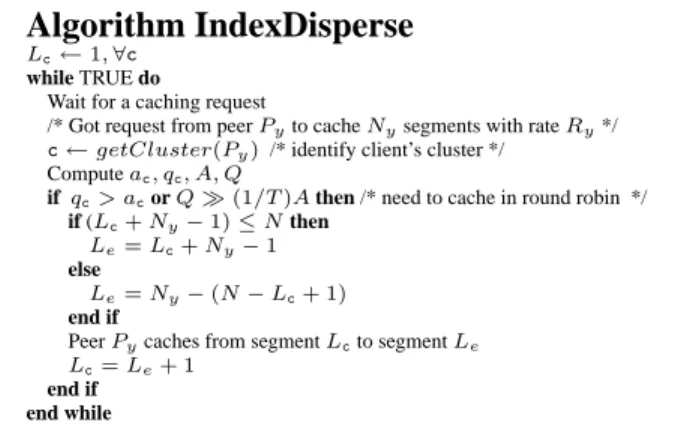
TheIndexDispersealgorithm, shown in Figure 2, is to be run by the index server. Consider one media file with N segments, rateR Kb/s, and duration T hours. The al-gorithm requires the index server to maintain three types of information: per-peer information, per-cluster information, and per-system (or global) information.
For every peerPx, the index server maintains: (1)Nx,
the number of segments which are currently cached byPx;
(2)Rx,the rate at whichPxis willing to stream the cached
segments; and (3)ux,0 ≤ux≤1,the fraction of timePx
is online. Recall that the peer is not available all the time. For every clusterc, the index server maintains the
fol-lowing: (1)Lc,1 ≤ Lc ≤ N,the next segment to cache.
(2)qc,the average request rate (per hour) the media file is
being requested by clients fromc. qcrepresents the required
capacity in the clustercper hour. (3)ac,the average
num-ber of copies of the movie cached by peers in clusterc.cis
computed from the following equation: ac= X Pxinc Rx R Nx N ux. (1)
The summation in Equation (1) computes the effective num-ber of copies available in the cluster. It accounts for two facts: first, peers are not always online (through the term ux), and second, peers do not cache all segments at the
full rate (through the term RxNx/RN). Dividingac by
T results in the number of requests that can be satisfied per hour, since every request takesT hours to stream. Hence,
Algorithm IndexDisperse
Lc←1,∀c
while TRUE do
Wait for a caching request
/* Got request from peerPyto cacheNysegments with rateRy*/ c←getCluster(Py)/* identify client’s cluster */
Computeac, qc, A, Q
ifqc> acorQ(1/T)Athen /* need to cache in round robin */
if (Lc+Ny−1)≤Nthen
Le=Lc+Ny−1 else
Le=Ny−(N−Lc+ 1)
end if
PeerPycaches from segmentLcto segmentLe
Lc=Le+ 1 end if end while
Figure 2. Index-based dispersion algorithm.
(1/T)acrepresents the available capacity in the cluster c
per hour.
The index server maintains two global variables: (1) A = Pcac, the average number of copies of the movie
cached by all peers in the system. (2)Q=Pcqc,the
av-erage movie request rate in the system.Qand(1/T)A rep-resent the global required capacity and the global available capacity in the system, respectively.
The algorithm proceeds as follows. Upon getting a re-quest from peerPyto cacheNysegments, the index server
identifies the clustercof the requesting peer. Then, it
com-putesac, qc, A, andQ. The algorithm decides whetherPy
caches based on the available and the required capacities in the cluster. If the demand is larger than the available ca-pacity in the cluster,Pyis allowed to cacheNysegments in
a cluster-wide round robin fashion. To clarify, suppose we have a 10-segment file. Lcis initially set to 1. If peerP1
sends a request to cache 4 segments, it will cache segments 1, 2, 3, and 4. Lc, the next segment to cache, is now set to
5. Then, peerP2sends a request to cache 7 segments. P2 will cache segments 5, 6, 7, 8, 9, 10, and 1.Lcis updated to
2, and so on. This ensures that we do not over cache some segments and ignore others.
Furthermore, theIndexDispersealgorithm accounts
for the case in which some clusters receive low request rates while others receive very high request rates in a short pe-riod. In this case, the global required capacityQis likely to be much higher than the global available capacity(1/T)A, i.e.,Q (1/T)A. Therefore, even if the intra-cluster ca-pacity is sufficient to serve all requests within the cluster, the peer is allowed to cache if Q (1/T)A in order to reduce the global shortage in the capacity. The operator
used in comparison is relative and can be tuned experimen-tally.
5. Evaluation
We study the performance of the P2P model under various situations, e.g., different client arrival patterns and different levels of cooperation offered by peers. We simulate a large (more than 13,000 nodes) hierarchical, Internet-like, topology. We use the GT-ITM tool [1] for generating the topology and the Network Simulator ns-2 [8] in the simulation. Due to space limitations, we present a sample of the results. The reader is referred to the technical report [6] for a detailed description of the simulation as well as more results including results for Poisson and flash crowd arrivals, and the evaluation of the dispersion algorithm.
We simulate the following scenario. A seeding peer with a limited capacity introduces a media file into the system. According to the simulated arrival pattern, a peer joins the system and requests the media file. Then, theP2PStream
protocol, described in Section 3, is applied. We do not as-sess the overhead imposed by the searching step in this set of experiments. If the request can be satisfied, i.e., there is a sufficient capacity in the system, connections are es-tablished between the supplying peers and the requesting peer. Then, a streaming session begins. The connections are over UDP and carries CBR traffic. If the requesting peer does not find all segments with the full rate, it backs off and tries again after an exponentially increased waiting time. If the waiting time reaches a specific threshold, the request is considered “rejected” and the peer does not try again. When the streaming session is over, the requesting peer caches some of the segments depending on the level of cooperation, called the caching percentage. For instance, if the caching percentage is 10% and the media file has 20 segments, the peer stores two randomly-chosen segments. The peer also selects a rate at which it wants to stream the cached segments to other peers.
Figure 3 shows how the system capacity evolves over the time. The average service rate increases with the time, be-cause as the time passes more peers join the system and con-tribute resources to serve other requesting peers. The aver-age waiting time, shown in Figure 4, is decreasing over the time, even though the system has more concurrent clients. This is due to the rapid capacity amplification. The capacity is rapidly amplified, especially with high caching percent-age. For instance, with 50% caching, the system is able to satisfy all the requests submitted at 5 requests/minute after about 250 minutes from the starting point.
Figure 5 verifies the diminishing role of the seeding peer. Although the number of simultaneous clients increases until it reaches the maximum (limited by the arrival rate), the pro-portion of these clients that are served by the seeding peer
0 1 2 3 4 5 0 50 100 150 200 250 300 350
Average service rate (request/min)
Time (min) 0% caching
10% caching 30% caching 50% caching
Figure 3. Average service rate.
0 0.5 1 1.5 2 2.5 3 3.5 4 0 50 100 150 200 250 300 350
Average waiting time (min)
Time (min) 0% caching
10% caching 30% caching 50% caching
Figure 4. Average waiting time.
0 0.2 0.4 0.6 0.8 1 0 50 100 150 200 250 300 350
Seed server load (%)
Time (min) 0% caching
10% caching 30% caching 50% caching
decreases over the time, especially with high caching per-centages. For instance, with 50% caching and after about 5 hours, we have 100 concurrent clients (6.7 times the orig-inal capacity) and none of them is served by the seeding peer. Reducing the load on the seeding peers is an impor-tant feature of the P2P streaming architecture, because it means that the seeding peers need not to be powerful ma-chines with high network connectivity. Besides being mod-erate machines, the seeding peers are used only for a short period of time. Therefore, the cost of deploying and run-ning these seeding peers (in case of a commercial service) is greatly reduced.
6. Related Work
Significant research effort has addressed the problem of efficiently streaming multimedia, both live and on demand, over the best-effort Internet. Directly related to our work are systems like SpreadIt [2] for streaming live media and CoopNet [10], [9] for both live and on-demand streaming. Both systems build distribution trees using application-layer multicast and, like ours, they rely on cooperating peers. Multicast (network- or application-layer) is the basis for several other media delivery systems [3] [4]. Our work is different from these systems, since we do not use multi-cast in any form and our system is more appropriate for on-demand media service.
In the client/server world, proxies and caches are de-ployed at strategic locations in the Internet to reduce and balance load on servers and to achieve a better service. Con-tent Delivery Network (CDN) companies such Akamai and Digital Island follow similar approaches to provide media streaming and other services. Our approach does not re-quire any powerful proxies or caches. Rather, it uses peers’ extra resources as numerous tiny caches. These tiny caches do not require large investment and collectively enlarge the capacity of the system in a way that potentially outperforms any powerful caches.
7. Conclusions and Future Work
We presented a P2P media streaming model that can serve many clients in a cost effective manner. We presented the details of the model and showed how it can be deployed over the current Internet. Specifically, we presented a P2P streaming protocol used by a participating peer to request a media file from the system; a cluster-based dispersion al-gorithm, which efficiently disseminates the media into the system; and a searching algorithm to locate nearby peers who have segments of the requested media file. Through a large-scale simulation, we showed that our model can han-dle several types of client arrival patterns, including sud-denly increased arrivals, i.e., flash crowds.
We are currently embarking on implementing a proto-type of the P2P media streaming system. The objective is to better assess to the proposed model and to demonstrate its applicability for a wide deployment. Addressing the se-curity and robustness issues of the model are parts of our future work.
Acknowledgments
This research is sponsored in part by the National Sci-ence Foundation grants CCR-991712 and CCR-001788, and CERIAS.
References
[1] K. Calvert, M. Doar, and E. Zegura. Modeling inter-net topology. In IEEE Communications Magazine, pages 35:160–163, 1997.
[2] H. Deshpande, M. Bawa, and H. Garcia-Molina. Stream-ing live media over peer-to-peer network. Technical report, Stanford University, 2001.
[3] A. Dutta and H. Schulzrinne. A streaming architecture for next generation internet. In Proc. of ICC’01, Helsinki, Fin-land, June 2001.
[4] L. Gao and D. Towsley. Threshold-based multicast for con-tinuous media delivery. IEEE Transactions on Multimedia, 3(4):405–414, December 2001.
[5] P. Golle, K. Leylton-Brown, and I. Mironov. Incentives for sharing in peer-to-peer networks. In Proc. of Second work-shop on Electronic Commerce (WELCOM’01), Heidelberg, Germany, November 2001.
[6] M. Hefeeda, B. Bhargava, and D. Yau. A cost-effective ar-chitecture for on-demand media streaming. Technical report, CERIAS TR 2002-20, Purdue University, November 2002. [7] B. Krishnamurthy and J. Wang. On network-aware
cluster-ing of web clients. In Proc. of ACM SIGCOMM’00, Stock-holm, Sweden, August 2000.
[8] The network simulator. http://www.isi.edu/nsnam/ns/. [9] V. Padmanabhan and K. Sripanidkulchai. The case for
co-operative networking. In Proc. of 1st International Work-shop on Peer-to-Peer Systems (IPTPS ’02), Cambridge, MA, USA, March 2002.
[10] V. Padmanabhan, H. Wang, P. Chou, and K. Sripanidkulchai. Distributing streaming media content using cooperative net-working. In Proc. of NOSSDAV’02, Miami Beach ,FL, USA, May 2002.
[11] S. Saroiu, P. Gummadi, and S. Gribble. A measurement study of peer-to-peer file sharing systems. In Proc. of Mul-timedia Computing and Networking (MMCN02), San Jose, CA, USA, January 2002.
[12] D. Xu, M. Hefeeda, S. Hambrusch, and B. Bhargava. On peer-to-peer media streaming. In Proc. of IEEE ICDCS’02, Vienna, Austria, July 2002.