Analysis, Representation and Mapping
of Neural Networks
onto Parallel Hardware
Ugur Bilge
a thesis submitted for the degree o f
Doctor of Philosophy in Computer Science
University o f London
D epartm ent o f C om puter Science University College London Gower Street, London W C IE 6BT
ProQuest Number: 10017352
All rights reserved
INFORMATION TO ALL USERS
The quality of this reproduction is dependent upon the quality of the copy submitted. In the unlikely event that the author did not send a complete manuscript and there are missing pages, these will be noted. Also, if material had to be removed,
a note will indicate the deletion.
uest.
ProQuest 10017352
Published by ProQuest LLC(2016). Copyright of the Dissertation is held by the Author. All rights reserved.
This work is protected against unauthorized copying under Title 17, United States Code. Microform Edition © ProQuest LLC.
ProQuest LLC
789 East Eisenhower Parkway P.O. Box 1346
Abstract
Neural networks provide solutions to a class of pattern recognition and optimisation problems that are hard to solve with conventional techniques. Currently, most neural network applications are computationally intensive simulations on conventional sequential computers. As a solution general-purpose parallel architectures are increasingly used to speed up simulations. Hence, there is a growing need for generic strategies for simulating neural networks on parallel computers. This thesis investigates generic representation and mapping strategies for neural networks on general-purpose parallel architectures. The research comprises three main parts: an analysis of neural network models, an analysis of neural network representations, and by utilising these analyses, the representation and mapping of neural networks on parallel hardware.
To understand the computational and structural properties of neural network models, and to establish a generic representation, an in-depth analysis is carried out in the form of three case studies. The Hopfield, the Self-Organising Map and the Backpropagation models are used respectively in three appropriate real-world applications; pattern recognition, data clustering and
financial forecasting.
Neural network representations determine parallel mapping options and the subsequent efficiency of mappings. Function-oriented, object-oriented and matrix-based representations are examined with examples, stressing their advantages and disadvantages. A matrix-based C library MATLIB
and a neural network library NETUB are put forward as generic, modular and flexible means to represent neural networks and exploit parallel, general-purpose execution environments.
The mapping of neural networks onto parallel hardware is a computational optimisation problem with two main constraints: processing costs and communications costs. The Mapper’s task is to optimise for a fast and efficient execution, by partitioning and distributing neural network representations across a number of parallel processors, and scheduling the parallel execution. A Computational Analysis Tool (CAT) is developed to calculate processing and communications costs, and to detect parallelism in a given MATLIB definition. An Automatic Parallel Mapper (APM), using this analysis, can partition the representation and generate parallel or pipelined code with appropriate data exchange instructions between the parallel processing modules.
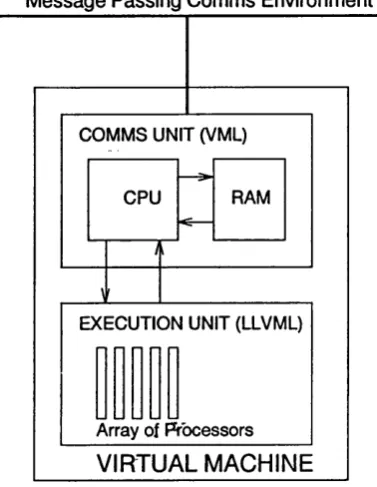
The Esprit II Galatea General Purpose Neural Computer (GPNC) is used as a test and implementation domain for this research work. The GPNC is a multi-processor architecture consisting of a host and a number of parallel Virtual Machines (VM), each containing a local
CPU and a co-processor board, communicating and interpreting a matrix-based intermediate- level language called VML. The Galatea Mapper is designed and developed for semi-automatic mapping of VML rules to a number of parallel VMs.
To assess the performance of the mapping strategies, MATLIB definitions of the three neural network models are partitioned and simulated in parallel on a network of SUN workstations. CAT projections are used to authorise data or task parallel mappings automatically. Multiple neural network applications are also simulated with two or more neural networks cooperating or competing in the solution of a problem.
Acknowledgements
I would like to thank my supervisor Professor Philip Treleaven for his guidance and support throughout my research, and for always making time, whenever I needed to consult him.
I wish to thank my friend Dr. Paulo Rocha for his encouragement and support. I am grateful for his meticulous reading of this thesis and his detailed comments on it.
I also wish to thank Dr. Peter Rounce for his valued contribution in finding time to read and comment on this thesis.
I acknowledge my friends and colleagues Ing. Cesare Alippi, Jason Kingdon, Mike Hewetson, Anoop Mangat, Dr. Meyer Nigri, Michael Recce, John Taylor, Dr. Marley Vellasco and many others in the Department of Computer Science at UCL, for their various kinds of support during my research.
Table of Contents
C H A PT E R 1 - In tr o d u c tio n ... 12
1.1. Neural Networks... 12
1.2. Research G o als... 18
1.3. Research Plan ... 19
1.4. Research Contributions ... 20
1.5. Thesis Organisation... 21
C H A PT E R 2 - N eu ral C o m p u tin g ... 23
2.1. Introduction ... 23
2.2. Applications and Algorithms... 24
2.3. Programming Environments... 27
2.4. Execution Environments ... 30
2.4.1. Special Purpose Neurocomputers ... 32
2.4.2. General Purpose Neurocomputers... 34
2.5. Summary... 42
C H A PT E R 3 - Pygm alion an d G alatea P r o je c ts ... 43
3.1. Introduction ... 43
3.2. Pygmalion Programming Environment... 43
3.3. Galatea Neurocomputing Project ... 46
3.3.1. Galatea General Purpose Neural Computer... 46
3.3.2. Galatea Programming System... 50
3.4. Summary... 52
C H A PT E R 4 - Analysis o f N eural N e tw o rk s ... 54
4.1. Introduction ... 54
4.2. The Hopfield Networks ... 54
4.2.1. The M odel... 55
4.2.2. Case Study: Pattern Recognition... 56
4.3. Self-Organising M aps... 60
4.3.1. The Model ... 61
4.3.2. Case Study: Clustering Neural Spikes ... 62
4.3.3. Computational Analysis... 67
4.3.4. Parallel Hardware M apping... 68
4.4. The Backpropagation M odel... 69
4.4.1. The Model ... 69
4.4.2. Case Study: Financial Forecasting... 71
4.4.3. Computational Analysis... 76
4.4.4. Parallel Hardware Mapping ... 78
4.5. Comparison of the three Models ... 80
4.6. Multiple Neural Networks... 81
4.7. Conclusion... 83
C H A PT ER 5 - N eural N etw ork R e p re s e n ta tio n ... 85
5.1. Introduction ... 85
5.2. Neural Network Representation Techniques... 87
5.2.1. Function-Oriented Representations... 88
5.2.2. Object-Oriented Representations... 90
5.2.3. Vector-Oriented Representations... 91
5.3. MATLIB Matrix Library ... 92
5.3.1. MA7L/B Functions... 93
5.3.2. Parallelising M A TU B... 96
5.4. NETLIB Neural Network Library... 97
5.5. Summary... 99
C H A PT E R 6 - M apping S tr a te g y ... 101
6.1. Design Considerations... 101
6.2. Mapping Techniques ... 104
6.3. The Strategy... 106
6.4. Cost of Parallelism ... 109
6.5. Computational Analysis T ool... 112
6.6. Automatic Parallel Mapper ... 115
C H A PT E R 7 - G alatea M ap p er an d S c h e d u le r ... 118
7.1. Introduction ... 118
7.2. Galatea Mapper ... 119
7.3. Galatea Scheduler... 121
7.4. Mapping and Scheduling... 125
7.5. Galatea Mapper Implementation... 126
7.6. Mapping VML to Galatea GPNC... 130
7.6.1. Co-operating Hopfield/Backpropagation Networks... 130
7.6.2. Semi-Automatic Mapping of Backpropagation... 133
7.6.3. Automatic Mapping ... 134
7.7. Summary... 135
C H A PT E R 8 - M apping M A TLIB R e p re se n ta tio n s... 136
8.1. Simulations Overview ... 136
8.2. Computational Analysis Tool R esults... 137
8.3. Mapping the Three Models ... 142
8.3.1. Hopfield N ets... 142
8.3.2. The Self-Organising Maps ... 149
8.3.3. The Backpropagation M odel... 153
8.4. Mapping Multiple Neural Networks ... 155
8.4.1. Cooperating SOM/Backpropagation Networks ... 155
8.4.2. Competing Backpropagation Networks... 157
8.5. Summary... 158
C H A PT E R 9 - A s se ssm e n t... 159
9.1. Target Review ... 159
9.2. Neural Network Analysis ... 160
9.3. Neural Network Representations... 162
9.4. The Strategy... 165
9.5. The Implementation ... 167
9.6. Mapping Results and Performance... 169
C H A P T E R 10 - Conclusion an d F u tu re W o r k ... 172
10.1. Conclusions ... 172
A PPEN D IX A - N eural N etw ork R epresentations ... 188
A.I. The nC Data Structure... 188
A.2. The Hopfield Recall Rule in C ... 190
A. 3. The Decrement Distance Function in « C ... 191
A.4. The Recall Rule for the Backpropagation in V M L... 192
A PPEN D IX B - M A TLIB F u n c tio n s... 193
A PPEN D IX C - M A TLIB Listings o f the th ree M o d e ls ... 198
C.l. The Hopfield MATLIB Listing... 198
C.2. The SOM MATLIB Listing ... 199
C.3. The Backpropagation MATLIB Listing ... 200
A PPEN D IX D - C A T an d A PM R e s u lts ... 202
D.l. The Hopfield Net ... 202
D.2. The Self-Organising M a p ... 205
D.3. The Backpropagation Model ... 207
D.4. The SOM/Backpropagation Model ... 210
List of Figures
Figure 1.1. Models of Neurons ... 13
Figure 1.2. Applications and Simulators ... 14
Figure 1.3. General Purpose Neural Computer and Mapper ... 19
Figure 2.1. The Spectrum of Execution Environments ... 31
Figure 2.2. The UCL Generic Neuron ... 34
Figure 2.3. HNC General Purpose Neural Computer ... 37
Figure 3.1. The Pygmalion General Purpose Programming Environment... 44
Figure 3.2. The Virtual Machine ... 47
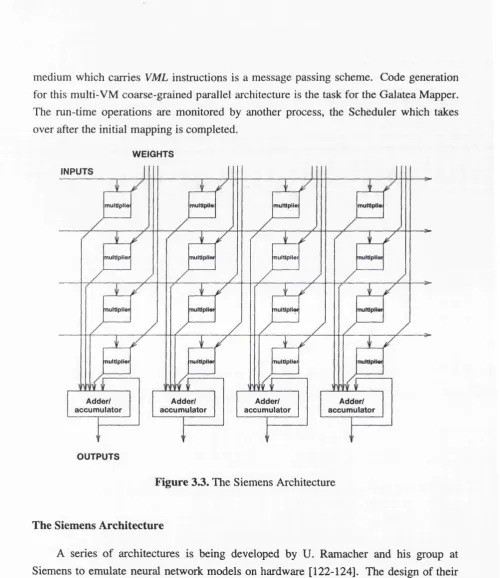
Figure 3.3. The Siemens Architecture ... 48
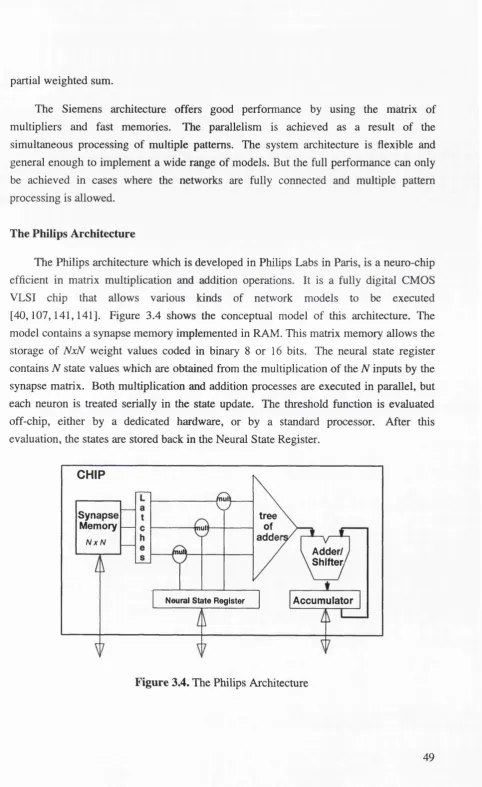
Figure 3.4. The Philips Architecture... 49
Figure 3.5. Galatea Programming System... 51
Figure 4.1. The Hopfield Net ... 55
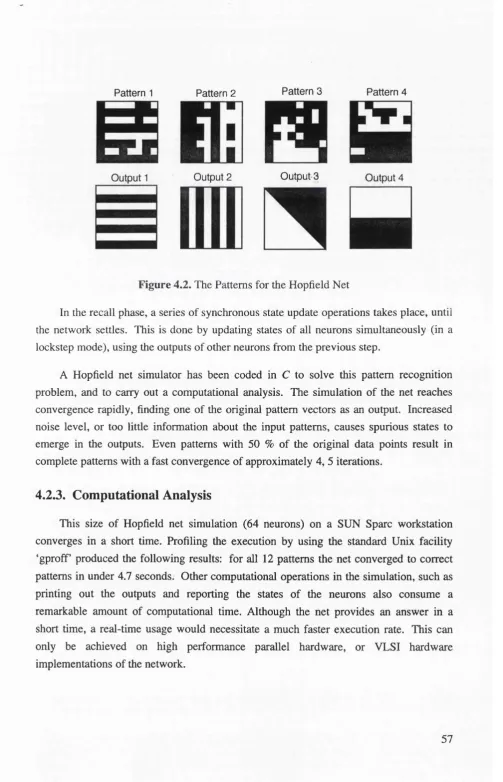
Figure 4.2. The Patterns for the Hopfield N e t... 57
Figure 4.3. Structural Mapping of the Hopfield M o d el... 60
Figure 4.4. The Self-Organising M ap... 61
Figure 4.5. Gain and Neighbourhood... 63
Figure 4.6. Error Histogram in Clustering ... 64
Figure 4.7. Neural Spike Clusters ... 65
Figure 4.8. Cluster Envelope Widths ... 66
Figure 4.9. Structural Mapping of the SOM M o d el... 68
Figure 4.10. A three layered Backpropagation ... 70
Figure 4.11. Lagged Patterns for the Backpropagation ... 72
Figure 4.12. Autocorrelating Input V alues... 72
Figure 4.13. The Dataset: FTSE 100 index ... 74
Figure 4.14. Euclidean Error in Training... 75
Figure 4.15. Test on Learning FTSE Index ... 75
Figure 4.16. Long Term Forecasting FTSE Index... 76
Figure 4.17. Structural Mapping of the Backpropagation ... 80
Figure 6.1. Communications Costs in Data Parallelism ... 110
Figure 7.2. The Galatea Scheduler ... 122
Figure 7.3. Demonstrator I ... 132
Figure 7.4. Demonstrator II ... 133
Figure 8.1. Socket Communications C osts... 139
Figure 8.2. Actual and CAT results for Hopfield N e t ... 140
Figure 8.3. Actual and CAT results for S O M ... 141
Figure 8.4. Actual and CAT results for Backpropagation ... 141
Figure 8.5. Line by Line Computations in Hopfield Net ... 143
Figure 8.6. Projections on Data Parallel Hopfield... 145
Figure 8.7. Scalability of Data Parallel Hopfield Executions ... 146
Figure 8.8. Scheduler-Chent Interaction ... 147
Figure 8.9. Sequential and Data Parallel Hopfield ... 148
Figure 8.10. Hopfield on multiple processors... 149
Figure 8.11. Line by Line Computations in SO M ... 150
Figure 8.12. Projections on Data Parallel SOM ... 151
Figure 8.13. Sequential versus Pipelined SO M ... 152
Figure 8.14. RMS Error in Sequential and Parallel SOM ... 153
Figure 8.15. Line by Line Computations in Backprogapation ... 153
Figure 8.16. Projections on Data Parallel Backpropagation... 154
Figure 8.17. Cooperating SOM/Backpropagation Networks... 156
Figure 8.18. Competing Baclq)ropagation Networks ... 157
Figure 9.1. Data Parallelism and Communication Speed... 170
Figure 9.2. Data Parallelism and number of Processors ... 171
List of Tables
Table 1.1. The Brain and Neural Networks ... 13
Table 2.1. Neural Networks Applications and Properties ... 27
Table 4.1. Neural Networks Structure and Properties... 81
Table 5.1. The use of MATLIB data operators ... 94
Table 5.2. The use of MATLIB arithmetic operators ... 95
Table 5.3. The use of MATLIB neural operators... 95
Table 8.1. Computational costs fox MATLIB on su n4 ... ♦... 138
Table 8.2. CAT results for the Hopfield n e t ... 142
Table 8.3. Variable Analysis for Temp ... 143
Chapter 1
Introduction
This chapter presents a brief introduction to Neural Networks, outlines the motivations and research goals o f this work, and gives an overview o f the research contributions and thesis organisation.
1.1. Neural Networks
The Neural Networks field is an information processing paradigm that has been inspired by the organisation of the brain. This field has surged over the last 5 years, becoming one of the fastest growing computing technologies. As a multidisciplinary field [24,37,148], it covers areas such as neuroscience, psychology and computing. Neural Computing specifically deals with neural network algorithms, applications, programming and execution environments.
Dendrites
Soma
Summer ]—>[rhresholc|
Axon
Synapse
(a) Biological Neuron (b) Artificial Neuron
Figure 1.1. Models of Neurons
An artificial neuron imitates a biological neuron in three aspects: it has weighted input connections, a summation function and a threshold function that generates the output. To further the similarity in an attempt to build a replica of the brain [101] is not yet feasible, for two reasons. Firstly, our understanding of the brain is limited, and secondly, today’s technology cannot match the same level of processor interconnectivity on silicon circuits. Despite the high level of interconnectivity, the brain is not homogeneous. Computations in the brain seem to be localised for specific tasks. PET (Positron Emission Tomography) scans and MRI (Magnetic Resonance Imaging) results confirm that the brain has a modular structure. These results encourage the design of modular networks and distributed parallel hardware platforms, to overcome the interconnectivity bottleneck.
The Brain Artificial Neural Networks
Organisation network of neurons network of Processing Elements
Components dendrites & axon synapses
inputs & output weights
Processing analog digital or analog
Architecture 10-100 billion neurons 1-1,000,000 PEs
Interconnectivity 1 neuron to 10,000 others limited and slow
Hardware neuron switching device
Switching Speed 1 millisec 1 nanosec -1 millisec
Technology biochemical silicon, optical
Table 1.1. The Brain and Neural Networks
computationally demanding, requiring high performance hardware platforms with large memories. Figure 1.2 shows the computational requirements for a range of neural network applications and the performance of neural network simulators (CPS stands for Connections Per Second; a performance criterion which is widely used.) As can be seen, using parallelism, both the speed and the storage capacity can be improved. One major problem is to program or map software onto parallel hardware, and exploit parallel execution environments efficiently. This thesis specifically deals with the mapping of neural networks onto parallel hardware for efficient execution. Four main research areas of neural computing are considered in the course of this research. These are neural network models and applications, programming and execution environments.
Speed (CPS)
Multiprocessing (Parallelism) Fast Processors
10
► RAM Technology
N eural N etw ork S im u lato rs
10 10 10 10 Storage (Bytes)
Figure 1.2. Applications and Simulators [6]
Neural Network Models and Applications
A large number of models have been developed and tested on a number of real- world applications. Models differ from one another by the interconnection topology and the varying properties of artificial neurons. Today, there are over 100 established network models [99,144]. The best known models are the Hopfield nets [72], the Self- Organising Map (SOM) [88], and the Backpropagation model [130]. These three models are analysed in detail in three case studies in chapter 4.
Neural networks are suitable for a diversity of real-world applications covering brain modelling, speech and image processing, robotics and control, planning and optimisation, and human-machine interfacing systems [129]. The main applications are pattern recognition problems which are difficult to solve by conventional techniques. Other popular applications are optimisation problems which take an impractical amount of computer time to reach a solution using conventional techniques. In the last 3 years, financial applications have gained momentum. As part of wider data processing applications, neural networks are used in predicting trends in prices, stock market and exchange rate forecasting [86], credit and insurance assessments [34]. An interesting image processing application is the recognition of hand-written characters. This has become particularly important in the wake of pen driven computers [22,57], an important step in the human-machine interfacing systems.
Neural networks present different computational requirements during the training and recall phases, depending on applications. A neural network study [6] outlines these requirements as memory (connections) and execution speed (connections per second). For a robotic arm manipulator, real-time speed requirements are estimated as 350,000 CPS, and the computational demand in vision applications can go up to 2 GCPS. In most cases training can be done off-line, but recalls often require a real-time performance. These requirements are still far from satisfactory, presenting a stumbling block in the neural network development.
Neural network research is recently focusing on modular, hybrid systems. These systems require coarse-grained parallel distributed architectures consisting of general- purpose high performance modules. Mapping and execution strategies must consider these modular trends in models and applications.
Neural Network Programming and Execution
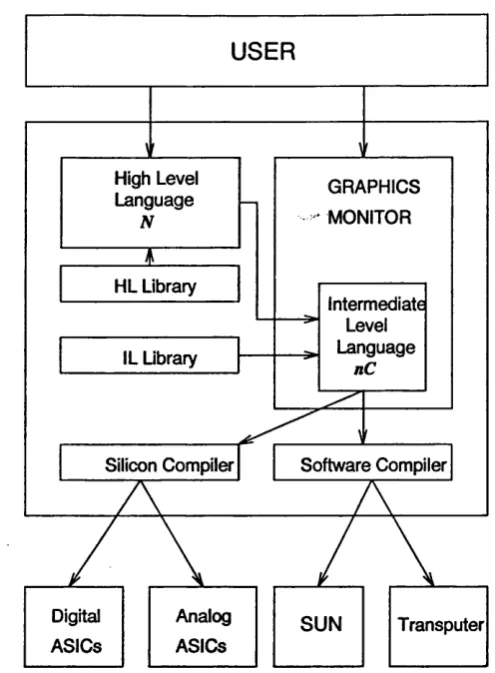
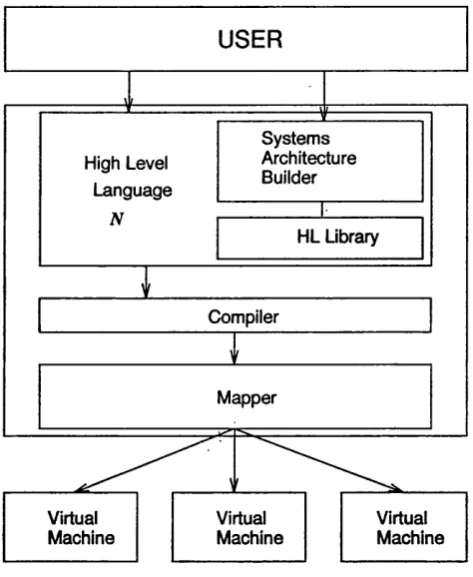
Neural Network Programming Environments (NNPE) are sophisticated programs which ease the cycle of program development and execution of an application. They facilitate the transformation of real-world problems onto computer programs with user-friendly interfaces and testing, debugging and monitoring functions. Most NNPEs contain the following modules: a graphics monitor and a high-level language for user- friendly definition of networks, an intermediate-level neural network specification language for low level representation of the applications, and an algorithm library consisting of parameterised models. A number of research systems and commercial products have been developed in this field, and they are reviewed in chapter 2.
Neural Network Execution Environments are high performance hardware platforms where neural network execution takes place. Today, most execution environments are sequential computers. For small applications where training can be done off-line, PCs are often sufficient. Early PCs delivered 25,000 CPS execution speeds [6], and this figure has been increased tenfold in the last 5 years. Neural network applications such as signal processing and vision tasks require vast amounts of processing power. Neurocomputers are developed to provide this high performance, communications facilities. Neurocomputer research is progressing in two directions to overcome these difficulties.
Special-purpose Neurocomputers are usually fine-grained compact VLSI implementations of certain neural network models. The Hopfield nets and the Self- Organising Map [12,90,101,102] are the two most popular models implemented in hardware because of their simplicity. Special-purpose neurocomputers provide fast execution (currently 10^ CPS), and can be implemented as compact analog circuits, but they lack flexibility and programmability.
General-purpose Neurocomputers on the other hand are general, flexible and progranunable platforms, but they provide poorer performance rates (typically in the range of 10^ - 10^ CPS) [107,120]. They are often coarse-grained architectures aiming at high performance and generality. Most neural network models and some non-neural network applications can be executed on these machines. The general-purpose neurocomputers are mainly digital circuits with some analog hybrid implementations. A detailed review of the current hardware platforms is presented in chapter 2.
difficulties can be overcome by parallel, distributed and modular designs. Future architectures can make use of special and general purpose neurocomputers by combining them in a parallel distributed framework. These systems will be able to incorporate multi-domain applications and hybrid solutions, and run on heterogeneous architectures, consisting of general-purpose and dedicated processors.
Mapping Neural Networks onto Parallel Hardware
The rapid development of computer hardware in speed, memory and data storage facilities has not been sufficient to meet the demand for high performance computing in some applications. Neural network applications are among these applications which are computationally intensive on conventional computer simulations. Given the choice of having a high performance system now or waiting five years, parallelism can deliver the required performance by exploiting current hardware platforms [121]. In fact, parallelism increasingly is used in the design of single-chip microprocessors. Yet parallelism introduces one important issue; the programming or mapping of applications onto hardware. Mapping involves decomposing and partitioning representations and distributing them onto parallel processors for a fast and efficient execution. Neural networks are intrinsically parallel algorithms, and it is natural to think they can be executed most efficiently on parallel architectures. In reality, inefficient use of parallel resources can result in slower execution rates over sequential executions.
A parallel neural network simulation is closely linked to the application and model which are mapped, and to the programming and execution environments where simulation and finally execution takes place. Overall, the efficiency of execution on a parallel system depends on the following factors:
• Efficient representation - The neural network specification language must be general, flexible and allow easy manipulation by the mapping process.
• Efficient mapping - The mapper must efficiently partition and distribute the neural network representation across a number of parallel processors.
• Processor speed - The speed of the processors in the system directly affects the speed of the execution.
# Interprocessor communications - Interprocessor communications facilities must be sufficient both in speed and latency to cope with the data transfer and update throughout the network.
1.2. Research Goals
The main goal of this research is to investigate generic strategies for mapping neural networks onto parallel hardware. Part of this goal is to achieve a generic representation that captures neural network properties and facilitates parallel mapping. The following are the main criteria to be met in the research for representation and mapping strategies in this thesis:
High Performance: Execution speed must be improved over sequential speed as a result of the mapping.
Generality: The system must provide high performance for a wide range of neural network models and applications, and support a variety of neurocomputers.
• Flexibility: The system must be easily modified, and it must allow for expansion for new applications, models, and hardware platforms.
• Modularity: The system must be modular to allow for expandability and upgradability.
• Efficiency: The system must supply efficient use of resources.
• Scalability: The system must scale up to increasing number of processors.
• Automation: Parallel code should be generated and distributed automatically.
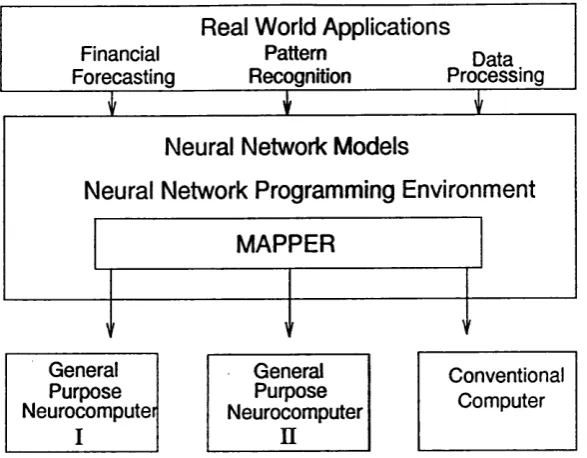
This thesis attempts to achieve these research goals within the framework of a General Purpose Neural Computer (GPNC). A GPNC is a high performance system, consisting of a coarse number of parallel general-purpose modules, all connected to a host computer with a user-friendly, flexible programming environment, capable of executing a wide range of neural network models and applications (Figure 1.3).
Real World Applications
Financial Pattern
Forecasting_______ Recognition_________ Processing
i
i
I
Neural Network Models
Neural Network Programming Environment MAPPER
General General Conventional
Purpose Neurocomputef
Purpose
Neurocomputer Computer
I n
Figure 1.3. General Purpose Neural Computer and Mapper
specification of the Scheduler are parts of the research work undertaken during this thesis research.
1.3. Research Plan
To achieve the research goals;
• An in-depth analysis of neural networks has been carried out in the form of three case studies. The Hopfield nets, the Self-Organising Maps and the Backpropagation model with three appropriate applications have been used in the case studies. These three models are selected because they represent a good cross-section of most neural network models in terms of their applications, structures, training and recall procedures. This analysis aims to : (i) understand neural network models and their computational properties, (ii) highlight suitable application domains, (Hi) explore potential structural parallelism, and (iv) search for a generic representation.
• The mapping strategy has been outlined as a computational optimisation process which is generic, flexible and upgradable. A Computational Analysis Tool (CAT) and an Automatic Parallel Mapper (APM) have been developed for automatically partitioning and mapping MATLIB representations onto parallel processors.
• The Galatea Mapper has been implemented as part of the programming system for the Galatea GPNC simulator, and is used for demonstrating mapping and scheduling strategies. VML, the intermediate-level language of the Galatea GPNC, has been semi- automatically partitioned and parallel executions are simulated on a network of SUN workstations.
• MATLIB representations have been partitioned and parallelised on a network of SUN workstations to assess data and task parallel mapping strategies. CAT parallel projections are used to detect parallelism in MATUB definitions of neural network models. Both single domain and multiple neural network models have been used in these parallel simulations.
1.4. Research Contributions
The main contributions of this work to Neural Computing are:
• The analysis of neural networks. An analysis of three neural network models with appropriate real-world applications, in the form of three case studies.
• The analysis of neural network representations. A comparative analysis of function-oriented, object-oriented and vector-oriented neural network representations.
• The design and implementation of MATLIB. A matrix-based C library with parallel features. MATLIB is a generic representation domain for neural networks and is suitable for mapping onto general-purpose parallel hardwares.
• The design and implementation of NETLIB. NETLIB is a parallel neural network library with parameterised routines for the training and the recall functions of the three models, exploiting MATUB functions.
• The design and implementation of the CAT. CAT provides a computational profile for MATLIB programs and detects parallelism in these representations.
MATLIB code.
• The design and implementation of the Galatea Mapper. It provides semi automatic mapping of intermediate-level language VML onto a number of parallel Virtual Machines.
• Parallel to this research, original research contributions have been made by proposing novel solutions to problems such as data clustering [26], dataset pre processing [126], financial forecasting [27] and navigation [28]. These efforts are documented as published papers and as departmental research notes. The Galatea GPNC development is also documented in chapter 3 and chapter 7, and in the form of technical reports.
1.5. Thesis Organisation
This thesis is organised as follows:
Chapter 2 presents a survey of neural computing. An overview of neural network models and applications is given, and neural network programming and execution environments are investigated.
Chapter 3 presents the Pygmalion and Galatea programming environments as major development works in European Neurocomputing. The Galatea General Purpose Neural Computer is presented as it forms the main test and implementation domain for this thesis work.
Chapter 4 comprises an in-depth analysis of neural network models in three case studies with real-world applications. The Hopfield nets, the Backpropagation model and the Self-Organising Map are chosen as they provide a good cross-section of neural network models and applications.
Chapter 5 discusses neural network representation and programming issues. Function-oriented, object-oriented and vector-oriented approaches are compared with simulation examples. A matrix-based C library, MATLIB is put forward as a generic and flexible environment to represent neural networks and exploit general-purpose parallel hardware. A neural network library NETLIB is also presented in this chapter.
automatic generation of parallel code.
Chapter 7 describes the Galatea Mapper implementation, as part of the Galatea GPNC development. The Galatea Mapper and the Scheduler are defined, and the implementation steps are presented. Results of parallel mappings of VML are presented on the GPNC simulator running on a network of SUN workstations.
Chapter 8 presents the simulation results of mapping MATLIB representations. Parallel simulations involving single-domain, and multi-neural-network applications are used to assess the performance of the mapping strategy.
Chapter 9 provides an assessment of the work in terms of strategy, design, implementation and results. A target review is made, and neural network model, representation and execution issues are raised.
Chapter 2
Neural Computing
This chapter provides a brief survey o f the Neural Computing field, aiming to place the thesis work in this context. With this purpose, popular neural network models and applications, programming and execution environments are reviewed and assessed.
2
.
1
.
Introduction
Conventional Artificial Intelligence (AI) techniques, manifested as the 5th generation computers, have been successfully applied to problems where a well defined number of rules determine a system’s behaviour. In the late 1970’s, a number of AJ- based medical diagnosis packages and chess playing programs were developed. They were so successful that the chess playing programs manage to beat over 99 % of all players. But the same AI techniques are found inadequate for problems such as speech and image recognition. There are two main reasons for this. Firstly, the rules and parameters involved in these problems are unknown or not well defined. Secondly, most pattern recognition and optimisation problems are so called NP-complete, and the computational requirements for these problems become unsurmountable as the number of parameters increases. As a result, the computational requirements increase rapidly, pushing sequential, conventional computers to the limits of their performance. Many believe the answer is in parallel processing and in new forms of computation based on parallel computing.
The proliferating applications and models are pushing the demand for high performance simulators. As mentioned above parallelism can be one way of speeding up computationally intensive simulations. Yet it brings together difficulties of parallel programming which is the topic of this research. In the pursuit of generic representation and mapping strategies of neural networks this chapter surveys the state of the art neural network algorithms, applications, programming and execution environments.
2.2. Applications and Algorithms
Popular Applications
Constructing a taxonomy of neural network applications is not easy because the same application can be categorised as an optimisation, a pattern classification and a pattern recognition task, depending on the point of view. Although the boundary is not so clear-cut, most neural network applications are optimisation or pattern classification problems.
Optimisation tasks are one of the first set of complex problems neural networks addressed. Hopfield and Tank [74] showed that a neural network can find a good solution to the Travelling Salesman Problem within an acceptable time. TSF requires the shortest tour of several cities with the condition that each city is visited only once. TSF is a typical NF-complete problem; since the number of cities increases finding a solution takes an impractically long time, as the computational requirements increase exponentially. Using the Hopfield net, a representative weight space can be constructed with the connection weights between the neurons, and this space can be used to solve optimisation problems.
Pattern classification is a major application domain for neural networks, as most highly dimensional, complex real-world problems can be reduced to pattern classification problems. Traditionally, statistical classifiers are used to solve these problems [99]. These classifiers separate given patterns to a number of classes by calculating the similarity scores for each class, and selecting the closest class as the class identity of the pattern.
mechanisms which most neural networks possess. In training, a neural network continuously monitors its own performance, and adapts its weights accordingly. In recall, the weights are used to establish the class identity of a novel pattern.
The Perceptron, a supervised neural network classifier, strongly resembles the traditional Gaussian classifier. In fact, the Perceptron architecture can be used as a traditional classifier with the added advantage of a potential parallel execution.
Neural networks can also be trained by using unsupervised techniques. Unsupervised neural network classifiers such as Kohonen’s Self-Organising Maps are also known as clustering algorithms. These models do not require labelled data; they classify input patterns into a pre-defined number of unlabelled classes. The SOM is similar to the traditional K-means algorithm [36,39], yet it is adaptive, and can be executed in a massively parallel fashion.
A number of real-world applications are important as part of the broad class of pattern recognition problems. These are; speech and image processing, handwritten character recognition, and sonar/radar signal processing applications. Financial forecasting is one of the areas that has boomed in the last couple of years. The high dimensional and fuzzy nature of this area make it a suitable application for neural networks.
Adaptive control is another area in which neural networks are used successfully. By classifying world data adaptively and taking an appropriate set of actions, multi dimensional control problems can be solved. Neural network based adaptive control systems find applications in industrial robotics, manufacturing, process control and autonomous robot navigation.
Popular Models
rules in training. The three most popular models the Hopfield nets, the Backpropagation model and the Self-Organising Maps are analysed in detail, in chapter 4. The Neocognitron, Counter-Propagation, Adaptive Resonance Theory [33], and the Boltzmann machine [65] are amongst other well known models. The Neocognitron and the Counter-Propagation are briefly described here.
The Cognitron and Neocognitron were put forward by Fukushima as close imitations of the human visual cortex [47-49]. Biological plausibility is the first objective in the design of these models. The structure of the Neocognitron is a multi layered architecture containing excitatory and inhibitory neurons and synapses with a competitive learning mechanism. The system is a powerful image recognition system, working under the conditions of translation, rotation and distortion of the objects, even able to recreate the original image from reverse propagation of the network. The Neocognitron is fault tolerant and self-recovering when faults occur on processors. One problem with the early models was the amount of computational power required.
The Counter-Propagation Network (CPN) [60,61] is a combination of two neural network models complementing each other with different properties. It is a three layered network; the first layer is the input layer where the external inputs are clamped, the second is a Kohonen layer which associates certain neurons with certain input patterns, and the third layer is a Grossberg layer following Grossberg’s outstar learning rule. The resulting network can be rapidly trained and used as an approximate vector mapping system. An average training session is 100 times shorter than that required for the Backpropagation network, but CPN is not as accurate as the Backpropagation. The most interesting application for CPN is data compression. This involves splitting the CPN into two, and using the Kohonen layer as a vector quantiser. Then the labels of the quantised vectors, which are much more compact than the original vectors are transmitted and new vectors are reconstructed on an identically trained CPN system. CPN is also an interesting example of using networks as components. Similar modular neural network architectures are put forward and simulated on parallel processors in the following sections of this thesis, as powerful problem solving domains.
Conclusion
their popular applications, strengths and weaknesses.
Models Popular Applications Strengths Weaknesses Remarks
Perceptrons Pattern classification Simple, adaptive cannot classify con^)lex patterns
first neural networks
Hopfield Nets Optimisation, Planning Content-Addressable Memory
Large scale analog inq>lementation
No learning rule Limited storage
Covergence in recall
Self-Organising Maps Feature extraction Statistical Analysis tool Noise sensitive Unsupervised learning Backpropagation learning on MU*
Wide applications Speech, image processing
Robust Fault-tolerant Computationally demanding Most popular model Counter-Propagation
Data Compression Quick and approximate less accurate than Backpropagatirm Inverse pattern generation Neocognitron Hand-written character recognition Can handle conq)lex patterns Computationally demanding modeled on visual cortex
Table 2.1. Neural Networks Applications and Properties
In chapter 4, three case studies are used to assess computational requirements for three neural network models. In the remainder of this chapter Neural Network Programming Environments and Execution Environments are reviewed.
2.3. Programming Environments
Neural Network Programming Environments are software tools for developing computer simulations of real-world applications and monitoring the execution of these applications. The effectiveness of the representation and efficiency of the execution greatly depend on the programming environment. Neural network representations are crucial for mapping purposes, as they are the very domain where partitioning takes place.
NNPEs address a wide variety of users ranging from novices to experts whose purpose are research, experimentation, education or a solution to an industrial or business oriented problem. NNPEs can be classified into three categories [144]:
• application-oriented, • algorithm-oriented, and
• general programming environments.
systems, NLS (Nestor Learning System), for applications covering mortgage underwriting, and risk assessment in automobile insurance [4].
Algorithm-oriented systems either provide one algorithm or they provide a number of parameterised algorithms as an algorithm library. Many programming systems provide the Backpropagation model and its variations, as it is the most widely used neural network model. Examples are the Brainmaker system, supplied by California Scientific Software and the Owl system which provides an algorithm library for computer professionals. It is based on a generic, C data structure encompassing 19 parameterised neural network models. Users can specify network parameters and call the library functions in their routines. The system also offers an optional graphics interface. Esprit n Pygmalion project [14,15,18,146] also provides a C library of the most popular models. Applications can be developed by calling appropriate library routines with correct parameters.
General programming environments aim to address a wide variety of applications, algorithms and users. These are often research or educational systems aiming at generality and flexibility as opposed to high performance. Most generic programming environments contain the following functional modules;
• User Interface - This module provides flexible, modular and user-fnendly access to neural network models. A number of parameterised models and a High-Level Language are provided to ease the programming process. Usually, menu-driven graphical systems support the user interface. The execution of applications can be monitored, interrupted, saved or loaded. Debugging facilities aid the monitoring in the run-time and post-mortem. Results of the execution are displayed both numerically and graphically.
• Neural Network Representation - This constitutes a generic, machine- independent, intermediate-level, sophisticated network specification language which is capable of covering all possible models and configurations. A number of parameterised models can also be stored as an Intermediate-Level Language Library. Advanced users can program in ILL if they want to exploit the facilities of the low level representation for a high performance execution.
the intermediate-level representation is first partitioned, then distributed over the parallel processors. A fast, efficient and optimised execution is the purpose of this module.
Popular Systems
An early example for generic programming environments came from SAIC: GINNI, Generic Interactive Neural Network Interpreter [2] system provided an interactive developmental system for experimentation with neural network modeling. This system contains all functional modules mentioned above: networks are defined as hierarchical data structures, a high level neural network description language is used to define new algorithms, and the networks can be executed on remote machines over the Local Area Network (LAN) using an integrated message passing system.
AXON, launched by HNC, is a machine-independent neural network specification language [53]. It combines common features of C and Pascal, and a set of neural network specific features. AXON encompasses a generic model of neural networks regardless of the topology or functionality of the artificial neurons. An object-oriented programming approach has been adopted in the network description. A generalised Processing Element concept has been adopted to allow future models to be coded in the language. The AXON Processing Element is the basic building block of all neural models. The PE contains the following attributes: Output State, Transfer Function, Connection Classes, Connection Weights, and Local Data Memory. Processing elements with different attributes can also be defined and used in the same network description.
PDF simulation package is offered to accompany the book ‘Explorations in Parallel Distributing Processing" [1]. It contains a set of programs written in C, and runs on both MSDOS and Unix operating systems. Seven algorithms are provided which included the Backpropagation, Adaptive Resonance Theory and Competitive Learning models. The system is portable, easy to use with the support of the examples in the book, but it lacks a graphics user interface.
The Genesis system was developed by the Division of Computational and Neural Systems of the California Institute of Technology [151]. It promotes biologically plausible neural network modelling. The package is a Unix/C based environment representing the networks as hierarchical objects. The graphic interface Xodus uses the X Windows environment.
Conclusion
Popular neural network programming environments presented above, are mainly for research, development and experimentation. Most systems are written in C and provide data structures for representing neural network concepts. Systems which provide a set of simple library functions with their source code are favoured as open systems where users can modify and tailor the system to their specific needs. In chapter 3, the Pygmalion programming environment is presented in detail as an early system which provided a general programming environment with an objective of a parallel execution. In chapter 5, a number of representation techniques are assessed with simulation examples, and a matrix-based library is put forward as modular, clear means for neural network programming.
2.4. Execution Environments
Neural network simulations are computationally intensive, involving repetitive multiply and add operations. Real-world applications may require the processing of huge amounts of data in a short time. Depending on the application size and domain, large amounts of memory and high speed processors may be necessary.
The general trend in computing is to use parallel architectures to overcome the computational limitations of single processor systems. Indeed, recently, parallelism has been used in the implementation of single chip microprocessors [121]. Architectures such as Intel 80860 and recent RISC architectures exploit microparallelism to execute multiple processes simultaneously by pipelining sequential operations.
schemes. Distributed memory (multicomputer) architectures are scalable systems, but they suffer from interprocessor data dependency and consistency problems and parallel programming difficulties. Shared memory systems are easier to program but the number of processors must be kept to a minimum because of interprocessor competition for memory access and cache coherency problems [121]. The most advanced form of MIMD machines do not have a central controller, and are fully distributed, asynchronous systems [77].
Parallel implementation is the natural method for neural networks, which are inherently parallel. There have been some special-purpose implementations of neural models. These are usually SIMD architectures with simple analog processors connected in a matrix topology [101]. For general-purpose neural computing, computational arrays provide a good execution platform [125].
Parallel or sequential, execution environments for neural networks are called
neurocomputers. Neurocomputers appear in great varieties. On one extreme, there are dedicated parallel SIMD machines, while on the other, there are simple RAM chips such as in the WISARD system [10,11]. Figure 2.1 shows the trade-off between performance and flexibility for a number of hardware platforms which are used as execution environments for neural network applications.
Performance RAMs
^ Special-purpose neurocomputers
Computational arrays
General-purpose neurocomputers
r V Systolic arrays
Conventional parallel computers
' V Sequential computers
Flexibility
Figure 2.1. The Spectrum of Execution Environments [144]
they lack flexibility and programmability. General-purpose neurocomputers can be programmed to emulate a wide range of neural net models. Some architectures can also be used for other computationally intensive tasks. Although general-purpose neurocomputers can offer a higher performance than conventional computers, they are usually a magnitude of order slower than special-purpose neurocomputers [143,144].
2.4.1. Special Purpose Neurocomputers
Special-purpose neurocomputers are physical implementations of neural networks for high performance. The implementations are usually algorithm and application- oriented. The Hopfield nets and Kohonen’s Self-Organising Maps are the two most popular models which were implemented as VLSI chips [90]. Most special-purpose neurocomputers are research systems, used in the investigation of hardware implementations for a number of neural network models and applications. The implementations of special-purpose architectures are analog, digital or optical.
Analog implementations imitate artificial neurons by using basic circuits such as transistors, operational amplifiers and resistors. The resistors are used as neural connection weights, and the amplifiers emulate the processing elements which carry out summations and apply the thresholds. Capacitors are also used to allow weight updating for on-chip learning. Special-purpose neurochips have been developed by Mitsubishi, AT&T Bell Laboratories, and California institute of Technology. These chips provide a very high performance, but they lack flexibility and programmability.
Optical implementations of special-purpose neurocomputers aim to overcome the difficulties of realising high level interconnectivity on VLSI architectures. These architectures use holograms to communicate incoming signals to a great number of processing elements. With a single hologram it could be possible to connect 10,000 light sources to 10,000 light sensors without interference even though the light beams cross each other. Optical technology could meet the interconnectivity requirements set by the biological systems. However, the technology is still young and optical neural computers are still in the early stages of development [59].
Two examples can be given for digital general-purpose systems:
WISARD has been developed by I. Alexander’s group at Imperial College, London. This system uses Random Access Memories (RAM) as neuron-like devices. The hardware implementation of the system is used in image recognition, it has shown some success in real-time face recognition.
PNNP, Probabilistic Neural Network Processor by Lockheed, is another digital special-purpose neurocomputer implementation. This system implements real-time learning for the Probabilistic Neural Network (PNN) model. The system is connected to the backplane of an IBM-PC compatible computer through a dual port memory.
Digital!Analog hybrid implementations and wafer scale integration techniques have recently gained momentum. In Japan a series of hybrid neurochips have been developed
[66], and an example is Hitachi’s 576 neurons Wafer Scale Integration neurochip [153].
Institut National Polytechnique de Grenoble (INPG) is also developing a neurochip which can be potentially generated in wafer scale [118]. INPG’s design is a neuron-based architecture for executing a variety of neural network models. One goal of this project is to develop a framework for the automatic generation of application-specific VLSI chips, namely silicon compilation. The architecture is based on a processing element which is capable of performing all operations required, during the training or recall phase of a neural model. Processing elements are linked in a two-dimensional array, with each PE is connected to two external buses.
s
(state
inputs) (state
output)
(weights)
(error inputs) (error
output)
Figure 2.2. The UCL Generic Neuron [147]
Silicon Compilation is a logical extension to the evolution of special-purpose neuro-chip implementation techniques. Silicon Compilers are sophisticated programs, which process the neural network representation, and generate the VLSI definition of microchips using VLSI development packages. UCL’s Silicon Compiler Project is an example of this kind of work. This project aims to develop a framework to generate the UCL Generic Neuron based architectures as target products, using Silicon Compilation [117].
2.4.2. General Purpose Neurocomputers
General Purpose Neurocomputers are programmable machines for emulating a wide spectrum of neural networks [144]. The following hardware architectures are used as general-purpose neurocomputers:
• co-processor based architectures, • parallel processor arrays, and • massively parallel architectures.
Co-processor Based Architectures
second (CPS). Two simple examples can be given; firstly, Intel’s 80x87 series maths processor boards, developed for IBM PC compatible machines with a 80x86 central processors and secondly. Motorola MC68881 co-processor board developed for MC68020 based CPUs [142]. A number of commercial neurocomputers have been put forward using the co-processor boards accompanied by a neural network programming environment They are usually general-purpose environments with a number of neural net models and general-purpose neurocomputer hardware. Some of the examples are presented below.
The ANZA neurocomputer is developed and marketed by HNC [62,63]. It is designed to support any neural network model. The system comprises a co-processor boards for PC-AT, User Interface Routine Library and Basic Netware Package to support most neural network models. The ANZA boards exploit cunent hardware domains as execution environments. ANZA and ANZA-plus co-processor boards are based on a Motorola MC68020 plus a MC68881 floating point co-processor with 4Mbytes of dynamic RAM to store networks. ANZA is capable of implementing 30,000 PEs with 480,000 interconnections. The more recent ANZA-plus supports IM PEs, with 1.5M interconnections and is capable of 1.5M connection updates per second during training and 6M updates during recall. The Basic Netware Package supports parameterised algorithms; the Backpropagation, the Hopfield and the Counter-Propagation.
The TRW M ark Neurocomputer family includes the Mark II software simulator, the Mark m parallel processor system and the Mark IV pipelined processor based system [143]. All systems share the Artificial Neural System Environment (ANSE) programming environment. Mark IQ comprises 15 parallel physical processors, each built from a Motorola MC68020 microprocessor and MC68881 floating point co processor, all connected to a VME bus. Networks are distributed across the local memories of the 15 physical processors minimising the communications requirements on the common bus. Mark IQ supports 65,000 virtual processing elements with over 1 M trainable connections and processing 450,000 interconnections per second. Mark IV, on the other hand, supports up to 236,000 virtual PEs and 5.5 M interconnections, and is capable of processing 5 M interconnections per second.
MHz, approximating to 22 million floating point operations per seconds peak rate. The processor is based on a pipelined Harvard floating point architecture with one program memory and two data memories. The 12 Mbyte memory supports up to 3.1 M PEs, with a rate of 11 M CPS. SIGMA-1 comes together with an object-oriented programming language ANSpec and a neural net library ANSim. ANSim library is menu-driven, and contains 13 neural network models, providing an interface to dBase m and Lotus 1-2-3 software packages. The models covered by the systems include variations of Backpropagation, Adaptive Resonance Theory, Kohonen Feature Maps and the Boltzmann machine.
Most large neural network applications are executed on conventional parallel architectures [59,144] such as Transputers [108]. Transputer based co-processor boards are popular as they offer a good performance for a wide range of applications, and Transputer-based systems are cheap and efficient. Similar to Transputers, other general- purpose, multi-processing RISC architectures Sparc and Mips processors also provide programmability and flexibility. Transputers are much faster than the co-processor boards for the PCs. A 20MHz T800 chip provides 10 MIPS and 1.5 MFLOPS and is 3 times faster than a 20MHz 80386 with a maths co-processor [98]. Transputers are medium-grained parallel architectures providing concurrent parallel processing with a parallel language called OCCAM [71]. T800 has 4 KBytes internal RAM and supports 32 bit external memory interface. A transputer can be attached to a maximum of four others at a time. Communications are synchronised using a simple protocol with start stop bits and message acknowledgement. The maximum data transfer between the T800s is 1.7 MBytes/sec. There are two links, and when both are used 2.4 MBytes/sec is obtained. The new Transputer INMOS T9000 has a 16 KByte cache and a 64-bit address bus [150].
Parallel Processor Arrays
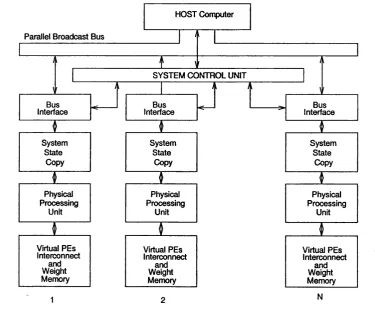
Execution of a neural network involves a continuous update of the states of the virtual PEs. Updating a virtual PE implies broadcasting the update through the network. Processors that need access to that information accept and store the update in their local system state memory. Computation, therefore is carried out through a sequence of iteration cycles. The subsequent iteration occurs in lock step, when all the other processors have completed the previous cycle. This approach is a way of time- multiplexing [21] several PEs on each available physical processor. Performance can be increased by increasing the number of processors, or adding co-processor accelerator boards for fast execution, or high-speed memories for fast memory access.
Parallel Broadcast Bus
Bus
Interface InterfaceBus InterfaceBus
Physical Processing Unit Physical Processing Unit System State Copy System State Copy Physical Processing Unit HOST Computer System State Copy SYSTEM CONTROL UNIT
Virtual PEs Interconnect and Weight Memory Virtual PEs Interconnect and Weight Memory
Virtual PEs Interconnect
and Weight Memory
Figure 23, HNC General Purpose Neural Computer
Some processor arrays are built from replicable boards based on industry standard microprocessor chips such as DSPs and Transputers. Others develop custom designed neuro-microprocessors. Research groups in the USA, Japan and Europe have developed processor array based neurocomputers [143]. Here are some examples:
Each NBTSIM card is an autonomous single-board processing unit based on an industry- standard microprocessor and designed to solve NN problems. A large number of NBTSIM cards can be connected via a message passing network. Bach NBTSIM card contains the following modules; an Intel 80188 local microprocessor, an associated program memory, a Solution engine, and a microprocessor for communications. The Solution engine is the heart of the system; operating as a back-end vector co-processor for the local microprocessor, and performing mathematical functions on the contents of the synapse/input memory. It computes the sum of products between the input vector and the synapse vector. The result is returned to the microprocessor, which in turn computes the threshold function to produce the output of the neuron, and determines the destination for subsequent transmission. The communications processor interconnects NBTSIM cards to their nearest neighbours. The host, a SUN, a VAX or a PC acts as a system controller for the neurocomputer by initialising and mapping applications to the system. The system is programmable, and supports a wide range of NN models. The synapse memory size (1 to 2 MBytes) determines the number of input neurons or networks per NBTSIM card. The execution time depends on the network configuration of the chosen model. A typical implementation using 125 network cards has shown a rate of 450 million CPS on the recall phase.
The Network Emulator Processor (NBP) by IBM is part of a complete network programming environment called Computation Network Environment (CONE) [35,55] developed by IBM at Palo Alto. NBP is a cascadable unit designed as a co-processor for IBM PC. Up to 256 NBPs can be cascaded in a unidirectional interprocessor communications network, to support a total of 1 M virtual PBs and 4 M interconnections. A global interface to the host PC is 100 MBytes/sec inter-NBP NBPBUS service. NBP can simulate about 4 K virtual PBs and 16 K interconnections, with 30-50 total network updates per second. The length of the network update cycle can be reduced by partitioning the network across a number of NBPs [35]
Intel Scientific Computers offers iPSC, a multiprocessor system which can operate concurrently with up to 128 processors as a hypercube. Each node is a board level microcomputer with 80286/80287 chip sets. Local memory is 512 K expandable to 4.5 MB. Each node contains 8 bidirectional communications channels managed by dedicated communications co-processors. The first 7 of these channels are direct links, the 8th is the global communications link to the Ethernet for program load I/O and diagnosis. The system provides a 10 Mbit/second bandwidth for intemode communications. iPSC-VX is a vector concurrent system which couples vector processors to the nodes. The system can yield up to 1280 MFLOPS on 32-bit data.
The ANNE (Another Neural Network Emulator) [20] system has the following modules: a user interface with monitoring facilities, a high level language. Network Description Language (NDL) which is based on Scheme (a lexical scoped version of Lisp) which is used to describe NN structures; a low level generic neural network specification language called Beaverton Intermediate Form (BIF). BIF is generated by a compiler from NDL definition, then the Mapper partitions the BIF definition onto Intel’s iPSC processors. During the runtime, a message passing scheme supports the communications between the different iPSCs nodes. A tuning mechanism is also included to synchronise execution.
The Giga CoNection (GNC) [67] system contains a two dimensional array of general purpose 64-bit RISC Intel 80860 processors. Each processor has 4 MBytes of local memory and 2 FIFOs (first in first out 64-bit memory) for mesh cormection. The 80860 contains a floating point pipeline providing high performance for multiply/add operations. Hiraiwa et al. report 1 Giga CPS on a 128 processor system in the simulation of the Backpropagation model. GCN-128 system provides two pipelined communications paths. The Sony group is incorporating the system as a super chip.
Ariel [46] is a multiprocessor architecture based on coarse-grained processing modules. The modules make use of fast digital signal processors and large semiconductor memories to provide the necessary throughput and storage capacity. Each Ariel module consists of a 32-bit fixed/floating point DSP (TMS320C320), a 32-bit general-purpose processor (GPP), 128 MBytes memory and several high speed conununications ports, and a dedicated disk memory unit. The Ariel architecture uses bus communications to achieve generality over a wide range of neural network models.
TMS320C320 floating point Digital Signal Processors, each with 2K internal and 64K high speed external RAMs. A ring communications topology with 67 MBytes/sec band width serves parallel processors. The 256 processor system can reach 587 MCPS during a Backpropagation training, involving networks with more than 256 neurons. Sandy system is also suitable for conventional image processing and vector processing as well as neural network applications.
W arp is a MIMD one-dimensional systolic array computer designed at Carnegie Mellon University [103,120]. It consists of 10 identical cells in a linear array with a peak performance of 100 MFLOPS. Each cell contains one ALU and a multiplier, with a 4KByte of 152-bit word micro-store and a 4KByte of 32-bit RAM, and can deliver 5 MFLOPS. Cells can be programmed separately for different operations, and data can be pipelined through the cells using the two data channels per cell. The Warp machine is designed to interface with VAX 11/780 with a 1 MByte of memory and 24 Mbyte/sec bandwidth. High level routines are carried out on the host computer.