101 Nail Drug Delivery System: A Review
PatiNikunja Basini 1*, Dey Biplab Kr. 2, Das Sudip 2, Sahoo Subhas1
1. Pulla Reddy College of Pharmacy, Dundigal, Hyderabad, Andhra Pradesh, India
2. Himalayan Pharmacy Institute, Rangpo, E. Sikkim, India
*Corresponding author: [email protected]
ABSTRACT
The purpose of this review is to explore the difficulties in penetration of drug across nail
plate & enhancement of bioavailability of antifungal drug. The existing clinical evidence
suggests that a key to successful treatment of fungal diseases by topical antifungal product
lies in ineffectively overcoming the nail barrier. Current topical treatments have limited
therapeutic effectiveness possibly because they cannot sufficiently penetrate in the nail
plate to transport a therapeutically sufficient quantity of antifungal drug to the target sites
to eradicate the protection. Also the analysis of the drug's penetration is a difficult task.
Here in the present article a method to analyze the drug permeated across nail barrier is
suggested.
Keyword: Nail plate, bioavailability, antifungal, penetrate, nail barrier.
INTRODUCTION
The nail is horny structure. Nail plate is responsible for penetration of drug across it. As it is
hard enough the penetration becomes difficult, only a fraction of topical drug penetrates
across it. Hence the effective therapeutic concentration is not achieved. The nail plate may
appear abnormal as a result of decreased glow. It`s involvement of nail bed, reduction of
blood supply, physical or chemical features of nail bed. As a result variety of diseases
occurs. These diseases can be cured by achieving desired therapeutic concentration of drug
by nail drug delivery system.
The human nail plate consists of three layers; the dorsal & intermediate layer derived from
the matrix, & the ventral layer from nail bed. The intermediate layer is three - quarter of the
102
layer thick but consist of hard keratin, with a relatively high sulphur content, mainly in the
form of amino acids cysteine, which constitutes 94 % by weight of nail.4 The upper layer of
the nail mainly diffuses into & through the nail plate. The ventral layer consists of soft
hyponychial in which many pathological changes occur. Thus, in the treatment of these nail
diseases; an effective drug concentration in the ventral nail plate would be of great
importance.
COMMON DISEASES OF NAIL:
The nail plate may appear abnormal as result of, a congenital defect, disease of skin with
involvement of the nail bed, systematic disease, reduction of blood supply, local trauma,
tumors of the nail fold or nail bed, infection of the nail fold, infection of the nail plate.
Leuconychiawhite spots or lines appears on one or more nails & grow out spontaneously.
Onychomycosis Yellow-brown patches near the lateral border of the nail. Beneath the
masses of soft horny debris accumulate & the nail plate gradually becomes thickened,
broken & irregularly distorted. One or many nails may be affected & there may be
associated infection of the skin. Most of the infections are caused by Trichophyton rubrum,
T. inerdigitale.
Tinea Unguis, or ringworm of the nails, is characterized by nail thickening, deformity and
eventually results in nail plate loss.
Onychatrophia is an atrophy or wasting away of the nail plate which causes it to lose its
luster, become smaller and sometimes shed entirely. Injury or disease may account for this
irregularity.
Onychogryposis are claw-type nails are characterized by a thickened nail plate and are
often the result of trauma. This type of nail plate will curve inward, pinching the nail bed
and sometimes requires surgical intervention to relieve the pain.
Onychorrhexis are brittle nails which often split vertically, peel and\or have vertical ridges.
103
the home, including household cleaning solutions. Although oil or paraffin treatments will
rehydrate the nail plate, one may wish to confer with a physician to rule out disease.
Onychauxis is evidenced by over thickening of the nail plate and may be the result of
internal disorders.
Leuconychiais evident as white lines or spot in the nail plate and may be caused by tiny
bubbles of air that are trapped in the nail plate layers due to trauma. This condition may be
hereditary and treatment is required as the spots will grow out with the nail plate.
Beaus linesare nails that are characterized by horizontal lines of darkened cells and linear
depressions. The disorder may be caused by trauma, illness, malnutrition or any major
metabolic condition, chemotherapy or other damaging event, and is the result of any
interruption in the protein formation of the nail plate.
Koilonychia is usually caused through iron deficiency anemia. These nails show raised
ridges and are thin and concave.
Melanonychiaare vertical pigmented bands, often described as nail ‘moles’, which usually
form in the nail matrix. It could signify a malignant melanoma or lesion. Dark streaks may
be a normal occurrence in dark-skinned individuals, and are fairly common.
Psoriasisof the nails is characterized by raw, scaly skin and is sometimes confused with
eczema. When it attacks the nail plate, it will leave it pitted, dry and it will often crumble.
The plate may separate from the nail bed and may also appear red, orange or brown, with
red spots in the lunula. Do not attempt salon treatments on clients with nail psoriasis.
REQUIREMENTS FOR LOCAL THERAPY
• Potential active (antifungal)agent
• High concentration of the drug in the formulation
• Diffusion at levels exceeding MIC
• Adequate method of delivery
104 The diffusion of drug through nail depends on:
• The physicochemical properties of the nail,
• The properties of chemical,
• The physicochemical characteristics of the vehicle containing the active agent.
PHYSICOCHEMICAL PROPERTIES OF NAIL
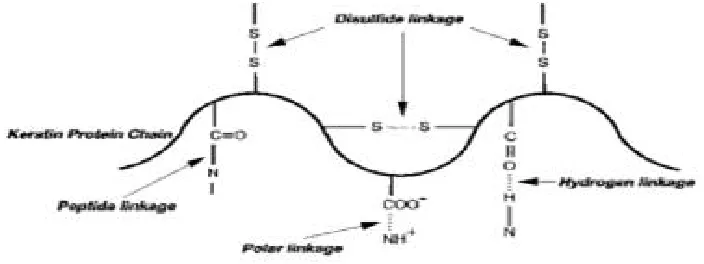
The entire nail fabric is hard keratin. The hardness of the nail plate not only depends on the
junctions between the cells and the transverse orientation of the keratin filaments with
respect to the axis of the nail growth. Moreover, the multiplicity of the lateral bonds
between keratin fibers (disulfide bridges, hydrogen bonds, acid- base bonds, electrostatic
bonds) also account for high resistance. The keratin of nails has been classified as “hard
trichocyte keratins”. It contains significant amount of phospholipids, mainly in the dorsal
and intermediate layers, which contribute to its flexibility (Fig. 1).
Fig. 1: Simplistic presentation of chemical bonds involved in a nail keratin chain
PROPERTIES OF THE CHEMICAL:
Among the other physicochemical properties of chemicals, these are the important set of
properties which affect the most, the drug absorption through nail.
SOLUTE MOLECULAR SIZE:
As the nail plate is produced mainly by differentiation of cells in the nail matrix, and it
comprises three horizontal layers: a thin dorsal lamina, the thicker intermediate lamina,
and a ventral layer from the nail bed. Because the nail plate is composed of many strands of
105
finite size causing the nail plate to act like a molecular sieve. Small molecules can weave
through these spaces while larger molecules are unable to pass.
The molecular weight of most antifungal agents is >300Da. accordingly, these drugs will
have difficulty penetrating the nail plate, a likely reason for low clinical efficacy observed.
So, the optimum small particle size of the drug is the foremost prerequisite for formulation
point of view.
HYDROPHILICITY/HYDROPHOBICITY
There is a marked difference between the permeability characteristics of the nail plate and
the epidermis. These observed differences have been largely attributed to the relative
amounts of lipid and protein regulation within the structures and the possible differences in
the physicochemical nature of the respective phases. The lipid levels in the nail plate are
near 1%, which combined with lower water levels of about only 10% affords the nail plate.
Studies using DMSO, homologous alcohols of different molecular weights have shown that,
the nail plate was permeable to dilute aqueous solutions of low molecular weight
homologous alcohols. As well as the significant decrease in the permeation of the
hydrophobic entity n-octanol following delipidization of nail plate by chloroform/ methanol
also suggested that the nail plate possessed a highly “polar” penetration route and becomes
rate controlling for hydrophobic solutes.
The chemical composition of nail and experimental evidence indicate that the aqueous
pathway plays a dominant role in drug penetration into nail. Water is the principal
plasticizer for the nail. Upon being hydrated, hard nail plates become softer and more
flexible. Nail hydration is influenced by many factors, such as solution pH and certain
chemicals.
pH OF VEHICAL & SOLUTE CHARGE
Antifungal agents have a range of pKa values and so studies have been reported that
compare the penetration of the ionic and non-ionic forms of the parent. These studies
investigated the penetration of miconazole (pKa =6.7), benzoic acid (pKa= 4.2), pyridine (pKa
=5.3) and 5-fluorouracil (pKa =7.9) in vehicles over pH range from 2 to 8.5. In the case of
miconazole, it was reported that penetration was independent of the pH of the vehicle.
However, in all the other cases, the ionic forms of the parent did not penetrate as well, as
106
compounds and the relationship with molecular weight also found non-ionic compounds
penetrate better. These authors speculated that the decrease in penetration of ionic drugs
may be due to an apparent increase in molecular weight of around 100 Da from ion
hydration.
ENHANCEMENT OF NAIL PERMEATION
Targeting drug treatment to diseases that reside within or below the nail plate is
problematic due to the highly restrictive barrier of the human nail. To optimize topical
formulations for ungual drug delivery, inclusion of an effective penetration enhancer (PE) is
imperative. Research is currently being undertaken to design novel in vitro methods to
assess the ability of compounds to penetrate the nail plate. In addition, methods of chemical
and physical analysis of the nail are being developed.
PHYSICAL MEANS of enhancing drug permeation: The composition of the nail plate
suggests that, the use agents that effect by delipidization or fluidization of the intracellular
lipids can help in drug permeation.
Many approaches have been used to resolve these barriers to drug delivery. These include:
a. Transdermal diffusion
b. Iontophoresis
c. Electroporation
d. Microneedles & thermal poration
Iontophoresis, an electrochemical technology under development for nearly 20 years, has
shown the most promise, utilizing a low-voltage electric current to induce fluid and particle
movement. However, it is limited to a small class of drugs which are polarized and small
enough to permeate through the nail.
Electroporation isa method in which, with the application of an electric pulse of about
100–1,000 V/cm creates transient aqueous pores in the lipid bilayers making the solute
107
Microneedle enhanced delivery systems, a method using arrays of microscopic needles
to open pores in the SC directly to the skin capillaries; also has the advantage of being too
short to stimulate the pain fibers, thus facilitating drug permeation.
Other physical techniques include manual and electrical nail abrasion, acid etching, ablation
by lasers, microporation, application of low-frequency ultrasound and electric currents.
CHEMICAL MEANS of enhancing drug permeation: the high disulfide bond content of nail
has been found to be responsible for the hardness of the nail. In recent years, the ability of
compounds that possess –SH groups to increase nail permeation has been documented.
Promising enhancers include papain, sulfhydryl containing endopepetidase enzyme,
2-mercaptoethanol, 1, 4-Dithiothreitol, which contains 2-SH groups and various reducing
sulfites and bisulfites. These increase the ability of the nail to hydrate. As well as nail
softening agents (keratolytic agents) like urea and salicylic acid can be used in the
formulation for enhancing the drug permeation through chemical-means.
TOPICAL THERAPIES AVAILABLE:
Topical drug delivery is especially suitable for onychomycosis and nail psoriasis, which
affect 2 - 13 and 1 - 3% of the general population, respectively, and make up the bulk of nail
disorders. Topical therapy would avoid the adverse events and drug interactions of
systemic antifungal agents and the pain of injection when antipsoriatic agents are injected
into affected nail folds. Moreover, the target sites for the treatment of onychomycosis and
other nail disorders reside in the nail plate, nail bed and nail matrix.
Various topical therapies for nail disorders, which have been studied so far are:
Lacquers, Gels / Solutions, Creams / Pastes, Colloidal systems / Liposomes, Powders,
Aerosols / Foams / Sprays.
A Bandage is adapted comprising a T-shaped adhesive backing, and a flexible pad having an
impervious backing and a nail-shaped cavity (containing active solute along with other
additives).
Nail Lacquer of Ciclopirox distributed commercially under the trade name PENLAC.TM. by
Dermik Laboratories, Inc.), as an 8% topical solution and 5% amorolfine, a morpholine
derivative, and is manufactured by Roche Laboratories under the trade name LOCERYL.TM.
108 CONCLUSION
Addressing the specific characteristics of the nail barrier is essential to successfully
delivering drugs to the nail. The permeability characteristics of nail plate are well
understood and topical formulations can be designed to optimize drug delivery into the nail.
In conclusion, it does not seem unreasonable to predict that it may soon be possible for
pharmaceutical manufacturers to chemically tailor drugs that will prove more effective in
topical management of some nail conditions.
REFERENCES
1. Y. L. S. Ngai, Update on the Treatment of Onychomycosis Hong Kong Dermatology &
Venereology Bulletin, Vol.9 No.3, September 2001, 137-138.
2. Pravin D.Chaudhari, Shilpa P. Chaudhari , Pramod K. Kolsure, C.Bothiraja, Drug Delivery
Through Nail - A Review, Pharmainfo.net [internet]. 2006 Jan; Vol.4 (1).
3. Available from:
http://www.pharmainfo.net/reviews/drug-delivery-through-nail-review.
4. Marc Brown & Matthew Traynor, Treatment of Fungal Nail Infections. Drug Delivery
Report Spring/Summer 2007 [internet]. Available from:
http://www.medpharm.co.uk/uploads/media/MedPharmFungalNailInfections.pdf.
5. Hui X, Shainhouse Z, Tanojo H, Anigbogu A, Markus GE, Maibach HI, Wester RC et al.
Enhanced human nail drug delivery: nail inner drug content assayed by new unique
method. J Pharm Sci. 2002 Jan; 91(1):189-95.
6. Narasimha Murthy S, Wiskirchen DE, Bowers CP. Iontophoretic drug delivery across
human nail. J Pharm Sci. 2007 Feb; 96(2): 305-11.
7. R. H. Khengar, S. A. Jones, R. B. Turner, B. Forbes and M. B. Brown. Nail Swelling as a
Pre-formulation Screen for the Selection and Optimization of Ungual Penetration Enhancers.
J. Pharmaceutical Research. December, 2007; Volume 24(12): 2207-2212.
8. Marc B. Brown, Gary P. Martin, Stuart A. Jones, Franklin K. Akomeah. Dermal and
Transdermal Drug Delivery Systems: Current and Future Prospects. Drug Delivery. May
109
9. Anroop B Nair. Coulombic dose controlled ungual and trans-ungual iontophoretic
delivery of terbinafine hydrochloride. J.Pharmaceutical Sciences. May 2009; Volume
98(5):1788–1796.
10.MHG Dehghan & Md Ismail Mouzam. Advances in Iontophoresis for Drug Delivery.
International Journal of Health Research. September 2008; 1(3):115-127.
11.Stephen J.Baker, Xiaoying Hui & Howard I. Maibach. Progress on Therapeutics for
Fungal Nail Infections. Annual Reports in Medicinal Chemistry. 2005; Vol 40: 11-15.
12. Sudaxshina Murdan. Enhancing the nail permeability of topically applied drugs. Expert
opinion on drug delivery 2008-Nov; vol 5 (issue 11):1267-82.
13.B. Nair, Anroop Chakraborty, B.Narasimha Murthy. Effect of Polyethylene Glycols on the
Trans-Ungual Delivery of Terbinafine. Current Drug Delivery December-2010;
7(5):407-414(8).
14.Thong HY, Zhai H, Maibach HI. Percutaneous penetration enhancers: An overview. Skin Pharmacol Physiol. 2007; 20:272–282.
15.Hemali B., Gunt M. S. University of Cincinnati, Hydration Effect on Human Nail
Permeability, 6, 2006.
16.Hemali B. Gunt and Gerald B. Kasting. Equilibrium water sorption characteristics of the
human nail. J.Cosmetic Sciences 2007; 58:1-9.
17.Hemali B. Gunt, Matthew A. Miller, Gerald B. Kasting. Water diffusivity in human nail
plate. Journal of Pharmaceutical Sciences December- 2007; 96(12): 3352–3362.
18.Stamatis Gregoriou; Dimitris Kalogeromitros; Nikolaos Kosionis; Aikaterini Gkouvi;
Dimitris Rigopoulos. Treatment Options for Nail Psoriasis. Expert Review of
Dermatology, 2008. Available from: http://www.medscape.com/.
19.Cumbie; William E. Alteration of the skin and nail for the prevention and treatment of
skin and nail infections, United States Patent 7306620.