NOVEL FRAMEWORK SUPPORTING SEARCH IN
DATABASES BASED ON SQL
K Nagarjuna
1, A Ramaswamy Reddy
2 1M.Tech Scholar (CSE), Nalanda Group of Institutions, Siddharth Nagar, Guntur, A.P, (India)
2
Associate Professor & HOD (CSE), Nalanda Group of Institutions, Guntur, A.P, (India)
ABSTRACT
The search as you type system computes answers on the fly as the user type in the keyword query character by character. We study in the support search as you type on the data residing in relational DBMS. We completely focus on how to the support this type of search using native database language. The main scope is how to force existing database functionalities to meet the high performance requirement to the achieved the interactive speeds. We study how to use the auxiliary indexes deposited as in the tables to the surge search the representation. We present the solution for together keyword queries and the multi keywords queries and the developed novel techniques for fuzzy search using SQL by allowing mismatches among query keywords and answers. Present techniques to answer first-N queries and discuss how to the support updates efficiently. The experiments on big real data sets show that our techniques enable DBMS systems on the commodity computer to support search-as-you-type on tables with millions of the records.
Index Terms Are:-Search As You Type and Databases SQL Fuzzy Search
I. INTRODUCTION
More information systems currently improved the user search experiences by providing instant feedback asthe
users verbalize search query. Frequently search engine, online search forms support sedan completion which are
shows recommended queries or even answers on fly as the user types in the keyword query character by the
character. Since instance consider Web search interface at the Netflix which tolerates the user to search for the
movie information. Whether the user types in the partial query mad system shows movies with the title
matching this keyword as the prefix such as Madagascar and Mad Men The instant feedback helps the user not
only in the formulating the query then also in understanding underlying data. This is type of the search generally
called search as you type or type onward search.Thereforeadditional search systems store their information in
the Backend interpersonal DBMS question arises naturally how to the support search as you type on data
residing in the DBMS. Some databases such as the Oracle and SQL server already support prefix search and we
could use this feature tosearch as you type. However entire databases provide this feature. We study new
method that can be used in all databases. Once the methodology is to the developed the separate application
layer on to the database to construct indexes and the implement algorithm is for the answering queries. However
this approach has the advantage of the achieving the high performance it is main drawbacks are duplicating data
and the indexes resulting in the additional hardware cost. The alternative methodologies are to the use database
extenders such as the DB2 Extenders Informix Data Blades Microsoft SQL Servers Common Language.
Runtime (CLR) integration and Oracle Cartridges which isalloweddevelopers to the implement novel
functionalities to DBMS. In this type of approach isn‟t feasible for databases that don‟tprovide such extender
solution for oncedatabase might portable tothe others. The extender based solutionsare especially those
implemented in the C or the C++ could cause the serious reliabilityand the security problems are to the database
engine.We study how to a support search as you typeon the DBMS systems using native query language (SQL)
Structure queries language. We want to the use SQL to find responses to searchquery as user types are in the
keywords character by the character.Our aim is toutilize built in query engine of databasesystem as moreas the
possible. We can decreaseprogramming efforts to the support search as you type. Solutions are developed on
one the database usingthe standard SQL techniques areportable to another databasewhich is supportsimilar
standard. Correspondingly the observations are also completed by Gravanoetand Jestes which is use SQL to the
support similarity join indatabases.
II. PRELIMINARIES
2.1 Problem Formulation
Let be theinteractive table with attributes let be collection of the records in
and denote the content of the record in the attribute Aj. Let be set of the tokenized keywords in the
R. Search-as-You-Type for the Single keyword QueriesExact Search As the user types in the single partial
prefixkeyword character by the character search-as-you-type onflyfinds records that is contain keywords with
the prefixw. We are call this is search paradigm prefix search. Deprived of loss ofgenerality every tokenized
keyword is in the data set andthe queries are assumed to use the lower case characters.
Table 1, = title, = authors, = booktitle, and = year. R = { , ... , }. r3[booktitle]= „sigmod‟.
W = {Privacy, Sigmod ,…}
III. DIVERSEMETHODS FOR SEARCH AS YOU TYPE
Possible different methods are to support search asyou typeand give their advantages and the limitations.Method
first is to use the separate application layer inwhich can achieve the very high performance as it is can
usevarious programming languages and the complex data structure.Howeverthe insulated from DBMS
systems.Method is to use the database extender. For thatthis is extension based method not safe to the
queryengine which is could causereliability and security problemto database engine. This is methoddepend on
API ofthe specific DBMS being are used and different DBMS systemshave transposed API. Nevertheless this
method doesn‟t workuncertaintyDBMS systems has no this is extender feature.Method based on SQL ismore
compatible whether it is using standard SQL. MySQL database is third methods to use SQL. So ifthe DBMS
systems don‟t provided search as you typeextension feature indeed on the DBMS systems provide are suchan extension SQLbased method can also to be used in thiscase. So SQL based method is much portable to
thedifferent platform than start two methods.We takeattentionon the paper on the SQL-based method andthe
developed various techniques to theachieved high cooperativespeed.
IV. EXACT SEARCH FOR SINGLE KEYWORD
4.1 No Index Methods
Straightforward way to support the search-as-you-type is tothe issue the SQL query that scans every record and
1) Calling User Defined Functions. We can add functions into a databases to the verify if record contains the
query keyword
2) UsingLIKE predicate databases provide LIKE predicate toallow user to perform string matching. We can use
LIKEpredicate to check if record haveencompasses querykeyword. This isthe method might the introduced
incorrect positivesfor examplekeyword „publication‟ contains the query string „ic‟ but keyword doesn‟t have
query string „ic‟ by way of the prefix.We can eliminate these deceptive positives by the calling UDF. The methods are needs no additional space but they mayn‟t scale subsequently they need to scan entire records in
table.
4.2 Index-Based Method
We propose this scenario to buildauxiliary tables as the indexstructures to facilitate the prefix search. Particular
databases such asOracle and then SQL server already support prefix search and we could use this feature to do
prefix search. However not entire database provide this feature. For this motive we develop the newfangled
method that can be used in entire databases. In addition our experiments in this show that our method performs
are prefix search much efficiently.Given a table T we assign uniqueids to the keywords in the table T following
their sequentialorder. We create an inverted index table for IT with records in the form ikid and ridi, where kid
is the id of keyword and rid is the id of the record that is encompasses keyword. Given the complete keyword
we can use an inverted index table to the find records with keyword.Prefix table:The assumed the table T for the
entire prefixes of keyword we build the prefix PT with the recordsinformhp; lkid; ukidi, where p is a prefix of a
keyword kid is smallest id of this keywords T having p as the prefix, andukid is the largest id of this keywords
having p as the prefix. The interesting observation is that the complete wordWiththe p as the prefix must and
should have the ID in the keyword range and every complete word in T with an IDin this keyword
range must and should have the prefix p. So given the prefix keyword w we can use prefix table to find therange
of the keywords with prefix. .kid
AND AND
For example assuming a user types in the partial query “sig” on the table dblp issue on the following SQL.
.kid AND
AND
V. SUPPORTING MULTIKEYWORD QUERIES
Computing Answer from Scratch:
The given multikeyword query Q with the keyword .
1) Using the „INTERSECT‟ Operator:- The straightforward wayis to the first compute records for every
keyword using previous method and then use the „INTERSECT‟ operator to join these records for the different
keywords to compute the answers. 2) Using completetext Indexes: we first use full-text indexes (example
CONTAIN command) to find records are matching the first m 1 complete keyword and then use ourmethods are
to discovery records matching the latter prefix keyword. Lastly we join the results. These two methods cannot
usethe recomputed results and may lead to the low performances. To the address this is problem we propose the
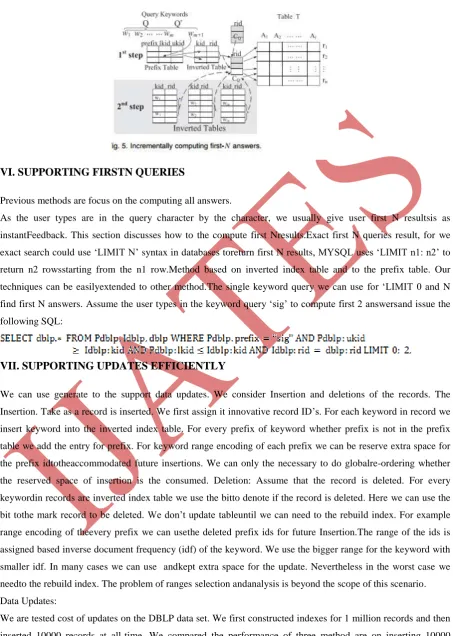
incremental computation method.Word-Level Incremental Computation: We can usethe previously computed
results are to the incrementally answer the query. Presumptuous the user has typed in the query Q with the
Whether the user types in the new the keyword wmþ1 and submits the new query Q0 withthe
keywords we use the temporary table CQ to the incrementallyanswer the new query.
VI. SUPPORTING FIRSTN QUERIES
Previous methods are focus on the computing all answers.
As the user types are in the query character by the character, we usually give user first N resultsis as
instantFeedback. This section discusses how to the compute first Nresults.Exact first N queries result, for we
exact search could use „LIMIT N‟ syntax in databases toreturn first N results, MYSQL uses „LIMIT n1: n2‟ to
return n2 rowsstarting from the n1 row.Method based on inverted index table and to the prefix table. Our
techniques can be easilyextended to other method.The single keyword query we can use for „LIMIT 0 and N
find first N answers. Assume the user types in the keyword query „sig‟ to compute first 2 answersand issue the
following SQL:
VII. SUPPORTING UPDATES EFFICIENTLY
We can use generate to the support data updates. We consider Insertion and deletions of the records. The
Insertion. Take as a record is inserted. We first assign it innovative record ID‟s. For each keyword in record we
insert keyword into the inverted index table. For every prefix of keyword whether prefix is not in the prefix
table we add the entry for prefix. For keyword range encoding of each prefix we can be reserve extra space for
the prefix idtotheaccommodated future insertions. We can only the necessary to do globalre-ordering whether
the reserved space of insertion is the consumed. Deletion: Assume that the record is deleted. For every
keywordin records are inverted index table we use the bitto denote if the record is deleted. Here we can use the
bit tothe mark record to be deleted. We don‟t update tableuntil we can need to the rebuild index. For example
range encoding of theevery prefix we can usethe deleted prefix ids for future Insertion.The range of the ids is
assigned based inverse document frequency (idf) of the keyword. We use the bigger range for the keyword with
smaller idf. In many cases we can use andkept extra space for the update. Nevertheless in the worst case we
needto the rebuild index. The problem of ranges selection andanalysis is beyond the scope of this scenario.
Data Updates:
We are tested cost of updates on the DBLP data set. We first constructed indexes for 1 million records and then
inserted 10000 records at all-time. We compared the performance of three method are on inserting 10000
record. It took more than 40 seconds tore-index data while our incremental indexing method only took0.5
Exact Search:
In the single keyword queries, we implemented three methodsFor the single keyword queries:
1) Exhausting UDF. 2) Exhausting the LIKE predicate.
3) Exhausting inverted index table and prefix table known as the „IPTables‟. We are compared the performance
of this three methods to the compute the first N answers. Unless otherwise specified N=10. Method had low
search performance as theyare necessary to the scan records. IPTables achieved a high performanceby using
index Keyword length augmentedperformance of the Start two method decreased the subsequently
keywordsuitedmuch selective and the two methodsrequiredscanning more records in order to find the
samenumber (N) of answers. As the keyword length increasedIPTables had the higher performance since there
were fewer wholekeywords for the query and query necessaryfewer join operations.Multikeyword queries. We
implemented six methods for multi-keyword queries using UDF;2. Using the LIKE predicate. 3. Using full-text
indexes and UDF known as “FI+UDF”. 4. Usingadequate text indexes, LIKE predicate known as „FIþLIKE‟.
5. Using the inverted-index table and prefix table(IPTables);
VIII. EXISTING SYSTEM
In the existing system strings are search which given the set of strings and the query string all strings in the set
that are similar to query string. Likeness joins are the extensively studied which is given two sets of the string
find entire similar string pairs from two sets. Uses are the existing built in the functionalities for example
full-text indexes and CONTAINS command in Oracle and the SQL Server. This system follows q-gram algorithms.
The keyword search is happening as taking query keywords as the complete keywords.Existing technique are
the Q gram-based technique.
Disadvantages:
1. Firstly they are needed to searchsimilar introducesof keyword from scratch.
2. Secondly they may be essential to call UDFmany times.
3 Concentration on the computing entire the answers.
IX. PROPOSED SYSTEM
In this propose system we consideredas the problem of the using SQL to support the search-as-you-type in
thedata bases. The focused is on the challenge of how to leverage existing DBMS functionalities to the
meethigh-performance requirement to achieve interactive speed. To the support prefix matching we proposed
the solutions that use the auxiliary tables as the index structures and the SQL queries to support search-as-you
type. We are protracted techniques are to case of the fuzzy query and suggested vary many techniques to
improve the query presentation. We proposed the incremental computation techniques toanswer multi keyword
queries and deliberate how to the support first N queries and the incremental updates. Our experimental results
on the large real data sets showed that proposed techniques could allowthe DBMS systems to the support search
as you type on big tables.
X. ADVANTAGES
Improving Performance Using the Indexes.
we propose efficient techniques to the support
Multi keywords queries.
Word Level Incremental Computation (WLIC) write the user in the query character by we usually give
the user first N (any-N) results as imperative feedback.
We can use trigger to support the data update and weare consideringthe insertion and deletion of record
by using the Fuzzy Search.
XI. CONCLUSION
In this scenario we focused on challenge of how to the leverage existing DBMS functionalities to meet the
high-performance requirement to the achievedthe interactive speeds. To support the prefix matchingare proposed
solutions are that use auxiliary tables as the index structures and SQL queriessupport to search as you type.
Long drawn outtechniques to case of the fuzzy queries and anticipatedseveral techniques to the improve query
performance.In the proposed we are incrementalcomputation techniquestothe answer ofmulti keyword queries
and the studied how tosupport the first N queries and the incremental update. Our main aim to experimental
results on large real data sets showed that proposed techniques can beallowed DBMS systems tothe support
search-as-you-type on the big tables.Many problem support SQL suppose asyou typeusing SQL, one is how to
support ranking queriesefficiently and other is how to support the multiple table.
REFERENCES
[1] S. Agrawal, K. Chakrabarti, S. Chaudhuri, and V. Ganti, “Scalable Ad-Hoc Entity Extraction from Text
Collections,” Proc. VLDB Endowment, vol. 1, no. 1, pp. 945-957, 2008.
[2] S. Agrawal, S. Chaudhuri, and G. Das, “DBXplorer: A System for Keyword-Based Search over Relational
Data Bases,” Proc. 18th Int‟l Conf. Data Eng. (ICDE ‟02), pp. 5-16, 2002.
[3] A. Arasu, V. Ganti, and R. Kaushik, “Efficient Exact Set-Similarity Joins,” Proc. 32nd Int‟l Conf. Very
Large Data Bases (VLDB ‟06), pp. 918-929, 2006.
[4] H. Bast, A. Chitea, F.M. Suchanek, and I. Weber, “ESTER: Efficient Search on Text, Entities, and
Relations,” Proc. 30th Ann. Int‟l ACM SIGIR Conf. Research and Development in Information Retrieval
[5] (SIGIR ‟07), pp. 671-678, 2007.
[6] H. Bast and I. Weber, “Type Less, Find More: Fast Autocompletion Search with a Succinct Index,” Proc.
29th Ann. Int‟l ACM SIGIR Conf. Research and Development in Information Retrieval (SIGIR ‟06), pp.
364-371, 2006.
[7] H. Bast and I. Weber, “The Complete Search Engine: Interactive,Efficient, and Towards IR & DB
Integration,” Proc. Conf. Innovative Data Systems Research (CIDR), pp. 88-95, 2007.
[8] R.J. Bayardo, Y. Ma, and R. Srikant, “Scaling up all Pairs Similarity Search,” Proc. 16th Int‟l Conf. World
Wide Web (WWW ‟07), pp. 131- 140, 2007.
[9] G. Bhalotia, A. Hulgeri, C. Nakhe, S. Chakrabarti, and S. Sudarshan, “Keyword Searching and Browsing
[10] K. Chakrabarti, S. Chaudhuri, V. Ganti, and D. Xin, “An Efficient Filter for Approximate Membership
Checking,” Proc. ACM SIGMOD Int‟l Conf. Management of Data (SIGMOD ‟08), pp. 805- 818, 2008.
[11] S. Chaudhuri, K. Ganjam, V. Ganti, R. Kapoor, V. Narasayya, and T. Vassilakis, “Data Cleaning in
Microsoft SQL Server 2005,” Proc. ACM SIGMOD Int‟l Conf. Management of Data (SIGMOD ‟05),pp.
918-920, 2005.
[12] S. Chaudhuri, K. Ganjam, V. Ganti, and R. Motwani, “Robust and Efficient Fuzzy Match for Online Data
Cleaning,” Proc. ACM SIGMOD Int‟l Conf. Management of Data (SIGMOD ‟03), pp. 313-324, 2003.
AUTHOR PROFILE
Nagarjuna Kolluru is currently pursuing M.Tech in the Department of Computer
Science & Engineering, from Nalanda Institute of Technology (NIT), siddharth
Nagar, Kantepudi(V), Sattenapalli (M), Guntur (D), Andhra Pradesh , Affiliated to
JNTU-KAKINADA.
A Ramaswamy Reddy (M.Tech, Ph.D) working as Associate Professor & HOD (CSE) in Nalanda Institute of Engineering & Technology (NIET), siddharth Nagar,
Kantepudi(V), Sattenapalli (M), Guntur (D), Andhra Pradesh , Affiliated to