PERFORMANCE ANALYSIS OF GUARANTEED
TIME SLOT MECHANISM FOR CLUSTER BASED
ROUTING PROTOCOL IN MANET
V. Lalitha
1, B. Gopinathan
2 1,2Department of Computer Science and Engineering, Adhiyamaan College of Engineering, (India)
ABSTRACT
Mobile Adhoc Network (MANET) is a self configuring network it does not have any infrastructure so it is called
as infrastructure less network. In existing system, the Cooperative load balancing and dynamic channel
allocation algorithm is used in the MANET with cluster formation, the bandwidth efficiency is improved. But the
delay of packet is not reduced. Therefore, in proposed system the Guaranteed Time Slot (GTS) mechanism is
used for each node in the network. GTS is suitable for transmitting time-sensitive data, it allocates time slots to
a specific node. With that slot the nodes may transmit the packets in a timed manner. This will reduce the delay
because, the packets are transmitted in a specific order. GTS mechanism prefers reliable communication with
no loss and duplication of data but, the delay is viewed up to a certain level. With that more number of packets
will be transmitted by consuming low energy from the nodes. This will increase the network performance so,
that the throughput, packet delivery rate will increase and the delay is minimized in the clustered MANET.
Keywords: Bandwidth efficiency, GTS, MANET, Network Performance.
I. INTRODUCTION
between nodes only the routes are requested by the source nodes. The AODV routing protocol will supports both the unicast and multicast. The term unicast means a small piece of information is sent from one place to another place. In unicast transmission the packet is sent from a single source to specified destination whereas in multicast a piece of information is simultaneously sent to group of receiver. The term channel sensing is used to detect the channel availability. The DSDV routing protocol maintains a routing table that consists of all available destination list and each destination have sequence number. If the packets are transmitted from source to destination by number of intermediate nodes are called as multi hop network. The Mobile Adhoc Network will provide communication to support for mission critical scenario that consists of military operations, search operations and disaster recovery operations.
II. RELATED WORKS
Bora Karaoglu, Member, IEEE and Wendi Heinzelman, Senior Member, IEEE has proposed the cooperative
load balancing and dynamic channel allocation for cluster based Mobile Adhoc Network. This paper focuses on
energy and bandwidth efficiency in clustered MANET. The Cooperative load balancing and dynamic channel
allocation algorithms are used in order to improve bandwidth efficiency, throughput. But, delay of packet is not
reduced.
Bulent Tavli and Wendi B. Heinzelman have proposed multi-hop time reservation using adaptive control for energy efficiency (MH-TRACE). In this paper they have proposed MH-TRACE it is an MAC layer that combines the features of centralized and distributed networks for energy efficiency in Multihop networks. But, here the channel allocation is not possible.
M.Felegyhazi, M.Cagalj, S.Bidokhti, and J.P.Hubaux have proposed Non-cooperative Multi-radio Channel Allocation in Wireless Networks. In this paper they have explained a problem of multiradio channel allocation. Here, the channel allocation shows a result of load balancing solution. There are three channel allocation schemes are used Fixed Channel Allocation (FCA), Dynamic Channel Allocation (DCA) and Hybrid Channel Allocation. In Fixed Channel Allocation same number of channels is permanently allocated and it will perform well under traffic load but it will not adapt to changing traffic conditions. To overcome this problem Dynamic Channel Allocation is proposed. In Dynamic Channel Allocation there is no constant relationship between base station and their respective channels all the channels are available for each base station and they are assigned dynamically. But, it performs worse than Fixed Channel Allocation in terms of heavy traffic load. The hybrid Channel allocation will combine the above two methods. The problem of this technique it is not fit for multi hop communication and the time delay will occur in terms of packet transmission.
Celimuge Wu, Kazuya Kumekawa, and Toshihiko Kato have proposed A MANET protocol considering link stability and bandwidth efficiency. Based on Adhoc on-demand distance vector routing protocol (AODV) they increase the bandwidth efficiency. For selecting a route they use Q- Learning algorithms this will increase the bandwidth efficiency and also it will reduce the number of route errors. But, it is used only for the communication. This method is not fit for multi hop communication.
JiaweiXie, Amitabha Das, Sukumar Nandi , Anil K. Gupta have proposed Improving reliability of IEEE 802.11 In this paper they have introduced a Broadcast scheme for Multicasting in Mobile Adhoc networks. Multi casting in Mobile Adhoc Networks are mainly based on MAC layers. Here, the RRAR (Round Robin Acknowledge and Retransmit) mechanism is used. If any packet is lost during packet transmission between source and destination means it will retransmit the packet again. So, reliability is improved and also delay is reduced. Each node consumes more energy for transmitting the packet. This literature survey says about the problem of packet delay during packet transmission and also the problem of energy consumption. In our proposed systems, that delay of packets will be reduced, and the nodes energy consumption will be reduced.
III. SYSTEM MODEL
In this section we are going to explain the concepts of Cooperative load balancing and dynamic channel allocation algorithm along with Guaranteed Time Slot (GTS) mechanism. Here, we have mentioned some key terms that is related with this research.
3.1
Single Hop Network
The Single hop network has direct communication between source and destination. There are no intermediate nodes between the source and destination. In existing system, the performance of dynamic channel allocation is compared with the single hop network.
3.2
Multi hop Network
The term Multi hop network means it does not have direct communication between the source and destination nodes. In other words, with the help of number of intermediate nodes the packets will be transmitted from source node to destination node are called as multi hop network.
3.3
Cluster formation
In this module the group of similar nodes forms into a cluster. It means based upon the energy level of the nodes the clusters are formed.
3.4
Cluster Head
In our proposed system, along with Guaranteed Time Slot (GTS) mechanism the cooperative load balancing and dynamic channel allocation algorithms are used.
IV. ALGORITHMS
4.1
Dynamic Channel Allocation algorithm
The Dynamic Channel Allocation algorithm is used to sense the transmission range. In this algorithm, the channel coordinator frequently monitors the power level of all available channels that are presented within the network and then it accesses the available channels. If the channel controller load increases means it starts using of additional channel that has lowest power level.
4.2
Cooperative load balancing algorithm
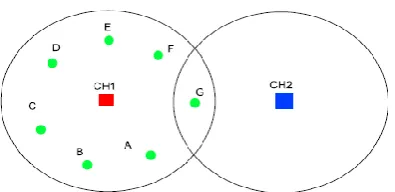
In Cooperative load balancing algorithm the nodes select their channel provider based on the available resources.
Fig 1: Demonstration for the cooperative load balancing algorithm.
Here, the one who have more number of resources are assigned as a cluster head. The Cluster Head is otherwise called as Coordinator. Then, the Cluster head load increases means it will shift their load to next neighbor cluster that has more number of available resources.
4.3
Guaranteed Time Slot Mechanism
The Guaranteed Time Slot (GTS) mechanism is used to transmit time sensitive data and also the nodes get acknowledgement about the data. Here, the GTS will allocate time slots to each specific node in the network. GTS mechanism gives reliable communication with no loss and no duplication of data.
V. SIMULATION RESULTS
the Guaranteed Time Slot (GTS) mechanism is used. Here, time slot is given to each node. That will transmit the packet in timed manner. And also the node consumed low energy with that maximum number of packets is transmitted. The parameters that are used in the system for the performance evaluation is throughput, delay, network lifetime and packet delivery ratio. Here, the performance of proposed system is analyzed with the system.
5.1
Packet Delivery Ratio
Fig 2: Number of sensor node Vs PDR
The performance of packet delivery ratio is compared with the existing system. Here, the packet successful delivery ratio is significantly increased than the existing system.
S
5.2 Delay
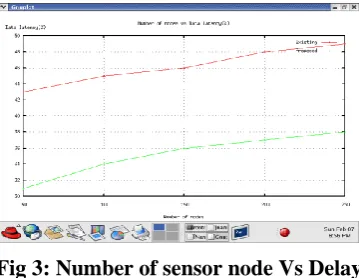
Fig 3: Number of sensor node Vs Delay
In the above figure 3, the performance of delay is described. The packet delay is minimized than the existing system with the help of Guaranteed Time Slot mechanism.
5.3 Throughput
Fig 4: Number of sensor node Vs Throughput
Here, more number of packets will be transmitted in our system. So, that the throughput is increased than the existing system.
5.4 Network life time
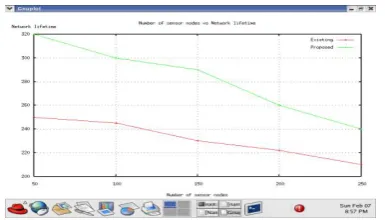
Fig 5: Number of sensor node Vs Network Life time
In the above figure 5, the performance is analyzed with the overall network performance. This will increases the overall performance of the network.
5.5 Energy
Fig 6: Energy Consumption
In the existing system, the node consumes more energy during packet transmission. But, here in proposed system the node consumes low energy that will maximizes the packet transmission.
VI. CONCLUSIONS
REFERENCES
[1] Bora Karaoglu, Member, IEEE and Wendi Heinzelman, IEEE Transactions on mobile computing,
“Cooperative Load Balancing and Dynamic Channel Allocation for Cluster-Based Mobile Ad Hoc
Networks, vol 14, no 5, may 2015.
[2] B.Tavli, and W. B. Heinzelman, “MH-TRACE: Multi hop time reservation using adaptive control for energy efficiency,” IEEE J. Sel. Areas Commun., vol. 22, no. 5, pp. 942–953, Jun. 2004.
[3] M. Felegyhazi, M. Cagalj, S. Bidokhti, and J.-P. Hubaux, “Noncooperative multi-radio channel allocation in wireless networks,” in Proc. IEEE 26th Conf. Comput.Commun., May.2007, pp. 1442–
1450.
[4] Yu-CheeTseng, Chih-MinChao, Dynamic channel allocation with location awareness formulti - hop mobile adhoc networks”, Comput . C omm un.,vol. 25,no. 7, p p. 676–688 , 200 2. [5] Carmela Comito,
Deborah Falcone ,Domenico Talia and Paolo Trunfio “Energy Efficient Task Allocation over Mobile Networks ”.
[5] Wu, K. Kumekawa, and T. Kato, “A MANET protocol considering link stability and bandwidth efficiency,” in Proc. Int. Conf.Ultra ModernTelecommun. Workshops, Oct. 2009, pp. 1–8.
[6] S.Toumpis, and A. Goldsmith, “New media access protocols for wireless ad hoc networks based on cross-layer principles,”IEEE Trans. Wireless Commun., vol. 5, no. 8, pp. 2228–2241,Aug.2006
[7] B. Karaoglu, T. Numanoglu, and W. Heinzelman,“Analytical performance of soft clustering protocols,” Ad Hoc Netw., vol. 9, no. 4,pp. 635–651, Jun. 2011.
[8] J. Xie, A. Das, S. Nandi, and A. Gupta, “Improving the reliability of ieee 802.11 broadcast scheme for multicasting in mobile ad hoc networks,” in Proc. IEEE Wireless Commun. Netw. Conf., 2005, vol. 1,
pp. 126–131.
[9] N. Jain, S.Das, and A.Nasipuri, “A multichannel CSMA MAC protocol with receiver-based channel selection for multihop wireless networks,” in Proc. 10th Int. Conf. Comput.Commun. Netw., 2001, pp.
432–439.
[10] L. Gao, and X. Wang,”A game approach for multi-channel allocation in multi-hop wireless networks,” in Proc. 9th ACM Int. Symp.Mobile Ad Hoc Netw.Comput., 2008, pp. 303–312.
[11] I.Katzela, and M. Naghshineh,”Channel assignment schemes for cellular mobile telecommunication systems: A comprehensive survey,” IEEE Pers. Commun. , vol. 3, no. 3, pp. 10–31, Jun. 1996.
[12] C.-L. I, and P.-H. Chao,’’Distributed dynamic channel allocation algorithms with adjacent channel constraints”, in Proc. 5th IEEEInt.Symp. Personal, Indoor Mobile Radio Commun., Wireless
Netw.-Catching Mobile Future , Sep. 1994, vol. 1, pp. 169–177.
[13] J. Jiang, T.-H.Lai, and N. Soundarajan,’’On distributed dynamic channel allocation in mobile cellular networks”, IEEE Trans. Parallel Distrib. Syst. , vol. 13, no. 10, pp. 1024–1037, Oct. 2002.