R E S E A R C H
Open Access
Testing of aspect-oriented programs:
difficulties and lessons learned based on
theoretical and practical experience
Fabiano C. Ferrari
1*, Bruno B. P. Cafeo
2, Thiago G. Levin
1, Jésus T. S. Lacerda
1, Otávio A. L. Lemos
3,
José C. Maldonado
4and Paulo C. Masiero
4Abstract
Background: Since the first discussions of new challenges posed by aspect-oriented programming (AOP) to software testing, the real difficulties of testing aspect-oriented (AO) programs have not been properly analysed. Firstly, despite the customisation of traditional testing techniques to the AOP context, the literature lacks discussions on how hard it is to apply them to (even ordinary) AO programs based on practical experience. Secondly, and equally
important, due to the cautious AOP adoption focused on concern refactoring, test reuse is another relevant issue that has been overlooked so far. This paper deals with these two issues. It discusses the difficulties of testing AO programs from three perspectives: (i) structural-based testing, (ii) fault-based testing and (iii) test set reuse across paradigms. Methods: Perspectives (i) and (ii) are addressed by means of a retrospective of research done by the authors’ group. We analyse the impact of using AOP mechanisms on the testability of programs in terms of the underlying test models, the derived test requirements and the coverage of such requirements. The discussion is based on our experience on developing and applying testing approaches and tools to AspectJ programs at both unit and integration levels. Perspective (iii), on the other hand, consists of recent exploratory studies that analyse the effort to adapt test sets for refactored systems and the quality of such test sets in terms of structural coverage.
Results: Building test models for AO programs imposes higher complexity when compared to the OO paradigm. Besides this, adapting test suites for OO programs to AO equivalent programs tends to require less effort than doing the other way around, and resulting suites achieve similar quality levels for small-sized aplications.
Conclusions: The conclusion is that building test models for AO programs, as well as deriving and covering paradigm-specific test requirements, is not straightforward as it has been for procedural and object-oriented (OO) programs at some extent. Once you have test suites in conformance with programs implemented in both paradigms, the quality of such suited in termos of code coverage may vary depending on the size and characteristics of the applications under testing.
Keywords: Software testing, Aspect-oriented programming, Object-oriented programming, Software refactoring, Test reuse
*Correspondence: [email protected]
1Computing Department, Federal University of São Carlos, Rod. Washington Luis, km 235, 13565-905 São Carlos, SP, Brazil
Full list of author information is available at the end of the article
Introduction
In 2004, Alexander et al. [1] first discussed the chal-lenges posed by aspect-oriented programming (AOP) to the software testing researchers. They enumerated poten-tial sources of faults in aspect-oriented (AO) programs, ranging from the base code itself (i.e. not directly related to aspectual code) to emerging properties due to multi-ple aspect interactions. In the same report, they proposed a candidate, coarse-grained fault taxonomy for AO pro-grams. Ever since, the software testing community has been investigating ways of dealing with the challenges described by them. In summary, research on testing of AO programs (hereafter called AO testing) has been mainly concerned with: (i) the characterisation of fault types and bug patterns [2–7], (ii) the definition of underlying test models and test selection criteria [8–18] and (iii) the provision of automated tool support [11, 14, 16, 18–22]. In particular, structural-based and mutation-based test-ing have been on focus by several research initiatives [8, 9, 11–29].
Despite the variety of approaches for testing AO soft-ware, too little has been reported about the difficul-ties of applying them based on practical experience. In other words, researchers rarely discuss the difficulty of fulfilling AO-specific test requirements and the abil-ity of their approaches in revealing faults in AO pro-grams. For example, questions like “how hard is for one to create a test case to traverse a specific path in an AO program graph (in structural-based testing)?” and “how hard is for one to kill an AO mutant (in mutation-based testing)?” can hardly be answered based on the analysis and discussions presented in the exist-ing literature. Besides this, we observe that, even after almost two decades of the AOP dissemination, it is still adopted with caution by practitioners and researchers. This fact was observed in two relatively recent reports [30, 31]. From our experience and observations, when adopted, AOP is applied to refactor existing object-oriented (OO) systems to achieve better modularisation of behaviour that appears intertwined or spread across the system modules (these are the so-calledcrosscutting concerns [32]). Examples of AOP applied in this con-text can be found in the work of van Deursen et al. [2], Mortensen et al. [33], Ferrari et al. [34] and Alves et al. [35, 36], not limited to particular technologies such as Java and AspectJ.
Our previous research investigated the fault-proneness of AO programs based on faults identified during the testing of real-world AO applications [34]. This is related to the first aforementioned topic (i.e. fault characterisation). The conclusion was that, amongst the main mechanisms commonly used in AO pro-grams, none of them stands out in terms of fault-proneness. In that exploratory study, we used test sets
built upon the OO versions of the applications and then used such test sets to evaluate the AO counter-parts with some test set customisations. Even though that study [34] addressed the reuse of test suites in refactoring scenarios, we did not provide any discus-sion with respect to the achieved code coverages, nei-ther with respect to effort required for reusing test sets.
In this paper, we revisit our contributions on AO test-ing achieved by our research group along the last decade. We discuss the challenges and difficulties of testing AO programs from three perspectives: (i) structural-based testing, (ii) fault-based testing and (iii) test set reuse across programming paradigms. Regarding perspectives (i) and (ii), we analyse the impact of using AOP mechanisms on the testability of programs in terms of the definition of the underlying models, the derivation of test requirements and the coverage of the requirements. In regard to the perspective (iii), considering the OO and AO paradigms, we address the effort for adapting test suites from one paradigm to the other and analyse the quality of reused test sets in both paradigms.
We highlight upfront that this paper extends the dis-cussions and results presented in a previous publication [37]. In order to extend our previous work, we focused on the aforementioned perspective (iii)—test set reuse across programming paradigms. We report on the results of a recently performed exploratory study that measures the effort (in terms of code changes) required to adapt test suites from one paradigm to the other and vice versa. Beyond this, we measure the structural coverage that results from the applied test sets. The reader should notice the points presented in this paper rely on our practi-cal experience of establishing and applying approaches to test AO programs by means of theoretical definitions and exploratory assessments.
Background
Structural testing
Structural testing—also called white-box testing—is a technique based on internal implementation details of the software. In other words, this technique establishes testing requirements based on internal structures of an application. As a consequence, the main concern of this technique is with the coverage degree of the program logic yielded by the tests [38].
In structural testing, acontrol flow graph(CFG) is typ-ically used to represent the control flow of a program. A CFG is a directed graph representing the order in which the individual statements, instructions or function calls of program are executed. In a CFG, nodes represent a statement or a block of statements, and edges represent the flow of control from one statement or block of state-ments to another. In the context of this paper, we define a block of statement as a set of statements of a program. After the execution of the first statement of the block, the other statements within the block are sequentially executed according to the control flow. Each block corre-sponds to a node in the CFG and the transfer of control from one node to another is represented by directed edges between nodes.
Test selection criteria (or simplytesting criteria) based on control flow use only information about the execu-tion flow of the program such as statements and branches to determine which structures need to be tested. Typical structural-based testing criteria defined based on a CFG are all-nodes, all-edges and all-paths [38]. These criteria require test cases that exercises all nodes (i.e. all state-ments), all edges (i.e. all branches), and all paths (i.e. all possible combination of nodes and edges) that compose a CFG, respectively. It is important to notice that, although desirable, the coverage of all of these criteria is unfeasi-ble in general. For instance, the coverage of the all-paths criterion may be impracticable due to the high number of paths in a CFG. This and other limitations of the con-trol flow-based criteria motivated the introduction of data flow-based criteria.
For data flow-based testing, thedef-use graph extends the CFG with information about the definitions and uses of variables [39]. Data flow-based testing uses data flow analysis as source of information to derive testing require-ments. In other words, the interactions involving defini-tion of variables and use of such definidefini-tions are explored to derive test requirements. For our purposes, the occur-rence of a variable in a program is classified either as a definition or a use. We consider as a definitiona value assignment to a variable. With respect to use occurrences, we consider as a predicate use (p-use), a use of a variable associated with the decision outcome of the predicate por-tion of a decision statement—e.g. if (x == 0)—and as a computational use (c-use), a use of a variable that directly
affects a computation and it is not a p-use—e.g.y = x + 1. P-uses are associated to the def-use graph edges and c-uses are associated to the nodes. A definition clear path (def-clear path) is a path that goes from the definition place of a variable to a subsequent c-use or p-use, such that the variable is not redefined along the way. A def-use pair with respect to some variable is then a pair of defi-nition and subsequent use locations such that there is a def-clear path with respect to that same variable from the definition to the use location [39]. If a def-use graph is used as the underlying model, typical criteria are all-defs and all-uses [39]. In short, such data flow-based criteria require test cases that traverse paths that include the def-inition and subsequent uses of variables of the program. For more information about the structural-testing criteria mentioned in this section, the reader may refer to seminal studies of structural testing [38, 39]).
Fault-based testing and mutation testing
The fault-based testing technique derives test require-ments based on information about recurring errors made by programmers during the software development pro-cess. It focuses on types of faults which designers and programmers are likely to insert into the software and on how to deal with this issue in order to demonstrate the absence of such prespecified faults [40]. In this tech-nique, fault models (or fault taxonomies) guide the selec-tion or design of test cases that are able to reveal fault types characterised on such models. Fault models and tax-onomies can be devised from a combination of historical data, researchers’ and practitioners’ expertise and specific programming paradigm concepts and technologies.
The most investigated and applied fault-based test selec-tion criterion is the mutant analysis [41], also known as mutation testing. Basically, it consists in creating several versions of the program under testing, each one contain-ing a simple fault. Such modified versions of the program are called mutants and are expected to behave differ-ently from the original program. Each mutant is executed against the test data and is expected to produce a differ-ent output when compared to the execution of the original program.
In mutation testing, given an original programP, muta-tion operators encapsulate a set of modification rules applied toPin order to create a set of mutantsM. Then, for each mutantm,(m ∈ M), the tester runs a test suite T originally designed forP. If∃t,(t ∈ T)|m(t) = P(t), this mutant is consideredkilled. If not, the tester should enhance T with a test case that reveals the difference betweenmandP. IfmandPare equivalent, thenP(t)= m(t)for all test cases that can be derived fromP’s input domain.
of the test data (i.e.T). In the first case, faults inP are uncovered when fault-revealing mutants are identified. Given thatSis the specification ofP, a mutant is said to be fault-revealing when it leads to the creation of a test case that shows thatP(t)=S(t),(t∈T)([42] p. 536).
In the second case, mutation testing evaluates how sen-sitive the test set is in order to identify as many faults simulated by mutants as possible.
Mutation testing is usually performed in four steps [41]: (1) execution of the original program, (2) generation of mutants, (3) execution of the mutants and (4) analysis of the mutants. After each cycle of mutation testing, the current result is calculated through the mutation score, which is the ratio of the number of killed mutants to the total number of generated (non-equivalent) mutants. The mutation score is a value in the interval [ 0, 1] that reflects the quality of the test set with respect to the produced mutants. The closer to 1 the mutant set is, the higher the quality of the test set [42].
Aspect-oriented programming
Aspect-oriented programming (AOP) [32] relies in the principle of separation of concerns (SoC) [43]. Software concerns, in general, may address both functional require-ments (e.g. business rules) and non-functional properties (e.g. synchronisation or transaction management). In the context of AOP, a concern is handled as a coarse-grained feature that can be modularised within well-defined implementation units. In AOP, the so-calledcrosscutting concernscannot be properly modularised within conven-tional units [32]. For example, in tradiconven-tional programming approaches like procedural and object-oriented program-ming (OOP), code that implements a crosscutting concern usually appears scattered over several modules and/or tangled with other concern-specific code. Other (non-crosscutting) concern codes comprise thebase codeof the software.
To improve the modular implementation of crosscut-ting concerns, AOP introduces the notion of aspects. An aspect can be either a conceptual programming unit or a concrete, specific unit named aspect (as in widely investigated languages such as AspectJ1 and CaesarJ2). Once both aspects and base code are developed, they are
combined during a weaving process [32] to produce a
complete system.
In AspectJ, which is the most investigated AOP lan-guage and whose implementation model has inspired the proposition of several other languages, aspects have the ability to modify the behaviour of a program at specific points during its execution. Each of the points at which aspectual behaviour is activated is called ajoin point. A set of join points is identified by means of a pointcut descriptor or simplypointcut. A pointcut is represented by a language-based matching expression that identifies a
set of join points that share some common characteris-tic (e.g. based on properties or naming conventions). This selection ability is often referred to asquantification[44]. During the program execution, once a join point is identified, a method-like construct named advice may run, depending or not of some runtime checking routine. Advices can be of different types depending on the sup-porting technology. For example, in AspectJ, advices can be defined to run at three different moments when a join point is reached:before,afteroraround(in place of ) it.
AspectJ can also perform structural modifications of modules that comprise the base code. These modifica-tions are achieved by the so-called intertype declara-tions (ITDs). Examples of intertype declarations are the introduction of a new attribute or method into a base module or a change in the class’ inheritance.
Structural-based viewpoint analysis
This section revisits the contributions of our research group on structural testing of AO programs. It addresses three main concerns of systematic testing: the establish-ment of underlying structural models (section ‘Creating an underlying model’), the identification of relevant test requirements based on that models (section ‘Deriving test requirements’) and the difficult to analyse and cover such requirements (section ‘Covering and analysing test requirements’).
Creating an underlying model
As described in Section ‘Structural testing’, the basic idea behind structural testing criteria is to ensure that spe-cific elements (control elements and data structures) in a program are exercised by a given test set, providing evidence of the quality of the testing activity. It is sup-posed that the underlying model represents the dynamic behaviour of programs based on static information to gen-erate relevant test requirements. In general, such static information is extracted from the source code. However, there may be differences between what is extracted from source code and what is the real dynamic behaviour. In techniques such as OO programming, such differences can be seen in cases of, for example, member (e.g. method or attribute) overriding and method overloading. In such cases, a special representation of these cases in the under-lying model can help to reveal problems related to the dynamic behaviour.
dynamic behaviour is more evident. For example, AOP allows the use of different mechanisms, such as thecflow
command or the around advice, which are inherently
runtime-dependent.
To ameliorate the aforementioned problem, our research group applies a more sophisticated approach. We devised a series of underlying test models based on static information which are closer to the dynamic behaviour of the program. We consider specific situations that happens in OO and AO to be represented in the models and then generate relevant test requirements for testing dynamic behaviour of that program. We use the Java bytecode to generate the underlying model for programs written in Java and AspectJ [11, 14, 16, 24, 46]. We take advantage of the AspectJ weaving process to extract static information of two different programming languages from one unified representation (the Java bytecode). This reduces the gap between static information and dynamic behaviour of a program. Moreover, our approach handles some particular cases where the bytecode does not have sufficient information for building the underlying model. This is related to information that enables the genera-tion of relevant test requirements for testing OO and AO programs such as overriding, recursion and around advice.
Deriving test requirements
Structural testing uses an internal perspective of the sys-tem to define testing criteria and derive test requirements. These test requirements aim at exercising the program’s data structures and its control flow. To better analyse the issues of deriving test requirements in AO programs, we summarise some research that has proposed structural testing criteria for procedural and OO programs. After-wards, we describe adapted (procedural and OO) criteria to AO programs and contrast them with AO-specific to emphasise the tricks of deriving test requirements in AO programs.
Structural requirements for procedural and OO programs Control flow- and data flow-based criteria for procedu-ral programs (e.g. all-nodes, all-edges and all-uses) are well-established. They date from 30 years ago [39] and have been evolved to address the integration level [47]. The underlying models explicitly show the internal logic of units and the data interactions when either unit or integration testing is on focus.
For OO programs, control flow and data flow criteria are evolutions of criteria defined for procedural programs. For instance, Harrold and Rothermel [48] addressed the structural testing of OO programs by defining data flow-based criteria for four test levels: intra-method, inter-method, intra-class and inter-class. The authors addressed only explicit unit interactions; dealing with polymorphic
calls and dynamic binding issues—i.e. OO specificities— was listed as future work [48].
Inspired by Harrold and Rothermel’s criteria, Vincenzi et al. [49] presented a set of testing criteria based on both control flow and data flow for unit (i.e. method) testing. Vincenzi et al. approach relies on Java bytecode analysis and is automated by the JaBUTi tool. As the reader can notice, unit interactions was again not addressed by the author.
Structural requirements for AO programs
In our research [11], we developed an approach for unit testing of AO programs considering a method or an advice as the unit under testing. We proposed a model to rep-resent the control flow of a unit and the join points that may activate an advice. Special types of nodes, the so calledcrosscutting nodes, are included in the CFG to rep-resent additional information about the type of advice that affects that point, as well as the name of the aspect the advice belongs to. Control flow and data flow testing crite-ria are proposed to particularly require paths that include the crosscutting nodes and their incoming and outgoing edges.
To address the integration level, we explored the pair-wise integration testing of OO and AO programs [14]. In short, the approach combines two communicating units into a single graph. We also defined a set of control flow and data flow criteria based on such representa-tion. Figure 1 exemplifies the integration of two units (caller and called). Note that one of the units is affected by a before advice, which is represented with the cross-cutting node notation. Note that crosscross-cutting nodes are represented as dashed, elliptical nodes.
Neves et al. [46] developed an approach for integra-tion testing of OO and AO programs in which a unit is integrated with all the units that interact with it in a single level of integration depth. We presented an evo-lution [24] of the approaches presented by ourselves [11, 14] and by Neves et al. [46]. We augmented the inte-gration of units considering deeper interaction chains (up to the deepest level), without making the integration test-ing activity too expensive, since we integrate units in a configurable level of integration depth. Such augmented integration approach also brings customised control flow and data flow criteria. We highlight that all the representa-tion models we proposed relies on Java bytecode analysis; furthermore, they all represent crosscutting nodes using a special type of node as shown in Fig. 1.
(a)
(b)
(c)
Fig. 1Example of an integrated CFG for the pairwise approach [14]Covering and analysing test requirements
In a series of preliminary assessment studies, we emphasised the effort required to cover test require-ments derived from the proposed criteria for pair-wise testing [14], multi-level integration testing [24] and
pointcut-based integration testing [16]. A summary of the results is depicted in Table 1.
For each application we collected, for example, the num-ber of test cases required to cover 100 % of all-nodes, all-edges and all-uses of each unit (#u.TCs in Table 1)
Table 1Results of evaluation study of structural-based testing approaches
Application and basic metrics Pairwise [14] Multi-level integration [24] Pointcut-based [16]
Max
#C #A #u #u. #ad. %ad. #u. Depth #ad. %ad. #u. #ad. %ad.
TCs TCs TCs TCs Depth TCs TCs TCs TCs TCs
1. Stack 4 2 13 5 0 0 5 4 0 0 5 0 0
2. Subj-obs 5 2 14 6 0 0 6 2 0 0 6 0 0
3. Bean 1 1 15 5 0 0 5 4 0 0 5 0 0
4. Telecom 6 3 46 22 2 9 23 3 2 9 22 1 5
5. Music 10 2 45 19 3 16 22 4 4 18 19 3 16
6. Shape 5 1 52 25 6 24 14 6 21 150 25 0 0
Average 5.2 1.8 30.8 13.7 1.8 8.2 12.5 3.8 4.5 29.5 13.7 0.7 3.5
and the number of additional test cases required to cover requirements derived from the testing criteria of each approach (#ad.TCs in Table 1). Note that in these studies, we targeted optimal test sets with the minimum number of test cases as possible.
Analysing Table 1, we notice that in three applications (Stacks,Subj-obsandBean), no additional effort was nec-essary considering all testing approaches. The other three applications (Telecom,MusicandShape) needed less than 25 % of additional test cases from the initial unit test set to cover the testing criteria of each approach. Thus, it is pos-sible to say that the average of additional test cases needed to cover the requirements for integration testing criteria is not high. The cost of using these criteria is not high com-pared to the possible benefits achieved by applying such criteria. The only exception was the number of additional test cases of the multi-level integration approach in the Shapeapplication. In this case, due to the depth consid-ered during the generation of the test requirements, the cyclomatic complexity of some units largely increased the number of required test cases. In this way, we can say that, despite the possible applicability of the criteria, some of
them may be heavily affected by structural characteristics of the implementation.
Despite the low number of additional test cases required to cover all test requirements of the proposed approaches, the analysis of the underlying model for creating test cases is not trivial. It is essential that the model facilitates the understanding of the dynamic behaviour of a program and thus the generation of relevant test cases.
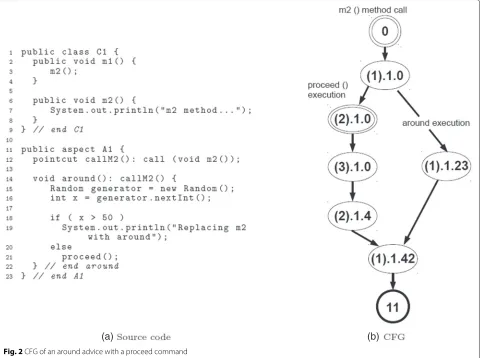
The example of Fig. 2 illustrates how anaroundadvice that is activated at a method call can be represented to enhance the comprehension of dynamic behaviour of a program. Is is obtained by applying the aforemen-tioned multi-level integration approach by Cafeo and Masiero [24].
In this example, the node labelled with “0” represents the call tom2which happens inside m1(line 3). In this case, the CFG of thearoundadvice is integrated in place of them2’s CFG (this integration starts in node labelled with “(1).1.0”). Along thearoundexecution, theproceed instruction may be invoked, depending on a predicate evaluation (line 18, which is included in the “(1).1.0” node). If theproceedis invoked, then the original join
(a) (b)
point is executed (nodes labelled with “(2).1.0”, “(3).1.0” and “(2).1.4”). Alternatively, onlyaroundinstructions are executed (this is represented by the node labelled with “(1).1.23”).
In short, the CFG shown in Fig. 2 tries to represent an execution that depends on a runtime evaluation by show-ing the replacement of the join point by the advice and the return of the execution flow to the join point by the execution of the proceed command.
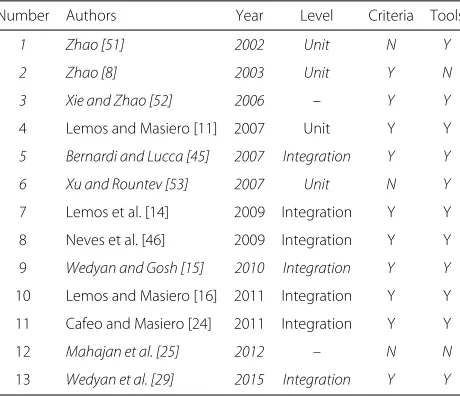
Related work on structural-based testing of AO programs To the best of our knowledge, few approaches and test-ing criteria have been defined for structural testtest-ing of AO programs. Table 2 shows a list of them. Such pieces of work either propose testing approaches or explore inter-nal implementation details of the software to support testing activity. The studies were selected based on recent literature and on a systematic review about AO software testing [50]. For each work listed in the table, the following information is presented: authors (Authors), year of pub-lication (Year), testing level (Level), whether the approach defines testing criteria (Criteria) and whether the work implements a supporting tool (Tools). The table highlights in italics the contributions that are not from our research group in order to compare them with our work.
Zhao [8, 51] developed a data-flow testing approach for AO programs, based on the OO approach proposed by Harrold et al. [48], addressing the testing of interfaces from the aspect perspective and from the class perspec-tive. Differently from the contributions of our research group, Zhao considers a unit to be a class or an aspect and relies on source code analysis to enables the graph generation.
Table 2List of related work on structural testing of AO programs
Number Authors Year Level Criteria Tools
1 Zhao [51] 2002 Unit N Y
2 Zhao [8] 2003 Unit Y N
3 Xie and Zhao [52] 2006 – Y Y
4 Lemos and Masiero [11] 2007 Unit Y Y
5 Bernardi and Lucca [45] 2007 Integration Y Y
6 Xu and Rountev [53] 2007 Unit N Y
7 Lemos et al. [14] 2009 Integration Y Y
8 Neves et al. [46] 2009 Integration Y Y
9 Wedyan and Gosh [15] 2010 Integration Y Y
10 Lemos and Masiero [16] 2011 Integration Y Y
11 Cafeo and Masiero [24] 2011 Integration Y Y
12 Mahajan et al. [25] 2012 – N N
13 Wedyan et al. [29] 2015 Integration Y Y
Y/Nyes/no,−not mentioned
Xie and Zhao [52] presented an approach for structural-and state-based testing with support of a framework called Aspectra. In their approach, the framework generates wrapper classes. These classes are the input of a tool that generates test cases for aspectual behaviour considering structural and state-based coverage. This approach is a mixed approach (structural- and state-based) focusing on test case generation. Our contributions focus on propos-ing different control flow and data flow testpropos-ing criteria for AO programs.
Bernardi and Lucca [45] also proposed a similar approach to our work [14, 16, 24, 46]. They defined a graph to represent the interactions between a base program and the pieces of advice interacting with it. They also defined some control flow-based criteria from such model. However, their approach does not incorpo-rate data-flow analysis. Furthermore, to the best of our knowledge, no implementation of the approach has been presented yet.
Xu and Rountev [53] proposed an approach for regres-sion testing of AO programs. This approach uses a con-trol flow graph to analyse additional behaviour added by aspects as a way of generating regression testing require-ments. Despite using control flow graph and proposing a tool for generating test requirements, Xu and Rountev did not propose testing criteria for AO programs.
Mahajan et al. [25] applied genetic algorithm to improve data flow-based test data generation. In this approach, the authors use the CFG to generate the data flow model of the program under test (i.e. def-use graph). Based on this information, they apply a genetic algorithm on it with many different parameters. The goal is to generate several test sets in order to reach 100 % of coverage of the all-uses criterion. Differently from the contributions of our research group, Mahajan et al. focus on generating test sets based on structural information instead of present-ing an approach with an underlypresent-ing model and testpresent-ing criteria.
Finally, Wedyan and Gosh [15] and Wedyan et al. [29] presented an approach and tool implementation for mea-suring data flow coverage based on state variables defined in base classes or aspects. The goal of the approach is to prevent faults resulting from interactions (i.e. data flow) between base classes and aspects by focusing on attributes responsible for change the behaviour of both (state variables). Similarly to the work of our research group, they also define data flow criteria for AO programs. However, they only focus on the interaction between base classes and aspects established by the so-called state variables.
Mutation-based viewpoint analysis
group on fault-based testing (in particular, mutation test-ing) of AO programs.
Creating an underlying model
As introduced in section ‘Fault-based testing and muta-tion testing’, fault-based testing relies on fault models and fault taxonomies—that is, sets of prespecified faults [40]. For AO software, fault taxonomies are mostly based on the pointcut–advice–intertype declaration (ITD) model implemented in AspectJ. We proposed a preliminary fault taxonomy for AO programs that take into consideration only faults related to pointcuts [54]. Afterwards, we iden-tified, grouped together and added to our taxonomy sev-eral fault types for AO software that have been described by other researchers [1–5]. Additionally, we included new fault types that can occur in programs written in AspectJ [7, 12].
In total, our taxonomy encompasses 26 different fault
types distributed over four categories. Category F1
includes eight pointcut-related fault types that address, for instance, incorrect join point quantification, misuse of primitive pointcut designators and incorrect pointcut composition rules. CategoryF2includes nine fault types that regard ITD- and declare-like expressions. Exam-ples of fault types in this category are improper class member introduction, incorrect changes in exception-dependent control flow and incorrect aspect instantiation rules. Category F3 describes six types of faults related to advice definition and implementation. Examples ofF3 fault types are improper advice type specification, incor-rect advice logic and incorincor-rect advice-pointcut binding. Finally, categoryF4includes three faults types whose root causes can be assigned to the base program. For instance, code evolution that causes pointcuts to break and duplicated crosscutting code due to improper concern refactoring.
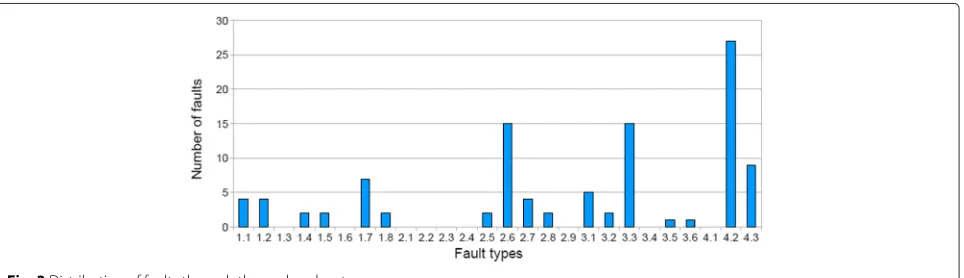
We used the taxonomy to classify 104 faults docu-mented from three medium-sized AO systems [7]. The chart of Fig. 3 summarises the distribution. In thex-axis,
fault types 1.1–1.8 are related to pointcuts, 2.1–2.9 are related to ITDs, 3.1–3.6 are related do advices and 4.1– 4.3 are related to the base code. Overall, the taxonomy has shown to be complete in terms of fault categories. It also helped us to characterise recurring faulty imple-mentation scenarios3that should be checked during the development of AO software.
Deriving test requirements
According to section ‘Fault-based testing and mutation testing’, mutation testing [41] is a largely explored fault-based criterion. Based on a fault taxonomy, mutation operators are designed to insert faults into a program (i.e. to create the mutants). The mutants are used to evalu-ate the ability of the tests to reveal those artificial faults. In this context, in this section, we first summarise how mutation operators have been designed for procedural and OO paradigms. Then, we contrast this process with the designing of AO operators.
Mutation operators for procedural and OO programs Agrawal et al. [55] designed a set of unit mutation operators—77 operators in total—for C programs, which was based on an existing set of 22 mutation opera-tors for Fortran [56]. Although the number of C-based mutation operators is much larger than the number of Fortran-based ones, Agrawal et al. explain that their operators are either customisations or extensions of the latter, however considering the specificities of the C language.
Delamaro et al. [57] addressed the mutation testing of procedural programs at the integration level. The authors characterised a set of integration faults related to com-munication variables (i.e. variables that are related to the communication between units such as formal parameters, local and global variables and constants).
They then proposed the interface mutation criterion, which focuses on communication variables and encom-passes a set of 33 mutation operators for C programs.
In 2004, Vincenzi [58] analysed the applicability of these two sets of C-based operators in the context of OO pro-grams. The author focused on C++ and Java propro-grams. With a few customisations and restrictions, Vincenzi concluded that most of the operators are straightfor-wardly applicable to programs written in these two languages.
The 24 inter-class mutation operators for Java programs proposed by Ma et al. [59] intend to simulate OO-specific faults. They focus on changes of variables but also address the modification of elements related to inheritance and polymorphism (e.g. deletion of an overriding method or class field or removal of references to overridden meth-ods and fields). This is clearly an attempt to address paradigm-specific issues, even though some preliminary assessment has shown that the operators are not effective in simulating non-trivial faults [60]4.
Based on this brief analysis, we conclude that design-ing those operators was a “natural” evolution of opera-tors previously devised for procedural programs, despite addressing different testing levels (i.e. unit and integra-tion testing) and fault types. A few excepintegra-tions regard some class-level operators [59] which still require assessment through empirical studies.
Mutation operators for AO programs
Similarly to structural-based approaches for OO pro-grams, all the mentioned sets of mutation operators can be applied to AO programs. However, they are not intended to cover AOP-specific fault types.5 To apply mutation testing to AO programs properly, one must consider the new concepts and, in particular, the
AOP mechanisms together with fault types that can be introduced into the software. The design of mutation operators for AO programs must take these factors into account.
In our previous research, we designed a set of 26 muta-tion operators for AspectJ programs [12]. The opera-tors address instances of several fault types (18 in total) described in the taxonomy mentioned in section ‘Creating an underlying model’. In particular, the operators simu-late instances of faults within the first three categories (the groups are namedG1,G2andG3, each one simulat-ing faults of categoriesF1,F2andF3, respectively). These fault types are strictly related with the main concepts introduced by AOP.
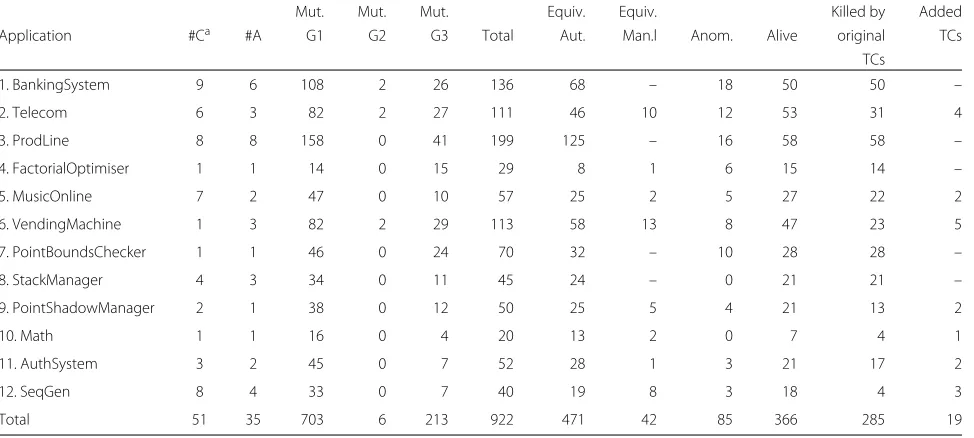
In a preliminary assessment study, we checked the abil-ity of the operators to simulate non-trivial faults [26]. We applied the operators to 12 small AspectJ applications and ran the non-equivalent mutants on a functional-based test set. Table 3 summarises the study results. It includes some metrics for the systems (e.g. the number of classes and aspects); the number of mutants by group of operators; the number of equivalent, anomalous and live mutants; the number of mutants killed by the original test set; and the number of test cases that have been added to kill the mutants that remained alive.
Regarding the numbers of mutants for each group of operators (columns four to six in the table), we can observe that changes applied to pointcuts (i.e. operators fromG1group) yield the largest number of mutants for all systems except for FactorialOptimiser. In total, they represent nearly 76 % of mutants (703 out of 922). This was expected since G1 is the largest operator group,
Table 3Results of evaluation study of mutation-based testing
Mut. Mut. Mut. Equiv. Equiv. Killed by Added
Application #Ca #A G1 G2 G3 Total Aut. Man.l Anom. Alive original TCs
TCs
1. BankingSystem 9 6 108 2 26 136 68 – 18 50 50 –
2. Telecom 6 3 82 2 27 111 46 10 12 53 31 4
3. ProdLine 8 8 158 0 41 199 125 – 16 58 58 –
4. FactorialOptimiser 1 1 14 0 15 29 8 1 6 15 14 –
5. MusicOnline 7 2 47 0 10 57 25 2 5 27 22 2
6. VendingMachine 1 3 82 2 29 113 58 13 8 47 23 5
7. PointBoundsChecker 1 1 46 0 24 70 32 – 10 28 28 –
8. StackManager 4 3 34 0 11 45 24 – 0 21 21 –
9. PointShadowManager 2 1 38 0 12 50 25 5 4 21 13 2
10. Math 1 1 16 0 4 20 13 2 0 7 4 1
11. AuthSystem 3 2 45 0 7 52 28 1 3 21 17 2
12. SeqGen 8 4 33 0 7 40 19 8 3 18 4 3
Total 51 35 703 6 213 922 471 42 85 366 285 19
and the mutation rules encapsulated in these operators addresses varied parts of pointcuts. Nonetheless, as dis-cussed in the next section, the analysis step for pointcut-related mutants can be partially automated, thus reducing the effort required for this task.
Covering and analysing test requirements
According to the results presented in Table 3, the oper-ators were able to introduce non-trivial faults into the systems. In total, 39 mutants remained alive after their execution against the respective test sets in 7 out of 12 systems.
The main point with respect to covering and analysing mutation-based test requirements regarded the analysis of mutants to figure out if we needed to either classify them as equivalent or devise new test cases to kill them. The analysis of conventional mutants (i.e. derived from non-AO programs) is typically unit-centred; the task is concentrated on the mutated statement and perhaps on its surrounding statements. For AO mutants, on the other hand, detecting the equivalent ones may require a broader, in-depth analysis of the woven code.6 This is due to the quantification and obliviousness properties [44] that are realised by AOP constructs such as pointcuts, advices and declare-like expressions.
In the sequence, we present an example to illustrate sce-narios in which in-depth system analyses were required in order to classify mutants as equivalent.
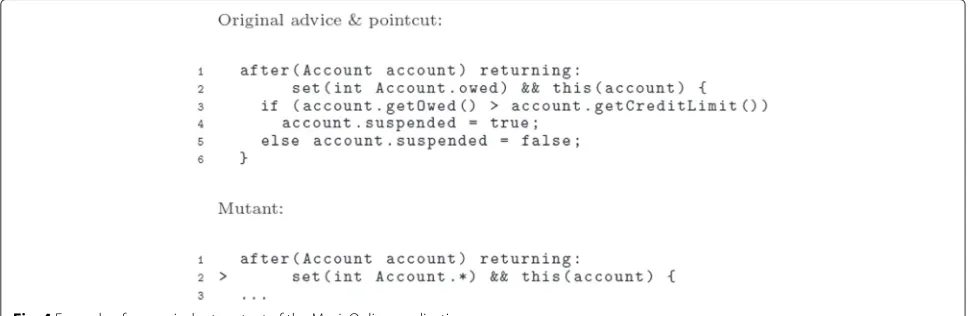
The code excerpts shown in Fig. 4 characterise a sce-nario in which an in-depth analysis was required. It con-sists of a pair advice–pointcut and a pointcut mutant produced by thePWIWoperator (pointcut weakening by insertion of wildcards) for theMusicOnlinesystem, which consists in an online music service presented by Bodkin and Laddad [62]. The mutation is the replacement of a naming part of the pointcut (i.e. the owed attribute that appears in line 2) with the “∗” wildcard. At the first view, the mutant could not be classified as equivalent,
since the mutant pointcut matched four join points in the base code, while the original pointcut matched only three. This additional activation of the after returning advice represents undesired control flow. However, the extra advice execution did not produce an observable failure. In this case, the advice logic sets the account status— suspended or not—according to the current credit limit.
The extra advice execution would set the suspended
attribute as false twice in a roll; nevertheless, the sys-tem behaves as expected despite this undesired execution control flow. Consequently, this mutant must be classi-fied as equivalent. For this mutant, the conclusion is that even though the mutation impacted on the quantifica-tion of join points, the behaviour of the woven applicaquantifica-tion remained the same.
Mutations such as the one shown in Fig. 4 requires dynamic analyses of the woven code to help one iden-tify (un)covered test requirements, since the aspect-base interactions cannot be clearly seem at the source code level. Even though current IDEs such as AJDT7provide the developer with hints about the relationship about aspects and the base code, understanding the behaviour of the woven application to decide about equivalence regard-ing semantics cannot be feasible based only on static infor-mation. On the other hand, as shown in Table 3, many mutants were automatically classified as equivalent.8 In total, around 50 % of the mutants were automatically classified as equivalent (471 out or 922). They are all pointcut-related mutants, and the automatic detection of the equivalent ones is based on the analysis ofjoin point static shadows[63]. If two pointcuts capture the same set of join points, they are considered equivalent, despite the dynamic residues left in the base code during the weaving process.
Recently, we investigated the cost reduction of mutation testing based on the identification of sufficient mutation operators [28]. We ran the sufficient procedure [64] on a group of 12 small AspectJ applications, which are the same
applications tested by Ferrari et al. [26]. The procedure output is a subset of mutation operators that can keep the effectiveness of a reduced test suite in killing mutants pro-duced by all operators. The results of our study point out a five-operator set that kept the mutation score close to 94 %, with a cost reduction of 53 % with respect to the number of mutants we had do deal with.
Related work on mutation-based testing
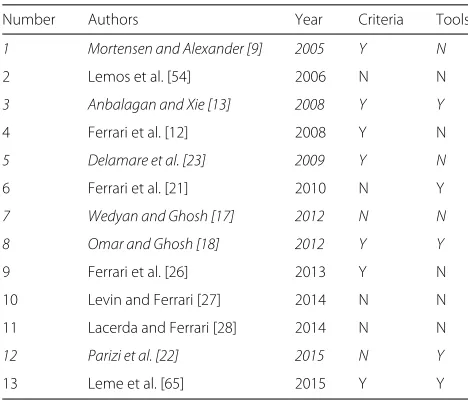
Apart from our contributions, some other researchers have been investigating fault based-testing for AO pro-grams, mainly focusing on mutation testing. Their ini-tiatives are summarised in Table 4. Such pieces of work either customise the mutation testing for AO programs, apply the criterion as a way of assessing other testing approaches, or describe a tool. Again, the studies were selected based on recent literature and on a systematic review about AO software testing [50]. For each work listed in the table, the following information is presented: authors (Authors), year of publication (Year), whether the approach customises mutation testing to be applied to AO programs and whether the work implements a supporting tool (Tools). The table highlights in italics the contribu-tions that are not from our research group in order to compare them with our work.
Mortensen and Alexander [9] defined three muta-tion operators to strengthen and weaken pointcuts and to modify the advice precedence order. However, the authors did not provide details of syntactic changes and implications of each operator. In our research [12], we precisely described the mutations performed by each operator.
Table 4List of related work on fault-based testing of AO programs
Number Authors Year Criteria Tools
1 Mortensen and Alexander [9] 2005 Y N
2 Lemos et al. [54] 2006 N N
3 Anbalagan and Xie [13] 2008 Y Y
4 Ferrari et al. [12] 2008 Y N
5 Delamare et al. [23] 2009 Y N
6 Ferrari et al. [21] 2010 N Y
7 Wedyan and Ghosh [17] 2012 N N
8 Omar and Ghosh [18] 2012 Y Y
9 Ferrari et al. [26] 2013 Y N
10 Levin and Ferrari [27] 2014 N N
11 Lacerda and Ferrari [28] 2014 N N
12 Parizi et al. [22] 2015 N Y
13 Leme et al. [65] 2015 Y Y
Y/Nyes/no
Anbalagan and Xie [13] automated two pointcut-related mutation operators defined by Mortensen and Alexander [9]. Mutants are produced through the use of wildcards as well as by using naming parts of original pointcut and join points identified from the base code. Based on heuris-tics, the tool automatically ranks the most representative mutants, which are the ones that more closely resemble the original pointcuts. The final output is a list of the ranked mutants; no other mutation step is supported. The set of mutation operators proposed in our research [12] includes and refines the operators defined by Anbalagan and Xie.
Delamare et al. [23] proposed an approach based on test-driven development concepts and mutant analysis for testing AspectJ pointcuts. Their goal was to validate point-cuts by means of test cases that explicitly define sets of join points that should be affected by specific advices. A mutation tool named AjMutator [20] implements a sub-set of our pointcut-related operators [12]. The mutant pointcuts are used to validate the effectiveness of their approach.
More recently, Wedyan and Ghosh [17] proposed the use of simple object-based analysis to prevent the gen-eration of equivalent mutants for some mutation oper-ators for AspectJ programs. They argue that reducing the amount of equivalent mutants generated by some operators would consequently reduce the cost of muta-tion testing as a whole. The authors used three test-ing tools (namely, AjMutator [20], Proteum/AJ [21] and MuJava [60]) to assess their technique. Apart from tra-ditional class-level mutation operators [59], Wedyan and Ghosh applied a subset of operators defined in our pre-vious work [12] using the Proteum/AJ and AjMutator tools.
Omar and Ghosh [18] presented four approaches to generate higher order mutants for AspectJ programs. The approaches were evaluated in terms of the ability to create mutants of higher order resulting in higher efficacy and less effort when compared with first order mutants. All approaches proposed can produce higher order mutants that can be used to increase testing effectiveness and reduce testing effort and reduce the amount of equivalent mutants. Differently from Omar and Ghosh’s work, our work only considers first order mutations.
Reuse-centred viewpoint analysis
As discussed in section ‘Introduction’, AOP is typically applied to refactor existing systems to achieve better mod-ularisation of crosscutting concerns [2, 33–36]. Given this scenario of AOP adoption, our recent work investigated the difficulty of testing AO and OO programs, in partic-ular when there is a migration from one paradigm to the other. In particular, we aim to analyse the following: (i) the effort required to adapt a test suites from one paradigm to the other and vice versa, given that two equivalent pro-grams (regarding their semantics) are available (one OO and another AO) and (ii) the structural code coverage yielded by such adapted test suites.
Results of objective (i)—effort to adapt test sets—were presented by Levin and Ferrari [27] and are summarised in section ‘Effort to adapt test sets across paradigms’. In this paper, we extend Levin and Ferrari’s work by testing a hypothesis using statistical procedures. In the sequence, section ‘Structural coverage yielded by test sets across paradigms’ brings novel results regarding objec-tive (ii)—structural coverage of adapted test sets. We start by describing the study configuration, including target applications and applied procedures.
Study configuration
We identified 12 small applications plus one medium-sized application for which we fully created functional-based test sets in conformance with the systematic functional testing (SFT) criterion [66]. In short, SFT com-bines equivalence partitioning and boundary-value anal-ysis [38] aiming at associating the benefits of functional testing (independent implementation) and greater code coverage on test [66]. The test set must include at least two test cases that cover each equivalence class and one test case to cover each boundary value. According to the SFT proponents, this minimises problems of coincidental correctness.
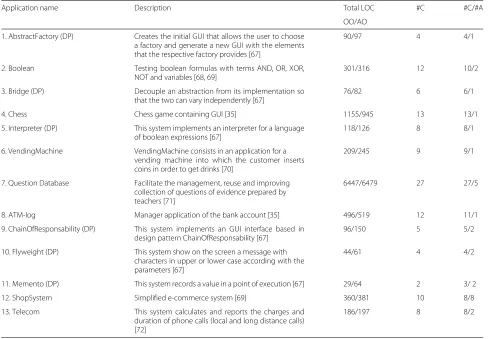
Table 5 brings general information for each applica-tion. Note that six applications have a “DP” suffix and consist of randomly selected examples of design patterns implemented by Hannemann and Kiczales [67]. Other columns show the number of classes (#C) and the number of aspects (#A) in each system.9
These applications were selected because they all had OO and AO equivalent implementations developed by third-party researchers. Furthermore, their source code was either available for download or listed in the original
Table 5Target applications—study of reuse of test sets across paradigms
Application name Description Total LOC #C #C/#A
OO/AO
1. AbstractFactory (DP) Creates the initial GUI that allows the user to choose a factory and generate a new GUI with the elements that the respective factory provides [67]
90/97 4 4/1
2. Boolean Testing boolean formulas with terms AND, OR, XOR,
NOT and variables [68, 69]
301/316 12 10/2
3. Bridge (DP) Decouple an abstraction from its implementation so
that the two can vary independently [67]
76/82 6 6/1
4. Chess Chess game containing GUI [35] 1155/945 13 13/1
5. Interpreter (DP) This system implements an interpreter for a language of boolean expressions [67]
118/126 8 8/1
6. VendingMachine VendingMachine consists in an application for a
vending machine into which the customer inserts coins in order to get drinks [70]
209/245 9 9/1
7. Question Database Facilitate the management, reuse and improving collection of questions of evidence prepared by teachers [71]
6447/6479 27 27/5
8. ATM-log Manager application of the bank account [35] 496/519 12 11/1
9. ChainOfResponsability (DP) This system implements an GUI interface based in design pattern ChainOfResponsability [67]
96/150 5 5/2
10. Flyweight (DP) This system show on the screen a message with
characters in upper or lower case according with the parameters [67]
44/61 4 4/2
11. Memento (DP) This system records a value in a point of execution [67] 29/64 2 3/ 2
12. ShopSystem Simplified e-commerce system [69] 360/381 10 8/8
13. Telecom This system calculates and reports the charges and
duration of phone calls (local and long distance calls) [72]
186/197 8 8/2
reports (references can be found in Table 5). The spec-ifications of these applications, which we used to define test requirements, were either documented in the original reports or were elaborated after analysing the source code. For Question Database (application #7 in Table 5), due to its size, we only tested non-functional concerns that are implemented with aspects in the AO version. Obviously, such concerns are also present in the OO implementa-tion, though spread across or tangled with code of other concerns.
To design and perform the tests, initially we defined two groups of applications (namely, group A and group B), each one including OO and AO implementations of six programs plus two concerns10 of the Question Database system. In group A, we created SFT-adequate test sets for the OO implementation (i.e. test sets written purely in Java). Then, we adapted test cases to make them exe-cutable in the AO equivalent implementations. On the other way around, in group B, we firstly created test sets for the AO implementations, then adapted such test sets to the OO counterparts.
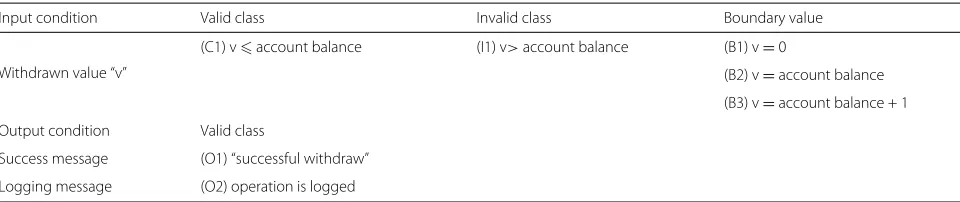
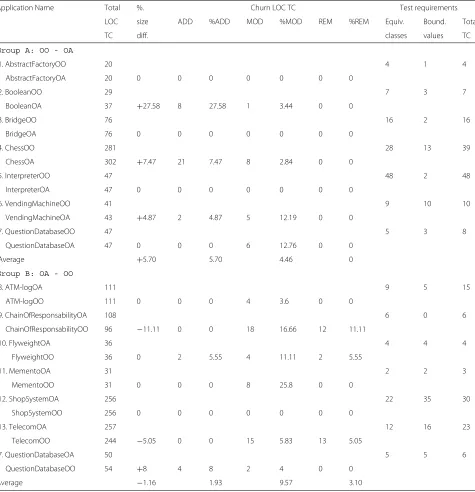
Table 6 illustrates the specification of functional test requirements for an operation of the ATM-log applica-tion. The table shows the input/output conditions, the valid and invalid (equivalence) classes and the bound-ary values. This template of specification was applied to all tested systems and guided the creation of test cases for both groups of applications (group A and group B). The last three columns of Table 8 summarise the num-ber of test requirements and the numnum-ber of test cases with respect to each target application.
Effort to adapt test sets across paradigms
As described by Levin and Ferrari [27], in this investi-gation, we wanted to study the effect of different pro-gramming paradigms on the effort required to migrate (i.e. adapt) test code from OO to AO programs and vice versa. To extend the original analysis [27], we define the hypotheses listed in Table 7 (namely, H1, H2, H3 and H4). Note that the hypotheses are related to metrics described in the sequence and assume that there is no difference between the effort required to migrate test sets across
Table 7Hypotheses formulated for effort-related analysis
(Null) hypotheses
H1 TOTAL-LOC-TCOO↔AO= TOTAL-LOC-TCAO↔OO
H2 ADDOO↔AO= ADDAO↔OO
H3 MODOO↔AO= MODAO↔OO
H4 REMOO↔AO= REMAO↔OO
OO and AO implementations (i.e. they represent null hypotheses).
Metrics and tool: The metrics we collected to evalu-ate the effort required to adapt test sets across paradigms focus on code churn. Code churn is generally used to predict the defect density in software systems, and it is easily collected from a system change history [73]. Usu-ally, this kind of metric is used to compare system versions to measure how many lines were added, changed and removed. In particular, we collected the following: Total-LOC-TC—number of non-commented LOC in the test classes;ADD—number of lines added to the new version of a test class; MOD—number of lines changed in the new version of the test class in comparison with its pre-vious version; andREM—number of lines removed from the previous version of a test class to create a new ver-sion. Note that by ‘new version’, we mean the test class that has been adapted to the new paradigm. We used the Meld tool11 to provide visual support in the analysis of code changes between different implementations of the same application.
Results and analysis: Table 8 summarises results regarding the collected metrics. On average, for group A, adapting OO test sets to AO implementations required additions of 5.70 %, modifications in 4.46 % of test code lines, with no code removal in any application. For group B, on the other hand, more modifications and removals were needed than for group A. On average, test code was 9.57 % modified and 3.10 % removed to conform with OO implementations, while only 1.93 % lines were added to the test code.
Overall, our preliminary findings were that (i) less code is written for testing OO programs, specially because
Table 6Example of a specification of functional test requirements for the withdraw operation (ATM-log system)
Input condition Valid class Invalid class Boundary value
Withdrawn value “v”
(C1) vaccount balance (I1) v>account balance (B1) v=0
(B2) v=account balance
(B3) v=account balance + 1
Output condition Valid class
Success message (O1) “successful withdraw”
Table 8Results of test adaptation effort measurement—group A and group B
Application Name Total %. Churn LOC TC Test requirements
LOC size ADD %ADD MOD %MOD REM %REM Equiv. Bound. Total
TC diff. classes values TC
Group A: OO - OA
1. AbstractFactoryOO 20 4 1 4
AbstractFactoryOA 20 0 0 0 0 0 0 0
2. BooleanOO 29 7 3 7
BooleanOA 37 +27.58 8 27.58 1 3.44 0 0
3. BridgeOO 76 16 2 16
BridgeOA 76 0 0 0 0 0 0 0
4. ChessOO 281 28 13 39
ChessOA 302 +7.47 21 7.47 8 2.84 0 0
5. InterpreterOO 47 48 2 48
InterpreterOA 47 0 0 0 0 0 0 0
6. VendingMachineOO 41 9 10 10
VendingMachineOA 43 +4.87 2 4.87 5 12.19 0 0
7. QuestionDatabaseOO 47 5 3 8
QuestionDatabaseOA 47 0 0 0 6 12.76 0 0
Average +5.70 5.70 4.46 0
Group B: OA - OO
8. ATM-logOA 111 9 5 15
ATM-logOO 111 0 0 0 4 3.6 0 0
9. ChainOfResponsabilityOA 108 6 0 6
ChainOfResponsabilityOO 96 −11.11 0 0 18 16.66 12 11.11
10. FlyweightOA 36 4 4 4
FlyweightOO 36 0 2 5.55 4 11.11 2 5.55
11. MementoOA 31 2 2 3
MementoOO 31 0 0 0 8 25.8 0 0
12. ShopSystemOA 256 22 35 30
ShopSystemOO 256 0 0 0 0 0 0 0
13. TelecomOA 257 12 16 23
TelecomOO 244 −5.05 0 0 15 5.83 13 5.05
7. QuestionDatabaseOA 50 5 5 6
QuestionDatabaseOO 54 +8 4 8 2 4 0 0
Average −1.16 1.93 9.57 3.10
test cases for AO implementations required more specific code to expose context information to build JUnit asser-tions, and (ii) test code for OO programs conforms better with the open-closed principle [74], since a higher num-ber of changes were required to make test sets of group B executable in OO implementations and (iii) test code for OO programs is more reusable, which is reflected by the MODandREMaverages that indicate recurring interven-tions in test sets for AO systems in order to adapt them to OO implementations.
Fig. 5Test case example for the Chess application
To evaluate if the preliminary findings have statistical relevance, we tested the hypotheses defined in Table 7. Initially, we checked whether the data has normal distri-bution. For this, we applied the Shapiro-Wilk test. Results are summarised in Table 9.
Note that, for statistical significance, we adopted the tra-ditional confidence of 95 %; thus, our analysis considers pvalues below 0.05 significant. For all statistical tests, we used the R language and environment.12
As the reader can notice, apart from TOTAL-LOC-TCAO↔OOand MODAO↔OO, all otherpvalues are below the defined threshold of 0.05. Therefore, the null hypothe-ses (that is, the data has normal distribution) are rejected. We then applied the non-parametric Mann-Withney test to compare the effort to migrate test sets across the two paradigms, given that such test does not assume nor-mal distributions [75]. Results are summarised in Table 10.
The results reveal that, even though the preliminary findings favoured the OO paradigm regarding the anal-ysed test sets (and their reuse), this could be not assessed with statistical rigour. Overall, the null hypotheses could
Table 9Results of Shapiro-Wilk test for effort-related metrics p-value
Group A
TOTAL-LOC-TCOO↔AO 0.00515
ADDOO↔AO 0.00515
MODOO↔AO 0.01878
REMOO↔AO 0.00000
Group B
TOTAL-LOC-TCAO↔OO 0.26280
ADDAO↔OO 0.00098
MODAO↔OO 0.37110
Table 10Results of Mann-Whitney test for effort-related metrics
(Null) hypotheses test pvalue
H1 TOTAL-LOC-TCOO↔AO= TOTAL-LOC-TCAO↔OO 0.10160
H2 ADDOO↔AO= ADDAO↔OO 0.35770
H3 MODOO↔AO= MODAO↔OO 0.17490
H4 REMOO↔AO= REMAO↔OO 0.07541
not be rejected due to the low probability of perceiv-ing difference between the two paradigms with respect to the analysed issue. One should notice that not rejecting a hypothesis does not mean the hypothesis is accepted. In fact, we cannot accept a null hypothesis, but only find evidence against it. In our case (i.e. results presented in section ‘Effort to adapt test sets across paradigms’), pos-sible explanations for the lack of statistical significance of preliminary findings may rely on (i) the small number of analysed programs (14, in total) or (ii) the impossibility of showing differences between the two paradigms (i.e. there is no difference between them at all). Case (i) will be addressed in our future work, as stated in section ‘Final remarks, limitations and research directions’. The impos-sibility (and consequent conclusion) regarding case (ii) can be assessed with the enlargement of our application sets.
Structural coverage yielded by test sets across paradigms With the aim of assessing the quality of reused test sets, we now analyse the structural coverage that can be achieved when test sets are reused across paradigms. In other words, we want to study the effect of different pro-gramming paradigms on the test coverage with respect to the structure (statements and branches) of OO and AO programs. This investigation develops in terms of the hypotheses defined in Table 11:
Metrics and tool:To evaluate H5 and H6, we computed the code coverage yielded by SFT-adequate test sets con-sidering the same groups of applications (i.e. group A and group B). The metrics we collected are statement coverage and branch coverage, which are similar to the all-nodes and all-edges traditional control flow-based cri-teria. For the Question Database system, we focused the analysis on parts of the code affected by the crosscutting behaviour that, in the AO implementation, was encap-sulated within one or more aspects. For the remaining (small) applications, we considered the full code (base
Table 11Hypotheses formulated for coverage-related analysis
(Null) hypotheses
H5 STATEMENTOO↔AO= STATEMENTAO↔OO
H6 BRANCHOO↔AO= BRANCHAO↔OO
code and aspects, if any) for computing test requirements and coverage.
The metrics collection task was automated by EclEmma13, which is code coverage analysis tool devel-oped as an Eclipse plugin. Note we had to manually inspect the coverage of AspectJ implementations due to the fact that EclEmma, as other Java-based coverage tools, processes ordinary bytecode (i.e. Java compiled code) to trace the traversed paths during test execution. When it comes to AspectJ, the standard ajc14 compiler adds some structures to the compiled bytecode that are not recognised by EclEmma. These structures cor-respond to specific AOP constructions. For example, for each pointcut in the source code, the ajc compiler adds a method to the bytecode. Such method is often created only for retaining pointcut-related information that could be lost after compilation. However, EclEmma treats this spurious method as code that should be equally covered by the tests and hence must not be considered for coverage purposes. Such spurious requirements were spotted and discarded through a manual inspection step.
We highlight that the JaBUTi/AJ tool, developed by our group to support AO-specific structural criteria [11, 14, 16, 24, 46], is able to compute test requirements and trace the execution for particular modules of a system under testing, depending on the chosen level of integra-tion. In other words, JaBUTi/AJ instruments and runs spe-cific parts of a system, according to the tester’s selection. Since we intended to compute the coverage for all system modules, to speed up the process, we adopted EclEmma. Such tool is able to run full test set in a single run and compute the coverage of the full application, even though manual inspection was necessary to achieve precise results.
Results and analysis:Table 12 shows the results regard-ing statement and branch coverage for small applications of group A and group B. Visual representation can be found in Figs. 6 and 7. Similarly, Table 15 and Figs. 8 and 9 present results for the Question Database applica-tion, though separately from the other small applications. Note that results with respect to the Question Database application will be later discussed in this section.
Table 12Statement and branch coverage for small applications
Application name % diff # # Covered/ % diff # # Covered/
Covered % Statem. missing Covered % Branches missing
Statem. statem. branches branches
Group A: OO - AO
1. AbstractFactoryOO 100.0 134 134/0 n/a n/a n/a
AbstractFactoryAO 100.0 0.0 147 147/0 n/a n/a n/a n/a
2. BooleanOO 87.5 431 377/54 66.7 24 16–8
BooleanAO 85.5 −2.0 532 455/77 70.8 4.2 24 17–7
3. BridgeOO 100.0 120 120/0 100.0 4 4/0
BridgeAO 100.0 0.0 151 151/0 100.0 0.0 4 4/0
4. ChessOO 75.8 955 724/231 63.8 232 148/84
ChessAO 76.8 1.0 964 740/224 65.3 1.5 248 162/86
5. InterpreterOO 92.0 225 207/18 71.4 14 10/4
InterpreterAO 85.5 −6.5 290 248/42 78.6 7.2 14 11/3
6. VendingMachineOO 87.9 321 282/39 87.5 16 14/2
VendingMachineAO 89.1 1.2 366 326/40 80.0 −7.5 5 4/1
Average OO 90.5 77.9
Average AO 89.5 −1.0 78.9 1.1
Group B: AO - OO
8. ATM-logAO 72.7 326 237/89 71.4 14 10/4
ATM-logOO 80.8 0.0 271 219/52 83.3 11.9 12 10/2
9. ChainOfResponsabilityAO 76.7 257 197/60 68.8 16 11/5
ChainOfResponsabilityOO 77.7 1.1 157 122/35 66.7 −2.1 18 12/6
10. FlyweightAO 82.5 120 99/21 87.5 8 7/1
FlyweightOO 85.4 2.9 82 70/12 75.0 -12.5 8 6/2
11. MementoAO 100.0 112 112/0 n/a n/a n/a
MementoOO 100.0 0.0 44 44/0 n/a n/a n/a n/a
12. ShopSystemAO 85.7 1581 1355/226 75.6 41 31/10
ShopSystemOO 82.6 −3.1 872 720/152 73.8 −1.9 80 59/21
13. TelecomAO 91.8 477 438/39 100.0 20 20/0
TelecomOO 91.6 −0.2 381 349/32 100.0 0.0 20 20/0
Average AO 84.9 67.2
Average OO 86.3 1.4 66.5 −0.8
Fig. 7Statement and branch coverage for small applications—group B
66.5 % and 67.2 % of covered branches for OO and AO implementations, respectively.
To evaluate whether such minimal coverage differ-ences have statistical relevance, we tested the hypotheses defined in Table 11, considering the differences amongst coverages (statements and branches—“dif %” columns) in both groups and paradigms. Initially, again, we checked whether the data has normal distribution. For this, we applied the Shapiro-Wilk test. Results are summarised in Table 13.
Differently from the analysis presented in section ‘Effort to adapt test sets across paradigms’, thepvalues obtained
for the STATEMENTi and BRANCHi metrics are all
above the defined threshold of 0.05. Thus, the null hypotheses (that is, the data has normal distribution) cannot be rejected. We then applied the Student’st test to compare the structural coverage yielded by test sets that are originally built for programs written under one paradigm (namely, OO and AO) and then migrated to the other one. Results are summarised in Table 14. Note that the null hypotheses cannot be rejected, sincepvalues are above 0.05.
The results confirms the preliminary findings that, for small applications, there is no difference between the two paradigms with respect to (control flow-based) structural coverage when test sets are reused across them.
Differently from results for small applications, tests exe-cuted on Question Database resulted in higher statement and branch coverage in all OO implementations (see
Table 15 and Figs. 8 and 9). For example, for theTime concern in the OO implementation, statement and branch coverages were 72.2 and 44.6 %, respectively, while the same measures for the AO version were 25.8 and 3.8 %. On average, statement and branch coverage in group A were 59.2 and 33.9 % for OO implementation and 24.1 and 4.3 % for the AO implementation, respectively. Similar results (in terms of higher coverage for OO implementation) are observed for group B.
The numbers for the Question Database system have some peculiarities. Firstly, considering both paradigms, test execution resulted in low coverage rates for all con-cerns (the only exception is TimeOO—see Table 15). As mentioned in the beginning of this section, for this system the coverage analysis focused only on modules—aspects and classes—which are related to the selected crosscutting concerns. For them, the tool computed test requirements and their respective coverage. Despite this concern-driven analysis, we emphasise that test cases were designed to those particular concerns and hence did not exercise sub-stantial parts of the involved modules.
Secondly, and equally important, we can notice a much higher number of test requirements in the AO implemen-tations. Such difference relies basically on two reasons: (i) the generality of the aspect possibly to facilitate sys-tem evolution without breaking pointcuts and (ii) the strategy adopted by the developer to create aspects (and their internal parts) using AspectJ mechanisms. Both rea-sons are related to the conservative procedure to define
![Fig. 1 Example of an integrated CFG for the pairwise approach [14]](https://thumb-us.123doks.com/thumbv2/123dok_us/858482.1583434/6.595.56.545.558.713/fig-example-integrated-cfg-pairwise-approach.webp)