Improved Functional Proxy Re-encryption Schemes for
Secure Cloud Data Sharing
Xu An Wang1,2, Xiaoyuan Yang1, Cong Li1, Yudong Liu1, and Yong Ding2 1 Key Laboratory of Information and Network Security, Engineering University of Chinese
Armed Police Force, P. R. China 2
Guangxi Key Laboratory of Cryptography and Information Security, Guilin University of Electronic Technology, P. R. China
[email protected], [email protected], [email protected], [email protected], [email protected]
Abstract. Recently Liang et al. propose an interesting privacy-preserving cipher-text multi-sharing control for big data storage mechanism, which is based on the cryptographic primitive of anonymous multi-hop identity based conditional proxy re-encryption scheme AMH-IBCPRE. They propose a concrete AMH-IBCPRE
scheme and conclude their scheme can achieve IND-sCon-sID-CCA secure (in-distinguishable secure under selectively conditional selectively identity chosen ci-phertext attack). However, our research show their scheme can not be IND-sCon-sID-CCA secure for single-hop and multi-hop data sharing. Also in 2014, Liang et al. propose an interesting deterministic finite automata-based functional proxy re-encryption schemeDFA-based FPREfor secure public cloud data sharing, they also conclude their scheme can achieve IND-CCA secure (indistinguishable secure under chosen ciphertext attack), we also show their scheme can not be IND-CCA se-cure either. For these two proposals, the main reason of insecurity is that part of the re-encryption key has the same structure as the valid ciphertext, thus the adversary can query on the decryption oracle with this part of the re-encryption key to get se-cret keys, which will break the CCA-security of their scheme. We give an improved
AMH-IBCPREscheme and an improvedDFA-based FPREscheme for cloud data sharing and show the new schemes can resist our attack and be CCA-secure. We also demonstrate our improvedAMH-IBCPREscheme’s efficiency compared with other related identity based proxy re-encryption schemes, the results show our scheme is almost the most efficient one.
Keywords:Attack, multi-control for big data storage, secure cloud data sharing, proxy re-encryption, chosen ciphertext security.
1.
Introduction
data management or knowledge discover techniques, many useful results can not be ob-tained, thus it is a challenge on how to organize/store/process big data.
Let us focus on one of the most basic challenge for big data, that is, how to secure and scalably store these large amount of data. Cloud computation is such a promising technique. Data owners first outsource datum to the cloud servers to reduce the local management overhead. They often worry about the security and privacy if directly out-sourcing their data sets to the cloud, thus it is often a practice that the data owners first encrypt datum and then upload them to the cloud [18–21]. But this time scalability is a new problem, can these encrypted data be shared efficiently and scalably? Aiming at solv-ing this issue, Blaze et al. [5] and Atenesis et al. [3, 4] proposed a new notion called proxy re-encryption (PRE), which allows the proxy with re-encryption key can transform the original ciphertext associated with a public key to the re-encrypted ciphertext associated with another public key.
In proxy re-encryption(PRE), a proxy can transform ciphertexts for Alice to cipher-texts for Bob without the proxy knowing either Alice or Bob’s private key and the un-derlying plaintexts. PRE has very important applications for secure cloud storage and its sharing [32–34]. CCA-security (chosen ciphertext secure) is an important security no-tion for proxy re-encrypno-tion, which means that the schemes can resist the attacking even with adaptive decryption oracle [6, 7, 14, 15, 24, 26–31]. Multi-hopPRErefers the scheme can support ciphertexts being able to be re-encrypted again, while single-hop PREhas no this ability. For the users’ secret keys or the underlying plaintexts can not be induced by the proxy, this primitive can be used for efficiently and scalably sharing encrypted contents for multi-users in cloud. The cloud servers can be acted as proxy and trans-form the ciphertexts for the users, otherwise the data owner has to first download his data sets and then re-encrypt them, which is very inefficient. Conditional proxy re-encryption (CPRE) aims at more flexible re-encryption forPRE, which can only re-encrypt the ci-phertexts which satisfying some condition. Multi-hop identity based conditional proxy re-encryption (MH-IBPRE) [9, 16]combines the feature of identity based encryption (IBE) withCPRE, which simultaneously has the advantage of no relying on public key infras-tructure, supporting fine-grained re-encryption and multi-hop ciphertext transformation. However, directly usingMH-IBPRE in multi-sharing control for big data storage may leak the identities of the users, and thus break the user’s privacy. Therefore, Liang et al. exploited to use anonymousMH-IBPRE(AMH-IBCPRE) scheme to achieve the pri-vacy persevering property when sharing data among multi-users. Fairly to say, their work give an interesting solution on the issue of how to secure share data storage efficiently and scalably in big data era. Unfortunately, the authors claimed their scheme can achieve IND-sCon-sID-CCA security, but we show their scheme can not be CCA-secure.
combines the feature of DFA-based functional encryption with proxy re-encryption. The re-encrypted ciphertext can only be decrypted if and only if the delegatee’s deterministic finite automata accepts the string associated with the re-encrypted ciphertext. Really this is a novel notion and generalize the concept of proxy re-encryption to a very widely extension. They also proposed a concrete DFA-based PRE scheme and claimed it is fully CCA-secure in the standard model. Fairly to say, this is an interesting and foundational work, but unfortunately, we show their scheme can also not achieve CCA-security by exploiting some shortcoming of the form of their re-encryption keys.
1.1. Cloud Storage and Chosen Ciphertext Security
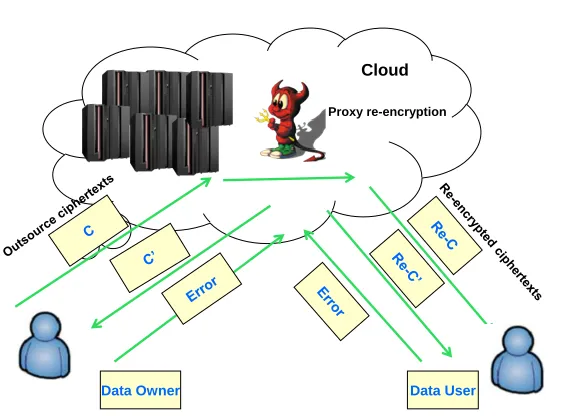
Chosen ciphertext security is a very important security notion for encryption in crypto-graphic society, and now it is considered as the gold standard for evaluation of the encryp-tion schemes’ security. Also it is very important for cloud storage, Figure 1 demonstrates several chosen ciphertext attacks on the cloud storage, which shows that secure cloud storage also should achieve this gold security notion.
1. Assume the attacker is the malicious cloud, it can launch the chosen ciphertext attack on the data owners. First the data owner outsources his datum to the cloud by first encrypting and then uploading the ciphertexts, after that some day when the data owner want to retrieve his data, the cloud maliciously return the modified ciphertexts to him, and he will decrypt the modified ciphertexts and find the decrypted results are not correct. The data owner will notify the cloud on this error, and thus the cloud can utilize this information to launch the chosen ciphertext attack.
2. The malicious cloud can also launch the chosen ciphertext attack on the data users. First the data owner shares his datum with other data users via proxy re-encryption. The cloud, which is the proxy for implementing the proxy re-encryption, can easily launch the chosen ciphertext attack. When the proxy re-encrypts the original cipher-text to be an encrypted ciphercipher-text, it sends the incorrect re-encrypted ciphercipher-texts to the data user, the data user decrypts the incorrect re-encrypted ciphertexts and will find they are incorrect. He will return the error information to the cloud, and thus the cloud can utilize this information to launch the chosen ciphertext attack.
1.2. Our Contribution
Data Owner Data User
Proxy re-encryption Cloud
Fig. 1.Cloud storage and chosen ciphertext security
1.3. Organization
We organize our paper as the following. In section 2, we review Liang et al.’s AMH-IBCPRE scheme, then we demonstrate the attacks to show it can not achieve IND-CCA security in section 3. In section 4, we give an improved AMH-IBCPRE scheme and roughly evaluate its security and performance. In section 5, we review Liang et al.’s DFA-based PRE scheme, then we show the attacks to demonstrate their scheme can not achieve IND-CCA security in section 6. In section 7, we give an improved DFA-based PREscheme and roughly evaluate its security. We conclude our paper in the last section.
2.
Review the AMH-IBCPRE Scheme
2.1. The Concrete Scheme
The definition and security model of AMH-IBCPRE can be found in [16], here we just review their concrete construction. The scheme consists of the Setup, Extract, Enc,
ReKeyGen,ReEnc,Decalgorithms as the following:
1. Setup(1k):A Target Collision Resistant (TCR) hash function H0 : {0,1}∗ → Z∗ q
first be used to hash the conditions and identities which could be arbitrary length. Run
BSetup(1k)to get(q, g,ˆg,G1,G2,GT, e)with input parameterk. Denoteω ∈ Z∗q
as a condition.α, β, γ, δ1, δ2, δ3, η ∈R Z∗q are randomly chosen, computes g1 = gα, g2=gβ, h=gγ, f1 =gδ1, f2=gδ2, f3 =gδ3, t=gη,g1ˆ = ˆgα,g2ˆ = ˆgβ,ˆh= ˆ
gγ,f1ˆ = ˆgδ1,f2ˆ = ˆgδ2,f3ˆ = ˆgδ3,tˆ= ˆgη. DenoteH1 :{0,1}k →
Z∗q,H2 :GT →
{0,1}poly(1k)
as a CCA-secure one-time symmetric key encryption. Choose a sUF one-time signa-ture scheme(Sig.KG, Sign, V er)and let its verification keyKvinZ∗q. The master
public key is
mpk= (q, k, g,ˆg,G1,G2,GT, e, g1, h, f1, f2, f3, t,g2,ˆ f2,ˆ f3,ˆ ˆh, H1, H2, SY M,
(Sig.KG, Sign, V er))
and the master secret key is
msk= ( ˆg0= ˆgαβ,f1,ˆ tˆ)
.
2. Extract(msk, ID):Taken input an identityID∈Zq∗,msk,r, R∈RZ∗q, output skID= (skID0, skID1, skID2) = ( ˆg0(ˆhIDf1ˆ)rtˆR,gˆr,gˆR)
The validity of the secret key can be checked as:
e(g, skID0)
?
=e(g1,gˆ2)e(hIDf1, skID1)e(t, skID2)
3. Enc(IDi, ω, m):Chooses a one-time signature key pair
(Ks, Kv)←Sig.KG(1k)
ands0∈RZ∗qcompute
C0=Kv, C1=e(g1,g2ˆ)s0·m, C2=gs0, C3= (hIDif1)s0, C4=ts0,
C5= (hwf2)s0, C6= (hKvf3)s0,
C7=Sign(Ks,(C1, C2, C3, C4, C5, C6))
outputC1,IDi,w = (C0, C1, C2, C3, C4, C5, C6, C7)as the 1-st level ciphertext, where
the ciphertext implicitly includeswandIDi ∈Z∗q, m∈GT.
4. ReKeyGen(IDi, skIDi, IDi0, ω):Chooses(K
(l)
s , Kv(l))← Sig.KG(1k)as a
one-time signature key pair andθ(l)1 ∈R GT, ρ(l), s (l)
1 ,r¯1(l) ∈ Zq∗,rkω,IDi→IDi0 can be
computed as:
rk0(l)= (skIDi0(ˆh
wfˆ 2)ρ
(l)
)H1(θ1(l)), rk(l)
1 = (ˆg ρ(l)
)H1(θ(1l)),
rk2(l)= (skIDi
1)
H1(θ(1l)), rk(l)
3 = (skIDi2)
H1(θ(1l)), rk(l)
4 =e(g1,g2ˆ) s(1l)·θ(l)
1 ,
rk5(l)=gs(1l),
rk6(l)= (hIDi0f1)s
(l)
1 , rk(l)
7 =t
s(1l), rk(l) 8 = (h
wf2)s(1l), rk(l) 9 = (h
K(l)
v f3)s
(l)
1 ,
rk10(l)=Kv(l)
rk11(l)=Sign(Ks(l),(rk4(l), rk5(l), rk6(l), rk7(l), rk8(l), rk9(l))),
rk12(l)= (hIDi0f
1)r¯1
(l)
, rk13(l)=gr¯1(l), rk(l)
14 =t ¯
r1(l), rk(l)
15 =h ¯ r1(l),
rk16(l)=e(g1,g2ˆ)r¯1(l),
rk17(l)=fr¯1(l)
2 , rk (l) 18 =f
¯ r1(l)
3 ,
5. ReEnc(rkω,IDi→IDi0, Cl,IDi,w).Ifl= 1, (a) Verify
e(ˆhKvf3, C2ˆ )=? e(ˆg, C6), e(ˆhωf2, C2ˆ )=? e(ˆg, C5),
V er(Kv, C7,(C1, C2, C3, C4, C5, C6))= 1? (1) (b) Choose a one time signature key pair
( ¯Ks(1),K¯v(1))←Sig.KG(1k)
and
θ(1)2 ∈RGT, s (1) 2 ∈RZ
∗ q
compute
C7(1)=e(C2, rk
(l)
0 )/e(C5, rk (1) 1 )
e(C3, rk(l)2 )e(C4, rk(l)3 )
,
δ(1)=SY M.Enc(C0||C1|| · · · ||C7||C7(1), H2(θ(1)2 )),
C8(1)=rks
(1) 2
16 ·θ (1) 2 , C
(1) 9 =rk
(1)s(1)2 13 , C
(1) 10 =rk
(1)s(1)2 12 ,
C11(1)=rk(1)s
(1) 2
14 , C (1) 12 = (rk
(1)ω 15 rk (1) 17) s1 2,
C13(1)= (rk(1) ¯K
(1)
v
15 rk
(1) 17)
s12, C(1) 14 = ¯K
(1) v ,
C15(1)=Sign( ¯Ks(1),(C8(1), C9(1), C10(1), C11(1), C12(1), C13(1)))
and
C2,IDi0,w = (δ(1), C (1) 8 , C
(1) 9 , C
(1) 10, C
(1) 11 , C
(1) 12, C
(1) 13, C
(1) 14, C
(1) 15, rk
(1) 4 ,
rk(1)5 , rk(1)6 , rk(1)7 , rk8(1), rk9(1), rk10(1), rk11(1))
is outputted. Ifl≥2, (a) Verify
e(rk(l−1)5 ,ˆhωfˆ2) ?
=e(rk(l−1)8 ,gˆ),
e(rk5(l−1),hˆKv(l−1)f3ˆ)=? e(rk(l−1)
9 ,gˆ),
V er(rk(l−1)10 , rk11(l−1),(rk4(l−1), rk(l−1)5 , rk(l−1)6 ,
rk7(l−1), rk(l−1)8 , rk(l−1)9 ))= 1? (2)
e(C9(l−1),ˆhωfˆ2) ?
=e(C12(l−1),gˆ),
e(C9(l−1),ˆhK¯v(l−1)f3ˆ)=? e(C(l−1)
13 ,gˆ),
V er(C14(l−1), C15(l−1),(C8(l−1), C9(l−1), C10(l−1),
(b) Choose a one time signature key pair
( ¯Ks(l),K¯v(l))←Sig.KG(1k)
and
θ(l)2 ∈RGT, s (l) 2 ∈RZ
∗ q
and then compute
C7,0(l) =e(rk
(l−1) 5 , rk
(l) 0 )/e(rk
(l−1) 8 , rk
(l) 1 )
e(rk(l−1)6 , rk(l)2 )e(rk(l−1)7 , rk3(l))
,
C7,1(l) =e(C
(l−1) 9 , rk
(l) 0 )/e(C
(l−1) 12 , rk
(l) 1 )
e(C10(l−1), rk2(l))e(C11(l−1), rk(l)3 )
δ(l)=SY M.Enc(δ(l−1)||C8(l−1)|| · · · ||C15(l−1)||rk4(l−1)|| · · ·
||rk(l−1)11 ||C7,0(l−1)||C7,1(l−1), H2(θ(l)2 ))
C8(l)=rks
(l) 2
16 ·θ (l) 2 , C
(l) 9 =rk
(l)s(2l) 13 , C
(l) 10 =rk
(l)s(2l) 12 , C
(l) 11 =rk
(l)s(2l) 14 ,
C12(l)= (rk15(l)ωrk17(l))sl2,
C13(l)= (rk(l) ¯K(vl)
15 rk
(l) 17)
sl
2, C(l)
14 = ¯K (l) v ,
C15(l)=Sign( ¯Ks(l),(C8(l), C9(l), C10(l), C11(l), C12(l), C13(l)))
and
Cl,IDi0,ω = (δ(l), C (l) 8 , C
(l) 9 , C
(l) 10, C
(l) 11, C
(l) 12, C
(l) 13, C
(l) 14, C
(l) 15, rk
(l) 4 , rk
(l) 5 ,
rk(l)6 , rk(l)7 , rk(l)8 , rk(l)9 , rk(l)10, rk(l)11)
is outputted. 6. Dec(skIDi, Cl,IDi,w).
– Ifl= 1,
(a) Check Eq. (1) whether holds or not. Output⊥if Eq. (1) does not hold. Pro-ceed otherwise.
(b) Compute
C1/
e(C2, skID0)
e(C3, skID1)e(C4, skID2)
=e(g1,g2ˆ)s0·m/ e(gs0,g0ˆ(ˆh
IDifˆ)rˆtR)
e((hIDif)s0,gˆr)e(ts0,gˆR) =e(g1,g2ˆ)s0·m/e(g1,g2ˆ)s0 =m
– Ifl≥2, (a) Verify
e(rk(l)5 ,ˆhωfˆ2) ?
=e(rk8(l),gˆ), e(rk5(l),ˆhKv(l)fˆ
3) ?
=e(rk9(l),gˆ),
V er(rk(l)10, rk(l)11,(rk(l)4 , rk(l)5 , rk(l)6 , rk(l)7 , rk(l)8 , rk(l)9 ))= 1? (4)
e(C9(l),ˆhωf2ˆ)=? e(C12(l),gˆ), e(C9(l),hˆK¯v(l)f3ˆ)=? e(C(l)
13,ˆg),
Output⊥if Eq. (4) and (5) do not hold. Proceed otherwise. (b) Compute
e(rk5(l), skID
i00)
e(rk(l)6 , skID
i01)e(rk
(l)
7 , skIDi02)
= e(g
s(1l),g0ˆ (ˆhIDi0f1ˆ)rtˆR e((hIDi0f1)s1(l),ˆg(r))e(ts
(l) 1 ,ˆgR)
=e(g1,g2ˆ)s(1l)
and
e(C9(l), skID
i00)
e(C10(l), skIDi0
1
)e(C11(l), skIDi0
2 )
= e(g
¯ s(2l),gˆ
0(ˆhIDi0fˆ1)rtˆR e((hIDi0f1)s¯2(l),ˆg(r))e(ts¯
(l) 2 ,ˆgR)
=e(g1,g2ˆ)s¯(2l)
where¯s(l)2 =s(l)2 ·r¯(l)1
(c) Computeθ(l)1 =rk4(l)/e(g1,gˆ2)s
(l)
1 , andθ(l)
2 =C (l)
8 /e(g1,gˆ2)¯s
(l)
2 . Recover (δ(l−1)||C8(l−1)|| · · · ||C15(l−1)||rk4(l−1)|| · · · ||rk11(l−1)||C7,0(l−1)||C7,1(l−1))
=SY M.Dec(δ(l), H2(θ(l)2 )
(d) Compute
C(l−1)(H1(θ(1l)))
−1
7,0
= (e(g1,gˆ2)s
(l−1)
1 )(H1(θ1(l)))(H1(θ(1l)))
−1
=e(g1,gˆ2)s
(l−1) 1
if Eq. (2) holds, computeθ(l−1)1 =rk4(l−1)/e(g1,g2ˆ )s(1l−1).
Compute
C(l−1)(H1(θ(1l)))
−1
7,1
= (e(g1,gˆ2)s¯
(l−1)
2 )(H1(θ1(l)))(H1(θ(1l)))
−1
=e(g1,gˆ2)¯s
(l−1) 2
if Eq. (3) holds, computeθ(l−1)2 =C8(l−1)/e(g1,ˆg2)s¯(2l−1).
(e) As in the previous steps, computeθ1(j)andθ(j)2 for1≤j≤l−2, froml−2
(f) RecoverC0||C1|| · · · ||C7||C7(1)=SY M.Dec(δ(1), H2(θ(2)(1)))
If Eq. (1) holds, compute
C1/C(1)(H1(θ(1)1 ))
−1
7
=e(g1,g2ˆ)s0·m/(e(g1,g2ˆ)s0H1(θ1(1))(H1(θ(1)1 ))
−1
=m
3.
Cryptanalysis of the AMH-IBCPRE Scheme
3.1. On the IND-sCon-sID-CCA Property
'( )
i
ID Uncorrupted
'
, i i( )
w ID ID
rk Uncorrupted
oxy
Pr
* 1,ID ,iw
C C *
( )
i
ID ID Uncorrupted
' 2,ID ,iw
C 1
10 4 5 6 7 8 9 11 [Dec, Cattack ( , , , , , , , )]
l l l l l l l l
rk rk rk rk rk rk rk rk
( ) 1
l
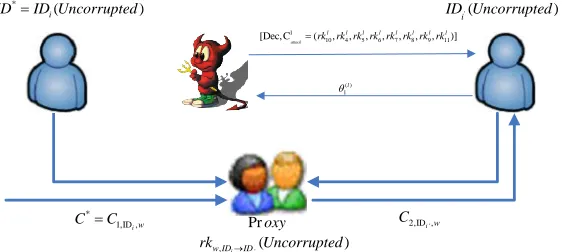
Fig. 2.Attack by querying the decryption oracle
Attack I Here we give the first attack on the IND-sCon-sID-CCA property, which can be seen in Figure 2. Note in this attack the delegator, delegatee and proxy are all uncorrupted. The main strategy is the following: the adversary just modifies the re-encryption key to be a valid ciphertextC1
attack(which can be assumed atllevel), then he queries this ciphertext
to the decryption oracle (which can be assumed at1level) to get secret valueθ1(l). Note hereCattack1 is not a derivative ofC∗. By using this value, he can derive the delegator’s secret key and thus can easily find the plaintext corresponding toC∗, which breaks the IND-sCon-sID-CCA property. Concretely, the attack can be described as following:
1. Assume the challenge identity and condition are(ID∗
i, w∗)and the challenge first
level ciphertext is C1,ID∗
i,w∗ = (C0, C1, C2, C3, C4, C5, C6, C7), where ID
∗ i ∈
Z∗q, mb∈GT andw∗is implicitly included in the ciphertext, concretely C0=Kv, C1=e(g1,g2ˆ)s0·mb, C2=gs0, C3= (hID∗if1)s0, C4=ts0,
C5= (hw∗f2)s0, C6= (hKvf3)s0,
2. The adversary first queries the re-encryption key generation oracle with input
(ID∗i, IDi0, w∗)
for thelhop, and he will get the re-encryption key as following:
rk(l)0 = (skID∗
i0(ˆh
w∗f2ˆ)ρ(l))H1(θ1(l)), rk(l)
1 = (ˆg
ρ(l))H1(θ(1l)),
rk(l)2 = (skID∗
i1)
H1(θ(1l)), rk(l)
3 = (sk ∗ IDi2)
H1(θ1(l)),
rk(l)4 =e(g1,g2ˆ)s(1l)·θ(l)
1 , rk (l) 5 =g
s(1l),
rk(l)6 = (hIDi0f1)s
(l)
1 , rk(l)
7 =t
s(1l), rk(l) 8 = (h
w∗f2)s(1l),
rk(l)9 = (hK(vl)f
3)s
(l)
1 , rk(l)
10 =K (l) v
rk(l)11 =Sign(Ks(l),(rk(l)4 , rk(l)5 , rk(l)6 , rk(l)7 , rk(l)8 , rk(l)9 )),
rk(l)12 = (hIDi0f1)r¯1(l), rk(l)
13 =g ¯
r1(l), rk(l)
14 =t ¯ r1(l),
rk(l)15 =hr¯1(l), rk(l)
16 =e(g1,gˆ2)r¯1
(l)
,
rk(l)17 =fr¯1(l)
2 , rk (l) 18 =f
¯ r1(l)
3 ,
3. Now the adversary can extract a valid ciphertext from this re-encryption key, which is
rk(l)4 =e(g1,gˆ2)s
(l)
1 ·θ(l)
1 , rk (l) 5 =g
s(1l),
rk(l)6 = (hIDi0f
1)s
(l)
1 , rk(l)
7 =t
s(1l), rk(l) 8 = (h
w∗f 2)s
(l)
1 ,
rk(l)9 = (hK(vl)f3)s
(l)
1 , rk(l)
10 =K (l) v
rk(l)11 =Sign(Ks(l),(rk(l)4 , rk(l)5 , rk(l)6 , rk(l)7 , rk(l)8 , rk(l)9 ))
This ciphertext has exactly the same structure as the first level ciphertext!
4. The adversary query this ciphertext to the first level ciphertext decryption oracle of
IDi0, which will returnθ(l)1 . Note here the adversary does not need to corrupt the
delegateeIDi0, he just use his decryption oracle!
5. After obtainingθ(l)1 , the adversary can easily compute the partial private key ofID∗ i,
which is enough to decrypt the challenge first level ciphertext:
♣= (skID∗
i0(ˆh
w∗fˆ 2)ρ
(l)
),♦= (ˆgρ(l)),
♥= (skID∗
i1),♠= (sk
∗ IDi2)
6. He decrypt the challenge ciphertext as following:
C1/
e(C2,♣)
e(C3,♥)e(C4,♠)e(C5,♦)
=e(g1,g2ˆ)s0·m/ e(gs0,g0ˆ(ˆh
IDifˆ)rtˆR(ˆhw∗f2ˆ)ρ(l))
e((hIDif)s0,ˆgr)e(ts0,gˆR)e((ˆgρ(l)),(hw∗f2)s0) =e(g1,gˆ2)s0·m/e(g1,gˆ2)s0
'( )
i
ID Uncorrupted
'
, i i( )
w ID ID
rk Uncorrupted
oxy
Pr
* 1,ID ,iw
C C *
( )
i
ID ID Uncorrupted
' 2,ID ,iw
C 1
10 4 5 6 7 8 9 11 [Dec, C ( , , , , , , , )]
attack
l l l l l l l l
rk rk rk rk rk rk rk rk
2 ( ) ( ) ( ) ( ) ( ) ( ) ( ) ( ) 14 8 9 10 11 12 13 15 [Dec, Cattack ( , , , , , , , )]
l l l l l l l l
C C C C C C C C
( ) 1
l
( )
2
l
And
And
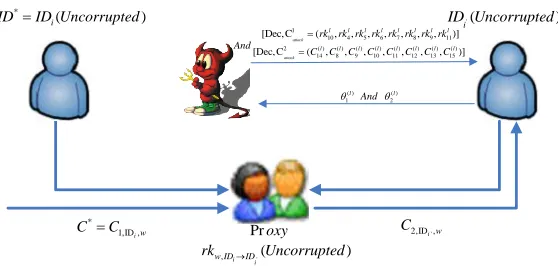
Fig. 3.Another attack by querying the decryption oracle
Attack II Here we give the second attack on the IND-sCon-sID-CCA property, which can be seen in Figure 2. Note in this attack the delegator, delegatee and proxy are all un-corrupted. The main strategy is similar as the first attack except the adversary modifies the challenge ciphertext to two valid ciphertexts. Concretely, the adversary first just mod-ifies the re-encrypted challenge ciphertextC∗(which can be assumed atl+ 1level) to be
another ciphertextC1
attackandC 2
attackwhich are valid original ciphertexts (which can be
assumed atllevel), then he queries this ciphertext to the decryption oracle (which can be assumed atllevel) to get secret valueθ1(l)andθ(l)2 . By using these value, he can derive the delegator’s secret key and thus can easy find the plaintext corresponding toC∗, which breaks the IND-sCon-sID-CCA property. For this attack is similar with Attack I, here we omit the details.
On the IND-sCon-sID-CCA Security Model Here we give some comments on Liang et al.’s IND-sCon-sID-CCA security model. Here we first review the definition of uncor-rupted delegation chain and coruncor-rupted delegation chain.
“Uncorrupted Delegation Chain. Suppose there is a delegation chain underw
fromIDitoIDj(i.e.w|IDi → · · · →IDj). If there is no corrupted identity in the chain, it is an uncorrupted delegation chain, else it is corrupted.”
Then we review the part about uncorrupted delegation chain in the IND-sCon-sID-CCA security model
“In this phase, the followings are forbidden to issue:
1. Osk(ID)for anyID, if there is an uncorrupted delegation chain underw∗
fromID∗toID, orID∗=ID.
2. Ork(IDi, IDi0, w∗) for anyIDi, IDi0, if there is uncorrupted delegation
chain underw∗fromID∗toIDi, orID∗=IDi, butIDi0is in a corrupted
delegation chain.”
delegatees after the challenge delegator even these delegatees are far away from the del-egator, which is obviously contradict our intuition in the multi-hop proxy re-encryption settings.
3.2. On the ANO-OC Property and the ANO-RK Property
0'( )
ID Uncorrupted
0 0 '
*, ( )
w ID ID
rk Uncorrupted
oxy
Pr
* *
1,ID,
b w
C C
0( )
ID Uncorrupted
1 1'
*, ( )
w ID ID
rk Uncorrupted
1'( )
ID Uncorrupted
1( )
ID Uncorrupted
* 0 ?
b
* 1?
b
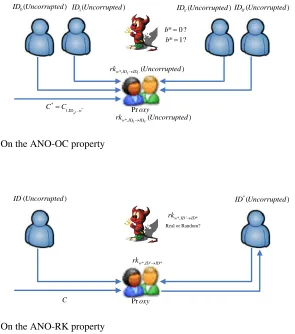
Fig. 4.On the ANO-OC property
*( )
ID Uncorrupted
oxy
Pr
C '
( )
ID Uncorrupted
*, ' *
w ID ID
rk
*, ' *
w ID ID
rk
Real or Random?
Fig. 5.On the ANO-RK property
The above two figures describe the ANO-OC property and ANO-RK property. It is easy to see, if the IND-sCon-sID-CCA security does not hold for the scheme, the ANO-OC property and ANO-RK property can not hold for this scheme either.
4.
Our improved AMH-IBCPRE scheme
4.1. Concrete Construction
part of the re-encryption key have different forms, then our attack can no longer work again. In particular, we just modify the signature structure in the original ciphertext, the re-encrypted ciphertext and part of the re-encryption key based on Liang et al.’s scheme [16]. Concretely, we letC7 =Sign(Ks,(C0, C1, C2, C3, C4, C5, C6))instead ofC7 =
Sign(Ks,(C1, C2, C3, C4, C5, C6)),C15(1)=Sign( ¯Ks(1),(C8(1), C9(1), C10(1), C11(1), C12(1), C13(1), C14(1) = ¯Kv(l)))instead ofC
(1)
15 =Sign( ¯K (1) s ,(C
(1) 8 , C
(1) 9 , C
(1) 10, C
(1) 11, C
(1) 12, C
(1) 13)).
In this way, the original ciphertext, part of the encrypted ciphertext and part of the re-encryption key shall have different forms and can not be used by the adversary improperly. Concretely, our improved scheme is the following:
1. Setup(1k):The same as the original scheme [16].
2. Extract(msk, ID):The same as the original scheme [16].
3. Enc(IDi, ω, m):Choosess0∈RZ∗qand a one-time signature key pair
(Ks, Kv)←Sig.KG(1k)
compute
C0=Kv, C1=e(g1,g2ˆ)s0·m, C2=gs0, C3= (hIDif1)s0, C4=ts0,
C5= (hwf2)s0, C6= (hKvf3)s0,
C7=Sign(Ks,(C0, C1, C2, C3, C4, C5, C6))
and output the 1-st level ciphertext
C1,IDi,w= (C0, C1, C2, C3, C4, C5, C6, C7)
whereIDi∈Z∗q, m∈GT andwis implicitly included in the ciphertext.
4. ReKeyGen(IDi, skIDi, IDi0, ω):The same as the original scheme.
5. ReEnc(rkω,IDi→IDi0, Cl,IDi,w). – Ifl= 1,
(a) Verify
e(ˆhKvf3, C2ˆ )=? e(ˆg, C6),
e(ˆhωfˆ2, C2) ?
=e(ˆg, C5), (6)
V er(Kv, C7,(C0, C1, C2, C3, C4, C5, C6))= 1?
(b) Chooseθ(1)2 ∈RGT, s (1)
2 ∈RZ∗q and a one time signature key pair
compute
C7(1)=e(C2, rk
(l)
0 )/e(C5, rk (1) 1 )
e(C3, rk (l)
2 )e(C4, rk (l) 3 )
,
δ(1)=SY M.Enc(C0||C1|| · · · ||C7||C7(1), H2(θ(1)2 )),
C8(1)=rks
(1) 2
16 ·θ (1) 2 , C
(1) 9 =rk
(1)s(1)2 13 , C
(1) 10 =rk
(1)s(1)2 12 , C
(1) 11 =rk
(1)s(1)2 14 ,
C12(1)= (rk15(1)ωrk(1)17)s12,
C13(1)= (rk(1) ¯Kv(1)
15 rk
(1) 17)
s1 2, C(1)
14 = ¯K (1) v ,
C15(1)=Sign( ¯Ks(1),(C8(1), C9(1), C10(1), C11(1), C12(1), C13(1), C14(1)))
OutputC2,IDi0,w = (δ(1), C (1) 8 , C
(1) 9 , C
(1) 10, C
(1) 11, C
(1) 12, C
(1) 13, C
(1) 14, C
(1) 15, rk4(1), rk5(1), rk6(1), rk(1)7 , rk(1)8 , rk(1)9 , rk(1)10, rk(1)11).
– Ifl≥2, (a) Verify
e(rk5(l−1),ˆhωf2ˆ)=? e(rk8(l−1),ˆg),
e(rk5(l−1),ˆhKv(l−1)f3ˆ)=? e(rk(l−1)
9 ,gˆ)
V er(rk10(l−1), rk(l−1)11 ,(rk(l−1)4 , rk(l−1)5 , rk6(l−1),
rk7(l−1), rk(l−1)8 , rk(l−1)9 ))= 1?
e(C9(l−1),ˆhωf2ˆ)=? e(C12(l−1),gˆ),
e(C9(l−1),ˆhK¯(vl−1)fˆ
3) ?
=e(C13(l−1),ˆg) (7)
V er(C14(l−1), C15(l−1),(C8(l−1), C9(l−1),· · ·, C13(l−1), C14(l−1)))= 1?
If Eq. (7) do not hold, output⊥. Otherwise, proceed. (b) Chooseθ(l)2 ∈RGT, s
(l)
2 ∈RZ∗q and a one time signature key pair
and then compute
C7,0(l) = e(rk
(l−1) 5 , rk
(l) 0 )/e(rk
(l−1) 8 , rk
(l) 1 )
e(rk6(l−1), rk2(l))e(rk7(l−1), rk(l)3 )
,
C7,1(l) = e(C
(l−1) 9 , rk
(l) 0 )/e(C
(l−1) 12 , rk
(l) 1 )
e(C10(l−1), rk(l)2 )e(C11(l−1), rk3(l))
δ(l)=SY M.Enc(δ(l−1)||C8(l−1)|| · · · ||C15(l−1)||rk(l−1)4 || · · · ||rk11(l−1)||
C7,0(l−1)||C7,1(l−1), H2(θ(l)2 ))
C8(l)=rks
(l) 2
16 ·θ (l) 2 , C
(l) 9 =rk
(l)s(2l) 13 , C
(l) 10 =rk
(l)s(2l) 12 , C
(l) 11 =rk
(l)s(2l) 14 ,
C12(l)= (rk15(l)ωrk(l)17)sl2,
C13(l)= (rk(l) ¯K
(l)
v
15 rk
(l) 17)
sl2, C(l) 14 = ¯K
(l) v ,
C15(l)=Sign( ¯Ks(l),(C8(l), C9(l), C10(l), C11(l), C12(l), C13(l), C14(l)))
Output
Cl,IDi0,ω= (δ(l), C (l) 8 , C
(l) 9 , C
(l) 10, C
(l) 11, C
(l) 12, C
(l) 13, C
(l) 14, C
(l) 15, rk
(l) 4 ,
rk5(l), rk6(l), rk7(l), rk8(l), rk9(l), rk10(l), rk11(l))
6. Dec(skIDi, Cl,IDi,w).
– Ifl= 1,
(a) Verify Eq. (6). If Eq. (6) does not hold, output⊥, otherwise, proceed. (b) Compute
C1/
e(C2, skID0)
e(C3, skID1)e(C4, skID2)
=e(g1,g2ˆ)s0·m/ e(gs0,g0ˆ(ˆh
IDifˆ)rˆtR)
e((hIDif)s0,gˆr)e(ts0,gˆR) =e(g1,g2ˆ)s0·m/e(g1,g2ˆ)s0
=m
– Ifl≥2, (a) Verify
e(rk5(l),ˆhωf2ˆ)=? e(rk(l)8 ,ˆg), e(rk(l)5 ,ˆhKv(l)f3ˆ)=? e(rk(l)
9 ,ˆg),
V er(rk10(l), rk11(l),(rk4(l), rk5(l), rk6(l), rk(l)7 , rk(l)8 , rk(l)9 ))= 1? (8)
e(C9(l),hˆωfˆ2) ?
=e(C12(l),ˆg), e(C9(l),ˆhK¯v(l)fˆ
3) ?
=e(C13(l),gˆ),
(b) The other steps are the same as the original scheme [16] except the verifica-tion equaverifica-tions changes to be the above corresponding equaverifica-tions .
For our scheme is almost the same as Liang et al.’s scheme, except this scheme can resist the attack we have proposed, we omit the security analysis of it which can be followed Liang et al’s security proof, thus we get the following theorem:
Theorem 1. Our improved AMH-IBCPRE scheme is IND-sCon-sID-CCA secure assum-ing the decisionalP−BDHassumption3holds,(Sig.KG, Sign, V er)is a sUF one-time
signature scheme, SYM is a CCA-secure one-time symmetric key encryption, andH1, H2
are TCR hash functions.
Proof. Here we just give the roughly security proof. For we just modify Liang et al.’s scheme on the Encrypt algorithm used in the re-encryption key generation process, and the corresponding Decrypt algorithm used in the decryption process for the first level ciphertexts. And other algorithms are the same as the original scheme, thus the security proof is almost the same as Liang et al’s proof.
But there is a crucial difference, in our scheme
C7=Sign(Ks,(C0, C1, C2, C3, C4, C5, C6))
which is not the same structure as part of the re-encryption key
rk(l)11 =Sign(Ks(l),(rk(l)4 , rk(l)5 , rk(l)6 , rk(l)7 , rk(l)8 , rk(l)9 ))
Note hereC0=Kv, and the part of the re-encryption key can be successfully decrypted
by querying to the decryption oracle only if the adversary successfully forge a signature
F orgedSignature=Sign(Ks(l),(rk10(l), rk (l) 4 , rk
(l) 5 , rk
(l) 6 , rk
(l) 7 , rk
(l) 8 , rk
(l) 9 ))
which is not possible, due to the security of one-time signature and the tight connection betweenrk(l)9 andKv(l)as following:
rk(l)9 = (hKv(l)f
3)s
(l) 1
Table 1.Feature Comparison
Scheme CCA-security W.R.O. M.U. C.R. Conditional Share Anonymity
[16] No Yes Yes Yes Yes Yes
Our Yes Yes Yes Yes Yes Yes
Table 2.Efficiency Comparison
Scheme Enc Check Reenc Dec Ciph-Len
1stCiph 2ndCiph 1stCiph 2ndCiph GA07B [9] 1tp+ 1te 2tp 2te+ 2tp 1te+ 2tp2te+ 2tp 1|G|+ 1|GT| 2|G|+ 1|GT|
+2|m|+|id| +|m|
LZD+10 [13] 5t
e 6tp 6te 24tp 8tp 13|G|+ 1|GT| 4|G|+ 1|GT|
WCW10 [25] 5te 4tp 2tp 1te+ 2tp1te+ 4tp 2|G|+ 1|GT| 4|G|+ 1|GT|
+|m|+|id| |id|+|m|
Ours 4.1 t00e+ 2te 4t0p+ 1tv 4t0p+ 3te 3t0p 6t0p+ 4t 00
e 6|G1|+ 1|s| 5|G1|+ 1|GT|
+3t0
me+ 1ts +2t0e +3t0me+ 1ts +1tsd +1|SE|+|vk| +1|SE|
4.2. Comparison
First we compare our scheme’s feature with Liang et al.’s in Table 1. In this table multi-ple ciphertext receiver update denotes as M.U., con- ditional (data) share denotes as C.S., collusion resistance denotes as C.R., anonymity, and without random oracle denotes as W.R.O.. From this table, we can see our scheme and Liang et al’s scheme simultane-ously have many good properties, but Liang et al.’s scheme is not CCA-secure, which is important for cloud storage.
Then we compare our scheme’s efficiency with other related scheme’s, the analysis results can be seen in Table 2. Note here we do not compare our improved scheme with Liang et al.’s scheme for the two schemes almost share the same efficiency, but their scheme can not be CCA-secure while our scheme can. To be fair, we just compare one-single hop of our scheme with the GA07B scheme (the second scheme in GA07) [9], the LZD+10 scheme [13] and the WCW10 [25] scheme, which are all CCA-secure identity based proxy re-encryption schemes. Note in the performance evaluation analysis below, we just compare the length of the ciphertext overhead, not including the plaintext length in the total ciphertext length.
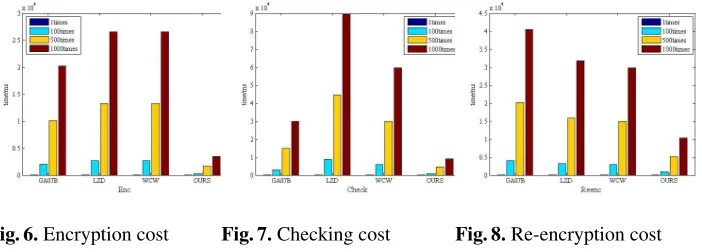
Fig. 6.Encryption cost Fig. 7.Checking cost Fig. 8.Re-encryption cost
Notations: In Table 2, encryption is denoted as Enc, re-encryption is denoted as Reenc, decryption is denoted as Dec, ciphertext is denoted as Ciph and ciphertext length is de-noted as Ciph-Len,tp,teandtmerepresent the computational cost of a pairing, a modular
exponentiation and a modular multi-exponentiation inG1, respectively in type-I bilinear
group(G1=G2).t0p,t0e,t
00
mod-ular exponentiation inG1, a modular exponentiation inG2 and a multi-exponentiation
inG1 respectively in type-III bilinear group(G1 6= G2).tse, tsd andtsv represent the
computational cost of once symmetric encryption, once symmetric decryption and once symmetric checking decryption results’ validity. ts andtv represent the computational
cost of a one-time signature signing and verification respectively. |G| andGT| denote
the bit-length of an element in groupsGandGT respectively for type-I pairing,|G1|,
|G2|andGT|denotes the bit-length of an element in groupsG1,G2andGT respectively
for type-III pairing.|SE|denotes the bit length of once symmetric encryption. Finally,
|vk|and|s|denote the bit length of the one-time signature’s public key and a one-time signature respectively.
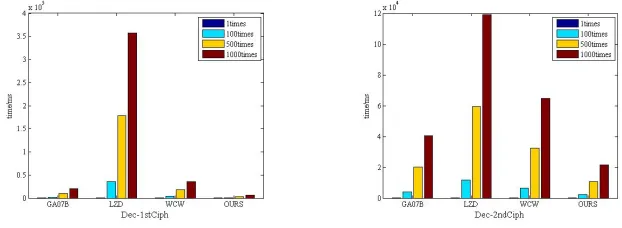
Fig. 9.First level decryption cost Fig. 10.Second level decryption cost
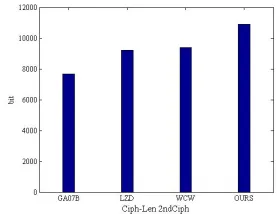
To further demonstrate our schemes efficiency, we roughly evaluated our scheme’s practical performance according to implementation in [1]. We give the performance com-parison results for GA07B, LZD+, WCW and Our schemes in Fig. 6,7,8,9,10, 11, 12, ac-cording to the efficiency benchmark of SS156 and BN256 groups [1] implemented in the highly efficient RELIC cryptographic toolkit version 0.4 [2](using the GMP library [12] for big number operations and the default configuration options for prime field arithmetic ), measured on a standard workstation, which is 2.4GHz Intel Core i5 processor and 8GB of RAM (1067MHz DDR3) running Mac OS X Lion version 10.7.5. We have neglected some operations such as the computation cost of one-time symmetric encryption, one-time symmetric decryption and one-time checking for the decryption results’ validity, one-time signature and verification. From Fig. 6,7,8,9,10, we can see our scheme is the most effi-cient scheme for encryption, checking, re-encryption, second-level ciphertext decryption and first-level ciphertext decryption. From Fig. 11, 12, we can see our scheme is a little inefficiency on the ciphertext length compared with some other schemes. Considering our scheme have many interesting properties while others do not have, we think this is not an essential shortcoming.
5.
Review of the DFA-based FPRE Scheme
Fig. 11.First level ciphertext length Fig. 12.Second level ciphertext length
1. Setup(1n, Σ):Chooseg, g0, z, h0 ∈R
Gp1, andα, k, a, b, αend, αend ∈R Z
∗ N. Set hstart = gαstart,hend = gαend andhk = gk. For each symbolδ ∈ Σ, choose aαδ ∈R ZN∗, and set hδ = gαδ. Choose a one-time signature scheme OT S, a one-time symmetric encryption scheme SY M = (SY M.Enc, SY M.Dec), and two hash functions:H1 : GT → Z∗N andH2 : GT → {0,1}poly(n). The P P is
(e(g, g)α, g, gab, g
0, z, h0, hstart, hend, hk,∀δ∈Σhδ, OT S, SY M, H1, H2)along with
the descriptions ofGand the alphabetΣ. TheM SK is(g−α, X3), whereX3is a
generator ofGp3.
2. KeyGen(M SK, M = (Q,T, q0, F):The description ofMincludes a setQof states
q0,· · ·, q|Q|−1 and a set of transitions T where each transitiont ∈ T is a triple
(x, y, δ)∈ Q × Q ×Σ.q0is designated as a unique start state andF ⊆ Qis the set of accept states. The algorithm choosesD0, D1,· · ·, D|Q|−1 ∈R Gp1 (associating
Diwithqi), for eacht∈ T, it choosesrt∈RZ∗N,∀qx∈Fit choosesrendx ∈RZ
∗ N,
and chooses au∈RZ∗N. It also choosesRstart1, Rstart2, Rstart3, Rt,1, Rt,2, Rt,3, Rendx,1, Rendx,2 ∈R Gp3and arstart ∈R Z
∗
N. The algorithm constructs the key as
the follows. First it sets:
Kstart1=D0·(hstart)rstart ·Rstart1, Kstart2=grstart ·Rstart2,
Kstart3=gu·Rstart3
For eacht= (x, y, δ)∈ T the algorithm sets:
Kt,1=Dx−1·zrt·Rt,1, Kt,2=grt·Rt,2, Kt,3=Dy·(hδ)rt·Rt,3
For eachqx∈F it computes:
Kendx,1 =g−α·Dx·(hend·gab)rendx ·gku·Rend x,1,
Kendx,2 =g
rendx ·R endx,2
Finally the key is
SK= (M, Kstart1, Kstart2, Kstart3,∀t∈ T(Kt,1, Kt,2, Kt,3),
∀qx∈F(Kendx,1, Kendx,2))
(a) Choose ay∈RGT, andvx∈RZ∗N (for∀qx∈F) and setrk1=K H1(y)
start1, rk2= KH1(y)
start2, rk1 = K H1(y)
start3,∀t ∈ T(rkt,1 = K H1(y)
t,1 , rkt,2 = K
H1(y)
t,2 , rkt,3 =
KH1(y)
t,3 ),∀qx∈F(rkendx,1 =K
H1(y)
endx,1·h
vx
end, rkendx,2 =K
H1(y)
endx,2·g
vx)
(b) Runrk4←Encrypt(P P, ω, y), and finally output
rkM→w= (M, rk1, rk2, rk3, rk4,
∀t∈ T(rkt,1, rkt,2, rkt,3),∀qx∈F(rkendx,1, rkendx,2))
4. Encrypt(P P, ω, m):Chooses0, s1,· · ·, sl∈RZ∗N, run(ssk, svk)←KeyGen(1n)
and constructsCT as following. First setCm = m·e(g, g)αsl, Cstart1 = C0,1 = gs0, Cstart2= (hstart)s0, Cstart3= (gsvk
0 h0)s0, fori= 1tolsetCi,1=gsi, Ci,2=
(hwi)sizsi−1, finally set
Cend1=Cl,1=gsl, Cend2= (hendgab)sl, Cend3= (hk)sl,
Cend4=Sign(ssk,(ω, Cm, Cstart1, Cstart2, Cstart3,(C1,1, C1,2),· · · ,
(Cend1, Cl,2), Cend2, Cend3)).
The original ciphertext is
CT = (svk, ω, Cm, Cstart1, Cstart2, Cstart3,(C1,1, C1,2),· · ·,(Cl,1, Cl,2),
Cend2, Cend3, Cend4)
5. ReEnc(rkM→ω0, CT):
(a) If
V erif y(ssk,(Cend4,(ω, Cm, Cstart1, Cstart2, Cstart3,(C1,1, C1,2),· · · ,
(Cend1, Cl,2), Cend2, Cend3))) = 1
ande(Cstart1, gsvk
0 h0) =e(g, CStart3)
proceeds; otherwise, output⊥.
(b) CT is associated with a string ω = (ω1,· · ·, ωl) and the re-encryption key
rkM→ω0is associated with a DFAM = (Q,T, q0, F)whereACCEP T(M, ω).
There must exist a sequence ofl+1statesu0, u1,· · · , ulandltransitionst1,· · · , tl
whereu0 =q0andul∈F and fori= 1,· · · , l, we haveti = (ui−1, ui, wi)∈ T, the proxy re-encryptsCT as follows.
i. If first computesA0=e(Cstart1, rk1)e(Cstart2, rk2)−1=e(g, D0)s0H1(y)
ii. Fori= 1tol, it computes:
Ai=Ai−1·e(Ci−1,1, rkti,1)·e(Ci,2, rkti,2)·e(Ci,1, rkti,3) =e(g, Dui)
siH1(y)
Since M accepts w, we have that ul = qx for someqx ∈ F andAl =
e(g, Dx)slH1(y).
iii. It sets
Aend=Al·e(Cendx,1, rkendx,1)−1·e(Cendx,2, rkendx,2)·e(Cendx,3, rk3)
iv. The proxy sets C1 = SY M.Enc(H2(δ), ξ), C2 = Encrypt(P P, ω0, δ), whereδ∈RGTandξ= (CT||Aend||rk4). It finally outputs the re-encrypted
ciphertextCR= (C1, C2). 6. Dec(SKM, CT):If
V erif y(svk,(Cend4,(ω, Cm, Cstart1, Cstart2, Cstart3,(C1,1, C1,2), · · ·,(Cend1, Cl,2), Cend2, Cend3))) = 1
ande(Cstart1, gsvk
0 h0) =e(g, Cstart3)proceed; otherwise, output⊥. First compute B0=e(Cstart1, Kstart1)e(Cstart2, Kstart2)−1=e(g, D0)s0
Fori= 1tolcompute
Bi=Bi−1e(Ci−1,1, Kti,1)·e(Ci,2, Kti,2)
−1·e(Ci,1, Kt
i,3) =e(g, Dui)
si
SinceM acceptsw, we have thatul =qxfor someqx ∈ F andBl =e(g, Dx)sl.
Finally compute
Bend =Bl·e(Cendx,1, Kendx,1)
−1e(C
endx,2, Kendx,2)·e(Cendx,3, Kstart3) =e(g, g)αsl
and output the messagem= Cm
Bend. 7. Dec(SKM, CR):
(a) Runδ ← Decrypt(SKM, C2), compute ξ ← SY M.Dec(H2(δ), C1), where ξ= (CT||Aend||rk4).
(b) Runy←Decrypt(SKM, rk4), then computeKey=AH1(y)−1
end .
(c) Verifye(Cstart1, g0svkh0) =e(g, Cstart3), Verify(svk,(Cend4,(ω, Cm, Cstart1, Cstart2, Cstart3,(C1,1, C1,2),· · ·,(Cl,1, Cl,2), Cend2, Cend3)))= 1? If the equa-tions hold, proceed; otherwise, output⊥.
(d) Output the messagem=Cm/Key.
6.
Cryptanalysis of the CCA-secure DFA based FPRE Scheme
6.1. On the IND-CCA Property
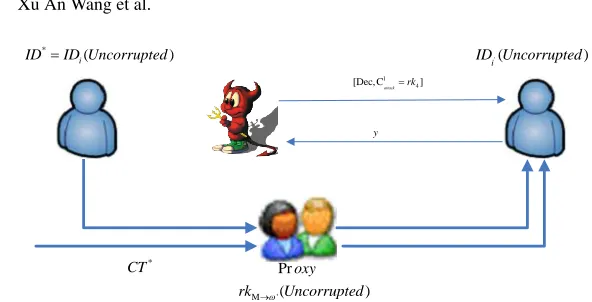
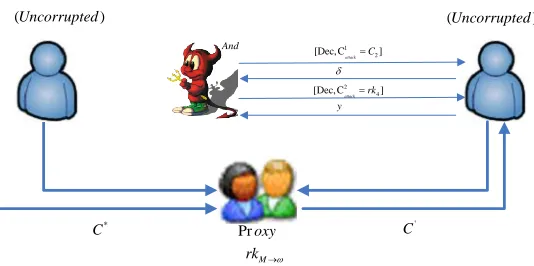
Attack I Here we give the first attack on the IND-CCA property, which can be seen in Figure 13. Note in this attack the delegator, delegatee and proxy are all uncorrupted. The main strategy is the following: the adversary just modifies the re-encryption key to be a valid ciphertextCattack, then he queries this ciphertext to the decryption oracle to
get secret valuey. Note hereCattack is not a derivative ofC∗. By using this value, he
'( )
i
ID Uncorrupted
M '( )
rk Uncorrupted oxy
Pr
* CT *
( )
i
ID ID Uncorrupted
1 4 [Dec, Cattackrk]
y
Fig. 13.Attack by querying the decryption oracle
1. Assume the challenge string isω∗and the challenge original ciphertext is
CT = (svk, ω∗, Cm, Cstart1, Cstart2, Cstart3,(C1,1, C1,2),· · · ,
(Cl,1, Cl,2), Cend2, Cend3, Cend4)
whereCm=mb·e(g, g)αsl, Cstart1=C0,1=gs0, Cstart2= (hstart)s0, Cstart3= (g0svkh0)s0, fori= 1tolsetCi,1=gsi, Ci,2= (hω∗
i)
sizsi−1, set
Cend1=Cl,1=gsl, Cend2= (hendgab)sl, Cend3= (hk)sl,
Cend4=Sign(ssk,(ω∗, Cm, Cstart1, Cstart2, Cstart3,(C1,1, C1,2), · · · ,(Cend1, Cl,2), Cend2, Cend3)).
2. The adversary first queries the re-encryption key generation oracle with inputω∗, and the re-encryption key oracle runs as following:
(a) Choose ay∈RGT, andvx∈RZ∗N (for∀qx∈F) and setrk1=K H1(y)
start1, rk2= KH1(y)
start2, rk1 = K H1(y)
start3,∀t ∈ T(rkt,1 = K H1(y)
t,1 , rkt,2 = K H1(y)
t,2 , rkt,3 =
KH1(y)
t,3 ),∀qx∈F(rkendx,1 =K
H1(y)
endx,1·h
vx
end, rkendx,2 =K
H1(y)
endx,2·g
vx)
(b) Runrk4←Encrypt(P P, ω∗, y), and finally output
rkM→w= (M, rk1, rk2, rk3, rk4,
∀t∈ T(rkt,1, rkt,2, rkt,3),∀qx∈F(rkendx,1, rkendx,2)).
3. Now the adversary can extract a valid ciphertext from this re-encryption key, which isrk4←Encrypt(P P, ω∗, y)This ciphertext has exactly the same structure as the original level ciphertext!
4. The adversary query this ciphertext to the original level ciphertext decryption oracle withSKM0, whereM0acceptω, and he will gety. Note here the adversary does not
5. After obtainingy, the adversary can easily compute the partial private key, which is enough to decrypt the challenge original level ciphertext:
Kstart1=rk
1
H1 (y)
1 , Kstart2=rk
1
H1 (y)
2 , Kstart3=rk
1
H1 (y)
1 ,
∀t∈ T(Kt,1=rk
1
H1 (y)
t,1 , Kt,2=rk
1
H1 (y)
t,2 , Kt,3=rk
1
H1 (y)
t,3 ),
∀qx∈F(F Kendx,1 = (rkendx,1/hvx
end)
1
H1 (y), F Kend
x,2 = (rkendx,2/g
vx)H1 (1y))
6. He decrypts the challenge ciphertext as following: First compute
B0=e(Cstart1, Kstart1)e(Cstart2, Kstart2)−1=e(g, D0)s0
Fori= 1tolcompute
Bi=Bi−1e(Ci−1,1, Kti,1)·e(Ci,2, Kti,2)
−1·e(Ci,1, Kt
i,3) =e(g, Dui)
si
SinceM acceptsω∗, we have thatul =qxfor someqx ∈F andBl =e(g, Dx)sl.
Finally compute
Bend= Bl·e(Cendx,1,(F Kendx,1))−1e(Cendx,2,
F Kendx,2)·e(Cendx,3, Kstart3)
= e(g, g)αsl
and output the messagemb= Cm
Bend.
In this way, the adversary can easily break the IND-CCA security.
(Uncorrupted)
M
rk
oxy
Pr
* C
(Uncorrupted)
' C 1
2 [Dec, CattackC]
And
2 4 [Dec, Cattackrk]
y
Fig. 14.Another attack by querying the decryption oracle
ciphertext to two valid ciphertexts. Concretely, the adversary first just modifies the re-encrypted challenge ciphertextC∗to be another ciphertextC1
attackandCattack2 which are
valid original ciphertexts , then he queries this ciphertext to the decryption oracle to get secret valuey. By using this secret value, he can derive the delegator’s secret key and thus can easy find the plaintext corresponding toC∗, which breaks the IND-CCA property. For this attack is similar with Attack I, here we omit the details.
7.
Our improved DFA-FPRE scheme
Our main idea is to modify the encryption algorithm used in the re-encryption process to be another one, which is not the same as the encryption algorithm used for second level ciphertext generation.
1. Setup(1n, Σ):Chooseg, g0, z, h0 ∈R
Gp1, andα, k, a, b, αend, αend ∈R Z
∗ N. Set hstart = gαstart,hend = gαend andhk = gk, h0
k=gk
0
. For each symbolδ ∈ Σ, choose a αδ ∈R ZN∗, and set hδ = gαδ. Choose a one-time signature scheme
OT S, a one-time symmetric encryption schemeSY M= (SY M.Enc, SY M.Dec), and two hash functions:H1 : GT → Z∗N andH2 : GT → {0,1}poly(n). TheP P
is{e(g, g)α, g, gab, g0, z, h0, hstart, hend, hk,∀δ∈Σhδ, OT S, SY M, H1, H2} along
with the descriptions ofGand the alphabetΣ. TheM SKis(g−α, X3), whereX3is
a generator ofGp3.
2. KeyGen(M SK, M = (Q,T, q0, F)):The description ofMincludes a setQof states
q0,· · ·, q|Q|−1 and a set of transitions T where each transitiont ∈ T is a triple
(x, y, δ)∈ Q × Q ×Σ.q0is designated as a unique start state andF ⊆ Qis the set of accept states. The algorithm choosesD0, D1,· · · , D|Q|−1∈RGp1(associatingDi
withqi), for eacht∈ T, it choosesrt∈RZN∗,∀qx∈Fit choosesrendx ∈RZ
∗ N, and
chooses au∈RZ∗N. It also choosesRstart1, Rstart2, Rstart3, Rt,1, Rt,2, Rt,3, Rendx,1,
Rendx,2 ∈R Gp3 and arstart ∈R Z
∗
N. The algorithm constructs the key as the
fol-lows. First it sets:
Kstart1=D0·(hstart)rstart·Rstart1, Kstart2=grstart·Rstart2, Kstart3=gu·Rstart3.
For eacht= (x, y, δ)∈ T the algorithm sets:
Kt,1=Dx−1·zrt·Rt,1, Kt,2=grt·Rt,2, Kt,3=Dy·(hδ)rt·Rt,3,
For eachqx∈F it computes:
kendx,1=g−α·Dx·(hend·gab)rendx ·gku·Rend
x,1, Kendx,2 =g
rendx ·Rend x,2
Finally the key is
SK= (M, Kstart1, Kstart2, Kstart3,∀t∈ T(Kt,1, Kt,2, Kt,3),
∀qx∈F(Kendx,1, Kendx,2)
(a) Choose ay∈RGT, andvx∈RZ∗N (for∀qx∈F) and setrk1=K H1(y)
start1, rk2= KH1(y)
start2, rk1 = K H1(y)
start3,∀t ∈ T(rkt,1 = K H1(y)
t,1 , rkt,2 = K
H1(y)
t,2 , rkt,3 =
KH1(y)
t,3 ),∀qx∈F(rkendx,1 =K
H1(y)
endx,1·h
vx
end, rkendx,2 =K
H1(y)
endx,2·g
vx)
(b) Run rk4←Encrypt0(P P, ω, y), and finally outputrkM→w= (M, rk1, rk2, rk3, rk4,∀t∈ T(rkt,1, rkt,2, rkt,3),∀qx∈F(rkendx,1, rkendx,2)). Here theEncrypt
0
(P P, ω, y)algorithm runs as following: Chooses0, s1,· · · , sl∈RZ∗N, run
(ssk, svk)←KeyGen(1n)
and constructsCT as following. First setCm=m·e(g, g)αsl, Cstart1=C0,1=
gs0, Cstart2 = (hstart)s0, Cstart3 = (gsvk
0 h0)s0, for i = 1 tol set Ci,1 = gsi, Ci,2= (hw
i)
sizsi−1, finally set
Cend1=Cl,1=gsl, Cend2= (hendgab)sl, Cend3= (hk)sl, Cend4= (h0k)sl
Cend5=Sign(ssk,(ω, Cm, Cstart1, Cstart2, Cstart3,(C1,1, C1,2),· · ·,(Cend1, Cl,2), Cend2, Cend3, Cend4))
The ciphertext is
CT = (svk, ω, Cm, Cstart1, Cstart2, Cstart3,(C1,1, C1,2),· · · ,(Cl,1, Cl,2),
Cend2, Cend3, Cend4, Cend5)
4. Encrypt(P P, ω, m):Chooses0, s1,· · ·, sl∈RZ∗N, run(ssk, svk)←KeyGen(1n)
and constructsCT as following. First setCm = m·e(g, g)αsl, Cstart1 = C0,1 =
gs0, Cstart2= (hstart)s0, Cstart3= (gsvk
0 h0)s0, fori= 1tolsetCi,1=gsi, Ci,2=
(hwi)sizsi−1, finally set
Cend1=Cl,1=gsl, Cend2= (hendgab)sl, Cend3= (hk)sl
Cend4=Sign(ssk,(ω, Cm, Cstart1, Cstart2, Cstart3,(C1,1, C1,2),· · · ,
(Cend1, Cl,2), Cend2, Cend3))
The original ciphertext is
CT = (svk, ω, Cm, Cstart1, Cstart2, Cstart3,(C1,1, C1,2),· · ·,(Cl,1, Cl,2),
Cend2, Cend3, Cend4)
5. ReEnc(rkM→ω0, CT):
(a) If
V erif y(ssk,(Cend4,(ω, Cm, Cstart1, Cstart2, Cstart3,(C1,1, C1,2),· · · ,
(Cend1, Cl,2), Cend2, Cend3))) = 1
ande(Cstart1, g0svkh0) =e(g, CStart3)proceeds; otherwise, output⊥.
(b) CT is associated with a string ω = (ω1,· · ·, ωl) and the re-encryption key
rkM→ω0is associated with a DFAM = (Q,T, q0, F)whereACCEP T(M, ω).
There must exist a sequence ofl+1statesu0, u1,· · · , ulandltransitionst1,· · · , tl
i. If first computesA0=e(Cstart1, rk1)e(Cstart2, rk2)−1=e(g, D0)s0H1(y)
ii. Fori= 1tol, it computes:
Ai =Ai−1·e(Ci−1,1, rkti,1)·e(Ci,2, rkti,2)·e(Ci,1, rkti,3)
=e(g, Dui)siH1(y)
Since M accepts w, we have that ul = qx for someqx ∈ F andAl =
e(g, Dx)slH1(y).
iii. It sets
Aend=Al·e(Cendx,1, rkendx,1)
−1·e(C
endx,2, rkendx,2)·e(Cendx,3, rk3)
=e(g, g)αslH1(y)
iv. The proxy sets C1 = SY M.Enc(H2(δ), ξ), C2 = Encrypt(P P, ω0, δ), whereδ∈RGTandξ= (CT||Aend||rk4). It finally outputs the re-encrypted
ciphertextCR= (C1, C2).
6. Dec(SKM, CT):If
V erif y(svk,(Cend4,(ω, Cm, Cstart1, Cstart2, Cstart3,(C1,1, C1,2),· · ·,
(Cend1, Cl,2), Cend2, Cend3))) = 1
ande(Cstart1, g0svkh0) =e(g, Cstart3)proceed; otherwise, output⊥. First compute B0 = e(Cstart1, Kstart1)e(Cstart2, Kstart2)−1 = e(g, D0)s0. Fori = 1tol
com-puteBi = Bi−1e(Ci−1,1, Kti,1)·e(Ci,2, Kti,2)
−1·e(C
i,1, Kti,3) = e(g, Dui)
si. SinceM acceptsw, we have thatul =qxfor someqx ∈ F andBl =e(g, Dx)sl.
Finally compute
Bend =Bl·e(Cendx,1, Kendx,1)−1e(Cendx,2, Kendx,2)·e(Cendx,3, Kstart3)
=e(g, g)αsl
and output the messagem= Cm
Bend. 7. Dec(SKM, CR):
(a) Runδ ← Decrypt(SKM, C2), compute ξ ← SY M.Dec(H2(δ), C1), where
ξ= (CT||Aend||rk4).
(b) Run y←Decrypt0(SKM, rk4), then computeKey=A H1(y)−1
end , while Decrypt0(SKM, rk4)
runs as following If
V erif y(svk,(Cend5,(ω, Cm, Cstart1, Cstart2, Cstart3,(C1,1, C1,2),· · ·,
(Cend1, Cl,2), Cend2, Cend3, Cend4))) = 1
ande(Cstart1, gsvk
0 h0) =e(g, Cstart3)proceed; otherwise, output⊥. First
com-puteB0 = e(Cstart1, Kstart1)e(Cstart2, Kstart2)−1 = e(g, D0)s0. Fori = 1
tol compute Bi = Bi−1e(Ci−1,1, Kti,1)·e(Ci,2, Kti,2)
−1·e(Ci,1, Kt
i,3) =
e(g, Dui)si. SinceM acceptsw, we have that ul = qx for someqx ∈ F and
Bl=e(g, Dx)sl. Finally computeBend=Bl·e(Cend
x,1, Kendx,1)
−1e(Cend
x,2,
Kendx,2)·e(Cendx,3, Kstart3) =e(g, g)αsland output the messagem= Cm
(c) Verifye(Cstart1, gsvk
0 h0) =e(g, Cstart3), Verify
(svk,(Cend4,(ω, Cm, Cstart1, Cstart2, Cstart3,(C1,1, C1,2),· · · ,(Cl,1, Cl,2),
Cend2, Cend3))) ?
= 1
If the equations hold, proceed; otherwise, output⊥. (d) Output the messagem=Cm/Key.
Theorem 2. Suppose Liang et al’s original scheme is IND-CPA secure, SYM is a CCA-secure symmetric encryption, OTS is a strongly existential unforgeable one-time signature andH1, H2are TCR hash functions, our DFA-based FPRE system is IND-CCA secure in the standard model.
Proof. Here we just give the roughly security proof. For we just modify Liang et al.’s scheme on the RekeyGen algorithm used in the re-encryption key generation process, and the corresponding Decrypt algorithm. And other algorithms are the same as the original scheme, thus the security proof is almost the same as Liang et al’s proof.
But there is a crucial difference, in our scheme
rk4←Encrypt0(P P, ω, y)
and
Cend1=Cl,1=gsl, Cend2= (hendgab)sl, Cend3= (hk)sl, Cend4= (h0k)sl
Cend5=Sign(ssk,(ω, Cm, Cstart1, Cstart2, Cstart3,(C1,1, C1,2),· · ·,(Cend1, Cl,2), Cend2, Cend3, Cend4))
which has not the same structure as the ciphertexts outputted by the Encrypt algorithm
Cend1=Cl,1=gsl, Cend2= (hendgab)sl, Cend3= (hk)sl
Cend4=Sign(ssk,(ω, Cm, Cstart1, Cstart2, Cstart3,(C1,1, C1,2),· · · ,(Cend1, Cl,2),
Cend2, Cend3))
that means, part of the re-encryption key can not be used to recoveryby querying to the decryption oracle. Thus the above described attack can not be launched.
8.
Conclusion
Acknowledgment This work is supported by National Natural Science Foundation of China (Grant Nos. 61772550, 61572521, U1636114, 61402531), National Cryptography Development Fund of China Under Grants No. MMJJ20170112, National Key Research and Development Program of China Under Grants No. 2017YFB0802000, Natural Sci-ence Basic Research Plan in Shaanxi Province of china (Grant Nos. 2018JM6028) and Guangxi Key Laboratory of Cryptography and Information Security (No. GCIS201610).
References
1. Akinyele, A., Garman, C., Hohenberger, S.: Authomating fast and secure translations from Type-I to Type-III paring schemes. ACM CCS 20015, pp. 1370–1381 (2015)
2. Aranha, D., Gouvea, C.: RELLC is an Efficient Library for Cryptography. http://code.google.com/p/relic-toolkit/.
3. Ateniese, G., Fu, K., Green, M., Hohenberger, S.: Improved Proxy Re-Encryption Schemes with Applications to Secure Distributed Storage. NDSS 2005, pp. 29–43 (2005)
4. Ateniese, G., Fu, K., Green M., Hohenberger, S.: Improved proxy re-encryption schemes with applications to secure distributed storage. ACM Transation Information System Security 9(1), pp. 1–30 (2016)
5. Blaze, M., Bleumer G., Strauss, M.: Divertible Protocols and Atomic Proxy Cryptography. Advances in Cryptology - Eurocrypt’98, LNCS 1403, pp. 127–144 (1998)
6. Canetti, R., Hohenberger S.: Chosen Ciphertext Secure Proxy Re-encryption. ACM CCS 2007, pp. 185–194 (2007)
7. Deng, R., Weng, J., Liu, S., Chen, K.: Chosen Ciphertext Secure Proxy Re-encryption without Pairing. CANS’08, LNCS 5339, pp.1–17 (2008).
8. Li, F., Liu, B., Hong, J: An efficient signcryption for data access control incloud computing. Computing, 99(5), pp. 465-479 (2017).
9. Green, M., Ateniese, G.: Identity-based proxy re-encryption. ACNS 2007, volume 4521 of LNCS, pp. 288–306 (2007)
10. Guo, S., Xu, H.: A secure delegation scheme of large polynomial computation in multi-party cloud. International Journal of Grid and Utility Computing, 6(2), pp.1-7 (2015)
11. Hegarty, R., Haggerty, J.: Extrusion detection of illegal files in cloud-based systems. Interna-tional Journal of Space-Based and Situated Computing, 5(3), pp. 150-158 (2015)
12. Torbjorn, G.(and the GMP development team): GNU MP: The GNU Multiple Precision Arith-metic Library, 5.0.5 edition, http://gmplib.org (2012)
13. Lai, J., Zhu, W., Deng, R., Liu, S., Kou W.: New constructions for identity-based unidirectional proxy re-encryption. Journal of Computer Science and Technology, 25(4), pp. 793–806 (2010) 14. Libert, B., Vergnaud, D.: Unidirectional Chosen-Ciphertext Secure Proxy Re-encryption. PKC
2008, LNCS 4939, pp. 360–379, Springer–Verlag (2008)
15. Libert, B., Vergnaud, D.: Unidirectional Chosen-Ciphertext Secure Proxy Re-Encryption. IEEE Transactions on Information Theory, 57(3), pp. 1786–1802 (2011)
16. Liang, K., Susilo, W., Liu J. K.: Privacy-Preserving Ciphertext Multi-Sharing Control for Big Data Storage. IEEE Transactions on Information Forensics and Security, 10(8), pp. 1578–1589 (2015)
17. Liang, K., Au, M., Liu, J., Susilo, W., Wong, D., Yang, G., Phuong, T., Xie, Q.: A DFA-Based Functional Proxy Re-Encryption Scheme for Secure Public Cloud Data Sharing. IEEE Transactions on Information Forensics and Security, 9(10), pp. 1667–1680 (2014)
19. Miao, Y., Ma, J., Liu, X., Li, X., Liu, Z., Li. H.: Practical Attribute-Based Multi-keyword Search Scheme in Mobile Crowdsourcing. IEEE Internet of Things Journal, DOI:10.1109/JIOT.2017.2779124, (2017)
20. Miao, Y., Ma, J., Liu, X., Li, X., Jiang, Q., Zhang, J., Shen L., Liu, Z.: VCKSM:Verifiable con-junctive keyword search over mobile e-health cloud in shared multi-owner settings. Pervasive and Mobile Computing, 40, pp. 205-219 (2017)
21. Miao, Y., Ma, J., Liu, X., Zhang J., Liu Z.: VKSE-MO: verifiable keyword search over encrypted data in multi-owner settings. SCIENCE CHINA Information Sciences, 60(12), 122105:1-122105:15 (2017)
22. Liang, K., Susilo, W.: Searchable Attribute-Based Mechanism With Efficient Data Sharing for Secure Cloud Storage. IEEE Transactions on Information Forensics and Security, 10(9), pp. 1981–1992 (2015)
23. Petrlic, R., Sekula, S., Sorge, C.: A privacy-friendly architecture for future cloud computing. International Journal of Grid and Utility Computing, 4(4), pp. 265-277 (2013)
24. Shao, J., Cao, Z.: CCA-secure proxy re-encryption without pairing. PKC 2009, LNCS 5443, pp. 357–376, Springer–Verlag (2009)
25. Wang, H., Cao, Z., Wang, L.: Multi-use and unidirectional identity-based proxy re-encryption schemes. Information Science, 180, pp. 4042–4059 (2010)
26. Shao, J., Cao, Z., Lin, P.: Generic construction for CCA-secure unidirectional proxy re-encryption. Security and Communication Networks, 2, pp. 1–16 (2009)
27. Weng, J., Deng, R., Chu, C., Ding, X., Lai J.: Conditional proxy re-encryption secure against chosen-ciphertext attack. ACM ASIACCS 2009, pp. 322–332 (2009)
28. Weng, J., Yang, Y., Tang, Q., Deng, R., Bao F.: Efficient conditional proxy re-encryption with chosen-ciphertext security. ISC 2009, LNCS 5735, pp. 151–166 (2009)
29. Weng, J., Zhao, Y., Hanaoka, G.: On the Security of a Bidirectional Proxy Re-encryption Scheme from PKC 2010. PKC 2011, pp. 284–295 (2011)
30. Weng, J., Chen, M., Yang, Y., Deng, R., Chen K., Bao, F.: CCA-secure unidirectional proxy re-encryption in the adaptive corruption model without random oracles. Science China Infor-mation Sciences, 53, pp. 593-606 (2010)
31. Chow, S., Weng, J., Yang, Y., Deng R.: Efficient unidirectional proxy re-encryption. AFRICACRYPT 2010, LNCS 6055, pp. 316–332 (2010)
32. Wang, X., Ma, J., Xhafa, F., Zhang, M., Luo, X.: Cost-effective secure E-health cloud system using identity based cryptographic techniques. Future Generation Computer System, 67, pp. 242–254 (2017)
33. Wang, X., Ma, J., Xhafa, F., Qin, B., Zhang, M.: New efficient chosen ciphertext secure Elgamal encryption schemes for secure Cloud storage service. International Journal of Web and Grid Services, 13(3), pp. 246–269 (2017)
34. Wang, X., Xhafa, F., Ma, J., Barolli, L., Ge. Y.: PRE+: dual of proxy re-encryption for secure cloud data sharing service. International Journal of Web and Grid Services, 14(1), pp. 44–69 (2018)
35. Guo, S., Xu, H.: A secure delegation scheme of large polynomial computation in multi-party cloud. International Journal of Grid and Utility Computing, 6(2), pp.1–7 (2015)
36. Wang, Y., Du, J., Cheng, X., Liu, Z., Lin, K.: Degradation and encryption for outsourced png images in cloud storage. International Journal of Grid and Utility Computing, 7(1), pp. 22–28 (2016)
37. Zhu, S., Yang, X.: Protecting data in cloud environment with attribute-based encryption. Inter-national Journal of Grid and Utility Computing, 6(2), pp. 91–97 (2015)