ISSN (online): 2349-784X
Comparative Analysis of Optimization
Algorithms for Solving Optimal Power Flow
using IPFC
B. Gopinath S. Rubiya
Associate Professor & Head of Department PG Scholar
Department of Electrical & Electronics Engineering Department of Electrical & Electronics Engineering Vivekanandha institute of Engineering and technology for Vivekanandha institute of Engineering and technology for
Women, Tiruchengode, Namakkal District-637205 Women, Tiruchengode, Namakkal District-637205
Abstract
Interline power flow controller plays a vital role in power system control as they have multi functionality and dynamic responsibility. It can manage power between two or more interconnected transmission lines. PSO, Cuckoo search, Bat Algorithm, Firefly optimization and plant pollination Algorithms have been analyzed and the best one is utilized along with IPFC for solving transmission system problems. However optimal power flow is a major problem in power system. This paper aims to reduce the power loss and balance the power flow of electrical energy in the multi transmission line can be controlled by using optimization algorithms incorporating with IPFC. This paper provides overview of all the above algorithms.
Keywords: IPFC-Interline power flow controller, Particle Swarm Optimization, Cuckoo Search Algorithm, BAT, Firefly algorithm and plant pollination algorithm
________________________________________________________________________________________________________
I. INTRODUCTION
Nowadays fact devices are used to enhance the reliability of the transmission line. The optimal power flow is a nonlinear programming problem, which is used to optimize physical and operational constraints in power system. This is used to determine the optimal operating problem of a power system and the corresponding control variables for economic operation. The optimal power flow problems are solved by using conventional and non-conventional methods in power system. However, convergence and complexity are the major issues. FACTS controller were used to improving power flow in transmission lines and voltage stability in HVDC transmission line. The IPFC is capable to balance the power flow between multiple transmission lines. IPFC having the capacity to transmit the power from under load lines into overloaded lines. Compared to the Unified Power Flow Controller (UPFC), the IPFC gives a relatively economical solution for power flow control in multi transmission line, since only one shunt converter is involved. IPFC FACTS controller is used to reduce the power loss in optimal system operation and improving the voltage profile [2]. Nature inspired algorithms are the most powerful algorithms for optimization [3].
II. INTERLINE POWER FLOW CONTROLLER (IPFC)
Comparative Analysis of Optimization Algorithms for Solving Optimal Power Flow using IPFC
(IJSTE/ Volume 2 / Issue 11 / 078)
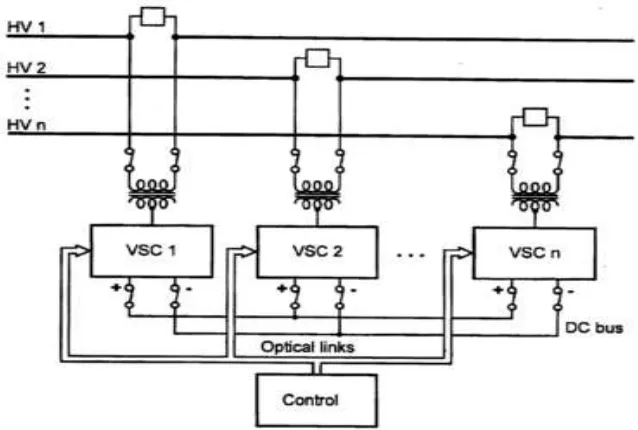
Fig. 1: Schematic diagram of IPFC
It has many type of instability problems occur during the transmission of power so that we require inter line Power flow controller for, Power flow management between multiline transmission systems, Increase the power transfer capability and to enhancing the controllability, reducing the power losses in lines and Protect the system from damage and unscheduled outages.
Particle Swarm Optimization (PSO)
The Particle Swarm Optimization (PSO) algorithm is a heuristic approach inspired by the observation of social behavior of birds flocking and fish schooling. The initial ideas on particle swarm were described by James Kennedy and Eberhart were aimed to produce computational intelligence of swarm and it imitates the social optimization. This simulation involved in bird flocks searching for corn was formulated by Heppner and Grenander’s.
Particle Swarm Optimization (PSO) is a powerful optimization method and it is based on Swarm intelligence. It combines self-experience with social self-experience. PSO is a population-based optimization method. The concept is to uses a number of particles that contains a swarm moving around and looking for the best solution in problem space. Each particle in search space adjusts its own flying capability and experience of other particles. The objective of the PSO is the optimization of continuous nonlinear functions to finding the best solution in problem space. It has been proved to be very effective for solving global solution in various engineering and research application such as image and video analysis and optimization of communication networks.
Cuckoo Search Algorithm
Cuckoo search is the latest family of metaheuristic search algorithms, which is inspired by the life of a bird, has been developed by Yang and Deb (2009). It is suitable for nonlinear optimization problem. It is very promising and outperform existing algorithm such as PSO. The cuckoo birds maintain an aggressive reproduction strategy. It is based on the obligate brood parasitic nature of some cuckoos and it is combined with the Levy flight behavior of other birds [6]. Cuckoo search (CS) is a population based optimization technique and as many other heuristic algorithms it starts with random initial population. Cuckoos have aggressive reproduction behavior and it laid eggs in communal nests, a strategy known as brood parasitism [6]. One of the female brood-parasitic has evolved in such a way to mimic the color and pattern of the eggs [4]. Generally the cuckoo eggs hatch slightly earlier then their host eggs which increase their productivity. At first instinct a cuckoo chick gets after being hatched is that, it through away the host birds eggs out of the nest.
In order to simplify Cuckoo search algorithm three idealized rules can be used [5]:
A single cuckoo lays one egg at a time and dumps it randomly chosen host nest.
Selection of the highest quality eggs from the best nests are to carry out to the next generation.
The number of available host nests is fixed and probability is that an Egg laid by a cuckoo bird can be discovered by the host bird.
(IJSTE/ Volume 2 / Issue 11 / 078)
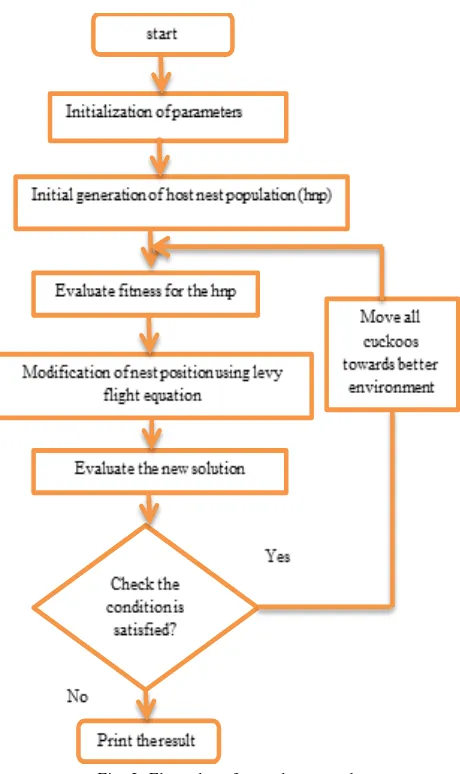
Fig. 2: Flow chart for cuckoo search BAT ALGORITHM
Based on the behavior of the bats, developed by Yang [9] is an interesting optimization technique called Bat Algorithm, which is an optimization algorithm, inspired from the echolocation of microbats. The capability of echolocation of bats can find their prey and perceive different types of insects in complete darkness. In most of the cases they use short frequency signals to analyze the object. Echolocation of bats works as sonar in bats, emits a loud and short pulse sound, and it hits an object after a fraction of time, the echo returns back to their bats ears. In addition, this makes bats being able to distinguish the difference between an obstruction and a prey, allow them to hunt even in complete darkness. Bat algorithm is a considered as a new metaheuristic algorithm based on Bat behaviour. The optimal solution of economic load dispatch (ELD) is obtained and it is used to optimize the total generating cost of power plant by using the proposed bat algorithm. This bat algorithm has good convergence and better quality of solution than PSO and IWD reported in [20]. The main advantage of this technique is easy is implement and capable of finding feasible global optimal solution. BAT Algorithm has priory of accuracy and better efficiency compared to other algorithms.
For simplicity, we are now considering the following rules are:
All bats use echolocation to sense and they also know the difference between food/prey.
Bats fly randomly with velocity (Vi) and position (Xi) and frequency (fmin) with wavelength (λ) and loudness (Ao) to search prey and able to interpret the signal and sees the prey is large or small.
The velocity of the each of the population (N) is calculated using,
Vi
new = Viold + fi (Gbest - Xi) The frequency of signals transmitted by each of the bat is calculated asfi= fi
new+α (fi
max- fi
min)
Here, fmin, fmax and are the maximum and minimum frequency values of each bat and α is a random number between 0 and 1.After this modification of the positions of bats, there is one more modification in the positions using another fly, the new positions for each of the population can be calculated as
Comparative Analysis of Optimization Algorithms for Solving Optimal Power Flow using IPFC
(IJSTE/ Volume 2 / Issue 11 / 078)
Where, At is the mean value of the loudness of all bats, £ is the random number generated between 0 and 1.
FIREFLY ALGORITH
Firefly algorithm (FA), developed by Xin-She Yang [7] for Solving optimal power flow problem and to achieve better global optimal solutions. It based on the idealized behavior of the flashing characteristics of fireflies, including the
light emission, absorption and the mutual attraction.
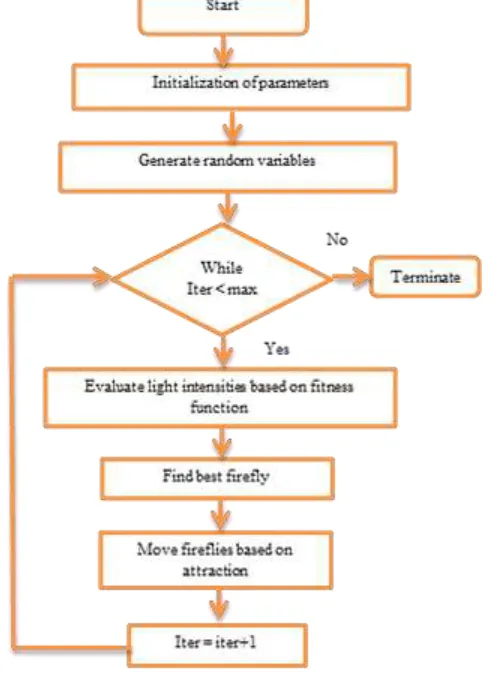
The algorithm has less number of operators and can be easily implemented for any optimization problems. The flow chart for Firefly Algorithm for minimization of Real power loss
Fig. 3: Flow chart for Firefly Algorithm The following rules are given,
A firefly will be attracted by other fireflies regardless of their sex.
Attractiveness is proportional to their brightness and decreases as the distance among them increases.
The landscape of the objective function determines the brightness of a firefly.
Flower Pollination Algorithm
Flower pollination is a meta-heuristic algorithm for the optimal solution of optimal power flow problem such as minimizing the fuel cost of a thermal power plant. The objective of ELD problem is to minimize the fuel cost by setting the real power outputs from generators. Real power generations are adjusted for minimizing the fuel cost by using flower pollination algorithm (FOA). It is estimated that 80% of plants use pollination for reproduction and 90% of pollination is through insects and animals only the remaining 10 % is by wind and other natural causes. Flower pollination is the transfer of pollen from a male flower to a female flower. Pollination may take place in the form of biotic or abiotic. Biotic pollination may be of self-pollination or cross-pollination. Self-pollination takes place in the same flower between its male and female parts and Cross-pollination means pollination occurring between two different flowers. Biotic and self-pollinations can be thought of local optimization.
(IJSTE/ Volume 2 / Issue 11 / 078)
3) Pollinators, like insects develop flower loyalty, which is comparable to the reproduction and proportional to the matching of two flowers involved.
4) Switching or the interaction of global pollination and local pollination can be controlled by a switch probability p £ [0, 1], slightly biased towards local pollination.
The flower pollination process can happen at both local and global levels. But in reality, flowers in the neighbourhood have chances to getting pollinated by pollen from local flowers than those which are far away. To simulate this proximity probability (Rule 4) can be used to switch between local pollination to common global pollination.
A comparative study is made between these algorithms according to various constraints such as time, convergence speed, number of iterations, and applications. The result obtained from this comparison is tabulated below.
Table – 1 Comparison of Algorithms
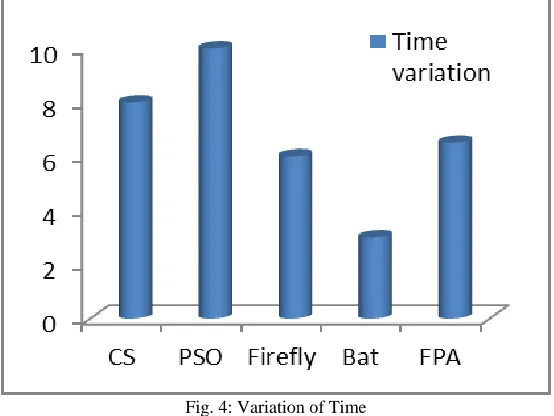
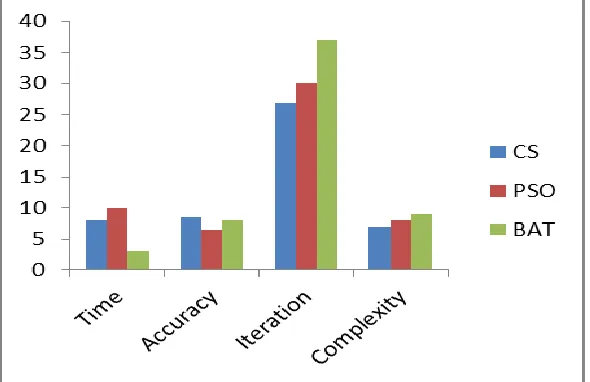
Based on the above comparison we made a graphical Representation to compare each algorithm with each Parameter, to identify the suitable algorithm.
Fig. 4: Variation of Time
Comparative Analysis of Optimization Algorithms for Solving Optimal Power Flow using IPFC
(IJSTE/ Volume 2 / Issue 11 / 078)
Fig. 5: Accuracy
From the figure.8 it is clear that the Flower pollination Algorithm has lower accuracy while all others have better accuracy. Even then when we consider the Cuckoo search have better accuracy with better time.
Fig. 6: Number of Iteration.
Now we considered the number of iteration that each Algorithm needed, based on this figure 9 is plotted and the result was shown. From the above graph it is well clear that Flower Pollination algorithm takes more number of iteration than all other algorithms. Whereas the cuckoo search and Firefly Algorithm takes less number of iteration. From the fig. 7 we can also analyze that cuckoo search algorithm has less complex. Based on the above graph and its observation we plotted a graph which compares the three algorithms which was selected.
(IJSTE/ Volume 2 / Issue 11 / 078)
In the fig. 7, we compared Cuckoo search, bat algorithm and particle swarm optimization according to time, accuracy, number of iteration and complexity of solution. From this it is clear that cuckoo search has better accuracy. Number of iteration and has less complexity of solution. So for to minimize the reactive power loss in IPFC we have choose the best algorithm for the optimization.
III. CONCLUSION
In this paper, optimization techniques such as Particle Swarm Optimization, Cuckoo Search and various algorithms are analyzed for solving OPF in power system using IPFC was proposed. From the comparative analysis the proposed method is effectively maintained by the OPF in power system by economically maintaining the power balance and real power loss of the system. IPFC controller have the ability to make power balance between multi transmission line and it improves the power quality of the system.The results demonstrate the effectiveness and robustness algorithms to solve OPF problem incorporating IPFC. From the results, the effectiveness of IPFC to improve the power flow in multiple lines is also understood. It is concluded that this algorithm has good convergence characteristics, high computational efficiency and the ability to find the better quality solution. This algorithm can be applied to solve the optimal power flow incorporating other FACTS devices also.
REFERENCES
[1] Mohamed, K. H., Rama-Rao, K. S., & Hasan, K. N. M. (2005). “Application of particle swarm optimization and its variants to interline power flow controllers and optimal power flow”. Proceedings ofTransmission and Distribution Conference and Exhibition: Asia and Pacific (pp. 1–7). Dalian, China.
[2] Abdel-Moamen, M. A., & Padhy, N. P. (2003). “Optimal power flow incorporating FACTS devices-bibliography and survey”. Proceedings of IEEE PES Transmission and Distribution Conference and Exposition (pp. 669-676).
[3] F.van den Bergh. “An Analysis of Particle Swarm Optimizers”. PhD the- sis, University of Pretoria, Faculty of Natural and Agricultural Science, November 2001.
[4] Yang, X. et al.: “Cuckoo Search via Levy Flights”. Computing. 210–214 (2009).
[5] Reynolds, A.M., Frye, M. a: “Free-flight odor tracking in Drosophila is consistent with an optimal intermittent scale-free search”. PloS one. 2, 4, e354 (2007). [6] Kennedy and R.C. Eberhart. Swarm Intelligence. Academic Press, London, (2001).
[7] Preeti Rai, Arushi Varshney., “Comparative Analysis of Meta-Heuristic Algorithms based on their Application Areas in SRGM” International Journal of Innovative Research in Computer and Communication Engineering Vol. 3, Issue 6, June 2015
[8] K.S.Pandya, 3.D.A.Dabhi. “Comparative Study of Bat & Flower Pollination Optimization Algorithms in Highly Stressed Large Power System”. conference on march 2015.
[9] P. Sudheer Kumar Reddy P. Anil Kumar G.N.S. Vaibhav “Application of BAT Algorithm for Optimal Power Dispatch”. International Journal of Innovative Research in Advanced Engineering (IJIRAE) ISSN: 2349-2163 Issue 2, Volume 2 (February 2015).
[10] R. Prathiba1, M. Balasingh Moses. “Flower Pollination Algorithm Applied for Different Economic Load Dispatch Problems”. International Journal of Engineering and Technology (IJET) ISSN: 0975-4024 Vol 6 No 2 Apr-May 2014