Cross-domain Authentication Alliance Protocol
Based on Isomorphic Groups
Qikun Zhang
School of Computer Science and Technology, Beijing Institute of Technology, Beijing, China Email: [email protected]
Jun Zheng, YuanTan, Ruifang Wang, Yuanzhang Li
School of Computer Science and Technology, Beijing Institute of Technology, Beijing, China Email: [email protected]
Abstract—With the development of information technology
in distributed network, such as cloud computing and grid computing. They need mutual coordination resources among the various areas to meet the requirement in infinite speed and infinite space of information technology for people. To ensure secure access resources among areas, the paper proposes a cross-domain authentication alliance-agreement. This agreement constructs a large prime group over elliptic curve, and uses direct product decomposition of the large prime group to construct multiple automorphism groups. Each automorphism group is made as a different key parameter in different domains to overcome the defect of key parameters consistency in the alliance-domain of the existing programs, and all the members must register with blinded keys in their domains to avoid the authority faking the members to cross-domain access resources of the existing programs, and uses the bilinear automorphism group for inter-domain signcrypt to achieve the cross-domain alliance certification, to overcome the complexity of certificate transmission and bottlenecks in the scheme of PKI-based. Analyses show that this scheme has anonymity, security and supporting mutual anonymous authentication.
Index Terms—inter-domain signcryption; alliance- certification; direct product decomposition; bilinear groups
I. INTRODUCTION
Along with the rapid development of information technology, the information service requirement of people is continual growing. There has developed some huge distributed networks recent years, such as grid computing, cloud computing, etc, which unite a lot of computers to intensify mutual cooperation for meeting the information requirement of infinite speed and space of people. The features of these networks is that lots of computers within the network work together and access each other’s resource in differences domains to obtain sufficient resource to provide sufficient services. Within this background, it relates to the security issue of resource
access among different domains. Each domain would configure its local authentic service mechanism to provide authentic services and therefore, every organization has established relatively independent trust domain, users within a domain trust the local authentic center, authentic center of each domain provides convenient authentic services for local users. Single domain does not satisfy large amount of service requirements, so it is necessary to request multi-domain resources. Therefore, the request of shared resources comes not only from members within the domain, but also from members outside the domain. Here exist the problems of cross-domain authentication when users of other domains access resources of this trust domain.
Applications of cross-domain authentication, such as the authentication among multiple heterogeneous domains within a virtual organization under the grid environment[1], the roaming access authentication under the environment of wireless network, etc. there are mainly two cross-domain authentication frameworks under specific environments: one is authentication framework (such as Kerberos)[2] based on the symmetric key system. This scheme relates to the complexity of symmetric key management and key consultations, and cannot deal with the anonymous problem effectively. The other is authentication framework based on traditional
PKI
[3][4][5], the procedures of credentials under public key cryptography is a heavy burden, specifically, the consumptions is caused by the construction of credential paths and the query of the status of credentials and transfer of credentials .It can also cause the network bottleneck of authentication center when under frequent cross-domain accesses. References [6][7][8] purposed an identity-based multi-domain authentication model, which is based on the trust of the authority of the other side, and it requires the key agreement parameters of all domains to be same, this have limitations and could not avoid the authority faking the members to cross-domain access resources. Reference [9][10] adopt signcryption to implement the authentication when users access resource each other within the same domain, it is confined to a single domain, and reference [11] extends it to enable the members from the difference Manuscript received November 20, 2010; revised December 10,
domains to authenticate each other, but the precondition of this solution is the hypothesis that PKG of every domain is honest. PKG possesses the private keys of all the members within its domain, and if PKG is malicious, the truth identity of user and the confidential of private key could not be guaranteed.
Cross-domain authentication union protocol should achieve security authentication among domains and also ensure the anonymity of each side Correspondent. Given a cross-domain authentication protocol, the verifier can not figure out the identity of the prover, this is called anonymity of cross-domain authentication. Manager of each domain can track the identity of the prover within the domain, and this is called the traceable problem. Along with the research of cross-domain authentication, more and more features required of the cross-domain authentication mechanism. Cross-domain authentication protocol purposed in this article can achieve the features as follows:
Correctness: a legal member within a domain can definitely pass the authentication among domains through authentication algorithm of the cross-domain authentication alliance protocol.
unforgeability: it is computationally infeasible that a member fake others to generate an algorithm that can be passed the authentication by the cross-domain alliance authentication, even if the member is a manager of a domain.
Anonymity: except for the manager of the domain, it will be computationally infeasible for anyone to determine the identity of the prover.
Traceability: for anonymous authentication, the manager of the domain can determine the identity of the prover.
Anti-attack:cross-domain authentication alliance protocol should adopt strict logical authentication process, which can defenses various attacks.
II. PRELIMINARIES
A. Self-isomorphic Group of Finite Group [12]
Let
G
be a group,AutG
represents self-isomorphic group ofG
,C G
( )
is the center ofG
,g
is anAbel
group generated by
g
. IfG
is a finite group,G
is the order ofG
. IfG
is a finite group andG
=
p n
n(
>
0)
, andG
is defined asp
−
gr oup
(p
is a prime).Let
H
be ap
−
Subgroup
of a finite groupG
, andH
is the highest exponentiation ofp
in thefactorization of
G
,H
is defined assylow p
−
subgroup
ofG
Theorem 1[12]: let
G
be a finiteAbel
group,1
,
2,...,
np p
p
are all prime factors ofG
,(1
)
i
p
G
≤ ≤
i
n
are thesylow
p
−
subgr oups
ofG
, which gives direct product decomposition:1 2
...
ip p p
G G
=
×
G
× ×
G
.Theorem 2[12]: let
G
=
G
1×
G
2× ×
...
G
n, ifK
i is a sub-group ofG
i(1
≤ ≤
i
n
)
, andK K
1,
2,...,
K
n are isomorphic to each other, and thenG
hasn
sub-groups which are isomorphic to each other.Theorem 3[12]: let
G
1=
g
1 ,G
2=
g
2 are cyclic groups, andm
,n
are the order ofG
1 andG
2respectively, if
( , ) 1
m n
=
, thenG
1×
G
2 is a cyclic group with the order ofmn
.B. Bilinear Group [13]
Let
G
1 andG
2 be a pair of bilinear groups, let1 1
G
=
g
,G
2=
g
2 , andG
3is a cyclic group withhigh prime order
p
,ϕ
is the isomorphic mapping from1
G
toG
2,ϕ
(
g
1)
=
g
2,e
is a computable mapping,1 2 3
:
e G
×
G
→
G
has the following properties:Bilinearity: For all
u
∈
G
1,v
∈
G
2 anda b
,
∈
Z
p,(
,
)
( , )
abe au bv
=
e u v
.Non-degeneracy:
e g g
( ,
1 2)
≠
1
.C. M ulti-linearMapping
Multi-linear Diffie-Hellman hypothesis:paper [14] give the definition of
l
-multi-linear mapping, let1
G
be anaddition group,
2
G
be a multiplicative group, the discrete logarithmic over1
G
andG
2 is hard to solve.Definition 1: mapping 1
:
1 2 Le G
→
G
is definedL
multi-linear mapping, if it has the following properties:a)
G
1 andG
2 have the same prime orderp
;b) For all
a a
1, ,...
2a
l∈
Z
p,g g
1, ,...
2g G
l∈
1, there exists1 2...
1
(
1 1,
2 2,...
)
1( , ,... )
1 2l
a a a
l l l
e a g a g
a g
=
e g g
g
c) non- degeneracy: if
g
is one of generators ofG
11
(
g
∈
G
)
, thene g g
1( , ,... )
g
is also one of generatorsof
G
2.Definition 2: Determinable multi-linear Diffie-Hellman problem (DMDH) is that, given
e g a g a g
( ,
1,
2,...
a g
l+1)
and∀ ∈
z
G
2, whether determine 1 2... 11
( , ,... )
l
a a a
e g g
g
+.
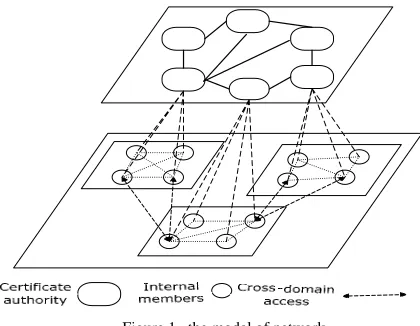
III. CROSS-DOMAIN AUTHENTICATION MODEL In order to ensure resource network to provide infinite information resource, space resource and computation speed, it is necessary that resources distributed in every domain of the network to coordinate and cooperate. Cross-domain authentication is a kind of inter-Cross-domain authentications that ensure the security of communication and resource sharing among domains, resource network model is shown in Fig1.
Figure 1. the modal of network
In this model, system is composed of multiple domains, and each domain is independent and autonomous. Each domain is composed of an key authentication center
(
KAC
)
and many internal members,KAC
like to the traditionalCA
orPKG
, members of alliance-domain are both provider and user of the resources, internal members of each domain need cross-domain access resource in the case of collaborative computing. EachKAC
select one of automorphism cyclic groups to design its key parameters,KAC
distribute and manage the key of the members within the domain. For the authentication and access resource among domains, theKAC
need announce the public key of its domain. In order to trace entity conveniently, members need to register in the domain when they enrolled in a domain.IV. INTER-DOMAIN SIGNCRYPTION SCHEMES
A. Initiation of The System
Choose
R
big primes that mutual prime each other constitute a setR
S=
{
r
i(2
≤ ≤
i
R
)
}
, Choose a big primeP
, compute a hypersingular elliptic curve/
( )
E GF P
that satisfiesWDH
security hypothesis,G
is a sub-group of
E GF P
/
( )
with high prime orderq
(
q
= × × ×
r
1r
2...
r
i ). Let(1
)
ir
G
≤ ≤
i
R
besylow
p
−
subgr oups
ofG
, The direct product decomposition ofG
:1 2
...
ir r r
G
=
G
×
G
× ×
G
. ConstructR
sub-groups ofG
that are isomorphism to each other according to the Theorem 2, let the set ofsub
−
groups
{
k(1
)
}
GK
=
G
≤ ≤
k
R
. Under the multi-domain unite architecture, each domain select a different sub-groupG
k(1
≤ ≤
k
R
)
from setGK
as the key generator parameter of the domain. Let generators of each cyclic group are respectively:g g
1,
2,...
g
R, and the private key of eachKAC
in alliance-domain arex x
1,
2,...,
x
3respectively, the corresponding public keys are:
1 1 1
,
2 2 2,...,
R R Rp x g p
=
=
x g
p
=
x g
respectively, public keys are published. According to the multi-linear mapping theorem, eachKAC
calculates the key of alliance-domain as follows:1 2
0 1 1 2
1 1 2
1 1 2
...
1 1 2
( ,
,...,
)
(
,
,...,
)
...
(
,
,...,
)
( ,
,...,
)
RR R
R x x x R
s
e x p
p
e p x
p
e p p
x
e g g
g
=
=
=
=
=
B. Inter-domain Signcrypt Scheme
a) Let
D
1 andD
2be two domains in thealliance-domain,
D
1 select cyclic groupG
d1=
g
1 as the key generator parameter of its domain, anD
2 select cyclic groupG
d2=
g
2 as the key generator parameter of its domain (g g
1,
2∈
R
S) ,G
d1,
G
d2 are two isomorphismprime groups in set
GK
,ϕ
is the isomorphismmapping from
G
d2 toG
d1 ,*
2 1
: (
kg
)
kg k
,
RZ
Pϕ ϕ
→
∈
,e G
:
d1×
G
d2→
G
p is an efficiently computable bilinear mapping,:{0,1}*
ph
→
Z
is a hash function, public-private keypairs of the two domains are
( ,
x x g
1 1 1)
and( ,
x x g
2 2 2)
respectively,
x x
1,
2∈
RZ
*P.b) Key distribution and key registration of members of internal domain: assume that domain
D
1 hasn
members,
1
D
KAC
is the key authentication center ofD
1,1
x
is a private key of1
D
KAC
, and the correspondingpublic key is
p
1=
x g
1 1.s
0 is a private key of alliance-domain and the corresponding public key isp
p=
s g
0 . The mapped public key of alliance-domain in domainD
1is
p
0=
s g
0 1.1
D
KAC
compute 10 1
1
(
s
+
x
)
g
and thensent to all the members in its domain ,each member
U
mafter received 1
0 1
1
(
s
+
x
)
g
, and compute the register key1 0 1 m m
x
A
g
s
x
=
+
, the public-private key pair of themember is
(
x
m,
x g
m 1)
, and then sent public key1
m m
y
=
x g
and 10 1 m m
x
A
g
s
x
=
+
to hisKAC
D1 ,1
D
KAC
verify the received value1 0 1
(
m, (
))? (
m,
)
e A
p
+
p
e y
g
,If the check success andm
y
is unique within that domain, , thenU
m can register withA
m as register-key.1
D
KAC
store(
A
m,
y
m)
for tracking. All members of each domain register in this way.c) Given inter-domain public
key
dpk
=
(
p p A
1,
0,
m,
y
m,
g
1, )
ϕ
, and the private keym
x
and register keyA
m of the prover, and the signature messagem
∈
{0,1}*
, member holding the key pair(
A
m,
y
m)
operates as follows:1) Choose
u v
,
∈
RZ
P* randomly;2) Compute
1 1 2 m
T
ug
T
vy
←
←
3) Compute the question value
1 2
( ,
, )
c
←
h T T m
4) Compute
1
2
m
m m
b
u
cx
b
vA cx
← +
←
5)
σ
=
( ,
T T b b c
1 2, ,
1 2, )
as the inter-domain signcryption to signature messagem
generated by prover.d) Verify: given domain public
key
dpk
=
(
p p A
1,
0,
m,
y
m,
g
1, )
ϕ
, signature messagem
and signatureσ
. The verifier verifies the signature as follows:1) Compute
1 0 1
(
m, (
))? (
m,
)
e A
p
+
p
e y
g
1 2
'
( ,
, )
c
←
h T T m
1 1
1 0 2 2
? 1
'
1
(
(
),
)? (
,
)
'
m
m
b g T
c y
e
p
p
b
e y T
c
+
+
2) If the signature satisfies above 3 expressions, it is valid signature. Else, it is not valid signature.
V. CROSS-DOMAIN ALLIANCE AUTHENTICATION AND KEY CONSULTATION PROTOCOL
To ensure the security, members from different domains need to be authenticated when they access resources each other. There is a
KAC
in every domain. To speed up the resource access, and to avoid the bottleneck problem during the authentication, this paper purposed a inter-domain alliance authentication protocol, which enables direct authentication between members and does not need the ticket transfer through the authentication center. Let two domains in the alliance-domain are1
D
and
2
D
respectively, the cyclic group1 d
G
of 1D
generated by 1g
and cyclic groupG
d2 ofD
2 generatedby
2
g
, the public-private key pair ofKAC
in1
D
is1 1
( ,
x p
)
and public-private key pair ofKAC
in2
D
is( ,
x p
2 2)
, and the public-private key pair of alliance-domain is0 0
( ,
x p
)
.U V
,
are internal members of1
D
and2
D
respectively.u
x
is the private key ofU
,andu
A
is the register key ofU
,and1
u u
y
=
x g
is the public key ofU
.v
x
is the private key ofV
,andv
A
is the register key ofV
,and2
v v
y
=
x g
is the public key ofV
.The public key between the two domains is0 1 1
(
,
,
u,
u,
, )
dpk
=
p p A y g
ϕ
(any publickey between two domains is dynamic, it is determined by the register key and public key of prover). When
U
want to access resource fromV
, the process of cross-domain authentication is described as follows:1 2
, , dsk T T
U
⎯ ⎯ ⎯⎯
→
V
(1)1 2
( , , ) c h T T m
U
←⎯⎯⎯⎯
=⎯
V
(2)1, 2,
b b c
U
⎯ ⎯ ⎯→
V
(3),
v u v
x y y
U
←⎯ ⎯⎯
V
(4) u vx y
U
⎯ ⎯ ⎯
→
V
(5)1 u v
x x g
U
← ⎯ ⎯→
V
(6)The expression (1): prover
U
send the public key0 1 1
(
,
,
u,
u,
, )
dpk
=
p p A y g
ϕ
of theirs and the relatedauthentication parameters
T T
1,
2 to verifierV
,V
verifies whether
p
1 is a public key ofKAC
in the alliance-domain and whethery
u is a public key of a member that belongs to this domain by whether the expressionse A
(
u, (
p
1+
p
0))? (
e y g
u,
1)
and'
0 0
(
p
)?
p
having received the question value
c
, and send the result1
,
2b b
together with the question valuec
back toV
. The expression (4):V
verifies if expression1 1
? 1
'
ub g T
+
c y
and(
1
(
1 0),
2)? (
,
2)
'
ue
p
p
b
e y T
c
+
(1 2
'
( ,
, )
c
=
h T T m
)are satisfaction. If the signature satisfies above 4 expressions, it is valid inter-domain signature. The expressions (5)and(6) are the session key agreement of them .They can compute1
(
)
vu v u u v uv u v
p
=
x y
=
ϕ
x y
=
p
=
x x g
as their sessionkey.
VI. PERFORMANCE ANALYSIS
A. Correctness Analysis
Cross-domain alliance authentication protocol is established based on inter-domain signature. In order to ensure the safe authentication when the domains access resources each other, the correctness of the signature must be ensured for first time:(1)
KAC
that is not in the alliance-d domain cannot be valid inter-domain signature, (2) members that are not in the domains cannot be valid inter-domain signature, (3) ensure the uniqueness of the internal member in a domain.a)
0 1
0 1
1 0
1 0 1 1 1
0 1
1 0 1 1
0 1 ( ) ( ) 1 1 1 1 1 1 1 ( , ( )) ( , ( )) ( ) ( , ( ) ) ( ) ( , ) ( , ) ( , ) ( , ) m m m m m x s x s x x m m
e A p p
x
e g s g x g
s x
x
e g s x g
s x
e g g
e g g
e x g g
e y g
+ + + = + + = + + = = = = b)
1 1 1
1 1 ( ) 1 m m m
b g u cx g
ug cx g
T cy = + = + = + c) 0 1 0 1
1 0 2
0 1 1 0 1 1 1 0 1 ( ) ( ) 1 1 1 1 1 1 2 1 ( ( ), ) ( ) ( , ) ( ) ( , ) ( ) ( , ) ( , ) ( , ) ( , ) m m m m m m m m s x x
v cx c s x vx x
m m
m
e p p b
c
s x
e g vA cx
c
s x x
e g v g cx
c s x
e g g
e g g
e x g vx g
e y T
+ + + + = + = + = = = =
B. Security Analysis
The security of cross-domain alliance authentication protocol has two aspects: one is the security of the inter-domain signature, the other is the security of the authentication protocol. The security of the signature method purposed in this article relies on the elliptic curve discrete logarithmic problem.
a) unforgeability: any member or
KAC
that is out of the alliance-domain can not fake theKAC
that is in the alliance-domain, and any member within a domain can not fake other members to achieve cross-domain access resource.1) Assume that any
KAC
that is out of the alliance-domain can fake the public keyp
1 of any domainD
1 .He has not the corresponding keys
0of thealliance-domain, and the verification
1 0 1
(
m, (
))
(
m,
)
e A
p
+
p
=
e y
g
will be fail.2) Assume that the member
U
in the domainD
1attempt to access the resource of member
V
within another domainD
2, because the private keyx
uofU
is not published, even if theKAC
of domainD
1 can fake the identity of memberU
with identityU
'
to send0 1 1
(
,
,
u,
u,
, )
dpk
=
p p A y g
ϕ
toV
, and this can onlyprove that
U
'
is a member in the domainD
1, butU
'
do not know the private keyx
u ofU
, therefore the verificationb g
1 1= +
T
1cy
u will be fail.b) Anonymity: there can only determine that a user is a specific member of a certain domain, but the identity of the member can not be determined, and only his
KAC
can determine the identity of the member through registered identity. The anonymity of cross-domain authentication alliance protocol is designed by two steps:1) User
U
sends inter-domain public key0 1 1
(
,
,
u,
u,
, )
dpk
=
p p A y g
ϕ
toV
, andV
determinesU
from which domain.2)
U
sends the signatureσ
toV
, andV
can determineU
is a specific member that not be faked by others through verification, but does not know the identity of the member.c) Traceability: It is not an ideal method to design cross-domain authentication alliance protocol based on the trust, and it is impractical to let members to trust the
KAC
that is from different domains, and it is must to provide reliable certification to prove irregularities of a certain entity when the disputes are occurred. This protocol is traceable for that the verifierV
verify the expressione A
(
u, (
p
1+
p
0))
=
e y g
(
u,
1)
, andV
sends
A
u ,y
u ,p
1 andp
0 to the correspondingd) Anti-attack: the defensives of the protocol in this article:
1) Against
MITM
: assume that mediatorW
attempt to attack this protocol, it can not achieve the consistency session key toU
andV
,becauseW
does not have the private keyx
u ofU
, and he can not compute1 uv v u
p
=
x x g
whenV
→
U
: (
y x y
v,
v u)
. Obviously he also can not computep
vu=
x x g
u v 2.W
andU
orW
andV
can not achieve the consistent session key1
(
)
uv vu v u
p
=
ϕ
p
=
x x g
at last.2) Against Spoofing Attack: assume that user
W
fakeU
to access resource ofV
:0 1 1
( )
:
(
,
,
u,
u,
, );
W U
→
V dsk
=
p p A y g
ϕ
1 2( ):
( , , );
V
→
W U c h T T m
=
W U
( )
→
V
.1 2 1 2
( ,
T T b b c
, ,
, )
σ
=
is the signature for messagem
generated by
U
within the domain, andV
can verify that is valid signature according to(
dpk T T b b m c
, , , , , , )
1 2 1 2 .3) Against replay attack: The session key used during the communication between two domains is in one-time key, and thus it can defense replay attack.
C. consumption analysis
The consumption of computation and communication is from signature verification and key consultation. The computation consumptions are shown in Table 1.
TABLE I.
COMPUTATION CONSUMPTIONS OF THE PROTOCOL
Type of computation Times of computation
Bilinear pairing 2
Multiplication 6
Isomorphic mapping 1
Hash 1
Addition 1
This protocol needs 2 bilinear pairing, 4 multiplications, 1 hash and 1 addition for the process of the signature verification and it needs 2 multiplications for the process of the session key consultation. The consumption of communication is mainly from the information exchange between the two sides of the protocol, this article only analysis the member of times of the information exchange between two sides. The communication can also be divided into two processes, one is signature verification and the other is key consultation, the signature verification needs 3 information transfers, and the key consultation needs 2 information transfers.
Analysis shows that this protocol is correct and can defense attack effectively and is not to need to know the identity of each other, which can achieve the effective authentication and good anonymous. The entity can be tracked when there have dispute occurs. It has a good security.
VII. CONCLUSION
Multi-domain alliance-authentication is required for security in multi-domain network environment. The scheme of cross-domain alliance-authentication purposed in this article can ensure the security while share the resource among multiple domains. The anonymity can protect the privacy of each entity, and each entity can access cross-domain resources needless the intervention of the key authentication center, which provide good flexibility. It can avoid the bottleneck problem and the complexity of the transfer tickets of the traditional pattern based on PKI. It is safe and practical.
REFERENCES
[1] Sunan Shen, Shaohua Tang. Cross-Domain Grid Authentication and Authorization Scheme Based on Trust Management and Delegation[C]. Computational Intelligence and Security, vol.1,pp: 399 – 404,January 2008.
[2] Randy Butler, Von Welch, etc... A National-Scale Authentication Infrastructure [J].IEEE Computer, vol. 33,pp:60-66, December 2000.
[3] Jung-San Lee, Chin-Chen Chang, Pen-Yi Chang,
Chin-Chen Chang. Anonymous authentication scheme for wireless communications[C]. International Journal of Mobile Communications.pp: 590 – 601, 2007.
[4] Miao Feng-man,Zhang Qiu-yu. Cross-Domain Authentication Model Based on Lattice[C].Information Engineering (ICIE), Vol. 1, pp: 115 – 118, January 2010. [5] Zheng Xiaorong. Cross-Domain Authentication Model in
SOA based on Enterprise Service Bus[C]. Computer Engineering and Technology (ICCET), Vol.5, pp: V5-78 - V5-82,2010.
[6] Peng Huaxi. An identity-based authentication model for multi-momain[J]. Journal of Computers, Vol. 29,pp: 1271-1281, August 2006.
[7] L Chen, K Harrison, D Soldera, N Smart .Applications of multiple trust authorities in pairing based cryptosystems[A].In Proceedings of Infrastructure Security ,Berlin: Springer-Verlag,pp: 260-275,2002.
[8] Noel McCullagh, Paulo S. L. M. Barreto. A new two-party identity-based authenticated key agreement[OL].
http://citeseerx.ist. psu. edu/viewdoc/download?doi=10.1.1.58.9294&rep=rep1&ty
pe=pdf.
[9] J Malone-Lee. Identity-based signcryption [OL]. http://eprint.iacr.org/2002/098.pdf.
[10] Wenbo Zhang ; Hongqi Zhang ; Bin Zhang ; Yan Yang ; An Identity-Based Authentication Model for Multi-domain in Grid Environment[C]. Computer Science and Software Engineering. Vol. 3, pp: 165 – 169, 2008. [11] Lu Xiaoming, Feng Dengguo. An identity-based
authentication model for multi-domain grids [J]. Chinese Journal of Electronics, Vol. 34,pp: 577-582, April 2006. [12] Zhu Wen, He Mingxing. On automorphism group of finite
groups[J].Journal of UEST of China, Vol.29,pp: 549-551,May 2000.
[13] Boneh D. and Franklin M.. Identity based encryption from the Weil pairing [J]. SIAM Journal on Computing. Vol. 32,pp: 586-615, March 2003.
Qikun Zhang,born in 1980 . Ph.D. candidate. Beijing Institute of Technology, Beijing, China. His research interests include information security and cryptography.
Jun Zheng, born in 1969, Vice professor. Beijing Institute of Technology, Beijing, China. Her research interests include information security.
Yuan Tan, born in 1972 .Ph.D. Professor, Ph.D. Beijing Institute of Technology,Beijing,China .supervisor, senior member of China Computer Federation. His current research interests include Information Security and network storage.
Ruifang Wang, born in 1982 . Now she is working in Cityexpress of Beijing. Her research interests include information security and cryptography.