Abstract— In digital communications, information is expressed in the form of bits. The term symbol refers to a collection, in various sizes, of bits. Communication means sharing of information. Information may be image, audio, video, data. Security is major threat in the transmission of information. Therefore the steganography technique is used .The provide information security The information or message is to be transmitted is embedded on cover image. The image with embedded information is called stego image. The message is to be transmitted through OFDM system is embedded into the cover image. This stego image is transmitted using OFDM transmitter through AWGN channel. The performance of this transmission is study and analyzed by simulink model. The stego image is transmitted and received by simulink model transmitter and receiver with addition of error correction and detection block.. The BER, MSE, PSNR are calculated and compared. Index Terms— OFDM, Simulink model, Steganography, Digital Modulation schemes
I. INTRODUCTION
In digital communications, information is expressed in the form of bits. The term symbol refers to a collection, in various sizes, of bits. Communication means sharing of information. Information may be image, audio, video, data. Basically all information is data, whether it is an image audio or video. The data is consists 0 and 1 bit stream. Data transmission or digital transmission or digital communication is the physical transfer of data (a digital bit stream) point-to-point or point-to-multipoint communication channel. While analog transmission is the transfer of a continuously varying analog signal, digital communications is the transfer of discrete messages. The messages are either represented by a sequence of pulses by means of a line code (baseband transmission), or by a limited set of continuously varying wave forms (pass band transmission), using a digital modulation method. The information is transmitted through communication channel whether it is wired and wireless. Information security or data security of the concealed information could be achieved through Cryptography, Steganography or watermarking. While Cryptography accomplishes data security through encryption, Steganography hides the fact of existence or transmission of confidential information itself and Watermarking
shields the copyright. A simple classification in steganography is the spatial or the transform domain and other is based on the cover object (used to carry information covertly). Furthermore, Steganography could be categorized into six types on the basis of the methods employed on the cover object like Substitution, Transform domain, Spread Spectrum, Distortion, Statistical and other new cover generation methods. Typically, Encryption / Embedding are performed at presentation layer of the Open Systems Interconnection (OSI) model. On the other hand, physical layer Encryption / Embedding offers huge advantage over encryption at higher layers without affecting information throughput, and it is easy to integrate with traditional upper layers encryption techniques. The evolution of this brainchild began with proposal of multi-carrier modulation scheme by in late 1960. Later, a through a survey on OFDM with its modulations, techniques and channel estimation elucidated its performance which sought to improve performance of the same. The methods of encoding and decoding are used to in digital communication systems to achieve privacy in data is said to have failed when an intruder suspects the possibility of a hidden message in a file. Various technologies were developed to embed a message or a cipher text inside an image or a multimedia file to embed secret data. Embedding secret data after encoding the data by OFDM modulation has been carried out to ensure secure wireless communication. By the implementing steganography techniques the intruder is denied about the existence of the secret message.
II. TRANSMISSION OF STEGO IMAGE THROUGH OFDM CHANNEL
High data rate transmission over mobile or wireless channels is required by many applications. However, the symbol duration reduces with the increase of the data rate, and dispersive fading of the wireless channels will cause more severe inter symbol interference (ISI) if single-carrier modulation, such as in time-division multiple access (TDMA) or Global System for Mobile Communications (GSM), is still used. To reduce the effect of ISI, the symbol duration must be much larger than the delay spread of wireless channels. In order to avoid inter-symbol interference in single carrier communication long symbol periods are used. Since
COMPARATIVE ANALYSIS OF STEGO IMAGE TRASMISSION
THROUGH OFDM CHANNEL: A SIMULINK MODEL
Ravi Tiwari
1, Mr. Rakesh Mishra
21 (M.TECH Student, Dept of Electronics &Comm Engg, SRIST, M.P, Jabalpur)
2(Assistant Professor, Dept of Electronics &Comm. Engg, SRIST, MP, Jabalpur)
symbol period is inversely proportional to data rate, presence of long symbol periods will lead to low data rate and inefficiency in communication. In Frequency Division Multiplexing (FDM), the available bandwidth is separated into sub-bands for multicarrier to transmit in parallel. In FDM high data rate can be achieved, but due to lack of spacing to separate the carrier inter-carrier interference will occur. OFDM (Orthogonal frequency division multiplexing) is the multicarrier communication scheme to solve both issues. It constructs a high data rate channel by combining large number of low rate carriers. The carriers are closely spaced and even overlapped without inter-carrier interference due to the orthogonal property of OFDM. High rate data streams are converted into numerous parallel low rate streams in order to provide high data rate. The two signals are said to be orthogonal to each other, if the integral of the product of two signals is zero over a time period T0.
Orthogonality is the key feature of OFDM. The orthogonality is defined by
For the case of continuous time:
= 0, (1.5.1)
For the case of discrete time:
= 0, (1.5.2)
Where in both case; fo is the fundamental frequency.
A stego system requires cover image which holds the secret data. The secret data embedded within cover image forms the stego image. Robustness, security and capacity are key features of any digital image steganography. The number of bits that can be embedded decided the capacity of the cover image. Robustness refers to the restivity of the image after embedding. Security deals with the unintended user fingering out the secret data in the cover image. To prevent unauthorized access and copyright of the data in digital form, confidentiality and data integrity are essential as most of the data access are done through the internet, while to eradicate, some secret data has been embedded in the digital data which cannot be extracted easily without the intended algorithm. There are many algorithm carried out in the information hiding in image as cover both in time and frequency domain. In this work we are implementing image steganography through OFDM in simulink.
III. PROBLEMIDENTIFICATION
The message is to be transmitted through OFDM system is embedded into the cover image. This stego image is transmitted using OFDM transmitter through AWGN channel. After receiving
the stego image, the data is retrieved from the image to get original message. The BER, PSNR, MSE is calculated between the data retrieved and the original message. The performance of the base paper simulink model system is poor as compare to proposed error correction method because there is no channel coding or error correction codes for the noise occurring in it.
The advanced technology used in wireless communication make its fast pace in the recent decades and the challenges are also arising in par with the developments. In reference to above simulink model as shown in figure the following problem may be occur:
1.The important issues for any existing communication system are the security, shortage of bandwidth in the licensed and unlicensed band and the signal interference.
2.Many sophisticated algorithms have been proposed for traditional communication systems, but it is essential to verify their performance in a wireless scenario. Since interference is a major threat in wireless communication, the algorithms should assure for reliability for different noise and channel characteristics.
3.The performance of communication system of stego image transported over a noisy wireless link with OFDM transceiver. Performance comparison is made for QPSK and BPSK modulation schemes. The internet and multimedia communication in the present wireless age is need of everyone.
4. Therefore high speed and high data transmission is required. High capacity and variable bit rate information transmission with high bandwidth efficiency are just some of the requirements that the modern transceivers have to meet in order for a variety of new high quality services to be delivered to the customers.
5. OFDM as a multicarrier transmission technique is a subject of high interest in wireless communications. The use of OFDM has increased greatly due to its numerous advantages: high data rate transmission, the quality of the reception and its ability to combat Intersymbol Interference (ISI) especially in fading channels. Because in the wireless environment signals are usually impaired by fading and multipath delay spread phenomenon, traditional single carrier mobile communication systems do not perform well. 6. In such channels, extreme fading of the signal amplitude occurs and Inter Symbol Interference (ISI) due to the frequency selectivity of the channel appears at the receiver side. This leads to a high probability of errors and the system’s overall performance becomes very poor.
7. Techniques like channel coding and adaptive equalization have been widely used as a solution to these problems. However, due to the inherent delay in the coding and equalization process and high cost of the hardware, it is quite difficult to use these techniques in systems operating at high bit rates, for example, up to several Mbps.
The purpose of this project is to investigate how OFDM performs in an Additive White Gaussian Noise (AWGN) channel only. 8. In this channel only one path between the transmitter and the receiver exists and only a constant attenuation and noise is considered. Therefore no multipath effect is taken into account. This is a basic investigation and it is intended as a basis of understanding OFDM better in order for future studies of this technique in multipath channel. Security is the major threat for wireless communications. If two persons need to exchange message secretly through wireless network, it is difficult in modern days as there are many techniques which captures and alter the message sent. These techniques are created by intruders to listen the private communication. One should ensure security in the network before exchanging the data. In this study, a paragramatic approach was accomplished by the simulink model of orthogonal frequency division multiplexing (OFDM) using image steganography incorporating BPSK and QPSK modulation schemes. To contemplate the distortion in the image, the discerning distortion metrics called as mean square error and peak signal to noise ratio were computed. The BER of OFDM system is also analyzed. the field of digital communication is gifted with OFDM, a very powerful technology that opened doors to several applications requiring higher bandwidth and data rates. It survives severe channel conditions like narrow band interference and frequency selective fading. However, the increasing rate of data piracy accentuates the need for a secure wireless transmission. In this paper, we propose a technique to increase the efficiency of OFDM by incorporating embedding in it. The data is embedded in the system following the steps of modulation and cyclic prefix in the OFDM process. The BER graphs for various modulation schemes like BPSK, QPSK and QAM are analyzed to arrive at the best modulation scheme having higher error tolerance than other.
IV. METHODOLOGY IMPLEMENTATION A flow chart is presented below as shown in figure 4.1.The stego image is contains secret data which is embedded for k=1 bit, k = 2bit transmitted through OFDM channel using BPSK, QPSK modulation schemes. In addition with error correction and error detection encoding. Error detection code is applied to the received image At the receiver, demodulate the data using the key. Compute MSE and PSNR to analyze the image quality.
Fig 4.1 Flowchart of the proposed methodology Algorithm for data embedding and extraction Step 1: Get the input cover image of 256*256 Step 2: Modulation acts as key.
Step 3: If BPSK modulation is selected, then one bit of secret data has been embedded in the cover image.
Step 4: Else QPSK modulation was carried out and the data will be two bits.
Step 5: Error correction coding is applied to the image
Step 6: Transmission of image was done through OFDM channel. Step 7: Error detection code is applied to the received image Step 8: At the receiver, demodulate the data using the key. Step 9: Retrieve the embedded data and original cover image. Step 10: Compute MSE and PSNR to analyze the image quality.
V.SIMULINK MODEL
MATLAB and Simulink are used for modeling to study the stego image transmission through OFDM channel. Simulink provides a very powerful extension to MATLAB for modeling and simulation
start ttt
Get 256*256 image as an input
BPSK K=1 bit embedding
QPSK =2 bit embedding
Error correction encoding
Transfer the embedded image through OFDM channel
Error detection encoding
Retrieve the embedded secret data and reconstruct the image
Compute BER, MSE, PSNR to justify the quality of image
of many types of systems especially communication systems. It provides set of ready block library. It is suitable for multi-domain and dynamic system simulation using graphical user interface.In reference to new simulink model with error correction and detection block as shown in figure 5.1.Read the cover image using image from file block to work space block is used to display the pixels of the image in the workspace .Reshape is used to convert 2D array into 1D.Then integer into binary conversion is done using integer to bit converter and the number of bits per integer is 8. Reshape1 will convert single dimension binary bits into 8 rows and 65536 columns matrix. By giving the starting and ending value of the required row and column to the sub matrix extracting the required values from the matrix can be done.Transponding rows to columns and vice versa is done using transpose block .To read the data from workspace constant block is used .Reshape 2 will convert the given data into k row and 65536 columns , where k denotes the number of bits to be embedded. The data output is converted into 1D array and is further converted into integer values by bit to integer block. Then data to be embedded is displayed in the workspace using to workspace data embedding block. Error detection encoding block is used to detect error and correct it. An extra bit is added to the stego image which is used for error detection and correction bit. This error detection block output is applied to the matrix concatenate block.
Matrix concatenate block is used to concatenate the outputs of the blocks. The output of this is given to the transpose 2 blocks. demodulator. Reshape 4 is used for converting the 1 D array of the OFDM subsystem output into a matrix of 8 rows and 65536 columns and is displayed in the workspace.The matrix is obtained is reshaped into 1D array using Reshape block and binary bits are converted into bits to integer block. Then the integer matrix is converted into {[256*256] matrix using reshape 5 block and this matrix is displayed in the workspace .This is pixel matrix in which data has to be displayed in the using work space 9 that will perform integer to bit conversion .Then the embedded image is transmitted through the OFDM subsystem. The input to the OFDM system is the binary matrix. The subsystem contains BPSK/QPSK/QAM/DPSK modulator, IFFT block, AWGN process of error detection encoding where the extra bit is examined and checked. This improves the previous result obtained from the base paper Simulink model. The addition of error detection encoding and decoding bought changes in the output of the base paper method result. The new proposed Simulink model with error detection encoding and decoding improves the PSNR and MSE compared to the base paper simulink model. The result obtained for both modulation schemes BPSK and QPSK with data embedded k= 1bit and k = 2bit.The tabulated result and output figure for base paper method and error correction is in section VI. vout Image Video To Workspace ofdm_image To Workspace6 data_out To Workspace2 encoded_image To Workspace1 In1Out1 Subsystem4 In1Out1 Subsystem3 OFDM Subsystem2 In1Out2 Subsystem1 In1Out2 Subsystem U( : ) Reshape3 2 Matrix Concatenate uT Math Function lenna_gray.png Image
Image From File
To Frame Frame Conversion
In1 Out1
Extract data Binary Bits
In1 Out1
Error detection Decoding
In1Out1
Error Detection Encoding data_1bit
Constant
In1 Out1
VI .RESULT ANDDISCUSSION 6.1 Evaluation Parameters
Input Image 256 x 256
Integer Bit 65536 x 8
Stego image generation LSB Method After LSB Method new
integer bit
65536 x 7
Integer Data 65536/8
Integer to Bit 65536/8 x 8
OFDM channel noise (SNR) 1 to 10
Embedding bit K= 1, K=2
Modulation schemes BPSK, QPSK Error Correction Convolutional
Encoding Error Detection Convolutional
Decoding
Error Metrics BER,MSE,PSNR
Table no. 6.1 Evaluation Parameter
6.2 Simulation Parameters
The input image is a cover image of lena 256*256.The image is converted into integer bit 65536*8.The secret message is embedded on cover image. The LSB method is used for generation of stego image. After LSB method a new integer bit is 65536*7.The integer data applied is 65536/8.The integer to bit conversion is 65536/8*8.The OFDM channel noise i-e SNR (Signal to Noise ratio) applied to the stego image varies from 1 to 10.The embedding bit are k=1 and k=2.The digital modulations BPSK for embedded bit k=1 is used and for QPSK embedded bit k=2 is used. The new method of error correction and error detection is added into simulink model which improves the performance of stego image transmission through OFDM channel.
6.2.1 Bit Error Rate (BER)
The bit error rate or bit error ratio (BER) is the number of bit errors divided by the total number of transferring bits during a studied time interval. BER is a unit less performance measure, often expressed as a percentage.
(6.1)
6.2.2 Signal-to-Noise Ratio (SNR)
Signal-to-noise ratio (SNR or S/N) is a measure that compares the level of a desired signal to the level of background noise. It is defined as the ratio of signal power to the noise power. The ratio is usually measured in decibels (dB). A ratio higher than 1:1 (greater than 0 dB) indicates more signal than noise.
In other words, signal-to-noise ratio is defined as the power ratio between a signal (meaningful information) and the background noise (unwanted signal):
(6.2) 6.3 Error Metric
The effectiveness of the stego process proposed has been studied by estimating the following three metrics.
A. Bit Error Rate (BER) and Bit Error
BER evaluates the actual number of bit positions which are replaced in the stego image in comparison with cover image. It has to be computed to estimate exactly how many bits of the original cover image (Ic) are being affected by stego process. The BER for the Stego image (Is) is the percentage of bits that have errors relative to the total number of bits considered in Ic.Let Icbin and Isbin are the binary representations of the cover image and stego cover then, The total number of bit errors,
Te = (6.3) And the bit error rate BER = Te / Tn
B. Peak Signal to Noise Ratio (PSNR)
The PSNR is calculated using the equation,
PSNR=10log10 db (6.4) where Imax is the intensity value of each pixel. Higher the values of
PSNR better the image quality.
C. Mean Square Error (MSE)
The MSE is calculated by using the equation, MSE =
(6.5) where M and N denote the total number of pixels in the horizontal and the vertical dimensions of the image Xi,j represents the pixels in the original image and Yi, j, represents the pixels of the stego-image. The error metrics or measures of quality of image are BER, PSNR, and MSE .This is calculated by the given formula. Comparing this value with the existing method to the new method. The image is passed through AWGN OFDM channel. After that its quality gets measured.
6.4 Comparison between numerical results of simulink models
Table 6.2 Base paper numerical result for k=1 bit
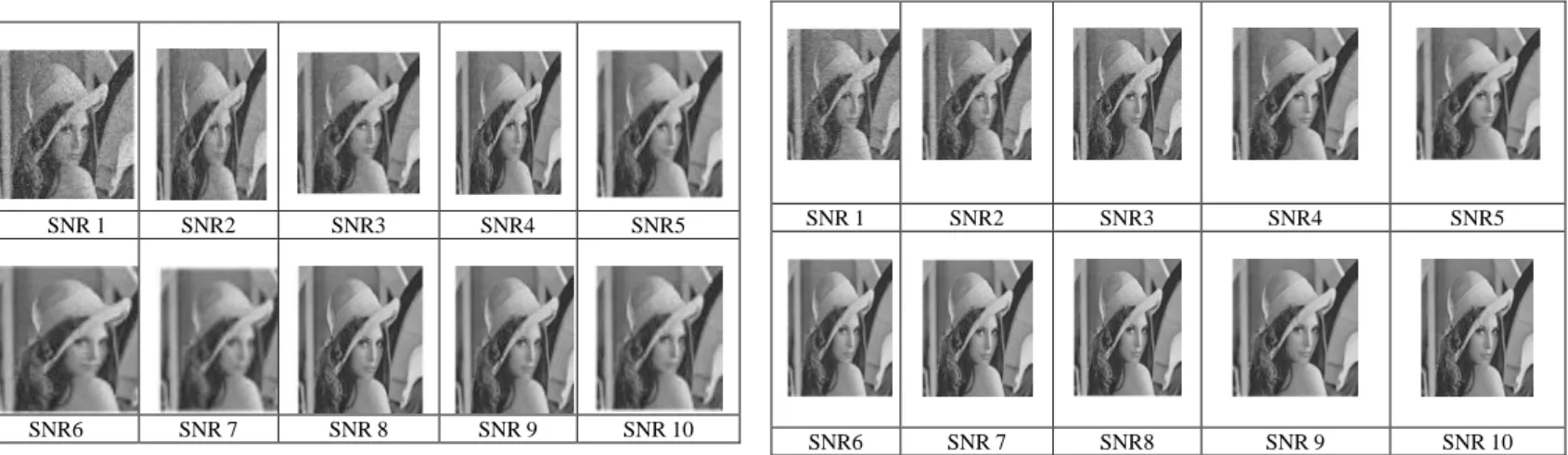
Figure 6.1 Base paper method for k = 1bit output stego image after OFDM transmission.
In reference to above table no. 6.2 and figure 6.1 base paper numerical result and stego image quality. After transmission of stego image. The BPSK modulation is used for embedding k= 1bit.
Table 6.3 Error correction numerical result for k=1 bit
Figure 6.2 Error correction method output stego image after OFDM.
In reference to above table no. 6.3 and figure 6.2 error correction numerical result and stego image quality. After transmission of stego image. The BPSK modulation is used for embedding k= 1bit. Step1
Base paper method for BPSK modulation data embeddi k = 1 bit.
S.NO Signal to Noise Ratio MSE encoded image MSE OFDM encoded image MSE decoded image(0-255) PSNR 1 10 0.4342 0.4382 0 51.7136 2 9 0.4342 0.4505 0 51.5943 3 8 0.4342 0.5239 2.5 50.938 4 7 0.4342 0.791 5.8784 49.1491 5 6 0.4342 1.636 55.6826 45.993 6 5 0.4342 3.5721 108.852 42.6016 7 4 0.4342 7.0573 209.472 39.6444 8 3 0.4342 12.3946 454.067 37.1985 9 2 0.4342 19.2303 755.679 35.291 10 1 0.4342 28.1222 1.1632 x10³ 33.6403 SNR1 SNR2 SNR3 SNR4 SNR5 SNR6 SNR7 SNR8 SNR9 SNR10 Step 2
Error correction method for BPSK modulation data embedding one bit.
S.NO Signal to Noise Ratio MSE encoded image MSE OFDM encoded image MSE decoded image(0-255 ) PSNR 1 10 0.2454 0.2493 0 54.1628 2 9 0.2454 0.2616 0 53.9545 3 8 0.2454 0.3348 0 52.8834 4 7 0.2454 0.5998 0 50.3507 5 6 0.2454 1.4339 0 46.5656 6 5 0.2454 3.345 0.1641 42.8868 7 4 0.2454 6.7966 10.1641 39.8079 8 3 0.2454 12.0735 55.6973 37.3125 9 2 0.2454 18.8437 147.282 35.3791 10 1 0.2454 27.6678 287.049 33.7111 SNR1 SNR2 SNR3 SNR4 SNR5 SNR6 SNR7 SNR8 SNR9 SNR10
Table 6.4 Base paper numerical result for k=2bit
Figure 6.3 Base paper method for k= 2 bit output stego image after OFDM transmission.
In reference to above table no. 6.4 and figure 6.3 base paper numerical result and stego image quality. After transmission of stego image. The QPSK modulation is used for embedding k=2bit.
Table 6.4 Error Correction numerical result for k=2bit
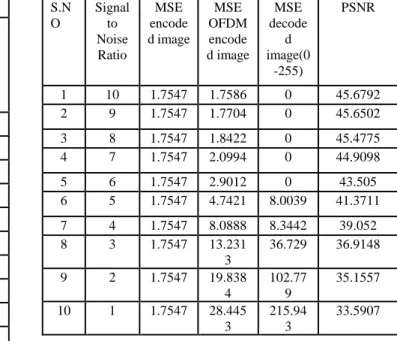
Figure 6.4 Error correction method for k= 2 bit output stego image after OFDM transmission.
In reference to above table no. 6.5 and figure 6.4 error correction numerical result and stego image quality. After transmission of stego image. The QPSK modulation is used for embedding k=2bit. Step 3- Base paper method for QPSK modulation data embedding
two bit. S.NO Signal to Noise Ratio MSE encoded image MSE OFDM encoded image MSE decoded image(0-255 ) PSNR 1 10 2.9338 2.9376 0 43.4508 2 9 2.9338 2.9491 0 43.434 3 8 2.9338 3.0226 4.0635 43.327 4 7 2.9338 3.283 5.1526 42.968 5 6 2.9338 4.1091 28.5486 41.9934 6 5 2.9338 6.0067 97.4458 40.3445 7 4 2.9338 9.4342 239.122 38.3838 8 3 2.9338 14.6774 486.729 36.4643 9 2 2.9338 21.3866 777.852 34.8294 10 1 2.9338 30.1018 1.1640e+00 3 33.3449 SNR1 SNR2 SNR3 SNR4 SNR5 SNR6 SNR7 SNR8 SNR9 SNR10
Step 4- Error Correction method for data embedding K= 2 bit
S.N O Signal to Noise Ratio MSE encode d image MSE OFDM encode d image MSE decode d image(0 -255) PSNR 1 10 1.7547 1.7586 0 45.6792 2 9 1.7547 1.7704 0 45.6502 3 8 1.7547 1.8422 0 45.4775 4 7 1.7547 2.0994 0 44.9098 5 6 1.7547 2.9012 0 43.505 6 5 1.7547 4.7421 8.0039 41.3711 7 4 1.7547 8.0888 8.3442 39.052 8 3 1.7547 13.231 3 36.729 36.9148 9 2 1.7547 19.838 4 102.77 9 35.1557 10 1 1.7547 28.445 3 215.94 3 33.5907 SNR1 SNR2 SNR3 SNR4 SNR5 SNR6 SNR7 SNR8 SNR9 SNR10
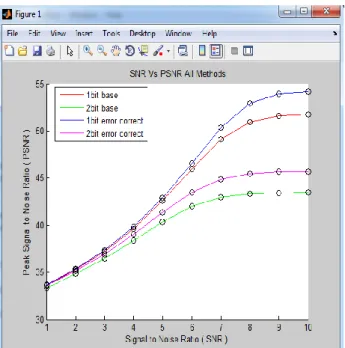
Figure 6.5 The graph between PSNR and SNR for both embedding bit and method
VII. CONCLUSION AND FUTURE SCOPE. 7.1 Conclusion
In this study, a paragramatic approach was accomplished by the Simulink model of orthogonal frequency division multiplexing (OFDM) using image steganography incorporating BPSK and QPSK modulation schemes. To contemplate the distortion in the image, the discerning distortion metrics called as mean square error and peak signal to noise ratio were computed. The BER of OFDM system is also analyzed. The field of digital communication is gifted with OFDM, a very powerful technology that opened doors to several applications requiring higher bandwidth and data rates. It survives severe channel conditions like narrow band interference and frequency selective fading. However, the increasing rate of data piracy accentuates the need for a secure wireless transmission. In this work, we propose a technique to increase the efficiency of OFDM by incorporating embedding in it. The data is embedded in the system following the steps of modulation and cyclic prefix in the OFDM process. The PSNR graphs for various modulation schemes like BPSK, QPSK are analyzed to arrive at the best modulation scheme having higher error tolerance than others.
7.2 Future scope
Security and interference is two imp major threats which affect the communication system. In this study of Simulink model we study the stego image transmission through OFDM channel. In future we can study different types of images like digital image, synthetic aperture radar image. And able to calculate their measure of image quality BER, PSNR and MSE.
VII. REFERENCES.
[1] Vannee, Richard, and Ramjee Prasad. ―OFDM for Wireless
Multimedia Communications” Boston: Artech House 2000.
[2] R.Amirtharajan, Dr. R. John Bosco ―Tri-Layer Stego for Enhanced Security –A Keyless Random Approach‖ Balaguru, 2009 IEEE
[3] K Thenmozhi, P Praveen Kumar, R Amirtharajan, V Prithiviraj ―OFDM+CDMA+Stego = Secure Communication: A Review‖ Research Journal of Information Technology 4, 31-46 [4]PP,RAmirtharajan, K Thenmozhi, JBB Rayappan
―Stego-OFDM blend for highly secure multi-user communication” Wireless Communication, Vehicular Technology, Information Technology.
[5] Padmaa, M.; Venkataramani, Y.; Amirtharajan, Rengarajan ―Stego on 2n:1 Platform for Users and Embedding ―Information Technology Journal;Oct2011, Vol. 10 Issue 10
[6] P Praveenkumar, R Amirtharajan, K Thenmozhi, JBBRayappan ―Phase for Face saving-a multicarrier Stego”Procedia
Engineering 30, 790-7976
[7] PP, K Thenmozhi, M Nagadinesh, R Amirtharajan “ Fixing,
padding and Embedding–A Modulated Stego” International Journal
of Engineering and Technology
[8] PP,G Hemalatha,S Bharathsimha Reddy, K Thenmozhi, .“Secret
Link Through Simulink: A Stego on OFDM Channel.”..Information
Technology Journal 13 (12), 1999-2004
[9] PP,K Thenmozhi, S Vivekhanandan, JBB Rayappan ―Intersect embedding on OFDM channel—A stego perspective‖ Information & Communication Technologies (ICT), 2013 IEEE.
[10]PPraveenkumar, R Amirtharajan, K Thenmozhi, JBB Rayappan
“Sub Carriers Carry Secret: An Absolute Stego Approach” Journal
of Applied Sciences 14 (15), 1728-1735
[11] ― Multi (Carrier+ Modulator) Adaptive System-an Anti
Fading Stego Approach” Journal of Applied Sciences 14 (16),
1836-1843
[12]PPraveenkumar,R Amirtharajan, RSaiJanani,―Data Puncturing in OFDM Channel: A Multicarrier Stego‖Information Technology Journal 13 (12), 2047-2051
[13]PPraveenkumar,KThenmozhi,JBBRayappan,RAmirtharajan― Stego in Multicarrier: A Phase Hidden Communication‖Information Technology Journal 13 (12), 2011-2016
[14]PPraveenkumar, K Thenmozhi, JBB Rayappan, R Amirtharajan ―Spread and Hide-A Stego Transceiver‖ Information Technology Journal 13 (12), 2061-2064