Acoustic
Design
Guide
QuietStuf
®, GreenStuf
®and QuiteSpace
®1
– Introduction to Autex
2
– Autex Acoustic Products
3
– Why Polyester?
4
– Environmental
5
– Understanding Acoustics
6
– Common Wall System performance
7
– Australian Building Code Requirements for Acoustics
8
– Performance of Autex Wall Infill Products
9
– Autex Wall Systems
10
– Timber Floors
11
– Ceilings
12
– Residential Roof Cavities – Thermal and Acoustic
13
– Internal and External Noise Control - Quitespace
This guide has been produced to provide guidance in the selection of Insulation
Products for Acoustic Control. All information is given in good faith but without warranty. All products are subject to constant development and we reserve the right to change specification without warranty.
1.Welcome
Autex Pty is an Australian company. You will find Autex products almost everywhere. Our acoustic wall linings are in schools across Australasia, helping children to hear better in the classroom. Our bedware is found in the hotel rooms of a five star hotel chain in Portugal and Spain. You‘ll find our marine carpets on pleasure boats in Dubai and our carpets brighten Hong Kong Disneyland. We use the same innovation and technology to produce our range of residential insulation solutions that are presented in this brochure. Autex has been manufacturing polyester insulation for over fifteen years and is now the largest polyester insulation manufacturer in Australasia. Autex also exports insulation materials around the world and has been specified and used in projects in the UK, the Middle East, SE Asia, Japan, China, South Africa, and throughout the Pacific region.
Our various thermal and acoustic insulations are used in a wide range of applications from domestic and commercial buildings to automotive and marine, as well as air conditioning and industrial functions.
All of our products are based on 100% user friendly polyester fibres. We utilise recycled fibre in our insulation and have a zero waste ethos. All of our insulation products are 100% recyclable. We can even take back insulation, offcuts and surplus, and reuse this material allowing for endless product life cycles.
Our plants operate using an integrated ISO 9001 quality and ISO 14001 Environmental management control system.
www.autex.com.au
2. Autex Acoustic Products
The Autex Acoustic Design Guide provides aready reference to the acoustic performance of an extensive range of Autex products in a variety of wall and ceiling systems.
Autex wall systems are designed to provide maximum acoustic performance with minimal weight and thickness.
Products refered to in this manual are;
ASB (Autex Sound Blanket)
A standard range of partition infill blankets designed to fit between studs, available in common sizes including 610mm wide.
HPI (High Performance Infill)
A range of high density partition infill blankets designed to provide the maximum performance possible for a bulk insulation product. These products use a blend of fine fibres to provide higher acoustic performance.
AIB (Autex Isolation Blanket)
An ultra high density non-woven polyester blanket designed to provide isolation, density and decoupling properties to wall systems
AAB (Autex Absorption Blanket)
A range of blankets designed for ceiling overlays and sound absorption
Baffle Block®
A blanket designed for installation as a stacked baffle to reduce ceiling path sound transmission.
ACO (Autex Ceiling Overlay)
A range of blankets designed specifically for use as ceiling overlays to reduce sound transmission and provide room sound absorption.
QuietSpace®
A range of high density and laminated linings and panels which provide superior sound absorption and finished in a variety of formats. More detailed product information is provided in the relavent sections of this manual. Data sheets on individual Autex insulation products are available from your Autex sales consultant or via our website.
WARNING -
SUBSTITUTION
Systems and products in this manual have specific design characteristics. Substituting them for other products may invalidate
performance. No warranty for the performance of any system will be given where subsituted product is used.
All Autex products have undergone extensive testing and comply with building code requirements. As an example, products have been tested to AS1530 P3 and provide the following results
Ignitability Index(0-20) 0
Spread of Flame Index(0-10) 0
Heat Evolved Index(0-10) 0
Smoke Develped Index(0-10) 0-3
In many cases the use of acoustic products is mandated by the Building Code of Australia for building elements such as walls to comply with specified performance requirements. In this manual examples of how these products can be used to meet these requirements, and solve other building acoustic problems, are explained. An overview of the building code classifications, performance requirements, deemed-to-comply standards, and an explanation of acoustic terms are also reviewed.
Polyester is the name of the fibre extruded from PET plastic. Most of the polyester we use has been recycled from various sources, such as plastic bags and packaging.
Polyester does not “leach” any chemicals and is food safe. The polyester we use is the same as found in milk bottles, clothing and bedding. Polyester is also used extensively in medical applications due to its safe nature.
3.Why
Polyester?
Performance /
Compliance and Safety
Polyester fibres do not contain nor produce any Ozone depleting substances or gases. They are also odourless.
Polyester fibres have been used in bedding and clothing for many years. Polyester is classified as “no more toxic than wood”.
Polyester’s thermal insulation performance has been proven in Polar Fleece® and similar clothing
during expeditions to the coldest places on earth.
All of our insulation is thermally bonded and will continue to loft over time unlike other forms of insulation that use chemical binders that can break down over time resulting in a loss of performance. This also ensures that the insulation in your walls won’t slump down and become ineffective.
It’s also fire safe – Autex polyester insulation exceeds the requirements of the Building Code of Australia as tested in compliance with AS1530 P3.
Autex polyester insulation is incredibly easy to install. No protective clothing or equipment is required and it comes in widths to suit over 90% of all standard house framing.
Finally, polyester is resistant to attack by insects, vermin and other pests, and is unaffected by moisture.
> breathe easy
> non-irritant
> non-toxic
> non-allergenic
There are no health concerns associated with polyester fibres. Autex Polyester insulation contains no formaldehyde based chemical binders. Formaldehyde is a known carcinogen. This off-gassing of formaldehyde can occur during and after installation.
As well as being a known carcinogen
formaldehyde is also a major asthma trigger and can be a contributing factor to many other known health concerns.
Our insulation has no airborne fibres of a respirable size. Absolutely no precautions or protective equipment is needed during installation.
Polyester fibres are non-irritant, non-toxic and non-allergenic. There is no need to use protective clothing during installation and your family’s ongoing health will not be compromised. Polyester does not “leach” any chemicals and is food-safe. The polyester we use is the same as found in clothing and bedding. Polyester is also used extensively in medical applications due to its safe nature.
Autex Polyester Insulation goes beyond the environmental benefits gained from the performance of its thermal insulation. The most obvious contribution to the environment of Autex Insulation is the improvement in the thermal efficiencies of buildings, which in turn greatly aids in the reduction of energy use and greenhouse gas production.
It is largely accepted that insulating buildings is one of the most cost effective ways of combating greenhouse gas emissions. The energy saved via insulation outweighs the energy used in the production of the insulation by hundreds of times over the life time of a typical building.
To this end Autex could be classified as better than carbon neutral
But Autex goes much further than this: we ensure that Ecological Sustainable Design applies to both our product and its use. Unlike many other forms of insulation which may be classified as hazardous waste, Autex polyester insulation’s make-up, production, and its performance, have been engineered to ensure the best possible environmental outcome.
Autex Polyester Insulation is manufactured using up to 85% recycled content and our manufacturing plants have a zero waste policy. All off-cuts and waste are immediately recycled back into the process or recycled into anything from plastic pallets to fence posts, which may also be recycled in the future.
We ensure every excess item used in our production plants is recycled, including packaging, straps and any other forms of material.
Autex polyester insulation is fully recyclable, unlike many other types of insulation which must be treated as hazardous waste. Autex insulation does not need to add to landfill. The embodied energy of our insulation is one of the lowest available due to the high level of recycled material used, and the low energy production process. Being fully recyclable allows for a continued reduction in our products embodied energy.
4.Enviromental-
Ecological
Sustainable
Design
We can arrange for the
recycling of any off-cuts or
surplus Autex Insulation.
Clean Autex Insulation can be
returned to our manufacturing
facilities for processing.
A full product stewardship
program is available.
Our gas-fired ovens are the most efficient available and no other chemicals are used during the manufacturing process. Our insulation will not off-gas, providing for safer and better indoor air quality, as well as ensuring that no Ozone depleting substances are used or produced. Autex is also a signatory to the National Packaging Covenant and has committed to programs to reduce all impacts of pre and post consumer packaging use and disposal.
Autex Insulation is the ideal choice for projects requiring GreenStar or ESD accreditation. Autex insulation has been fully assessed by Ecospecifier and Good Environmental Choice Australia as well as being manufactured under ISO 9001 quality and ISO14001 environmental management systems.
Taking into account the above information Autex polyester insulation can provide the best support for your GreenStar rated project providing the maximum credit available.
GreenStar
To whom it may concern
Re: Manufacturers statement on environmental aspects of GreenStuf® & QuietStuf® products.
The GreenStuf® & QuietStuf® products, as manufactured by Autex Pty Ltd are produced using 100% polyester fibre without the need for any binders or adhesives.
These two product types do not contain nor produce any Ozone depleting substances or gases.
Our products are classed as low VOC.
The manufacturing process is a very clean, low noise, low energy use production process. The manufacturing process also embraces a zero waste policy. All surpluses, offcuts or excess material are fully recycled. All packaging materials are fully recyclable.
Our products have ultra low embodied energy through recycled content and life cycle/recycle process.
Autex plants operate with integrated ISO9001 / ISO 14001 management systems.
This statement is to be used in conjunction with the Autex Insulation Material Safety Data Sheet.
Autex Pty Ltd
166 Bamfield Rd, PO Box 5099, West Heidelberg, Melbourne, VIC 3081 Australia Phone +61 3 9457 6700 Fax +61 3 9457 1020 Freephone 1800 678 160 www.autex.com.au ISO 9001 CERTIFIED ABN 84 495 094 585 Warrick Batt Managing Director Autex Pty Ltd
5. Understanding Acoustics
In buildings, acoustic treatment is addedto reduce the impact of sound entering into specific areas.
Sound is controlled by three means:
a) Firstly treatment of the source (e.g. building an enclosure around the source such as around compressors, or adding acoustic treatment to the area where the sound is coming from)
b) Secondly treatment of the path of the noise (e.g. erection of barriers such as building walls on freeways)
c) And finally treatment at the receiver end. (E.g. wearing earplugs)
There are two types of acoustic functions that are of concern in this manual: sound insulation and noise absorption.
The acoustic treatments discussed relate not only to the treatment of the path of the sound, such as walls, but also Autex has devised acoustic treatments that not only reduce sound transmission of the path but also treat the source room and receiving rooms, so that noise levels are reduced.
Common sound
insulation terms.
Rw
Rw is the weighted sound reduction index in dB (decibels) and it describes the airborne sound insulating power of a building element. It is a laboratory-measured value as defined in ISO717 Part 1. It can apply to walls, ceiling/ floors, ceiling/roofs, doors, or windows. The higher the number, the greater the sound insulating power of the building element. It is measured over the frequency range 100 to 3150Hz and replaces the old measure STC (Sound Transmission Class) that was measured over 125 to 4000Hz. In many cases the Rw has a value of one point less than the STC value for the same construction.
An increase in the Rw of a wall by 6 to 10 points will reduce the perceived loudness of sound passing through the wall by about half. Detailed below is how the sound insulating effectiveness of walls depends on their Rw (or Rw + Ctr values).
Rw +Ctr
Rw + Ctr are Rw with the addition of a low frequency sound correction factor Ctr. (a negative number). The use of Rw + Ctr has become more relevant due to the increase in low frequency sound sources such as surround sound systems, traffic and aircraft noise, drums and bass guitars. Two walls can have the same Rw rating, but have different resistance to low frequency sound, thus a different Rw + Ctr. Rw Rw+Ctr Effect Rw of these on sound Insulation performance
30 25 Loud speech can be heard easily
35 28 Loud speech can be heard but not understood
42 35 Loud speech heard as murmur
45 38 Must strain to hear loud speech
63 55 Music heard faintly, bass notes ‘thump’ 70 60 Loud music still heard very faintly
DnTw
DnTw is the equivalent of Rw, but measured on-site. Rw is the value measured in an acoustic laboratory, while DnTw is measured on-site. An on-site measured value of DnTw + Ctr is permitted to be 5 points lower than the Rw + Ctr value. Where the BCA may call for an Rw + Ctr > 50, the same requirement may be satisfied by measuring DnTw + Ctr > 45 on-site.
Ln,w +Ci
Ln,w + Ci describes how easily impact sound travels through a wall or floor. Impact sound is generated by sources such as dryers, washing machines and heeled shoes on a wooden floor. Unlike Rw values, better performing walls or floors have lower values. Therefore when specified, Ln,w + Ci values are maximums while Rw values are minimums. For example, the BCA requires some floors to have Ln,w + Ci < 62.
Impact Sound Isolation and walls
Walls that have an Impact Sound Insulation requirement are defined in the BCA as walls that do not have any rigid mechanical connection between two separate leaves except at the perimeter. Discontinuous Construction is defined in the BCA as walls that have a gap of at least 20mm between two separate leaves. Double stud plasterboard walls connected only at the perimeter are classed as ‘discontinuous’.
NRC
A materials ability to absorb sound is measured by its sound absorption coefficient and is often expressed in terms of a Noise Reduction Coefficient (NRC) The NRC is the arithmetic average of the product’s sound absorption coefficients at 250,500,1000 and 2000Hz. The sound absorption coefficients of products are measured according to ISO140-3. An NRC of 0.4 means 40 % of sound is absorbed by the material. Typical building materials such as plasterboard have an NRC of approximately 0.04 which means only 4% sound will be absorbed.
Frequencies of common sounds
Frequency Example of Source Sound 20 - 15000Hz Home Theatre
50 - 100 Hz Trucks or Earthmoving Equipment 100 - 300Hz Cars
200 - 1600 Hz Speech 200 - 2000Hz Office 300 - 1000Hz Aircraft 2000 - 8000Hz Birds
6. Common
Wall System
Performance
The information provided for these standard wall constructions without insulation(Tables 1-6) is used in table 7 to predict the overall performance where different Autex Infill products are used.
1. Masonry
Construction:
a) Brick walls:
For Brick construction such as two leaves of 110mm clay bricks with a cavity of not less than 50mm Autex ASB3 is recommended to achieve an Rw+Ctr not less than 50
b) Concrete walls
For concrete walls 125mm thick with a row of 64mm steel studs at 600mm centers spaced 20mm from the wall with Autex QuietStuf® 75 insulation and one layer of
13mm plasterboard achieves an Rw+Ctr not less than 50 and a BCA energy efficiency Rating of Total R 1.8
Table 1 - Rw/ Rw+Ctr for Steel Wall Framed Internal Single Stud at 600mm Centers**
*The actual finished wall thickness in each case is the cavity thickness plus the total thicknesses of the plaster sheets.
For other lining materials the same performance as plasterboard will be achieved with lining of similar weight/m2 Plasterboard layers and thickness (mm) either side of wall Wall Cavity
Thickness 51mm Thickness 64mmWall Cavity Thickness 76mmWall Cavity Thickness 92mmWall Cavity
Rw/Rw+Ctr Rw/Rw+Ctr Rw/Rw+Ctr Rw/Rw+Ctr 10/10 31/23 32/24 33/26 35/28 13/13 34/26 35/28 36/27 37/30 13X2/13 38/30 39/32 40/32 42/35 13/13 fire rated 37/26 37/28 37/29 38/30 13X2/13X2 45/37 47/38 47/39 48/40 16/16 fire rated 38/29 38/30 39/31 40/32 16X2/16X2 fire rated 48/39 48/40 49/51 49/42
2. Steel Dry wall construction:
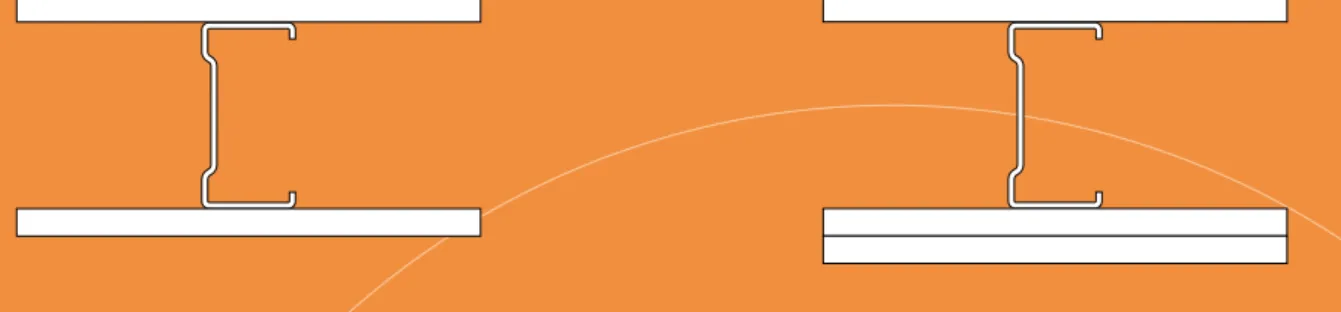
Steel stud dry wall construction is usually of three types
2. Staggered stud with single or multiple plasterboard layers of various thicknesses. Using common top/bottom track
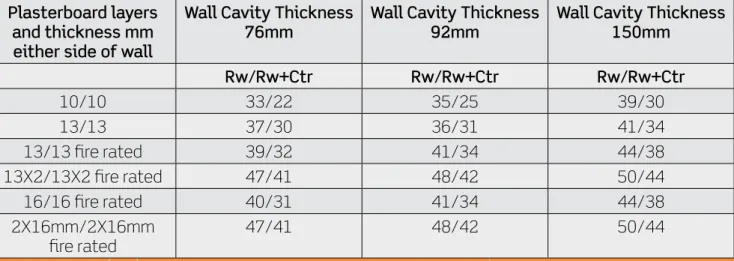
* The actual wall thickness in each case is the cavity thickness plus the total thicknesses of the plaster sheets.
Table 2 - Rw and Rw +Ctr for Staggered Stud Wall Construction* at 600mm centers
Plasterboard layers and thickness mm either side of wall
Wall Cavity Thickness
76mm Wall Cavity Thickness 92mm Wall Cavity Thickness 150mm Rw/Rw+Ctr Rw/Rw+Ctr Rw/Rw+Ctr 10/10 33/22 35/25 39/30 13/13 37/30 36/31 41/34 13/13 fire rated 39/32 41/34 44/38 13X2/13X2 fire rated 47/41 48/42 50/44 16/16 fire rated 40/31 41/34 44/38 2X16mm/2X16mm fire rated 47/41 48/42 50/44
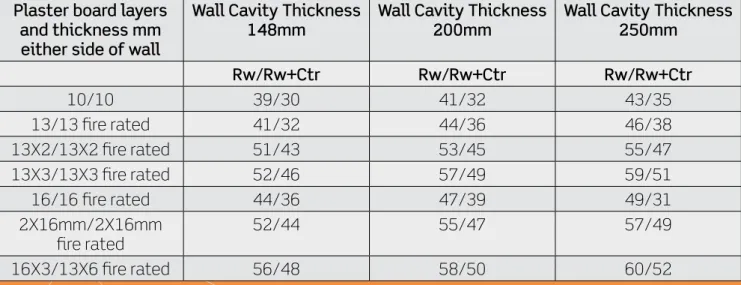
Table 3 - Rw and Rw + Ctr for Double Stud Wall Construction*
Plaster board layers and thickness mm either side of wall
Wall Cavity Thickness
148mm Wall Cavity Thickness 200mm Wall Cavity Thickness 250mm Rw/Rw+Ctr Rw/Rw+Ctr Rw/Rw+Ctr 10/10 39/30 41/32 43/35 13/13 fire rated 41/32 44/36 46/38 13X2/13X2 fire rated 51/43 53/45 55/47 13X3/13X3 fire rated 52/46 57/49 59/51 16/16 fire rated 44/36 47/39 49/31 2X16mm/2X16mm fire rated 52/44 55/47 57/49 16X3/13X6 fire rated 56/48 58/50 60/52
* The actual wall thickness in each case is the cavity thickness plus the total thickness’ of the plaster sheets
* Deemed Discontinuous construction by BCA
As these tables show, increasing plasterboard thickness, or the addition of plasterboard sheets, makes some improvements in the acoustic performance of dry walls whilst significantly increasing wall size and weight.
By comparison, by utilising Autex acoustic insulation infill products it is possible to achieve
maximum acoustic performance whilst keeping walls sizes and weights to a minimum. (e.g. typical plasterboard sheets weigh 8.5 to 13.5kg/m2 compared to insulation in-fills of 0.35 to 1.6kg/m2).
3. Double stud wall (BCA requirement) with single or multiple plasterboard layers of various thicknesses. Using independent top/bottom tracks
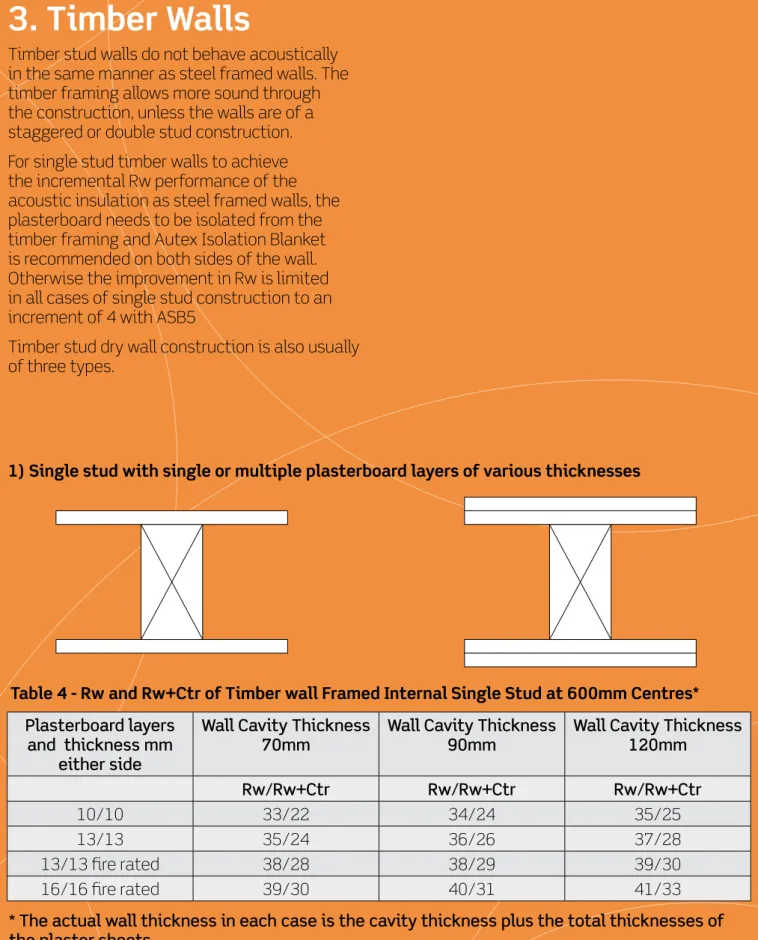
Table 4 - Rw and Rw+Ctr of Timber wall Framed Internal Single Stud at 600mm Centres*
Plasterboard layers and thickness mm
either side
Wall Cavity Thickness
70mm Wall Cavity Thickness 90mm Wall Cavity Thickness 120mm Rw/Rw+Ctr Rw/Rw+Ctr Rw/Rw+Ctr
10/10 33/22 34/24 35/25
13/13 35/24 36/26 37/28
13/13 fire rated 38/28 38/29 39/30
16/16 fire rated 39/30 40/31 41/33
* The actual wall thickness in each case is the cavity thickness plus the total thicknesses of the plaster sheets
3. Timber Walls
Timber stud walls do not behave acoustically in the same manner as steel framed walls. The timber framing allows more sound through the construction, unless the walls are of a staggered or double stud construction. For single stud timber walls to achieve the incremental Rw performance of the acoustic insulation as steel framed walls, the plasterboard needs to be isolated from the timber framing and Autex Isolation Blanket is recommended on both sides of the wall. Otherwise the improvement in Rw is limited in all cases of single stud construction to an increment of 4 with ASB5
Timber stud dry wall construction is also usually of three types.
Table 5 - Rw and Rw+Ctr of Timber Staggered Stud Wall Construction* at 600mm centres
Plaster thickness mm
either side Plate Thickness 90mm Plate Thickness 120mm Plate Thickness 140mm
10/10 38/28 41/32 42/33
13/13 fire rated 40/31 44/36 43/35
16/16 fire rated 41/32 44/36 45/37
2X13mm/2X13mm
fire rated 48/39 50/42 51/43
*The actual wall thickness in each case is the cavity thickness plus the total thicknesses of the plaster sheets
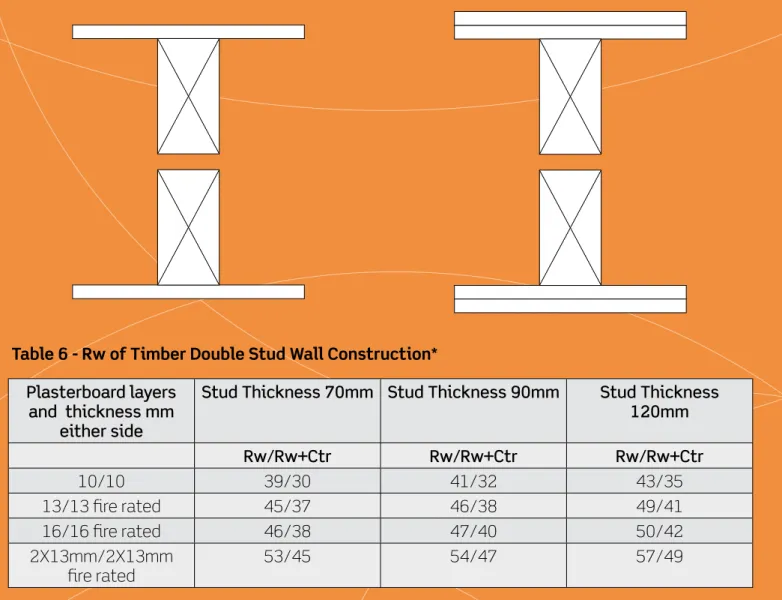
Table 6 - Rw of Timber Double Stud Wall Construction*
Plasterboard layers and thickness mm
either side
Stud Thickness 70mm Stud Thickness 90mm Stud Thickness 120mm Rw/Rw+Ctr Rw/Rw+Ctr Rw/Rw+Ctr 10/10 39/30 41/32 43/35 13/13 fire rated 45/37 46/38 49/41 16/16 fire rated 46/38 47/40 50/42 2X13mm/2X13mm fire rated 53/45 54/47 57/49
3) Double stud wall single or multiple plasterboard layers of various thicknesses using independent top and bottom plates
* The actual wall thickness in each case is the cavity thickness plus the total thickness
The incremental performance of Autex Acoustic Insulation in these walls can be determined from the data in Table Four and the appropriate wall construction detailed in Tables Five to Seven.
Thus for example a 90mm timber stud wall with 13mm plasterboard either sides and Autex Isolation Blanket both sides at 600mm centers with AAB3250 will have an Rw of 46.
7. Australian
Building Code
Requirements
for Acoustics
BUILDING CLASS 1, 2 & 3 -
QLD & NT
Walls separating a bathroom, toilet, laundry or kitchen and a habitable room (Other than a kitchen) in adjoining SOUs
(Sole Occupancy Units) Rw ≥ 50 and Discontinuous construction
REF AUTEX WALL SYSTEMS ARw50.1-4
Walls separating SOUs in all other cases Rw ≥ 45 Walls or ceilings separating a soil or waste pipe Rw45 from a habitable room
REF AUTEX WALL SYSTEMS ARw45.1-3
Walls or ceilings separating a soil or waste pipe Rw ≥ 30 from a kitchen, bathroom or other
non-habitable room
Floors between SOUs Rw ≥ 45w
BUILDING CLASS 1 -
VIC TAS, NSW, WA, ACT & SA
Walls separating a bathroom, toilet, laundry or kitchen and a habitable room
(Other than a kitchen) in adjoining SOUs Rw+ Ctr ≥ 50 and Discontinuous construction
REF AUTEX WALL SYSTEMS ARwCtr50.1-4 Rw+ Ctr ≥ 50 Walls separating SOUs in all other cases
Walls or ceilings separating a duct, soil, waste or Rw+ Ctr ≥ 40 water supply pipe or storm water pipe from a
habitable room
Walls or ceilings separating a duct, soil, waste or Rw+ Ctr ≥ 25 water supply pipe or storm water pipe from a
BUILDING CLASS 2 & 3 -
VIC TAS, NSW, WA, ACT & SA
Walls separating habitable rooms in adjoining SOUs Rw+ Ctr ≥ 50
REF AUTEX WALL SYSTEMS ARwCtr50.1-4
Walls separating kitchens, toilets, bathrooms Rw+ Ctr ≥ 50 and laundries in adjoining SOUs
REF AUTEX WALL SYSTEMS ARwCtr50.1-4
Walls between a bathroom, toilet, laundry or kitchen and a habitable room
(other than a kitchen) in adjoining SOUs Rw+ Ctr ≥ 50 and Discontinuous construction
REF AUTEX WALL SYSTEMS ARwCtr50.1-4
Walls between a SOU and a public corridor, Rw ≥ 50 and Discontinuous construction public lobby, stairway or the like or parts of a
different classification
REF AUTEX WALL SYSTEMS ARw50.2
Walls between a SOU and a plant room or lift shaft Rw ≥ 50 and Discontinuous construction
REF AUTEX WALL SYSTEMS ARw50.2
Walls or ceilings separating a duct, soil, Rw+ Ctr ≥ 40 waste or water supply pipe or storm
Water pipe from a habitable room
REF AUTEX WALL SYSTEMS ARwCtr40.1-3
Walls or ceilings separating a duct, soil, waste or Rw+ Ctr ≥ 40 water supply pipe or storm water pipe from a
kitchen or other non-habitable room
REF AUTEX WALL SYSTEMS ARwCtr40.1-3
Floors between SOUs and between a SOU and a Rw+ Ctr ≥ 50 plant room, lift shaft, stairway, public corridor, Ln,w+ Ci < 62 public lobby or the like, or parts of a
different classification
BUILDING CLASS 9C -
ALL AUSTRALIA
Walls separating SOUs from a kitchen or laundry Rw ≥ 45 Walls and floors separating SOUs, and walls Rw ≥ 45 separating SOUs from a bathroom, toilet,
plant room or utilities room
Performance requirements of the BCA relating to sound transmission and insulation can be satisfied by one of the following options:
A. Deemed-to-Satisfy Construction Construction of a wall or ceiling system that complies with the deemed-to-satisfy provisions of the BCA. The BCA details generic systems that satisfy the acoustic BCA requirements.
B. Laboratory testing or Acoustic Engineering
In general, more efficient solutions can be determined by meeting the performance requirement of the BCA. In this manual alternative suggestions are provided.
Modeling can also often generate acoustic predictions for systems not published in this manual. Contact Autex Technical Services for an acoustic prediction.
Attention to detail during construction is important for achieving good acoustics, as performance is governed by the weakest link in the system. Performance of installed acoustic systems may fall short of laboratory-measured results. Acoustic measurements in a typical laboratory test represent the maximum performance that can be achieved: meticulous care goes into laboratory installation of the system.
Actual site conditions are usually less than ideal and sound flanking paths normally exist around the perimeter of the system. Flanking paths may be minimised by sealing the perimeter with acoustic sealant, including behind the cornice, and by installing services using acoustically rated details. Acoustic performance is easier and cheaper to achieve if it is considered before construction begins. Good acoustic design includes selection of appropriate systems to limit sound
transmission and/or sound reverberation levels.
Fire Resistance Levels
Where a construction has a FRL level then the FRL nominated by the plasterboard/masonry manufacturer must be the basis of the wall construction. The addition of Autex Insulation Infill products will not compromise the FRL of the wall system.
8. Performance of Autex Infill
and Isolation Products
The performance impact of in fills of acoustic insulation on steel stud dry wall construction is primarily related to the volume infill of the cavity and the weight/m2 of the infill
Autex acoustic insulation when incorporated into the wall cavities will have the following incremental effect on the Rw of the wall systems featured in tables 1 – 6.
Table 7 - Rw improvement for Autex Acoustic products in particular walls*
* For single stud timber walls see comments in the following section on the need for isolation of the framing
**In double stud walls a double amount of insulation increases the Rw by an additional 4 *** Product is compressed into wall cavity in double stud walls only
- Insulation infill must be overlapped by a min of 50mm at joints Wall Cavity Thickness INFILL TYPE Steel 51mm Steel 64mm/
Timber 70mm Steel 76mm Steel 92mm/Timber 90mm and 120mm Steel 150mm and greater** ASB2 3 3 3 3 3 ASB3 5 4 4 4 3 ASB4 7 6 6 5 5 ASB5 8 7 7 6 6 ASB6 7 6 HPI 60 9 8 8 7 HPI90 8 8 HPI165 - - - - +10*** AIB 7 7 7 7 7
AIB and Infill Add additional 2 to
Autex Wall Performance
Calculator
The data from previous tables can be used in the following sheet to determine the Rw of wall constructions. Simply enter the Plain wall Rw value from Tables 1 – 6, add this to the infill value to calculate the total Rw of the wall system.
Additional copies of this sheet are available from Autex
As an example - A 10mm plasterboard faced both sides 64mm steel stud wall at 600mm centres without insulation has an Rw of 34. With the addition of Autex ASB4 this will increase to an Rw of 41 and an Rw+Ctr of 30. Including Autex Poly Isolation board will increase this further to Rw 43 (and the Rw+ Ctr to 32.)
Wall Type and Cavity Thickness
Steel 51mm Steel 64mm/ Timber 70mm
INFILL TYPE Wall Rating Infill Adds Total Wall Rating Infill Adds Total
ASB2 3 3 ASB3 5 4 ASB4 7 6 ASB5 8 7 HPI 60 9 AIB 7 7
AIB and Infill Plus 2 Plus2
Wall Type and Cavity Thickness
Steel 76mm Steel 92mm/ Timber 90mm
INFILL TYPE Wall Rating Infill Adds Total Wall Rating Infill Adds Total
ASB2 3 3 ASB3 4 4 ASB4 6 5 ASB5 7 6 ASB6 7 HPI 60 8 8 HPI90 8 AIB 7 7
BCA –
Standard
Deemed-to-comply
options
The following are BCA deemed-to-comply options which can be constructed using Autex insulation
A. For Rw and Rw+Ctr>50
A double steel stud wall comprising of two rows of 64 mm steel studs at 600 mm centres with an air gap not less than 80 mm between the rows of studs; and 200 mm thick polyester insulation with a density of 14 kg/m3;
positioned between studs; one layer of 13 mm fire-protective grade plasterboard on one side face and two layers of 13 mm fire-protective grade plasterboard on the other
B. For Rw>50
One row of 92 mm steel studs at 600 mm centers with:
(a) 60 mm thick polyester insulation with a density of 8 kg/m3, positioned between studs; and
(b) Two layers of 13 -mm fire-protective grade plasterboard or one layer of 6 mm fibre cement sheet and one layer of 13 mm fire-protective grade plasterboard, fixed to each face.
C. For Rw >45
(a) One row of 64 mm steel studs with 2 layers of 16 mm fire-protective grade plasterboard fixed to each face.
(b) One layer of 16 mm fire-protective grade plasterboard fixed to one face; and 50 mm thick mineral insulation
(c) One row of 64 mm steel studs with 2 layers of 13 mm plasterboard on each face.
9. Autex Wall Systems
The following wall systems are provided to give specific examples of how Autex insulation products can be used to meet various sound transmission requirements.
System names provide direct reference to sound reduction performance. Where different options are provided for the same performance level systems are noted as .1, .2, .3 etc.
System performance can be affected by design or construction varibles.
WARNING - SUBSTITUTION
The Systems and products in this manual have specific design characteristics, substituting them for other products may invalidate performance. No warranty for the performance of any system will be given where subsituted product is used. In many products Autex uses a special blend of fine fibres to achieve superior performance.
Key FR - Fire Resistant Plaster Board AIB - Autex Insulation Blanket
PB - Plaster Board HPI - High Performance Infill
ASB - Autex Sound Blanket
10. Timber
Floors
11. Ceilings
Where the timber floors of either 19mm chipboard or tongued and grooved boards are constructed as per manufacturer’s requirements, Autex QuietStuf® 100 batts
will ensure Rw+Ctr not less than 50 are met. Impact isolation will be achieved by use of the appropriate isolation mounts.
Acoustic Insulation for ceilings can be used in a number of applications. These are roof to ceiling, ceiling overlay and floor/ceilings.
A. Roof /ceiling and floor ceiling Systems
For Floor/Ceiling systems, Autex GreenStuf®
R2.0 is recommended The Rw and Rw+Ctr of ceiling systems such as 19mm particle board, 600mm centred joists, 190mm cavity with 13mm plasterboard will be increased from 35/27 to 39/31.
For roof ceiling systems Autex GreenStuf® R3.0
is recommended (BCA requirements for energy efficiency may require greater insulation in some climate zones) The Rw/Rw+Ctr of a roof ceiling system such as pitched tiles roof with10mm plasterboard will increase from 33/27 to 47/40.
B. Indirect or flanking paths
Acoustic insulation where it involves indirect or flanking paths over ceilings is often called ceiling overlays. This insulation runs over the top of the finished ceiling.
In new construction, it is often impractical for walls to go through the ceiling space due to the presence of services such as ductwork and electrical services, or due to prohibitive costs of extending the wall. Similarly, in retrofit situations walls cannot go though lay in tile type ceilings to a concrete slab, and as a result the top of the wall finishes at the ceiling. In these cases sound can travel across the ceiling space from one room to the other thus flanking the wall between the rooms.
Autex has designed a variety of acoustic isolation options to minimise this flanking. These are based on the dividing wall having at least equivalent, but preferably lower Rw, to the over ceiling path transmission loss. In many cases the ceiling-to-ceiling transmission loss is called weighted suspended ceiling normalised level difference (or Dn,c,w). The rating previously used was DN,C,W (Ceiling attenuation class). Where the over the ceiling path (DN,C,W) has a higher rating than that of the dividing wall (Rw) the room-to-room sound transmission should be taken as the wall value.
Autex has developed two design options to achieve the required Dn,c,w for these applications. These are based on treating the ceiling itself and/or treating the ceiling space directly over the wall.
Firstly, Autex BaffleBlock® fitted above a wall as shown, and extending by a minimum of 300mm
either side of the wall, will add 10 to 16 dB of transmission loss through the ceiling space. Baffle Block® reduces the need to ensure the wall goes through the ceiling thus significantly reducing
building costs Furthermore it provides the acoustic sealing of the ceiling plenum where services are placed as a simple exercise.
Thus where mineral fibre or plasterboard tiles of a Dn,c,w of 35 are used in a ceiling this can be increased up to 51 and for continuous plasterboard ceilings up to 55dB (depending on the level of compression at 30% to 50%, the nature of the ceiling lining and its ability to handle the deflection due to the BaffleBlock® compression).
Secondly, Autex has developed a range of acoustic insulation overlays such as AAB 10/100 and 25/100 which lie over tile ceilings and will also improve the room-to-room Dn,c,w by up to 10 dB.
CONCRETE SLAB
AUTEX QUIETSTUF BAFFLEBLOCK
ACOUSTIC PARTITION USING AUTEX INSULATION
(ASB 2,3,4,5) INFILL WALL PARTITION SUPPORTED CEILING GRID SUPPORTED CEILING HANGER CONCRETE SLAB
These products individually and in combination will provide the ceiling attenuation below:
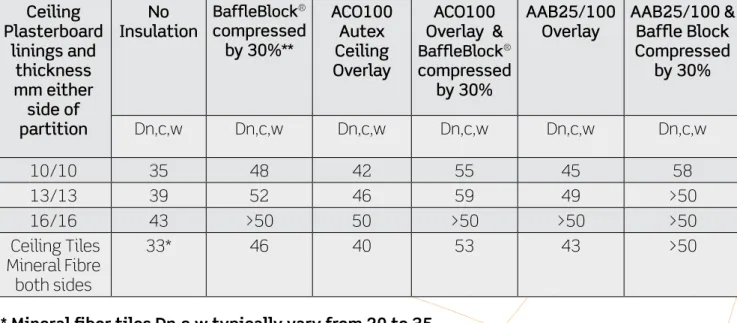
Table 8 - Room-to-Room Dn,c,w for Ceiling Systems
* Mineral fiber tiles Dn,c,w typically vary from 20 to 35.
Down-lights and other penetrations will degrade the ceiling Dn,c,w by nominally 1 to 2 dB/ downlights up to 4 and need to be compensated for in the final design
** BaffleBlock® may be installed to a height of one meter without design considerations. Over this height advice should be sought on load requirements of the grid manufacturer
In design for speech privacy where the Rw of the dividing wall is specified, the appropriate flanking insulation over the ceiling should be such that it is equal to or greater by about 3dB than that of the Rw of the wall.
***Compression. Where it is stated that the product is compressed by 30% this requires that the overall thickness will be 30% less than original i.e. a 1m high stack of BaffleBlock® compressed by 30% will require 13 layers of 100mm thick product.
Therefore for walls where:
Normal voice privacy is required (Normal voice conversation can be just heard) e.g. Rw of the dividing wall of 40 to 45 and a continuous ceiling of 10mm plaster meets the wall AAB25/100 should be placed on the ceiling or a combination of AAB10/100 and BaffleBlock® used.
Normal Voice Confidential privacy (Normal voice can be heard only as muffled sound) e.g. Rw of the dividing wall 45 to 50 and a continuous ceiling of 10mm plaster meets the wall a combination of AAB10/100 and BaffleBlock® used.
Raised Voice Confidential Privacy (Normal voice levels cannot be heard) e.g. Rw of the dividing wall 50 to 55 and a continuous ceiling of 10mm plaster meets the wall AAB25/100 should be placed on the ceiling and BaffleBlock® used.
Ceiling Plasterboard linings and thickness mm either side of partition No Insulation BaffleBlock® compressed by 30%** ACO100 Autex Ceiling Overlay ACO100 Overlay & BaffleBlock® compressed by 30% AAB25/100
Overlay AAB25/100 & Baffle Block Compressed by 30% Dn,c,w Dn,c,w Dn,c,w Dn,c,w Dn,c,w Dn,c,w 10/10 35 48 42 55 45 58 13/13 39 52 46 59 49 >50 16/16 43 >50 50 >50 >50 >50 Ceiling Tiles Mineral Fibre both sides 33* 46 40 53 43 >50
12. Residential Roof Cavities
– Thermal and Acoustic
Houses that are subjected to higher than normal environmental noise such as those close to airports, major roads and railway lines can have the internal noise levels significantly reduced by utilising Autex QuietStuf® Acoustic/
Thermal polyester insulation in the roof cavity. Research has shown that excessive levels of noise within the home can create higher levels of stress, limit learning in children and raise anxiety levels.
For added noise control we recommend the use of QuietStuf® 100 or QuietStuf® 200 insulation.
QuietStuf® 100 and 200 are designed to
provide a higher degree of sound insulation whilst still providing thermal insulation of R2.5 and R4.5 respectively. QuietStuf® Batts
are a higher density product utilising a unique blend of polyester fibres to provide maximum performance for both sound and thermal insulation.
Residential
Internal Walls
Today’s modern Homes and lifestyles incorporate many more sound generating activities. From home theatre systems to computer games, and a myriad of appliances, noise is everywhere in our homes. This noise can make your home a battleground, limit sleep, and raise stress levels.
The addition of Autex QuietStuf® Acoustic
Insulation to internal walls can greatly reduce sound transmission between rooms.
Acoustic insulation should at least be considered between all living areas and bedrooms as well as toilets and bathrooms. To provide the ultimate in home sound comfort and privacy we recommend that Autex
QuietStuf® be installed in all interior walls.
Where a 75mm cavity is available QuietStuf®
75 can be used. For superior performance with 90mm studs the installation of QuietStuf®90
can improve Rw wall performance by eight points which can dramatically help reduce sound transmission.
Coupled with common sense design like ensuring power points are not placed adjacent to each other in adjoining rooms, noise levels can be reduced by over 8 Rw points from standard wall systems.
A loud room, such as one with a television turned on may have a sound level of 80dB (decibels)
A wall system using sound rated plasterboard and QuietStuf® 75 can reduce that sound
by more than 45dB to below 36dB which is considered to be more than a comfortable level for a bedroom.
For special areas such as dedicated home theatre systems a more comprehensive approach is required to ensure that sound integrity and fidelity is enhanced within the room and extra measures are taken to reduce low frequency and loud sound transmission through walls. Sound levels over 100dB can be present and require more control. Wall systems with ratings above 60 are available – these wall systems can reduce cinema type sound levels to more than reasonable levels. Refer to Autex Cinema Wall System (Section 9).
Internal and External Noise Control –
Quietspace
®/ QuietStuf
®The Best of both worlds
Autex has a broad range of products designed to provide sound absorption. These products range from medium density absorbers in the AAB (Autex Absorption Blanket) range through to ultra high density plain and fabric finished Quietspace® panels.
Autex ABB products are available in a wide range of thicknesses / sizes and densities and can be used for absorption in theatres, ceilings, plant rooms and as a component in modular panel systems. Please refer to the AAB datasheet for more information.
Autex Quietspace® products are a range of high performance sound absorption products that
feature high density and composite construction to provide superior absorption properties at minimal thicknesses. Available plain or fabric finished they are typically used for the control of reverberation in buildings. Ideal for schools, theatres, offices and any area subject to high noise levels.
Autex QuietSpace® products not only reduce the internal noise level but also, when completely
adhered to. Wall constructions significantly reduce sound transmission Rw through the walls. Please refer to the Autex Quietspace® Product manual for further information.
Wall Construction Rw /Rw +Ctr
100mm timber with 10mm acoustic grade plaster either side and no
insulation at 600mm centers 36/29
As above with QuietSpace® Acoustic Fabric adhered to one wall and
acoustic batt infill 45/36
As above with Acoustic Fabric QuietSpace® adhered on both sides and
acoustic infill 47/38
Tests conducted at the University of Auckland 2006
These improvements can be included in other dry wall constructions to the same incremental effect! For example:
a) A single 64mm steel stud wall with 10mm plasterboard either side and an infill of ASB5 with the wall treatments above will have an Rw of 45 at a wall thickness of 104mm.
A plaster wall with one layer one side and two layers of fire-rated 13mm plasterboard will have an Rw of 43 at the same overall wall thickness.
b) Similarly a wall of 2X13mm plasterboard on either side of 64mm steel studs has a Rw of 45 at a wall thickness of 116mm which is a 12mm thicker wall than utilising the Autex system detailed above.
In this application not only is the room sound pressure level reduced by the wall lining but the sound transmission is also reduced.
This is an effective method of improving the sound transmission properties of existing walls without adding to the construction.
The table below details the Rw benefit from installing Autex Acoustic Fabric.
level 2, unit 6
383 smith st. fitzroy 3065 p: (03) 9419 3033 f: (03) 9419 3133 e: [email protected] Design and Production by