Reference Guide
Cisco Aironet Antennas and Accessories
Overview
Executive Overview
This antenna reference guide explains issues and concerns about antennas used with a Cisco
®Aironet
®wireless
LAN system or wireless bridge system. It details deployment and design, limitations and capabilities, and basic
theories of antennas. This document also contains information about the Cisco antennas and accessories, as well
as installation scenarios, regulatory information, and technical specifications and diagrams of the available
antennas.
Overview of Antennas
Each Cisco Aironet radio product is designed to perform in a variety of environments. Implementing the antenna
system can greatly improve coverage and performance.
To optimize the overall performance of a Cisco wireless LAN, it is important to understand how to maximize radio
coverage with the appropriate antenna selection and placement. An antenna system comprises numerous
components, including the antenna, mounting hardware, connectors, antenna cabling, and in some cases, a
lightning arrestor. For a consultation, please contact a Cisco Aironet partner at:
http://tools.cisco.com/WWChannels/LOCATR/jsp/partner_locator.jsp
.
Cisco partners can provide onsite engineering assistance for complex requirements.
Radio Technologies
In the mid-1980s, the U.S. Federal Communications Commission (FCC) modified Part 15 of the radio spectrum
regulation, which governs unlicensed devices. The modification authorized wireless network products to operate in
the industrial, scientific, and medical (ISM) bands using spread spectrum modulation. This type of modulation had
formerly been classified and permitted only in military products. The ISM frequencies are in three different bands,
located at 900 MHz, 2.4 GHz, and 5 GHz. This document covers both the 2.4- and 5-GHz bands.
The ISM bands typically allow users to operate wireless products without requiring specific licenses, but this will
vary in some countries. In the United States, there is no requirement for FCC licenses. The products themselves
must meet certain requirements to be certified for sale, such as operation under 1-watt transmitter output power (in
the United States) and maximum antenna gain or effective isotropic radiated power (EIRP) ratings.
Each set of bands has different characteristics. The lower frequencies exhibit better range, but with limited
bandwidth and hence lower data rates. The higher frequencies have less range and are subject to greater
attenuation from solid objects.
802.11 Modulation Techniques
The IEEE 802.11 standard makes provisions for the use of several different modulation techniques to encode the
transmitted data onto the RF signal. These modulation techniques are used to enhance the probability of the
receiver correctly receiving the data and thus reducing the need for retransmissions. The techniques vary in their
complexities and robustness to RF signal propagation impairments.
Direct-Sequence Spread Spectrum
The direct-sequence spread spectrum (DSSS) approach involves encoding redundant information into the RF
signal. Every data bit is expanded to a string of chips called a
chipping sequence
or
Barker sequence
. The
chipping rate, as mandated by the U.S. FCC, is 10 chips at the 1- and 2-Mbps rates and 8 chips at the 11-Mbps
rate. So, at 11 Mbps, 8 bits are transmitted for every one bit of data. The chipping sequence is transmitted in
parallel across the spread spectrum frequency channel.
Frequency-Hopping Spread Spectrum
Frequency-hopping spread spectrum (FHSS) uses a radio that moves or hops from one frequency to another at
predetermined times and channels. The regulations require that the maximum time spent on any one channel is
400 milliseconds. For the 1- and 2-Mb FHSS systems, the hopping pattern must include 75 different channels, and
must use every channel before reusing any one. For wide-band frequency hopping (WBFH) systems, which permit
up to 10-Mb data rates, the rules require the use of at least 15 channels, and they cannot overlap. With only 83
MHz of spectrum, WBFH limits the systems to 15 channels, thus causing scalability issues.
In every case, for the same transmitter power and antennas, a DSSS system will have greater range, scalability,
and throughput than an FHSS system. For this reason, Cisco has chosen to support only direct-sequence systems
in the spread spectrum products.
Orthogonal Frequency Division Multiplexing
The orthogonal frequency division multiplexing (OFDM) used in 802.11a and 802.11g data transmissions offers
greater performance than the older direct-sequence systems. In the OFDM system, each tone is orthogonal to the
adjacent tones and therefore does not require the frequency guard band needed for direct sequence. This guard
band lowers the bandwidth efficiency and wastes up to 50 percent of the available bandwidth. Because OFDM is
composed of many narrow-band tones, narrow-band interference degrades only a small portion of the signal, with
little or no effect on the remainder of the frequency components.
Antenna Properties and Ratings
An antenna gives the wireless system three fundamental properties - gain, direction, and polarization.
Gain
is a
measure of increase in power.
Direction
is the shape of the transmission pattern. A good analogy for an antenna
is the reflector in a flashlight. The reflector concentrates and intensifies the light beam in a particular direction
similar to what a parabolic dish antenna would do to a RF source in a radio system.
Unlike isotropic antennas, dipole antennas are real antennas. Dipole antennas have a different radiation pattern
compared to isotropic antennas. The dipole radiation pattern is 360 degrees in the horizontal plane and 75 degrees
in the vertical plane (assuming the dipole antenna is standing vertically) and resembles a donut in shape. Because
the beam is “slightly” concentrated, dipole antennas have a gain over isotropic antennas of 2.14 dB in the
horizontal plane. Dipole antennas are said to have a gain of 2.14 dBi (in comparison to an isotropic antenna).
Some antennas are rated in comparison to dipole antennas. This is denoted by the suffix dBd. Hence, dipole
antennas have a gain of 0 dBd (= 2.14 dBi).
Note that the majority of documentation refers to dipole antennas as having a gain of 2.2 dBi. The actual figure is
2.14 dBi, but is often rounded up.
Types of Antennas
Cisco offers several different styles of antennas for use with access points and bridges in both 2.4-GHz and 5-GHz
products. Every antenna offered for sale has been FCC-approved. Each type of antenna will offer different
coverage capabilities. As the gain of an antenna increases, there is some tradeoff to its coverage area. Usually
high-gain antennas offer longer coverage distances, but only in a certain direction. The radiation patterns below will
help to show the coverage areas of the styles of antennas that Cisco offers: omnidirectional, Yagi, and patch
antennas.
Omnidirectional Antennas
An omnidirectional antenna (Figure 1) is designed to provide a 360-degree radiation pattern. This type of antenna
is used when coverage in all directions from the antenna is required. The standard 2.14-dBi “Rubber Duck” is one
style of omnidirectional antenna.
Figure 1. Omnidirectional Antenna
Directional Antennas
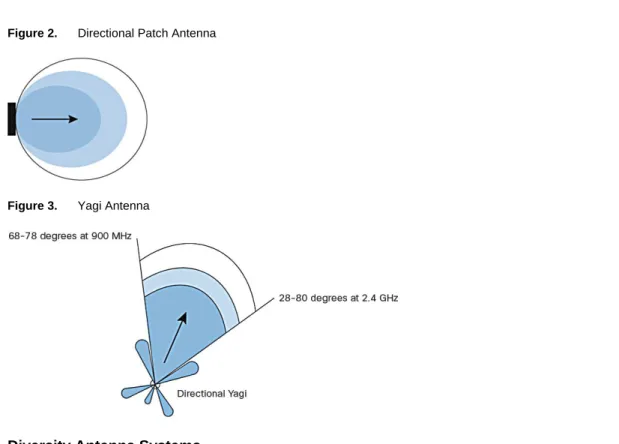
Figure 2. Directional Patch Antenna
Figure 3. Yagi Antenna
Diversity Antenna Systems
Diversity antenna systems are used to overcome a phenomenon known as
multipath distortion
or
multipath
interference
. A diversity antenna system uses two identical antennas, located a small distance apart, to provide
coverage to the same physical area.
Multipath Distortion
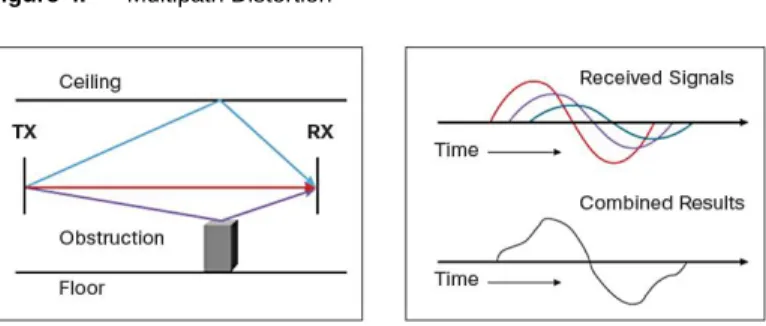
Multipath interference occurs when an RF signal has more than one path between a receiver and a transmitter.
This occurs in sites that have a large amount of metallic or other RF reflective surfaces.
Just as light and sound bounce off of objects, so does RF. This means there can be more than one path that RF
takes when going from a transmit (TX) and receive (RX) antenna. These multiple signals combine in the RX
antenna and receiver to cause distortion of the signal.
Multipath interference can cause the RF energy of an antenna to be very high, but the data would be
unrecoverable. Changing the type of antenna and location of the antenna can eliminate multipath distortion
(Figure 4).
Figure 4. Multipath Distortion
You can relate multipath distortion to a common occurrence in your car. As you pull up to a stop, you may notice
static on the radio. But as you move forward a few inches or feet, the station starts to come in more clearly. By
rolling forward, you move the antenna slightly, out of the point where the multiple signals converge.
How Diversity Antenna Systems Reduce Multipath Distortion
A diversity antenna system can be compared to a switch that selects one antenna or another, never both at the
same time. The radio in receive mode will continually switch between antennas listening for a valid radio packet.
After the beginning sync of a valid packet is heard, the radio will evaluate the sync signal of the packet on one
antenna, and then switch to the other antenna and evaluate. Then the radio will select the best antenna and use
only that antenna for the remaining portion of that packet.
On transmit, the radio will select the same antenna it used the last time it communicated to that given radio. If a
packet fails, it will switch to the other antenna and retry the packet.
One caution with diversity antenna systems is that they are not designed for using two antennas covering two
different coverage cells. The problem in using it this way is that if antenna number 1 is communicating to device
number 1 while device number 2 (which is in the antenna number 2 cell) tries to communicate, antenna number 2
is not connected (due to the position of the switch), and the communication fails. Diversity antennas should cover
the same area from only a slightly different location.
With the introduction of the latest direct-spread physical layer chips, and the use of diversity antenna systems,
direct-spread systems have equaled or surpassed frequency-hopping systems in handling multipath interference.
While the introduction of WBFH does increase the bandwidth of frequency-hopping systems, it drastically affects
the ability to handle multipath issues, further reducing its range compared to present direct-spread systems in sites
that are highly RF reflective.
The Physical Environment
After mobility issues are resolved, the physical environment must be examined. While the area of coverage is the
most important factor for antenna selection, it is not the sole decision criterion. Building construction, ceiling height,
internal obstructions, available mounting locations, and the customer’s aesthetic desires also must be considered.
Cement and steel construction have different radio propagation characteristics. Internal obstructions such as
product inventory and racking in warehousing environments are factors. In outdoor environments, many objects
can affect antenna patterns, including trees, vehicles, and buildings, to name a few.
The Network Connections
Cisco Aironet access points use a 10/100/1000-Mb Ethernet connection. Typically the access point is in the same
location as the antenna. While it may seem that the best place to put the access point is in a wiring closet with the
other network components, such as switches, hubs, and routers, this is not the case. The antenna must be placed
in an area that provides the best coverage (determined by a site survey).
Many people new to wireless LANs want to locate the access points in the wiring closet and connect the antenna
using RF coax. Antenna cable introduces losses in the antenna system on both the transmitter and the receiver. As
the length of cable increases, so does the amount of loss introduced. To operate at optimum efficiency, cable runs
should be kept as short as possible. (See the
Cabling
section in this document for more information.)
Building Construction
The density of the materials used in a building's construction determines the number of walls the RF signal can
pass through and still maintain adequate coverage. Following are a few examples. The actual effect on the RF
must be tested at the site, and therefore a site survey is recommended.
Paper and vinyl walls have very little effect on signal penetration. Solid walls and floors and precast concrete walls
can limit signal penetration to one or two walls without degrading coverage. This may vary widely based on any
steel reinforcing within the concrete. Concrete and concrete block walls may limit signal penetration to three or four
walls. Wood or drywall typically allow for adequate penetration through five or six walls. A thick metal wall reflects
signals, resulting in poor penetration. Steel-reinforced concrete flooring will restrict coverage between floors to
perhaps one or two floors.
Recommendations for some common installation environments are outlined below:
●
Warehousing/manufacturing:
In most cases, these installations require a large coverage area.
Experience has shown that an omnidirectional antenna mounted at 20 to 25 feet typically provides the best
overall coverage. Of course, this also depends upon the height of the racking, material on the rack, and
ability to locate the antenna at this height. Mounting the antenna higher will sometimes actually reduce
coverage, as the angle of radiation from the antenna is more outward than down. The antenna should
be placed in the center of the desired coverage cell and in an open area for best performance. In cases
where the radio unit will be located against a wall, a directional antenna such as a patch or Yagi can be
used for better penetration of the area. The coverage angle of the antenna will affect the coverage area.
●
Small office/small retail store:
The standard dipole may provide adequate coverage in these areas
depending on the location of the radio device. However, in a back corner office a patch antenna may
provide better coverage. It can be mounted to the wall above most obstructions for best performance.
●
Enterprise/large retail store
: In most cases, these installations require a large coverage area. Experience
has shown that omnidirectional antennas mounted just below the ceiling girders or just below the drop
ceiling typically provide the best coverage (this will vary with stocking, type of material, and building
construction). The antenna should be placed in the center of the desired coverage cell and in an open area
for best performance. In cases where the radio unit will be located in a corner, or at one end of the building,
a directional antenna such as a patch or Yagi can be used for better penetration of the area.
Also, for areas that are long and narrow - such as long rows of racking - a directional antenna at one end
may provide better coverage. The radiation angle of the antennas will also affect the coverage area.
●
Point-to-point
: When connecting two points together (such as a wireless bridge), the distance,
obstructions, and antenna location must be considered. If the antennas can be mounted indoors and the
distance is very short (several hundred feet), the standard dipole or mast mount 5.2 dBi omnidirectional may
be used. An alternative is to use two patch antennas. For very long distances (1/2 mi. or more), directional
high-gain antennas must be used. These antennas should be installed as high as possible, and above
obstructions such as trees, buildings, and so on; and if directional antennas are used, they must be aligned
so that their main radiated power lobes are directed at each other. With a line-of-site configuration,
distances of up to 25 miles at 2.4 GHz and 12 miles at 5 GHz can be reached using parabolic dish
antennas, if a clear line-of-site is maintained. With the use of directional antennas, fewer interference
possibilities exist and there is less possibility of causing interference to anyone else.
●
Point-to-multipoint bridge
: In this case (in which a single point is communicating to several remote
points), the use of an omnidirectional antenna at the main communication point must be considered. The
remote sites can use a directional antenna that is directed at the main point antenna.
Cabling
As stated above, cabling introduces losses into the system, negating some of the gain an antenna introduces and
reducing range of the RF coverage.
Interconnect Cable
Attached to all antennas (except the standard dipoles), this cable provides a 50 ohm impedance to the radio and
antenna, with a flexible connection between the two items. It has a high loss factor and should not be used except
for very short connections (usually less than 10 feet). Typical length on all antennas is 36 in. (or 12 in. on some
outdoor antennas).
Low-Loss/Ultra-Low-Loss Cable
Cisco offers two styles of cables for use with the 2.4-GHz and 5-GHz product lines. These cables provide a much
lower loss factor than standard interconnect cable, and they can be used when the antenna must be placed at any
Connectors
According to the U.S. Federal Code of Regulations, products used in the 2.4- and 5-GHz ISM bands manufactured
after June 1994 must either use connectors that are unique and nonstandard (meaning not readily available on the
market by the average user) or be designed to be professionally installed (“professional” here indicates a person
trained in RF installation and regulations). Since many of the 2.4-GHz products are installed by non-RF trained
personnel, these products must comply with the unique connector ruling. The Cisco outdoor access and bridge
products are designed for installation by a RF professional, and therefore may use a standard N style connector.
Cisco Aironet indoor products use reverse polarity-TNC (RP-TNC) connectors. While they are similar to the normal
TNC connectors, they cannot be mated to the standard connectors.
To ensure compatibility with Cisco Aironet products, use antennas and cabling from Cisco.
Mounting Hardware
Each antenna requires some type of mounting. The standard dipole antenna simply connects to the RP-TNC
connector on the unit. Mast mount antennas are designed to mount to a variety of mast diameters and each comes
with mounting hardware for attachment. The Yagi antennas have an articulating mount option. Patch antennas are
designed to mount flat against a wall or ceiling, and ceiling-mount antennas are equipped with a drop-ceiling
cross-member attachment. The 2.4-GHz 21-dBi parabolic dish mounts to a 1.625- up to a 2.375-in. mast. In this dish
antenna, fine-threaded turn-buckles allow accurate aiming of the antenna.
For most indoor applications, a .75- or 1-in. electrical conduit provides a suitable mounting. For outdoor
applications, use a heavy galvanized or aluminum wall mast that will withstand the wind-loading rating of the
selected antenna.
Lightning Arrestors
When using outdoor antenna installations, it is always possible that an antenna will suffer damage from potential
charges developing on the antenna and cable, or surges induced from nearby lightning strikes. The Cisco Aironet
lightning arrestor is designed to protect 2.4-GHz to 5.8- GHz radio equipment from static electricity and
lightning-induced surges that travel on coaxial transmission lines. Both systems need to be properly grounded as identified
in the hardware installation manuals of the products. These protection mechanisms will not prevent damage in the
event of a direct lightning hit.
Theory of Operation
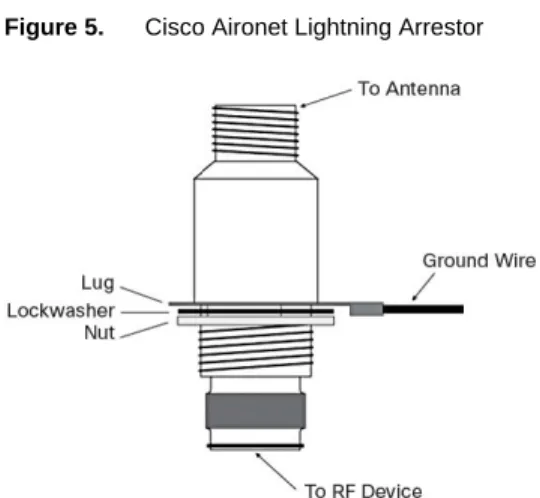
The Cisco Aironet Lightning Arrestor (Figure 5) prevents energy surges from reaching the RF equipment by the
shunting effect of the device. Surges are limited to less than 50 volts, in about .0000001 seconds (100
Figure 5. Cisco Aironet Lightning Arrestor
The accepted IEEE transient (surge) suppression is .000008 seconds (8 micro seconds). The Cisco Aironet
Lightning Arrestor is a 50-ohm transmission line with a gas discharge tube positioned between the center
conductor and ground. This gas discharge tube changes from an open circuit to a short circuit almost
instantaneously in the presence of voltage and energy surges, providing a path to ground for the energy surge.
Installation
This arrestor is designed to be installed between your antenna cable and the Cisco Aironet access point.
Installation should be indoors, or inside a protected area. A good ground must be attached to the arrestor. This can
be accomplished by attaching a ground lug to the arrestor and using a heavy wire (number 6 solid copper) to
connect the lug to a good earth ground (see Figure 6).
Understanding RF Power Values
Radio frequency (RF) signals are subject to various losses and gains as they pass from transmitter through cable
to antenna, through air (or solid obstruction), to receiving antenna, cable, and receiving radio. With the exception of
solid obstructions, most of these figures and factors are known and can be used in the design process to determine
whether an RF system such as a WLAN will work.
Decibels
The decibel (dB) scale is a logarithmic scale used to denote the ratio of one power value to another. For example:
X1`dB = 10 log10 (Power A/Power B)
An increase of 3 dB indicates a doubling (2x) of power. An increase of 6 dB indicates a quadrupling (4x) of power.
Conversely, a decrease of 3 dB reduces power by one half, and a decrease of 6 dB results in a one fourth of the
Increase Factor Decrease Factor
20 dB 100 x -20 dB 0.01 x
30 dB 1000 x -30 dB 0.001 x
40 dB 10,000 x -40 dB 0.0001 x
Power Ratings
WLAN equipment is usually specified in decibels compared to known values. Transmit Power and Receive
Sensitivity are specified in “dBm,” where “m” means 1 milliwatt (mW). So, 0 dBm is equal to 1 mW; 3 dBm is equal
to 2 mW; 6 dBm is equal to 4 mW, and so on, as shown in Table 2.
Table 2. Common mW Values to dBm Values
dBm mW dBm mW 0 dBm 1 mW 0 dBm 1 mW 1 dBm 1.25 mW -1 dBm 0.8 mW 3 dBm 2 mW -3 dBm 0.5 mW 6 dBm 4 mW -6 dBm 0.25 mW 7 dBm 5 mW -7 dBm 0.20 mW 10 dBm 10 mW -10 dBm 0.10 mW 12 dBm 16 mW -12 dBm 0.06 mW 13 dBm 20 mW -13 dBm 0.05 mW 15 dBm 32 mW -15 dBm 0.03 mW 17 dBm 50 mW -17 dBm 0.02 mw 20 dBm 100 mW -20 dBm 0.01 mW 30 dBm 1000 mW (1 W) -30 dBm 0.001 mW 40 dBm 10,000 mW (10 W) -40 dBm 0.0001 mW
Outdoor Range
The range of a wireless link is dependent upon the maximum allowable path loss. For outdoor links, this is a
straightforward calculation as long as there is clear line of sight between the two antennas with sufficient clearance
for the Fresnel zone. For line of sight, you should be able to visibly see the remote locations antenna from the main
site. (Longer distances may require the use of binoculars). There should be no obstructions between the antennas
themselves. This includes trees, buildings, hills, and so on.
As the distance extends beyond six miles, the curve of the earth (commonly called earth bulge) affects installation,
requiring antennas to be placed at higher elevations.
Fresnel Zone
Fresnel zone is an elliptical area immediately surrounding the visual path. It varies depending on the length of the
signal path and the frequency of the signal. The Fresnel zone can be calculated, and it must be taken into account
when designing a wireless link (Figure 6).
Figure 6. Fresnel Zone
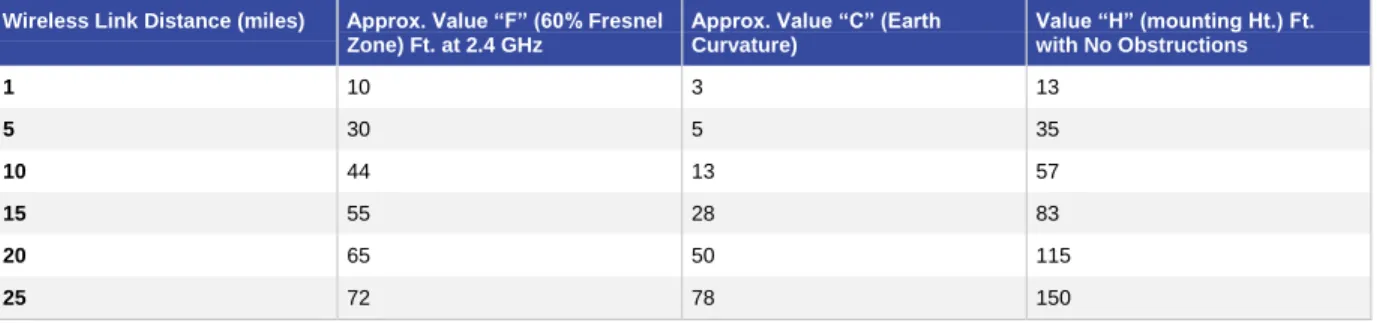
Based on both line-of-sight and Fresnel zone requirements, Table 3 provides a guideline on height requirements
for 2.4-GHz antennas as various distances. This refers to height above any obstacles located in the middle of the
RF path.
Table 3. Guideline on Height Requirements for 2.4-GHz Antennas
Wireless Link Distance (miles) Approx. Value “F” (60% Fresnel Zone) Ft. at 2.4 GHz
Approx. Value “C” (Earth Curvature) Value “H” (mounting Ht.) Ft. with No Obstructions 1 10 3 13 5 30 5 35 10 44 13 57 15 55 28 83 20 65 50 115 25 72 78 150
A 10-dB fade margin is included for 2.4-GHz calculations, while the included 5-dB fade margin for 5-GHz
calculations is sufficient for dependable communications in all weather conditions. The distances given are only
theoretical and should only be used to determine the feasibility of a particular design.
In outdoor deployments, and as a rule of thumb, every increase of 6 dB will result in a doubling of the distance.
Likewise, a 6-dB decrease will halve the distance. Shorter-cable runs and higher-gain antennas can make a
significant difference to the range. The following links provide range calculations for the outdoor mesh products:
●
Cisco Aironet 1550 Series:
http://www.cisco.com/c/en/us/support/wireless/aironet-1550-series/products-implementation-design-guides-list.html
●
Cisco Aironet 1530 Series:
http://www.cisco.com/c/en/us/support/wireless/aironet-1530-series/products-implementation-design-guides-list.html
The FCC 1994 rules are intended to discourage use of amplifiers, high-gain antennas, or other means
of significantly increasing RF radiation. The rules are further intended to discourage “home brew” systems that are
installed by inexperienced users and that - either accidentally or intentionally - do not comply with FCC regulations
for use in the ISM band.
Both the original rules and the amendments sought to enable multiple RF networks to “coexist” with minimum
impact on one another by exploiting properties of spread-spectrum technology. Fundamentally, the FCC 1994 rules
intend to limit RF communications in the ISM band to a well-defined region, while ensuring multiple systems can
operate with minimum impact on one another. These two needs are addressed by limiting the type and gain of
antennas used with a given system, and by requiring a greater degree of RF energy “spreading.”
Antenna Gain and Power Output
FCC regulations specify maximum power output and antenna gain. For the UNII3 band, the FCC limits the
transmitter power to 1 watt or 30 dBm, and the antenna gain of an omnidirectional antenna to 6 dBi. For directional
antennas operating in a point-to-point system, gains of up to 23 dBi are permitted. For antennas with gain higher
than 23 dBi, the transmitter output power must be reduced 1 dB for every 1 dB above 23 dBi increase in the
antenna gain.
At 2.4 GHz, the maximum transmitter power is also 1 watt. Using this maximum power, the maximum antenna gain
is 6 dBi. However, the regulations also define the maximum values in regards to the following two different system
scenarios.
Point-to-Point and Point-to-Multipoint Systems
In point-to-multipoint systems, the FCC has limited the maximum EIRP to 36 dBm. EIRP = TX power + antenna
gain. For every dB that the transmitter power is reduced, the antenna may be increased by 1 dB. Thus, 29 dBm
TX, +7 dB antenna = 36 dBm EIRP; 28 dBm TX +8 dB antenna = 36 dBm EIRP.
In point-to-point systems for 2.4-GHz systems using directional antennas, the rules have changed. Because a
high-gain antenna has a narrow beamwidth, the likelihood is great that it will cause interference to other area users.
Under the rule change, for every dB the transmitter is reduced below 30 dBm, the antenna may be increased from
the initial 6 dBi, by 3 dB. Thus, a 29-dB transmitter means 9-dBi antenna; a 28-dB transmitter means 12-dBi
antenna. Because we are operating at 20 dBm, which is 10 dB below the 30 dBm level, we can increase the
antenna gain by 30 dB. Note that Cisco has never tested, and therefore has not certified, any antenna with gain
greater than 21 dBi.
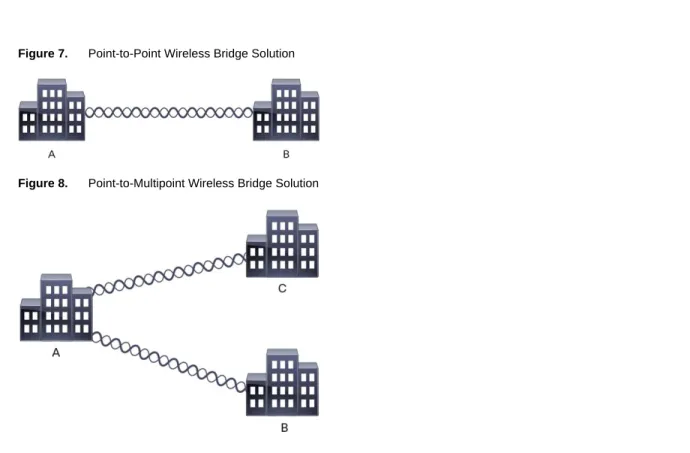
The main issue that comes up here is: What differentiates a point-to-point from a multipoint system.
In Figure 7, point A communicates to a single point (point B), and point B communicates to a single point A;
therefore, it is simple to see that both locations see this as a point-to-point installation.
In Figure 8, point A communicates to more than one (or multiple) points; therefore, point A is operating in a
multipoint configuration, and the largest antenna permitted is 16 dBi. Point B or point C can each communicate to
only one point (point A); therefore, point B and point C actually operate in a single-point or point-to-point operation,
and a larger antenna may be used.
Figure 7. Point-to-Point Wireless Bridge Solution
Figure 8. Point-to-Multipoint Wireless Bridge Solution
Amplifiers
In the FCC rules, Section 15.204-Part C states: “External radio frequency power amplifiers shall not be marketed
as separate products.” Part D states: “Only the antenna with which an intentional radiator (transmitter) is originally
authorized may be used with the intentional radiator." This means that unless the amplifier manufacturer submits
the amplifier for testing with the radio and antenna, it cannot be sold in the United States. If it has been certified, it
must be marketed and sold as a complete system, including transmitter, antenna, and coaxial cable. It also must
be installed exactly this way.
If you are using a system that includes an amplifier, remember that these rules concerning power are still in effect.
If the amplifier is one-half (.5) watt (27 dBm), this means in a multipoint system, the maximum antenna gain is only
9 dBi, and in a point-to-point system it is only 15 dBi.
ETSI
The European Telecommunication Standardization Institute (ETSI) has developed standards that have been
adopted by many European countries as well as many others. Under the ETSI regulations, the power output and
EIRP regulations are much different than in the United States.
Frequencies and Channel Sets
IEEE 802.11b/g Direct Sequence Channels
Fourteen channels are defined in the IEEE 802.11b/g direct-sequence channel set. Each direct-sequence channel
as transmitted is 22 MHz wide; however, the channel center separation is only 5 MHz. This leads to channel
overlap such that signals from neighboring channels can interfere with each other. In a 14-channel direct-sequence
system (11 usable in the United States), only three nonoverlapping (and hence, noninterfering) channels, 25 MHz
apart, are possible (for example, channels 1, 6, and 11).
This channel spacing governs the use and allocation of channels in a multiple-access-point environment such as
an office or campus. Access points are usually deployed in “cellular” fashion within an enterprise, where adjacent
access points are allocated nonoverlapping channels. Alternatively, access points can be collocated using
channels 1, 6, and 11 to deliver 33 Mbps bandwidth to a single area (but only 11 Mbps to a single client).
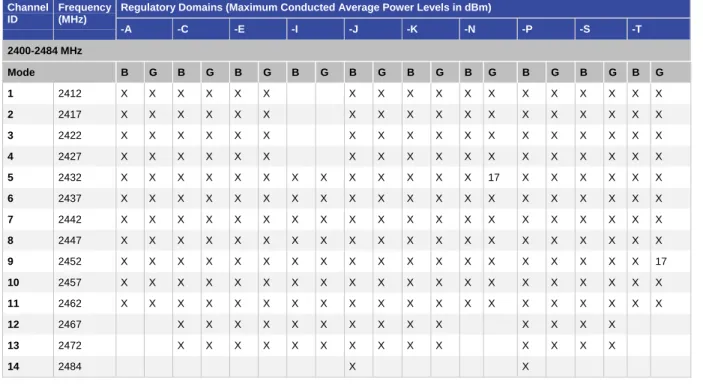
The channel allocation scheme is illustrated in Figure 9, and the available channels in the different regulatory
domains are defined in Table 4.
Figure 9. IEEE 802.11b/g DSSS Channel Allocations
Table 4 shows the channels permitted in the corresponding approval areas.
Table 4. DSSS PHY Frequency Channel Plan
Channel ID
Frequency (MHz)
Regulatory Domains (Maximum Conducted Average Power Levels in dBm)
-A -C -E -I -J -K -N -P -S -T 2400-2484 MHz Mode B G B G B G B G B G B G B G B G B G B G 1 2412 X X X X X X X X X X X X X X X X X X 2 2417 X X X X X X X X X X X X X X X X X X 3 2422 X X X X X X X X X X X X X X X X X X 4 2427 X X X X X X X X X X X X X X X X X X 5 2432 X X X X X X X X X X X X X 17 X X X X X X 6 2437 X X X X X X X X X X X X X X X X X X X X 7 2442 X X X X X X X X X X X X X X X X X X X X 8 2447 X X X X X X X X X X X X X X X X X X X X 9 2452 X X X X X X X X X X X X X X X X X X X 17 10 2457 X X X X X X X X X X X X X X X X X X X X 11 2462 X X X X X X X X X X X X X X X X X X X X 12 2467 X X X X X X X X X X X X X X
IEEE 802.11a Channels
The 802.11a specification today specifies four channels for the UNII1 band, four channels for the UNII2 band, and
four channels for the UNII3 band. These channels are spaced at 20 MHz apart and are considered noninterfering;
however, they do have a slight overlap in frequency spectrum. It is possible to use adjacent channels in adjacent
cell coverage, but it is recommended when possible to separate adjacent cell channels by at least 1 channel.
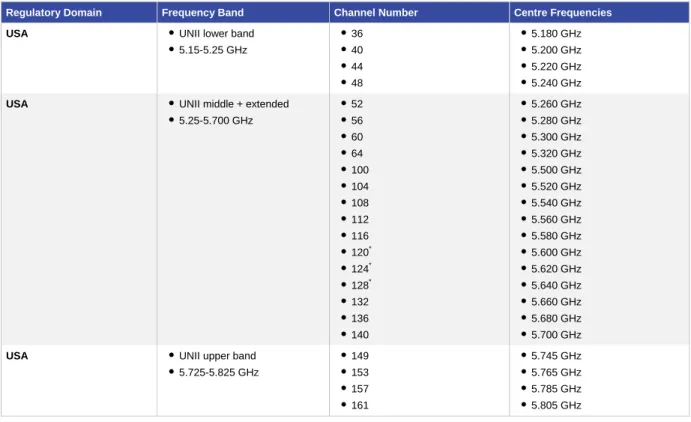
Figure 10 shows the channel scheme for the 802.11 bands, and Table 5 lists the North American frequency
allocations.
Figure 10. 802.11a Channel Allocation
Table 5. 802.11a Frequency Plan
Regulatory Domain Frequency Band Channel Number Centre Frequencies
USA ● UNII lower band
● 5.15-5.25 GHz ● 36 ● 40 ● 44 ● 48 ● 5.180 GHz ● 5.200 GHz ● 5.220 GHz ● 5.240 GHz
USA ● UNII middle + extended
● 5.25-5.700 GHz ● 52 ● 56 ● 60 ● 64 ● 100 ● 104 ● 108 ● 5.260 GHz ● 5.280 GHz ● 5.300 GHz ● 5.320 GHz ● 5.500 GHz ● 5.520 GHz ● 5.540 GHz
Regulatory Domain Frequency Band Channel Number Centre Frequencies
USA ● ISM band
● 5.725-5.825 GHz ● 149 ● 153 ● 157 ● 161 ● 165 ● 5.745 GHz ● 5.765 GHz ● 5.785 GHz ● 5.805 GHz ● 5.825 GHz *
Not supported in US due to weather radars.
Cisco Aironet Antenna Descriptions
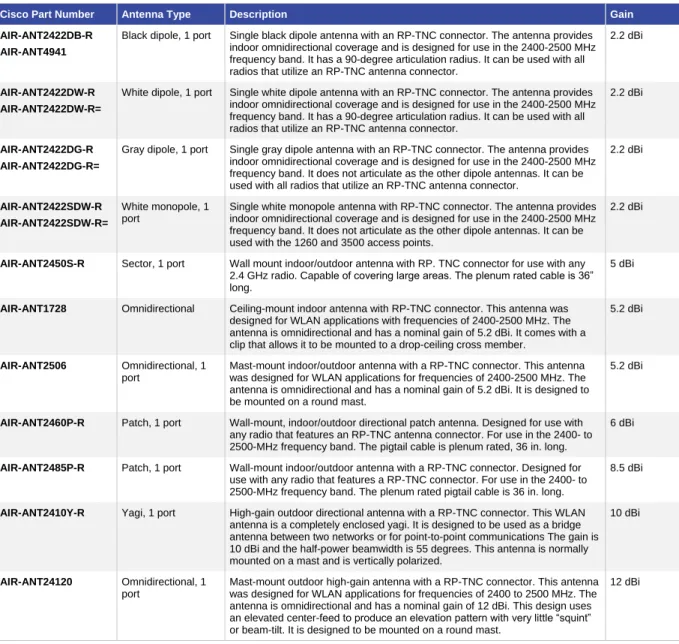
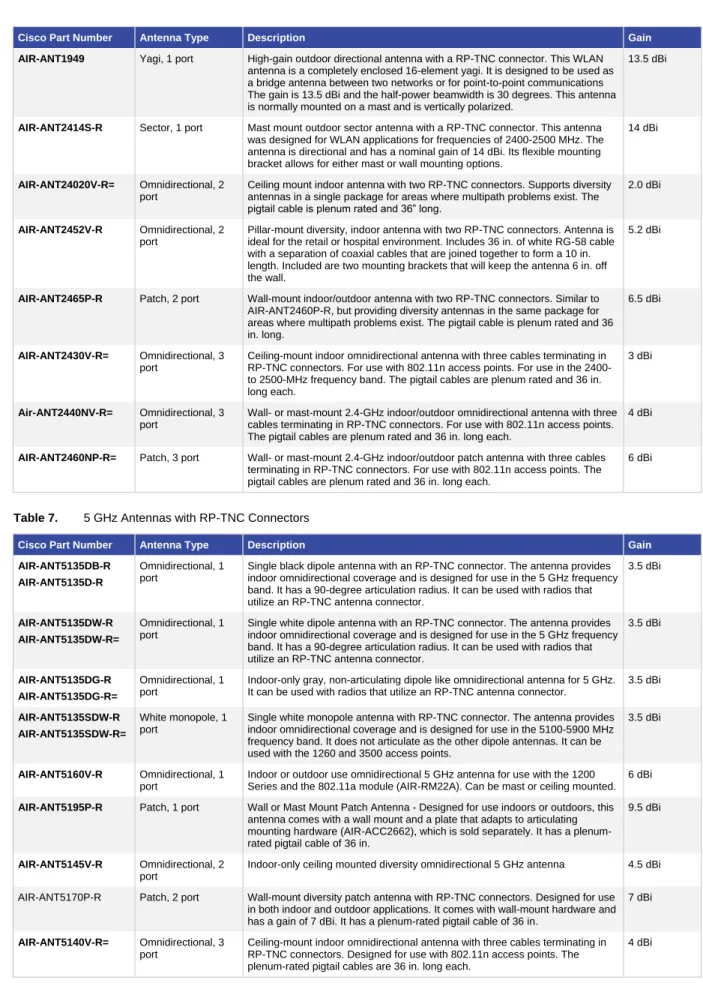
Table 6 below defines the various 2.4 GHz antennas that are offered by Cisco for the Cisco Aironet product line,
and Table 7 lists the available antennas for the Cisco Aironet 5 GHz bridge products. Table 8 defines the dual band
antennas that are offered for use with the Cisco Aironet G2 Access Points.
Table 6. 2.4 GHz Antennas with RP-TNC Connectors
Cisco Part Number Antenna Type Description Gain
AIR-ANT2422DB-R AIR-ANT4941
Black dipole, 1 port Single black dipole antenna with an RP-TNC connector. The antenna provides indoor omnidirectional coverage and is designed for use in the 2400-2500 MHz frequency band. It has a 90-degree articulation radius. It can be used with all radios that utilize an RP-TNC antenna connector.
2.2 dBi
AIR-ANT2422DW-R AIR-ANT2422DW-R=
White dipole, 1 port Single white dipole antenna with an RP-TNC connector. The antenna provides indoor omnidirectional coverage and is designed for use in the 2400-2500 MHz frequency band. It has a 90-degree articulation radius. It can be used with all radios that utilize an RP-TNC antenna connector.
2.2 dBi
AIR-ANT2422DG-R AIR-ANT2422DG-R=
Gray dipole, 1 port Single gray dipole antenna with an RP-TNC connector. The antenna provides indoor omnidirectional coverage and is designed for use in the 2400-2500 MHz frequency band. It does not articulate as the other dipole antennas. It can be used with all radios that utilize an RP-TNC antenna connector.
2.2 dBi
AIR-ANT2422SDW-R AIR-ANT2422SDW-R=
White monopole, 1 port
Single white monopole antenna with RP-TNC connector. The antenna provides indoor omnidirectional coverage and is designed for use in the 2400-2500 MHz frequency band. It does not articulate as the other dipole antennas. It can be used with the 1260 and 3500 access points.
2.2 dBi
AIR-ANT2450S-R Sector, 1 port Wall mount indoor/outdoor antenna with RP. TNC connector for use with any 2.4 GHz radio. Capable of covering large areas. The plenum rated cable is 36” long.
5 dBi
AIR-ANT1728 Omnidirectional Ceiling-mount indoor antenna with RP-TNC connector. This antenna was designed for WLAN applications with frequencies of 2400-2500 MHz. The antenna is omnidirectional and has a nominal gain of 5.2 dBi. It comes with a clip that allows it to be mounted to a drop-ceiling cross member.
5.2 dBi
AIR-ANT2506 Omnidirectional, 1 port
Mast-mount indoor/outdoor antenna with a RP-TNC connector. This antenna was designed for WLAN applications for frequencies of 2400-2500 MHz. The antenna is omnidirectional and has a nominal gain of 5.2 dBi. It is designed to be mounted on a round mast.
5.2 dBi
AIR-ANT2460P-R Patch, 1 port Wall-mount, indoor/outdoor directional patch antenna. Designed for use with any radio that features an RP-TNC antenna connector. For use in the 2400- to 2500-MHz frequency band. The pigtail cable is plenum rated, 36 in. long.
6 dBi
AIR-ANT2485P-R Patch, 1 port Wall-mount indoor/outdoor antenna with a RP-TNC connector. Designed for use with any radio that features a RP-TNC connector. For use in the 2400- to 2500-MHz frequency band. The plenum rated pigtail cable is 36 in. long.
8.5 dBi
AIR-ANT2410Y-R Yagi, 1 port High-gain outdoor directional antenna with a RP-TNC connector. This WLAN antenna is a completely enclosed yagi. It is designed to be used as a bridge antenna between two networks or for point-to-point communications The gain is 10 dBi and the half-power beamwidth is 55 degrees. This antenna is normally mounted on a mast and is vertically polarized.
10 dBi
AIR-ANT24120 Omnidirectional, 1 port
Mast-mount outdoor high-gain antenna with a RP-TNC connector. This antenna was designed for WLAN applications for frequencies of 2400 to 2500 MHz. The
Cisco Part Number Antenna Type Description Gain
AIR-ANT1949 Yagi, 1 port High-gain outdoor directional antenna with a RP-TNC connector. This WLAN antenna is a completely enclosed 16-element yagi. It is designed to be used as a bridge antenna between two networks or for point-to-point communications The gain is 13.5 dBi and the half-power beamwidth is 30 degrees. This antenna is normally mounted on a mast and is vertically polarized.
13.5 dBi
AIR-ANT2414S-R Sector, 1 port Mast mount outdoor sector antenna with a RP-TNC connector. This antenna was designed for WLAN applications for frequencies of 2400-2500 MHz. The antenna is directional and has a nominal gain of 14 dBi. Its flexible mounting bracket allows for either mast or wall mounting options.
14 dBi
AIR-ANT24020V-R= Omnidirectional, 2 port
Ceiling mount indoor antenna with two RP-TNC connectors. Supports diversity antennas in a single package for areas where multipath problems exist. The pigtail cable is plenum rated and 36” long.
2.0 dBi
AIR-ANT2452V-R Omnidirectional, 2 port
Pillar-mount diversity, indoor antenna with two RP-TNC connectors. Antenna is ideal for the retail or hospital environment. Includes 36 in. of white RG-58 cable with a separation of coaxial cables that are joined together to form a 10 in. length. Included are two mounting brackets that will keep the antenna 6 in. off the wall.
5.2 dBi
AIR-ANT2465P-R Patch, 2 port Wall-mount indoor/outdoor antenna with two RP-TNC connectors. Similar to AIR-ANT2460P-R, but providing diversity antennas in the same package for areas where multipath problems exist. The pigtail cable is plenum rated and 36 in. long.
6.5 dBi
AIR-ANT2430V-R= Omnidirectional, 3 port
Ceiling-mount indoor omnidirectional antenna with three cables terminating in RP-TNC connectors. For use with 802.11n access points. For use in the 2400- to 2500-MHz frequency band. The pigtail cables are plenum rated and 36 in. long each.
3 dBi
Air-ANT2440NV-R= Omnidirectional, 3 port
Wall- or mast-mount 2.4-GHz indoor/outdoor omnidirectional antenna with three cables terminating in RP-TNC connectors. For use with 802.11n access points. The pigtail cables are plenum rated and 36 in. long each.
4 dBi
AIR-ANT2460NP-R= Patch, 3 port Wall- or mast-mount 2.4-GHz indoor/outdoor patch antenna with three cables terminating in RP-TNC connectors. For use with 802.11n access points. The pigtail cables are plenum rated and 36 in. long each.
6 dBi
Table 7. 5 GHz Antennas with RP-TNC Connectors
Cisco Part Number Antenna Type Description Gain
AIR-ANT5135DB-R AIR-ANT5135D-R
Omnidirectional, 1 port
Single black dipole antenna with an RP-TNC connector. The antenna provides indoor omnidirectional coverage and is designed for use in the 5 GHz frequency band. It has a 90-degree articulation radius. It can be used with radios that utilize an RP-TNC antenna connector.
3.5 dBi
AIR-ANT5135DW-R AIR-ANT5135DW-R=
Omnidirectional, 1 port
Single white dipole antenna with an RP-TNC connector. The antenna provides indoor omnidirectional coverage and is designed for use in the 5 GHz frequency band. It has a 90-degree articulation radius. It can be used with radios that utilize an RP-TNC antenna connector.
3.5 dBi
AIR-ANT5135DG-R AIR-ANT5135DG-R=
Omnidirectional, 1 port
Indoor-only gray, non-articulating dipole like omnidirectional antenna for 5 GHz. It can be used with radios that utilize an RP-TNC antenna connector.
3.5 dBi
AIR-ANT5135SDW-R AIR-ANT5135SDW-R=
White monopole, 1 port
Single white monopole antenna with RP-TNC connector. The antenna provides indoor omnidirectional coverage and is designed for use in the 5100-5900 MHz frequency band. It does not articulate as the other dipole antennas. It can be used with the 1260 and 3500 access points.
Cisco Part Number Antenna Type Description Gain
AIR-ANT5140NV-R= Omnidirectional, 3 port
Wall- or mast-mount 5-GHz indoor/outdoor omnidirectional antenna with three cables terminating in RP-TNC connectors. Designed for use with 802.11n access points. The plenum-rated pigtail cables are 36 in. long each.
4 dBi
AIR-ANT5160NP-R= Patch, 3 port Indoor or outdoor wall-mounted 5-GHz patch antenna with three cables terminating in RP-TNC connectors. Designed for use with 802.11n access points. The plenum-rated pigtail cables are 36 in. long each.
6 dBi
Table 8. Dual Band Antennas for 2.4 and 5 GHz Access Points with RP-TNC Connectors
Cisco Part Number Antenna Type Description Gain
AIR-ANT2524DB-R AIR-ANT2524DB-R=
Black dipole, 1 port Single white dipole antenna with RP-TNC connector. The antenna provides indoor omnidirectional coverage. It has a 90-degree articulation radius and can be used with the 1600/2600/3600/3700 access points.
2.4 GHz: 2 dBi 5 GHz: 4 dBi
AIR-ANT2524DG-R AIR-ANT2524DG-R=
Gray dipole, 1 port Single white dipole antenna with RP-TNC connector. The antenna provides indoor omnidirectional coverage. It has a 90-degree articulation radius and can be used with the 1600/2600/3600/3700 access points.
2.4 GHz: 2 dBi 5 GHz: 4 dBi
AIR-ANT2524DW-R AIR-ANT2524DW-R=
White dipole, 1 port Single white dipole antenna with RP-TNC connector. The antenna provides indoor omnidirectional coverage. It has a 90-degree articulation radius and can be used with the 1600/2600/3600/3700 access points.
2.4 GHz: 2 dBi 5 GHz: 4 dBi
AIR-ANT2535SDW-R AIR-ANT2535SDW-R=
White dipole, 1 port Single white dipole antenna with RP-TNC connector. The antenna provides indoor omnidirectional coverage. It does not articulate as the other dipole antennas. It can be used with the 1600/2600/3600/3700 access points.
2.4 GHz: 3 dBi 5 GHz: 5 dBi
AIR-ANT2451V-R= Omnidirectional 4 port (2 ports for 2.4 GHz, 2 port for 5 GHz)
Ceiling-mount omnidirectional antenna. Designed for use indoors, this antenna comes with ceiling-mount hardware. It has 4 plenum rated pigtail cables, 18 in. each, with 4 right-angle RP-TNC connectors.
2.4 GHz: 2 dBi 5 GHz: 3 dBi
AIR-ANT2451NV-R= Omnidirectional, 6 port (2 ports for 2.4 GHz, 2 port for 5 GHz)
Ceiling Mount Omni-directional Antenna - Designed for use indoor, this antenna comes with ceiling mount hardware. It has 6 plenum rated pigtail cables, 18 in. each, with 6 RP-TNC connectors.
2.4 GHz: 2 dBi 5 GHz: 3 dBi
AIR-ANT25137NP-R= Patch, 6 port (2 ports for 2.4 GHz, 2 port for 5 GHz)
Designed for high density wireless applications such as stadiums and arena. Wall mounted patch antenna with 6 plenum-rated pigtail cables, 36 in. each and 6 RP-TNC connectors. Only certified for use with AP3502P access point.
2.4 GHz: 13 dBi 5 GHz: 7 dBi
AIR-ANT2524V4C-R= Omnidirectional 4, port (all ports dual band)
Ceiling mount omnidirectional antenna - Designed for use indoor, this antenna comes with ceiling mount hardware. It has 4 plenum rated pigtail cables, 3 foot each, with four RP-TNC connectors.
2.4 GHz: 2 dBi 5 GHz: 4 dBi
AIR-ANT2544V4M-R= Omnidirectional, 4 port (all ports dual band)
Indoor/outdoor wall or mast mounted dual band omnidirectional antenna with 4 plenum-rated, 36-in. cables and RP-TNC connectors. Designed for use with access points having dual band ports such as 1600, 2600, or 3600.
2.4 GHz: 4 dBi 5 GHz: 4 dBi
AIR-ANT2566P4W-R= Patch, 4 port (all ports dual band))
Indoor/outdoor wall mounted dual band patch antenna with 4 plenum-rated, 36-in. cables and RP-TNC connectors. Designed for use with access points having dual band ports such as 1600, 2600, or 3600.
2.4 GHz: 6 dBi 5 GHz: 6 dBi
Table 9. 2.4 GHz and 5 GHz Access Point and Bridge Antennas with N Type Connectors
Cisco Part Number Antenna Type Description Gain
AIR-ANT2420V-N (=) Omnidirectional 2.4 GHz omnidirectional antenna for mesh access points. Suitable for use on Cisco Aironet 1552CU Mesh Access Points. It is only 5 in. long, mounts directly to the access point, and has no cable attachments.
2 dBi
AIR-ANT2450V-N (=) Omnidirectional 2.4 GHz omnidirectional antenna for mesh access points. Suitable for use on Cisco Aironet 1520/1550 Series Mesh Access Points. It mounts directly to the access point and has no cable attachments.
Cisco Part Number Antenna Type Description Gain
AIR-ANT2480V-N (=) Omnidirectional 2.4 GHz omnidirectional antenna for mesh access points. Suitable for use on Cisco Aironet 1520/1550 Series Mesh Access Points. It mounts directly to the access point and has no cable attachments.
8 dBi
AIR-ANT2413P2M-N= Patch, 2 port 2.4 GHz, 13 dBi directional antenna with two orthogonally polarized ports. Antenna comes with two 30-in. cables terminated in right angle N-type connectors.
13 dBi
AIR-ANT5140V-N (=) Omnidirectional 5 GHz omnidirectional antenna for mesh access points. Suitable for use on Cisco Aironet 1552CU Mesh Access Points. It mounts directly to the access point and has no cable attachments.
4 dBi
AIR-ANT5175V-N (=) Omnidirectional A 7.5 dBi antenna which supports 4900-5825 MHz. It has a 12-in. pigtail cable and an N-type connector.
7.5 dBi
AIR-ANT5180V-N (=) Omnidirectional 5 GHz omnidirectional antenna for mesh access points. Suitable for use on Cisco Aironet 1520/1550 Series Mesh Access Points. It mounts directly to the access point and has no cable attachments.
8 dBi
AIR-ANT5114P-N= Patch 5 GHz, 14 dBi patch antenna for use in the 4950-5850 MHz frequency band. The antenna has an N-type connector, and will require a separate low loss cable for mounting to the access point. Articulating mount included. Fits mast pole sizes 2 in. diameter maximum.
14 dBi
AIR-ANT5114P2M-N= Patch, 2 port 5 GHz, 14 dBi directional antenna with two orthogonally polarized ports. Antenna comes with two 30-in. cables terminated in right angle N-type connectors.
14 dBi
Table 10. 2.4 GHz and 5 GHz Dual-band Antennas with N Type Connectors
Cisco Part Number Antenna Type Description Gain
AIR-ANT2547V-N (=) AIR-ANT2547VG-N (=)
Omnidirectional 2.4 GHz, 4 dBi and 5 GHz 7 dBi dual-band omnidirectional antenna which utilizes an N-type connector. It mounts directly to the access point and has no cable attachments. AIR-ANT2547VG-N has a gray radome.
2.4 GHz: 4 dBi 5 GHz: 7 dBi
AIR-ANT2568VG-N (=) Omnidirectional 2.4 GHz, 6 dBi and 5 GHz 8 dBi dual-band omnidirectional antenna that uses an N-type connector. It mounts directly to the access point and has no cable attachments. It has a gray radome.
2.4 GHz: 6 dBi 5 GHz: 8 dBi
AIR-ANT2588P3M-N= Patch, 3 port 2.4 GHz, 8 dBi and 5 GHz 8 dBi dual-band directional antenna with three N-type connectors. It can be used with the outdoor access points and has no cable attachments.
2.4 GHz: 8 dBi 5 GHz: 8 dBi
AIR-ANT2513P4M-N= Patch, 4 port 2.4 GHz, 13 dBi and 5 GHz 13 dBi dual-band directional antenna with four(4) N-type connectors. It is outdoor rated and has no cable attachments.
2.4 GHz: 13 dBi 5 GHz: 13 dBi
Table 11. 2.4 GHz and 5 GHz Access Point and Bridge Integrated Antennas
Cisco Part Number Antenna Type Description Gain
Integrated AP 3500 Antenna
Omnidirectional 802.11n antenna package for both 2.4 GHz and 5 GHz designed for high performance in both ceiling and wall mount applications. Antennas provide hemispherical coverage and cannot be removed from the Access Point. No connectors are offered for additional
external antennas.
2.4 GHz: 4 dBi 5 GHz: 3 dBi
Cisco Part Number Antenna Type Description Gain
Integrated AP 1600 Antenna
Omnidirectional 802.11n antenna package for both 2.4 GHz and 5 GHz designed for high performance in both ceiling and wall mount applications. Antennas provide hemispherical coverage and cannot be removed from the Access Point. No connectors are offered for additional external antennas.
2.4 GHz: 4 dBi 5 GHz: 4 dBi
Integrated AP 2600 Antenna
Omnidirectional 802.11n antenna package for both 2.4 GHz and 5 GHz designed for high performance in both ceiling and wall mount applications. Antennas provide hemispherical coverage and cannot be removed from the Access Point. No connectors are offered for additional external antennas.
2.4 GHz: 4 dBi 5 GHz: 4 dBi
Integrated AP 3600 Antenna
Omnidirectional 802.11n antenna package for both 2.4 GHz and 5 GHz designed for high performance in both ceiling and wall mount applications. Antennas provide hemispherical coverage and cannot be removed from the Access Point. No connectors are offered for additional external antennas.
2.4 GHz: 2 dBi 5 GHz: 4 dBi
Integrated AP 3700 Antenna
Omnidirectional 802.11ac antenna package for both 2.4 GHz and 5 GHz designed for high performance in both ceiling and wall mount applications. Antennas provide hemispherical coverage and cannot be removed from the Access Point. No connectors are offered for additional external antennas.
2.4 GHz: 4 dBi 5 GHz: 4 dBi
Integrated AP 2700 Antenna
Omnidirectional 802.11ac antenna package for both 2.4 GHz and 5 GHz designed for high performance in both ceiling and wall mount applications. Antennas provide hemispherical coverage and cannot be removed from the Access Point. No connectors are offered for additional external antennas.
2.4 GHz: 4 dBi 5 GHz: 4 dBi
Integrated AP 1700 Antenna
Omnidirectional 802.11ac antenna package for both 2.4 GHz and 5 GHz designed for high performance in both ceiling and wall mount applications. Antennas provide hemispherical coverage and cannot be removed from the access point. No connectors are offered for additional external antennas.
2.4 GHz: 4 dBi 5 GHz: 4 dBi
Integrated AP 1550 Antenna
Omnidirectional 802.11n antenna package for both 2.4 GHz and 5 GHz. When the integrated antenna version is ordered, this antenna is attached to the access point and provides omnidirectional coverage in a low-profile package. No connectors are offered for additional external antennas.
2.4 GHz: 2 dBi 5 GHz: 4 dBi
Integrated AP 1530 Antenna
Omnidirectional 802.11n antenna package for both 2.4 GHz and 5 GHz. When the integrated antenna version is ordered, this antenna is attached to the access point and provides omnidirectional coverage in a low-profile package. No connectors are offered for additional external antennas.
2.4 GHz: 3 dBi 5 GHz: 5 dBi
Integrated AP 1570 Antenna
Omnidirectional 802.11ac antenna package for both 2.4 GHz and 5 GHz. When the integrated antenna version is ordered, this antenna is attached to the access point and provides omnidirectional coverage in a low-profile package. No connectors are offered for additional external antennas.
2.4 GHz: 4 dBi 5 GHz: 6 dBi
Cisco Aironet Cable Descriptions
Table 12 below defines the cables available for interconnecting the antennas and the radio devices for the Cisco
Aironet product line.
Table 12. Cisco Cables
Cisco Part Number Type of Cable Description Loss at 2.4 GHz Loss at 5.8 GHz
AIR-CAB002L240-N= Interconnect 2-ft low-loss cable, one straight N connector, one 90-degree N connector
0.5 dB 0.8 dB
AIR-CAB005LL-N Interconnect 5-ft low-loss cable, one straight N connector, one 90-degree N connector
0.5 dB 0.8 dB
AIR-CAB005LL-R Interconnect 5-ft low-loss cable, one RP-TNC plug, one RP-TNC jack
0.5 dB 0.8 dB
AIR-CAB005LL-R-N= Interconnect 5-ft low-loss cable, one RP-TNC plug, one 90-degree N male connector
Cisco Part Number Type of Cable Description Loss at 2.4 GHz Loss at 5.8 GHz
AIR-CAB050LL-R Interconnect 50-ft low-loss cable, one RP-TNC plug, one RP-TNC jack
3.4 dB 5.75 dB
AIR-CAB100ULL-R Interconnect 100-ft ultra-low-loss cable, one RP-TNC plug, one RP-TNC jack
4.4 dB 7.25 dB
AIR-CAB150ULL-R Interconnect 150-ft ultra-low-loss cable, one RP-TNC plug, one RP-TNC jack
6.6 dB 11 dB
AIR-CAB025HZ-N= Interconnect 25-ft ultra-low-loss cable, two straight N male connectors, ruggedized jacket for use in hazardous locations
2.0 dB 3.5 dB
AIR-ACC2537-060 Bulkhead Extender 5-ft (60 in.) RG-58 type cable with one RP-TNC plug and one RP-TNC jack
2 dB 3 dB
Table 13. Accessories
Cisco Part Number Name Description
AIR-ACC2662 Yagi Articulating Mount This mount permits the Yagi antenna to be mounted to a flat surface or a mast, and then be adjusted in both horizontal and vertical angles.
AIR-ACC245LA-R Lightning Arrestor Supports both 2.4 GHz and 5 GHz operation with RP-TNC connectors. Provides lightning and related energy surges at the antenna from reaching the radio circuitry. A ground ring is included.
AIR-ACC245LA-N= Lightning Arrestor Supports both 2.4 GHz and 5 GHz operation with N-Type connectors. Provides lightning and related energy surges at the antenna from reaching the radio circuitry. A ground ring is included.
Cisco Aironet Antenna Specifications
The following section provides detailed descriptions, including physical and electrical specifications for the
antennas offered by Cisco for the Cisco Aironet product line. Full detailed installation guides for each antenna can
be found at the following:
2.2 dBi Dipole
AIR-AT2422DB-R=/AIR-ANT4941
Dimensions and Mounting Specifications
Azimuth Plane Radiation Pattern Elevation Plane Radiation Pattern
Frequency Range 2.4-2.484 GHz
VSWR Less than 2:1
Power 5 watts
Gain 2.2 dBi
Polarization Linear Azimuth 3dB Beamwidth Omnidirectional Elevations 3dB Beamwidth 65 degrees Antenna Connector RP-TNC
Cable Length None
Dimensions 5.5 in.
2.2 dBi Dipole
AIR-ANT2422DW-R
Dimensions and Mounting Specifications
Azimuth Plane Radiation Pattern Elevation Plane Radiation Pattern
Frequency Range 2.4-2.484 GHz
VSWR Less than 2:1
Power 5 watts
Gain 2.2 dBi
Polarization Linear
Azimuth 3dB Beamwidth Omnidirectional Elevations 3dB Beamwidth 65 degrees Antenna Connector RP-TNC
Cable Length None
Dimensions 5.5 in.
2.2 dBi Dipole
AIR-ANT2422DG-R
Dimensions and Mounting Specifications
Azimuth Plane Radiation Pattern Elevation Plane Radiation Pattern
Frequency Range 2.4-2.484 GHz
VSWR Less than 2:1
Power 5 watts
Gain 2.2 dBi
Polarization Linear Azimuth 3dB Beamwidth Omnidirectional Elevations 3dB Beamwidth 65 degrees Antenna Connector RP-TNC
Cable Length None
Dimensions 3.9 in.
2.2 dBi Monopole
AIR-ANT2422SDW-R
Dimensions and Mounting Specifications
Azimuth and Elevation Plane Radiation Pattern
Frequency Range 2400 - 2500 MHz
VSWR Less than 2:1
Gain 2.2 dBi
Polarization Linear Azimuth 3dB Beamwidth Omnidirectional Elevations 3dB Beamwidth 50 degrees Antenna Connector RP-TNC
Cable Length None
Dimensions 1.7 in.
5 dBi Sector
AIR-ANT2450S-R
Dimensions and Mounting Specifications Azimuth Plane Radiation Pattern Elevation Plane Radiation Pattern
Frequency Range 2.4-2.5 GHz
VSWR 1.5 or less
Gain 5.0 dBi
Polarization Linear vertical
Azimuth 3dB Beamwidth 135 degrees
Elevations 3dB Beamwidth 54 degrees
Antenna Connector RP-TNC
Cable Length 3 ft. (91 cm)
Dimensions 6 x 3 x 2 in (15.2 x 7.6 x 5 cm)
5.2 dBi Ceiling Mount Omnidirectional
AIR-ANT1728
Dimensions and Mounting Specifications
Azimuth Plane Radiation Pattern Elevation Plane Radiation Pattern
Frequency Range 2.4-2.83 GHz
VSWR Less than 2:1, 1.5:1 Nominal
Gain 5.2 dBi
Polarization Vertical
Azimuth 3dB Beamwidth Omnidirectional 360 degrees Elevations Plan (3dB Beamwidth) 36 degrees
Antenna Connector RP-TNC Cable Length 3 ft. (91 cm)
Dimensions 11.25 in. x 1 in. (28.57 cm x 2.54) Mounting Drop ceiling cross member - indoor only
5.2 dBi Mast Mount Omnidirectional
AIR-ANT2506
Dimensions and Mounting Specifications
Azimuth Plane Radiation Pattern Elevation Plane Radiation Pattern
Frequency Range 2.4-2.83 GHz
VSWR Less than 2:1, 1.5:1 Nominal
Gain 5.2 dBi
Polarization Vertical
Azimuth 3dB Beamwidth Omnidirectional 360 degrees Elevations Plan (3dB Beamwidth) 36 degrees
Antenna Connector RP-TNC
Cable Length 3 ft (91 cm)
Dimensions 11.5 in. x 1.125 in. (29.21 cm x 2.85 cm) Mounting Mast Mount - indoor/outdoor
6 dBi Wall Mount Directional
AIR-ANT2460P-R
Dimensions and Mounting Specifications Azimuth Plane Radiation Pattern Elevation Plane Radiation Pattern
Frequency Range 2.4-2.5 GHz
VSWR Less than 2:1
Gain 6 dBi
Polarization Vertical
Azimuth 3dB Beamwidth 75 degrees Elevation Plan (3dB Beamwidth) 73 degrees
Antenna Connector RP-TNC
Cable Length 3 ft. (91 cm)
Dimensions 4.1 in. x 3.9 in. x .75 in. (10.41 cm x 9.90 cm x 1.90 cm)
8.5 dBi Wall Mount
AIR-ANT2485P-R
Dimensions and Mounting Specifications Azimuth Plane Radiation Pattern Elevation Plane Radiation Pattern
Frequency Range 2.4-2.5 GHz
VSWR 2:1 Max, 1.5:1 Nominal
Gain 8.5 dBi
Polarization Vertical
Azimuth 3dB Beamwidth 66 degrees
Elevations 3dB Beamwidth 56 degrees
Antenna Connector RP-TNC
Cable Length 3 ft. (91 cm)
Dimensions 5.3 in. x 5.3 in. x .90 in. (13.5 cm x 13.5 cm x 2.2 cm)
10 dBi Wall/Mast Mount YAGI
AIR-ANT2410Y-R
Dimensions and Mounting Specifications Azimuth Plane Radiation Pattern Elevation Plane Radiation Pattern
Frequency Range 2.4-2.483 GHz
VSWR Less than 2:1
Gain 10 dBi
Polarization Vertical
Azimuth 3dB Beamwidth 55 degrees Elevations Plan 3dB Beamwidth 47 degrees
Antenna Connector RP-TNC
Cable Length 3 ft. (91 cm)
Dimensions 3 in. x 7.25 in. (7.62 cm x 18.42 cm)
12 dBi Mast Mount Omnidirectional
AIR-ANT24120
Dimensions and Mounting Specifications Azimuth Plane Radiation Pattern Elevation Plane Radiation Pattern
Frequency Range 2400-2500 MHz
VSWR 1.5:1
Gain 12 dBi
Polarization Linear, Vertical
Azimuth 3dB Beamwidth Omnidirectional 360 degrees Elevation (3dB Beamwidth) 7 degrees
Antenna Connector RP-TNC
Cable Length 1 ft. (30.48 cm)
Dimensions 42 in. x 1.25 in. (106.68 cm x 3.17 cm)
Wind Rating 125 MPH
13.5 dBi Mast/Wall Mount YAGI
AIR-ANT1949
Dimensions and Mounting Specifications Azimuth Plane Radiation Pattern Elevation Plane Radiation Pattern
Frequency Range 2.4-2.83 GHz
VSWR Less than 2:1, 1.5:1 Nominal
Gain 13.5 dBi
Front to Back Ratio Greater than 25 dB
Polarization Vertical
Azimuth 3dB Beamwidth 30 degrees Elevations 3dB Beamwidth 25 degrees
Antenna Connector RP-TNC
Cable Length 3 ft. (91 cm)
Dimensions 18 in. x 3 in. (45.72 cm x 7.62 cm)
Wind Rating 110 MPH
14 dBi Mast Mount Sector
AIR-ANT2414S-R
Dimensions and Mounting Specifications
Azimuth Plane Radiation Pattern Elevation Plane Radiation Pattern
Frequency Range 2.4-2.5 GHz
VSWR 1.5:1
Gain 14 dBi
Polarization Linear, Vertical Azimuth 3dB Beamwidth 90 degrees Elevations 3dB Beamwidth 8.5 degrees
Antenna Connector RP-TNC
Cable Length 5 ft. (152.4 cm)
Dimensions 36 in. x 6 in. x 4 in. (91.44 cm x 15.24 cm x 10.16 cm)
2 dBi Omnidirectional, 2 Element
AIR-ANT24020V-R=
Dimensions and Mounting Specifications Left Antenna Patterns Right Antenna Patterns
Frequency Range 2.4-2.5 GHz
VSWR 1.5:1
Gain 2.2 dBi
Polarization Vertical
Azimuth 3dB Beamwidth 360 degrees Elevations Plan (3dB Beamwidth) 97 degrees
Antenna Connector RP-TNC
Cable Length 3 ft. (91 cm)
Dimensions 6.9 in. x 3 in. x .90 in. (17.5 cm x 7.6 cm x 2.5 cm)
5.2 dBi Wall Mount
AIR-ANT2452V-R
Dimensions and Mounting Specifications Left Antenna Patterns Right Antenna Patterns
Frequency Range 2.4-2.5 GHz
VSWR < 2:1
Gain 5 dBi
Polarization Vertical
Azimuth 3dB Beamwidth 360 degrees Elevations Plan (3dB Beamwidth) 27 degrees
Antenna Connector RP-TNC
Cable Length 3 ft. (91 cm)
Dimensions 11 in. x 5 in. x 1 in. (27.2 cm x 12.7 cm x 2.5 cm)
6.5 dBi Wall Mount
AIR-ANT2465P-R
Dimensions and Mounting Specifications Left Antenna Patterns Right Antenna Patterns
Frequency Range 2.4-2.5 GHz
VSWR 1.7:1 Nominal
Gain 6.5 dBi
Polarization Vertical
Azimuth 3dB Beamwidth 75 degrees Elevations Plan (3dB Beamwidth) 57 degrees
Antenna Connector RP-TNC
Cable Length 3 ft. (91 cm)
Dimensions 5 in. x 6.7 in. x .90 in. (12.7 cm x 17.0 cm x 2.2 cm)
Omnidirectional, 3 Element Ceiling Mount
AIR-ANT2430V-R=
Antenna A Radiation Pattern Antenna B Radiation Pattern Antenna C Radiation Pattern
Frequency Range 2402 - 2485 MHz
VSWR 2:1
Gain 3 dBi
Polarization Linear
Azimuth 3dB Beamwidth Omni
Elevations 3dB Beamwidth 60
Antenna Connector (3) RP-TNC male
Cable Length 36 in (91.4 cm) plenum rated
Dimensions 12.1 in . x 4.2 in x 1.6 in (30.7 cm x 10.6 cm x 4.0 cm)
Omnidirectional, 3 Element Wall Mount
AIR-ANT2440NV-R=
Antenna A Radiation Pattern Antenna B Radiation Pattern Antenna C Radiation Pattern
Frequency Range 2402 - 2484 MHz
VSWR 2:1
Gain 4 dBi
Polarization Linear
Azimuth 3dB Beamwidth Omni
Elevations 3dB Beamwidth 36
Antenna Connector (3) RP-TNC male
Cable Length 36 in (91.4 cm) plenum rated
Dimensions 8.6 in x 6.3 in dia. (21.8 cm x 16 cm dia.)
6 dBi Patch, 3 Element Wall Mount
AIR-ANT2460NP-R=
Antenna A Radiation Pattern Antenna B Radiation Pattern Antenna C Radiation Pattern
Frequency Range 2402 - 2484 MHz
VSWR 2:1
Gain 6 dBi
Polarization Linear
Azimuth 3dB Beamwidth 80 degrees Elevations 3dB Beamwidth 75 degrees
Antenna Connector (3) RP-TNC male
Cable Length 36 in (91.4 cm) plenum rated
Dimensions 5.8 in x 11.25 in x 1.13 in (14.7 cm x 28.6 cm x 2.9 cm)
3.5 dBi Dipole
AIR-ANT5135D-R
Dimensions and Mounting Specifications
Azimuth Plane Radiation Pattern Elevation Plane Radiation Pattern
Frequency Range 5.15-5.85 GHz
VSWR 2:1 or better
Gain 3.5 dBi
Polarization Linear Azimuth 3dB Beamwidth Omnidirectional Elevations 3dB Beamwidth 40 degrees Antenna Connector RP-TNC
Cable Length None
Dimensions 5.3 in. (13.46 cm)