The purpose of this study was to examine gender role portrayal in the illustrations of board books for young children. Young female characters in the illustrations of nineteen board books were examined according to a pre-determined rubric. Characters were shown stereotypically in their clothing and hairstyle and in their tendency to display nurturing behavior. However, characters were non-stereotypical in their completion of a variety of instrumental activities.
Headings:
Children’s literature -- evaluation -- sexism
GENDER ROLE PORTRAYAL IN BOARD BOOK ILLUSTRATIONS
by Jesse L. Carter
A Master’s paper submitted to the faculty of the School of Information and Library Science of the University of North Carolina at Chapel Hill
in partial fulfillment of the requirements for the degree of Master of Science in
Library Science.
Chapel Hill, North Carolina April, 2009
Approved by:
Table of Contents
Introduction………..2
Literature Review……….4
Research Methodology………...15
Results..………..19
Conclusion……….33
References………..37
Appendix A………41
Gender Role Portrayal in Board Book Illustrations
Introduction:
The gender identity of most children is shaped by the universally shared beliefs about gender roles that are held by their society…. In most cultures the most important and effective way of
transmitting values and attitudes is through storytelling, and in literate cultures, this process includes children’s books.
(Kortenhaus & Demarest, 1993, p. 220)
Early experiences with books shape not only children’s future literacy, but also their first encounters with cultural values and attitudes. Board books, which are small books with thick cardboard pages, are often the first books with which infants and toddlers come into contact. Although parents may show young children traditional picture books and share the stories within those books, board books are constructed specifically so that young hands can grab and explore them without much damage to the book itself.
With short, simple sentences to accompany the pictures, and with pictures that themselves could stand alone to display the plot, board books exemplify the importance illustrations can have in a reading experience for young children. While illustrations make up an important part of young children’s understanding of books, the books themselves are an important way in which young children come to understand their world.
Literature Review:
This literature review is comprised of four sections related to understanding gender role portrayal and children’s books. It examines available literature to give a brief overview of how young children develop ideas about gender roles, and it looks at how the development of literacy skills occurs alongside gender role understanding in these
children. It then delves more deeply into how the illustrations in children’s books impact children’s understandings of the books in general and gender roles specifically and examines the research on gender role portrayal in these books. Finally, it looks at picture decoding principles that are applied in the upcoming examination of board books.
Gender Role Development
Many researchers see the development of children’s ideas about gender roles begin early and be expressed often (Davies, 2003; Eaton, 1983; Kuhn, Nash, & Brucken, 1978; Urberg, 1982). Children as young as two years of age possess substantial
correctly as male or female, since that is what is required of them in order to have a recognizable identity within the existing social order” (p. 14).
Interestingly, young children develop different levels of awareness about the two genders. At 36 months of age, boys are less knowledgeable about the female role than girls, while girls and boys of this age have equivalent knowledge about the male role (O’Brien, et. al, 2000). These findings show that children learn the content of the
culturally salient and consistently portrayed male role early in life, but that boys may not tend to explore aspects of the feminine gender role. This study, and Stangor and Ruble’s 1987 study, seem to support the idea that children acquire two different gender-related schemas, one for male roles and one for female roles. While research has not shown specifically what influences this way of thinking in young children, it will be interesting to examine whether or not the early illustrations to which children of this age are exposed could play a role in their ideas about the two genders.
likely to have violent, aggressive, competitive, dangerous, and risky experiences with typically masculine toys. Social play among children is also affected by some of the same ideas. Children have been shown to detect the regularities governing traditional gender roles and then interpret them as rules to be applied to their lives, even in play (Wynn & Fletcher, 1987). Since gender role learning and understanding is pervasive in many areas of the lives of young children, it is important that equitable gender role portrayal is available in as many avenues as possible.
Development of Literacy
The definition of literacy is important to consider, especially in light of the primary audience of board books—infants and toddlers who are not yet reading text. Venezky (1995) provides one definition, “Literacy, therefore, requires active,
autonomous engagement with print and stresses the role of the individual in generating as well as receiving and assigning independent interpretations to messages” (p. 142). While this definition itself focuses primarily on words, it could also be interpreted with
illustrations as the “print” matter to be considered—and with this interpretation, it fits quite well when considering board books. Engaging with the illustrations, receiving those illustrations, and interpreting those illustrations are all part of the process infants and toddlers go through as they interact with board books.
“readiness” and “learning to read.”. In the late 1940s, Gates proposed “pre-reading” and “reading readiness.” In the 1960s, Russell based his research on child development, and labeled only one stage before reading began—“pre-reading.” Chall’s more recent work on reading development theory places infants, toddlers, and children up to the age of six in Stage 0. In this stage, children learn simple concepts of reading and writing (like those shown in board books) by looking at letters, practicing writing, and pretending to read.
This early stage of literacy is the one of most interest when considering board books, and it naturally lends itself to a stronger focus on images and illustrations than on text. Visual literacy develops in young children earlier than does their ability to
understand text. Children can recognize and interpret images before they are able to read and understand letters (Stanley & Sturm, 2008; Steinman, Lejeune, & Kimbrough, 2006). Making sense of these visual objects is itself a learned process—one that involves
cultural conventions (such as ideas about gender), prior experience, and personal idiosyncrasies (Randhawa & Coffman, 1978; Stanley & Sturm, 2008). Since the
Importance of Illustrations
Since the young children who are the primary audience of board books are not generally text-literate, it is important to examine the research on the impact illustrations can have as children interact with illustrated books. Children who are in Piaget’s preoperational stage (from ages 2-7) tend to focus on centralized and prominent images in illustrations—thus using less attention on understanding and interpreting the
background or other small details (Piaget, 1969; Stanley & Sturm, 2008). Similarly, young children (preschool age) tend to selectively view illustrations, choosing only some aspects of the pictures on which to impart meaning. It is only over time that children come to realize that multiple interpretations can exist for one book and one illustration (Parkes, 1998). Along the same lines, children of this young age also interpret images very narrowly—they are unable to infer content that is not physically depicted on the page (Higgins, 1980; Stanley & Sturm, 2008). Children are also more likely to rely on the picture cues in lieu of understanding text cues (Samuels 1967; Stanley & Sturm, 2008). In light of this research, it is interesting to see that board books, in general, provide centralized, prominent images and very little text. In this way, they are both easily understood and developmentally appropriate for their intended audience.
However, the content of those simple images has not been examined closely, and that is the purpose of the research in this paper—to determine what gender-role messages young children are receiving from their earliest interactions with illustrated books.
Illustrated books play a significant and pervasive role in early gender
child not only with role models, but also with clear images that prescribe for children what they can and should be like when they grow up (Weitzman et al., 1972). Along the same lines, many researchers believe that the implicit messages of the media (especially those portrayed in images) are often as powerful as explicit ones. Vandergrift (1995) says that, “Awareness and analysis of visual messages may be equally important in studying the perceptions of youngsters as they make meanings in response to… the media which pervade their lives” (p. 63). Especially when text is understated, illustrations in children’s books begin to demonstrate things like a character’s personality, the
importance of everyday objects, or the sense of community.
Historical Gender Inequality in Children’s Books
Gender role portrayal in children’s books has been examined extensively in the literature, particularly in the genre of picture books. The research done in this area provides a good baseline for understanding the issues involved in the analysis of these books, as well as ideas about methodology to incorporate in the study of board books.
Research began in earnest on the topic of gender inequality in children’s books during the 1970s, and it initially focused on Caldecott award-winning titles. Seen as some of the best books for children, and known to be widely purchased by bookstores and libraries, these books were examined in light of their well-known status and wide audience. Weitzman et al. (1972) completed one of the first studies on this topic by examining the Caldecott medal winners and honors books from 1938-1972. Their explanation for choosing to focus on picture books is enlightening: “These books are often read over and over again at a time when children are in the process of developing their own sexual identities” (p. 1126). This fits in well with the earlier discussion of gender role development in young children, and it provides a still-compelling reason to examine resources with which these children interact. In addition to finding that females were generally underrepresented in picture books and that females were shown as passive while males were shown as active, Weitzman et al., noted that women were often simply invisible in the books they examined, especially in illustrations.
Czaplinksi’s 1972 study is another that formed the basis for this line of inquiry, and it examined many of the same books that Weitzman, et al studied. By looking at gender portrayal in Caldecott medal winning and honor books from 1941-1971,
found that sexism in picture books had actually increased in the 1960s and 1970s. Greater physical, intellectual, and emotional strengths were attributed to males than to females, and males performed more actions surrounding a wider range of activity. One of Czapinksi’s main conclusions was: “Adult sexist themes were also the same themes as those found in children’s picture books. Sexism begins early and borrows heavily from the adult world” (p. 97).
Stewig and Knipfel (1975) attempted to update the earlier studies by examining 100 randomly selected picture books published between 1972 and 1974. By using books other than those associated with the Caldecott medal, researchers were broadening their understanding of children’s books more generally, and by looking at recent books, Stewig and Knipfel hoped to find progress in the portrayal of gender equality. While some progress was noted (women were shown in professions outside of the home, for example), researchers concluded that much remained to be done in portraying women equitably.
Kolbe and LaVoie provided an update to Weitzman et al.’s study in 1981 by analyzing the 19 Caldecott medal winners and honor books from 1972 through 1979. Once again, little progress was shown in the representation of gender equality in these books considered representative of the picture book genre. Women were not main characters in the stories and none of the books showed women working outside of the home. However, for the first time in the research, women were shown more frequently in the illustrations of this sample.
According to their study, the approximate numbers of male and female characters were nearing equality, and girl characters were just as likely to be shown having adventures as they were to be shown in domestic settings. Their study was one of the first that began to document increasing gender role equality.
Kortenhaus and Demarest (1993) also documented the increasing equality in the frequency of male and female characters in picture books for children. In their 150-book sample, the researchers also found that female characters were taking part in more instrumental activities, but were still portrayed in some ways as passive and dependent. In contrast, male characters were rarely shown as passive and dependent, but remained just as instrumental as they had in previous studies. These subtle differences concerned the researchers, but the overall pattern of equality in gender role representation was encouraging.
This increasing equality continued to be shown in research. Caldecott books were still of interest—the 22 award winners and honor books from 1986 through 1991 were studied by Oskamp et al. (1996). They noted a continuing trend toward more equitable gender representation—female characters were being portrayed as fuller individuals with a greater number and variety of both active and passive attributes than had been noted before. Notably, male characters were also depicted more often as dependent,
cooperative, and emotional—a key piece of the gender equality puzzle that had been missing up until this point. While changes in female characters’ portrayal in children’s books was the main focus of early research, more recent research has begun to focus on portraying both male and female characters as well-rounded with many different
As studies have continued on gender role portrayal in children’s books,
conclusions have varied. Davis and McDaniel (1999) examined Caldecott books from 1972 through 1997 and found notably fewer female characters than male characters in both text and illustrations overall, with a noted increase in the proportion of female characters from a low of 19% in the 1960s to a high of 36% in the 1980s. Diekman and Murnen (2004) employed a new method of analyzing books by combining a quantitative and narrative approach—they found substantial stereotypical roles for females along with a lack of male characters adopting traditionally feminine characteristics.
Table 1: Summary of previous study conclusions Studies Females under-represented Females shown as passive Males shown as active Females shown alone Males shown together Females shown in domestic activities Diekman & Murnen (2004)
X X X
Davis & McDaniel (1999) X Oskamp, et al. (1996)
X X X X
Kortenhau s & Demarest (1993)
X X X X
Peterson & Lach (1990)
X X
Kolbe & LaVoie (1981)
X X
Stewig & Knipfel (1975)
X X X
Czaplinski (1972) X Weitzman, et al. (1972)
X X X X X
Research Methodology:
Specific board book titles were chosen for this study based on several factors. First and foremost, a convenience sample was taken of the board books available in local public libraries. Since this is one major context in which children and parents come into contact with these types of books, it makes sense to examine various local library
collections. Chapel Hill Public Library and Carrboro Branch Library (both located in Orange County, North Carolina) were the two libraries whose board book collections were perused. Since board books have not been examined exhaustively in the literature, there was not a need to focus on specific dates of publication. However, to give the study a somewhat current focus, books published prior to 1990 were not used.
as well—the illustrator portrayal of gender is an important facet of this study, and photographs do not permit full exploration of that facet.
Since board books are meant for a specific age range of children, and since that age range is considerably younger than that of picture book consumers, board books that were simply re-printed picture books were not chosen.
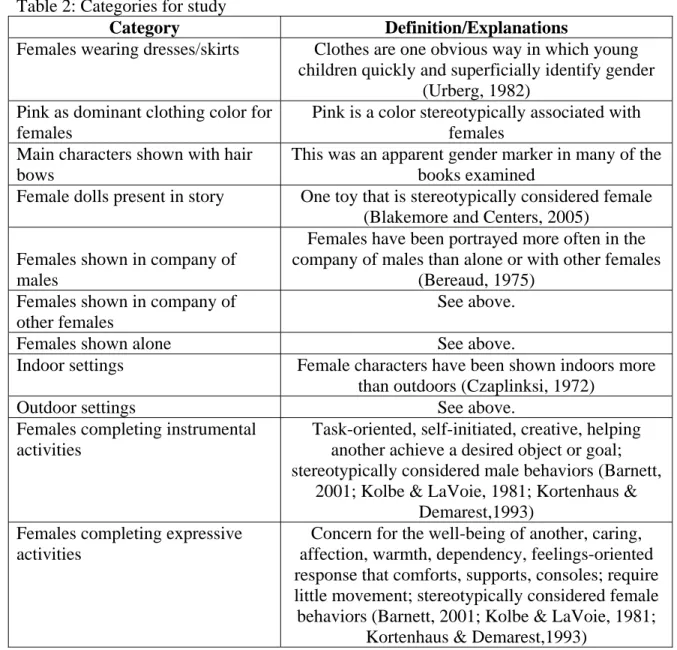
Table 2: Categories for study
Category Definition/Explanations Females wearing dresses/skirts Clothes are one obvious way in which young
children quickly and superficially identify gender (Urberg, 1982)
Pink as dominant clothing color for females
Pink is a color stereotypically associated with females
Main characters shown with hair bows
This was an apparent gender marker in many of the books examined
Female dolls present in story One toy that is stereotypically considered female (Blakemore and Centers, 2005)
Females shown in company of males
Females have been portrayed more often in the company of males than alone or with other females
(Bereaud, 1975) Females shown in company of
other females
See above.
Females shown alone See above.
Indoor settings Female characters have been shown indoors more than outdoors (Czaplinksi, 1972)
Outdoor settings See above.
Females completing instrumental activities
Task-oriented, self-initiated, creative, helping another achieve a desired object or goal; stereotypically considered male behaviors (Barnett,
2001; Kolbe & LaVoie, 1981; Kortenhaus & Demarest,1993)
Females completing expressive activities
Concern for the well-being of another, caring, affection, warmth, dependency, feelings-oriented response that comforts, supports, consoles; require little movement; stereotypically considered female behaviors (Barnett, 2001; Kolbe & LaVoie, 1981;
Kortenhaus & Demarest,1993)
Females were considered as shown alone if no other human characters were in the illustration, although it was noted if a girl appeared to be interacting with a non-human character. Finally, settings were considered either indoor or outdoor only if the whole book took place in one category. Books that took place both indoors and outdoors were noted, as were books whose settings were unclear based on illustrations. A table
containing the coding chart for each book is available in Appendix B.
Results:
Clothing, Hair, and Toys
The clothing of young girl characters in board book illustrations is remarkably varied and relatively non-stereotypical. Both color of clothing as well as type of clothing was considered when examining how these characters dressed. Pink was the dominant color of clothing for young girl characters in only six of the nineteen books examined. The rest of clothes were shown in many colors, although blue was strikingly absent. The data on clothing color is shown below, in Table 3. Although illustrators may be making an effort to not portray girls in stereotypical pink, they have not yet moved to portraying them in stereotypically male colors.
Table 3: Dominant color of clothing Dominant color of
clothing Number of books
Pink 6 Red 6 Yellow 4 Purple 1 Orange 1 White 1 Green 1 Multi-colored 1
set were varied. However, due to the nature of the board book (a very focused and short story), it is difficult to show the same female character in numerous types of clothing. Similarly, illustrators might be keeping a character consistently dressed to keep him or her easily recognizable to young readers. These reasons make sense, and must be considered when thinking about gendered character portrayal. However, some
illustrators handle this issue by including more than one female character and dressing each character differently. I Can!/ ¡Yo Puedo! does a great job of including multiple females who stay in the same clothing page-to-page, but whose clothing varies by character. Skirts, pants, shorts, and baseball uniforms all make appearances on different girls. When possible, showing the wide variety of clothing females can wear is positive, and including multiple female characters may be the best way to do so. Another
interesting way illustrators of these books have handled the clothing of female characters is by showing only their top halves. While this eliminates the concern over gendered clothing (since only shirts are visible), it generally also includes some other obvious gender indicator (such as hairstyle or appearance of an accessory). Overall, young girl characters appeared in skirts or dresses in nine of the nineteen books examined. A more detailed clothing breakdown is shown below, in Table 4.
Table 4: Type of clothing
Type of clothing Number of Books
Dresses 8 Pants 4 Shorts 2 Overalls 2
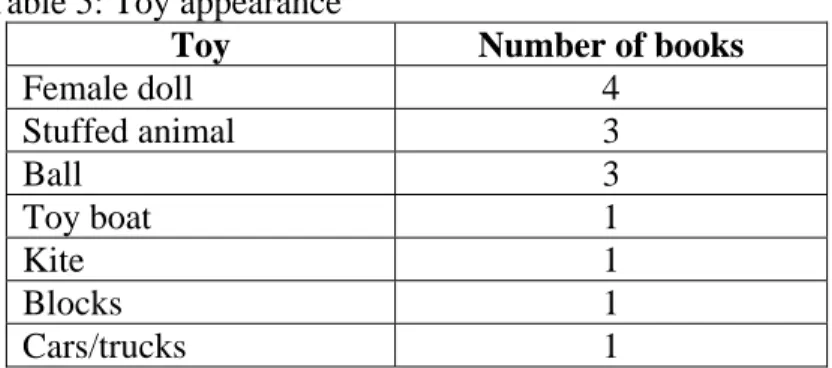
Toys can also serve as an important marker of gender in board book illustrations. Dolls are one toy considered stereotypically female, and dolls were present in some of the books in this sample. Other toys were present as well. Below, in Table 5, is a list of toys played with by the books’ main characters, as well as the number of books in which the toys appeared.
Table 5: Toy appearance
Toy Number of books
Female doll 4
Stuffed animal 3
Ball 3
Toy boat 1
Accompaniment by Other Characters
Since board books are such a unique genre to consider, many of the characteristics looked for in other studies were too complex to find in the illustrations of this data set— characters in these books did not complete a large number of activities or engage in multiple instances of interaction. However, the other characters with whom female characters were shown is one facet of earlier studies that can be easily examined in any type of illustration, and it is illuminating to consider for these books. Since only
illustrations were considered, the characters are classified simply as young or adult, male or female. More specific classifications could not be made without using textual
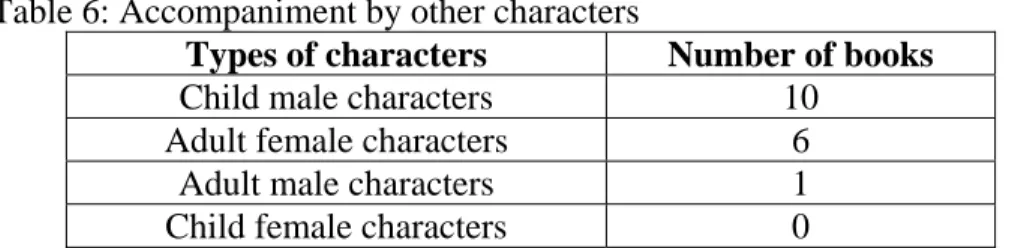
information as well. Below, in Table 6, are the types of characters with whom young female characters were shown.
Table 6: Accompaniment by other characters
Types of characters Number of books
Child male characters 10
Adult female characters 6
Adult male characters 1
Child female characters 0
It is astounding that none of the young female characters of these books was ever shown in the presence of another young female character. It is a stark contrast to the number of times child male characters were present, and an even starker contrast when one considers that in most instances (nine of the ten books) the male children with whom the females were shown were younger than the females—in many instances, the females were taking on a mothering/nurturing role with these younger characters. This
numerous others in which young females were often shown caring for siblings or other children (Diekman, 2004; Kortenhaus, 1993; Stewig & Knipfel, 1975; Weitzman, et al, 1975). In this particular aspect, it appears that these current board books are perpetuating stereotypes about female characters that have been around in children’s books for years. Along the same lines, Bereaud (1975) also found that young female characters were shown alone less often than young male characters in children’s books. Although more in-depth study of male characters in board books is required to fully explore this idea, the data from these books indicate that young female characters are not shown alone very often. In eight of the nineteen books, female characters were shown alone at least some of the time. In four of those eight, the female characters were shown alone on every page of the book. This is a welcome discovery, since it portrays female characters as
independent and active, two characteristics in the past associated with males. In the other four, females were shown alone in anywhere from 12% to 40% of the illustrations. This is also positive, since it shows females interacting with other characters as well as acting independently.
Indoor versus Outdoor Settings
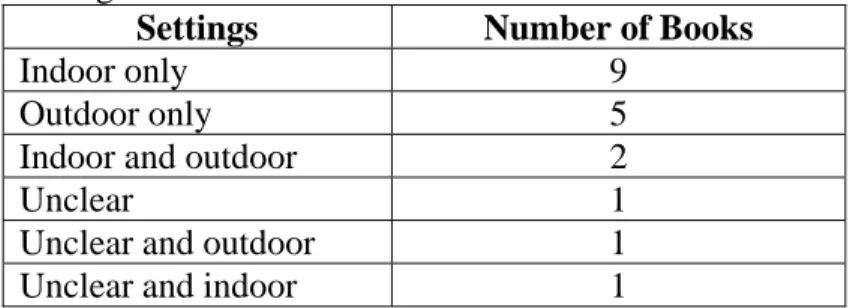
Table 7: Settings
Settings Number of Books
Indoor only 9
Outdoor only 5
Indoor and outdoor 2
Unclear 1
Unclear and outdoor 1
Unclear and indoor 1
Previous studies have shown that female characters are typically portrayed indoors more often than male characters, thus limiting their range of activity and
adventure. This holds true for this board book sample as well. Almost half of the books take place solely indoors—the largest number of any of the setting variations. Board books with young female main characters continue to portray those characters in limited settings. Interestingly, the next highest category is outdoor settings only. This is a
Portraying characters in an unclear setting generally leaves the focus in the illustration on the characters themselves. This technique can allow children to
concentrate on a character’s appearance and activities more closely—those things then become more important in gender role portrayal. Unfortunately, in the one book with a truly unclear setting (Where’s Willy?) the character is portrayed in stereotypically female clothes (a dress) with a stereotypically female toy (a doll), and a stereotypically female role (caring for a younger child). While an unclear setting can be helpful for allowing children to focus fully on a character, it is even more important in those instances that a character is portrayed non-stereotypically.
Showing settings as unclear in some instances, but either indoor or outdoor in others, is another way in which illustrators of board books can depict a well-rounded young female character. Azul does a great job showing a young girl in a variety of fantastical settings, one of which involves riding a newspaper boat across the ocean. Although her clothes are stereotypically female, her activities interact well with the settings to show her as multi-faceted and adventurous. My Doll Keshia does not do as well with its use of unclear and indoor settings. Children might assume that the whole story takes place indoors due to the illustrations that show various indoor rooms, and a more well-rounded character could have been shown interacting with her doll both indoors and outdoors.
Instrumental and Expressive Activities
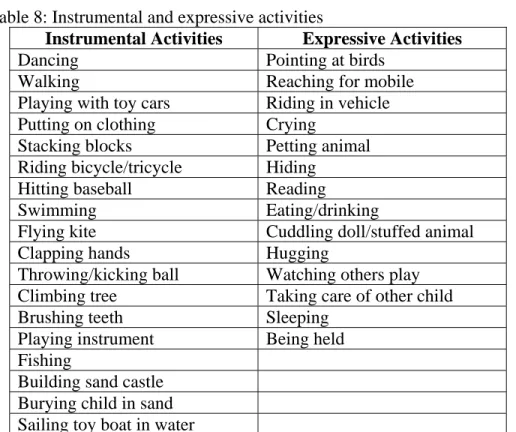
Listed below, in Table 8, are all of the activities completed by the young female characters in this sample of books. These activities are then categorized as instrumental or expressive. This categorization is based on previous studies (Barnett, 2001; Bereaud, 1975; Diekman & Murnen, 2004; Kortenhaus & Demarest, 1993; Stewig & Knipfel, 1975) which have classified behaviors in these or similar categories.
Table 8: Instrumental and expressive activities
Instrumental Activities Expressive Activities
Dancing Pointing at birds
Walking Reaching for mobile
Playing with toy cars Riding in vehicle Putting on clothing Crying
Stacking blocks Petting animal Riding bicycle/tricycle Hiding
Hitting baseball Reading
Swimming Eating/drinking Flying kite Cuddling doll/stuffed animal
Clapping hands Hugging
Throwing/kicking ball Watching others play Climbing tree Taking care of other child
Brushing teeth Sleeping
Playing instrument Being held
Fishing Building sand castle
Burying child in sand Sailing toy boat in water
activities were self-initiated in all but four of the nineteen books. In those four, adults did play a more active role, with adult females initiating activities in three of the four books. The young female characters in this book sample were good role models for young children in terms of independence, at least in some ways. Independence of female characters can also be analyzed in relation to these characters’ accompaniment by others in illustrations. While it is positive for female characters to be portrayed alone and independent (as occurred in eight of the books studied), it is also interesting to note how characters were portrayed in their interactions with others. Some of the instrumental activities that were completed by female characters and could be considered positive from another perspective might also be seen as stereotypical. Young girls completing activities on their own when other characters are present in the illustration might indicate a lack of friendship formation for females, which has been a problem in children’s books in the past (Bereaud, 1975). Males are typically depicted as having more camaraderie with their peers, and the independent play of young females shown in some of these books might perpetuate that stereotype. Showing females completing self-initiated activities while alone is a double-positive depiction of gender roles. However, showing the same characters playing alone when other children are present (regardless of the type of activities being completed) plays into stereotypes that have been problematic in
children’s literature in the past. Understanding self-initiated and independent activities is an interrelated process with complex conclusions.
activities, including playing organized sports (such as baseball), riding bicycles and tricycles, fishing, swimming, and flying kites. The wide range of athletic activities in which females were shown participating is a refreshing and positive trend in this book sample. As discussed before, there are many complexities that arise when examining individual aspects of these characters’ behaviors and activities. However, the portrayal of young girls taking part in many athletic activities is positive, as is their consistent
interactive portrayal of these activities, mainly with other young male characters. By showing young girls alongside young boys, these books do well using athletic activity as a marker of gender equality.
Young female characters were also shown as creative in the illustrations of these books. Dancing, playing musical instruments, building sand castles, and constructing block towers were the specific instances in which characters created various forms of art. The wide range of ways in which females were shown creating was also positive. A young girl danced in the book Watch Me Dance, but instead of dancing in a
stereotypically feminine way (perhaps by performing ballet in a tutu) she wore pants and was shown shaking, kicking, twisting, rolling, stomping, clapping, and spinning as part of her dance moves. The girls who built sand castles and block towers were shown simply as young children rather than as stereotypically female (or male). It is refreshing to see the ways in which illustrators show young females as creative participators in non-stereotypical activities.
Expressive activities typically involve less movement than instrumental activities, and tend to show a character as dependent and nurturing. Although the number of
number of instrumental activities, there are some significantly stereotypical ones to report.
For several of the activities listed above, lack of movement is the defining factor in their expressiveness. Pointing at birds, reaching for a mobile, petting an animal, reading, eating and drinking, watching others play, and sleeping are all activities that involve very little movement or interaction. While more in-depth analysis of the books and characters would need to be done to determine exactly how stereotypical some of these activities truly are (a comparison of the number of male characters completing similar activities to the number of female characters, for example), a few conclusions can be drawn from the examinations in this study. Pointing at birds and reaching for a mobile were activities completed in the book Let’s Count Baby, and they were simply two of the more expressive activities this character completed throughout the book. In this instance, these particular activities can be seen as showing a well-rounded character (who
completes many activities, both instrumental and expressive) rather than a stereotypical one. Similarly, reading, eating, and drinking are not activities that should necessarily be considered stereotypically feminine on their own; however, they are the types of
activities that have been shown in past studies to more often fall to female characters rather than male ones. Overall, these activities that commonly lack movement cannot be categorized as stereotypical based on this type of analysis, and in at least one case, these activities were part of positive gender role depiction.
Choo, Choo, the only instrumental person in the book (the conductor who drove the train) was male. This book perpetuated gender role stereotypes by showing the male character in the only role that was active and in-control and by showing the only female characters as passively dependent on the conductor’s leadership. Similarly, Azul missed an
opportunity by showing the main female character simply riding in a boat. Since she was the only character present, it would have been pretty easy to indicate her control of the boat in the illustrations. Unfortunately, both the character and the boat were shown as being controlled by the elements (the wind and the ocean), and the book became another that portrayed a female character as dependent on things other than her own intellect and skill.
Finally, we have a group of expressive activities that show females as caring, concerned, and nurturing. These particular activities from this sample of books include cuddling a doll or stuffed animal, hugging, and taking care of another child in some way. A majority of the books in this data set (ten of the nineteen) showed young female
the focus is taken off of the main girl character when she has to feed or clean up after her younger sibling. Up Bear, Down Bear features a young girl who does the opposite of nurturing her teddy bear through most of the story (tossing it up into the air, dragging it down stairs, getting it stuck in trees), but the book does make sure to show the girl tucking the bear into bed at the very end. In this way, Up Bear, Down Bear is another example of a book showing a well-rounded female character that possesses both
Conclusions:
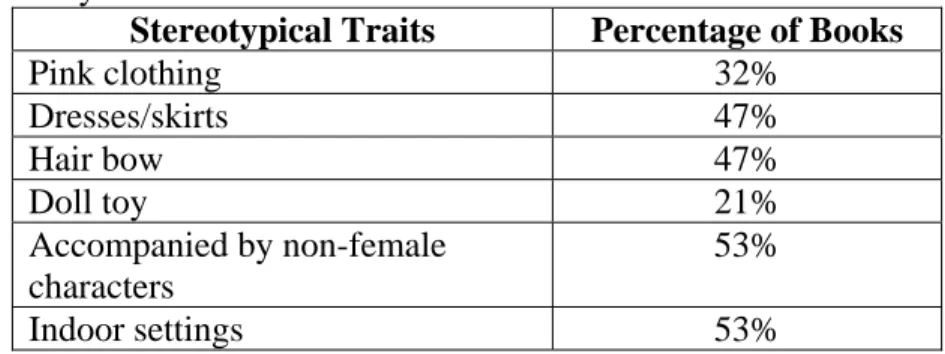
There were several common stereotypical themes that ran through this sample of board books, but overall, the books and their illustrations portrayed young females as well-rounded characters with a variety of attributes. Below, in Table 9, is a summary of stereotypical traits that were found in the illustrations and the percentage of books that contained depictions of those traits.
Table 9: Summary of results
Stereotypical Traits Percentage of Books
Pink clothing 32%
Dresses/skirts 47%
Hair bow 47%
Doll toy 21%
Accompanied by non-female characters
53%
Indoor settings 53%
showing young female characters indoors so often, authors and illustrators are limiting those characters’ realm of existence and number of possible activities. Illustrators are providing young female readers of these books with situations and settings that, in most instances, do not accurately reflect the reader’s own variety of life experiences.
Character accompaniment and settings were the two areas in which this sample of board books portrayed females the most stereotypically and are areas that deserve attention in the future.
Female characters were also portrayed stereotypically in their clothing and hair accessories. Interestingly, clothing color was not a source of stereotyping in many of the books—female characters were only depicted in pink in six of the nineteen books. However, dresses and skirts were widely used as markers of femininity, as were hair bows. As was discussed in the results section above, there are many possible reasons for this continued use of stereotypical clothing, including consistency of character portrayal. Nonetheless, it is important to note these stereotypical occurrences and to consider ways that they could be avoided in the future. Showing more female characters in board books is one possibility, thereby demonstrating the variety of ways in which females can be dressed.
note that these books depict that range of toys and do not fall back on traditional gender role stereotypes.
Overall, the young female characters in these books were shown completing a few more instrumental activities than expressive activities. While this in itself is encouraging, the details surrounding the completion of these activities are important to consider as well. The sampled books did well in representing females as well-rounded—characters were shown doing everything from playing sports to participating in bedtime routines. This alone is positive because it means that the audience of these books is receiving many messages about what it means to be female. While a child who randomly selects one of the board books from this sample might not observe this diversity in character portrayal, children who are routinely shown many different board books are likely to see female characters shown completing a variety of activities.
Unfortunately, there were several stereotypical themes that appeared in more than one of the books in this sample. One of the most prevalent was nurturing activities completed by young female characters. Ten of the nineteen books examined showed female characters cuddling a doll or stuffed animal, hugging another character, or taking responsibility for the care of a younger character. This stereotypically female behavior has been found in numerous previous studies of children’s literature, and it is
References
Abilock, D. (2008). Visual information literacy: Reading in a documentary photograph. Knowledge Quest, 36 (3), 7-13.
Arbuthnot, M. H. (1964). Children and books, 3rd ed. Chicago: Scott, Foresman. Blakemore, J. E. O., & Centers, R. E. (2005, November). Characteristics of boys’ and
girls’ toys. Sex Roles, 53 (9/10), 619-633.
Czaplinski, S.M. (1972). Sexism in award winning picture books. Pittsburgh, PA: Know. Davies, B. (2003). Frogs and snails and feminist tales: Preschool children and gender.
Cresskill, NJ: Hampton Press.
Davis, A.P., & McDaniel, T.R. (1999, February). You’ve come a long way, baby—or have you? Research evaluating gender portrayal in recent Caldecott-winning books. Reading Teacher, 52 (5), 532-537.
Diekman, A. B. & Murnen, S. K. (2004, March). Learning to be little women and little men: The inequitable gender equality of nonsexist children’s literature. Sex Roles, 50 (5/6), 373-385.
Eaton, W. O. (1983, Spring) Gender understanding and sex-role stereotyping in preschoolers: Implications for caregivers. Child Care Quarterly, 12 (1), 28-35. Evans, J. (2001). What’s in the picture? Responding to illustrations in picture books.
London: Paul Chapman Publishing.
Indrisano, R. & Chall, J. (1995). Literacy development. Journal of Education, 177 (1) 63-82.
Kolbe, R., & LaVoie, J. (1981, December). Sex-role stereotyping in preschool children’s picture books. Social Psychology, 44 (4), 369-374.
Kortenhaus, C. M., & Demarest, J. (1993, February). Gender role stereotyping in children’s literature: An update. Sex Roles, 28 (3/4), 219-232.
Kuhn, D., Nash, S. C., & Brucken, L. (1978, June). Sex role concepts of two- and three- year-olds. Child Development, 49, 445-451.
Levy, G. D., Sadovsky, A. L., & Troseth, G. L. (2000). Aspects of young children’s perceptions of gender-typed occupations. Sex Roles, 42 (11/12), 993-1006. O’Brien, P., et. al. (2000). Gender-role cognition in three-year-old boys and girls.
Sex Roles, 42 (11/12), 1007-1025.
Oskamp, S., Kaufman, K., & Wolterbeek, L. A. (1996, December). Gender role
portrayals in preschool picture books. Journal of Social Behavior & Personality, 11 (5), 27-39.
Parkes, B. (1998). Nursery children using illustrations in shared readings and
rereadings. In J. Evans (Ed.), What’s in the Picture? Responding to Illustrations in Picture Books (pp. 44-57). London: Paul Chapman Publishing.
Peterson, S.B., & Lach, M.A. (1990). Gender stereotypes in children’s books: Their prevalence and influence on cognitive and affective development. Gender & Education, 2 (2), 185-197.
Piaget, J. (1969). The mechanisms of perception. New York: Basic.
Samuels, S. J. (1967). Attentional process in reading: The effect of pictures on the acquisition of reading responses. Journal of Educational Psychology, 58 (6), 337- 342.
Stangor, C. & Ruble, D. N. (1987). Development of gender role knowledge and gender constancy. New Directions for Child Development, 38, 5-22.
Stanley, S. & Sturm, B. (2008, November/December). Sequential art books & beginning readers: Can the pictures help them decode words? Knowledge Quest, 37 (2), 50- 57.
Steinman, B. A., Lejeune, B. J., & Kimbrough, B. T. (2006, January). Developmental stages of reading processes in children who are blind and sighted. Journal of Visual Impairment and Blindness, 100 (1), 36-46.
Stewig, J. W., & Knipfel, M. L. (1975, December). Sexism in picture books: What progress? The Elementary School Journal, 76 (3), 151-155.
Urberg, K. A. (1982). The development of the concepts of masculinity and femininity in young children. Sex Roles, 8 (6), 659-668.
Vandergrift, K. E. (1995, Fall). Female protagonists and beyond: Picture books for future Feminists. Feminist Teacher, 9 (2), 61-104.
Venezky, R., Wagner, D., & Ciliberti, B. (Eds.). (1990). Toward defining literacy. Newark, DE: International Reading Association.
Warin, J. (2000). The attainment of self-consistency through gender in young children. Sex Roles, 42 (3/4), 209-231.
Appendix A Study Sample
Alexander, M. (1993). Good night, Lily. Cambridge, MA: Candlewick. Alexander, M. (1993). Where’s Willy? Cambridge, MA: Candlewick. Cummings, P. (1998). My aunt came back. New York: Harper Collins. Dickens, L. (1991). My sister and me at the beach. New York: Penguin. Dickens, L. (1991). My sister and me outside. New York: Penguin.
Gardiner, L. (2002). Good night, Poppy and Max. Boston: Little, Brown, and Company.
Greenfield, E. (1991). Big friend, little friend. New York: Black Butterfly. Greenfield, E. (1991). My doll Keshia. New York: Black Butterfly.
Harper, J. (2007). Night night baby Bundt. Cambridge, MA: Candlewick. Harris, T. (2001). Up bear, down bear. Boston: Houghton Mifflin. Horacek, P. (2008). Choo choo. Cambridge, MA: Candlewick. Hudson, C. W. (1995). Let’s count baby. New Jersey: Scholastic.
Livney, V. (2002). What I like about Passover. New York: Little Simon. Novoa, T. (2001). Azul. Madrid: Santillana.
Pinkney A. & Pinkney, B. (1997). Shake shake shake. San Diego: Harcourt. Pinkney, A. & Pinkney, B. (1997). Watch me dance. San Diego: Harcourt. Rose-Mendoza, G. (2002). I can! Yo puedo! Wheaton, IL: Me + mi. Taylor, A. (1999). Baby dance. New York: Harper Festival.
Appendix B Coding Charts
Expressive activities Reads;
sleeps Helps
younger
male when he falls
None Feeds
younger male Pets rabb
it
Instru
menta
l
activities None None Dances
Builds sand castle; bu
ries
child in sand
; sails toy boat; swims Rides tricycle ; kicks ba ll; fishes
Setting Indoor Unclear Outdoor Outdoor Outdoor
Other
characters Younger
male
Younger male Adult fema
le
Younger male Younger male
Toys Fema le doll Fema le doll None Boat Ball
Hair bow
in
hair/color of bow
None None
Hair ties; multi- colored None None
Dominant color of clothing Purple
Pink
Multi-colored Orange Red
Clothes worn Dress Dress Pants, shirt, vest One piece swim suit Cover- alls
;
long- sleeve shirt
Book Title Good Night Lil
y
Coding Charts (continued)
Expressive activities Eats and drinks; cuddles stuffed anima
ls;
reads
Supervises younger
male
s
Cuddles doll Assists with infan
t’s
bedtime Cuddles bear Rides in tra
in
Instru
menta
l
activities Brushes teeth None Dances; walks None
Throws ball; climbs tree
None
Setting Indoor Outdoor Indoor/ Unclear Indoor Indoor/ outdoor Outdoor
Other
characters
None
Younger male
s
Younger male Adult fema
le; infan t None Adult ma les Toys
Stuffed anima
ls
None Female doll Stuffed
anima
ls
Stuffed bear None
Hair bow
in
hair/color of bow None None Bow/
pink
Hair ties/
blue None None
Dominant color of clothing Yellow; green
Pink Pink Red White
Yellow;
red
Clothes worn Pajama outfit (pants and shirt) Shirt/ pants Dress Dress Dress Shirt
Book Title Good Night, Poppy
and Max
Big
Friend, Little Friend My Doll Keshia Night, Night Baby Bundt
Coding Charts (continued)
Expressive activities Reaches
for
mobile; points at birds Eats sandwich Rides in boat None None
Instru
menta
l
activities Plays with
toy cars; puts on socks; stacks blocks
None
Flies kite Plays instru
men
t
Dances
Setting Indoor Indoor Unclear; outdoor Indoor Indoor
Other
characters
None Adult
fema
les
;
adult and child male
s
None
Young male; adult fema
le
Young male
Toys Trucks
and cars
;
blocks None Female doll None None
Hair bow
in
hair/color of bow
Hair bows/ pink Head- bands/ red
Hair tie/ green None None
Dominant color of clothing
Pink
Orange;
red
Yellow Green Red
Clothes worn Cover- alls Shirts Dress Dress Pants; shirt
Coding Charts (continued)
Expressive activities
Rides
bike; h
its
baseball; swims Cries; is held by parents Hides; sleeps; eats
; read
s
Instru
menta
l
activities None None Dances;
throws ball;
Setting Indoor; outdoor Indoor Indoor
Other
characters
Young males Adult ma
le;
adult fema
le
Adult fe
male
Toys None None None
Hair bow
in
hair/color of bow
Hair
bow/ red Hair ties/ green Hair ties/
pink
Dominant color of clothing Green; pink; orange; yellow; red Green
Pink
Clothes worn Pants; shorts
;
skirts Dress Shirt; shorts
Book Title I Can! Yo