ABSTRACT
A Structural Characterization of an Aquatic Fulvic Acid
(Under the direction of Dr. Russell F. Christman)
The structural characterization of an aquatic fulvic acid was
attempted. Several approaches toward obtaining information concerning
the structure of a fulvic acid were taken. These included analysis of the
products from a mild oxidative degradation, elemental analysis, and
spectroscopic analysis of the undegraded fulvic acid.
The oxidative degradation method employed for this research was
an alkaline cupric oxide oxidation. Validation of this method with model
compounds was accomplished prior to the oxidation of the fulvic acid by
this technique. The products obtained from this procedure were analyzed
by gas chromatography and combined gas chromatography/mass
spectrometry.
Spectroscopic techniques employed for the purposes of analyzing
the structure of the undegraded fulvic acid include infrared spectroscopy
and proton and solid state ^^C nuclear magnetic resonance spectroscopies.
Additionally, the effects of the oxidative conditions employed for
the alkaline cupric oxide oxidation on selected compounds was
Key Words
alkaline cupric oxide oxidation
fulvic acid
mass spectrometry (MS) gas chromatography (GC)
nuclear magnetic resonance (NMR)
structure
Acknowledgements
I would like to extend my sincere thanks to Dr. Christman for having taken me
on as a student of his and for providing the necessary support and encouragement during my stay in the department. I would also like to extend my thanks to Dr. Johnson
for his encouragement throughout the course of my study and research. Dr. Norwood
deserves special mention for all the direction and instruction that he so willingly
provided. He has been extremely thoughtful during and after my stay as a member
of the department.
To all the members of the humics group, I would like to thank all of you for your
many moments of help that came so willingly .
Many thanks to my friend, Jim Jensen, for the many insightful conversations that
we had over the years.
I would like to thank my sister Jane, for providing her expertise in
graphics and helping make my final presentation as good as it was.
My parents deserve special mention for the tremendous encouragement
and support they have provided me throughout my entire academic and
professional career, for without them, I would not have made it nearly
as far or as well as I have.
Last, but certainly not least, I would like to extend my most sincere
List of Tables
Description and Title
Table 4-1 Percent Recovery of Index Phenols from Cupric Oxide
Oxidations
Table 4-2 Index Phenol Extraction Efficiency Data
Table 4-3
Table 4-4
Percent Recovery of Model Compounds from Cupric Oxide
Oxidations
CuO Oxidation Products from Lake Drummond Fulvic Acid
Table 4-5 Elemental Composition of Lake Drummond Fulvic Acid
Table 4-6A ^^C NMR Chemical Shift Regions and Associated Percent
Contributions
Table 4-6B Proton NMR Chemical Shift Regions and Associated Percent
Contributions
Figure 2-1 CuO Mechanism
Figure 4-1 Structures of Index Phenols
Figure 4-2 Chromatogram of Index Phenols
Figure 4-3 Structures of Model Compounds
Figure 4-4 Chromatograms of Group IV Model Compounds: before and
after CuO oxidationFigure 4-5 Mass spectrum of 3,4-Dihydroxybenzaldehyde
Figure 4-6 Diagram of CuO Mechanism
Figure 4-8 Infrared spectrum of Lake Drummond Fulvic Acid
Figure 4-9 ^^C NMR CP/MAS Spectrum of Lake Drummond Fulvic Acid
Figure 4-10 ^^C NMR Dipolar Dephased spectrum of Lake Drummond
Fulvic Acid
INTRODUCTION
Humic materials have been of interest to the investigative scientist
for some time (Green and Steelink, 1962, Christman and Ghassemi, 1966).
Humic substances are found in both aquatic and terrestrial environments and although humics from these two sources share similarities,
differences between the two groups do exist. Humic substances may be grouped into various categories or component matrices depending upon certain characteristics expressed in isolation schemes employed for the separation of the various components comprising the humic material
(Thurmond and Malcolm, 1981, Leenheer, 1981). A multitude of techniques have been employed to gather data on the origin, structure, metal chelating
ability, and reactions of humics under various conditions (Christman et al.,
1984, Schnitzer and Ortiz de Serra, 1973, Hatcher, 1981, Weber, 1983). The accumulation of data pertaining to humic material has generated different schools of thought in areas such as the genesis of humic
materials and structural models (Hatcher, 1981, Schnitzer and Ortiz de Serra, 1973, Christman et al., 1984).
Several techniques have been of use in humic research as in studies of
structural components of other naturally occuring materials such as lignin
and coal (Hedges and Ertel, 1982, Hatcher et al., 1981, Pearl, 1954). The
severity of techniques employed varies from nondestructive, as in the case of NMR and IR spectroscopic analysis to destructive as with harsh
oxidative conditions coupled with combined gas chromatography/mass
spectrometry for the analysis of the oxidation matrix components
(Hatcher, 1981, Wilson, 1981, Liao eta!., 1982, Norv/ood, 1986).
Christman and coworkers have noted that the lack of standard isolation
investigators to easily compare the results of existing databases and
propose coherent structural models for humic or fulvic acid (Nonwood,
1986).Norwood has noted the lack of model compound work performed
employing the various oxidation techniques which so many investigators
have used (Norwood, 1986).One of the objectives of this research was to standardize the oxidative
degradation conditions for the analysis of Lake Drummond fulvic acid. A
useful approach to this was to employ the alkaline cupric oxide oxidation procedure as outlined by Ertel and Hedges (1982). This method had to be verified in our own laboratory in the same manner as that of Ertel and
Hedges. This was accomplished by checking the stability of compounds previously reported in the literature as stable to the oxidative conditions
and procedures outlined by Ertel and Hedges. The series of compounds
employed for this purpose are known as the index phenols.
A second objective of the research was to structurally characterize
the Lake Drummond fulvic acid oxidation products. This goal was met by
employing the previously validated standard oxidative method of alkaline
cupric oxide oxidation. Analysis of the resulting product mixture was
accomplished via gas chromatography and combined gas chromatography/
mass spectrometry. In addition, other methods such as elemental
analysis, infrared spectroscopy and proton and ^^C nuclear magnetic
resonance spectroscopy were employed to provide addtional information
concerning the structure of the fulvic acid.
Finally, a third objective of the research was to investigate the
relative stability during the standardized oxidation of selected compounds
which had been reported in the literature as products of the alkaline
conditions as had been previously employed for the oxidation of the index
phenols and the Lake Drummond fulvic acid. Analysis of the resulting
products was accomplished by employing gas chromatography and combine
LITERATURE REVIEW
Humic substances are generally complex, base soluble, naturally
occuring materials found in both terrestrial and aquatic environments, and are thought to be the products of vegetative decomposition (Thurman and
Malcolm, 1981). They may be subdivided into different categories based
upon their behavior in various isolation schemes. It is generally accepted that humic acid is the acid insoluble fraction, that which precipitates
from solution when the pH of the aqueous medium is less than 2. Fulvic
acid is soluble in both basic and acidic media. Hymatomelanic acid is soluble in both basic media and low molecular weight alcohols (eg. butanol). however it is not soluble in dilute hydrochloric acid (Black and Christman, 1963). Humin is a terrestrial humic material component which is not base soluble. This property makes humin difficult to obtain for
analysis. Various methodologies have been worked out for the isolation
and seperation of the components of humic substances. These vary in approach from distillation under reduced pressure (Black and Christman, 1963) to employing exchange resins of various types (Christman and
Ghassemi, 1966, Liao et al., 1982, Thurman and Malcolm, 1981, Leenheer,
1981).
Recent trends in isolation schemes show a marked perference for the
macroreticular type resins such as XAD-7 and XAD-8. These resins have a
great affinity for high molecular weight polyelectrolytic substances
of humic substances. Leenheer provides a very practice tretise on the
various resins employed for isolation of the many components comprising dissolved organic carbon (DOC) in both natural waters and wastewaters
(1981). Thurman and Malcolm presented one of the earlier uses of
macroreticular resins in combination with cation exchange and
lyophylization for the isolation of aquatic humic and fulvic acids (1981).
These particular publications have laid much of the groundwork for the
methodologies presently employed in the isolation and fractionation of
aquatic humic substances. Much of the earlier literature focuses on
terrestrial humic materials, however some work on aquatic humic
material did parallel some of the earlier findings on terrestrial
substances (Christman and Black, 1963, Christman and Ghassemi, 1966).
The literature describes numerous techniques that have been employed
by various researchers in their quest for information relating to humic
materials. Oxidative degradation techniques comprise much of the earlier
literature. By the late 1970's advancements in the application of
spectroscopic techniques allowed for a new and different approach
towards studying humic substances. Of particular significance is the
application of some nuclear magnetic resonance (NMR) techniques such as
cross polarization- magic-angle spinning (CP/MAS) and dipolar dephasing.
These techniques have provided important information on the intact gross
structure of humic substances. The advent of CP/MAS provides a technique
to obtain relatively well defined spectra of humic materials in the solid
state, an important achievement.
difficult, if not controversial task (Christman et a!., 1984).
It is important not to rely too heavily on the information obtained from one particular technique, rather, it is more advantageous to employ the
resources of information obtained from as many approaches as possible.
However, it is equally important to know the limitations of the techniques
that are employed. \
One of the earlier oxidative degradation methods employed with humic material was alkaline permanganate oxidation. Schnitzer and DesJardins
(1970) found that the major products from alkaline permanganate
oxidation on a terrestrial fulvic acid were benzene carboxylic acids. Both 1, 2, 4, 5 - and 1, 2, 3, 5 -benzene tetracarboxylic acids along with penta-and hexabenzene carboxylic acids were found to predominate the oxidation
products of reacted fulvic acid. This was found to be the case both when
employing premethylated or unmethylated fulvic acid. With respect to smaller, volatile aliphatic acids found, unmethylated fulvic acid produced only acetic acid wereas methylated fulvic acid produced oxalic and acetic
acids along with propionic, butyric and isocaproic acids. Acetic acid was
also the major volatile aliphatic acid produced in the reaction of
methylated fulvic acid with alkaline potassium permanganate in this
study. The benzene carboxylic acid portion, although the major degradation product, accounts for only a small portion of the original starting material (0.4 to 1.4 %) (Schnitzer and DesJardins, 1970)
Neyroud and Schnitzer (1974), employing alkaline potassium
permanganate oxidation on premethylated terrestrial fulvic acids found
that the major degradation product consisted of benzene carboxylic acids.
This group was comprised primarily of 1,2, 4, 5-, and 1, 2, 3,4-benzene tetracarboxylic acids, benzenepentacarboxylic acid pentamethyl ester and
Liao, et al. (1982) utiized alkaline potassium permanganate oxidative
conditions on a set of aquatic fulvic and humic acids. Following potassium
permanganate oxidation, the product mixture was methylated with
diazomethane From this study, six major cateogries of compounds were
identified. These included benzene carboxylic acid methyl esters, furan carboxylic acid methyl esters, glyoxylic acid methyl esters, aliphatic monobasic acid methyl esters, aliphatic dibasic acid methyl esters and
aliphatic tribasic acid methyl esters. Mono-, di- and tribenzene carboxylic acid methyl esters were identified amongst the benzene carboxylic acid
methyl esters, however, the tri-, tetra-, penta- and hexabenzene carboxylic acid methyl esters predominate amongst this category and
account for approximately 65% of all identified chromatographable
products for humic acid and approximately 60% for identified fulvic acid
products resulting from oxidation with potassium permanganate. Other
individual major products from the humic and fulvic acid degradation
mixtures included oxalic, succinic and malonic acid dimethyl esters.
Alkaline nitrobenzene oxidation was a technique used mainly by wood chemists but found application for use by those exploring the composition of soil organic matter. Compared to alkaline potassium permanganate
oxidations, alkaline nitrobenzene appears to be less harsh. With alkaline nitrobenzene, less highly oxidized products are obtained. Aldehydes and ketones are readily detected amongst the isolated oxidation products.
Morrison (1963) describes a method for the determination of
p-hydroxybenzaldehyde, vanillin and syringaldehyde in the product mixture when employing alkaline nitrobenzene as the oxidant. From his findings,
Morrison states that phenolic aldehydes account for approximattely 1% to 4% of the T.O.C. in peat and 0.5% to 1% of the T.O.C. in soil, whereas in
plant material, that parameter measures approximately 7% when
mixture include p-hydroxybenzoic, vanillic, syringic, coumaric and ferrulic
acids along with p-hydroxyacetophenone and acetovanillone.
Acetosyringone is detected but not to the extent of other ketones.
Morrison notes that the composition of the product mixture is altered with respect to choice of reaction temperature. Employing a reaction
temperature below 170°C tended to favor the presence of substituted
cinnamic acids whereas choosing reaction temperatures above 180 C
favored the formation of aldehydes.
In a later study, Gardner and Menzel (1974) examine the aldehyde content of marine sediments after exposing the sediments to alkaline nitrobenzene oxidations. Gardner and Mentzel were attempting to employ the aldehydes as tracers of terrestrial derived organic matter. They chose p-hydroxybenzaldehyde, vanillin and syringealdehyde as their target
aldehydes. Syringaldehyde and vanillin were well known lignin degradation products which are derived from higher vascular plants only available
from terrestrial sources. They found a range of 0.1% to 1.0% of total
organic matter analyzed as being comprised of syringaldehyde and vanillin. The percentage decreased with increasing distance from shore. However,
laboratory blanks showed evidence of contaminating amounts of vanillin
and p-hydroxybenzaldehyde.
Hedges and Parker (1976) indicate that there are inherent problems associated with nitrobenzene oxidations of organic matter with respect to production fo organic compounds that coelute with p-hydroxybenzaldehyde and vanillin. This was verified by analysis of system blanks for the
oxidation conditions employed.
Alkaline hydrolysis is considered mild amongst the spectrum of the
oxidative degradation techniques employed by researchers throughout the
Neyroud, et al. (1974), having first methylated and then fractionated a
terrrestrial fulvic acid over alumina with solvents of increasing polarity,
subjected the two most polar fractions collected to alkaline hydrolysis.
The major reaction products isolated and identified by GC/MS consisted of
aliphatic acids, phenolic acids and benzene carboxylic acids. Overall yield
of products from these two fractions was 9.4% and 7.4%.
Liao, et al. (1982) using aquatic humic substances isolated on XAD-8
macro reticular resin examined the alkaline hydrolysis products by GC/MS.
Both humic and fulvic acid samples from two sources were examined under
this set of conditions. Products isolated from the reaction mixture were
methylated with diazomethane prior to GC/MS analysis. Although in
excess of 30 compounds for both humic and fulvic acids from each source
were identified, the major alkaline hydrolysis products consisted of the
methyl esters of benzene carboxylic acids and of aliphatic acids.
Dominant amongst the aliphatic acids were the dibasic acids. Overall
yields for products identified varied from 1.2% to 1.7%. The humic acid
fractions boasted a yield of approximately two times as much aliphatic
dibasic acid methyl ester content compared to the fulvic acid isolated
from the same source.Another degradative technique that has been utilized for studying
humic materials is alkaline cupric oxide. With regard to oxidative
strength, it is a mild technique, comparable in mildness to alkaline
hydrolysis, however it appears to be somewhat stronger than alkaline
hydrolysis. Although widely used by wood and lignin chemists, alkaline
copper oxide has gained considerable popularity as a degradative
technique amongst those studying the structure of humic material (Hedges
and Ertel, 1982).
Some of the earlier studies on aquatic humic material employing
10
Ghassemi (1966). They investigated aquatic humic material isolated from
several sources in the northwestern United States. The authors reported
that the dark color imparted to the humic material was due to the
presence of aromatic polyhydroxymethoxycarboxylic acids. Employing thin
layer chromatography and various indicator reagent sprays, the authors
identified seven degradation products which fell into the above mentioned
category. It was also noted that when activated by an appropriate
hydroxyl substitution pattern, alkyl side chains of certain phenolic
structures were converted to phenolic acids. The alkyl side chain was
oxidized to the position where only a one carbon carboxylic acid function
remains. This occurs when the alkyl side chain is influenced by the
presence of an ortho-para director; i.e., the activator is in a position ortho
or para to the alkyl side chain. In this particular case, the ortho-para
director is the hydroxyl moiety.
An earlier study by Greene and Steelink (1961) employing aqueous
alkaline cupric oxide was performed on soil humic acid. Separation and
identification of degradation matrix products was accomplished by paper
chromatography. Phenolic structures were also the major components
identified in this study and this was also the first time that resorcinol
and guiacyl derivatives were reported as humic acid degradation products.
The authors postulated that the presence of these compounds indicate that
lignin may not be the sole precursor of terrestrial humic acid.
In a later study performed by Ertel et al. (1984), the potential
contribution of lignin as a precursor to aquatic humic substances is
assessed by employing alkaline cupric oxide as the oxidative degradion
technique. Hedges et al. had utilized this technique extensively in earlier
research on the distribution of oxidation products of lignin derived from
various sources (1979,1982). Previous work by Hedges et al. led to the
to phenols that are commonly and consistently observed in cupric oxide
degradation of plant tissues of various origins. The phenols consist of the
aldehyde, ketone and carboxylic acid derivative of p-hydroxy, vanillyl and
syringyl structures. Cinnamyl phenols, which have trans-propenoic acid
functions, are also encountered.
Ertel and Hedges have found that certain types of the phenols are
associated with particular types of vegetation. Vanillyl phenols are found
amongst the cupric oxide degradation products from both the woody and
non woody tissues of angiosperms and gymnosperms, whereas syringyl
phenols are only found from angiosperm digests, and cinnamyl phenols
from gymosperm sources. The simplest class of phenols, the p-hydroxy
substituted phenols are found amongst the cupric oxide products from
vascular and non vascular plant tissues (1979,1982). Ertel and Hedges
(1982) state that a major protion of aquatic humic material comes from
vascular plants since these are the only source of lignin.
Ether extractable phenols were not observed when the isolated humic
materials were extracted, however, the distribution of the various forms
of index phenols were observed amongst the copper oxide oxidation
products. The authors felt that this implied that lignin-like structures
were present in the humic substances.
In comparing the distribution of the various phenols and their
respective form (i.e., aldehyde, ketone, carboxylic acid), Ertel et al. (1984)
found that the humic acid fraction had a greater proportion of syringyl and
lesser proportion of p-hydroxy phenols relative to the fulvic acid fraction.
It was also noted that the fulvic acid fraction yielded higher
acid/aldehyde ratios than the corresponding humic acid fraction. The
higher degree of demethoxylated and more oxidized moieties observed in
the fulvic acid fraction may be the result of a greater degree of biological
(Erteletal., 1984).
With regard to the mechanism of action by alkaline cupric oxide upon
complex matrices such as lignin or humic substances, there is a paucity of
literature or reported investigations. In a review by Hayes and Swift
(1978) the authors mention a plausible mechanism proposed by Chang and
Allan. They believe that the oxidation occurs by a one electron transfer
process. The authors further elaborate that the abstraction of an electron
to produce a phenoxy radical followed by a fast second electron transfer
back to the cupric oxide molecule which results in the production of a
quinonemethide. A reaction sequence proposed in their review follows;
12
n
CH..OH-^ o/ V,
= CHOH ---*ͨ HOAl J/-CHOOCH,
Figure 2-1
D
The second electron transfer back to the cupric oxide prevents coupling of
phenoxy radicals. Employing a high reaction temperature along with
excess cupric oxide increases the rate of electron transfer, hence, driving
the oxidation more quickly towards completion(Hayes and Swift, 1978).
Whereas oxidative degradation of humic substances followed by
chromatographic separation and possible mass spectrometric
substances, it offers little information with regards to the original
overall structure of the intact undegraded humic substance. Recent
advances in the area of nuclear magnetic resonance (NMR) allow one to
obtain usefulinformation concerning gross overall structural composition of the humic
substances. With the advent of cross polarization/magic angle spinning
and fourier transform techniques, the high degree of resolution once only
available through analysis of samples in the liquid state can now be
obtained for intact solids (Wilson, 1981, Hatcher et al., 1981).
Prior to the introduction of CP/MAS, some investigators felt that
proton NMR (^ H NMR) was a more reliable technique for quantitative
structural analysis of humic substances (Ruggerio et al., 1979). However,
the introduction of CP/MAS and fourier transform techniques to solid
state ^ ^C NMR analysis has changed that view (Hatcher et al., 1981,
Wilson etal., 1981).
In recent years, refinements in the use of the new ^'^C NMR techniques
have contributed to their applications for quantitative purposes. To
employ solid state '^C NMR, certain parameters such as optimum cross
polarization contact time and appropriate pulse delays must be determined
experimentally beforehand. In dealing with ^'^C nuclei from different
chemical environments, different rates of relaxation to the ground state
are to be expected once Rf pulses have been applied to the samples
(Wilson, 1981). Signals from the various chemical environments within
the sample may be seen throughout the spectrum and signals seen in
particular spectral regions of arise from distinct classes of structural
entities present within the sample.
The positions of the various signals seen in the spectrum may be
defined by their chemical shift, which is their resonance frequency
(Wilson, 1981). Hatcher (1983) divides the ''"^C spectra of humic
substances into five regions. The first region (0 to 50 ppm) is comprised
mainly of aliphatic moieties, carbons singly bonded to other carbons. An
important entity contained within this region is terminal methyl groups.
In region II, (50 to 110 ppm) carbons singly bonded to heteroatoms such as
oxygen and nitrogen are observed. Resonances from structural entities
such as ethers, carbohydrates, amines, alchohols, methoxyl and acetals are
observed within this frequency range. Region III (110 to 160 ppm) mainly
reflects the aromatic character of solids, however carbon-carbon double
bonds of non aromatic origin also resonate within this region. Carboxyl
carbons bonded to heteroatoms such as oxygen and nitrogen resonate
within region IV (160 to 190 ppm). Resonances from functional groups
such as carboxylic acids, esters and amides are observed in this range.
Region V (190 to 220 ppm) reflects the resonances of carbonyl carbons
bonded to other carbons or hydrogens, and the resonances arising from
ketones and aldehydes are seen in this region.
Another important set of experiments that the nuclear magnetic
resonance spectroscopist must perform in order to obtain useful
quantitative data is CP/MAS relaxation time experiments. The spin-latice
relaxation time (T.j) can be obtained from these experiments. By obtaining
this value, the correct parameters for cross polarization contact time and
pulse delay time may be established.
Knowledge of relaxation rate parameters may enable one to obtain
spectra devoid of signals from CH or CH2 moieties (Wilson et al., 1983).
This is accomplished through a series of experiments involving dipolar
dephasing. Dipolar dephasing involves an instrumental experiment
whereby a series of set time delays are inserted into the pulse delay
program without decoupling of ' H and ^ ^C nuclei prior to acquisition of
data. The dipolar dephasing time (Tdd) is acquired through this set of
experiments. As Tdd is increased the signal from protonated carbon
decreases. Wilson et al., (1983) employing a Maungatua soil sample shows
that as Tdd aproaches 40 u sec the signal from protonated carbon,
excluding methyl carbons, is almost completely diminished.
Utilizing this technique, the protonated carbon spectrum can be
obtained through a difference spectrum. Subtracting the ^'^C spectrum
obtain at a long Tdd from that obtained at Tdd=0, will provide the
spectrum of protonated carbon minus the methyl carbons. The spectrum
obtained will indicate if the aromatic content of the humic material is
heavily protonated.
Wilson adds a note of caution concerning interpretation of dipolar dephased spectra with respect to the methyl region. Methyl groups are allowed to rotate freely in the solid state and even at long Tdd's, the
methyl carbons do not relax and are present in spectra taken at long Tdds.
It is apparent that the knowledge of relaxation rates and dipolar
dephasing techniques provides another approach for functional group
analysis. Solid state ^^C NMR with ancillary techniques such as CP/MAS,
fourier transform, and dipolar dephasing provides the investigative
Experimental Methods
Fulvic acid obtained from the waters of Lake Drummond was the humic
substance of choice, employed for the purposes of copper oxide
degradation reactions. The reader is referred to the work of Liao for exact details concerning the location and characteristics of Lake Drummond
(1981). The fulvic acid was isolated according to the procedure outlined
by Christman et al. (1981). The exact isolation procedure is described in
detail by Norwood (1985).
Alkaline cupric oxide oxidation reactions on the Lake Drummond fulvic
acid (LDFA), the model compounds, and the index phenols were carried out in Monel stainless steel reaction cylinders as diagrammed by Hedges and Ertel (1982) and according to their procedure with minor modifications. Exceptions to the protocol outlined by the authors included the use of a replica of the commercially available 200ml Parr bomb (model 4753). Additionally, an alternative surrogate standard was chosen. Ertel and
Hedges employed uniformally ring labeled [^'^CJ-p-hydroxyacetophenone as
the surrogate standard for recovery studies. Instead, following the cupric oxide oxidations, known accounts of ethyl vanillin dissolved in pyridine were introduced into the 10 ml Monel minibombs upon opening and prior to any transfer steps (Hedges, personal communication).
Identical gas chromatographic operating conditions were employed with the exception of the instrument, recorder, column and split ratio. A
Carlo Erba temperature programmable gas chromatograph (Model HRGC
5160 mega series) interfaced with a Shimadzu C-R3A integrator was
employed. A 30m by 0.25mm i.d. fused silica DB-1 capillary column (J & W
A temperature controller (Cole Palmer Model C-2155-20) equiped with
a platinum temperature probe was used to heat the reaction cylinder and
maintain the reaction temperature of 170°C. The Monel reaction cylinder
was fitted into an insulated heating sleeve mounted on top of a shaker top
table. The Monel reaction cylinder, minibombs, insulated heating sleeve,
and glove box were manufactured in the UNC School of Public Health
instrument shop.Model compounds, index phenols, ethyl vanillin, trans-cinnamic acid,
homovanillic acid, and copper (II) oxide (gold label) were purchased from
Aldrich Chemical Company (Milwaukee, Wl) and were the best grade
commercially available. Structures for the model compounds and index
phenols appear in figures 4-3 and 4-1, respectively. Sodium sulfate and
ferrous ammonium sulfate were purchased from both Fisher Scientific
(Raleigh, NC) and EM Science (Cherry Hill, NJ). Sodium Hydroxide pellets
and Whatman extraction thimbles (33mm X 94mm) were purchased from
Fisher Scientific (Raleigh, N.C.). Pyrex brand glass wool was purchased
from Corning Glass Works (Corning, PA). Distilled in glass pyridine and
diethyl ether were purchased from Burdick & Jackson and were the best
quality grade commercially available and were used without further
purification. For the preparation of trimethylsilylated derivatives,
i2ls-(trimethylsilyl) trifiuoroacetamide (BSTFA) with 1% TMCS was employed
and was purchased from Pierce Chemical Company (Rockford, IL).
Sodium sulfate, ferrous ammonium sulfate, copper (II) oxide and glass
wool were all soxlet extracted with diethylether for 24 hours before being
employed for any purposes in any of the reaction steps. Prior to use for
extractions, diethyl ether was treated with soxlet extracted ferrous
18
GCandGC/MS
As a quality assurance check, stock solutions of the index phenols and various classes of model compounds were prepared, derivatized and
analyzed, as their TMS analog, via gas chromatography. The results of the chromatography indicated that all the index phenols and model compounds
were free from any interferring substances.
Verification of the identity of the components comprising the various stocks of index phenols and class of model compounds was accomplished via combined gas chromatography/mass spectrometry analysis. Standard solutions of the index phenols and the various classes of model compounds were analyzed, as their TMS derivatives, on a Hewlett Packard gas
chromatographic interfaced quadrapole mass spectrometer (Model 5985 B). A 30m X 0.25mm i.d. SE-30 fused silica capillary column was employed for
chromatographic separation of the components comprising the various
mixtures. A temperature program of 100°C to 270°C at 4°C/min with no
initial delay was employed. Samples were analyzed under electron impact conditions at 70eV. A scan rate of 1 second was employed. The identity of
the components comprising the mixture isolated after Lake Drummond fulvic acid was subjected to alkaline cupric oxide oxidation, was
accomplished on two different combined gas chromatography/quadrapole mass spectrometry instruments. One of the instruments is previously
described.
The second instrument employed was a Finnigan 4021 combined gas
chromatography/quadrapole mass spectrometer equiped with a 30m X
0.25mm i.d. DB-1 capillary column. A scan rate of 1 scan/second was employed. Samples were analyzed at 70eV. A total of 2600 scans was
computer equiped with Perkin-Elmer disk drives.
Calibration curves for the index phenols, the four classes of model
compounds, and ethyl vanillin were constructed for the purposes of
quantifying components in extracted samples. Stock solutions of the index
phenols with ethyl vanillin and the 4 classes of model compounds with
ethyl vanillin were prepared with known amounts of each component
present. Serial dilutions of the stock solutions were made over a 10 fold
range. To each solution, precise amounts of the appropriate GC internal
standard was spiked into each solution such that there was the same
amount of the GC internal standard at each level of dilution. For the
purposes of the index phenols, trans-cinnamic acid was employed as a GC
internal standard, whereas with respect to the model compounds,
homovanillic acid was utilized as the internal standard. On the DB-1
column, under the conditions previously described, homovanillic acid
coeluted with vanillic acid, one of the index phenols. It was suggested to
use trans-cinnamic acid as a substitute (Ertel, personal communication).
Trans-cinnamic acid did not interfere with any of the chromatographed
index phenols. Ethyl vanillin was employed as a surrogate standard in all
samples for the purposes of estimating overall recovery. The
concentration of components chosen for preparing the calibration curves
covered a range in the area of the initial starting materials employed for
alkaline copper oxide degradations.
Extraction Efficiency
The recovery of the index phenols was accomplised by measuring the
extraction efficiency of known amounts of the index phenols through the
complete set of post oxidations steps. A solution of index phenols in a 2 N
sodium hydroxide was split into equal volume aliquots and titrated with
6 N HCI until a pH of 2.0 was attained. The solution was then extracted
20
ferrous ammonium sulfate. The ether extracts were dried by being passed
through glass columns containing sodium sulfate. The columns were
washed with several aliquots of ferrous ammonium sulfate treated ether
and the washings were combined with the previously collected extracts.
The extracts were concentrated to a volume of approximately two
milliliters via rotary evaporation. The concentrate was transferred to
preweighed vials and blown to dryness under a gentle stream of nitrogen.
The vials were reweighed, capped with teflon line caps and stored at 0°C
until analysis by gas chromatography.
Functional Group Analysis
Functional group analysis for the Lake Drummond fulvic acid was
accomplished by scanning infrared spectroscopy, proton nuclear magnetic
resonance spectroscopy and carbon-13 nuclear magnetic resonance
spectroscopy.
Scanning infrared spectroscopy was performed using a Perkin-Eimer
71 OB spectrophotometer, a dual beam instrument (Perkin-Elmer, Norwalk,
CT). A 3 mg sample of LDFA was combined with 300 mg of KBr (Harshaw
Chemical Company, Solon, OH), thoroughly mixed with a mortar and pestle
and pressed into a transparent pellet at approximated 2000 psi for 1
minute. A reference spectra of KBr was also obtained. The reference KBr
pellet was prepared in the same manner as the LDFA sample, minus the
inclusion of fulvic acid. The KBr had been dried overnight in a drying oven
at approximately 120°
Proton nuclear magnetic resonance spectroscopy was performed with a
200 MHz Bruker Fourier Transform spectometer (Bruker Instruments, Inc.,
Manning Park, Billerica, MA) The sample was prepared by placing 13.1 mg
of LDFA in a 5mm (Aldrich premium grade NMR tube and adding 0.6 ml of
DgO (Sigma Chemical Co., St. Louis, MO) Enough sodium deuteroxide (NaOD)
tetramethylsilane was added as a reference standard in order to obtain a
lock on 0 ppm. A total of 300 scans were acquired and averaged. A 2
second cycle time was employed.
Solid state C-13 nuclear magnetic resonance spectra for Lake
Drummond fulvic acid were obtained under identical conditions asdescribed by Norwood (1985).
Elemental Analysis
Elemental analysis of the Lake Drummond fulvic acid was performed by
M-H-W Laboratories, Phoenix, Arizona. The samples were vacuum dried at
Results and Discussion
Index Phenols
A review of the most recent literature on alkaline copper oxide
oxidations of aquatic and terrestrial humic substances will reveal the
term index phenols, a term coined by Hedges to describe a set of nine
substituted phenols that are commonly and consistently found as oxidation
products from alkaline copper oxide oxidations of lignin (1975) Figure
4-1). The presence of these phenols amongst the products of humic
material subjected to alkaline copper oxide oxidative conditions infers the
importance of lignin as a significant or important precursor to humic
material formation (Ertel and Hedges, 1981). A major focus of this
project was to examine the product mixture obtained from subjecting Lake
Drummond fulvic acid to the same alkaline copper oxide oxidative
conditions as Ertel and Hedges employed for their studies on lignin (1979).
It had previously been demonstrated that the index phenols were relatively
stable towards the oxidative conditions employed In the alkaline copper
oxide reaction (Hedges, 1975). Since this was the first attempt at
alkaline copper oxide oxidations of humic material in our own laboratory
facilities, it was appropriate to examine the stability of the index
phenols. Approximately 3 milligrams of each compound was employed and
when recovery was corrected to that of ethyl vanillin, the surrogate
standard, the results indicate nearly quantitative recovery of the
p-hydroxyl and vanillyl moieties, however the syringyl compounds survive
the oxidation somewhat less than quantitatively (Table 4-1). In his
preliminary research on the copper oxide oxidation of the index phenols,
Figure 4--1
INDEX PHENOLS
OH ' OH OH
4-Hydroxybenzaldehyde 4-Hydroxyacetophenone 4-Hydroxybenzoic Acid
Vanillin Acetovanillone
OH
Vanillic Acid
OCH3 H3CO
Syringealdehyde Acetosyringone
C-OH
OCH3 H3CO
OH
24
Figure 4.-2
FID Chromatogram of Index Phenols
r,J .—»_J
recovery for the p-hydroxyl and vanillyl compounds, but only an 84% recovery for the syringyl phenols. The results obtained from this
experiment are comparable to those of Hedges, for we see quantitative
recovery of the p-hydroxyl and vanillyl moieties and an average recovery of 81% for the syringyl moieties. The losses of syringyl moieties could not be completely ascertained. The possibility of interconversion to
vanillyl and p-hydroxyl structures is not precluded, however, it could not
be verified by the results from this experiment.
To accompany the copper oxide oxidations of index phenols, the extraction efficiency of these compounds plus the surrogate standard, ethyl vanillin, was investigated. Throughout the course of the post
oxidation workup, several steps involving transfers, concentrations and
removal of water though the addition of a drying reagent are required. It was of interest to document the recovery of these compounds through the extraction efficiency procedure previously described in the experimental section. From this experiment, one could see how well ethyl vanillin
extracts compared to compounds of similar structure and, hence, be able
to assess its value as a surrogate standard. Throughout the course of their
work involving copper oxide oxidations. Hedges and Ertel employed
uniformally ring labeled ^^ C-acetophenone for the purposes of calculating
recovery. The purchase of uniformally ring labeled ^^C-acetophenone was
quite costly, therefore owing to cost restraints, it was decided to employ
non-radioactive compound as the surrogate standard. The addition of known amounts of ethyl vanillin to each minibomb following the oxidation
was suggested (Hedges, personal communication). The results of the
extraction efficiency appear in Table 4-2.
26
Table 4-1
Percent Recovery of Index Phenols from Cupric Oxide Oxidation
Percent
Recovery
4-Hydroxybenzaldehyde 99.3%
4-Hydroxyacetophenone 104.6%
4-Hydroxybenzoic Acid 102.9%
Vanillin 98.8%
Acetovanillone 101.3%
Vanillic Acid 106.9%
Syringealdehyde 80.3%
Acetosyringone 93.4%
27
Table 4-2
Index Phenol Extraction Efficiency Data
Percent Recovery for Five Extractions
Mean &
Sample 1 Sample 2 Sample 3 Sample 4 Sample 5 Std. Dev.
4-Hydroxybenzaldehyde 75.4 68.8 80.4 78.8 114.6 83.6+17.9
4-Hydroxyacetophenone 77.3 69.2 83.4 81.0 117.1 85.6+18.4
4-Hydroxybenzoic Acid 91.9 69.6 87.2 79.2 112.9 88.2+16.1
Vanillin 61.1 50.1 63.8 68.2 96.3 67.9+17.2 Acetovanillone 73.7 62.3 72.2 75.5 108.7 78.5+17.6 Vanillic Acid 90.5 67.2 92.2 80.4 116.3 89.3+18.1
Syringealdehyde 70.0 63.2 70.6 68.6 110.5 76.6+19.2
Acetosyringone 67.4 59.0 75.2 72.4 103.5 75.5+16.8
SyringicAcid 66.5 47.8 72.3 65.4 93.5 69.1+16.4
28
with sample 5. It is also seen that ethyl vanillin extracts and is recovered
in quantities similar to that of the other compounds and its use as a
surrogate standard for the purposes of quantitative is justified.
Model Compounds
A series of model compounds were chosen and subjected to the
oxidative conditions of the alkaline copper oxide reaction previously
described. This set of experiments was performed to investigate the
relative stability of some simple compounds which had been reported in
the literature as alkaline copper oxide oxidation products of humic
material. Additionally, related compounds which had not been cited as
products, but which were structurally similar to those reported, were also
employed.
A paucity of data concerning model compound work in relation to
alkaline copper oxide oxidations on humic material exists, however, that
which has been found deserves mention. Christman and Ghassemiperformed alkaline copper oxide oxidations on a series of phenolic and
flavenoid compounds. For the substituted phenolic compounds, it was
shown that cleavage of the alkyl side chain depends upon the hydroxyl
substitution pattern on the ring (1966). The authors stated that the alkyl
side chain is more easily cleaved to a one carbon acid function when the
appropriate activator resides in a position ortho or para to the alkyl side
chain. Results from the flavenoid model compound work indicated that the
flavenoid structure is oxidized to more simple phenolic compounds. It
must be added that the mode of detection and identification employed
consisted of separation of the components by thin layer chromatography
followed by spraying with specific indicator reagents.
Hedges subjected the index phenols to the oxidative conditions of the
alkaline copper oxide oxidation reaction. He noted that there was
Figure 4.-3 ( cont. )
GROUP III MODEL COMPOUNDS
29
^OH COOH
I
OH OH
1,3-Dihydroxybenzene 3-Hydroxybenzoic Acid
CH^COOH
OH
COOH
HO OH
3-Hydroxyphenylacetic Acid 3,5-Dihydroxybenzoic Acid
GROUP IV MODEL COMPOUNDS
COOH
OH
CH2COOH
OH OH
CH2CH2COOH
OH
OH OH
3,4-Dihydroxybenzoic Acid
3,4-Dihydroxy-phenyl acetic Acid
CH=CHCOOH
OH
3,4-Dihydroxy-hydrocinnamic Acid
CH2COOH
OCH,
OH OCH,
Figure -^-3 (cont.)
GROUP III MODEL COMPOUNDS
30
OH COOH
OH OH
1,3-Dihydroxybenzene 3-Hydroxybenzoic Acid
CH^COOH
OH
COOH
H0^^-^;;^:;^OH
3-Hydroxyphenylacetic Acid 3,5-Dihydroxybenzoic Acid
GROUP IV MODEL COMPOUNDS
COOH
OH
CH2COOH
OH
CH2CH2COOH
OH
OH OH OH
3,4-Dihydroxybenzoic Acid 3,4-Dihydroxy-phenyl acetic Acid
CH=CHCOOH
OH
3,4-Dihydroxy-hydrocinnamic Acid
CHgCOOH
OCH,
' OH OCH,
Figure k-k
FID Chromatograms of Group IV Model Compounds
n
Before Oxidation
I
•a o
32
acidic form (1975). Under identical conditions, employing syringyl propionic acid as the sole starting material the major oxidation products recovered included syringealdehyde, acetosyringone, and syringic acid.
Ferrulic acid was oxidized to vanillin and tyrosine was converted to
p-hydroxybenzaldehyde and p-hydroxybenzoic acid. The model compounds
chosen for the purposes of this study were all alkyl benzene moieties with various hydroxy! and methoxyl substitution patterns except for one class which did not have any hydroxy! or methoxyl substituents.
The series of model compounds were placed into four categories, Group
I through Group IV, according to their structure (Figure 4-3). Percent
recovery data for the bombed model compounds appear in Table 4-3.
Examination of the results indicates that certain compounds are more
resistant to the oxidative conditions than others.
With regard to the data obtained for the Group I model compounds, a note of caution must be made concerning interpretation of the result. One of the model compounds from this class, 3-(4-hydroxyphenyl)propionic acid is not baseline resolved from the internal standard, homovanillic
acid, and therefore, these results are somewhat suspect. The choice of
another internal stardard would clarify this situation.
Examination of the results for the Group II model compounds indicate that these compounds withstand the oxidative condition quite well. Nearly quantitative recovery of the compounds is attained (Table 4-3).
The results for the Group III model compounds readily indicate that
1,3-dihydroxybenzene is greatly affected by the oxidative conditions
associated with the reaction. Only 22% of original starting material
normalized to the internal stardard is recovered, whereas the other Group
III model compounds are recovered almost quantitatively. IVIechanisms
could be proposed with regard to the fate of 1,3-dihydroxybenzene under
Figure K'5
Mass Spectra of 3,^-Dihydroxybenzaldehyde
IH.(-l
M.l
2P
\ln ^1 f 'ͣͣ -^ "'----^2-_-i- •.fT I"S
2«2
, »ͣ -"' --?5 .^1
-5ii
^ £ :» 2M 3*
Standard
File >11474 23MPLE#6 EI lUL 30M SE30 100(l)-2 Scan 737
'' SUB ADO DVC
Bpk Ab 2.70120000:
10000"
o^i^
17.72 iiin.
^0
267
91 137 193
.../,i.[ .
44B
381 \ T-r*!—r ">-T"rT-''T^
4QQ
"40
Reaction product obtained from CuO oxidation
, , , 34
would be speculative at best. A further experiment employing
1,3-dihydroxybenzene as the sole starting material would be required to
obtain the necessary data from which one could propose plausible
mechanisms concerning the fate of this structure. Upon examination of
the data for the Group IV model compounds, one sees that the
3,4-dihydroxy moieties are not recovered after the reaction (Figure 4-4).
This is readily apparent from comparison of the chromatograms for a
stock solution of the compounds and that for the products obtained
following the reaction. Aside from the internal and surrogate standards,
there are two peaks present. One of them matches the retention index for
3,4-dimethoxyphenyl acetic acid, however, the second peak does not match
the retention index for any of the starting material. Analysis by combined
gas chromatography mass spectrometry yielded an empirical formula of
^i3'~'22^'2^3 ^"'-' ^ formula weight of 282. Analysis of an authentic sample
of 3,4-dihydroxy-benzaldehyde provided a match for both the g.c.
retention index and mass spectrum of the secondary oxidation product
obtained from the alkaline copper oxide oxidation of the Group IV model
compounds (Figure 4-5).
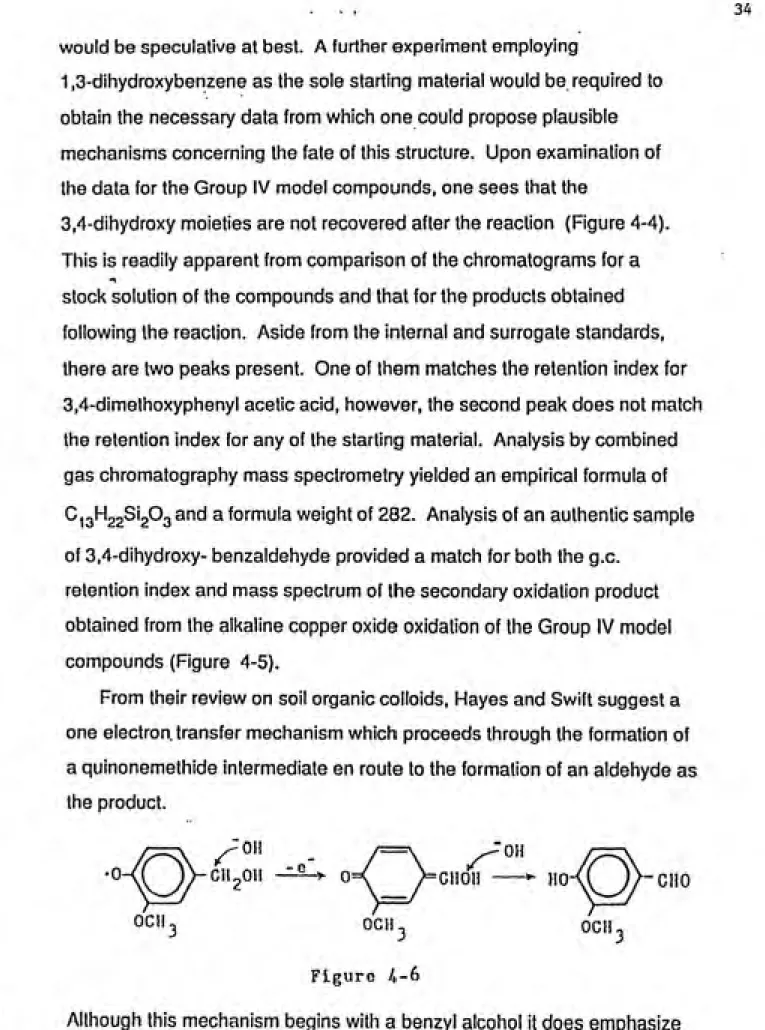
From their review on soil organic colloids, Hayes and Swift suggest a
one electron transfer mechanism which proceeds through the formation of
a quinonemethide intermediate en route to the formation of an aldehyde as
the product.
CHO
Figure It-()
Although this mechanism begins with a benzyl alcohol it does emphasize
the importance of the hydroxyl group in the para position. Referring to
Table 4-3
Percent Recovery of Model Compounds from Cupric Oxide Oxidation
Percent
Recovery
Group I Model Compounds
2-Hydroxybenzoic Acid 98.0% 4-Hydroxybenzoic Acid 94.4% 4-Hydroxyphenylacetic Acid 78.0% 3-(4-Hydroxyphenyl)proprionic Acid 23.7%
Group II Model Compounds
Phenylacetic Acid 91.6%
Hydrocinnamic Acid 102.7%
Cinnamic Acid ' 90.7%
Group III Model Compounds
1,3-Dihydroxybenzene 21.7% 3-Hydroxybenzoic Acid 116.2% 3-Hydroxyphenylacetic Acid 94.6% 3,5-Hydroxybenzoic Acid 102.6%
Group IV Model Compound
3,4-Dimethoxyphenylacetic Acid 86.0% 3,4-Dihydroxybenzoic Acid *
3,4-Dihydroxyphenylacetic Acid , *
3,4-Dihydroxyhydrocinnamic Acid * 3,4-Dihydroxycinnamic Acid *
36
Christman and Ghassemi's premise that cleavage of the alkyl side chain will occur when the appropriate activating groups are present on the
aromatic ring, It is evident from this study that hydroxyls present in both the meta and para positions exert a greater influence towards cleavage of the alkyl side chain than when present in either the ortho, meta, or para
position alone. However, since the data concerning the Group I model
compounds should be viewed cautiously, the influence of the ortho and para positions upon cleavage of the alkyl side chain cannot be stated with great certainty, it is also evident that the 3,4-dimethoxy substitution pattern is less activating than the 3,4-dihydroxy substitution pattern.
This is consistent with electrophilic aromatic substituent theory which places the hydroxyl group as a strongly activating ortho-para
director and the methoxyl group as only a moderately activating
ortho-para director (Solomons, 1976). This previous statement does not
suggest that the alkaline copper oxide reaction is classified as an
electrophilic aromatic substitution reaction, rather, it merely indicates that the hydroxyl group is believed to be a more potent activator of the aromatic ring than the methoxyl group.
The results from the Group IV model compounds study indicate that
3.4-dihydroxy substituted alkyl benzene may be present in macromolecular compounds such as lignin and humic materials, however, these may not be
seen amongst the reaction products from alkaline copper oxide
degradations due to secondary reactions occuring during the oxidation. It must be emphasized that the compounds employed are simple structures and are devoid of any near neighbor chemistry such as resonance and/or
inductive effects of adjacent moieties which may occur during the
Alkaline Cupric Oxidation of Lake Drummond Fulvic Acid
The results of the copper oxide oxidations of Lake Drummond fulvic
acid revealed the presence of numerous and diverse structural entities in
the product mixture. Both aliphatic and aromatic structures are found and
those identified by gas chromatography and combined gas chromatography/
mass spectroscopy appear in Table 4-4. This list of compounds comprises
approximately 31.4% of the FID chromatogram beyond the large solvent
front (Figure 4-7).
Analysis of the data presented in Table 4-4 reveals that the short
chain monobasic and dibasic aliphatic acids account for 12.9% of the total
peaks present or 41% of the identified products. This indicates that the
majority of identified products are aromatic structures. It is interesting
to note that the longest aliphatic structures identified, succinic and
maleic acids, are only four carbon atoms in length. This is consistent with
the premise that the fulvic acid contains shorter chain linkages compared
to humic acid, thus making the fulvic acid more soluble and less
hydrophobic than humic acid (Christman, 1983, Liao, 1982).
The aromatic moieties comprising the remainder of the product
mixture consist primarily of substituted phenols. Many, but not all, of the
index phenols described by Hedges were found. Exceptions to this group
included syringealdehyde and acetosyringone.
The presence of the index phenols is generally regarded as evidence of
lignin as a precursor to humic material formation (Ertel and Hedges, 1981,
1984). The presence of the p-hydroxyl phenols does not necessarily
indicate lignin as a precursor of humic material for these phenols are not
exclusively lignin derived, although they are seen as copper oxide
38
Figure k-'l
FID Chromatograms for LDFA Products from CuO Oxidation
With standards Ethyl Vanillin and trans-Cinnamic Acid
'JilLtWl
; 39
TABLE 4-4
CuO Oxidation Products from Lake Drummond Fulvic Acid
Compound Retention %Relative
Index Yield
1. Lactic Acid 0.347 3.54
2. alpha-Hydroxyisobutyric Acid 0.359 2.86
3. Levulenic Acid 0.408 1.22
4. alpha-Hydroxybutyric Acid 0.428 0.42
5. Malonic Acid 0.508 0.63
6. Benzoic Acid 0.566 1.19
7. Succinic Acid 0.649 1.82
8. Methyl Succinic Acid 0.670 1.41
9. Maleic Acid 0.684 2.86
10. 4-Hydroxybenzaldehyde 0.720 0.46
11. 1,3-Dihydroxybenzene 0.778 0.81
12. 4-Hydroxyacetophenone 0.848 0.55
13. Vanillin 0.922 0.98
14. 2-Hydroxybenzoic Acid 0.973 0.19
15. Acetovanillone 1.023 1.39
16. 3-Hydroxybenzoic Acid 1.041 0.93
17. 3,4-Dihydroxybenaldehyde 1.045 0.47
18. 4-Hydroxybenzoic Acid 1.049 2.08
19. Phthalic Acid 1.114 1.65
20. Tricarballylic Acid 1.178 0.57
21. Isophthalic Acid 1.196 3.36
22. Vanillic Acid 1.206 0.42
23. Terephthalic Acid 1.237 0.65
24. 3,5-Dihydroxybenzoic Acid 1.258 5.79
25. Syringic Acid 1.340 0.88
Retention Index - retention time of analyte relative to that for the
surrogate standard, ethyl vanillin. Retention
indices reported were obtained from GC data.
40
woods (Ertel and Hedges, 1984). It has been demonstrated that the various vanillyl and syringyl moieties comprising the remainder of the index
phenols are lignin derived. The vanillyl structures are copper oxide
oxidation products of gymnosperm woody tissues and syringyl moieties are derived from angiosperms. The distributions of these phenols generally
reflect the vegetative patterns indigenous to the area from which the
humic material is obtained.
Distributions of the different forms of the phenols mentioned within
the types of humic material analyzed, i.e., humic acid versus fulvic acid, may also vary. Humic acids generally produce higher aldehyde/acid ratios
than the corresponding fulvic acids. Also, it has been shown that fulvic acids produce a greater amount of p-hydroxyl phenols compared to vanillyl and syringyl phenols than the corresponding humic acid (Ertel and Hedges, 1984). This helps to explain the fact that syringealdehyde and
acetosyringone are not seen amongst the copper oxide oxidation products
of Lake Drummond fulvic acid.
An interesting product which was found amongst many products
identified was 3,4-dihydroxybenzaldehyde. Schnitzer and Ortiz de la Serra
reported seeing 3,4-dimethoxybenzaldehyde as an alkaline copper oxide
oxidation product of a terrestrial humic acid (1973). The products
characterized by these authors were methylated following isolation and prior to analysis by GC/MS. Therefore, the possibility exists that
3,4-dihydroxybenzaldehye was amongst the products isolated, however,
since the products were methylated prior to analysis, this position cannot
be ascertained. Had the products been analyzed as trimethylsilyl
derivatives, the present of 3,4-dihydroxybenzaldehyde as an oxidation product could be stated more confidently. The significance of
3,4-dihydroxybenzaldehyde as a product of the alkaline copper oxidation of
oxidation of the Group IV model compounds. The results of that
experiment indicated that 3,4-dihydroxyphenyl alkanoic moieties do not
survive the oxidative conditions of the alkaline copper oxide reaction, rather a secondary oxidation product results, namely 3,4-dihydroxy¬
benzaldehyde. It is therefore possible that 3,4-dihydroxyphenylalkanoic
moieties may be part of the macrostructure of the humic material,
however, upon their release during the alkaline copper oxide oxidation, they are further acted upon producing 3,4-dihydroxybenzaldehyde as one of the products. It must be emphasized that this process is not quantitative
and that other competing or subsequent reactions are most likely occuring, further oxidizing these structures.
It was noted during the course of experimentation that some color
remained on the sodium sulfate drying column and that this color was not easily removed by diethyl ether, however, a more polar solvent such as methanol would elute the color from the drying columns. The products analyzed in these sets of experiments and those reported by previous
investigators are for the most part, the ether extractable organics. It
would be of interest to choose an inert polar solvent (more polar than
diethyl ether) that would elute the color remaining on the column and see what the product composition of this fraction would be.
Infared Spectroscopy
Another approach to functional gorup analysis of the undegraded Lake
Drummond fulvic acid is provided by infrared spectroscopy. The IR spectra
for Lake Drummond fulvic acid and potassium bromide appear in Figure
4-8. Several investigators have assigned certain frequencies to various functional groups (Neyroud and Schnitzer, 1974, Thurman and Malcolm,
42
Figure U-8
Infrared Spectrum of Lake Drummond Fulvic Acid
100.
80.
60-c
o
CO CO
b40.
CO
C
CO U EH
C
S2O.
U
Spectrum of KBr
pellet
Spectrum of LDFA/KBr
pellet
4000
' -1
Frequency (cm" ) I6OI.I cm
Table 4-5
Elemental Composition of Lake Drummond Fulvic Acid
Sample 2iC 2il 23Ni %Ash
LDFA1 50.86 4.09 1.01 0.16
LDFA2 57.00 5.49 1.07 NIL
LDFA3 5L15 521 052 MQ
Mean 54.34 4.94 0.97 0.19
44
comparison of the spectrum for the KBr pellet versus that for the fulvic
acid, the presence of the hydrogen bonded hydroxyls is a contribution from
the fulvic acid. Aromatic C-H stretching appears around 3000 cm"^ and
aliphatic C-H stretching occurs near 2960 cm'^ and 2840 cm'^. An
intense signal at 1720 cm"^ is due to carbonyl stretching. A shoulder near
1620 cm"^ may be due to aromatic C=C possibly conjugated to C=0.
Aliphatic C-H bending should occur at 1440 cm-1 and C-O-C stretching
due to ethers appears at 1250 cm"^. The infrared spectrum for Lake
Drummond fulvic acid is very similar to that for Lake Singletary fulvic
acid (Norwood, 1986).
Elemental Analysis
The results of elemental analysis appear in Table 4-5. The ash content
is very low, less than 1%. Also the nitrogen content is low, typical of
fulvic acids (Thurman and Malcolm, 1983).
NMR Spectroscopic Analysis of Lake Drummond Fulvic Acid
Another set of experiments performed to complement the information
obtained from the GC/MS analysis of the product mixture obtained from
the cupric oxide oxidations of Lake Drummond fulvic acid, was solid state
^^C NMR analysis of the intact fulvic acid. CP/MAS spectra, with and
without dipolar dephasing were acquired (Figures 4-9, 4-10). An
informative and concise treatise concerning the principles of both C-13
NMR and proton NMR is provided by Wilson (1981). For details concerning
the aquisition of the spectra, the reader is referred to Nonwood (1985).
Whereas one obtains information concerning the subunit structure of
the carbon skeleton of the fulvic acid can be obtained from analysis of
spectra obtained from various solid state ^^C NMR experiments. The
analysis of the spectrum follows the format provided by Hatcher (1981).
The spectrum is divided into four regions, each region representative of
particular types of carbon moieties. The percent contributions for each
region appeaar in Table 4-6A.
Region I (0 to 50 ppm) consists primarily of paraffinic carbon
structures and will contain the signals arising from carbon-carbon single
bonds from polymethylene structures and those from terminal methyl
groups. Integration of the spectrum reveals a contribution of 21% of the
total carbon of the fulvic acid present in this region. Reference to the
dipolar dephased spectrum, a prominent peak centered at 20 ppm is
indicative of terminal methyl groups present. \
Region II (50 to 110 ppm) contains the resonances resulting from
carbons bonded to heteroatoms such as oxygen and nitrogen. The bond
order of the carbon-heteroatom linkage consists of single bonds and
structures representative of the signals one observes in this region,
include alcohols, ethers, carbohydrates, acetals and methoxyls. A
contribution of 23% of the total carbon contained within the intact fulvicacid was observed for this region. Several resonances which are
characteristic of particular structural entities which may or may not be
present are worth noting. Wilson et al., indicate the presence of
carbohydrates by the occurance of resonances at 72 ppm and 104 ppm. The
signal occuring at 72 ppm is assigned to O-alkyI carbons and that at 104
ppm is due to the presence of dioxygenated carbon structures. The authors
further note that these resonances can be more definitively assigned
through the use of a dipolar dephase difference spectrum. Also discussed
is the signal present at 55 ppm, which the authors attribute to methoxyl
46
rather than a distince peak is present at 55 ppm. However, in the dipolar dephased spectrum (tau=40 usec), a broad peak centered about 55 ppm is observed. This is probably due to the presence of methoxyl carbons.
Resonances observed from 110 ppm to 160 ppm (Region III) arise primarily from aromatic and olefinic carbon. Results from degradation studies have emphasized the importance of aromatic moieties as major structural constituents of humic material (Liao et al., 1981, Schnitzer and
DesJardin, 1970). With the advent of solid state C-13 NMR and the associated techniques of CP/MAS and dipolar dephasing, one can
confidently obtain an estimate of aromatic carbon present in the intact
undegraded humic material. However, when one views the percent contribution of aromatic/olefinic carbon and compares it to that which is obtained from degradation studies, a disparity between the results from
the two approaches is readily evident.
Permanganate oxidations produce mainly benzene carboxylic acids as the major products (Liao et al., 1981) and alkaline copper oxide oxidations
show a wide spectrum of phenolic structures (Ertel and Hedges, 1984).
The large aliphatic content not detected by chemical degradations is seen
via CP/MAS and further emphasized by dipolar dephased spectra. The
increase in observable aliphatic content therefore indicates that the aromatic content is lower than previously thought. Region III contributes
27% of the total signal observed in the spectrum. If one assumes that the
signal observed in this region is primarily aromatic, then one observes
four to five benzene rings per 100 carbons.
Upfield from the aromatic/olefinic region, one observes a large
resonance centered about 173 ppm and a cluster of lesser signals centered
approximately at 190 ppm. These signals arise from carbonyl and carboxyl
carbons. Contained within this region. Region IV (160 ppm to 220 ppm),