Article
1
Resolving the problem of thin films crystallinity at
2
ambient temperature by oriented magnetic fields
3
Stefan S. Ručman∗,†, Pisith Singjai∗,‡, Winita Punyodom,¶ and Jaroon Jakmunee¶
4
† Environmental Science Program, Environmental Science Research Center, Faculty of Science, Chiang Mai
5
University, Chiang Mai, 50100 Thailand
6
‡Department of Physics and Material Science, Faculty of Science, Chiang Mai University
7
¶ Department of Chemistry, Faculty of Science, Chiang Mai University
8
Corresponding Author
9
*(Associate Professor Dr. Pisith Singjai Department of Physics and Materials Science, Faculty of Science,
10
Chiang Mai University, Chiang Mai, 50200 Thailand OFFICE: ScB 2601/4 LAB: ScB 2610. Tel: 66-53-941922-24
11
Ext. 610 Mobile phone: 66 (0)89 7551040.). *([email protected]; [email protected])
12
13
ABSTRACT Grazing incidence X-Ray Diffraction spectroscopy was employed to characterize
14
crystallinity of Iron, Nickel, Copper and Tungsten, prepared by sparking discharge process in
15
presence of 0.4 T magnetic field at ambient temperature 25◦C. Iron thin film preserved crystallinity
16
even after one year of ageing. Nickel exhibit higher crystallinity when sparked in nitrogen gas flow
17
from the one sparked in oxygen. Tungsten was successfully crystalized after just 40 minutes of
18
sparking inside of magnetic field.
19
20
KEYWORDS crystallization of thin films; ambient crystallization; room temperature crystallization;
21
magnet induce crystallization; sparking discharge
22
23
Significance Statement
24
The relation between deposition temperature and thin film quality is crucial for properties,
25
potential application and mass production of nanomaterials. By decreasing annealing temperature,
26
we can design environmental-friendly and energy efficient way for thin film fabrication. Describing
27
reactions in external magnetic and electric ordered field, help us understand new mechanism of
28
kinetic and physical processes involved in nucleation and crystallization. Conducting in air
29
atmosphere, as oppose of water medium, we are able to get a new insight in DOLLOP theory of
30
magnetic field influence, developed by JMD Coey et al.
31
As thinner as can get, thin film will require higher thermal condition to crystalize,1,2,3 thus if it is
32
combined in nanocomposite material or deposited on substrate material that is not able to sustain
33
high temperatures it represents a dead end for scaling up or any wide range commercialization’s4,5.
34
In material chemistry field, low temperature is considered below 600 degrees of Celsius6. Ambient
35
temperature research will open new door for facile approach that can provide a cost-effective
36
synthesis that will allow integration of thin film on temperature sensitive and provide alternative for
37
widely used thermal annealing. In fabrication of Ti2O thin films, for now water vapor and UV
38
induced crystallization are used as the strategies for crystallization of thin films7,8,9 Room temperature
39
heating free growth and crystallization of perovskite films10 in ambient air without use of thermal
40
annealing was reported first by Dubey et al. in which exposure of thin film to humid air (40% RH)
41
promoted crystallization. Radiofrequency plasma11 (RF) treatment developed by Osaki et al were
42
used to crystalize ITO and Ti2O thin films that were prepared on PET substrate by DC magnetron
43
sputtering method12. Miniemulsion (ME) technique was used by Gross group to obtain
44
nanocrystaline CuS13. In our research group, we use thin films for application in photovoltaics,
self-45
cleaning glass coating, anti-dust coating, thermochromic, sensors, antibacterial and hydrophobic
46
coting as well as air purifier. If crystallinity is needed for any of application thermal annealing is
47
required, the temperature applied will depend on film thickness and material composition. Bretos et
48
al.14 (2018) in a review of low-temperature crystallization point out the crystallization process as a
49
limiting step in the low- temperature processing of metal oxide thin film materials. As one of
50
strategies to achieve crystallization apart from photochemistry previously mentioned, authors
51
discussed on the so-called seeding effect and excess metal addition. There is no mention of ambient
52
(room-temperature) reactions, also authors exclusively focus on wet routes. In our research of room
53
temperature crystallization of metal thin films, we employed breaking voltage discharge across tips
54
of metal wires, that way electric current across the gap between tips of wires, will induce ablation,
55
evaporation and ionization of metal (Al, Fe, Ni, Cu, W). We observe how magnetic field strength of
56
0.4T affect deposition time on substrate and crystallinity of thin film, we also present result of
one-57
year Fe iron thin film aging by exposure to atmospheric condition as conducted in our previous
58
work.15 Our primary objective was to examine time needed to achieve crystallization of thin films at
59
0.4 Tesla. Various metals are used in this study, however we failed to achieve any crystallization of
60
aluminum under Nitrogen, Argon or Oxygen flow. After 12h of sparking there were no visible
61
peaks on XRD. In contrast Tungsten, paramagnetic metal exhibited crystallization after 45 minutes in
62
ambient atmosphere, corresponding to peak intensity achieve with annealing at 400 degrees as
63
reported previously. 20,21Figure 1 represent following W phases a) higher peak W3O (00-041-1230) b)
64
smaller peak. on 45 degrees represent beta W (03-065-6453). Result present at Figure 1 of magnetic
65
field influence at tungsten crystallization in ambient conditions for 40 minutes is counterintuitive,
66
knowing that W has highest melting and boiling point, we can explain also oxidation of W as other
67
authors did on preparation of W and W3O thin films, they observed that a low oxidized tungsten
68
phase exists from beginning of thin film growth.22 However, W3O phase higher intensity from pure
69
W implies it is likely related to tungsten target cleaning23, which was not done in present experiment.
70
We can only with certainty conclude that atmospheric oxygen was not integrated into thin film
71
trough vaporization/ionization reaction. The integration of oxygen and nitrogen was previously
72
reported on example where zerovalent iron starting material was used. These thin films preserved
73
crystallinity even after one year of exposure to ambient conditions as represented at Figure 2. Another
74
ferromagnetic material, that crystalized in 30 minutes of sparking was Nickel. We also compared
75
possibility of sparked Nickel to incorporate nitrogen. In nitrogen flow, at 0.4 T, following phases were
76
detected Ni3N (01-070-9598) and pure zerovalent Nickel phase (03-065-0380). Mixed phase nickel
77
based thin films are important for water splitting applications25 and environmental applications26.
78
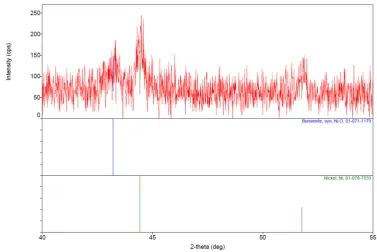
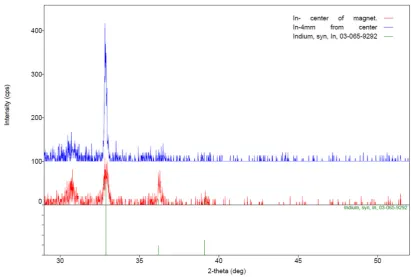
Figure 3 represent GIXRD results of Nickle wire sparked inside of nitrogen flow and 0.4T. XRD peaks
79
intensity decreased if Nickel was ionised inside of atmospheric air. It is possible to observe preserved
80
zerovalent nickel (03-065-2865) and NiN (01-083-8042), NiO (00-047-1049). Influence of gas flow type
81
on nanoparticle morphology by spark discharge was described already by Schmid-Otto research
82
group which produce aerosols by sparking method.27 Diamagnetic material that we use for sparking
83
inside of nitrogen flow and 0.4 T field was Copper. We were surprised with results of crystallization
84
and phase involving nitrides occurred during XRD analysis. Time for thin film fabrication was 30
85
minutes, phases represented at Figure 4, include pure Cu phase (03-065-9743) and CuN (01-076-8854).
86
This can be explained as magnetic field influence on ions or vaporized zerovalent metal and it creates
87
mixture of radicals where they can enter reaction if radicals are in close proximity of each other.
88
Radical pairs are formed between Copper and excited nitrogen. Nitrogen is ionized by applying
89
voltage trough spark gap. Only by looking at this system as chemical, we can explain why aluminum
90
didn’t crystalize because by ionization with spark discharge, two valence electron that successfully
91
pair inside of magnetic field, and thus opposes the change that produced magnetic field. Table 1
92
represent valence electrons of materials used in this study. In K. Watanabe et al., book28 the first use
93
of magnetic field applied for crystal growth process was for damping convection in semiconductor
94
melts. They review crystallization of organic molecules and proteins, in ambient condition, this
95
method is beneficial due to possibility of protein denaturation at higher temperature from 40oC,
96
the nucleation process, the ratio of the growth rates of the crystal faces. It was noticed that those
98
tendencies in magnetic field are enhanced by increasing protein concentration. Also, by increasing
99
magnetic field, number of crystals were decreased. According to them, crystallization of protein
100
occurred while they were sedimenting from solution. They conclude that number of crystals oriented
101
with magnetic field, can be increased by using higher concentration of protein and taller cells (crystals
102
grown from taller cells). It was found that a magnetic field decreased the growth rate of the crystals
103
in an electrolyte solution. Regarding inorganic molecules, there are two direction examining effect of
104
magnetic field on crystallization, one in thermal processing/analysis29 and other in solution
105
chemistry30 (sedimentation experiments). In first case, the high magnetic field (up to 20T) was
106
introduced in high temperature environments in order to control material functionality. Two reasons
107
for this: A) effect on phase transitions and B) an increase in coercivity of permanent magnets. Iron
108
phase in multicomponent crystalline alloys will increase in the nucleation rate Fe by annealing in
109
magnetic fields. On the other side, in solution chemistry, precipitation of 90% of CaCO3 in 1.2 T
110
external magnetic field resulted in sedimentation of aragonite/vaterite crystals. externally applied
111
magnetic field is lowering the zeta potential of CaCO3.31 Aragonite is formed at high temperature and
112
pressure from melts. Therefore, the formation of calcite is energetically in favor than of aragonite.
113
However, why in applied external field, aragonite is formed over calcite? Theoretically this can
114
happen only if magnetic field is 45T, but still researchers achieve it under application of 0.4T high
115
gain of aragonite concentration is achieved. (80%)30 Chandrasekhar32 used 5.5 T field on magnetic on
116
sodium hexafluorosilicate to improve the crystallinity. They explain effect referring to Mitrovic33,34,35
117
observation, that Lorentz force influence on ion movement in solution as they pass through magnetic
118
field and slowing down the growth disrupting the regularity of the lattice. Mitrovic35 who conducted
119
synthesis of manganese chloride and Rochelle salt in presence of magnetic field and Ohagaki36 et al.
120
who investigated barium chloride and produced crystals under magnetic field, at ambient and
121
temperature of maximum saturation of solution (50oC), according to their findings every molecule or
122
ion is regarded as diamagnet and orientation is results of movement and alignment of those
123
diamagnets. H.E. Lundager Madsen37, precipitated at 0,27T (25oC) and found an effect of the magnetic
124
field on carbonates and phosphates with diamagnetic metal ions. In 2008, Tai et al,31 will induce
125
crystallization of CaCO3 in pipes using 0.0074 T. They confirmed that aragonite crystals are formed
126
and calcite growth is inhibited in magnetic field. Permanent magnets outside of steel pipes were 0.1T
127
strong, generating the field inside of pipes, due to Teflon coating, of a 74 gauss. This utilization of
128
weak magnetic force or field is currently finding applications in environmental technology as
129
enhancing absorption and removal of heavy metals and other pollutants38-42By now, we can observe
130
two directions in research of magnetic field application for chemical reaction. One group that use
131
field above 5T for crystallization of alloy melts43-47 and groups addressing electrolyte crystallization
132
in magnetic field.48,49 J.M.D. Coey and H.E.L. Madsen, assumed role of water and prenucleation
133
clusters, referred as DOLLOPs. Proton dimers will mix single-triplet change in ionic bond of salts that
134
crystalized under magnetic fields. Why these authors are so vividly focused on water molecules
135
and protons, it appears to be related to historical context. Namely, at that time, there was
136
controversial trend of magnetic treatment water.50 Researchers never explored possibility that water
137
is just a medium for magnetic field, magnetic field influence on ions outside of solutions. As seen
138
with magnetic spattering method that was used to increase the density of argon ion plasma, in most
139
of cases chemical reactions such as oxidation and nitridification were not desirable, so effect on
140
chemical reaction of magnetron was suppress in describing about magnetic field ordered reactions,
141
even though this technique is famous and appeared at the same amount time as crystallization of
142
solutions in presence of magnetic field.51 This is perfectly understandable due to lack of
143
interdisciplinarity at that time and different purpose of both methods. Sparking process is perfect
144
combination for establishing conditions of ionization without solvents and obtaining experimental
145
condition in which chemical reaction can be influenced by magnetic field without complex
146
apparatuses that magnetron require. We would explain crystallization of thin films in magnetic fields
147
by effect of ground vs exited state of metals and valence electrons ordering. These two approaches
148
effect.53 Aluminum belongs to boron group, which have three electrons in last orbital with valence
150
configuration ns2np1. Since we sparked aluminum wire, therefor ionized with breakdown voltage
151
atoms in it, we assumed that electron from p-shell was loss, positive ionization and that magnetic
152
field couldn’t interact with other paired electrons. In order to prove this hypothesis, we decided to
153
spark Indium wire in magnetic field. Unfortunately, we achieved crystallization of indium, as
154
showed at Figure 5, we obtained two peaks of different intensity, the first one is measurement at the
155
center of magnet, where field is homogeneous, and second 3mm from center, at Figure 5b with blue
156
dot is marked central position of substrate, ring pattern appears due to rotation of magnet and
157
substrate on it. Quality assurance of process was comparatively done by sparking of tin(II) oxide
158
(SnO) and preparation of tungsten (W) that will cover whole substrate (as recommended by Rigaku)
159
prepared without presence of magnetic field, with furnace annealing. We didn’t obtain any
160
crystallization from SnO and W-covered substrate. We obtained crystallization at 0.4 Tesla, of iron,
161
nickel, copper, indium, tungsten. These elements are different in terms of atomic number, density,
162
melting points, atomic orbitals and magnetic properties of elements. We provided evidence that
163
crystallization is achievable outside of water and that previous hypothesis of proton transfer is not
164
suitable for explanation of crystallization.
165
All thin films are prepared at ambient condition, which could possibly open the door for
166
integration with polymer processing and wearable materials that are sensitive to increased
167
temperature. Also, whole process is breakthrough in energy efficient synthesis. Most important
168
contribution is elucidating effects on crystal formation, as alternative vision of the one claimed by
169
Coey and other explanation of magnetic field effect.54 Returning to magnetocrystalline anisotropy
170
as a future scope of magnetic field ordering is essential for understanding magnetic field effect on
171
ordering of ionized metal ions and other molecules.
172
173
Figure 1. “Tungsten (W) peaks of GIXRD.”.
174
176
Figure 2. “GIXRD HighScopre Plus PanAnalytical analysis of iron nitride thin films, exposed to air
177
for one year, prepared by sparking method”.
178
179
Figure 3. “Nickel GIXRD results, sparked in nitrogen for 30 minutes. Bunsenite phase coincidence
180
with nitride phase.”.
182
Figure 4. “Copper wire sparked inside of nitrogen flow. GIXRD results of Cu thin films”.
183
184
Figure 5. “Indium wire sparked inside of nitrogen flow, at 0.4 T. Blue-GIXRD results from center,
185
Red-4mm from center, as depicted at Figure 5b.”.
187
Figure 5b. “Picture of quartz substrate with indium thin film, blue dot depicted position of center.
188
Graphical representation of 3 GIXRD measurements.”.
189
Experimental Methods
190
Metal wires purchased from ADVENT research materials, ltd. Iron, aluminum, Tungsten,
191
Copper, Nickel 0.50 mm diameter wire of 99.5% and Indium wire of 99.9% purity that were annealed
192
in clean conditions. Catalogue number FE525711, CU514511, AL501012, W557609, NI535311,
193
IN522109.Quartz substrate used for deposition of nanoparticles onto sur- face. 0.4 Tesla high
194
temperature Neodymium magnet from Ningbo Risheng Magnets Co., Ltd. For thin film
195
characterization, Rigaku Smartlab XRD with Rigaku’s PDXL software for X-ray analysis was used.
196
Cu source (1.541862 A) with D/teX Ultra 250 detectors. HighScore with the Plus option from
197
PanAnalytical was used for Iron thin film characterization after one-year exposure.24 Sparking
198
discharge method. Metal nanoparticles were prepared as described previously15 16 17 18 19. In brief,
199
on changeable ends of electronic circuit, metal wires purchased from ADVET were placed, 2 mm in
200
distance of each other and 1 mm from quartz substrate. Circuit consists of power supply that is
201
connected to 7KV Boost Step-up Power Module High-voltage Generator Transformer (Note:
202
generator is commercial name, in scientific context it should be noted that this is converter) that leads
203
current to the capacitor. Four metallic fire on two parallel circuit, two for each, are ending with
204
interchangeable heads, where metal wires are inserted. Beneath substrate, magnet is placed on
205
rotating motor. Rotation is used to examine influence that different position of substrate in magnetic
206
field have in crystallinity and Magnetic strength measure with magnetometer to be set at 0.4T. These
207
ends of circuit are placed in flow box where pressure and gas flow can be controlled.
208
TABLES.
209
“Table 1. Sparked materials in this research, valence electrons”.
210
Element Atomic number Valence electrons Density g/cm3 Melting point oC
Al 13 [Ne]3s2 3p1 2,70 660
Fe 26 [Ar] 3d6 4s2 7,86 1535
Ni 28 [Ar] 3d8 4s2 8,908 1453
Cu 29 [Ar]3d104s1 8,96 1085
In 49 [Kr] 4d105s25p1 7,31 156,6
Tin oxide molecule Sn = O 6,95 1630
W 74 [Xe] 4f145d46s2 19,25 3422
Source: National Institute of Standards and Technology; nist.gov
211
The authors declare no competing financial interests.
ACKNOWLEDGMENT: We would like to acknowledge Material Science Research Center, Faculty of Science,
213
Chiang Mai University.
214
REFERENCES
215
1. Zhang, QM.; Xu, H.; Fang, F.; Cheng, ZY.; Xia, F.; You, H. Critical Thickness of Crystallization and
216
Discontinuous Change in Ferroelectric Behavior with Thickness in Ferroelectric Polymer Thin Films.
217
Journal of Applied Physics2001, 89, 2613-2616.
218
2. Chen, RQ.; Lu, QQ.; Cheng, QD.; Ao. LB.; Zhang, CY.; Hou, H.; Liu, YM.; Li, DW. Yin, DC. An ignored
219
variable: solution preparation temperature in protein crystallization. Scientific reports2015, 5, 7797-7782.
220
DOI: 10.1038/srep07797
221
3. Ferri, FA.; Low-temperature metal-induced Crystallization of Mn-containing Amorphous Ge Thin Films.,
222
Journal of Non-Crystalline Solids2012, 358, 58– 60.
223
4. Regula, M.; Ballif, C.; Remškar, M.; Lévy, F. Crystallinity and Texture Promotion in WS2 Thin Films., Journal
224
of Vacuum Science & Technology A: Vacuum, Surfaces, and Films 1997, 15, 2323–2329.
225
5. Pellegren, J.P.; and Sokalski, V. M., Thickness and Interface-Dependent Crystallization of CoFeB Alloy Thin
226
Films., IEEE Transactions on Magnetics2015, 51, 1–3. DOI: 10.1109/TMAG.2015.2435798
227
6. Yoon, SY.; Kim, KH.; Kim, CO.; Oh, JY.; Jang, J. Low temperature metal induced crystallization of
228
amorphous silicon using a Ni solution. Journal of applied physics1997, 82, 5865–5867.
229
7. JohnáK, A. et al., Rapid Room Temperature Crystallization of TiO2 Nanotubes, CrystEngComm2017, 19,
230
1585–1589.
231
8. Su, J.; Zou, X.; Li, B.; Chen, H.; Li, X.; Yu, Q.; Mi, Q.; Chen, J.S. Accelerated Room-temperature
232
Crystallization of Ultrahigh-surface-area Porous Anatase Titania by Storing Photogenerated Electrons.
233
Chemical Communications2017, 53, 1619–1621.
234
9. Lamberti, A.; Chiodoni, A.; Shahzad, N.; Bianco, S.; Quaglio, M.; Pirri, C.F., Ultrafast Room-temperature
235
Crystallization of TiO2 Nanotubes Exploiting Water-vapor Treatment, Scientific reports2015, 5, 7808-7814.
236
DOI: 10.1038/srep07808
237
10. Dubey, A.; Kantack, N.; Adhikari, N.; Reza, K.M.; Venkatesan, S.; Kumar, M.; Khatiwada, D.; Darling, S.;
238
Qiao, Q., Room Temperature, Air Crystallized Perovskite Film for High Performance Solar Cells. Journal
239
of Materials Chemistry A2016, 4, 10231–10240.
240
11. Ohsaki, H.; Shibayama, Y.; Suzuki, M.; Kinbara, A.; Yashiro, H.; Watanabe, T., Room Temperature
241
Crystallization by RF Plasma., Thin Solid Films2008, 516, 4490–4494.
242
12. Ohsaki, H.; Suzuki, M.; Shibayama, Y.; Kinbara, A.; Watanabe, T.; Room Temperature Crystallization of
243
Indium Tin Oxide Films on Glass and Polyethylene Terephthalate Substrates Using RF Plasma. Journal of
244
Vacuum Science & Technology A: Vacuum, Surfaces, and Films 2007, 25, 1052–1055.
245
https://doi.org/10.1116/1.2748807
246
13. Morgese, G.; Dolcet, P.; Feis, A.; Gellini, C.; Gialanella, S.; Speghini, A.; Badocco, D.; Pastore, P.; Casarin,
247
M.; Gross, S. Room-Temperature Crystallization of CuS Nanostructures for Photothermal Applications
248
through a Nanoreactor Approach., European Journal of Inorganic Chemistry 2017, 20, 2745–2754. DOI:
249
10.1002/ejic.201601435
250
14. Bretos, I.; Jiménez, R.; Ricote, J.; Calzada, M.L.; Low-temperature Crystallization of Solution-derived Metal
251
Oxide Thin Films Assisted by Chemical Processes., Chemical Society Reviews2018, 47, 291-308.
252
15. Stefan, R., Jakmunee, J., Punyodom, W. and Singjai, P., A Novel Strategy for Longevity Prolongation of
253
Iron-based Nanoparticle Thin Films by Applied Magnetic Force. New Journal of Chemistry2018, 42,
4807-254
4810. DOI 10.1039/C7NJ04730D
255
16. Kumpika, T.; Thongsuwan, W.; Singjai, P., Optical and Electrical Properties of ZnO Nanoparticle Thin
256
Films Deposited on Quartz by Sparking Process. Thin Solid Films2008, 516, 5640–5644.
257
17. Chuminjak, Y., Daothong, S., Kuntarug, A., Phokharatkul, D., Horprathum, M., Wisitsoraat, A.,
258
Tuantranont, A., Jakmunee, J.; Singjai, P., High-performance Electrochemical Energy Storage Electrodes
259
Based on Nickel Oxide-coated Nickel Foam Prepared by Sparking Method., Electrochimica Acta2017, 238,
260
298–309.
261
18. Chuminjak, Y., Daothong, S., Reanpang, P., Mensing, J.P., Phokharatkul, D., Jakmunee, J., Wisitsoraat, A.,
262
Tuantranont, A.; Singjai, P., Electrochemical energy-storage Performances of Nickel Oxide Films Prepared
263
by a Sparking., RSC Advances2015, 5, 67795–67802.
19. Meuller, B.O.; Messing, M.E.; Engberg, D.L.; Jansson, A.M.; Johansson, L.I.; Norlén, S.M.; Tureson, N.;
265
Deppert, K., Review of spark discharge generators for production of nanoparticle aerosols., Aerosol Science
266
and Technology2012, 46, 1256-1270.
267
20. Christou, K.; Louloudakis, D.; Vernardou, D.; Savvakis, C.; Katsarakis, N.; Koudoumas, E.; Kiriakidis, G.
268
Effect of solution chemistry on the characteristics of hydrothermally grown WO3 for electroactive
269
applications. Thin Solid Films2015, 594, 333–337.
270
21. Vernardou, D.; Psifis, K.; Louloudakis, D.; Papadimitropoulos, G.; Davazoglou, D.; Katsarakis, N.;
271
Koudoumas, E., Low pressure CVD of electrochromic WO3 at 400 C, Journal of The Electrochemical Society
272
2015, 162, H579–H582.
273
22. Maillé, L.; Sant, C.; Le Paven-Thivet, C.; Legrand-Buscema, C.; Garnier, P. Structure and morphological
274
study of nanometer W and W3O thin films. Thin Solid Films2003, 428, 237–241.
275
23. Girault, B.; Eyidi, D.; Goudeau, P.; Sauvage, T.; Guerin, P.; Bourhis, E.L.; Renault, P.O. Controlled
276
Nanostructuration of Polycrystalline Tungsten Thin Films. Journal of Applied Physics2013, 113, 174310.
277
24. Degen, T.; Sadki, M.; Bron, E.; König, U.; Nénert, G. The HighScore suite., Powder Diffraction2014, 29,
S13-278
S18. doi:10.1017/S0885715614000840
279
25. Shalom, M., Ressnig, D., Yang, X., Clavel, G., Fellinger, T.P. and Antonietti, M., Nickel Nitride as an
280
Efficient Electrocatalyst for Water Splitting. Journal of Materials Chemistry A2015, 3, 8171-8177.
281
26. Rudd, P.A., Liu, S., Gagliardi, L., Young Jr, V.G. and Lu, C.C., Metal–Alane Adducts With Zero-Valent
282
Nickel, Cobalt, and Iron. Journal of the American Chemical Society2011, 133, 20724-207273.
283
27. Feng, J., Guo, X., Ramlawi, N., Pfeiffer, T.V., Geutjens, R., Basak, S., Nirschl, H., Biskos, G., Zandbergen,
284
H.W. and Schmidt-Ott, A. Green Manufacturing of Metallic Nanoparticles: a Facile and Universal
285
Approach to Scaling Up. Journal of Materials Chemistry A2016, 4, 11222-11227.
286
28. Watanabe K., Motokawa, M. Eds.; Materials Science in Static High Magnetic Fields. Springer-Verlag, Berlin
287
Heidelberg; 2002;
288
29. Onodera, R.; Kimura, S.; Watanabe, K.; Lee, S.; Yokoyama, Y.; Makino, A.; Koyama, K.; Magnetic Field
289
Effects on Crystallization of Iron-based Amorphous Alloys., Materials Transactions2013, 54, 188-191.
290
30. Cefalas, A.C.; Kobe, S.; Dražic, G.; Sarantopoulou, E.; Kollia, Z.; Stražišar, J.; Meden, A.
291
Nanocrystallization of CaCO3 at solid/liquid interfaces in magnetic field: A quantum approach. Applied
292
Surface Science2008, 254, 6715–6724.
293
31. Tai, C.Y.; Wu, C.K.; Chang, M.C. Effects of Magnetic Field on the Crystallization of CaCO3 Using
294
Permanent Magnets. Chemical Engineering Science 2008, 63, 5606 – 5612.
295
32. Chandrasekhar, R., Influence of Magnetic Field on Sodium Hexafluorosilicate Synthesis., Journal of Crystal
296
Growth2000, 216, 407-412.
297
33. Mitrović, M.M., Growth Rate Dispersion of Small MnCl2· 4H2O Crystals II. Growth in a Magnetic Field.
298
Journal of Crystal Growth1991, 112, 171-182.
299
34. Mitrović, M.M.; Ristić, R.I.; Ćirić, I. The Influence of a Magnetic Field on the Mosaic Spread and Growth
300
Rate of Small Rochelle Salt Crystals. Applied Physics A1990, 51, 374-378.
301
35. Mitrović, M.M.; Žižić, B.B.; Napijalo, M.L.; Influence of Magnetic Field on Growth Rate Dispersion of
302
Small Rochelle Salt Crystals. Journal of Crystal Growth 1988, 87, 439—445.
303
36. Ohgaki, K.; Makihara, Y.; Sangawa, H., Effect of Exposure to Magnetism on Crystals Produced in Aqueous
304
Solutions. Chemical Engineering Science1994, 49, 911-913.
305
37. Madsen, H.L.; Influence of Magnetic Field on the Precipitation of Some Inorganic Salts. Journal of Crystal
306
Growth1995, 152, 94-100.
307
38. Fan, P.; Jiang, X.; Qiao, J.; Li, L. Enhanced Removal of Heavy Metals by Zerovalent Iron in Designed
308
Magnetic Reactors. Environmental Technology2017, 1-9. doi: 10.1080/09593330.2017.1360398
309
39. Liang, L.; Guan, X.; Shi, Z.; Li, J.; Wu, Y.; Tratnyek, P. G. Coupled Effects of Aging and Weak Magnetic
310
Fields on Sequestration of Selenite by Zero-Valent Iron. Environmental Science & Technology2014, 48,
6326-311
6334.
312
40. Xu, C.; Zhang, B.; Zhu, L., Lin, S.; Sun, X.; Jiang, Z.; Tratnyek, P. G. Sequestration of Antimonite by
313
Zerovalent Iron: Using Weak Magnetic Field Effects to Enhance Performance and Characterize Reaction
314
Mechanisms. Environmental Science & Technology2016, 50, 1483-1491.
315
41. Fan, P.; Sun, Y.; Qiao, J.; Lo I. M.; Guan, X. Influence of Weak Magnetic Field and Tartrate on the Oxidation
316
and Sequestration of Sb (III) by Zerovalent Iron: Batch and Semi-Continuous Flow Study. Journal of
317
Hazardous Materials2018, 343, 266-275.
42. Li, J.; Qin, H.; Zhang, W. X.; Shi, Z.; Zhao, D.; Guan, X. Enhanced Cr (VI) Removal by Zero-Valent Iron
319
Coupled with Weak Magnetic Field: Role of Magnetic Gradient Force. Separation and Purification Technology
320
2017, 176, 40-47.
321
43. Saban, K. V.; Jini, T.; Varghese, G. Influence of Magnetic Field on the Growth and Properties of Calcium
322
Tartrate Crystals. Journal of Magnetism and Magnetic Materials2003, 265, 296-304.
323
44. Sazaki, G.; Durbin, S. D.; Miyashita, S.; Ujihara, T.; Nakajima, K.; Motokawa, M.; Magnetic Damping of
324
the Temperature-Driven Convection in NaCl Aqueous Solution Using a Static and Homogeneous Field of
325
10 T. Japanese Journal of Applied Physics1999, 38, 842-844.
326
45. Zhanyong, W., Hui, X. U., Jiansen, N., Qiang, L., & Bangxin, Z., Effect of High Magnetic Field on the
327
Crystallization of Nd2Fe14B/α-Fe Nanocomposite magnets. Rare Metals2006, 25, 337-341.
328
46. Zhanyong, W. A. N. G., Wenqing, L. I. U., Bangxin, Z. H. O. U., Jiansen, N. I., Hui, X. U., & Qiang, L. I.
329
Microstructural Characteristics of Nd2Fe14B/α-Fe Nanocomposite Ribbons Bearing Nb Element. Rare
330
Metals2008, 27, 299-302.
331
47. Zhuang, Y. X.; Chen, J.; Liu, W. J.; He, J.C. Effect of High Magnetic Field on Crystallization of
332
Zr46.75Ti8.25Cu7.5Ni10Be27.5 Bulk Metallic Glass. Journal of Alloys and Compounds2010, 504S, 256-259.
333
48. Madsen, H. E. L.; Theory of Electrolyte Crystallization in Magnetic Field. Journal of Crystal Growth2007,
334
305, 271-277.
335
49. Coey, J.M.D.; Magnetic Water Treatment–How Might it Work?. Philosophical Magazine2012, 92, 3857-3865.
336
50. Powell, M. R.; Magnetic Water and Fuel Treatment: Myth, Magic, or Mainstream Science?. Skeptical
337
Inquirer1998, 22.1, 27-31.
338
51. Swann, S.; Magnetron Sputtering. Physics in Technology1988, 19, 67-75.
339
52. Matsuda, T.; Umeda, K.; Kato, Y.; Nishimoto, D.; Furuta, M.; Kimura, M. Rare-metal-free high-performance
340
Ga-Sn-O thin film transistor Scientific Reports2017, 7, 44326-44332. DOI: 10.1038/srep44326
341
53. Sudha, C.; Sivanarendiran, R.; Srinivasan, K. Influence of Magnetic Field on the Nucleation Rate Control of
342
Mono Paracetamol. Crystal Research and Technology2015, 50, 230-235. DOI 10.1002/crat.201400432
343
54. Chibowski, E.; Szcześ, A., Magnetic Water Treatment–a Review of the Latest Approaches. Chemosphere
344
2018, doi: 10.1016/j.chemosphere.2018.03.160.