PSO-Based Scheduling Algorithm for Time
and Cost Optimization in Mobile Grid
Mehdi Golsorkhtabaramiri* Department of Computer Engineering, Babol Branch, Islamic Azad University,
Babol, Iran.
[email protected], [email protected]
Fahimeh Zakeri
Department of Computer Engineering, Babol Branch, Islamic Azad University,
Babol, Iran. [email protected] Received: 9 March, 2018 - Accepted: 15 Jun, 2018
Abstract— Resource owners in mobile grids, with financial motivations in mind, provide their clients with the resources they possess. The clients can, on the other hand, obtain what they seek through the payments they make. Mobile grid users may also demand cost- and time-optimizing strategies as part of their service quality. As a result, the scheduling system, through making use of a proper algorithm, should allocate resources to users’ independent tasks in such a way that would minimize time and cost parameters. Hence, in this paper, two scheduling algorithms are introduced with regard to user needs based upon Particle Swarm Optimization (PSO), which, through mutation and population expanding, are able to find the best scheduling scheme for user tasks, while preventing quick algorithm convergence.
Keywords- Mobile Grid; Resource Scheduling; Time Optimization; Cost Optimization; Particle Swarm Optimization; local Minimum; Mutation, Expanding Population
I. INTRODUCTION1
A mobile grid is a combination of wire grids, gateways and a wireless grid that is setup based on mobile calculations and grid calculations [1,2]. In fact, users can send tasks to mobile grids, then a scheduler based on a scheduling algorithm distributes the tasks between mobile nodes, and after finishing the calculation, the results will be sent to the schedulerm and the scheduler transmits them to related the user [3,4]. Since the nodes are mobile, cases such as limitation of battery capacity, increased motions and low security can produce problems and new challenges in this context. A mobile grid is usually adopted the wireless connection between mobile devices and grids, this connection is unstable, thus the mobile device and grid system may disconnect at any time [5].
* Corresponding Author
One of the most important part in a mobile grid is scheduling of resources [6]. A scheduler of resources, regarding user needs, should take best scheme of allocating work for reaching optimum scheduling. Traditional schedulers often concentrate on execution time of tasks, but other limitations may also be imposed.
Mobile grid users can request optimization of time or cost as a quality of services, and system scheduling must follow the strategy that minimizes time and cost parameters in allocating tasks to resources. Hence in this paper, in order to realize user needs, two new algorithms are presented.
II. RELATED WORKS
Shengjun et al. [7] proposed a differential evolution algorithm that is similar to the majority of evolutionary algorithms. However, the difference is in the mutation operation, which is the most crucial part
Volume 10- Number 3 – Summer 2018 (12 -18)
of the differential evolution algorithm. In differential evolution algorithm, the basic principle is to select randomly three individuals in a population and to carry out the vector differential operator after which comes a multiplication by the scaling factor. Finally, a new individual is obtained by adding the third individual. The best individual will be the next generation individual by comparison with the new individual and the best individual in contemporary population. The differential evolution algorithm takes the possibility of global random points into account in the process of evolving, and enhances the global search capability.
Lei et al. [8] proposed a heuristic approach that is adopted in solving scheduling problems in grid environment. Each particle represents a possible solution, and the position vector is transformed from the continuous values to the discrete values based on the small position value rules, accordingly, a permutation is formed. This approach aims to generate an optimal schedule so as to get the minimum makespan and maximum resource utilization while completing the tasks.
Zahra et al. [9] proposed a hybrid-scheduling algorithm to solve the independent task scheduling problem in grid computing. This algorithm uses particle swarm optimization (PSO) as the main search algorithm, while the gravitational emulation local search (GELS) algorithm is used to improve the population. There are two reasons for using both algorithms. First, we need an algorithm that is based on a population that can search the entire grid space for this problem. Second, the grid environment is dynamic, so the scheduling algorithm must be fast enough to adapt with the natural grid environment and must be able to converge faster than other algorithms. Moreover, although PSO is weak for local searches, this combination of PSO with an algorithm that is strong in local searches addresses this weakness. This algorithm minimizes makespan and the number of tasks that fail to meet their deadlines.
Zhou et al. [10] proposed a novel cultural algorithm based on the PSO algorithm. In the process of PSO optimization, the particle traps two targets: one is the best-found position of the single particle up to the current iteration count, and the other is the global best-found position among all particles in the swarm up to the current iteration. The information of global best-found solutions is accepted to the belief space and then influences the update of population space in reverse. By the dual evolutionary mechanism of PSO space (the main population space) and belief space (the additional upper space), the algorithm attains a better capacity of global search. At each generation, individuals in the population space are first evaluated with the objective function so that the good-performing individuals are found. The acceptance function, accept (), is then used to determine which individuals will be allowed to update the belief space, which are normally elitists.The population space and the belief space of cultural algorithm are redesigned. The algorithm is stable and presents low variability.
Wang et al. [11] proposed an efficient task scheduling method based on an advanced no-velocity PSO. To standardize PSO, the particle modifies its
position by velocity. However, they advance the no-velocity PSO using the subgroup best position’s center instead of the swarm's center, using subgroup best position instead of the personal best position, and use it in the grid task scheduling. The initial particle groups can be divided into several subgroups. They use the personal best position for the best position of the subgroup, and use the global best position for the best position of the global group. In no-velocity PSO, the other leading node–the swarm's center is imported. But in the task-scheduling problem, the task response time requires more stringency, so it requests that the convergence time not be too long. In order to shorten the convergence time, they consider the value of all subgroup's best position as the center of the node. This can speed up the convergence. The subgroup's best position and their center information are taken into account to get minimum makespan and minimum mean task response time.
Bu et al. [12] proposed an improved algorithm with a discrete coding rule for the grid scheduling problem. In the grid environment, the scheduling problem is to schedule a stream of tasks to a set of nodes. During the execution, there are some communications between nodes. The function of the algorithm is to find the best tasks scheduling strategy and to obtain the optimal makespan.
Sara et al. [13] proposed a hybrid genetic algorithm (GA) and variable neighborhood search (VNS) which was presented to reduce the overall cost of task executions without a noticeable increment in system makespan. This paper addresses the scheduling problem of independent tasks in the market-based grid environment. In market-based grids, resource providers can charge users based on the amount of resource requested by them. In this case, scheduling algorithms should consider users' willingness to execute their applications in the most economical manner. GA-VNS runs the genetic as the main algorithm and uses the VNS procedure for improving individuals in the population. Each individual in the population is used to generate new offsprings by applying appropriate genetic operators such as selection, crossover and mutation.
III. THERESOURCES SCHEDULING ALGORITHM
Since users can request the time or cost parameter as quality of services, the aims of scheduling algorithm can be put forward as the following:
Time Optimization Cost Optimization
In case of time optimization, the user follows the allocative scheme to do the task in the least possible time, and in case of cost optimization, also, the user wants an allocative scheme that does the task with the least possible cost. Consequently, the resource scheduler must use an algorithm which meets the needs of the user.
In this paper, two new scheduling algorithms are introduced that are in agreement with each of the aims. For the first case, we assume that people use laptops, Personal Digital Assistants (PDAs) or other mobile
13
devices for connecting to a network. They send the task to the scheduler, and the scheduler divides the task into some sub tasks that do not have any relation with each other. This case must be considered that each resource can do a task simultaneously in every moment. Regarding these cases, the proposed evolutionary algorithms are stated as in the following:
A. The PSO algorithm
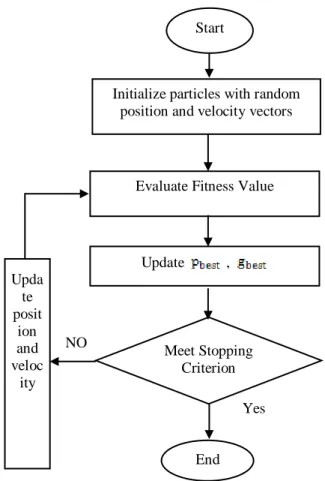
The PSO is a social search algorithm that is modeled from behavior of birds or fish groups [14]. In this method, particles are flowing in the search space, and the variation of particle positions in the search space is affected by their experiments and neighbors. Therefore, the position of other particles affects thesearch quality of a particle. The result of modeling such social behavior is a search process that leads particles toward the successful regions. The concept of PSO is not difficult, and the number of individuals is small, the calculations are simple, and it can be an advantage in the mobile telecommunications.
Fig 1. The flow of the PSO algorithm
In PSO, in every moment, every particle regulates its position in the search space regarding the best position that has been placed until now and the best position that exists in its neighborhood
according to (1) and (2) .
(1)
(2)
That is from 1 to , and ( is equal to the number of population particles, is velocity of Th particle, is the position of the Th particle, are random numbers, are training factors, is the best position of every particle, is the best position between all particles and is the amount of weight.
In resource scheduling in mobile grids, every allocation scheme can be shown with a particle in PSO. For this, we assume that N is the number of mobile nodes in the network and the number of independent tasks is also equal to M. In the vector of particle position , the Th task has been allocated to the node of the resource. There is a system in the network that obtains the time or cost of the task performance through the resource and, as a matrix, hands the result over to the PSO algorithm for being evaluated. Of course, here, the matrix is valued with random amounts.
The mathematical model for resource scheduling is as follows:
The set of tasks is T= { ,…, } and the set of resource nodes is R= { , ,…, }, where N can be less than or equal to M. the information matrixes of resources and tasks are as follows:
The expected execution time matrix (EET) returns the execution time of the nodes for doing the tasks.
EET=
The expected execution cost matrix (EEC) returns the execution costs of the nodes for doing the tasks.
EEC=
In the proposed methods, these matrixes are valued with random amounts. The proposed methods use these matrixes for evaluating the fitness values of particles. Therefore, the algorithms must find the best scheduling scheme through considering these matrixes. In fact, in this paper, the time optimization algorithm uses the EET matrix to find the optimal scheme with minimum time. The cost optimization algorithm uses the EEC matrix to find the optimal scheme with minimum cost.
B. Proposed algorithms of scheduling resources
based on PSO
The important issue is that the PSO algorithm is easily captured by the local minimum. That is, when one particle moves toward the local minimum, the capture will occur, because in PSO, particles learn from each other. Consequently other particles also move towards the local minimum, and the algorithm Start
Initialize particles with random position and velocity vectors
Evaluate Fitness Value
Update ,
Meet Stopping Criterion
Yes Upda
te posit
ion and veloc ity
NO
End
Volume 10- Number 3 – Summer 2018
14
gets convergent to a local optimum amount. Hence, for preventing this, the two following algorithms are proposed.
1) PSO algorithm with mutation
This method, much like the PSO algorithm, starts the search process with numerous particles as initial population. Particles are flowing in the search space with velocity and position. Fitness of every particle is calculated regarding the obtained information from the network. The best position of every particle is recognized as and the position of the particle that, among other particles, has less fitness is recognized as . Regarding the fact that the search process is a reiterative process, the solution of the problem will be a continued base on maximum iteration considered for it. For preventing trapping in local minimum in every iteration, uniform mutation is used[15]. For doing this in every iteration, half of the particles that have lower operation in population and change the position with a random amount are chosen. In case the new position is in lower fitness, the new position will be substituted with the particle former position, otherwise, substituting the position does not take place. In fact, the mutation results in the moving of particles in the search space and helps global searching. In addition to mutation, this procedure updates the position and velocity of particles according to (1) and (2) until reaching maximum iteration in every iteration. In updating, a great amount of helps global searching and a small amount helps local search. Hence with a linear decrease of from a great amount to a small amount we can obtain the best operation [16]. For better operation of this method, in every iteration, the amount of decreases based on the iteration. After updating, the fitness of particles is calculated in the
new position. If fitness of the new position of the particle is lower than fitness of that particle in previous iteration, the new position is saved as . Also, if the fitness of best particle is lower than the
fitness of in the previous iteration, the amount of is changed to that position.
Regarding the mentioned subjects, the algorithm of the new method is stated as follows:
2) PSO algorithm with mutation and expanding
population
This algorithm, like the former algorithm with mutation, leads the particles to better points. Wherever the initial population is more, more solutions are discovered [17]. This method increases the existing population, and since increasing population results in increasing calculations, the considered population increases only in a number of iterations.
Steps of the proposed algorithm are defined as follows:
This method, like the PSO algorithm, starts the searching process with a number of particles as initial population. Particles are flowing in the search space with velocity and position. Fitness of every particle is calculated regarding the obtained information from the network. The best position of every particle is recognized as , and the position of the particle that has less fitness compared to other particles is recognized as . Regarding the fact that the search process is a reiterative one, the solution of problem will be continued base on the maximum iteration that is considered for it. In order to detect more and better solutions, the population increases only in a number of iterations. For preventing trapping in local minimum, in every iteration, it uniform mutation is used. For doing so, in every iteration, half of the particles that have lower operation in population are chosen and change the position with a random amount. In case the new position is in lower fitness, the new position will be substituted by the particle former position, otherwise substituting of position does not take place. In fact, the mutation results in moving particles in the search space and helps global searching. In addition to mutation, this procedure updates the position and velocity of particles according to (1) and (2) until reaching maximum iteration in every iteration. In updating, the great amount of helps global searching and the small amount helps local search.
Hence with linear decrease of from the great amount to small, we can obtain the best operation. For better operation of this method in every iteration, the amount of decreases based on the iteration. After updating, the fitness of particles is calculated in the new position. If fitness of the new position of the particle is lower than fitness of that particle in previous iteration, the new position is saved as . Also, if the fitness of the best particle is lower than that of in the previous iteration, the amount of
is changed to that position. Regarding the mentioned subjects, the algorithm of the new method is stated as follows:
Algorithm1 PSO algorithm with mutation
Step 1: Initialize the size of the particles swarm Step 2: Initialize and for each particle in the
Population
Step 3: Calculate the fitness value of each particle
Step 4: Initialize for each particle Step 5: Initialize
Step 6: While the end criterion is not met do Steps 7 to 11
Step 7: For each particle update and according to equations (1) and (2)
Step 8: Calculate the fitness value of each particle Step 9: For each particle :
If fitness < Best Fitness Then =
Step10: Mutation Step11: Update
IV. SIMULATION RESULTS
The performance of the PSO algorithm, PSO algorithm with mutation (MPSO) and PSO algorithm with mutation and expanding population (MPSO with expanding population) in equal conditions have been studied for time and cost optimization.
Accordingly, it is assumed that the number of mobile resources in the mobile grid is 8, the number of initial population is 100, maximum iteration of algorithms is 100, and are 2 in MPSO and MPSO with expanding population algorithms and ,
, EET and EEC are valued with random amounts. The PSO algorithm has been compared with MPSO and MPSO with expanding population algorithms per numbers of 5, 10, 15 and 20 tasks. These comparison results with the aim of time optimization have been shown in “Fig. 2” and “Table.1”.
Table.1 Comparison of execution time
Number of task
Minimum execution time (S)
PSO MPSO MPSO with expanding
population
5 672 646 508
10 3158 2948 2540
15 7529 5981 3978
20 12950 11330 9140
As can be seen, the MPSO and MPSO with expanding population algorithms are better than the
PSO algorithm and find better schemes with lower time. In addition, the MPSO with expanding population algorithm is better than the PSO algorithm. Actually, the PSO algorithm is easily captured to local minimum time.
These algorithms have been run for 50 times, and the means of results have been computed. The means of minimum time of each algorithm have been shown in “Table.2”.
Also, the comparison of these algorithms with the aim of cost optimization have been computed. The
0 10 20 30 40 50 60 70 80 90 100 200
300 400 500 600 700 800
Generation
M
in
im
u
m
c
o
s
t
PSO MPSO
MPSO with expanding population
(a) The number of task=5
0 10 20 30 40 50 60 70 80 90 100 500
1000 1500 2000 2500 3000 3500
Generation
M
in
im
u
m
c
o
s
t
PSO MPSO
MPSO with expanding population
(b) The number of task=10
0 10 20 30 40 50 60 70 80 90 100 1500
2000 2500 3000 3500 4000 4500 5000 5500
Generation
M
in
im
u
m
c
o
s
t
PSO MPSO
MPSO with expanding population
(c) The number of task=15
0 10 20 30 40 50 60 70 80 90 100 3000
3500 4000 4500 5000 5500 6000 6500 7000 7500 8000
Generation
M
in
im
u
m
c
o
s
t
PSO MPSO
MPSO with expanding population
(d) The number of task=20
Fig.3 Comparison of minimum execution cost of algorithms
Algorithm2 PSO algorithm with mutation and
expanding population
Step 1: Initialize the size of the particles swarm Step 2: Initialize and for each particle in
the population
Step 3: Calculate the fitness value of each particle Step 4: Initialize for each particle
Step 5: Initialize
Step 6: While the end criterion is not met do Steps 7 to 18
Step 7: While (expanding iterations) do Steps 8 to 13
Step 8: Initialize a new Swarm
Step 9: Initialize and for the new particles Step10: Calculate the fitness value of particles Step11: Initialize for the new particles Step12: Add the new particles to the population Step13: Update
Step14: For each particle update and
according to equations (1) and (2)
Step15: Calculate the fitness value of each particle Step16: For each particle :
If fitness < Best Fitness Then =
Step17: Mutation Step18: Update
Volume 10- Number 3 – Summer 2018
16
comparison of results per numbers 5, 10, 15 and 20 tasks have been shown in “Fig. 3” and “Table.3”.
As can be seen, the proposed algorithms operate better than the PSO algorithm, and also, the MPSO with expanding population is better than the MPSO algorithm. The proposed algorithms find better schemes with lower cost and avoid quick convergence.
Table.2 Mean of minimum execution time
Number of task
Minimum execution time (S)
PSO MPSO
MPSO with expanding population
5 2.2436e+003 2.0848e+003 2.0322e+003
10 6.4811e+003 6.0589e+003 5.3191e+003
15 1.2681e+004 1.1268e+004 1.0663e+004
20 1.7750e+004 1.6947e+004 1.5689e+004
Table.3 Comparison of execution cost
Number of task
Minimum execution time (S)
PSO MPSO
MPSO with expanding population
5 262 240 218
10 1094 768 686
15 2246 1833 1752
20 4163 3497 3338
These algorithms were run for 50 times, and the means of minimum cost of each algorithm have been shown in “Table.4”.
Table.4 Mean of minimum execution cost
Number of task
Minimum execution time (S)
PSO MPSO
MPSO with expanding population
5 644.2600 556.3600 532.3800
10 1.8287e+003 1.6155e+003 1.5788e+003
15 3.3014e+003 3.1106e+003 3.0020e+003
20 5.1339e+003 4.9388e+003 4.6684e+003
5 10 15 20
0 0.2 0.4 0.6 0.8 1 1.2 1.4 1.6 1.8 2x 10
4
The number of tasks
T
h
e
e
x
e
c
u
ti
o
n
t
im
e
o
f
a
ll
t
a
s
k
s
(
S
)
Time optimization
PSO MPSO
MPSO with expanding population
Fig.4 Comparison of PSO algorithm with proposed algorithm of MPSO, MPSO with expanding population with aim of time
optimization
The PSO algorithm has been compared with MPSO and MPSO with expanding population algorithms when the number of tasks increases from 5 to 20. The mean results of 50 runs with the aims of time and cost optimization have been shown in “Fig. 4” and “Fig.5,” respectively.
As observed, the two proposed algorithms perform better than PSO. Also, the algorithm of MPSO with expanding population performs better than MPSO. In fact, MPSO, through mutation, can obtain the best scheme with the least possible time for time optimization as well as the least cost for cost optimization in comparison to the PSO algorithm. The MPSO with Expanding Population, through its expanding of the population searches more points in the space of possible answers and as a result, obtains better schemes than do the PSO and MPSO algorithms for resource scheduling with time and cost optimization goals.
5 10 15 20
500 1000 1500 2000 2500 3000 3500 4000 4500 5000
The number of tasks
T
h
e
e
x
e
c
u
ti
o
n
c
o
s
t
o
f
a
ll
t
a
s
k
s
(
$
)
Cost optimization
PSO MPSO
MPSO with expanding population
Fig.5 Comparison of PSO algorithm with proposed algorithm of MPSO, MPSO with expanding population with aim of cost
optimization
V. CONCLUSION AND FUTURE WORK
Since users can request time or cost optimization, scheduling systems are obliged to adopt a method for allocating the tasks to resources for realization of demanded parameters of users. Therefore, for minimizing time and cost parameters, two new algorithms have been introduced in this paper. The MPSO leads particles with high fitness toward a better allocation by mutation, and in MPSO with Expanding Population, in order to find better and more answers, through a gradual expansion of population, the existing population gradually increases as a result of which better schemes for scheduling are discovered. It is necessary to note that increasing population leads to increasing calculations and therefore leads to increasing the time of processing. However, both algorithms find better schemes than PSO.
As previously said, since the resource nodes are mobile, limitation of battery capacity is put forth as a new challenge for solving this problem, thus we propose combining Radio frequency identification (RFID) with mobile grid through which nodes of sensors are combined with RFID tags [18]. The integrated tag listens to the RFID reader radio of neighboring nodes. If channel activity is detected, the tag awakens the sensor to listen to the channel and
then receives data through the RF sensor radio. Otherwise, the sensor node can stay in sleep mode.
In case of cost optimization, we hereby suggest that the user specify a price for doing the task [19], so that the proposed algorithm evaluates the particles with regard to it. In future work, we will lay stress on resource load balance of dynamic task scheduling in mobile grid, and consider other resource in mobile grid computing, like, how network quality of service and workflow distribution influence task scheduling.
REFERENCES
[1] W. Runze, Z. Dandan and C. zhicong, “An Improved
Resource Scheduling Algorithm Based on the PSO in Mobile
Grid”, The 7th International Conference on Wireless
Communications, Networking and Mobile
Computing(WiCOM) , ISBN: 978-1-4244-6252-0, 2011.
[2] Navimipour, N. J., Rahmani, A. M., Navin, A. H., &
Hosseinzadeh, M. (2014). Resource discovery mechanisms in grid systems: A survey. Journal of Network and Computer Applications, 41, 389-410.
[3] D. Li-juan and Y. Zhen-wei, “Scheduling Algorithm with
respect to resourceintermittence in Mobile Grid”, The 6th
International Conference on Wireless Communications Networking and Mobile Computing (WiCOM) , ISBN: 978-1-4244-3709-2, 2010.
[4] Milani, B. A., & Navimipour, N. J. (2017). A systematic
literature review of the data replication techniques in the cloud environments. Big Data Research.
[5] Q. Jiang, X. Wu and H. Yang, “Task Scheduling based on
Genetic Algorithm in Mobile Grid”, International Conference on Computer Science and Service System(CSSS), Pages 719-722, 2012.
[6] Hirsch, M., Rodríguez, J. M., Mateos, C., & Zunino, A.
(2017). A two-phase energy-aware scheduling approach for cpu-intensive jobs in mobile grids. Journal of Grid Computing, 15(1), 55-80.
[7] S. Xue, C. Li, M. Yang and J. Nie, “Grid Resource
Scheduling Based on Improved Differential Evolution Algorithms”, Sixth International Conference on Natural Computation (ICNC 2010), Volume 8, Pages 4030 – 4034, 2010.
[8] L. Zhang, Y. Chen and B. Yang, “Task Scheduling Based on
PSO Algorithm in Computational Grid”, Sixth International
Conference on Intelligent Systems Design and Applications (ISDA'06), Volume 2, Pages 696 – 704, 2006.
[9] Z. Pooranian, M. Shojafar, J. H. Abawajy and A. Abraham,
“An efficient meta-heuristic algorithm for grid computing”, Journal of Combinatorial Optimization, DOI 10.1007/s10878-013-9644-6, 2013.
[10] Z. Wei, B. Yan-ping and Z. Ye-qing, “The Application of
An Improved Cultural Algorithm in Grid Computing”, Control and Decision Conference (CCDC), Pages 4565 – 4570, 2013.
[11] W. Meihong, Z. Wenhua and W. Keqing, “Grid task
scheduling based on advanced no velocity PSO”,
International Conference on Internet Technology and Applications, Pages 1 – 4, 2010.
[12] B. Yan-ping, Z. Wei and Y. Jin-shou, “An Improved PSO
Algorithm and Its Application to Grid Scheduling Problem”,
International Symposium on Computer Science and
Computational Technology, Volume 1, Pages 352 – 355, 2008.
[13] S. Kardani-Moghaddam, F. Khodadadi, R. Entezari-Maleki,
A. Movaghar, “A Hybrid Genetic Algorithm and Variable Neighborhood Search for Task Scheduling Problem in Grid
Environment”, International Workshop on Information and
Electronics Engineering (IWIEE), DOI
10.1016/j.proeng.2012.01.575,Pages 3808 – 3814, 2012.
[14] J. Kennedy and R. Eberhart, “Particle swarm optimization”,
IEEE Conference on Neural Networks, Pages 1942-1948, 1995.
[15] J.H. Holland. Adaptation in Natural and Artificial Systems.
University of Michigan Press, Ann Arbor, 1975.
[16] Y. Shi and R.C. Eberhart, “A Modified Particle Swarm
Optimizer”, In Proceedings of the IEEE Congress on Evolutionary Computation, pages 69– 73, 1998.
[17] B. Soudan and M. Saad, “An Evolutionary Dynamic
Population Size PSO Impelementation”, In Proc. International
Conference on Information and Communication
Technologies: From Theory to Applications (ICCTA 2008), Damascus, March 2008.
[18] H. Liu, M. Bolic and I. Stojmenovic, “Taxonomy and
Challenges of the Integration of RFID and Wireless Sensor Networks”, IEEE Network Magazine, Volume 22, Issue 6, Pages 26-35, 2008.
[19] Q. Xia, W. Sun, Z. Xu and M. Li, “A Novel Grid Resource
Scheduling Model Based on Extended Second Price Sealed Auction”, Third International Symposium on Parallel Architectures, Algorithms and Programming (PAAP), Pages 305-310, 2010.
AUTHOR'S INFORMATION
Mehdi Golsorkhtabaramiri received his M.Sc.
in Computer Systems Architecture
Engineering. He received his Ph.D. in Computer Engineering from Islamic Azad University Science and Research Branch, , Tehran, Iran. From 2011 until now, he has been working as an Assistant Professor in the Department of Computer Engineering of the Islamic Azad University, Babol Branch, Iran. His current research interests include Radio Frequency Identification (RFID) Systems, Wireless Sensor Network (WSN), Wireless Body Area Network (WBAN) and Named Data Networking (NDN). He has authored and co-authored many high-cited scientific articles published in
peer-reviewed conference proceedings and
international journals.
Fahimeh Zakeri received her M.Sc. degree in computer software engineering from Islamic Azad University, Babol Branch, Babol, Iran, in 2013. Currently, she is a software engineer in an Accounting software group. Her research interests include intelligent optimization methods, evolutionary algorithms, swarm intelligence, Radio Frequency Identification (RFID) Systems and its application in supply chain and the control systems.
Volume 10- Number 3 – Summer 2018
18