Equity: The Silent “E” in Sustainability
About the authors:
Jason Reece, AICP, is the senior research associate at the Kirwan Insti-tute. Jason joined the Institute in 2003, after receiving a Master’s degree in city and regional planning from The Ohio State University in 2001. In 1999 he received a Bachelor of Arts in geography and a Bachelor of Arts in urban and regional planning from Miami University. Prior to working for the Kirwan Institute, Jason worked in rural planning and community development for OSU Extension and was a regional trans-portation and land use planner in Michigan.
Samir Gambhir is a research associate at the Kirwan Institute. He graduated from the Master’s program in city and regional planning from The Ohio State University in 2003 and is currently seeking his Ph.D. Prior to starting his Master’s in planning in the US, Samir operated an architecture rm in India for 6 years. He earned his Bachelor’s degree in architecture from the School of Planning and Architecture in New Delhi in 1992.
Christy Rogers is a research associate at the Kirwan Institute and a doctoral candidate in geography at The Ohio State University. Christy has undergraduate and graduate degrees in English from Carleton College and Ohio University, and a graduate degree in landscape architecture from the Harvard Design School. She worked in Chicago for ve years in planning and construction litigation before starting her work with the Institute. Her Ph.D. research will focus on the intersection of race, landscape, and representation.
For more information on the Kirwan Institute for the Study of Race and Ethnicity, please visit www.kirwaninstitute.org.
A
s planners, advocates, and policymakers look to produce more sustainable communities, we facemultiple challenges. We face environmental
challeng-es in mitigating the environmental harms produced by
certain types of development. We must address social, racial, and geographic inequities, as certain
communi-ties are deprived of investment and opportunity. And
we must also work to create a vibrant economy,
at-tract investment, and stimulate economic growth that is bene cial to all residents. Given that these objectives
sometimes con ict with each other, perhaps the
great-est challenge facing sustainable development, or “smart
growth” planning, involves the need to balance these different interests—indeed, balancing these interests is
the fundamental premise behind the sustainable
devel-opment movement. In doing so, sustainability
advo-cates argue that development decisions must be guided by three goals, often referred to as the three “E’s” of
sustainability: Environmental protection, Economic
prosperity, and social Equity.2
While planners committed to sustainable development
ought to consider all three “E’s” in their land use
poli-Though social equity is a critical part of sustainable development, local municipalities often focus more on en-vironmental protection and economic prosperity than on equity when making land use decisions. The authors of this article examine land use decisions in Richland County, South Carolina that appeared to address growth pressures without taking equity issues into account. The authors also present a conceptual framework for ad-dressing the tension between the three fundamental principles, and then conclude by discussing ways to apply this framework to help bridge the gap between smart growth and social equity.
Social Justice and Smart Growth Must Work Together
for a Sustainable Future
cies, these goals are not always given equal weight,
producing unintentional con ict. Most notably, social equity is often the forgotten “E,” as many smart growth
planning initiatives focus more on addressing sprawl
at the rural fringe than on addressing related issues of
urban disinvestment and decline. In fact, a 1999 APA study found that most state land use reforms lacked
ur-ban redevelopment and affordable housing components,
and that only half of all state planning laws addressed
housing issues at all. Most states, it seems, focus more heavily on conservation goals than on redevelopment
and housing—both important components of social
eq-uity.3
In response to this policy disconnect, this paper moves
the focus of sustainable development and smart growth
planning back to the importance of social equity. We
begin by laying out our argument that addressing social and economic equity increases a region’s
competitive-ness in the global economy and does not necessarily
con ict with other smart growth objectives. We then
examine these conclusions in a brief case study of Richland County, South Carolina, selected as a clear
example of how smart growth planning can fail to give
adequate attention to equity. Finally, we build on this
experience to propose “Communities of Opportunity,” a sustainable development planning approach that will
hopefully assist other communities in addressing social
equity through their smart growth plans.
An Argument for Equity
Simply put, all residents share a linked fate in today’s
interconnected society. To thrive in the global
econo-my, regions must be competitive. Inequality is a sign of an economically and socially inef cient region, where
proper investments are not made in human capital, and
where much of the population cannot meet its creative
potential. As stated by economic development theorist Richard Florida in his Flight of the Creative Class:
“Rising inequality is a deadweight drag on our
econom-ic competitiveness…The baseconom-ic formula is simple: those companies, regions and countries that reduce waste and
effectively harness their productive assets have a huge
advantage in the Darwinian competition that powers
creative capitalism.”4
Racial, social, and geographic inequities impact the
economic and social health of everyone in the region,
producing a harmful environment, and reducing region-al competitiveness, both nationregion-ally and globregion-ally.
In order to reduce these drags on competitiveness, local
governments must proactively address issues of equity, and work to link together different interests,
stakehold-ers, and communities as they shape development
poli-cy. Though dif cult, these linkages are critical to
suc-cessful sustainable development. For example, many of Chicago’s recent affordable housing initiatives in
the region’s suburbs have been spurred by the business
community.5 In Michigan, environmental advocates and racial justice advocates united to advocate success-fully for more equitable transportation investments that
would direct more spending to urban communities and
limit road development in undeveloped areas.6 From these examples it becomes clear that successful sus-tainable development requires a broad-based coalition
committed to equity. Only by building diverse
coali-tions of business, environmental, and social justice
in-terests, is it possible to generate the public and political will essential to convincing policy makers to adopt an
ambitious agenda for a more sustainable future.
This kind of broad-based coalition brings together a cient number of different stakeholders so that attention
to each of the three “E’s” is properly balanced. After
all, con ict between the three principles of sustainable
development is not inherent; environmental protection and social equity can work extremely well in concert.
For example, Portland’s urban growth boundary helps
Figure 1: The Lower Richland area is severly impacted by lack of employment oppor-tunities, high mortgage denial rates, limited sewer availability, high mobile home rates and downzoning.
protecting open space while redirecting investment back
into urban neighborhoods. Another example is Minne-apolis’s revenue sharing policies. Revenue sharing
pro-vides an incentive for local governments to stop
com-peting for new housing and commercial development,
resulting in a zero-sum outcome, while simultaneously addressing the scal disparities impacting many urban communities of color.7
Despite successes like these, there are still many cases
in which environmental goals and equity goals con ict unnecessarily. Our experience working in Richland
County, South Carolina, provides a clear example of
a situation in which environmental goals, as expressed
through smart growth policies, can frustrate or ignore equity goals and can create unnecessary tension
Smart Growth Con ict in Richland County, SC
Tensions over “smart growth” policies in Richland
County, South Carolina provide an example of how
planning that ignores equity can actually be harmful
to both social justice and the smart growth goals them-selves. The Kirwan Institute rst learned of this con ict
in Richland County through the Center for Social
Inclu-sion (CSI), a national policy advocacy organization that
uses applied research to help local communities address issues of social and racial injustice
(http://www.center-forsocialinclusion.org). CSI had been working with the
Lower Richland community for years, providing
re-search and analysis to help identify the impacts of smart growth policies on the community. Additionally, CSI
also helped Richland County create equitable policies
to increase opportunities for the community and across
the broader Columbia metropolitan region. Because of its expertise in land use policy, the Kirwan Institute
began assisting CSI in its evaluation efforts in 2004.
Our research and analysis has been used to inform the
community’s concerns and develop alternative strate-gies that can promote both equity and smart growth.8 Lower Richland is a predominately rural,
African-American community outside of the City of Columbia,
South Carolina. The area contains little water, sewer, and highway infrastructure, and suffers high rates of
poverty, very high rates of mortgage denials, and it
of-fers few employment opportunities (see Figure 1).
Un-like similar communities across the nation, however, Lower Richland does have a high rate of land ownership
among African-Americans, a critical asset of this
Afri-can-American community for both nancial and social
reasons. Land ownership allows the intergenerational transfer of wealth through the passing of land, and also
provides the space needed to house family members
and heirs.
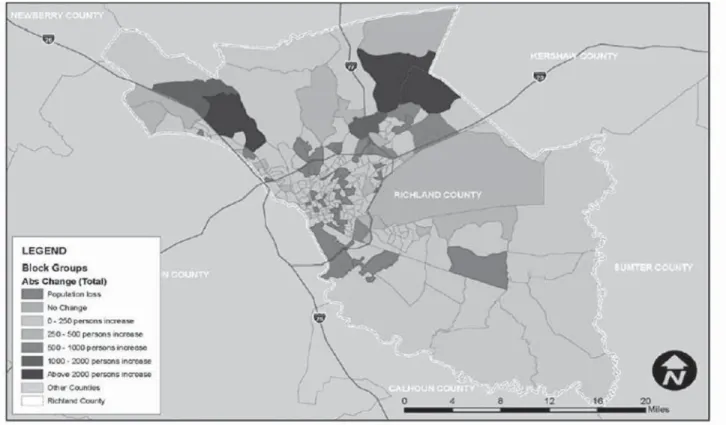
Although Northeast Richland has experienced the
fast-est growth in the region, the County government
en-acted growth controls that primarily impen-acted Lower
Richland, an area with only marginal population growth
(See Figure 2). These land use controls attempted to
limit development in the area by mandating larger mini-mum lot sizes, a move which amounted to a
“down-zoning” of many properties in Lower Richland. This
downzoning raised concerns about the likely impact
of reducing property values, given that these policies would discourage critical opportunities (jobs,
infra-structure, tax base) from locating in the community.
Another land use control attempted to target new
devel-opment in Lower Richland to newly planned residential villages. The lack of infrastructure and investment in
Lower Richland, however, created serious doubts about
the likelihood of these villages being built. Moreover,
because many of the planned villages were to be non-employment villages, and there were no plans to
in-crease public transit to the area, this community would
continue to be isolated from good jobs.
Because the plan lacked any real provision for equity
and investment in the Lower Richland community, it
created a tension between advocates promoting certain
smart growth policies and advocates for investment in Lower Richland. This tension remains to this day an
impediment to sustainable development in Richland
County.
Equitable Solutions for Richland County
What is the solution to this apparent con ict? The rst
step is to revise land use policies so that they support
both environmental and equity goals. In fact, equity is essential to promote a healthy environment, as seen in
research that has found that metropolitan regions with
greater racial equity also have stronger environmental
policies.9 The second step is to ensure that land use controls achieve their stated objectives, since some
strategies which would appear to stem sprawl may
ac-tually increase sprawl. For example, large lot zoning
is rarely an effective strategy for slowing suburban and exurban growth, and it usually results in more land lost
sprawl in the county, and would have serious negative
repercussions on the availability of opportunities for Lower Richland’s African-American residents. A
simi-lar analysis of the “equity” impact of land use planning
on marginalized communities should accompany any
proposed changes to land use policy.
Most importantly, planning that promotes both equity
and smart growth must include a more inclusionary
process of gaining public and stakeholder input. Mar-ginalized communities need a seat at the table, coupled
with the resources and research to inform their policy
suggestions. In the case of Lower Richland, the
com-prehensive plan drafted for the county as a whole sim-ply did not address many of the most pressing issues of
concern to residents of Lower Richland: unfair lending,
which forced most property owners into manufactured
housing, lack of water and sewer infrastructure,
inequi-ties in public school quality, and inequiinequi-ties in the devel-opment of sustainable economic opportunities.
Communities of Opportunity: A Development Framework for the Future
How can we learn from the Richland County example
and avoid future con icts between environmental and
equity goals in development policy? Our Institute has
developed a conceptual framework for sustainable de-velopment that re ects the goals of producing a vibrant
economy, equitable development, and an
environmen-tally healthy community. We refer to this framework
as “Communities of Opportunity” and have used this model to successfully organize and inform community
leaders and policymakers in adapting more sustainable
policies to achieve sustainable communities.
Figure 2: Richland County, SC Population Change (Absolute): 2000-2010 (projected)
The fundamental premise behind Communities of
Op-portunity is that policy should foster social and eco-nomic opportunity within neighborhoods and should
proactively connect all residents to such opportunities
throughout broader metropolitan areas.11 As a result, marginalized residents will have access to the resourc-es and opportunitiresourc-es they need to succeed; in turn, the
entire region will realize social, environmental, and
economic improvements that will bene t all residents.
The model is based on decades of research and policy experience, which support the concept that opportunity
matters, and that systematically denying opportunities
to certain populations and communities drives sprawl
and harms everyone.12
Speci cally, we propose the following policies for
pro-moting Communities of Opportunity:
• Policies should address the lack of opportunities for high quality education and sustainable
em-ployment, and investment in infrastructure and
housing, in depressed neighborhoods and
commu-nities.
• Policies should work to address problems of
con-centrated poverty and should proactively connect
low-income residents to areas with a gring job
market and high quality schools.
• Economic development policies should help
mar-ginalized populations build assets, increase the
skills of the work force, and improve the
educa-tional system.
• Growth management policies should protect the
integrity of communities on the rural/urban fringe
in gentrifying areas, while assuring that affordable
housing opportunities are included in high-growth areas.
Conclusion
Planning that promotes equity and investment in com-munities isolated from opportunities can help decrease
the poverty and sprawl that is often created by the ight
of population and resources to outlying areas. By
ad-dressing the various problems challenging urban
com-munities, this framework will help stem the vicious cy-cle of urban decline and suburban sprawl that produces
signi cant economic and environmental harm.
Endnotes
1 The authors would like to extend their gratitude to
Lynne Wolf of the Center for Social Inclusion for her
assistance and guidance with this article.
2 The President’s Council on Sustainable Development.
(1996). Sustainable America: A New Consensus for
Prosperity, Opportunity, and a Healthy Environment.
Washington, DC: Government Printing Of ce.
3 American Planning Association. (1999). Planning
Communities for the 21st Century. Accessed on-line
at:
http://www.planning.org/growingsmart/pdf/plan-ningcommunities21st.pdf.
4 Florida, Richard. (2005). Flight of the Creative
Class: The New Global Competition for Talent. New
York: Harper Business, 194.
5 Business leaders in the Chicago region have been
instrumental in recent advocacy for housing reform through the Chicago Metropolis 2020 initiative. For
more information about the initiative and the
corpo-rate pledge, please visit: “The Metropolitan Principles
Corporate Pledge FAQ.” http://www.chicagometropo-lis2020.org/10_20faq.htm.
6 Thayer, Kelly. (2003). “Look Close: Flood of Money,
Words Yield Scant Improvement in State Roads:
Exclu-sive study nds deep cracks in costly repair program, greater need for ‘ x it rst.’” Michigan Land Use
In-stitute. Great Lakes Bulletin News Service. March 3,
2003. See also Schneider, Keith. (2002). “Michigan’s
Smart Growth Governor and Her Unlikely Allies: Gra-nholm and Republican leaders share similar values on
sprawl.” Michigan Land Use Institute. Great Lakes
Bulletin News Service. November 22, 2002.
7 Or eld, Myron. (1998). Metropolitics: a regional
agenda for community and stability. Washington D.C.
The Brookings Institution and Cambridge MA, The
8 For more information related to the Center for
So-cial Inclusion’s applied research in South Carolina, visit: http://www.centerforsocialinclusion.org/projects_
SC.html.
9 Torras & Boyce. (1999). “Income, inequality, and
pol-lution: A Reassessment of the Environmental Kuznets Curve.” Ecological Economics, 25, 147-160. See also:
Boyce, Kemer, Templer & Willis, “Power distribution,
the environment and public health: A State Level
Anal-ysis.” Ecological Review, 29, 127-140.
10 EPA Region 4, Southeastern Regional Environmental Finance Center & University of Louisville, Center for
Environmental Policy and Management. (n.d.)
“Deal-ing with Growth: Alternatives to Large Lot Zon“Deal-ing on the Urban Fringe. Practice Guide #5.” Accessed online
at http://cepm.louisville.edu. See also: “Critics Fear
Higher Costs and Even More Sprawl.” (2003, June 23).
The Atlanta-Journal Constitution. See also Arendt, Ran-dall. (n.d.). Open Space Zoning: What It Is & Why It
Works. Planning Commissioners Journal.
11 powell, john [sic]. (2003). “Opportunity-Based
Housing.” Journal of Affordable Housing and Com-munity Development Law, Winter 2003, 188.
12 Galster, George. (1992). “A Cumulative Causation
Model of the Underclass: Implications for Urban
Eco-nomic Development Policy.” The Metropolis in Black and White: Place, Power, and Polarization, G.C.
Gal-ster and E.W. Hill. (Eds.). Center for Urban Policy
Re-search, Rutgers University.
13 Friedrichs, Jurgen, Galster, George & Musterd, Sako.
(2003). “Neighborhood Effects on Social
Opportuni-ties: The European and American Research and Policy
Context.” Housing Studies, 18,6., 797-806.
See also: Galster, George & Killen, Sean. (1995). “The Geography of Metropolitan Opportunity: A
Reconnais-sance and Conceptual Framework.” Housing Policy
Debate, 6,1, 7-43. See also: Turner, Margery &