ABSTRACT
BEVERLY A. YOUNG. A Case-Control Study of Diarrhea,
Water and Sanitation in Rural Malawi. (Under the
direction of Dr. John Briscoe)
An epidemiologic case-control study was conducted to test 1) the
hypothesis that improved water and sanitation would reduce diarrheal
incidence in children under five years of age, and 2) the feasibility of
using a case-control design to evaluate health impacts of environmental
interventions. Both improved water sources and access to latrines were
associated with increased rather than decreased diarrhea incidence except
when the children were exclusively breastfed. This increased incidence may be the result of diminishing or delayed immunity to diarrheal
diseases when sanitation and water facilities are improved. The results
show the need for health interventions which couple improved
environmental services and food hygiene. The significance of the findings are limited due to the poor precision of the estimates of the effect measures. Strong interactions between water, sanitation and
breastfeeding would necessitate a sample size at least four times larger
than what was used. Future case-control studies on diarrheal morbidity
should anticipate such interactions and increase sample sizes to
detect changes in diarrheal incidence which would be of public health
TABLE OF CONTENTS
Page
Acknowledgements ... iv
Introduction . . . ... 1
Materials and Methods .... ... 3
Results... 9
Discussion ... ... SO References... 28
LIST OF TABLES
Eiai
1. Distribution of Selected Variables in Cases and Controls . 10
2. Bacteriologic Water Quality ... . IS 3. Diarrheal Pathogens Isolated in Malawi Samples ... 13
i
^. Crude Odds Ratios... 15
ACKNOWLEDGEMENTS
This investigation was conducted as part of a research and
evaluation program supported by the U.S. Agency for International
Development Mission to the Republic of Malawi. The funding was provided under Contract C0-61S-0000-5-50003. The author wishes to acknowledge the considerable support of the many people in Malawi who enabled this work,
especially staff within the Ministry of Health and the Water Department, Ministry of Works. The staff of the South African Institute of Medical
Research, Johannesburg, were responsible for the diarrheal etiologies and are due special thanks for their technical and financial support.
INTRODUCTION
Diarrheal diseases are a major health problem in developing
countries? being a leading cause of illness and death in young children
(Walsh and Warren, 1979). Using 1980 population estimates, diarrhea accounts for about 800 million episodes of acute illness and nearly 5 million deaths annually in Africa, Asia (excluding China) and Latin America (Snyder and Merson, 1982). Children under 2 years of age are
especially vulnerable with the highest diarrheal mortality rates found in
infants and 1-year olds and highest morbidity rates in children 6-11 months of age.
Environmental interventions including water supply and excreta disposal improvements have been advocated by the World Health
Organizatiion as part of a multifaceted strategy for diarrhea control
(World Health Organization, 1985). Considering results of past studies, estimated reductions of 35-507. in diarrhea morbidity have been forecast for well-designed projects combining water supply, excreta disposal and
hygiene education (Esrey, Feachem and Hughes, 1985).
Many studies on the health effects of improved water supplies and
excreta disposal facilities have methodological problems which cast doubt
on the validity of their conclusions, however. Blum and Feachem (1983)
cite eight of these problems which include study design, validity of
information and analytical issues. They draw attention to the need for
studies on existing water supply and sanitation programs which are
been presented for applying case-control study design to diarrheal impact
evaluations of environmental interventions in order to overcome many of
these methodological problems (World Health Organization, 1985). A case-control study would allow a more rapid evaluation of environmental
projects than prospective studies and require a much smaller sample size than other designs if the disease of interest occurs infrequently among
the population. Additionally, such a study could be initiated only after the improved system is shown to be functioning adequately and used
appropriately. These potential advantages could result in substantial time and cost savings, but field trials are necessary to evaluate the feasibility of this approach.
The present study is the first such application of a case-control
design to study the association between severe diarrhea in children under 5 years of age and improvements in water supply and sanitation. The
rural water supply project in Malawi was selected because of its
MATERIALS AND METHODS
Stydy L9£iiion and PoEyiitign
The rural eastern Zomba district in Malawi was the area of recruitment for this case-control study. The tropical climate has a marked rainy season from November to March which coincides with peak diarrhea incidence in young children. Around half of the inhabitants are subsistence farmers growing maize or rice; the other half earn outside income through fishing, farming or small businesses. The
scattered small villages are dominated by houses built of mud or
sun-dried bricks. Several tribes predominate in this region but cultural
and behavioural differences are negligible.
Part of the area is served by a gravity-fed piped water system
supplied by untreated mountain streams. The system has been operational since 1981 and serves around 200 inhabitants at each standpost. These rural piped water systems are based on self-help community development and have a high degree of acceptance and use. The rural piped water project has a counterpart health education and sanitation program in
those villages served by standposts. Other water supplies in this region
consist of older boreholes, unprotected surface wells and streams and rivers.
Diarrheal diseases rank as the third highest cause of morbidity
and fifth highest cause of mortality in children under 5 years of age in
Malawi according to outpatient health facility and hospital data
similar rural community during the rainy season (Lindskog, 1983).
Diarrheal diseases increase in frequency beginning in September and peak
in January-March during the rainy season.
Study Design and Data Collection
Cases and controls were selected at one government and two private health clinics between January and May, 1985. All children under 5 years
of age reporting with severe diarrhea, or mild diarrhea and no other symptoms were chosen as cases. Symptomatic diagnoses were made by a
project nurse who classified severe diarrhea by dehydration and k or
more loose stools per day or by blood and mucous in the stool. Those children reporting 3 or less loose stools per day were classified as mild
diarrhea cases. Controls were randomly selected from children under 5 reporting to the clinic with symptoms of malaria, respiratory illness,
whooping cough or measles who did not have severe diarrhea. Fifty percent of the controls had malaria and another forty-five percent had
respiratory illness. Cases and controls were matched on clinic of recruitment and time of diagnosis. Time matching created incidence-density sampling which obviates the need for assumptions about the exposed proportion and disease rarity when estimating the incidence-density ratio. (Greenland &ͣ Thomas, 1982).
The sample si2e was calculated to detect a 33*/. reduction in
diarrheal morbidity <Odds Ratio=0.67) at a 5'/i one-sided significance
level and a power of 90y.. A sample of ^50 cases and ^50 controls would
thus be sufficient to evaluate the protective effect of a single factor
such as improved water or sanitation. A total of 399 cases and ^^0
controls were selected at the clinics and 95*/. of those had follow-up
measurements were collected by the project nurse and an assistant at the clinics. In the last month of the project, stool samples and rectal
swabs were collected at the clinic from a small random sample of both
cases and controls for diarrheal pathogen isolation studies. The follow-up home interviews were conducted by trained female enumerators who
collected data on environmental and socio-economic conditions.
Observations and questions administered to the mothers of the children
provided information on water sources, uses and quantity of water,
excreta disposal (existence and condition of a latrine), education and
economic indicators (occupation, house construction). The questionnaires
are presented in Annex A. Sets of samples of household drinking water and the water sources were randomly collected for 34*/. of the respondents
at the time of the household interview.
Laboratory analysis of the water samples identified the presence and number of fecal coliform and fecal streptococci organisms. Analyses were performed within 4 hours of sample collection using the membrane
filtration technique with Millipore field testing kits and incubators.
(Lewis 8, Chilton,198^)
Fecal samples and rectal swabs were refrigerated and air-shipped to South Africa where they were analyzed for diarrheal viruses, bacteria and parasites. Bacteriological samples were preserved in Amies medium and
parasitological samples in polyvinylalcohol. All samples arrived at the
laboratory within 2 weeks of sample collection at the health clinics.
organisms (Freiman et al., 1977; Richardson et al., 1983). The E^ cgli
isolates were serogrouped with a panel of sera representing the classical
enteropathogenic E^ cgl.i <EPEC) and enteroinvasive (EIEC) serogroups. All Ei cgli isolates were tested for the production of heat-labile
enterotoxin using a tissue culture technique and for heat-stabile
enterotoxin in baby mice. Only isolates that belonged to EIEC serotypes
were tested for enteroinvasive potential in guinea pig conjunctivae
(Sereny's test). All stool samples were checked for rotavirus using the
enzyme-linked immunosorbent assay (ELISA) (Schoub et al., 198S). A DNA
hybridization ("Dot Blot") technique was used for the determination of
Adenoviruses types 40 and 41 which cause gastorenteritis (DeJong et al.,
1983). Parasitological stool samples were centrifuged after saline addition and then mixed with a merthiolate-formaldehyde solution and ether. This was centrifuged again and the pellet resuspended in merthiolate-formaldehyde before examination. In addition trichrome
staining was carried out on all these stools.
Statistical Analysis
Four exposure categories were created based on the improved or
unimproved status of the water supply and excreta disposal facilities.
The reference exposure group had unimproved water supply and unimproved
sanitation, while the other three groups had either an improved water
supply (piped water or boreholes) or improved excreta disposal (a
latrine), or both. Since diarrheal diseases have many known risk
factors other than water and sanitation, these were included as a grigri
confounders in the specification of the logistic regression model. The
confounders included were age, child feeding practices, water
the well-baby clinic and level of health education. Dichotomous response
variables were used to represent all categories of confounders except for agei clinic attendance and water quantity which were treated as
continuous variables. The child feeding practice was specified as an interaction term due to the relationship established in a prior study
(Butzi Habicht and DaVanzo, 1984). Since controls were matched to cases on the basis of clinic and time of recruitment and both of these were
exposure related but not disease relatedi clinic and time of recruitment
were treated as selection confounders (Miettinen 8c Cook, 1981). Both
piped water availability and access to latrines varied during the 4 months of recruitment since heavy flooding caused pipeline breaks and destruction of the mud-walled latrines. House-to-clinic distance was
also controlled to eliminate bias due to an association between distance
and water service and the differential distances that cases
and controls lived from the clinic (World Health Organization, 1985).
The odds ratio estimate from the logistic regresion analysis was used to adjust for confounding variables. The matched odds ratio
estimate, using categorical matching on time of exposure, is a consistent estimator of the incidence density ratio (IDR) (Greenland & Thomas,
1982). Regression coefficients were fitted by maximum likelihood
estimation and 95'/. confidence intervals around the IDR estimates were calculated using the method given by Kleinbaum, Kupper and Morgenstern (1988).
Anthropometric data were analyzed with reference to the recommended NCHS population (Waterlow et al. 1977). These data were not included in the logistic regression model, however, since nutritional status is an
episodes. Had nutritional status been specified as an independent
variable in the model it would create bias in the estimates (Schultz*
RESULTS
Qd§E§£i§Ei§ii£§ 9f iiydy P9Eyl§iion
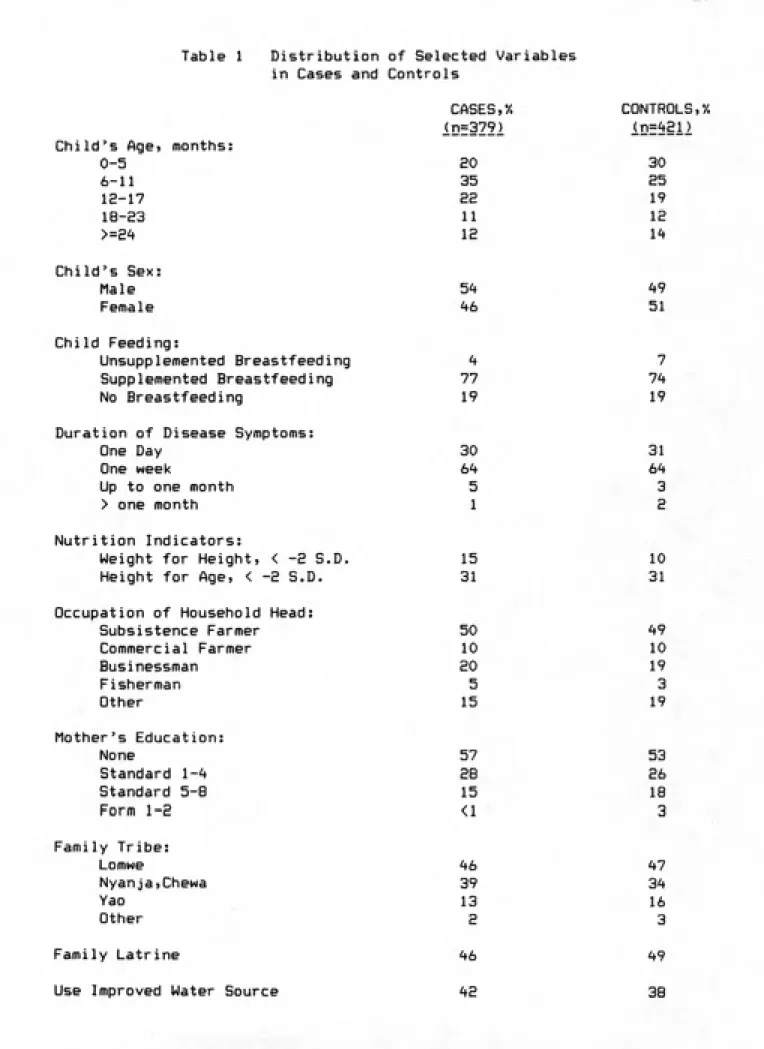
Cases and controls were similar with respect to age, sexi
breastfeeding practices and severity of disease as judged by duration of
symptoms prior to the clinic visit (Table 1). Ten percent more controls than cases were age 0-5 months^ but this was balanced by 10'/« more cases
in the 6-11 month age group. Eighty-seven percent of the children were under S years of age. The anthropometric indices showed more current malnutrition among the diarrhea cases than controls: 15*/. of cases
compared to 10'/. of controls were less than two standard deviations below
the median weight for height of the reference population. Long term malnutrition (as measured by height for age) was similar for cases and controls. Case and control families had similar occupations and tribal associations. A slightly higher level of the mother's education and more
frequent presence of a family latrine was evident among control families.
Case families more frequently used improved water sources than controls>
by 42 to 38'/.. Quantity of water used in the homes of diarrhea cases
averaged 31 liters/capita/day (led), while it was 32 led for control families. Due to the abundance and convenience of unprotected water sources during the rainy season, quantity used varied little between
improved and unimproved water sources.
y§tiL Qyiiii^
Table 1 Distribution of Selected Variables
in Cases and Controls
10
Child's Agej months:
0-5 6-11 12-17 18-E3 >=24 CASES,*/. lDf3Z?2 20 35 22 11 IS CONTROLS,'/. 30 as 19 12 It* Child's Sex: Male Female 5^ ^6 ^9 51 Child Feeding: Unsupplemented Breastfeeding Supplemented Breastfeeding No Breastfeeding
Duration of Disease Symptoms:
One Day
One week
Up to one month
> one month
77 19 30 5 1 7 7'f 19 31 3 S Nutrition Indicators:
Weight for Height, < -2 S.D. Height for Age, < -2 S.D. Occupation of Household Head:
Subsistence Farmer Commercial Farmer Businessman Fisherman Other 15 31 50 10 20 5 15 10 31 ^9 10 19 3 19 Mother's Education: None Standard 1-^ Standard 5-8 Form 1-2 57 28 15 <1 53 26 18 3 Family Tribe: Lomwe Nyanja,Chewa Yao Other 46 39 13 S 47 34 16 3 Family Latrine
Use Improved Water Source
46
42
49
11
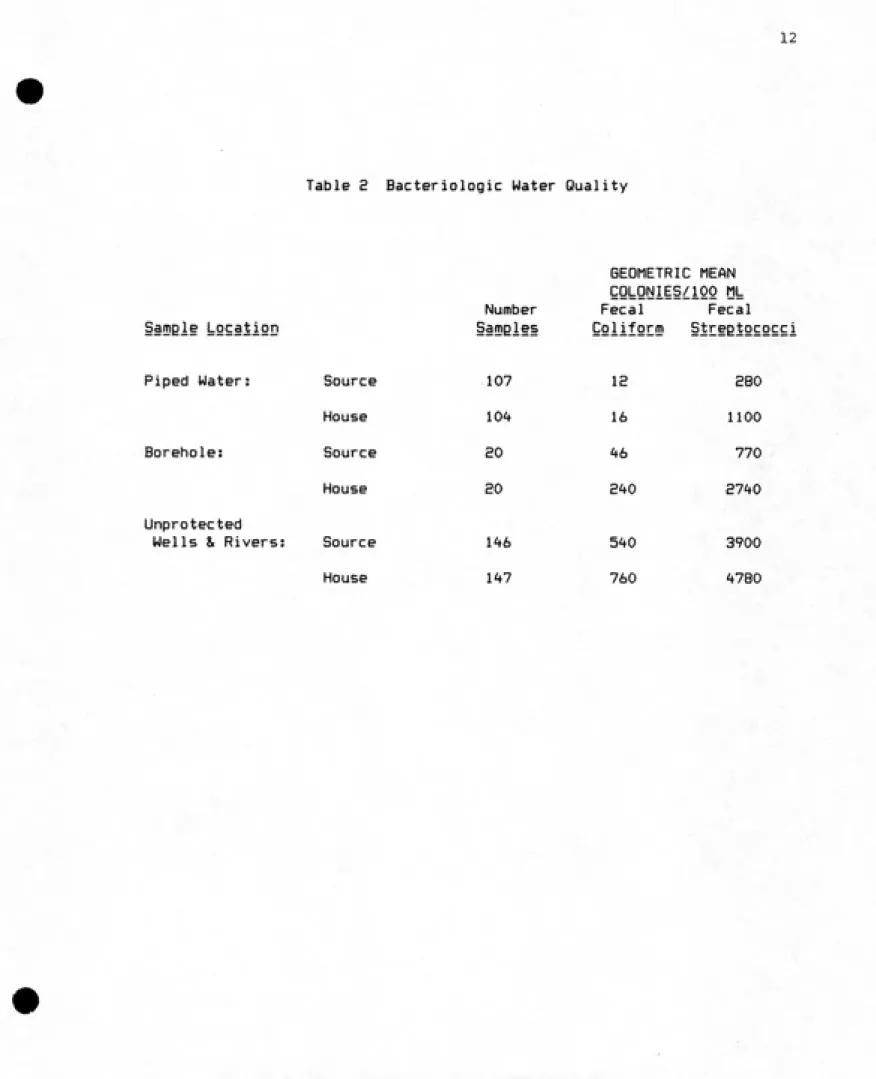
streptococci counts> was significantly better in the piped water supply
and boreholes than in the unprotected wells, rivers and streams (Table
E). The fecal coliform counts for the improved water supplies,
standposts and boreholes, averaged less than 50 colonies per 100
milliliters whereas the unprotected sources generally had fecal coliform
levels above 500 colonies/100 ml. Fecal streptococci levels typically were an order of magnitude greater than fecal coliform levels. The
persistence of fecal streptococci organisms, regardless of source or
season, has been noted previously in Malawi (Lewis & Chilton, 1984). Household quality was primarily a function of quality at the source.
An analysis of variance was performed to assess the effect on household
water quality (FC and FS logarithmic values) of; water source, where the water jar was stored, whether the jar was covered, whether the dipping cup had a handle and whether the same or different jar was used for fetching and storing water. The only statistically significant association with household water quality was the source of the water
(p<0.01). The lack of association for the storage variables may be
because there was little variation in water collection and storage habits in this area, with most women storing water in their homes, covering the
jar, and using a cup with a handle. Based upon these results, users of
piped water or boreholes were defined as the exposed population and users of unprotected sources were considered unexposed.
fii§EEt!§§l iiisi9ai§s
The pathogen isolation rates were higher among diarrhea cases than
controls for viruses and parasites but the same for bacteria (Table 3).
Thirty-four stool samples from cases and controls were examined for
12
Table S Bacteriologic Water Quality
Samele LocatiQD
Number Samgles
GEOMETRIC MEAN
QQkQNiiS/lQO ML
Fecal Fecal
QQiiform Streetococci
Piped Water: Source 107 IS SBO
House 104 16 1100
Borehole: Source 20 46 770
House ao E40 2740
Unprotected
Wells & Rivers: Source 1-^6 540 3900
13
Table 3
Diarrheal Pathogens Isolated in Malawi Samples
Viruses Rotavirus Adenovirus Diarrhea Cases 16.7% (4/24) 0% (0/24)
Overall 16.7% (4/24)
Controls
0% (0/10) 0% (0/10)
0% (0/10)
Bacteria
E. coli isolates:
EPEC 8.3% (4/48)
4.9% (2/41)
ETEC 2.1%
(1/48) 4.9% (2/41)
EIEC 8.3%
(4/48) 17.1% (7/41)
Salmonellae 12.3% (6/48)
4.9% (2/41)
Shigella 0% (0/48) 0% (0/41)
Aeromonas hydrophila 0% (0/48) 2.4% (1/41)
Campylobacter jejuni 0% (0/48)
ͣ
2.4% (1/41)
Overall 27.1%
(13/48)^
26.82; (11/41)Parasites
Ascaris lumbricoides ova 4.2% (1/24)
Entamoeba coli cysts 8.3% (2/24) Entamoeba histolytica cysts 4.2% (1/24) Taenia sp. ova 4.2% (1/24) Giardia lamblia cysts 4.2% (1/24)
Overall 25.0% (6/24)
10.0% (1/10) 0% (0/10) 0% (0/10) 0% (0/10) 0% (0/10) 10.0% (1/10)
The EPEC serogroups recovered from cases were 055 (2), 0119 (1) and
0142 (1). The 2 EPEC from controls comprised one isolate each 026
and 055. All EIEC strains typed were 0144.
2
These figures count multiple pathogens per sample only once.
No significant differences for total isolation rate or group
14
for bacterial pathogens. Multiple pathogens were found in three
diarrhea cases (IE.5*/.) and one control (10*/.) when all laboratory
analyses were conducted on stool samples. When a single diarrheal
pathogen was detected in a sample it was a bacterium in 50'/. of the
samples, a parasite in 36'/. and a virus in 1^'/..
The overall isolation rate among diarrheal patients was 5^'/., which
is good considering difficulties in sample collection and shipment to
South Africa. Diarrhea due to non-infectious causes, extra-intestinal
infection, die-off of the organisms or other etiologic agents may account
for some of the instances where no pathogen was detected. Although
significant differences in isolation rates between the diarrhea patients
and controls were not found, the trend in the viral and parasitological
results indicate this may be more a function of small sample sizes than
actual similarity. The similarity of bacterial isolation rates for cases
and controls is not uncommon and is probably indicative of the
asymptomatic presence of intestinal pathogens in the controls.
Health Effects of Envirgnmentai iDiiLventigns
The effect of improved water and sanitation upon the risk of
diarrheal disease was estimated through crude, stratified and
multivariate logistic regression analyses. Table 4 presents the results
of the crude analysis with reference to those children without a
protected water source or latrine. The diarrheal risk increased if only
a protected water source was available (0R=1.71, p=0.01) and showed a
small but non-significant trend towards increasing if only a latrine was
15
Table ^t Crude Odds Ratios
Protected
Water Number 95'/. Confidence Odds
Source Latrine Cases Controls Intervals Ratio
Yes Yes 68 93 0.63-1.40 0.9^^
(p=0.85)
Yes No 90 68 1.15-E.55 1.71
(p=0.01)
No Yes 107 114 0.84-1.73 l.El
(p=0.34)
16
compared to those without either intervention (0R=0.9^» p=0.85). Since
diarrhea has many other risk factors, however, these crude results are not considered reliable. A stratified analysis was performed controlling
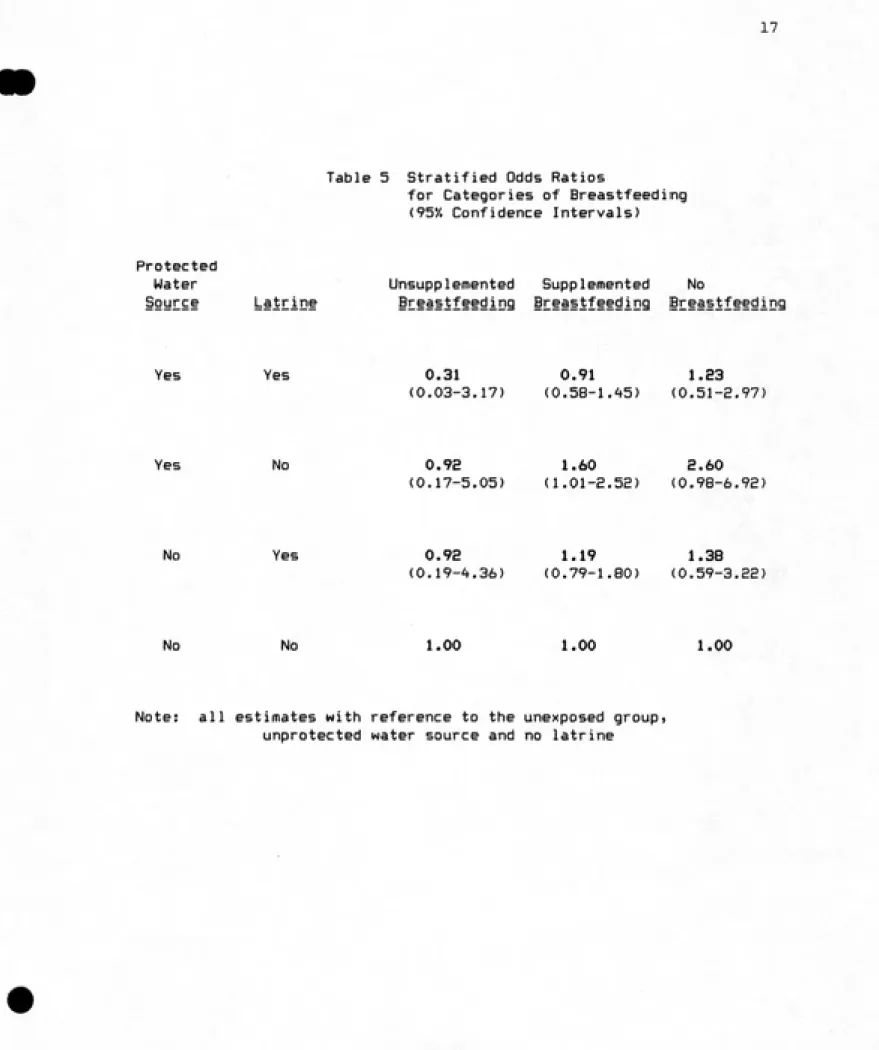
for the child feeding practices, and breastfeeding appeared as a moderate effect modifier especially when a protected water source was available
(Table 5). Protective effects of improved water or sanitation on
diarrheal risk appeared only when there was unsupplemented breastfeeding,
or if both interventions were available, for the supplemented
breastfeeding group, too. None of the OR estimates less than 1 were statistically significant, however. Generally when there was
supplemented or no breastfeeding an improved water source or latrine was
asociated with increased diarrheal risk. The risk of diarrhea had a
stronger association with protected water sources and it was marginally significant (p=0.06) for children with supplemented breastfeeding.
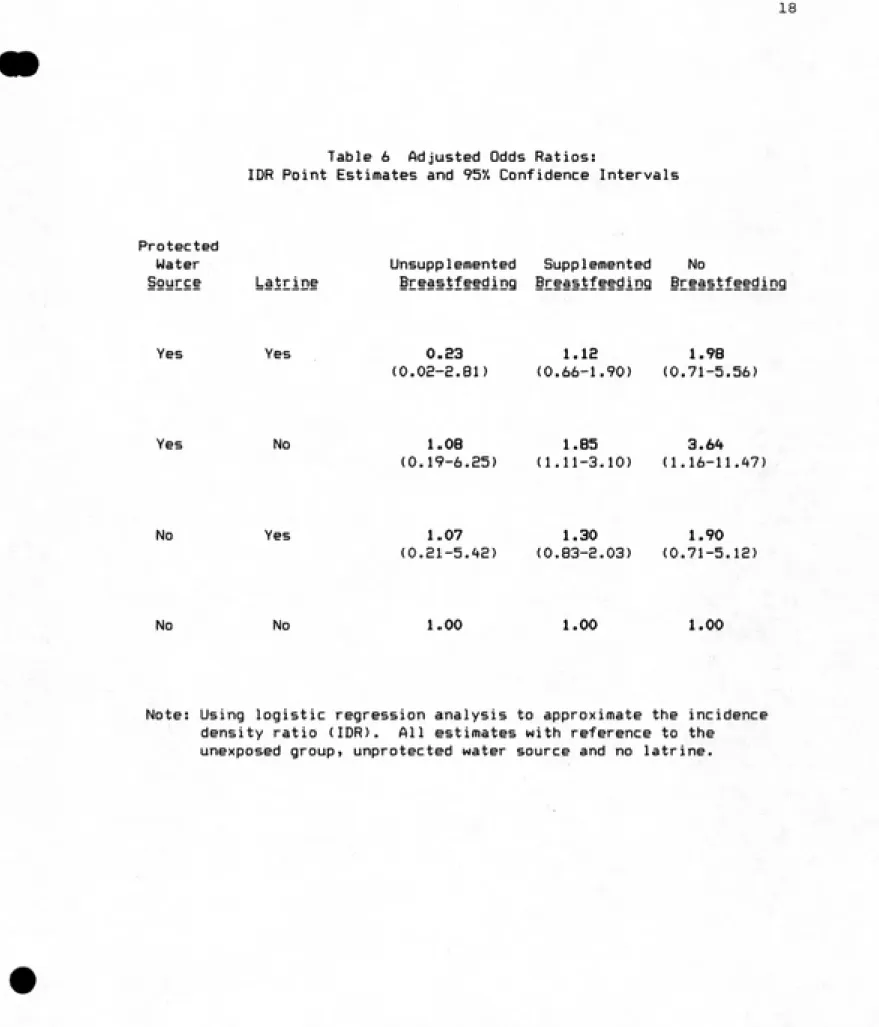
The results of the logistic regression analysis controlling for the
confounders listed earlier and specifying feeding practices as an effect
modifier yielded IDR estimates (Table 6) similar to those estimated from
the stratified analysis. In this model, children with unsupplemented
breastfeeding showed a large but nonsignificant decrease in diarrheal incidence when both improved water and sanitation were available
(IDR=0.e3, 95'/, CI= 0.02-E.81). Only when both interventions were present was this protective effect observed; solitary improvements in water or
sanitation resulted in no effect or an increased diarrheal incidence,
especially for those children not breastfed. Regardless of the level or type of environmental intervention, as supplementary feeding increased the adverse association between the intervention(s) and increased diarrheal
17
Table 5 Stratified Odds Ratios
for Categories of Breastfeeding
(95*/, Confidence Intervals) Protected
Water Unsupplemented Supplemented No
Soyrti Lr§iEiD§ §Ei§§tf§eding Breastfeeding Breastfeeding
Yes Yes 0.31 0.91 1.33
(0.03-3.17) (0.58-1.45) (0.51-2.97)
Yes No 0.9a 1.60 2.60
(0.17-5.05) (1.01-2.52) (0.98-6.92)
No Yes 0.92 1.19 1.38 (0.19-4.36) (0.79-1.80) (0.59-3.22)
No No 1.00 1.00 1.00
Note: all estimates with reference to the unexposed group,
Table 6 Adjusted Odds Ratios:
IDR Point Estimates and 95*/. Confidence Intervals
18
Protected
Water
Source Latrine
Unsupplemented Supplemented No
iEi§iifi§ding Breastfeeding Breastfeeding
Yes Yes 0.23 l.ie 1.98
(0.02-e.Bl) (0.66-1.90) <0.71-5.56)
Yes No 1.08 1.85 3.64
(0.19-6.25) (1.11-3.10) (1.16-11.47)
No Yes 1.07 1.30 1.90
(0.21-5.42) (0.83-2.03) (0.71-5.12)
No No 1.00 1.00 1.00
Note: Using logistic regression analysis to approximate the incidence density ratio (IDR). All estimates with reference to the
19
of protected water sources than it was for latrines. A significant
increase in diarrheal incidence associated with improved water supplies
was observed for children with supplemented breastfeeding (IDR=1.85, 95*/. CI = 1.11-3.10), and for children not breastfed (IDR=3.6't, 95*/.
CI=1.16-11.47). None of the IDRs associated with a subgroup were significantly different from the IDRs observed in the remaining subgroups of the population.
The analyses were repeated with a more restrictive set of disease
criteria. All diarrhea cases with mild diarrhea (n=28) and controls
with mild diarrhea associated with their malaria or respiratory illness (n=13) were excluded. Very similar results were obtained with IDR point
estimates generally the same. There were no indications of possible bias
either towards or away from the null with the broader disease
classifications. Again, the associations between diarrhea and water or sanitation showed a trend towards decreased risk with the availability of
DISCUSSION
This case-control study was conducted to test two things: 1) the
hypothesis that improved water and sanitation would reduce diarrheal
incidence* and 2) the feasibility of using a case-control design to
evaluate health impacts of environmental interventions. The results have
bearing on both policy implications for water and sanitation projects and
on the prospects for further application of case-control studies to
evaluations of such projects. First, though, several methodological and
analytical issues must be taken into consideration when interpreting
these results.
iii§
Misclassification of disease and exposure are both possible sources of bias in this study. The etiological results do not support an
association between specific diarrheal pathogens and our clinical
definition of severe diarrhea. By limiting the recruited diarrhea cases
to those reporting to the health clinics with diarrhea as the major
complaint, it was hoped to eliminate milder and non-infectious diarrheas.
The nonsignificant difference in isolation rates between cases and
controls indicates that the symptomology used in selecting both cases and
controls perhaps was not restrictive enough. Despite this, if disease
misclassification was a problem, it was nondifferential over exposure
21
The exposure classification could introduce bias since facility use (for standposts and boreholes) and availability (for latrines) were
assumed to be measures of environmental improvements which would affect young children. Although specific actions of the children could not be observed} the research intent was to investigate the impact on diarrhea
of general facility improvements and reasonable use. All families who truly used an improved water source or latrine would have been classified as doing so since classifications were based on observation of
facilities. There were no common water treatment practices to improve the
quality of a polluted source. Thus, the sensitivity of both the water
source and latrine classifications was high. If there was bias
introduced through poor specificity of the exposure classificationsj it would be nondifferential and would bias estimates towards the null value.
If misclassification of either disease or exposure did introduce bias*
then the observed trends of increased diarrheal incidence associated with
improved water and sanitation would be underestimated.
Precision
The statistical power of this study was limited by the sample size due to the strong interactions between water supply> sanitation and
breastfeeding. The power of the study was 77% (oC=0.05, two-sided) when
considering only water supply as a risk factor. The sample size had been calculated to detect a 33% reduction in diarrheal risk associated with
improved water supplies, with no adjustments in size made for confounders
or interaction effects. Controlling other risk factors as confounders in
the analysis should have little effect on sample size requirements
(increase of <15*/.) unless they are strongly associated with either
22
may require the sample size to be at least four times larger when there
is one dichotomous effect modifier. In this study> there were two
factors modifying the effect of water supply — sanitation and child feeding practices. Obviously the sample size was inadequate for
estimating risk at a desirable level of precision with two interaction terms included. By including these interaction terms in both the
stratified and logistic regressiion analyses^ more valid estimates of the
OR or IDR are available> but with an associated loss in precision. The
data from this study have revealed more about the synergistic effect of water, sanitation and breastfeeding on diarrheal morbidity than was
anticipated, but less specifically (significantly) about the effects of improved water.
iEi^§!Bi°io9ic and Health Policy ii§y§i
Both improved water sources and access to latrines were asociated
with increased rather than decreased diarrhea incidence except when the children were exclusively breastfed. External food sources would not be
a source of pathogen transmission with unsupplemented breastfeeding, whereas a contaminated water source used for infant feeding or the unhygienic practices of the child's caregiver could still be major transmission routes for pathogens. Improvements in these routes should have a more pronounced effect on diarrhea morbidity for children who are
exclusively breastfed (yet given water) than for those children who
receive additional, possibly contaminated food. The IDR point estimate
of 0.S3 indicates such an effect. Benefits of multiple interventions are
also shown in the lower IDR estimates for those children with both
23
a solitary improvement in water or sanitation.
These results are in contrast to the findings of a retrospective
Malaysian study on infant mortality, breastfeeding and environmental
factors (But2» Habicht and DaVanzo, 198^). For children with
unsupplemented breastfeeding) the presence of modern water and sanitation systems appeared unimportant for infant mortality. Recommendations were made to focus breastfeeding programs on areas with poor water and
sanitation, whereas the Malawi results would indicate the need for a
total intervention package improving water? sanitation and feeding practices.
The Malawi observations are consistent with the theory of a
nonlinear dose-response relationship (Briscoe, 1984) which credits the synergistic effect of multiple interventions with the major role in
disease outcome. An environmental improvement such as in water quality
should be evaluated not in isolation, but by the degree to which it affects the health impacts of other simultaneous or subsequent
improvements in sanitary facilities or hygienic practices. If the IDR
estimates are viewed in this manner, it can be seen that the effects of
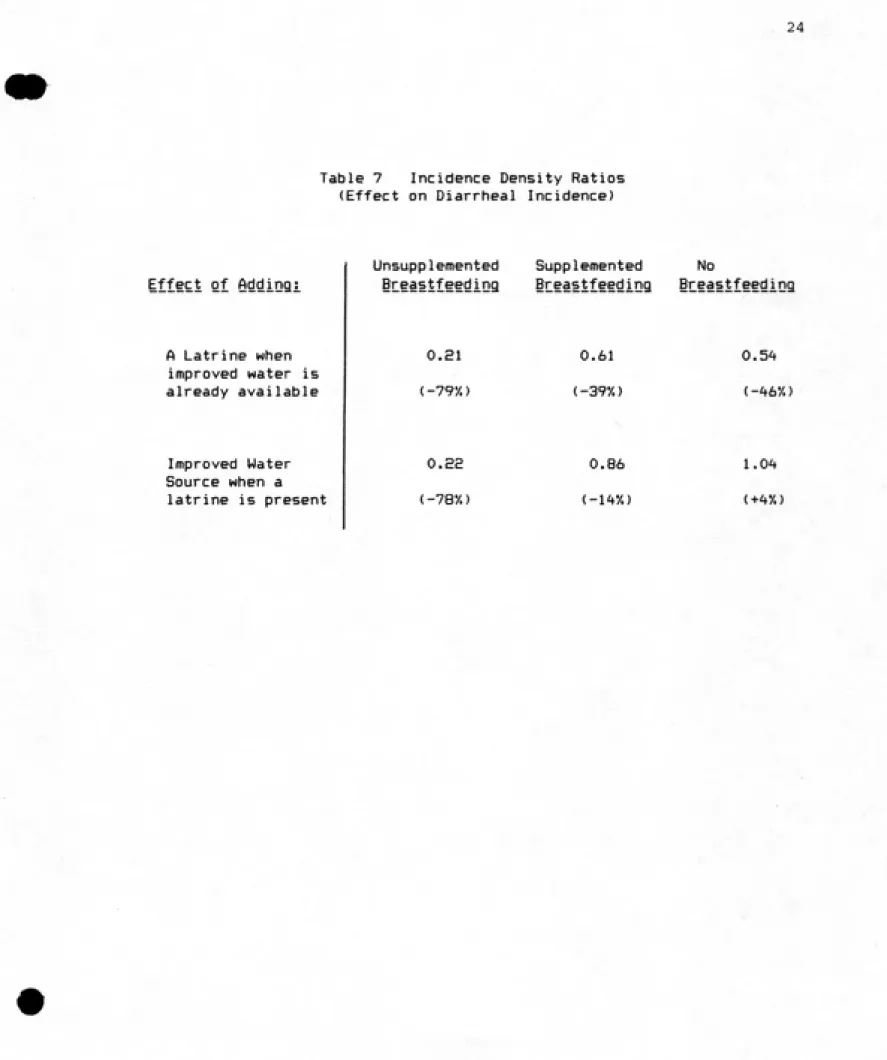
simultaneous or subsequent water and sanitation improvements could reduce the incidence of diarrhea up to 80*/. over the incidence when only one improvement was available (Table 7). Although these estimates are nonsignificant, the trend seems clear: multiple interventions are
necessary to see possible beneficial effects on diarrheal morbidity and to offset the apparently deleterious effect of a single intervention.
The increased diarrheal incidence associated with a solitary water and sanitation improvement may be the result of diminishing or delayed immunity to diarrheal diseases common to areas with very poor
Table 7 Incidence Density Ratios
(Effect on Diarrheal Incidence)
24
Effect of Addingi
A Latrine when improved water is already available
Improved Water Source when a
latrine is present
Unsupplemented Supplemented No
iLtastfeeding i!I§§stfeeding iLiiiifi§3iD3
0,21 < -79*/.)
o.se (-78*/.)
0.61 (-39y.)
0.86 (-1^*/.)
0.54 (-46*/.)
25
near 150 deaths per 1000 live births (Ministry of Health, 198^), could be classified as such a country which generally has very poor conditions. Based on extensive studies of typhoid fever in the Caribbean, Ashcroft
(196'») showed that prevalence and severity of the disease increased as hygiene and sanitation conditions progressed from appalling to a
mixture of primitive and modern. Only under excellent hygiene did both the organism S^ t^ehi and the disease become rare. In the worst
conditions, typhoid fever is rare due to immunity acquired in infancy and reinforced by additional subclinical infections. Improving hygiene
delays initial infections, emphasizes symptoms and apparently increases prevalence. This classification scheme has been used to explain current
global patterns of typhoid fever (Hornick, 1905). Similar epidemiologic
patterns have been seen with poliomyelitis virus (Gregg, 1980) and it has been suggested that the pattern may pertain to other fecal-oral diseases in developing countries (Bradley, 1978).
This model appears to be consistent with patterns seen in diarrheal morbidity in this study. As some hygiene improvements are made in either water or sanitation, the diarrhea incidence appears to increase
especially among the older, not-breastfed children. In Malawi, the child feeding practices are strongly correlated with age: unsupplemented
breastfeeding generally occurs at <6 months and children not breastfed are usually older than 18 months. An analysis of age distribution of
cases, however, showed no increase in the age of cases who are exposed to
improved water and/or latrines over those cases without these
improvements. There may not be evidence therefore for the delayed
initial infection concept, but certainly the incidence in severe
26
have improved. Under the worst conditions, diarrheal episodes may be
frequent and mild> not necessitating clinic services. If the infections
become less frequent but more severe as the environmental conditions
incrementally improve, an increase in severe diarrhea would become
apparent. This study focused on clinically reported diarrheas, presumed •
to be more severe since they required a considerable investment of
mother's time and often money to treat. The hypothesis that mild diarrheas may have been replaced by less frequent but severe diarrheas with environmental improvements seems plausible. A single intervention may therefore be necessary for future health benefits but insufficient to
realize immediate health improvements.
The health effects observed in this study also support the proposed
"threshold-saturation theory" which suggests a threshold below which no detectable health status improvement will result from investments in
water supply or excreta disposal projects under poor socioeconomic conditions (Shuval et al, 1981). Under such conditions, multiple and
simultaneous routes of disease transmission prevail, and water and sanitation projects may be "necessary to community health but not sufficient to ensure improved health status" (Shuval et al, 1981).
The results show the need for health interventions which couple improved environmental services and hygiene. A coordinated program for improving water supply, excreta disposal and food hygiene has the
27
Enosgiects for Case::Cgntrol Studies of Diarrheal Morbidity
One of the strong attractions of the case-control design for health
impact evaluations of water supply and sanitation facilities is the relatively small sample size required compared to longitudinal or cross-sectional studies. The necessary increases in sample size due to strong interaction effects would apply to both case-control and other study designs; thus case-control studies still retain their attraction. However» to detect the relatively small changes (33*/.) in incidence or risk which are of public health interest for diarrheal diseasesj we may need large sample sizes OSOOO cases), even for "small sample" designs such as case-control studies. The adequacy of a study requiring only 400-600 cases and a recruitment period of ^i-b weeks (World Health
Organization, 1985) appears questionable in light of the findings of this study. Diarrhea is a complex disease with many contributing
enteropathogens and transmission routes; interactions among risk factors should be expected and factored into the calculations of sample size. The number of required cases and controls will increase many-fold, thus involving more money and either an expanded time frame or expanded area of study. Hence, time and resources may even become constraints for
conducting a case-control study of diarrheal morbidity, as they have been
for quasi-experimental designs (International Bank for Reconstruction and Development, 1976). Other case-control studies on diarrhea and
environmental risk factors are currently in progress and will lend
REFERENCES
Ashcroft, M.I., "Immunization Against Typhoid and Paratyphoid Fevers," Clinical Pediatrics, Vol. 3, No. 7, pp. 385-393 (196^).
Blum, D., and Feachem, R.G., "Measuring the Impact of Water Supply and Sanitation Investments on Diarrhoeal Diseases; Problems of Methodology,"
iDiiLDitioQii J°yLD§i of iEidemieigg^, Vol. 12, No. 3, pp. 357-365
<198377'
Bradley, D.J,, "Towards an Engineering View of Health," in SanitatioQ in Deviioging Countries, Ed. by A. Pacey, Wiley, New York, 1978, pp. 19-23.
Briscoe, J., "Intervention Studies and the Definition of Dominant
Transmission Routes," American Journal of Egidemigigg^, Vol. 120, No. 3, pp. <:>'!t9-^55 (198^).
Bross, I., "Misclassification in 2x2 Tables," Biometrics, Vol. 10, pp.
^78-'f86 (1954).
Butz, W.P., Habicht, J.P. and DaVanzo, J., "Environmental Factors in the
Relationship between Breastfeeding and Infant Mortality; The Role of
Sanitation and Water in Malaysia," American Jgurnal of Egidemigigg^, Vol. 119, No. h, pp.516-525 (1984).
DeJong, J.C, Wigand, R., Kidd, A.H. et al, "Candidate Adenoviruses 40 and 41: Fastidious Adenoviruses from Human Infant Stool," Jgurnal of
Medical Virgiggy, Vol. 11, pp. 215-231 (1983).
Esrey, S.A., Feachem, R.G. and Hughes, J.M., "Interventions for the Control of Diarrhoeal Diseases Among Young Children: Improving Water Supplies and Excreta Disposal Facilities," Bulletin of the World Health
QE9§Di2§iieD> Vol- 63, No. 4, pp. 757-772 (1985).
Freiman, I., Hartman, H., Kassel, H. et al, "A Microbiological Study of
Gastro-Enteritis in Black Infants," South African Medical Jgurnal, Vol. 52, pp. 261-265 (1977).
Greenland, S. and Thomas, D.C., "On the Need for the Rare Disease
Assumption in Case-Control Studies," American Journal, of Egidemiologi;,
Vol. 116, No. 3, pp.547-553 (1982).
Gregg, M.B,, "Poliomyelitis" in Maxc^^OeieDiy Public Health and
Preventiye Medicine, 11th edition, Ed. by J.M. Last, Appleton-Century
29
Hornick, R.B., "Selective Primary Health Care: Strategies for Control of Disease in the Developing World. XX. Typhoid Fever," Reviews of
iDfictisys Diseases, Vol. 7, No. 4, pp. 536-5^6 (1985).
International Bank for Reconstruction and Development, "Measurement of the Health Benefits of Investments in Water Supply," Report of an Expert Panel, Public Utilities Department Report No. PUN 20, 13 pages, 1976. Kleinbaum, D.G., Kupper, L.L. and Morgenstern, H., iBidemiologi.c Rt5§§E£bl PEiD£iEi§§ §Dd QyiDiii§iiye Methods, Lifetime Learning
Publications, London, 1982.
Lewis, W.J. and Chilton, P.J., "Performance of Sanitary Completion
Measures of Wells and Boreholes Used for Rural Water Supplies in Malawi,"
Q!liii§D9i5 ID Bfnican HydroIggj^ and Water Resources, lAHS Publication No. 144~(1984).
Lindskog, P. and Lindskog, U., "Households Water Supply - A User's or a Supplier's Problem?" Progress Report IV, Linkoping University,
Linkoping, Sweden, December, 1983.
Miettinen, O.S. and Cook, E.F., "Confounding: Essence and Detection," AmecitiD JoyilDii of iBidemig1ggy, Vol. 11^, No. k, pp. 593-603 (1981).
Ministry of Health, "Health Status," Working Document, Planning Unit, Ministry of Health, Republic of Malawi, August, 1984.
Ministry of Health, "Control of Diarrhoeal Diseases," Malawi Eeidemiological QyiEtiIliy» Vol. 1, No. 3, p. 2 (1985).
Richardson, M.J., Koornhoff, H.J., Bokkenheuser, V.D. et al., "Age Related Susceptibility to Cameylgbacter jejuni Infection in a High Prevalence
Population," Archives of Disease in Childhood, Vol. 58, No. 8 (1983). Schoub, B.D., Cohen, P., Thompson, D. et al, "Variance in Rotavirus
Infection Rates in Different Urban Population Groups in South Africa," Journal of Medical Virology, Vol. 10, pp. 171-179 (1982).
Schultz, T.P., "Studying the Impact of Household Economic and Community Variables on Child Mortality," in Chil.d Suryiyal.2 Strategies for
R§§§§E£d' RoByiiiion §Dd DeyeloBfnent Review, Supplement to Vol. 10, pp. 215-236 (19i4).
Shuval, H.I., Tilden, R.L., Perry, B.H. and Grosse, R.N., "Effect of Investments in Water Supply and Sanitation on Health Status: A
Threshold-Saturation Theory," iyii§tin of the Wgrl_d Health Organization, Vol. 59,
No. 2, pp. 243-248 (198l7.
Smith, P. and Day, N.E., "The Design of Case-Control Studies: The
Influence of Confounding and Interaction Effects," iDtiLDiiioDii Journal
30
Snyder» J.D. and Merson» M.H., "The Magnitude of the Global Problem of
Acute Diarrhoeal Disease: A Review of Active Surveillance Data," Bulletin
of td§ WoEid Health Organization, Vol. 60, No. ^, pp. 605-613 (1988). Walsh, J.A. and Warren, K.S., "Selective Primary Health Care: An Interim Strategy for Disease Control in Developing Countries," New England
JoyEDai of Medicine, Vol. 301, pp. 967-97^ (1979).
Water low, J.C., Buzina, R., Keller, W. et al., "The Presentation and Use of Height and Weight Data for Comparing the Nutritional Status of Groups
of Children Under the Age of 10 Years," Bulletin of the World Health
QES§Dil§ti°D» Vol. 55, No. 4 (1977).
World Health Organization, "Report of the 6th Meeting of the Technical Advisory Group, Diarrhoeal Disease Control Group," S^ pages, Geneva,
1985.
ANNEX A
CLINIC FORM
31
Interviewer: Date
sQsitima
Clinic: l| |Pirimiti
2| I Chamba Dispensary
ASK OF THE CLINIC WORKER OR GET FROM THE aiNIC CARD: 1.1 What is the primary disease diagnosis?
iQ Diarrhea 4| [Measles
21IChickenpox
5| [Malaria
3[_JWhooping Cough 6r~]SymptOTis referable to
respiratory system
1.2 Does the child have diarrhea?
iQYes
2[~]No (If No. SKIP TO Q. 1.5)
1.3 What are the symptoms of diarrhea?
l|^Dehydration and watery 2r~]Mucus and bloody
diarrhea or 4 or more diarrhea with loose stools in the fever
last day 3Q]Mild diarrhea
I.D. Number
Day Month
D
D
D
n
1.4 Is the diarrhea associated with measles, malaria or malnutrition?
iQneasles 4| |No
2QMalaria spiDon't know
31 [Malnutrition
1.5 Date of birth
Age in months 1.6 Source of age;
l[~]Verified
21 [Estimate
1.7 Sex:
1 [ [Female
2[~~]Male
3r~]Said to be known
D
D
Page 2 32
IASK OF THE CHILD'S PARENT (or other adult who has brought
' the child to the clinic)
2.0 The government is choosing some of the children who come to this clinic to help in the study of diseases that are found here. We would be very happy if you would allow us to ask you a few
questions about your child and your family. But you have the freedom to refuse if you do not want to participate. Everything you tell us is confidential and the child's name or your name
will not appear in any of our reports. Will you answer a few
questions now and then let a young lady visit at your house and
ask you a few questions next week?
iQYes
2|~]No (If no, then thank her and ask the next person)
2.1 Child's name: __________________________________________________ 2.2 What is his father's name? _______________________________
2.3 What is your name? _______________________________________________ 2.4 What is your relation to the child?
iQMother AQsister |___|
2r~]Father SPlOther relative
sPlBrother 61 [Not a relative
2.5 From what tribal group does the child's family come?
iQYao e^Don't know I I
2| iLomwe 9[ INo response
SplNyanja/Chewa OFnother ________________
41 iNgoni
2.6 When did this sickness start in the child? (the sickness you have come for today?)
l| [Yesterday (within last 24 hours) 4r~JA month ago
2| [Before yesterday but within 8[~]Don't know
last week
3[ [Before last week but within 9| |No response
last month
2.10 Is there at^one within the child's family who had severe
diarrhea last week?
D
Page 3 33
2.7 Has the child come to the clinic since the beginning of the year?
iQYes eQOon't know
2QNo (SKIP to Q. 2.10) 9QNo response
2.8 Did the child come for the same sickness he has come for today?
1 I |Yes 8[^Don't know
21 |No 91 INo response
2.9 Was this child selected in this project then?
iQles SriDon't know
2r~]No 9Qno response
D
D
iQles 81 [Don't know
2[~1No 9r~]No response
2.11 Where does the child's family fetch their drinking water?
iQpipe 61 [Rainwater
21 [Borehole 7| [Spring
3 [~]Protected well SJ [Don't know
4[ [unprotected well 9j [No response
5[ [River O[^0ther___________________
3.0 Now we need to arrange for the time and day when you want another lady to visit you at your house and ask you a few
questions. What is a good time for you to be found at hone?
l[~~|Early in the morning 4| [After 12 noon
2I [Late in the morning 5| [Afternoon
Page 4 - ^^
3.1 Are there days you will not be found at home next week?
l| [Monday 5| [Friday
2QTuesday 6[ [Saturday
3 I__[Wednesday 7| [Sunday
AI [Thursday 8[^Any day
If so, the lady I have mentioned will come on ... and ... time, as you have suggested. Now I would like to know where you live.
Village _____________________________________
Traditional authority
How can I travel to reach your house? How would a person get to your house? (Nearby villages: missions or schools, stores, etc.)
NOW ASK THE PARENT (OR OTHER ADULT) IF YOU MAY TAKE SOME MEASUREMENTS OF THE CHILD
4.1 Weight:___________________(record in kilograms) 4.2 Height:___________________(record in centimeters)
IF THE CHILD'S MOTHER IS NOT IHE PERSON YOU HAVE TALKED TO PLEASE FIND
OUT THE MOTHER'S NAME
35
I.D. Number HOUSEHOLD SURVEY
Mother's name _________
Child's name
Person who brought the child to clinic (if different
from Mother) ____________________________________
VillageTraditional Authority Location of House
Interview Time/Day
VISIT RECORD
Interviewer Visit
Number
Date Time Result
(use Code)
Return for Interview
Date Time
Result Code:
Review by Supervisor:
1 - Interview completed
2 - Interview partly completed, appointment made for continuation
3 - No one at home
4 - Appropriate respondent not at heme;
appointment made for interview later.
5 - Refusal
6 - Other (specify) ______________________
Page 2 36
I am... from the Ministry of Health. I would like to ask you a
few questions about your children and your family. The government
wants to develop this country by bringing up our children well so that they will be better leaders for the future. Therefore, I have come
here to learn from you how you care for your children under five years of age. By so doing, the government will know how they can reduce the problems people are facing here. You have been chosen because your
child came to the Clinic this week. If you have problems in answering my questions, please let me know.
1 FETCHING WATER
1.1 Where do you fetch your drinking water?
iQpipe eQRainwater |___|
21 jBorehole 7[^Unprotected spring
3| [protected well 8| [Don't know (if this
response, then talk to
41 [unprotected well someone else)
5|~nRiver 9[_|No response
oFlother
1.2 Does your child, who came to the Clinic last week, usually drink
water from other sources?
l[~lProtected places (pipe, borehole, protected well)
2j [Unprotected places (unprotected well, rainwater,
unprotected spring)3| [Both types 9|__]No response
8| I Don't know O[~~]0ther______________
1.3 Do you know what water the child drank the week before he became
sick?
l[~nProtected places (pipe, borehole, protected well)
2| [Unprotected places (unprotected well, rainwater,
unprotected spring)
3| [Both types 9|_jNo response
8[~]Don't know Ofnother ______________
D
Page 3 37
1.4 Where do you fetch water for cooking?
iQpipe 61 [Rainwater
21 iBorehole 7|[Unprotected spring
sQProtected well 8| [Pon't know
4rnUnprotected well 9r~\No response
S^River Or~jOther ________________
1.5 Where do you fetch water for cleaning/washing food?
iQpipe 6 [^Rainwater I
21 iBorehole 7| [Unprotected spring
3|~]Protected well 8|~lDon't know
4| [unprotected well 9! [No response
SJ^River O[]^0ther ________________
1.6 Where do you fetch water for washing your utensils?
l[]]]pipe ej^ Rainwater I
21 [Borehole 7[^Unprotected spring
3|~~]Protected well 8|~]Don't know
4|^Unprotected well 9[ [no response
S^River OJ^Other ________________
1.7 Which water do you use for washing clothes?
l[~~]pipe 61 [Rainwater
2[^Borehole 7[^Unprotected spring
3[_JProtected well SJ^Don't know
4LJUnprotected well 9r~]No response
51__I River o| jother _____________
D
1,8 How many times do you bathe your child each week, each day?
l|~]More than once per day SJjPon't know
2I IOnce per day 9[~JNo response
3[^ Every other day Ol~]Other ________________
Page A
38
1.9 Where do you fetch the water to give the child a bath?
iQpipe 6J I Rainwater
2r~]Borehole 7r~]Unprotected spring
SrnProtected well 8| iDon't know
Al jUnprotected well 9[~JNo response
51 iRiver 0r~lOther ______
n
2 WATER QUANTITY
2.1 Who fetches the water you use at this house? And how old is
she/he?
Age Male Female Total
5-9
10-lA
15++
2.2 Is water usually brought to the house for the following uses?
Yes No Don't know No response
Men bathing 2 8 9
Women bathing 2 8 9
Washing clothes 2 8 9
Watering animals 2
n
8 9
Smearing floors 2
r
8 9
Making bricks 2 8 9
Other uses
1
2 8 9
Write other uses here
1
D
D
D
D
D
D
Page 5
39
3 HEALTH EDUCATION
3.1 Do you go to the Under-Five clinic with your child?
l[_]Yes 9 r~j No response
2[]]No (skip to Q. 3.3)
3.2 Will you please show me the clinic card for the child you brought
to the clinic? How many times have you been to the Under-Five
clinic with the child? Number
88 [~]Don't know
(SOURCE OF INFORMATION) iFnMother's estimate
99 rn No response
2 Q Clinic Card
3.3 How many meetings conducted by the Health Instructors have you attended since the last harvest?
OQO 3[]>2
irni 8| [Don't know
21 [2 9r~]No response
3.4 How many times have the Health Instructors visited you?
oDo
3.5 Does your child
l| [breastfeed?
2[ [breastfeed and eat other
'—'things?
3[~~] stopped breastfeeding?
3n>2
8[^Don't know
9r~[No response
sQJDon't know
9 riNo response
D
D
D
D
^D
GrasshouseD
D
Page 6 40
4 HYGIENE
4.1 Will you show me the jar/pot you use to keep drinking water? OBSERVE
IS THE JAR 1 [~~j Inside the house
2 I I Outside the house
8 Q Don't know
IS THE JAR 1 rn Covered
2 ^^ Not covered
8 rn Don't know
4.2 Will you show me the cup you use to fetch water from the jar?
OBSERVE 1 Qlt has a handle
2 l~]lt has no handle
8 rn Don't know
4.3 Do you use the same jar for fetching and storing water?
l[~|Ye8 SQDon't know I [
2| INo 9| I No response
4.4 Could you show me the place where you prepare your meals? OBSERVE
iQpilthy 3 Qciean and orderly j___|
21 I Clean but disorderly 0 f"] Other________________
WHERE DO TOEY 1 [^Kitchen (separate building)
PREPARE FOOD: I---.
2 []] On porch
D
4.5 Would you please show me where you dry your kitchenware (plates,
pots, etc.)
l| I Dish rack 5 [""Jin a basket |___|
2r~]0n the grainery 8 I iDon't know
3r~]0n grass/ground 9 [~|No response
Page 7 41
A.6 Would you show me where you dispose of your rubbish?
ij [Rubbish pit
2r~l Scattered everywhere
3I [Burnt
A[ [Buried
5 r~\ Used as manure/in
garden
8 J~2 Don't know
9 [ [No response
0 [ [other ___________
D
5 SOCIO-ECONOMIC
5.1 Where is the father of this child?
l[_]Here 9 [~~1 No response
2[^Not here
5.2 Whom do you ask when you want to take the child to the clinic?
l[^Father 4 [~^No
one2[^Child's uncle
3[~]Mother's uncle
5 [ I Grandmother or grandfather 9 I—I No response
0 ["JOther ________
5.3 What job is... (answer from Q. 5.2) doing?
l|~]Subsistence farmer 6 [^ Laborer
2r~][ Other farmer
3l^ [Businessman
4[ [Teacher
51 [Fisherman
7 |_J Carpenter
8 1^ Tailor
9 r~J No response
0 1^ Other ______
D
D
D
Page 8
42
5.5 What religion is the family?
l| I Catholic
2r~]church of Central
Africa Presbyterian
31 [Baptist
A I |church of Christ
5.6 Has the mother of the child ever
l[ [Never
21 [standard 1-4
3 j]^ Standard 5-8
4[^Form 1-2
5.7 Is the father also educated?
l| [None
21 [standard 1-4
31 ) Standard 5-8
4{ [Form 1-2
5| [Form 3-4
5 I I Zambezi Industrial
Mission 6 r~~] Anglican
8 P] Islam
9 [~~jNo response
0 [pother_______________
been to school?
5 [^ Form 3-4
7 [__I Above Foinn 4
8 rn Don't know
9 I [ No response
7 \__j Above Form 4
8 [^ Don't know
9 r~\ No response
0[ I Question not asked
because father lives
elsewhere
D
D
D
5.8 How many people use water from this house usually?
(RECORD HOW MANY IN EACH AGE CATEGORY) 0-4_ 5-9 10-14_ 15-25
D
D
D
26 and older
Page 9 43
10 OBSERVE IF THE HOUSE HAS:
Yes No Don't know
Iron sheets 2
1
8D
Cement floor1
2 8J
Mud floor 2
1 1
8
L
Burnt bricks 2 8
Mud bricks 2
1
8J
Of mud — 2f"
Glass windows 2 8
Other windows
— 2
1
8
Bath house
i-ij
2f^
5.11 Would you please show me what you use to fetch water?
Type
Height measure
to water level
Top circumference
at water level
Bottom circumference Widest circumference
for clay pots
Number fetched each day
ͤ
ͤ
D
D
D
D
D
Quantity of water fetched (liters)
Page 10 ^'^
^B|.12 Do you have a latrine?
lj~lYes (if so, ask to see it)
2|~]No
5.13 OBSERVE HOW THE LATRINE IS:
Yes No_ Don't know If the walls are destroyed
12 8
If the roof is well thatched
If the hole is covered
If there are flies
If possible, how many flies
If the path is well worn
1 2 8
1—1
1 2 8
1 1
1 2 8
1 2 8
BEFORE YOU LEAVE:
1) TAKE A WATER SAMPLE FROM THE DRINKING WATER POT. NUMBER THE BAG WITH ID NUMBER.
2) WALK TO THE WATER SOURCE AND RECORD THE NUMBER OF PACES
THANK THE MOTHER FOR HER HELP 111
Distance from house to health health clinic:
D
g g g
ͤ
If the floor is well smeared |__| |__| |__| |___|
D
D
D
D
Page 11 45
DRINKING WATER: Conductivity
Fecal coliform
Fecal strep ___
WATER SOURCE:
Fecal coliform