The current trends in ephemera cataloging and description are in web-based records, finding aids, MARC records. This paper discusses the literature devoted to ephemera cataloging and description since 1973 and identifies what kinds of ephemera cataloging repositories engage in today. Using seven repositories available on the free web at the beginning of 2009, the author has described the commonalities and differences among treatments of main entry and genre/form information. Observations are made on the effectiveness of traditional AACR2 standards of creating main entries and access points. The author makes recommendations for institutions wanting to come into currency with their ephemera descriptive cataloging.
Headings:
Printed ephemera Grey literature
CURRENT TRENDS IN EPHEMERA CATALOGING
by
Jennifer A. Townes
A Master’s paper submitted to the faculty of the School of Information and Library Science of the University of North Carolina at Chapel Hill
in partial fulfillment of the requirements for the degree of Master of Science in
Library Science.
Chapel Hill, North Carolina April 2009
Approved by
Acknowledgements
I am indebted to:
Irene Laube, who first gave me a chance.
Eileen McGrath, who introduced me to ephemera.
Jeanette Sarbo, who allowed me the idea of a “gin and marshmallows day” when things go pear-shaped.
Table of Contents
Introduction ... 3
Literature Review... 6
Methodology ... 20
Findings... 25
Discussion and Conclusion ... 42
Notes ... 47
Introduction
“Kipple is useless objects, like junk mail or match folders after you use the last match or gum wrappers or yesterday's homeopape. When nobody's around, kipple reproduces itself. For instance, if you to go bed leaving any kipple around your apartment, when you
wake up there is twice as much of it. It always gets more and more…
No one can win against kipple” he said, “except temporarily and maybe in one spot…” --J.R. Isidore, in Do Androids Dream of Electric Sheep?
In the novel Do Androids Dream of Electric Sheep, Philip K. Dick describes a slowly dying Earth, the continuous cycle of radioactive decay little by little smothering the planet. The byproduct of this disintegration is called “kipple.”1 Kipple is, by
definition, an unwanted or useless object. Places can become infested with kipple, as is the apartment of the speaker in the quote above, J.R. Isidore. His home is filled with papers, broken furniture, dust, and junk. When we pull a wadded political flyer out of the bottom of our handbag, save a playbill from a production of Madama Butterfly, or pick up a brochure for our dream vacation, we don’t call these things “kipple,” we call them “ephemera.” Transient, frangible — these are the materials that fill our scrapbooks, line our bulletin boards, and fill our mailboxes.
differently, and that they often convey the spirit of an occasion or period evocatively through their content, language and graphic style.”2 From a researcher’s perspective
ephemera can be priceless. It can have enormous informational value and often valid evidentiary and artifactual value. Ephemera can be an extremely important part of any local history collection.
Twyman has much to say on the significance of ephemera. Aside from being the best evidence for lithographical technical, social, and design innovations made in the nineteenth century, ephemera is significant for its content.3 It tells a story that may not
otherwise be told – documentation of the quotidian, language, and social mores.
Sometimes it can be the only representation left to history. A particular example of this is the Really Really Free Market in Carrboro, North Carolina. This organization is of a Marxist philosophy, periodically holding swap meets in downtown Carrboro. The only place this organization exists is in the marketplace and in its flyers. Ephemera like this exemplifies the need to represent the whole organization, not just the pieces that are convenient to preserve.
Libraries and archives, unfortunately, have a stormy relationship with ephemera. There are many problems associated with it, not least of which is quantity and access. In Dick’s novel, kipple is self-producing, and it seems that it comes from nowhere,
multiplying every time you turn your back. Like kipple, an ephemera collection can quickly become ponderous and unwieldy. In 2003 the Association of Research Libraries addressed this exact issue, and launched a conference (Exposing Hidden Collections) to explore the state of ephemera in the twenty-first century. The literature on access
matter. How are we to manage this flow of material? How are we to classify it, describe it, and keep it safe?
This study was born out of this dilemma and the author’s close work with ephemeral material for the past three years. The purpose of the study is to assess the situation as it exists at the beginning of 2009, and answer the following questions:
• What does the literature say repositories should do in regards to cataloging ephemera?
• What cataloging techniques are currently being used by repositories?
• How effective are these techniques in terms of access?
Literature Review
If the literature contains a single motif, it is this: SOS!
“An accepted minimal standard for cataloging individual pieces of ephemera clearly would be useful” – Georgia Barnhill.4
“It is too late to create rules everyone would follow: too many different
catalogues exist in too many unique institutional formats” – Julie Anne Lambert.5
“We’re all in this together. Good luck” – a respondent to Therese Lawrence’s survey.6
“Anyone who expects to find The Definitive Answer on how to provide access to visual ephemera in an archival and manuscript repository is doomed to
disappointment” – Nancy Hadley.7
“Without any universal guidelines it is tempting to return to a ‘local system’ that has, in fact, served us well in the past” – Linda Stanley.8
Ephemera Presents Unique Challenges
Ephemera is difficult to define – Richard Kolbet of the University of Iowa
compared the attempt to blind men describing an elephant.9 Chris Makepeace’s definition
is probably the most often used:
Ephemera is the collective name given to material which carries a verbal or illustrative message and is produced either by printing or illustrative processes, but not in the standard book, pamphlet or periodical format.10
different from typical library formats11 which fit easily into standard bibliographic
description. He defines ephemera according to this framework:
Ephemera are printed artifacts, usually less substantial than books, which, though intended for specific limited purposes or events, are kept by libraries and archives because they contain continuing research value, notably for the study of popular culture.12
Furthermore, Makepeace’s definition only describes printed material, but many other things such as campaign buttons, badges, magnets and bumper stickers (what the library profession terms “realia”) tend to show up in ephemera collections. Ephemera share some characteristics: they are transient documents created for a specific purpose,13 and usually
exist in a format other than the monograph. Ephemera also share some challenges. Ephemera is often flimsy and made of cheap materials, and while ephemera is classifiable, it defies conventional description, storage, and acquisition methods.
It is as difficult to place ephemera in an institution as it is to define it. Does it belong in the library or in the archives? Many professionals lump realia in with
ephemera, so perhaps it belongs in a museum? The North Carolina Collection (NCC) at the University of North Carolina at Chapel Hill has an extensive local ephemera
collection. In 2007 the collection underwent an evaluation to determine the best practice for processing and cataloging. Of the many decisions facing the curator, chief among them was to keep the collection in the NCC or to give it over to the University Archives. The nature of the material – is this library or archival material? – was under scrutiny.
cataloger or curator of a performing arts collection.14 In a donated collection, from an
important individual say, an archivist must adhere to the principal of respect-des-fonds. However, ephemera documenting the same event may be dispersed over different collections in the same library or archive, or in different parts of the same institution.
Dispersion is the case at any institution dealing with ephemera. Stanley’s case study at the Historical Society of Pennsylvania (HSP) demonstrates the problem. The HSP has three departments: the library, the Manuscripts and Archives department, and the museum collection. Through a liberal and vague collection development policy, ephemera exist in all three.15 This situation concerns the HSP staff, as material is often
duplicated across all three departments and the lack of integrated, cooperative descriptive practices makes cross-searching impossible.
Ephemera also presents a challenge to cataloging and description. Traditional cataloging (LCSH, AACR2, LC classification) is a rigid structure that works quite well with items that have an explicitly stated authority, a predictable physical description, and which clearly fall into predetermined subject categories. However, the farther away from the characteristics of traditional printed material an item gets, the harder it is to apply traditional cataloging. Different sources from the literature describe traditional cataloging practices for ephemera as “inadequate”16 and “impractical.”17 In 1989 Foley identified
Ephemera presents unique challenges by simple virtue of the many formats in which it can exist. Over the past three decades a few attempts have been made at developing a standard method of processing ephemera. No single attempt at
standardization has been effective on a national scale, however, and they exist today as case studies and recommendations. These attempts are described in the following sections.
TRENDS
To ephemera collections, the problem of non-standardization is not new. In 1972, Lawrence surveyed libraries with a desire to understand the access landscape of
ephemera collections.19
She was concerned that ephemera was inaccessible to researchers because of a lack of indexing, cataloging, and description, or perhaps unknown or non-existent procedures for doing so. The results of this survey indicate that libraries holding ephemera in 1972 engaged in descriptive cataloging, but only 18.2% of respondents indicated that each item in each category was cataloged.20 In fact, each institution in the
study handled ephemera in its own way.
In 1973, Akeroyd and Benedict inadvertently documented a hodge-podge method of descriptive cataloging when they compiled “A Directory of Ephemera Collections: A National Underground Network.” Akeroyd and Benedict profile fifteen different
Kansas’ Kenneth Spencer Research Library, cataloged its eight linear feet of material and submitted those records to the National Union Catalog.21 Another, the Social Documents
Collection at the University of Iowa, is cataloged by main entry – there is no descriptive cataloging.22 Only one collection, Akeroyd’s Alternative Press Collection at the
University of Connecticut’s Wilbur Cross Library, had a thorough system of descriptive cataloging geared towards access. Akeroyd indicates that the Alternative Press collection employed a simple cataloging system, consisting of a “separate card file divided
according to title or main entry, issuing group, subject, and place of publication or location of activity.”23 Akeroyd and Benedict find that many of the seven are arranged
categorically, and few are indexed.
The variety found in Akeroyd and Benedict’s sample is borne out elsewhere. A 1978 manual on local historical collection management states that all ephemera should be placed in a filing case by subject.24 In an article oft cited by other sources, Michael Organ
of the University of North South Wales Archive describes how in the 1980s the archive revamped their ephemera description process from filing items in a box marked
“Ephemera” 25 to indexing items by provenance and subject/title.26 The new method gave
each item at least three access points, which made finding the item in the index easier. In 1985, Andrew Wrighting was charged with processing a collection of Victorian
scrapbooks. When he found that AACR2 “proved its almost total failure to cover this type of material,”27 he arranged the collection according to eight different areas: subject,
The Rise of MARC
The emergence of the OPAC in the early 1990s granted the MARC record new potential. Freed from the physical dimensions of the paper card, bibliographic records could expand to include more access points than ever before – something professionals had indicated was important for ephemera cataloging. Organ remarks that since
ephemeral items are often “multifaceted,” describing them using more than one term makes processing and locating them easier.29 Lambert contends that “The provision of as
many access points as possible is one of the satisfactions of cataloguing ephemera,” and “we should be cataloguing the content of the item, including, of course, the images.”30
The early 1990s through the present has been one long debate over the usefulness of MARC for ephemera cataloging. While some professionals decry MARC as an
inadequate or outright restrictive tool to describe ephemera, other professionals have found success with it. Two 1996 articles are particularly illuminate this tension: Smith’s “Intellectual Control of Ephemera” and Greenberg’s “Subject Control of Ephemera: MARC Format Options.”
In her article, Smith retains a bleak outlook to cataloging ephemera, contending that “Assigning themes and subjects to a piece of paper ephemera is at best an exercise in second-guessing, at worst an imposition of the cataloger’s opinions.”31 In her opinion, the
rise of the computer corresponds to a standard nomenclature,32
a thing which still does not exist. Others have commented on this lack of standards in general. In 1996, Stanley still sought a definition for her series of ephemera, and laments the lack of universal guidelines.33 Twelve years later, in 2008, Barnhill remarks that “additional instruction
Greenberg’s article, in comparison, is optimistic. She believes that MARC, specifically the MARC-AMC and MARC-VM formats, is perfectly suited to handle ephemera in the online environment.35 Greenberg is confident that MARC is robust
enough to provide effective subject analysis as well, particularly for ephemera collections arranged singly or thematically.36 She even believes that the subject analysis used in
archives, when applied to ephemera, will alleviate the dispersal problem.37
In 2006, Copeland, Hamburger, Hamilton, and Robinson the Pennsylvania State University Libraries Special Collections published a seminal article: “Cataloging and Digitizing Ephemera: One Team’s Experience with Pennsylvania German Broadsides and Fraktur.”38 This article turns a corner on cataloging ephemera because of the detail it
provides. The authors describe their cataloging approach to these materials at great length, including a break-down of the main entry, title and variant title, place of
publication and name of publisher, date of publication, subjects and genres terms, added entries, and several notes fields. The most interesting decision, perhaps for its feeling of finality, is how to determine the content of the main entry. The authors stress that “The main entry was formulated based on rules applicable to the type of material.”39 This
emphasis on type coincides with AACR2, DACS, and Graphic Materials to align ephemera description with other descriptive guidelines.
complexity. Very large collections are unlikely to find an advantage in a categorical arrangement, and very small collections could be overwhelmed by an index. An ephemera collection with different levels of record (collection, series, item, event, etc.) could not exist in either an index or a categorical arrangement without some difficulty. In addition, growing open collections would be ill-served by either arrangement. The
solution found by the Pennsylvania State librarians is flexible in scale and complexity, and thus applies to more institutions than Wrighting or Organ.
Despite this thorough endorsement of MARC for ephemera cataloging, there exists an even more recent disapprobation. At the 2007 Rare Book and Manuscript Section (RBMS) preconference, “From Here to Ephemerality,” Lambert refuted the merits of MARC for ephemera: “I remain totally unconvinced that MARC is the best format to use for cataloguing ephemera.”40 Her reasoning is that MARC is designed for
monographs, thus neither the MARC format nor the ephemera record represented are well served by using it in another manner. At the same RBMS preconference, Georgia Barnhill discussed AACR2 for ephemera in her plenary session “Why Not Ephemera? The Emergence of Ephemera in Libraries.” She argues that AACR2 rules designed for monographs do not fit ephemera very well and that a lack of ephemera cataloging standards was a hindrance. 41
called “Exposing Hidden Collections” to discuss their results, and lament the problem of unprocessed pamphlets and printed ephemera. Though the task force was called to discuss issues facing every facet of special collections, ephemera is one type of material that particularly highlights the problems facing repositories today, and calls for new solutions.
The Special Collections task force succeeded in turning the profession’s eye to unprocessed collections, and with it, to uncataloged ephemera collections. The task force published its final report in 2006, giving an account of its activities since the “Exposing Hidden Collections” conference. These activities inspired some institutions to apply for grants to fund digitization projects43 and, in 2008 the Council on Library and Information
Resources (CLIR) launched a program to fund special collections cataloging projects. Among the institutions granted the first awards was the California Historical Society, with its proposal to create a searchable, online catalog linking the ephemera collections of four different repositories.44
The Online Environment
The online environment provides several options for institutions wishing to either enhance their MARC records or abandon them altogether: enhanced online public access catalogs (OPACs) and web-based records.
and content and places the material in a historical context. Lambert in particular describes the merits of digitization over the exclusivity of the MARC record: “Catalogue records on their own are arid means of finding a particular item or information about an item. But coupled with a digital image, they come alive.”45 A digital image may very well be a
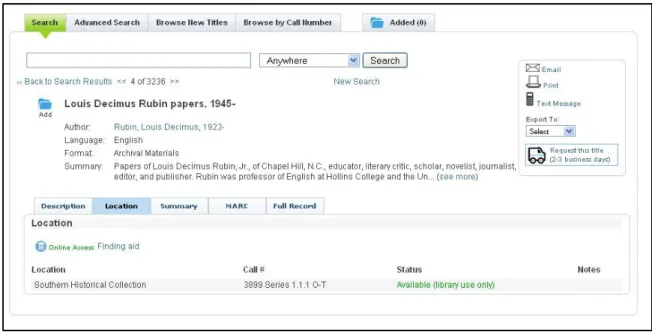
digital copy of the original item, but may also be an OCR file or photo of a three-dimensional object. Finding aids are mentioned specifically in the literature: Stanley discovered that the Historical Society of Pennsylvania materials used the most are those with finding aids attached to the main catalog.46
Figure 1: Sample Integrated OPAC Record, with EAD Finding Aid
Lambert goes further and suggests that all attempts to fit ephemera to AACR2 standards in MARC format should be scrapped, and an entirely new, web-based record adopted.47
A web-based record, in the confines of this research, is the metadata
goal, as Lambert sees it, should be effective cross-searching, made possible by common minimum fields: first line or title, names, date, subjects, etc.48
Dwindling or nonexistent resources is a pernicious barrier to integrated OPACs, however. Stanley remarks that the HSP would like to do item-level cataloging and take advantage of new technology such as integrated finding aids, but currently does not have the resources.49 As a result, the ephemera at the HSP will be treated archivally, and will
“require the researcher to engage in some creative browsing.”50 Foley wrote that full
cataloging for each item of ephemera in a collection is a luxury.51 Full cataloging,
item-level cataloging, scanning ephemera, running OCR software, and creating EAD finding aids all take a large amount of time and money in terms of training, man hours, and sustainability. For institutions without the resources to spare, this type of strategy is impossible.
These trends have implications for access. Lambert touches on this briefly by discussing cross-referencing of catalog records. “This is, for me, the raison d’être of cataloguing,” she writes.52 The point of cataloging is to provide access. The joy in
cataloging is forging connections among collections and records, thus making access easy. The only way, currently, the profession does this is through standard cataloging and description processes and agreed-upon nomenclature. As the trends related above testify, there is no such standardization when it comes to cataloging ephemera.
ACCESS
One cannot discuss collections backlog in the twenty-first century without also discussing the hugely influential work by Greene and Meissner, “More Product, Less Process: Revamping Traditional Archival Processing.”53 Greene and Meissner lament
“The existing archival culture [that] seems deeply rooted in an implicit belief that every item in twentieth-century collections is so precious that each must be scrutinized for paper clips that might damage a word.”54 To combat this they advocate that we “change
the way we process so that we can, with our existing resources, roughly triple the speed with which we process.”55 The ARL Special Collections Task Force mentioned above
studied the Greene and Meissner approach in its research,56 and as a result, in 2005, 37
repositories began testing the Greene and Meissner approach by processing collections according to their theory.57
A few years prior to the formation of the ARL Special Collections Task Force and the publication of “More Product, Less Process,” David H. Stam of Syracuse University was advocating the same sort of philosophy. Stam’s thesis is that access is more
important than preservation: “[Special collections] must get their precious treasures and scholarly ephemera into the sometimes dirty hands of potential users, must place a higher priority on access to unprocessed material…”58 Stam means the democratization of the
scholarly library; however, his ideas run parallel to those of Greene and Meissner when it comes to processing. For most acquired materials, access is the desired result, not
A suggestion that has not made a huge showing in the literature, but which is significant all the same, is collaboration among repositories. Different types of
collaboration could benefit access to ephemera collections, such as sharing the burden of designing universal guidelines for the cataloging and description of ephemera, sharing collection holdings, and sharing research about processing priorities. In a decade in which digital alliances (Calisphere, NC ECHO, and state initiatives such as NCLive and
GALILEO to name a few) grow more numerous every day, it is surprising that this point is not stronger in the literature. Johnson and Snyder are the only authors to discuss collaboration at length. In 1991 the Coalition Planning Group (Harvard Theatre Collection, Library of Congress, NYPL Dance Collection, and the San Francisco
Performing Arts Library and Museum) was formed in order to address access problems. The Planning Group resulted in the Dance Heritage Coalition (DHC), an NEH funded project.60 Among many notable achievements, the DHC developed coordinated
processing guidelines, and now coordinates a union catalog of dance materials and supervises NACO submissions.
Ephemera is so complex – “schizophrenic” as Stanley writes61 -- that the more
access points one has the better. Access points are mentioned in much of the literature, particularly by Hadley and Marcum.62 Both recognize that cataloging is a rapidly
changing concept. Marcum mentions that we know from “many studies” that students go to Google first because it is easier than navigating library websites and databases.63 It is
Is ephemera merely lying in wait for the profession to develop the right technology? It seems that way to Lambert and Barnhill. As stated before, Lambert believes digitization is the way to best exploit printed ephemera. Barnhill cites evidence from several repositories with digital ephemera collection that conclude the best way to improve access to ephemera collections is to mount web-based records.64 For example, at
the American Antiquarian Society, readers began asking to see originals after starting to catalog nineteenth century American broadsides.65
Though the literature is replete with case studies (e.g. Stanley, Organ, Wrighting, Copeland et. al, etc.), there was a noticeable lack of information about what the average repository is doing with their ephemera collections. The closest the profession has come to expressing this is Lawrence’s 1972 survey and Akeroyd and Benedict’s 1973
Methodology
There are no current surveys of cataloging practices among repositories collecting ephemera. This is a problem because there exists no context in which to place case studies, of which there are many. The Pennsylvania State librarians may have an
exceptional solution to the problems with MARC cataloging, but how many repositories are using MARC for ephemera cataloging in the first place? So much of the literature is devoted to the cause of providing format and genre access points for ephemera records, but there is precious little proof that it isn’t being done. For the profession to have any hope of developing any sort of cohesive plan for ephemera cataloging, it must first examine what is and is not being done.
To assess the situation as it exists at the beginning of 2009, seven repositories were selected (subdivisions are specific ephemera collections found at these repositories):
• The Australian Institute of Aboriginal and Torres Strait Islander Studies (AIATSIS) Ephemera Collection
• Long Island University (LIU), C.W. Post Library Special Collections and Archives
o Joseph Cameron Cross Theatre Collection, Circus and Buffalo Bill
Collection, Original Movie Poster Research Collection, and the Catalog of WWII Movie Posters
• National Library of New Zealand (NLNZ) Ephemera Collection
• San Diego State University (SDSU) Library Special Collections
o Printed Works: Radical Ephemera/Underground Publications Collection, Jane Adams Recipe and Menu Collection
• State Library of Western Australia (SLWA) Ephemera Collection
• University of Washington (UW) University Library o Vietnam War Era Ephemera Collection
• Washington State Historical Society (WSHS) Ephemera Collection
Criteria for inclusion in this study involved two options. The sample set of libraries were initially chosen for meeting one of two criteria. First, they were mentioned by name in the literature discussed in previous sections. Second, they appeared on a Google search for “ephemera collection.” For any library to be in the sample, the cataloging system must be apparent to the viewer, i.e., there is a PDF file to view, or the MARC record is available. The criteria eliminated ten repositories out of an initial sample of seventeen. Size, location, type of cataloging system or software, print or non-print material, or type of repository were not factors in the decision to include or exclude a repository in the sample.
Analysis
The terms in the literature review dictated the analysis. As mentioned above, the literature focused on three things: the difficulty of cataloging ephemera, different methods people had come up with to catalog ephemera, and the importance of access points, particularly main entry information and genre/format information. A large part of this analysis was
determining whether or not the cataloging systems used provide adequate access. For this research, adequate access is achieved when the user can identify the material, find information about its existence and location in the catalog, and know how to obtain the item or a copy of it.66
Stage 1 determined what cataloging system was utilized. Options included MARC, web-based records, digital galleries, indices, inventories, finding aids, or EAD finding aids. Once this was determined, the repository’s cataloging system was classified according to its type. Four types are represented in the sample: MARC, indices, web-based records, and finding aids. In Stage 2 records were extracted from each sample repository. For library catalogs, the process was straightforward. Each catalog* was searched by keyword. In all cases a broad keyword search for “ephemera” was done, and, if necessary, also a subject keyword or descriptive keyword search for “ephemera.” Other types of cataloging systems were simply scrutinized for separate record units. Records were extracted by simple cut-and-paste into separate document and labeled with the date of extraction, name of the repository, and any other information about the record that might be of use.
In order to be considered for this research, records must be ephemera according to classic definitions, i.e., printed ephemera defined by Makepeace, or non-print ephemera defined by Young.67 The types of records chosen conformed to one or more of four criteria. First, the
Repository Search Type Keyword Returned Results
Extracted
Records Date of Search
words and phrases ephemera 22 titles Feb. 6, 2009 words and phrases ephemera 23 titles Mar. 28, 2009
keyword ephemera none Feb. 6, 2009
subject keyword ephemera none Feb. 6, 2009
subject keyword printed ephemera none Feb. 6, 2009 broad keyword ephemera 785 records Feb. 6, 2009 broad keyword ephemera 790 records Mar. 27, 2009 descriptive keyword ephemera 222 records Feb. 6, 2009 descriptive keyword menu 179 records Feb. 6, 2009
keyword ephemera 5293 results Feb. 6, 2009
keyword ephemera 5393 results Mar. 29, 2009
SDSU n/a† n/a n/a 11 Feb. 6, 2009
UW n/a n/a n/a 2 Feb. 6, 2009
WSHS n/a n/a n/a 3 Feb. 6, 2009
7 SLWA NLNZ LIU AIATSIS 6 7 5
†Not applicable because the SDSU records used had specific links to the OPAC, so there was no need to search.
UW and WSHS: Only concerned with the digital collection records and metadata.
*The NLNZ catalog was offered more search options than others, so the keyword “menu” was tried just to see what would happen. Conversely, LIU was much less searchable than others, so much so that the keyword “printed ephemera” was tried in case “ephemera” was not used at all.
chosen because they demonstrated different format cataloging. Third, collection and item level records were both extracted. The fourth criterion concerned the researcher’s discretion – sometimes the records were chosen simply because they were interesting. The only exclusion criteria for records found by this process were for materials that did not fit the classic definition of ephemera mentioned above. For example, many monographs about ephemera and its
collection and study were retrieved.
Findings
What Types of Cataloging Systems are Being Used?
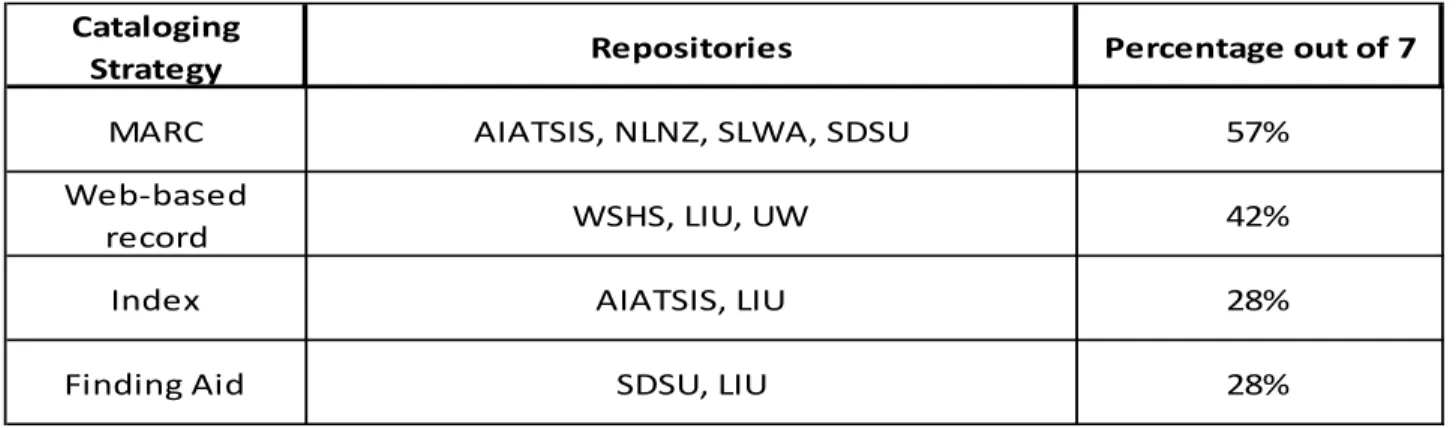
Finding aids, indices, MARC, and web-based records are ephemera cataloging strategies identified in the literature review. Four out of the seven repositories studied here used MARC for cataloging their ephemera collections. Thus MARC, at 57%, was the most often used cataloging strategy. The second most often used strategy; with three out of seven (42%) repositories were web-based records. Indices and finding aids both garnered two out of seven, or 28% each. For a summary of these findings, see Table 2.
Table 2: Summary of Cataloging Strategies Used by Sample Repositories
Cataloging
Strategy Repositories Percentage out of 7
MARC AIATSIS, NLNZ, SLWA, SDSU 57%
Web‐based
record WSHS, LIU, UW 42%
Index AIATSIS, LIU 28%
Finding Aid SDSU, LIU 28%
collection, like many of the other repositories. Instead, it had “Printed Works” and “Manuscript and Ephemera” collections.68 Samples of ephemera exist in both. The
Printed Works collection contained the Jane Adams Recipe and Menu collection, with a finding aid and a MARC record. LIU employs three different cataloging strategies at its repository: the Original Movie Poster Research Collection has an index as well as a finding aid, the Circus and Buffalo Bill Collections is a digital collection with web-based records, and the Joseph Cameron Cross Theatre Collection and the Catalog of WWII Movie Posters are both indices.
The repositories using MARC records were very similar in method. All use USMARC.69 Considering the reservation about MARC discussed above, it is interesting
that 57% of the repositories studied created MARC records for their ephemera collections. Looking back at Table #, using the genre keyword “ephemera” was successful at finding plenty of records. However, not a single repository in this study made use of the 655 Genre/form field. The closest any repository came was the SLWA. In that cataloging system, “650 x0 Printed Ephemera” was a field in each ephemera record in its system.
Internet Movie Database entry for each movie represented, presumably to add value to the collection.
In comparison, UW and the WSHS use CONTENTdm – a database software that is currently very popular among libraries for showcasing digital images and finding aids. The web-based records here are digitized images of posters, handbills, political tracts, newsletters, and pamphlets, accompanied by metadata such as title, creator, place of publication, date, and physical description. The metadata is based on Dublin Core elements, and thus much more extensive and standardized than the records at LIU.
Two repositories, AIATSIS and LIU, are using indices. The AIATSIS has one large (95 pages) PDF file as an index to its ephemera collection. And as mentioned above, LIU has indices for the Joseph Cameron Cross Theatre Collection and the Catalog of WWII Movie Posters.
The following tables and figures are arranged by cataloging strategy: MARC, index, web-based records, and finding aid. Sample main entry and genre/format information from extracted records are arranged according to the repository to which the record belongs, and by field or tag information. A discussion of each table follows.
MARC
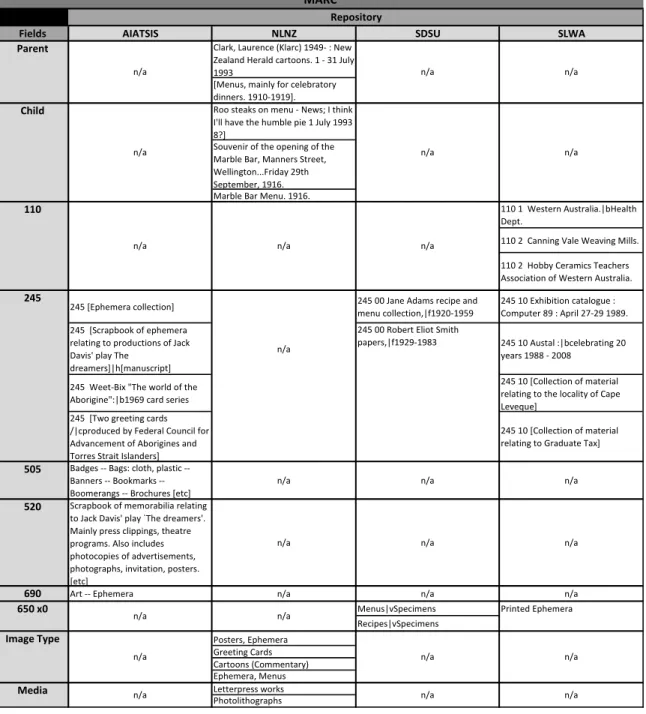
Table 3 illustrates the application the MARC format in four of the sample repositories. Similarities include putting collection titles in square brackets70 and the
The treatment of the main entry information at the four repositories represented in Table 3 differs in terms of putting the 245 field in square brackets and the inclusion of the
Table 3: MARC Formatting Samples
Fields AIATSIS NLNZ SDSU SLWA Parent Clark, Laurence (Klarc) 1949‐ : New
Zealand Herald cartoons. 1 ‐ 31 July 1993
[Menus, mainly for celebratory dinners. 1910‐1919].
Child Roo steaks on menu ‐ News; I think I'll have the humble pie 1 July 1993 8?]
Souvenir of the opening of the Marble Bar, Manners Street, Wellington...Friday 29th September, 1916. Marble Bar Menu. 1916.
110 110 1 Western Australia.|bHealth
Dept.
110 2 Canning Vale Weaving Mills.
110 2 Hobby Ceramics Teachers Association of Western Australia. 245
245 [Ephemera collection] 245 00 Jane Adams recipe and menu collection,|f1920‐1959
245 10 Exhibition catalogue : Computer 89 : April 27‐29 1989. 245 [Scrapbook of ephemera
relating to productions of Jack Davis' play The
dreamers]|h[manuscript]
n/a 245 10 Austal :|bcelebrating 20 years 1988 ‐ 2008
245 Weet‐Bix "The world of the Aborigine":|b1969 card series
245 10 [Collection of material relating to the locality of Cape Leveque]
245 [Two greeting cards /|cproduced by Federal Council for Advancement of Aborigines and Torres Strait Islanders]
245 10 [Collection of material relating to Graduate Tax]
505 Badges ‐‐ Bags: cloth, plastic ‐‐ Banners ‐‐ Bookmarks ‐‐ Boomerangs ‐‐ Brochures [etc]
n/a n/a n/a
520 Scrapbook of memorabilia relating to Jack Davis' play `The dreamers'. Mainly press clippings, theatre programs. Also includes photocopies of advertisements, photographs, invitation, posters. [etc]
n/a n/a n/a
690 Art ‐‐ Ephemera n/a n/a n/a
650 x0 Menus|vSpecimens Printed Ephemera Recipes|vSpecimens
Image Type Posters, Ephemera Greeting Cards Cartoons (Commentary) Ephemera, Menus Media Letterpress works Photolithographs
MARC Repository
n/a n/a
n/a n/a n/a
245 00 Robert Eliot Smith papers,|f1929‐1983
n/a n/a n/a
n/a n/a n/a
n/a n/a n/a
100 and/or 110 field(s). The AIATSIS, NLNZ, SLWA, and SDSU each put the title of collection level records in square brackets, though the NLNZ does not appear to be as consistent in this practice as the other repositories. All records containing a personal or corporate name were exclusively confined to the SLWA. As illustrated by Table 3, corporate names far outweigh personal names.
In addition, SDSU does not appear to have item level (individual pieces of ephemera cataloged separately) MARC records for collections containing ephemera. However, many of the collections are treated archivally in terms of description. For example, the Jane Adams Recipe and Menu Collection is clearly an ephemera collection, however this library has chosen to treat it in a traditionally archival manner. The record contains notes such as the 524 Preferred Citation, 540 Copyright, and 545
Biographical/historical notes. In another example, the Robert Eliot Smith Papers contain
ephemera, but the collection is an archival collection: it is called “papers” and arranged according to archival principles.
Another difference apparent in examining MARC records is each repository assigns their collections or items a genre/format term, but no two are alike. For example, the NLNZ uses “Image Type” and “Media” to indicate the genre and format,
subjects relating to Australian Aboriginal and Torres Strait Islander studies. These headings are used to describe all items held in the AIATSIS Catalog.” For the term
ephemera, the preferred term is “Art – ephemera,” and the single narrower term is “Art – ephemera – cards/postcards.” In the sample included in Table #, we can see the AIATSIS thesaurus at work.
Overall, the repositories using MARC seem to have a clear idea of the
information necessary to for the records to fulfill their roles as surrogates for the primary information.
The differences in MARC stem from approach – each repository treats it
differently. Some treat it archivally, like Greenberg has suggested in the literature review, and as many some case studies from the literature near out. Others treat it as a library would, as though they were using MARC to describe monographs. The choices of controlled vocabulary also differ (e.g. collection, papers, printed ephemera, etc.). The issue of main entry (what is it for ephemera?) and lack of consensus on access terms continue to be problematic in this cataloging strategy.
INDEX
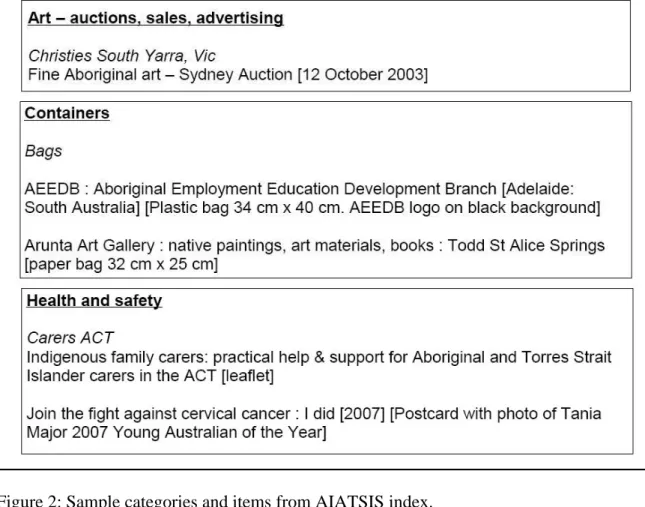
The following figures (Fig. 2, Fig.3, and Fig.4) illustrates the application of an index at two of the sample repositories. The most striking aspect of these indices is their dissimilarity. Though both repositories have started with a simple inventory and
Figure 2: Sample categories and items from AIATSIS index.
Figure 4: Sample item list from World War II Movie poster collection at LIU
The AIATSIS index is arranged in broad subject and format categories with smaller subcategories indicated in italics. The titles of ephemera appear to be transcribed directly from the material itself. For example, an item in Fig. 2 – “Join the fight against cervical cancer: I did” – is a single item title. Very little genre or format information can be gleaned from that. However, the AIATSIS adds descriptive information to most records in square brackets. Thus, we know that the item “Join the fight against cervical cancer: I did” is a postcard, “with photo of Tania Major 2007 Young Australian of the Year.”
There are several simple indices at LIU. Represented in Figs. 3 and 4 are items from the “Miscellaneous Items” list from the Archives of the Joseph Cameron Cross Theatre Collection and several items from the Catalog of WWII Movie Posters. The collection record titles are straight-forward and descriptive, though the term
“miscellaneous items” is perhaps overused when referring to ephemera. The item records for the Theatre collection (Fig. 3) are fascinating – the processor literally described exactly what they saw. In contrast, the items from the movie poster collection are the title of the movie – the titles of the item record do not describe the item. From these examples, it is obvious that LIU does not have a consistent method for handling ephemera.
WEB-BASED RECORDS
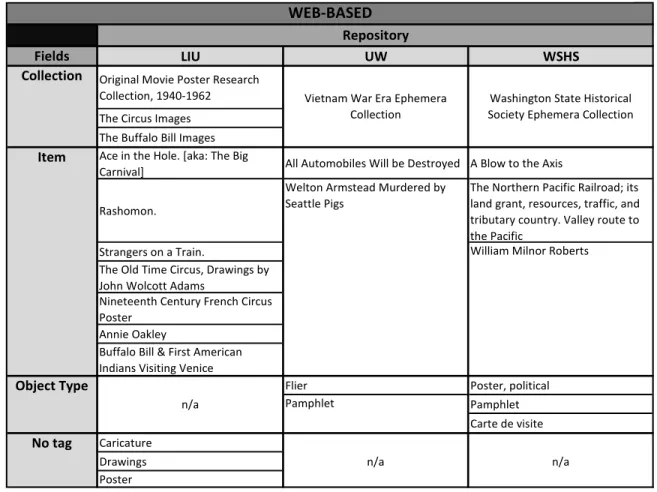
Original Movie Poster Research Collection, The Circus Images, and The Buffalo Bill Images. None use CONTENTdm or any other content management software. All
collections have digital images. The records shown here are similar in that titles for item records come from the physical items. Differences include metadata schema and
genre/format descriptions.
The item records for these web-based records are different from many main entry examples in Table 3 and some item records in Figs. 2-4. In these examples, the main entry information is descriptive. For example:
245 [Scrapbook of ephemera relating to productions of Jack Davis' play The dreamers]|h[manuscript] (Table 3, AIATSIS)
245 10 Exhibition catalogue : Computer 89 : April 27-29 1989. (Table 3, SLWA) 245 10 [Collection of material relating to the locality of Cape Leveque] (Table 3, SLWA)
3. Song lyrics for "That Fifth Avenue Rag" by Carl Randall. Dated week of March 31st, 1912. (Fig. 3, LIU)
13. Bronx Opera House playbill for "Peg O' My Heart" (Fig. 3, LIU)
In the above examples, the cataloger or processor has portrayed the item in their own words. With the web-based record samples, the reverse is true. The main entry information has been transcribed directly from the item itself. For example:
All Automobiles Will be Destroyed (UW) Annie Oakley (LIU)
William Milnor Roberts (WSHS)
signature, 1884.” It is unknown why these three are the exception. Nevertheless, transcription appears to be the rule for web-based records.
Fields LIU UW WSHS
Collection Original Movie Poster Research
Collection, 1940‐1962
The Circus Images The Buffalo Bill Images
Item Ace in the Hole. [aka: The Big
Carnival] All Automobiles Will be Destroyed A Blow to the Axis
Rashomon.
The Northern Pacific Railroad; its land grant, resources, traffic, and tributary country. Valley route to the Pacific
Strangers on a Train.
The Old Time Circus, Drawings by John Wolcott Adams
Nineteenth Century French Circus Poster
Annie Oakley
Buffalo Bill & First American Indians Visiting Venice
Object Type Flier Poster, political
n/a Pamphlet
Carte de visite
No tag Caricature
Drawings n/a n/a
Poster
WEB‐BASED
Repository
William Milnor Roberts Welton Armstead Murdered by
Seattle Pigs
Pamphlet
Vietnam War Era Ephemera Collection
Washington State Historical Society Ephemera Collection
Table 4: Web-based formatting samples
UW and the WSHS use Dublin Core, while LIU uses a home-grown metadata schema, when there is metadata to be found. The digital collections at LIU are
predominately collections of images with very little genre/format information for each. The Original Movie Poster Research Collection, for example, is obviously a collection of posters, but individual records give no information about the poster itself. Instead,
Title: Rashomon.
Information: RKO, 1951. 80m. b/w.
Description: In medieval Japan, four people have different versions of a violent incident involving a bandit's attack on a nobleman.
ACADEMY AWARDS:Best Foreign Language Film.
As mentioned in the previous section, LIU does not have a cohesive process for handling ephemera, and yet another example exists here in this metadata. The metadata scheme illustrated here appears to be home-grown: designed for this particular collection, perhaps based on the needs and wants of the typical user of this collection. This collection’s users may be more interested in information about the film than information about the poster. For information about the posters themselves, one must go to the collection finding aid abstract: “The Original Movie Poster Collection contains more than 6,000 Original Movie Posters dating from 1940 - 1962. Scope includes posters in two sizes: 24" x 28" and 36" x 14".”71 In contrast, the collections at UW and the WSHS contain a wealth of
genre/format information, including and “Object Type” tag for each record. These tags are searchable through a single mouse-click, identical to an OPAC keyword search. The tags appear to be based on the Art and Architecture Thesaurus – there is not enough information included at either the UW or the WSHS websites to conclude what vocabulary they are using.
In terms of adequate access, web-based records are very effective. Of all the cataloging strategies studied herein, web0based records have the most potential for cross-referencing capabilities and access point versatility. However, unless one is using
Fields LIU SDSU
Collection Original Movie Poster Collection Inventory of the Radical Ephemera/Underground Publications Collection, 1966‐1983 [Box] Miscellany, Memorabilia Jane Adams Recipe and Menu Collection, 1920‐1959 Series 3: Menus Barbara Abele Bookplate Collection, 1915‐1998 Series I, Bookplates by Subject Robert Eliot Smith Papers, 1929‐1983 Series 6: Miscellany Peoples Temple [Box] Transcripts
Item ADVENTURES OF ROBINSON CRUSOE "MRU: medical resistance union," Sep 1968, 12 page booklet
WRECK OF THE HESPERUS United Prisoners Union Bill of Rights, no date (2 copies) Folder 50: Alaska‐ Cruise Folder 10: Michigan‐Detroit Folder 17: Unknown Locations Animals Armorial Heraldic Seals Folder 3: Miscellaneous Miscellaneous Jim Jones phone call with David Kahn White Night, berating Children of Jonestown debate issues Last will
Scope and
Content 6,000+ Original Movie Posters dating from 1940 ‐ 1962 in two sizes: 24" x 28" and 36" x 14". The collection consists of newspapers, newspaper clippings, periodicals, newsletters, booklets, flyers and handouts, monographs, and one poster. The collection includes correspondence, awards, travel accounts, opera and recital programs, clippings, photographs, diaries, postcards, reviews, scrapbooks, photo albums, tape and phono recordings. This collection contains audiotape transcripts and summaries, audiotapes, photocopies of original unclassified documents from the federal government (on paper and also on other formats, including microfilm, microfiche, and compact disk), and newspaper and magazine articles related to the Peoples Temple Christian Church and the Peoples Temple Agricultural Settlement at Jonestown, Guyana. Formats
/Genres n/a Publications
FINDING AID
Repository
FINDING AID
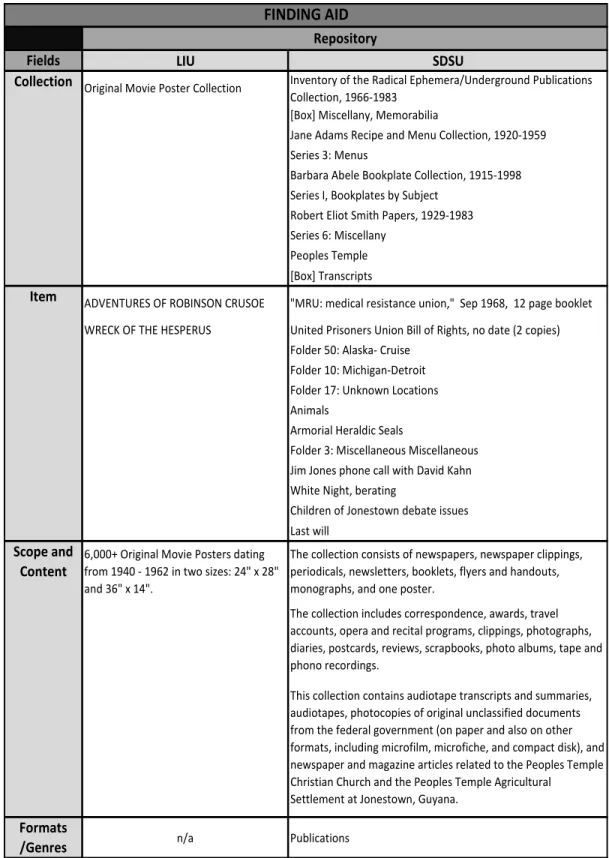
Table 5 illustrates the application of finding aid record formatting at two of the sample repositories. The two repositories represented in Table 5 have finding aids based on Describing Archives: A Content Standard (DACS). These finding aids differ in how strictly they adhere to DACS principles when structuring collection and item record titles, as well as when providing genre/format information. However, this strategy has by far the best samples of standardization among main entry and genre/format information than any other strategy studied herein.
Though the finding aid for the Original Movie Poster Collection at LIU is more loosely based on DACS than that of SDSU, it still effective as a comprehensive
description of the collection’s scope and content. The Original Movie Poster Collection at LIU has a finding aid attached to each genre of movie (action/adventure, science fiction, biography, drama, romance, etc.). This finding aid appears loosely based on DACS
principles. For example, in the “Action and Adventure” finding aid, the extent, or
“Quantity” of this collection is “6000+” (see Fig. 6). DACS suggests finding aids express extent in two parts, a number and an express of material type. In this example “6000+” provides a numerical amount but there is nothing to indicate the material type. It may be that the processors felt this was implicit – the title of the collection is Original Movie
“presentation purposes to enhance resource discovery.”72 In contrast, the Abstract is
almost identical to the Scope and Content note and contains no biographical information. The important information for adequate access, however, is present in this finding aid. Figure 5: Finding Aid for Original Movie Poster Collection, LIU
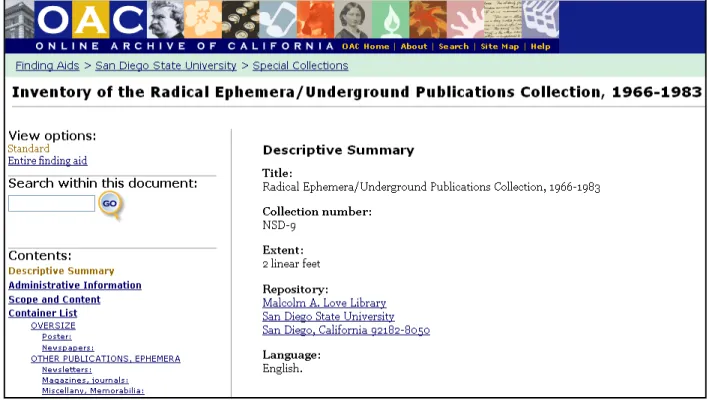
Seven collections with finding aids from SDSU are represented here. SDSU is part of the Online Archive of California (OAC), which hosts EAD finding aids. OAC has its own set of description standards, the OAC Best Practices Guidelines for Encoded Archival Description.73
These finding aids are much more aligned with DACS principles for the simple reason that Best Practices is based upon them. Fig. 7 shows an example of a typical finding aid. This record has standard elements such as “Administrative
DACS is the archival world’s answer to standardization – it supersedes Archives, Personal Papers, and Manuscripts as a cataloging standard and it is compliant with AACR2. A finding aid as a descriptive format can be versatile and is designed to be comprehensive. As an ephemera cataloging strategy, LIU and SDSU seem to have combined the best of the archival and library worlds for the benefit of ephemera description.
Figure 6: Finding Aid for Inventory of the Radical Ephemera/Underground Publications Collection, SDSU
Conclusion
After studying these seven repositories, it is clear that most repositories are using MARC as a cataloging strategy. It is also clear that the features offered by the online landscape are being taken advantage of, if only in a nascent sense. Only a small
percentage (28%) of repositories were using indices and finding aids. No other cataloging strategies were noted.
Discussion and Conclusion
Discussion
This study concentrated on finding widespread use of genre/format information, evidence of standardization in main entry information, as well as a snapshot of ephemera cataloging practices among ephemera collecting repositories. Some standard method of constructing main entry information was found, as well as a surprisingly frequent use of standardized genre/format headings. Despite the literature’s divided loyalties to MARC, four out of seven repositories used it for their ephemera category. Most surprising were the variety of web-based records and the occurrence of indices for ephemera cataloging.
Recommendations
1. Seriously consider format over main entry.
As mentioned in the Findings, main entry information can be placed into one of two categories: transcriptive or descriptive. Both types accurately describe an item, but only one is effective in conveying format to the researcher. When searching for a monograph, it is almost a given that the item will be a codex. Thus, the title or author or even subject matter is sufficient. When searching for ephemera, the possibilities are exponentially more complicated. As has been mentioned repeatedly in this paper, format is singular in importance to the definition of ephemera. It does not seem to be enough to simply transcribe the title (if any) of the piece at hand.
A small, but unique method of identifying format appeared in the SLWA OPAC (named “Henrietta”). Each ephemera record had a corresponding icon denoting format (see Fig. 8). Besides being a simple graphical display, having a representation of format as an access point is something for future ephemera catalogers to consider.
Figure 7: Ephemera Icon in Henrietta
2. Create a consistent process for handling ephemera.
repositories that have single cataloging systems represent simply a different philosophy, or perhaps more effective organization?
An excellent example of what happens when a repository does not have a standard process for handling ephemera is LIU. Access to this collection is diminished because there is no cross-referencing ability, no cohesiveness among collections, and there is no central catalog or even a comprehensive description of the ephemera holdings at this repository.
As mentioned in the literature review, dispersal is more likely to happen at a repository with no consistent method of handling ephemera. At the Historical Society of Pennsylvania, Stanley indicates that ephemera existed in every department of the
institution, and was often duplicated. Johnson and Snyder mention the eventuality of ephemera documenting the same event filtering into different collections at the same institution.
Without a homogenous cataloging scheme there is no way to combat these problems. The philosophy to espouse is that of effective organization in order to achieve, at the very least, adequate access.
3. If resources permit, consider creating EAD finding aids to describe ephemera
collections.
is dramatic because so many ephemera collections are not online – the activities of the Special Collections task force is proof of that.
Perhaps the reason ephemera has for so long defied traditional organization and description standards is because it was simply waiting for a standard technologically advanced enough to accurately handle it to come into existence. This does not mean that MARC records for ephemera are failures. On the contrary, Copeland does an excellent job proving that MARC can, indeed, be very effective at describing ephemera. However, a genre so “schizophrenic” as ephemera needs a descriptive standard equally as faceted.
The one strategy in this research that showed the most standardization, even at LIU, was finding aids. With DACS and EAD, it is possible to get the standardization desired for adequate access.
4. If time, resources, or technical skill preclude the former, MARC is still a good method.
Several times in the literature review authors stated that they wished they had the time or the resources to create item-level cataloging, or to integrate finding aids into their OPACs. In the real world, this is how libraries work: small budgets, overstretched staff. It is simply not possible to have the best all the time.
Conclusion
Notes
1.
Philip K. Dick. Do Androids Dream of Electric Sheep? (New York: Ballantine, 1996): 65.
2.
Working Party on Ephemera, Ephemera: The Stuff of History, Report of the Working Party on Ephemera set up by the CILIP Preservation and Conservation Panel (Thatcham, UK: Apple Print, 2003): 10.
3.
Michael Twyman, “The Long-Term Significance of Printed Ephemera,” RBM 9, no. 1 (Spring 2008): 26-27.
4.
Georgia B. Barnhill, “Why Not Ephemera? The Emergence of Ephemera in Libraries,” RBM 9, no. 1 (Spring 2008): 134.
5.
Julie Anne Lambert, “Immortalizing the Mayfly: Permanent Ephemera: An Illusion or a (Virtual) Reality?” RBM 9, no. 1 (Spring 2008): 153.
6.
Therese Lawrence, “Are Resource Treasures Hidden from Scholars in Our Libraries?” Special Libraries 64, no. 7 (July 1973): 289.
7.
Nancy Hadley, “Access and Description of Visual Ephemera,” Collection Management 25, no. 4 (2001): 39.
8.
Linda Stanley, “The Stranger in Our House: Managing Ephemera at the Historical Society of Pennsylvania,” Popular Culture in Libraries 4, no. 1 (1996): 104.
9.
Richard Kolbet, “Publish & Perish: Printed Ephemera and Social History,” University of Iowa Libraries Special Collections and University Archives, http://www.lib.uiowa.edu/spec-coll/Bai/kolbet3.htm (accessed Oct. 27, 2008): seventh paragraph.
10.
Chris E. Makepeace, Ephemera: A Book on its Collection, Conservation, and Use (Brookfield, VT: Gower, 1985): 10.
11.
Timothy Young, “Evidence: Toward a Library Definition of Ephemera,” RBM 4, no. 1 (Spring 2003): 16. 12. Ibid., 25. 13. Ibid. 14.
Catherine J. Johnson and Allegra Fuller Snyder, “Access,” in Securing Our Dance Heritage: Issues in the Documentation and Preservation of Dance (Council on Library and Information Resources, July 1999), http://clir.org/pubs/reports/pub84/pub84.html (accessed October 27, 2008): “Addressing the Cataloging Quandary.”
15.
16.
Lynette Foley, “Control of Ephemera,” Cataloguing Australia 15, no. 2 (June 1989): 49; Andrew Wrighting, “Cataloguing Ephemera: A Student’s Project,” Catalogue & Index 76-77 (Spring-Summer 1985): 16.
17.
Michael Organ, “Ephemera in Archives: What to do?” Archives and Manuscripts 15, no. 2 (1987): 110.
18.
Foley, “Control of Ephemera,” 48.
19.
Lawrence, “Are Resource Treasures Hidden…?” 287. Lawrence’s survey consisted of 28 categories of ephemera (advertisements, trade cards, souvenirs, calendars, etc.) for which respondents could mark holding, cataloged, and not cataloged. In addition, Lawrence added four questions on the nature of access.
20.
Ibid.
21.
Richard Akeroyd and Russell Benedict, eds., “A Directory of Ephemera Collections: A National Underground Network,” Wilson Library Bulletin 48, no. 3 (Nov. 1973): 245.
22.
Ibid., 251.
23.
Ibid., 253.
24.
Enid T. Thompson, Local History: A Handbook for the Collection, Preservation, and Use of Local History Materials (Colorado: Englewood Public Library, 1975): 30.
25.
Organ, “Ephemera in Archives,” 112.
26.
Ibid., 110.
27.
Wrighting, “Cataloguing Ephemera,” 16.
28.
Ibid., 16.
29.
Organ, “Ephemera in Archives,” 114.
30.
Ibid., 153-154.
31.
Deborah Smith, “Intellectual Control of Ephemera – A Museum’s Perspective.” Popular Culture in Libraries 4, no. 1 (1996): 69.
32.
Ibid., 65.
33.
Stanley, “Stranger in Our House,” 104.
34.
Barnhill, “Why Not Ephemera?” 135.
35.
Jane Greenberg, “Subject Control of Ephemera: MARC Format Options,” Popular Culture in Libraries 4, no. 1 (1996): 74.
36.
Ibid., 77.
37.
38.
“Fraktur” is a type of Pennsylvania German folk art. Baptism, marriage, and other
announcements are decorated with typically domestic illustrations, such as flowers, birds, angels, or hearts. Fraktur can be printed or in manuscript form.
39.
Anne Copeland and others, “Cataloging and Digitizing Ephemera: One Team’s Experience with Pennsylvania German Broadsides and Fraktur,” Library Resources & Technical Services 50, no. 3 (July 2006): 191. Italics mine.
40.
Lambert, “Immortalizing the Mayfly,” 153.
41.
Ibid., 155.
42.
ARL Special Collections Task Force, “Exposing Hidden Collections: 2003 Conference Summary,” Association of Research Libraries,
http://www.arl.org/rtl/speccoll/hidden/EHC_conference_summary.shtml (accessed Feb. 5, 2009): first paragraph.
43.
ARL Special Collections Task Force, “Special Collections Task Force Final Status Report, 2006,” Association of Research Libraries, http://www.arl.org/rtl/speccoll/spcolltf/status0706.shtml (accessed Apr. 12, 2009).
44.
Council on Library and Information Resources, “2008 Award Winning Projects,” Cataloging Hidden Special Collections and Archives, http://clir.org/hiddencollections/awards/index.html#chs (accessed Apr. 12, 2009).
45.
Ibid., 155.
46.
Stanley, “Stranger in Our House,” 102.
47.
Lambert, “Immortalizing the Mayfly, 154.
48. Ibid., 153. 49. Ibid., 104. 50. Ibid. 51.
Foley, “Control of Ephemera,” 49.
52.
Lambert, “Immortalizing the Mayfly,” 154.
53.
Mark A. Greene and Dennis Meissner, “More Product, Less Process: Revamping Traditional Processing Approaches to Deal with Late 20th-Century Collections,” The American Archivist, 68 (Fall/Winter 2005): 208-263.
54.
Ibid., 254.
55.
Ibid.
56.
Society of American Archivists, “Manuscript Repositories Section Meeting: Breakout Session Summaries,” Manuscripts Repositories Newsletter (Fall 2005),
http://www.archivists.org/saagroups/mss/fall2005.asp#4 (accessed Mar. 23, 2009): in “Hidden
57.
Ibid.
58.
David H. Stam, “So What’s So Special?” (address, Building on Strength: Developing an ARL Agenda for Special Collections, Brown University, Providence, RI, June 28, 2001).
59.
Ibid.
60.
Johnson and Snyder, “Formation of the Dance Heritage Commission.”
61.
Stanley, “Stranger in Our House,” 93.
62.
Deanna Marcum’s work, “The Future of Cataloging,” is not specifically about ephemera cataloging, but it is relevant to this paper.
63.
Deanna B. Marcum, “The Future of Cataloging” (address, EBSCO Leadership Seminar, Boston, MA, Jan. 16, 2005).
64.
Barnhill, “Why Not Ephemera?”130-131.
65.
Ibid., 133.
66.
This definition of adequate access is based on Johnson and Fuller.
67.
This definition is a compilation of both Makepeace’s and Young’s definitions.
68.
The website for SDSU Special Collections, http://scua.sdsu.edu/bookcoll.shtml, has changed since this study in February of 2009. The data represented here was current as of this date.
69.
AUSMARC being replaced by USMARC in 1991.
70.
Clearly following AACR2 rule 1.1B1.
71.
Collection Finding Aid, Original Movie Poster Research Collection 1940-1962, Special Collections, B. Davis Schwartz Memorial Library, C.W. Post Campus, Long Island University, http://www.liu.edu/cwis/cwp/library/sc/posters/posters_action.htm#finding.
72.
Society of American Archivists, Describing Archives: A Content Standard (Chicago: Society of American Archivists, 2004): 35.
73.
OAC Working Group Metadata Standards Subcommittee, “OAC Best Practices Guidelines for Encoded Archival Description,” California Digital Library,
Bibliography
Akeroyd, Richard, and Russell Benedict, eds. “A Directory of Ephemera Collections: A National Underground Network.” Wilson Library Bulletin 48, no. 3 (Nov. 1973): 236-254.
ARL Special Collections Task Force. “Exposing Hidden Collections: 2003 Conference Summary.” Association of Research Libraries.
http://www.arl.org/rtl/speccoll/hidden/EHC_conference_summary.shtml.
---. “Special Collections Task Force Final Status Report, 2006.” Association of Research Libraries. http://www.arl.org/rtl/speccoll/spcolltf/status0706.shtml.
Barnhill, Georgia B. “Why Not Ephemera? The Emergence of Ephemera in Libraries.”
RBM 9, no. 1 (Spring 2008): 127-135.
Bierbaum, Esther Green. “A Modest Proposal: No More Main Entry.” American Libraries (Jan. 1994): 81-84.
Copeland, Anne, Susan Hamburger, John Hamilton, and Kenneth J. Robinson. “Cataloging and Digitizing Ephemera: One Team’s Experience with Pennsylvania
German Broadsides and Fraktur.” Library Resources & Technical Services 50, no. 3 (July 2006): 186-198.
Council on Library and Information Resources. “2008 Award Winning Projects.” Cataloging Hidden Special Collections and Archives.
http://clir.org/hiddencollections/awards/index.html#chs.
Dick, Philip K. Do Androids Dream of Electric Sheep? New York: Ballantine, 1996. Foley, Lynette. “Control of Ephemera.” Cataloguing Australia 15, no. 2 (June 1989): 45-50.
Greenberg, Jane. “Subject Control of Ephemera: MARC Format Options.” Popular Culture in Libraries 4, no. 1 (1996): 71-91.
Hadley, Nancy. “Access and Description of Visual Ephemera.” Collection Management
25, no. 4 (2001): 39-50.
Johnson, Catherine J. and Allegra Fuller Snyder, “Access.” In Securing Our Dance Heritage: Issues in the Documentation and Preservation of Dance. Council on Library and Information Resources, July 1999. http://clir.org/pubs/reports/pub84/pub84.html. Kolbet, Richard. “Publish & Perish: Printed Ephemera and Social History.” University of Iowa Libraries Special Collections and University Archives.
http://www.lib.uiowa.edu/spec-coll/Bai/kolbet3.htm.
Lambert, Julie Anne. “Immortalizing the Mayfly: Permanent Ephemera: An Illusion or a (Virtual) Reality?” RBM 9, no. 1 (Spring 2008): 142-156.
Launder, Michael. “Saving printed ephemera: setting priorities in preserving evidence of the everyday.” Current Studies in Librarianship 26, no. ½ (Spring/Fall 2002): 67-76. Lawrence, Therese. “Are Resource Treasures Hidden from Scholars in Our Libraries?”
Special Libraries 64, no. 7 (July 1973): 285-290.
Levy, David M. “Cataloging in the Digital Order.” In Proceedings of Digital Libraries '95: the Second Annual Conference on the Theory and Practice of Digital Libraries, June 11-13, 1995, Austin, Texas, ed. Frank M. Shipman, Richard Furuta, and David M. Levy. College Station, TX: Hypermedia Research Laboratory, 1995.
http://csdl.tamu.edu/DL95/papers/levy/levy.html.
Makepeace, Chris E. Ephemera: A Book on its Collection, Conservation, and Use.
Brookfield, VT: Gower, 1985.
Marcum, Deanna B. “The Future of Cataloging.” Address, EBSCO Leadership Seminar, Boston, MA, Jan. 16, 2005.
OAC Working Group Metadata Standards Subcommittee. “OAC Best Practices Guidelines for Encoded Archival Description.” California Digital Library. http://www.cdlib.org/inside/diglib/guidelines/bpgead/.
Organ, Michael. “Ephemera in Archives: What to do?” Archives and Manuscripts 15, no. 2 (1987): 105-118.
Smith, Deborah. “Intellectual Control of Ephemera – A Museum’s Perspective.” Popular Culture in Libraries 4, no. 1 (1996): 63-69.
---. “Manuscript Repositories Section Meeting: Breakout Session Summaries.”
Manuscripts Repositories Newsletter (Fall 2005).
http://www.archivists.org/saagroups/mss/fall2005.asp#4.
Stam, David H. “So What’s So Special?” Address, Building on Strength: Developing an ARL Agenda for Special Collections, Brown University, Providence, RI, June 28, 2001. Stanley, Linda. “The Stranger in Our House: Managing Ephemera at the Historical Society of Pennsylvania.” Popular Culture in Libraries 4, no. 1 (1996): 93-105.
Thompson, Enid T. Local History: A Handbook for the Collection, Preservation, and Use of Local History Materials. Colorado: Englewood Public Library, 1975.
Twyman, Michael. “The Long-Term Significance of Printed Ephemera.” RBM 9, no. 1 (Spring 2008): 19-57.
Working Party on Ephemera. Ephemera: The Stuff of History, Report of the Working Party on Ephemera set up by the CILIP Preservation and Conservation Panel. Thatcham, UK: Apple Print, 2003.
Wrighting, Andrew. “Cataloguing Ephemera: A Student’s Project.” Catalogue & Index
76-77 (Spring-Summer 1985): 15-16.