Research Article
July
2017
Computer Science and Software Engineering
ISSN: 2277-128X (Volume-7, Issue-7)
Support Vector Machine vs Pattern Network for Gait
Recognition
Shahla A. AbdAlKader
Department of Computer Systems, Foundation of Technical Education, Technical Institute, Northern Technical University, Mosul, Iraq
DOI: 10.23956/ijarcsse/V7I7/01705
Abstract— Human recognition based on biometric information is important due to its reliability in identity verification. Gait recognition has ability to recognize individuals from a distance. This study includes human gait recognition based firstly on support vector machine (SVM) and secondly on PatternNet neural network. Experiments were conducted with comparisons based on the two approaches. Experimental results showed that the PattenNet neural network is more effective than the SVM in gait recognition.
Keywords— Gait Recognition, PatternNet, Support Vector Machine (SVM), Liner Discriminant Analysis (LDA)
I. INTRODUCTION
In recent years, a growing need for monitoring systems in banks, airports and human identification at a distance has gained increasing interest from computer researchers. Gait recognition is technology which can be detected and measured at a distance. It overcomes the challenges when using physical or close contact such as finger print recognition, face recognition by its inherent biological characteristics such as; non-invasive, non-contact, hiding and disguising difference and so on [1]. It is important to be able to quantify changes in gait pattern accurately to understand the clinical implications of surgery [2].
Human identification using gait is method to identify an individual by the way he walk or manner of moving on foot. Gait recognition is a type of biometric recognition and related to behavioral characteristics of biometric recognition. Gait recognition is one kind of biometric technology that can be used to monitor people without their cooperation. Controlled environments such as banks, military installations and airports need to be able to quickly detect threats and provide differing levels of access to user groups. Gait recognition is the process of identifying an individual by the manner in which they walk. Gait is less unobtrusive biometric which offers the possibility to identify people at a distance, without any interaction or co-operation from the subject [3]. It has accomplished a series of achievements in scientific research in recent years [4].
Visual surveillance is important in public places such as airports, shopping malls and banks. Therefore biometric information of any person is necessary for human recognition. Gait is affected by weight, limb length, habitual posture, bone structure, age and health status. All these parameters are unique for everybody and gait can be an individual feature for person recognition [5].
Many literature researches were based on different techniques and algorithms for gait recognition [1..7]. Zhaoxiang, et al (2011) [8] adopted a survey of gait progresses. They suggested that a further trends of gait recognition should be more robust features extracted; more accurate modeling of spatial and temporal information and improve the practicability of gait in real surveillance systems. While Jin Wang, et al (2010) [9] provided a survey of gait recognition approaches. The survey listed the issues involved in gait recognition system: gait image representation, feature dimensionality reduction and gait classification.
Artificial neural networks (ANN) had been used largely in the field of image and signal processing. Many researches related to gait recognition using different ANN approaches and algorithms [10..16].
Support vector machine (SVM) is a popular method for binary classification. Traditional training algorithms for SVM such as chunking and SMO, scale super linearly with the number of examples, which becomes infeasible for large training sets. Since it has been observed that dataset sizes have been growing larger over the past few years. Therefore, we need development of training algorithms that scale at worst linearly with the number of examples [17..20]. Linear discriminant analysis (LDA) can reduce dimensionality while preserving as much of class discriminatory information as possible [21]. Many literature studies were based on SVM for gait recognition [5][22][23].
Human recognition based on biometric information is important according to its reliability in identity verification. Gait recognition includes 3 steps: preprocessing; feature extraction; and classification. Saeid Fazli, et al (2011) [5] focused on these three steps. They standardized data and utilized LDA for feature reduction and then used multi class SVM classifier.
ISSN(E): 2277-128X, ISSN(P): 2277-6451, DOI: 10.23956/ijarcsse/V7I7/01705, pp. 352-359
Arun Joshi, et al (2014) [23] detected binary silhouette of a walking person from each frame. Then they extracted feature from each frame using image processing operation. The center of mass, step size length, and cycle length are talking as key feature. They used BPNN and SVM for training and testing. Their experiments are done on gait database and input video.
There is lack of literature studies which related to gait recognition approaches and techniques that obtain best recognition results with small computation time. Therefore, this research is based on using ANN, SVM and LDA for gait recognition. This paper is organized as follows: section 2 includes literature related to ANN for gait recognition. Section 3 includes detailed description of SVM, whereas section 4 give a preview of LDA. Section 5 includes research methodology and section 6 includes results. Finally section 7 concludes this work.
II. ANN FOR GAIT RECOGNITION
ANN had been used largely in the field of image and signal processing. This section includes brief review of the field of ANN for gait recognition. Jang-Hee, et al (2008) [10] used back propagation neural network (BPNN) for recognizing humans by their gait. They described gait motion as rhythmic and periodic motion and they also extracted a 2D stick figure from gait silhouette by motion information with topological analysis. They used set of 2D stick figures to represent the gait signature that is primitive data for feature extraction. Then they used BPNN to recognize humans.
Gait recognition has 3 steps: preprocessing; feature extraction; and classification. Saeid, et al (2010) [11] focused on classification that is essential to increase the CCR (Correct Classification Rate). They used and applied Multilayer Perceptron (MLP) for 11 views in database and compare the CCR values for these views. Experiments were performed with NLPR databases.
Also Sanjeev, et al. (2011) [12] used ANN for gait recognition. And Narasimhulu and Jilani (2012) [13] used BPNN for recognizing humans by their gait patterns. Automatic gait recognition using Fourier descriptors and independent component analysis (ICA) for the purpose of human identification at a distance. They used NLPR gait database.
Sharma and Bansa (2013) [14] detected binary silhouette of a walking person from each frame. Then, they extracted feature from each frame using image processing operation. Here center of mass, step size length, and cycle length are talking as key feature. BPNN is used for training and testing purpose. All experiments are done on gait database and input video [14]. Gaba and Kaur (2013) [15] converted input video into frame. Then they detected binary silhouette of a walking person from each frame. Secondly, feature from each frame is extracted using image processing operation. The distance between head and feet, distance between both hands, length of one hand, length of leg using hanavan’s model are taking as key feature. BPNN+MDA and BPNN+LDA techniques are used for training and testing purpose. All experiments are done on gait database and input video. Finally, Parneet Kaur (2013) [16] detected binary silhouette of a walking person from each frame. He extracted feature from each frame using image processing operation. Here center of mass, step size length, and cycle length are talking as key feature. At last NN and ENN technique is used for training and testing purpose.
III. SUPPORT VECTOR MACHINE
SVM can be regarded as one of the successful techniques for classification [18][19]. SVM is an optimal discriminant method based on Bayesian learning theory. SVM performs mapping of data into a higher dimensional feature space and finds linear separating hyper plane with maximal margin to separate data [20]. SVM can be used when your data has exactly two classes. SVM classifies data by finding best hyperplane that separates all data points of one class from those of other class. Best hyperplane for SVM means one with largest margin between the two classes. Margin means maximal width of slab parallel to hyperplane that has no interior data points. Support vectors are data points that are closest to separating hyperplane. These points are on boundary of slab [24]. The data for training is a set of points (vectors) xi along with their categories yi. For some dimension d, the xi # Rd, and the yi = ±1. The equation of a hyperplane is <w, x> + b = 0, where w # Rd, <w, x> is the inner (dot) product of w and x, and b is real [24].
The following problem defines best separating hyperplane. Find w and b that minimize ||w|| such that for all data points (xi,yi), yi (<w, xi> + b) ≥ 1.
Support vectors are xi on boundary, those for which yi (<w, xi> + b) = 1.
For mathematical convenience, problem is usually given as equivalent problem of minimizing <w, w> /2. This is quadratic programming problem. Optimal solution (wˆ ,bˆ ) enables classification of vector z as follows [24]:
………..………(1)
The dual is standard quadratic programming problem. To solve and obtain the dual quadratic programming problem, take positive Lagrange multipliers αi multiplied by each constraint, and subtract from objective function [24]:
………..………..……(2)
Where LP is a stationary point over w and b [24]. Setting gradient of LP to 0, to get [24]:
ISSN(E): 2277-128X, ISSN(P): 2277-6451, DOI: 10.23956/ijarcsse/V7I7/01705, pp. 352-359
Substituting into LP, calculate dual LD:
………..………..……(4)
which maximize over αi ≥ 0. Many αi are 0 at maximum. Nonzero αi in solution to dual problem define hyperplane, Gives
w as sum of αiyixi. Data points xi corresponding to nonzero αi are support vectors.
The derivative of LD with respect to nonzero αi is 0 at optimum [24]. This gives: yi(<w,xi> + b) – 1 = 0.
This gives value of b at solution, by taking any i with nonzero αi.
Data might not allow for a separating hyperplane. Therefore, SVM can use soft margin (hyperplane) that separates many data points [24]. There are two standard formulations of soft margins that involve adding slack variables si and penalty
parameter C. The L1-norm problem is [24]:
………..………(5)
such that:
……….….………..………(6)
The L1-norm refers to using si as slack variables instead of their squares. The SMO svmtrain method minimizes the L 1
-norm problem. The L2-norm problem is:
………..………..……(7)
We can see increasing C places more weight on slack variables si using these formulations. This meaning optimization
attempts to make stricter separation between classes. Reducing C towards 0 makes misclassification less important [24]. For easier calculations, L1 dual problem to soft-margin formulation. Using Lagrange multipliers μi, function to minimize
for L1-norm problem is [24]:
………..………(8)
Using stationary point of LP over w, b, and positive si. Setting gradient of LP to 0 to get [24]:
………...………..………(9)
These equations lead to dual formulation [24]:
……….………..…………...………(10)
subject to constraints [24]:
………..…..…………..………(11)
IV. SUPPORT VECTOR MACHINE
LDA is used to perform dimensionality reduction while preserving as much of class discriminatory information as possible. The steps of LDA are as follows [21]. Assume we have a set of 𝐷-dimensional samples 𝑥(1
, 𝑥(2, … 𝑥(𝑁
, 𝑁1 of
which belong to class 𝜔1, and 𝑁2 to class 𝜔2. We seek to obtain a scalar 𝑦 by projecting the samples 𝑥 onto a line 𝑦 =
𝑤𝑇𝑥 of all the possible lines we would like to select the one that maximizes the separability of the scalars.
In order to find a good projection vector, we need to define a measure of separation. The mean vector of each class in 𝑥 -space and 𝑦-space is:
…..…..…………..………(12)
We could then choose the distance between the projected means as our objective function:
ISSN(E): 2277-128X, ISSN(P): 2277-6451, DOI: 10.23956/ijarcsse/V7I7/01705, pp. 352-359 V. RESEARCH METHODOLOGY
The research methodology depends on a database taken from CASIA [25] database with different views that have different silhouette in person’s height and width.
1. The DataBase of the program includes 15 persons which selected from CASIA database. 2. Three angles (0, 45 and 90) were taken for each person.
3. Four cases for each angle will be taken.
4. 50 states (images) for each case. At the end the database includes: 15 persons × 3 angles × 4 cases × 50 states =9000 images.
5. Each original taken image is with 240×352 dimension. Each image is resized from its dimension to 190×100.
A. Algorithm
1. Read 50 images for each one of the 4 states.
2. Data standardization. Resize each one of the 240×352 dimension image to 190×100 dimension image. The main goal is producing a dataset with the same position of the person in the middle of each frame and same size in whole image sequence. The idea is to fix the head for each frame in a predefined position and resize the body to achieve a preset height. We perform a three stage preprocessing: extract rectangle including the person without extra black pixels and obtain height and width of the person; sequence is calculated and each frame is converted to biggest height and width; and finally, move head of each frame in a fixed point. Fig.1 explains this process.
Fig.1: The standardization process
3. The OR logical gate will be applied on each 50 images to produce only one image for each case of the 4 cases. This is applied for each angle. Then the total number of images resulted from this process are: 15 × 3 × 4 × 1= 180 images for 15 persons. This process is explained in Fig.2 and Fig.3. Fig.2 shows the image of person 1 after applying the OR gate on 50 images of gait of person1 for angle 0ₒ. Whereas Fig.3 shows the image of person 2 after applying the OR gate on 50 images of gait of person2 for angle 90ₒ.
Fig.2 Image of person 1 after applying OR on 50 images of gait of person1 for angle 0ₒ
ISSN(E): 2277-128X, ISSN(P): 2277-6451, DOI: 10.23956/ijarcsse/V7I7/01705, pp. 352-359
4. Convert the resulted image after applying OR gate from two dimensional array to one dimensional array. Compute centroid shape (xc, yc). After converting outer contour to distance signal. Every element of distance signal S={d1, d2, di, …… dNb} is distance between point of outer contour and shape’s centroid.
…..…..………..………(14)
Then, convert these distance signals to normalized ones with considering magnitude and size.
5. Dimension reduction. LDA is one of the most powerful techniques in dimensionality reduction. The person properties will be extracted by applying LDA algorithm.
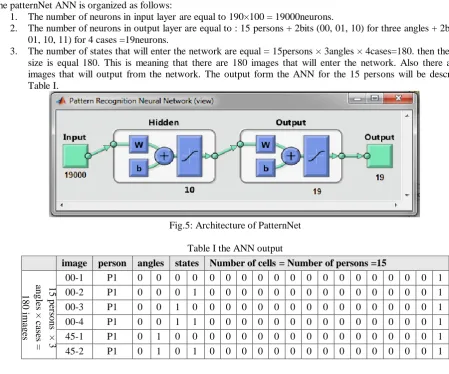
6. Classification. SVM can be regarded as one of the successful techniques for classification. The SVM algorithm is applied here in the first experiment. Also PatternNet ANN algorithm will be executed in another experiments. Fig4.shows the gait recognition system whereas Fiig.5 Shows main architecture of PatternNet ANN.
Fig.4 The gait recognition system
B. The ANN Architecture
The patternNet ANN is organized as follows:
1. The number of neurons in input layer are equal to 190×100 = 19000neurons.
2. The number of neurons in output layer are equal to : 15 persons + 2bits (00, 01, 10) for three angles + 2bits (00, 01, 10, 11) for 4 cases =19neurons.
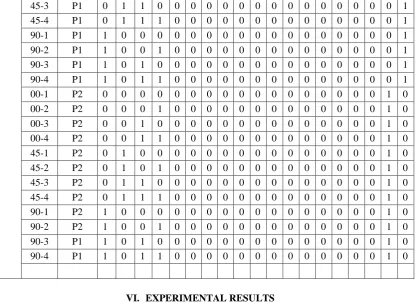
3. The number of states that will enter the network are equal = 15persons × 3angles × 4cases=180. then the Epoch size is equal 180. This is meaning that there are 180 images that will enter the network. Also there are 180 images that will output from the network. The output form the ANN for the 15 persons will be described in Table I.
Fig.5: Architecture of PatternNet
Table I the ANN output
ISSN(E): 2277-128X, ISSN(P): 2277-6451, DOI: 10.23956/ijarcsse/V7I7/01705, pp. 352-359 1 0 0 0 0 0 0 0 0 0 0 0 0 0 0 0 1 1 0 P1 45-3 1 0 0 0 0 0 0 0 0 0 0 0 0 0 0 1 1 1 0 P1 45-4 1 0 0 0 0 0 0 0 0 0 0 0 0 0 0 0 0 0 1 P1 90-1 1 0 0 0 0 0 0 0 0 0 0 0 0 0 0 1 0 0 1 P1 90-2 1 0 0 0 0 0 0 0 0 0 0 0 0 0 0 0 1 0 1 P1 90-3 1 0 0 0 0 0 0 0 0 0 0 0 0 0 0 1 1 0 1 P1 90-4 0 1 0 0 0 0 0 0 0 0 0 0 0 0 0 0 0 0 0 P2 00-1 0 1 0 0 0 0 0 0 0 0 0 0 0 0 0 1 0 0 0 P2 00-2 0 1 0 0 0 0 0 0 0 0 0 0 0 0 0 0 1 0 0 P2 00-3 0 1 0 0 0 0 0 0 0 0 0 0 0 0 0 1 1 0 0 P2 00-4 0 1 0 0 0 0 0 0 0 0 0 0 0 0 0 0 0 1 0 P2 45-1 0 1 0 0 0 0 0 0 0 0 0 0 0 0 0 1 0 1 0 P2 45-2 0 1 0 0 0 0 0 0 0 0 0 0 0 0 0 0 1 1 0 P2 45-3 0 1 0 0 0 0 0 0 0 0 0 0 0 0 0 1 1 1 0 P2 45-4 0 1 0 0 0 0 0 0 0 0 0 0 0 0 0 0 0 0 1 P2 90-1 0 1 0 0 0 0 0 0 0 0 0 0 0 0 0 1 0 0 1 P2 90-2 0 1 0 0 0 0 0 0 0 0 0 0 0 0 0 0 1 0 1 P1 90-3 0 1 0 0 0 0 0 0 0 0 0 0 0 0 0 1 1 0 1 P1 90-4
VI. EXPERIMENTAL RESULTS
Many experiments were conducted for the gait recognition system on the CASIA Gait Database [25]. Gait recognition has been an active research topic in recent years. The Institute of Automation, Chinese Academy of Sciences (CASIA) provide the CASIA Gait Database to gait recognition and related researchers in order to promote the research. In the CASIA Gait Database there are three datasets: Dataset A, Dataset B (multiview dataset) and Dataset C (infrared dataset). Dataset A (former NLPR Gait Database) was created on Dec. 10, 2001, including 20 persons. Each person has 12 image sequences, 4 sequences for each of the three directions, i.e. parallel, 45 degrees and 90 degrees to the image plane. The length of each sequence is not identical for the variation of the walker's speed, but it must ranges from 37 to 127. The size of Dataset A is about 2.2GB and the database includes 19139 images.
The format of the image filename in Dataset A is 'xxx-mm_n-ttt.png', where: xxx: subject id, mm: direction, n: sequence number, and ttt: frame number in a sequence. The algorithm of the gait recognition system was implemented using MATHLAB 2013. The DataBase of implemented program includes 15 persons which selected from CASIA [25] each person with 3 angles (0, 45 and 90), each angle with 4 cases and 50 images for each case. Finally, the database includes 9000 images. Each original taken image is with 240×352 dimension. Each image is resized from its dimension to 190×100.
The performance of the suggested method is computed using correct classification rates (CCR) as shown in the following equation:
CCR= NC / N * 100 …..…..………..………(15)
where NC is the total number of correct recognition samples. While N is the number of total gait samples.
The experiments were based firstly on executing LDA with SVM and secondly LDA with PatternNet ANN. Table II shows CCR and MSE when executing gait recognition system based SVM and PatternNet ANN.
Table II Results Of Patternnet And SVM Algorithms
CCR MSE
PatterNet SVM PatternNet SVM P1 98.4 95.6 0.0005 0.0056 P2 98.6 95.3 0.0003 0.0087 P3 98.7 95.5 0.0001 0.0067 P4 98.3 95.6 0.0004 0.0082
P50 98.52 95.1 0.0005 0.0071
ISSN(E): 2277-128X, ISSN(P): 2277-6451, DOI: 10.23956/ijarcsse/V7I7/01705, pp. 352-359
Fig.6: Performance of PatternNet
VII. CONCLUSION
Gait recognition is a type of biometric recognition and related to the behavioural characteristics of biometric recognition. Person identification using Gait is method to identify an individual by the way he walk. A gait recognition system was implemented in this paper firstly using LDA with SVM and secondly using LDA with PatternNet ANN. The gait recognition algorithm was implemented using MATHLAB 2013. The DataBase of the gait recognition program includes 15 persons which selected from CASIA database [25] with different angles (0, 45 and 90), cases (4 cases) and states (50 states). The overall program database includes 9000 images. Each image with 240×352 dimension and resized to 190×100 dimension. Many experiments were conducted for executing the gait recognition program based on LDA with SVM and also based on LDA and PatternNet ANN. The experimental results showed that the best values of CCR were taken when using PatternNet ANN. The results showed also that the lowest values of MSE were taken when executing PatternNet ANN. As a future work, other ANN algorithms may be used for the gait recognition system. Many comparisons may be conducted in the future work.
REFERENCES
[1] Yanbei Li, Lei Yan and Hua Qian, A Gait Recognition System using GA-based C-SVC and Plantar Pressure, TELKOMNIKA, Vol. 11, No. 10, October 2013, pp. 6135 -6142e-ISSN: 2087-278X
[2] Fong-Chin Su and Wen-Lan Wu, Design and testing of a genetic algorithm neural network in the assessment of gait patterns, Medical Engineering & Physics 22 (2000) 67–74, Technical note.
[3] Parneet Kaur, Gait Recognition For Human Identification Using ENN And NN, Proceedings of SARC-IRAJ International Conference, 14th July 2013, Delhi, India, ISBN: 978-93-82702-21-4
[4] Pratibha Mishra and Shweta Ezra, Human Gait Recognition Using Bezier Curves, International Journal on Computer Science and Engineering (IJCSE), Vol. 3 No. 2 Feb 2011, pp:969-975, ISSN : 0975-3397.
[5] Saeid Fazli, et al. Gait Recognition using SVM and LDA, Proc. of Int. Conf. on Advances in Computing, Control, and Telecommunication Technologies 2011, 2011 ACEEE DOI: 03.CSS.2011.1. Proc. of Int. Conf. on Advances in Computing, Control, and Telecommunication Technologies 2011, 42, pp:106-109.
[6] Hadi S. Yazdi, et al, Gait Recognition Based on Invariant Leg Classification Using a Neuro-Fuzzy Algorithm as the FusionMethod, International Scholarly Research Network, ISRN Artificial Intelligence, Volume 2012, Article ID 289721, doi:10.5402/2012/289721
[7] WEN-LAN WU, et al, Potential of the Genetic Algorithm Neural Network in the Assessment of Gait Patterns in Ankle Arthrodesis, Annals of Biomedical Engineering, Vol. 29, pp. 83–91, 2001, pp:83-91.
[8] Zhaoxiang Zhang, et al, A Survey of Advances in Biometric Gait Recognition, Biometric Recognition, Lecture Notes in Computer Science Volume 7098, 2011, pp 150-158.
[9] Jin Wang, et al , A Review of Vision-based Gait Recognition Methods for Human Identification, 2010 Digital Image Computing: Techniques and Applications,
[10] Jang-Hee Yoo, et al. Automated Human Recognition by Gait using Neural Network, Image Processing Theory, Tools & Applications, IEEE, 2008.
ISSN(E): 2277-128X, ISSN(P): 2277-6451, DOI: 10.23956/ijarcsse/V7I7/01705, pp. 352-359
[12] Sanjeev Sharma, et al. Identification of People Using Gait Biometrics, International Journal of Machine Learning and Computing, Vol. 1, No. 4, October 2011
[13] G. Venkata Narasimhulu and S. A. K. Jilani, Back Propagation Neural Network based Gait Recognition, (IJCSIT) International Journal of Computer Science and Information Technologies, Vol. 3 (5) , 2012,5025 – 5030.
[14] O. Sharma and S. Bansal Gait Recogniton System for Human Identification Using BPNN Classifier, International Journal of Innovative Technology and Exploring Engineering (IJITEE) ISSN: 2278-3075, Volume-3, Issue-1, June 2013.
[15] Ira Gaba and Paramjit Kaur, Biometric Identification on The Basis of BPNN Classifier with Other Novel Techniques Used For Gait Analysis, International Journal of Recent Technology and Engineering (IJRTE) ISSN: 2277-3878, Volume-2, Issue-4, September 2013.
[16] Parneet Kaur, Gait Recognition for Human Identification Using ENN And NN, Proceedings of SARC-IRAJ International Conference, 14th July 2013, Delhi, India, ISBN: 978-93-82702-21-4
[17] Aditya Krishna Menon, Large-Scale Support Vector Machines: Algorithms and Theory
[18] L. Lee, W.E.L. Grimson, Gait analysis for recognition and classification, in: IEEE International Conference on Automatic Face& Gesture Recognition (FG),2002, pp. 155–162.
[19] L. Walawalkar, et al. Support vector learning for gender classification using audio and visual cues, Int. J. Pattern Recognition Artif. Intell. 17 (3) (2003)417–439.
[20] G. Shan,S. Gong and P W. McOwan ,” Fusing gait and facecues for human gender recognition”, Neuro computing (2008).[17] C. Hsu, C. Lin (2002) “A Comparison of Methods for Multiclass Support Vector Machines”, IEEE Trans. NEURALNETWORKS, Vol. 13, NO.2, MARCH 2000.
[21] Ricardo Gutierrez-Osuna, CSCE 666 Pattern Analysis, L10: Linear discriminants analysis, CSE@TAMU. [22] Jang-Hee Yoo et al, Gender Classification in Human Gait Using Support Vector Machine, J. Blanc-Talon et al.
(Eds.): ACIVS 2005, LNCS 3708, pp. 138 – 145, 2005.© Springer-Verlag Berlin Heidelberg 2005.
[23] Arun Joshi1, et al. Gait Recognition Of Human Using Svm And Bpnn ClassifierS, International Journal of Computer Science and Mobile Computing, IJCSMC, Vol. 3, Issue. 1, January 2014, pg.281 – 290.