International Journal Advances in Social Science and Humanities
Available online at: www.ijassh.com
RESEARCH ARTICLE
Paid Work as an Originator of Daily Routine
Van Tienoven TP*, Glorieux I, Minnen J
Research Group TOR, Sociology Department, Vrije Universiteit Brussel, Brussels, Belgium.
*Corresponding Author: Email: [email protected]
Abstract
Paid work is assumed to have a latent function of creating regular activity. This contribution investigates whether this regularity creating mechanism of paid work passes over to other activities as well. We introduce an indicator of daily routine that allows us to express what percentage of time spent on different activities is done so every day at the exact same moment of time. When comparing the results for full-time employed (n=695) and non-working (n=971) samples for the workweek (Monday to Friday) we find that the former have a significant higher percentage of daily routine that is mainly due to the regularity of paid work. As a result, this surplus of routine is found mainly during daytime, the period of the day that, vice versa, is the least routineous for the non-working. On the other hand, only activities directly related to paid work (i.e. personal care and travel) are done more routineous by the full-time employed compared to the non-working sample. The opposite holds for all other activities.
Keywords:Daily routine, Time-use, Paid work, Regularity.
Introduction
Besides its ‘manifest function’ of remuneration, paid work or employment as a social institution has multiple ‘latent functions’: a source of social contact, participation in collective or individual transcending purposes, an acceptable status and social identity, and regular activity [1]. Simply because these experiences are unintended though inevitable consequences of the presence of paid work, they are especially experienced in case of unemployment. “While the unemployed are left to their own devices to find experiences within these categories if they can and suffer if they cannot, the employed take them for granted” [1:39].
Although taken for granted and unintended, the way of experiencing time and the regularity-creating characteristic of paid work play an enormous role in the organization of daily life. This structuring mechanism of paid work or being employed is one of the main reasons that the scheduling of paid work has been studied in such extensive ways [2, 3], as well as the best way to capture time spent on paid work [4, 5]. Work schedules form the basis of our daily and weekly time-use patterns. Most other time-use activities are scheduled around them or in function of them even for those who do not perform paid work. Shop opening hours, TV-shows and other leisure
activities, and even traffic jams are ‘scheduled’ in function of the working hours of the working population. Understanding the daily scheduling of paid work means understanding the way the temporal organisation of society takes place [6-8]. However, studying the scheduling of paid work does not only reveal the temporal organisation at the macro level of society. Also at the micro level or individual and household level the daily and weekly planning of activities happens in function of the working schedule. As a result, Hochschild [9] names work the ‘first shift’ of the day around which the ‘second shift’ of domestic work needs to be scheduled. Both shifts are in constant struggle for daytime planning for two reasons: firstly, both paid work and domestic work contain activities that cannot be postponed (i.e., we have to go to work and we have to eat), and, secondly, both shifts repeat themselves every day. (In the case of paid work at least on all contracted workdays). This struggle becomes more trying with the breadwinner family being replaced by the dual earner families. Dual-earners not only need to combine both ‘shifts’ themselves, but also take into account ‘shifts’ of their partner [10-12].
creating characteristic of paid work becomes an effective ‘tool’ for daily planning. Since paid work is largely bound to temporal rigidity of both its timing (i.e., fixed working hours) and its tempo (i.e., fixed working days), it provides employers with a daily routine for a large part of the day; every day of the workweek. With a large part of the day following a fixed and repetitive schedule and thus less time available for all other activities, we might argue that as a result these activities will also be scheduled as routines. After all, one of human’s solution to scheduling activities under time-pressure is to rely on habits [8]. Basically this means that we replace choice by
routine. “What we do now is what we did before, with small changes” [8:84]. Moreover, this repetition of daily routines or habits does not go on indefinitely but is framed within the weekly cycle. Generally we stick to tight daily schedules during five weekdays, loosen this schedule during two weekend days, and then start over the same schedule the next week [13].
In what follows, we, first, will present a way to measure the daily routine of activities. In other words, an indicator that allows us to express what percentage of time spent on different activities is done so every day at the exact same moment of time. Next we will calculate the daily routine of 11 categories of time-use of two groups: the fulltime employed on the one hand and the non-working on the other. By doing so, we intent to demonstrate that not only paid work itself is part of daily routines but that the fulltime employed have more daily routine for a wider variety of activities simply because the temporal rigidity of both timing and tempo of paid work during the workweek will create other routines as well. We will conclude on evaluating the indicator of daily routine by outlining its pitfalls and its applicability.
Method & Data
The calculation of the indicator of the percentage of daily routine for a certain activity is given by the equation below. To compute the percentage of daily routine we depart from a time-use database that includes multiple, consecutive days (indicated by j) and inquires time-use in fixed time-use intervals (indicated by i). We sum the number of occasions (indicated by yi) for which holds that a
specific activity (indicated by t) occurs on the same interval across all days. Then we divide this number by the daily average number of intervals the activity took place (indicated by ) and the result is the percentage of daily routine for this activity (indicated by Rt).
(1) with
with
and
Note that this indicator is based on a count of the number occasions a certain time-use interval contains the registration of the same activity across all days included in the calculation. It does not take one day as a day of reference to which all other days are compared nor does it calculate some ‘distance’ between days as if it where some modified intra-personal optimal matching algorithm. The indicator of daily routine simply gives the percentage of time spent on a certain activity that has a regular duration, timing and
tempo within a predefined time-cycle.
To make our calculation for daily routine we use the Flemish time-use surveys of 1999 and 2004 (abbrev. TOR99 and TOR04) conducted by the Research Group TOR of the Vrije Universiteit Brussel. In both TOR99 (n=1,474) and TOR04 (n=1,780) respondents in the age range of 18 to 75 years registered the exact beginning and ending time of each activity for seven consecutive days. We pooled both samples to get a larger dataset (n=3,059). For our analyses we withheld only the five weekdays (so j ranges from 1 to 5) and we converted the moment-to-moment time-use registration into 10-minute intervals (so i ranges from 1 from 144) starting at midnight and for every 10-minute interval keeping the activity registered on the 10th minute of the interval. A post-stratification weight was applied taking into account gender, age and educational level to correct for differences with the population register. Technical reports are available on demand.
registered at least four hours of paid work on all five weekdays in their diary (n=695; 22.7% of total sample). The second are the ‘non working’, consisting of respondents that are unemployed nor are students and did not register any paid work on any of the five weekdays (n=917; 30.0% of total sample).
Results
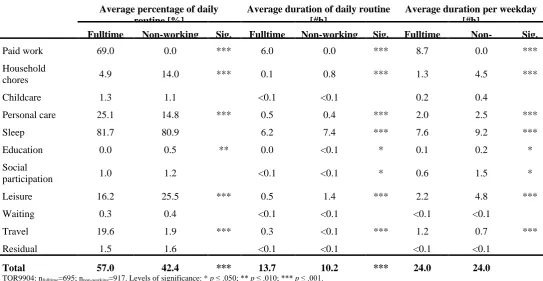
Table 1 presents the results of the calculations of daily routine for 11 main categories of activities. The first column contains the average percentages of daily routine per category; the second column contains the average duration of daily routine of these categories; the third column contains the average duration of these categories on a weekday. Differences between the fulltime employed and the non-working are tested for significances using the independent-sample t-test. Additionally, Fig. 1 presents the share of each activity to the total routine and Fig. 2 presents the total percentage of respondents following a daily routine for each moment of the day for the fulltime employed and non-working. For graphical representation, we added routine of education to paid work, routine of childcare to household chores, routine of social participation to leisure and left the categories of waiting and residual time out of the graph.
From the last row of Table 1 we derive that fulltime employed have the exact same time-use on all five weekdays for more than half of the day (57% or 13.7 hours a day). This is significantly more than the non-working (42% or 10.2 hours a day). The routine creating characteristic of paid work is clearly shown: almost 70% of the daily 8.7 hours spent on paid work is done on the exact same moment every weekday. More evidence for this can be derived from Fig. 1, where we find that 42.5% of the total daily routine of fulltime employed is a result of routine of paid work. Obviously the remainder of total daily routine for fulltime employed is a result of sleep routine (48.1%) and this is in high contrast with the composition of daily routine of the non-working. For the latter, sleep routine counts for over three quarters of total daily routine during the workweek. From Table 1 we derive that the fulltime employed spent less time on sleep (7.6 versus 9.2 hours per day but that there is no significant difference in percentage of time that is slept in a routine (i.e. every day at the exact same moment), which lies around 81%.
Hence we might conclude that both paid work and sleep are the main originators of daily routine. In
total daily routine is made up of routines of these two activities, which already indicates that the hypotheses that routineous paid working activity will lead to routines of other activities might need to be rejected.
When looking at the other activities in Table 1, we find that fulltime employed as compared to the non-working spend a larger percentage of personal care in a routine- although there is no significant difference in the contribution of personal care to total daily routine between both groups (3.5%) and have a larger percentage of travelling habits. On the other hand a significant smaller percentage of time is routineously spent on household chores and leisure. Fig. 1 shows that these routines of these two activities almost make up the other quarter of total daily routine of the non-working. From Fig. 2a-b we derive that routine of sleep for both the fulltime employed and the non-working occurs at night. Over 90% of both subsamples is asleep every weekday between 1 and 5 am. During daytime it is clearly shown that in case of the fulltime employed paid work is performed highly routineous. Between 9 am and noon 70 up to 80% of the fulltime employed are occupied with paid work every day and between 1 and 4 pm this holds for another 50 to 65%. This routine during daytime is almost absent for the non-working. Less then 20% of them have some routine in the morning (between 9 am and noon) that is made up of household chores. On the contrary, leisure in the evening is routineous for a larger proportion of the non-working than it is for the fulltime employed.
routineous for the fulltime employed compared to the non-working. Apparently, the fact that paid work and related activities are part of tight routines during the day (see Fig. 2a-b), makes that the remainder of the day (the evening) is exactly the opposite from routineous. Note that leisure here is a generic term for all leisure activities. The difference in routine of leisure between non-working and fulltime employed does not mean that the former engage in the same
activity every evening (such as watching TV) whereas the latter perform different activities every night (watching TV, sporting, cultural activities, …). Routine of leisure simply means having leisure time every day at the same moment of the day. So where the fulltime employed have a high daily routine in the morning and afternoon and a seemingly hectic evening, the non-working almost completely lack a routine during the morning and afternoon and have a moderately routine evening.
Table 1: Percentage of daily routine during the workweek
Average percentage of daily routine [%]
Average duration of daily routine [#h]
Average duration per weekday [#h]
Fulltime Non-working Sig. Fulltime Non-working Sig. Fulltime Non-working
Sig.
Paid work 69.0 0.0 *** 6.0 0.0 *** 8.7 0.0 ***
Household
chores 4.9 14.0 *** 0.1 0.8 *** 1.3 4.5 ***
Childcare 1.3 1.1 <0.1 <0.1 0.2 0.4
Personal care 25.1 14.8 *** 0.5 0.4 *** 2.0 2.5 ***
Sleep 81.7 80.9 6.2 7.4 *** 7.6 9.2 ***
Education 0.0 0.5 ** 0.0 <0.1 * 0.1 0.2 *
Social
participation 1.0 1.2 <0.1 <0.1 * 0.6 1.5 *
Leisure 16.2 25.5 *** 0.5 1.4 *** 2.2 4.8 ***
Waiting 0.3 0.4 <0.1 <0.1 <0.1 <0.1
Travel 19.6 1.9 *** 0.3 <0.1 *** 1.2 0.7 ***
Residual 1.5 1.6 <0.1 <0.1 <0.1 <0.1
Total 57.0 42.4 *** 13.7 10.2 *** 24.0 24.0
TOR9904: nfulltime=695; nnon-working=917. Levels of significance: * p ≤ .050; ** p ≤ .010; *** p ≤ .001.
Fig. 2a: Tempogram of daily routine during the workweek for non-working
0% 20% 40% 60% 80% 100% Non-working Travel Leisure/social participation Sleep Personal care Household chores/childcare Work/education Fig. 2b: Tempogram of daily routine during the workweek for non-working
Discussion
Daily Routine
In this contribution we questioned whether the regularity-creating characteristic of paid work is transferred to other activities. We interpreted this regularity-creating characteristic of paid work as the temporal rigidity of both the timing and tempo of paid work during the workweek that leads to a daily routine. We expressed this daily routine as the percentage of time that is spent on the same activities every weekday at the same moment of the day.
When we calculated the percentage of daily routine for 11 main categories of time-use for fulltime employed and non-working separately, the former turned out to have 13.7 hours of daily routine during the workweek, the latter 10.2. A large part of this routine stemmed form sleep routines. These turned out to be almost equal in both duration and timing for both subsamples. When looking at the composition of total routine, these sleep routines made up 75% of the total daily routine of the non-working and 50% of the total daily routine of the fulltime employed. For the latter, the other half of the total daily routine almost completely consisted of paid work. 70% or 6 out of the 8.7 hours of paid work during the day
occur every day on the exact same moment of the day.
Our expectation that the temporal rigidity of paid work serves as an originator for routine of other activities turned out to be only partially true. Activities that are directly related to (the timing of) paid work, such as personal care and travelling, were found to be much more routineous for those who are fulltime employed. On the contrary, activities that are less related to paid work, and especially leisure, turned out to be much more routineous for the non-working. So indeed, paid work is an originator of routine of activities situated around it, but not for that part of the day that is free from paid work (i.e., the evening).
Indicator of Daily Routine
contribution, studying daily routines using the indicator introduced here, favours the 7-day-diary registration method.
The indicator we used here requires activities to have a regular timing (in 10-minute time-use intervals) and a regular tempo (5 out of 5 weekdays). We realize that this is very strict and that there are lots of activities that might slightly vary in terms of timing and tempo. There is a reason for why Gershuny [8] described human’s routines or habits as a way of doing the things the way it works with modest modifications. Some activities might be part of a routine but still vary slightly in their timing. Someone who occasionally gets stuck in a traffic jam and arrives late at work will have lower percentage of daily routine for his first hours of paid work, simply because the indicator requires an activity to occur every day on the same 10-minute interval, no exception. Additionally, activities might not always recur on al five weekdays. People that work 4 out of 5 days might have very routine work schedules but are not incorporated in the indicator presented here. On the other hand, as the analyses in this contribution have shown, there were activities that occur every day in a routine and for which, thus, this indicator works well. It captured routine of sleep, personal care and paid work (for
fulltime employed) very well. Therefore, we suggest that the indicator presented here serves as the basic indicator of daily routine that can be adjusted according to the preferred definition of daily routine. (The definition of daily routine is given by the premise of daily routine [yi] in the
equation). By varying (both) the timing, that is, an activity needs for example to occur within plus or minus 20 minutes of the initial 10-minute time-use interval, and the tempo, that is, an activity needs to occur on at least 4 out of 5 weekdays, different definitions of routine will be served according to the activities or subsamples to be studied.
Still it is striking that even with this very strict definition of daily routine, we already find that the fulltime employed have a daily routine of 57% of their weekdays. It therefore seems promising that the calculations of daily routine presented in this contribution, with or without modified definitions, will provide a useful indicator of human’s habitual behaviour. Moreover, this indicator might serve well as an independent variable in further analyses on, for example, the social distribution of routineous behaviour, as well as a dependent variable to be related to scales on well being, happiness, or time-pressure.
References
1. Jahoda M. Employment and Unemployment (1982) A Social-psychological Analysis. Cambridge University Press, Cambridge.
2. Lesnard L, De Saint Pol T (2008) Patterns of Workweek Schedules in France. Soc Indic Res. 93:171-76.
3. Glorieux I, Mestdag I, Minnen J, Vandeweyer J (2009) The Myth of the 24-hour Society: Non-standard Work Hours in Belgium, 1966 and 1999. Soc Indic Res. 93:177-83.
4. Robinson J, Chenu A, Alvarez AS (2002) Measuring the complexity of hours at work: the weekly work grid. MonLabour Rev. 125:44-54.
5. Minnen J, Glorieux I. Two days a week? A comparison of the quality of time-use data from 2-day, 7-day diaries and a weekly work grid. In: Carrasco JA, Jara-Díaz S, Munizaga M, editors (2011) Time Use Observatory. Grafia LOM, Santiago de Chile. p. 105-18.
6. Dumazedier J (1967) Towards a society of leisure? Free Press, New York Free Press.
7. Robinson JP, Godbey J (1997) Time for life: The surprising ways Amercians use their time. Pennsylvania State University Press, Pennsylvania.
8. Gershuny J (2000) Changing times. Oxford University Press, Oxford.
9. Hochschild AR (1990) The second shift. Working parents and the revolution at home. Avon Books, New York. 10.Chenu A, Robinson J (2002) Synchronicity in the Work
Schedules of Working Couples. MonLabour Rev. 125:55-63.
11.Lesnard L (2008) Off-scheduling within Dual-Earner Couples: An unequal and Negative Externality for Family Time. AmJSociol. 114:447-90.
12.Glorieux I, Minnen J, Van Tienoven TP (2010) Spouse "Together Time": Quality Time within the Household. SocIndic Res, 101:281-87.
13.Zerubavel E (1985) The seven day cycle. The history and meaning of the week. University of Chicago Press, Chicago.
Remark
Part of the manuscript has been presented at the 33rd conference of the International Association of Time Use Research,
Oxford, UK, 1-3 August.