A Questionnaire and Model of Role Identity for
Iranian English Language Teachers: A Structural
Equation Modeling
Moslem Sadeghi
Department of Foreign Languages and Linguistics, Shiraz University, Iran
Rahman Sahragard
Department of Foreign Languages and Linguistics, Shiraz University, Iran
Abstract—The aim of this study was to develop a questionnaire and to explore and confirm a model of teacher role identity among Iranian English language teachers in an EFL context. To achieve this aim, a questionnaire was developed and validated based on the literature, the theoretical framework, and the results of a qualitative study. The questionnaire was piloted and its reliability was estimated through Cronbach Alpha (0.87). The face validity of the questionnaire was guaranteed through questionnaire’s good lay out and five experts judged about its content validity. The construct validity of the questionnaire was met through factor analysis. Based on the results of the exploratory factor analysis, thirteen factors emerged under three main categories for Iranian EFL teachers’ role identity. After piloting the questionnaire, it was administered to 507 Iranian EFL teachers from different genders and educational contexts. A structural equation modeling (SEM) was performed on the data using AMOS 22 to test a model of Iranian English language teachers’ role identity in the confirmatory factor analysis. The initial results revealed a poor fit model; however, by eliminating three items from the questionnaire the model fit the data eventually.
Index Terms—EFL context, Iran, questionnaire, structural equation modeling, teachers’ role identity
I. INTRODUCTION
The concept of identity as a multi-disciplinary notion has been taken into consideration in different interdisciplinary fields, such as anthropology, philosophy, psychology, sociology, literature, and applied linguistics (Clark, 2013; Noonan, 2007; Norton 2013; Tajfel & Turner, 1986). Because identity has complex, multi-layered, fluid, situated, and dynamic nature to provide a clear and unambiguous definition is difficult. Kumaravadivelu (2012) points out that “there is very little consensus among scholars about what really constitutes identity, or how it is actually formed and reformed” (p. 56); however, he warns that “teachers cannot simply make sense of their teaching self unless they fully understand their own identities, beliefs, and values” (p.72). For Burns and Richards (2009), identity deals with “how individuals see themselves and how they enact their roles within different settings” (p. 5). Role as a concept is psychologically defined according to the states and positions of the people in the specific group or community (Arikoski1999). Therefore, the functional side of people constitutes their roles and by referring to the status and position of every person in a specific groups or community the role of that person will be formed. The concept of ‘teacher role identity’ a term coined by Farrell views “how teachers recognize their roles within their world and involves their beliefs, values, and assumptions about teaching and being a teacher” (Farrell, 2008, p. 55). In line with this view, in every educational environment there is a proximity and interconnection between the concept of identity and the role which is performed by teachers in that educational context.
One of the significant components of each educational system is role identity of teachers. Canagarajah (1999) estimated that roughly 80% of English teachers around the world are NNS (Non- Native Speaker) and argued that these teachers may have different identities and bring these identities to language pedagogy. Therefore, knowing how these teachers perceive themselves as one who plays a determining role in this system is a place of debate in these years.
II. LITERATURE REVIEW
A review of the previous studies in both ESL and EFL contexts shows that a large number of studies has been conducted on the topic of teachers’ identity construction. These researches have concentrated on different dimensions of identity, such as professional, social, personal, etc.
fragmented and multiple entity rather than stable and fixed. In this way, the identity was more or less bestowed or achieved by an active location in a social environment. Ben-Peretz, Mendelson, and Kron (2003) investigated how teachers perceived their professional roles in the classroom and how they connected these perceptions to their self-image. They concluded that teachers perceived themselves in terms of their interactions with others, such as principals, students, and student’s parents. Their self-image were also constructed by their practical experiences. For Wright (1987), teacher’s role identity was always under the construction and can be realized through social behaviors. Hawkins and Norton (2009) assigned the role of social mediators for teachers which played an important role in the construction of learners’ beliefs, assumptions, and values. With regard to the role identity of teachers from cultural perspective, Duff and Uchida (1997) defined the role of cultural workers for teachers. They found that “teachers are very much involved in the transmission of culture, and each selection of videos, newspaper clippings, seating plans, activities, and so on has social, cultural, and educational significance” (p. 476).
In an EFL context, Moore and Hofman (1988) surveyed 247 teachers on the subject of teachers’ identity in Israel. Results revealed that teachers felt that self-esteem and self-actualization were more important than job satisfaction for them. In another study, Fisherman (2015) surveyed 240 teachers by two questionnaires (teacher burnout and professional identity scales) to investigate the relationship between professional identity and burnout among three different groups of school teachers in Israel. The findings of his study emphasized on the relationship between professional identity and burnout resulting in factors, such as career choice confidence, professional efficacy, and sense of mission. In Iran, Abednia (2012) conducted a case study to examine how a critical teacher education course could contribute to the process of professional identity construction among Iranian EFL teachers. Three shifts were occurred from conformity to critical autonomy; from no orientation to transformative orientation; and from a linguistic view to an educational view in SL education to construct Iranian teachers’ professional identity. In another study, Masoumpanah and Zarei (2014) found that Iranian teachers had a great sense of professional identity and their professional competence in their language teaching. Teachers assumed their profession as a respectable job in the society. The results of their study also revealed that Iranian teachers had a tendency toward ‘standard English’ to produce native-like bilinguals which in turn affected their professional identity.
Several frameworks have been proposed for the notion of identity construction. For instance, Wenger (1998) investigated the process of identity construction in terms of three modes of belonging to a community of practice, including engagement, imagination, and alignment. Wenger’s community of belonging can be connected to the community of teachers as a professional community. In this community, belonging to a teacher community plays a significant role in the process of teachers’ identity construction. Bijaared, Verloop, and Vermunt (2000) dealt with the notion of identity from a professional domain and emphasized on the practical side of teachers’ identity. They presented teachers’ identity framework based on ‘what teachers’ do by investigating teachers’ professional identity from three domains of expertise, including subject matter or content expertise, pedagogical expertise, and didactical expertise. Finally, Farrell (2011) conducted a case study to investigate the concept of role identity among ESL teachers. He combined the term role with identity and coined a new synthesized term under the title of role identity for teachers. Farrell’s (2011) framework assigned three main categories for teachers’ role identity: (1) teacher as manager: it discusses how a teacher tries to perform his/her role as a person who controls or manages what occurs within the classroom and sub-divides into ‘vendor’,‘entertainer’, ‘juggler’, ‘communication controller’, ‘motivator’, ‘arbitrator’, and ‘presenter’; (2) teacher as professional: the teacher plays his/her role as one “who is dedicated to her/his work, and takes it very seriously” (Farrell, 2011, p. 58) and sub-divides into ‘knowledgeable person’, ‘collaborator’, and ‘learner’; and (3) teacher asacculturator: it refers to “where the teacher is seen as one who engages in activities outside the classroom and helps students become accustomed to the local culture” (Farrell, 2011, p. 58), with subcategories of ‘socializer’, ‘social worker’, and ‘care-provider’.
By comparing these theoretical frameworks to each other, one can clearly observe that Farrell’s (2011) framework has some advantages. For instance, in other frameworks, there was not any room for the term ‘role’. This means that the functional side of teachers’ identity did not receive enough attention. But in Farrell’s model, social and functional sides of teachers’ role identity have comprehensively been taken into consideration. Another neglected matter was the pivotal role of the cultural factors in the process of teaches’ identity construction. Regarding the important role of culture in the process of identity construction, Farrell’s framework presented a broad classification for cultural factors. This framework also illustrated the role of teachers in a clear-cut classification with more details. By localizing Farrell’s (2011) theoretical framework in Iran as an EFL context, the present study could provide a whole picture regarding Iranian teachers’ role identity at both micro (inside classroom and school) and macro levels (outside classroom and school/ society).
in pedagogical milieu such as social, cultural, psychological, and ideological dimensions, viewing the role identity from one point of view is misleading. Although extensive studies have been done in the area of teacher’s identity and professional identity, there was a paucity of research conducted on the nature of role identity from a multi-dimensional perspective in Iran as an EFL context. It is also worth to mention that no valid and reliable model was suggested for Iranian English language teachers’ role identity. By conducting this study in a local context rather than an ESL or native context, Iranian EFL teachers may obtain better understanding about their own role identities.
The current study pursued two objectives on the concept of role identity among Iranian EFL teachers. The first aim of the study was to develop a questionnaire for Iranian English language teachers’ role identity. The second aim was to explore and then to test a model in order to know to what extent the model fits Iranian English teachers’ role identity. To achieve these aims, two questions were addressed: (1) how do Iranian EFL teachers perceive their role identity as managers, professionals and acculturators? And (2) what model eventually emerges for Iranian EFL teachers’ role identity?
III. THE STUDY
Previous studies on the topic of teacher identity construction have shown that both quantitative and qualitative approaches have been employed through different instruments, such as questionnaires, narratives, and interviews (Bijaared, et al. 2000; Connelly & Clandinin, 1999; Farrell, 2011). Although there has been a great tendency toward the qualitative approach, the matter of cost and time should be taken into consideration. Therefore, surveying a large number of participants through a questionnaire in a quick and cost effective way should be a viable and reasonable solution.
The current study pursued to develop a reliable and valid questionnaire proceeded by proposing a model for Iranian EFL teachers’ role identity. At first, previous studies and related theoretical frameworks on the topic of teachers’ role identity were reviewed. Then, several participants were interviewed and asked to provide their narratives in the qualitative phase2 of the study. Finally, based on the above mentioned steps, three main role identities and thirteen sub-role identities were re-conceptualized for Iranian EFL teachers. Farrell’s three main sub-role identities were kept and their sub-categories were redefined and localized for Iranian EFL teachers. The first Iranian EFL teachers’ role identity was teacheras manger which considered the managerial roles of the teachers in managing their classrooms. This role sub-divided into knowledge transmitter, trader, juggler, interaction supervisor, promoter, arbiter, and entertainer. The second Iranian EFL teachers’ role identity was teacher as professional which dealt with professional view of teachers pertaining to their careers and sub-divided into pundit, collaborator, and learner. The last Iranian EFL teachers’ role identity was teacher as acculturator which encompassed both cultural and social dimensions of teachers’ role identity and sub-divided into social panacea, cultural adapter, and tutelage-provider. Table 1 presents a definition for each component of Iranian EFL teachers’ sub-role identity.
TABLE 1
THE COMPONENTS AND DEFINITIONS OF IRANIAN EFL TEACHERS’ SUB-ROLE IDENTITY.
Component Definition
Knowledge transmitter
Trader
Juggler
Interaction supervisor
Promoter Arbiter
Entertainer Pundit Collaborator
Learner Social panacea
Cultural adapter
Tutelage-provider
The teacher transmits his/her knowledge to the students and also delivers the information to the students.
The teacher views his/her job from financial point of view and acts like someone who wants to trade his/her teaching.
The teacher provides multi-task simultaneously for students in order to increase students’ creativity.
The teacher functions as a supervisor who manages or conducts the interactions between student - student and teacher -students in the classroom.
The teacher encourages or promotes students in their activities in the classroom.
The teacher judges students’ performance in the classroom and gives them appropriate feedbacks when they make a mistake.
The teacher tries to entertain the students when the atmosphere of the class is boring. The teacher acts as one who has a profound knowledge about his own teaching.
The teacher negotiates his/her knowledge with colleagues and cooperates with colleagues in academic’s matters.
The teacher not only teaches the students but also learns from the students.
The teacher scaffolds the students and strives to solve student problems both inside and outside the classroom milieu.
The teacher respects and observes various cultural norms and customs. The teacher also adjusts the cultural differences and mismatches.
The teacher has a sense of intimacy with his/her students and tries to be a good friend for the students.
A. Respondents
from the study due to missing the data, however. The procedure for selecting the respondents was convenient sampling, i.e. those respondents who were accessible were selected as the sample. The respondents were from 17 provinces of the country and they were from 5 main geographical districts (west, east, center, north, and south) of Iran. They were both male and female with different majors, work experience, work status, and degree. Because Iranian EFL teachers were working at different educational contexts (universities, schools, and language institutes), these three contexts were also considered. Table 2 shows the descriptive statistics for the demographic information of the respondents. This table appears in the appendix A.
B. Development of the Questionnaire
The questionnaire was designed with two types of data: “factual and attitudinal questions” (Dörnyei & Taguchi, 2010, p. 5). Factual questions covered the personal information or demographic characteristics of the respondents (e.g. gender, teaching experience, major of study, etc.) whereas attitudinal questions considered teachers’ beliefs, attitudes, assumptions, and values. Dörnyei and Taguchi (2010) mentioned that “developing a questionnaire is a stepwise process, and the quality of the final instrument depends on the cumulative quality of each sub-process” (p. 111).Therefore, to construct a valid and reliable questionnaire a few necessary steps were taken.
Step 1: Drawing up item pool and writing items
The data gathered from the qualitativephase2 of the study, insights from the theoretical framework and previous studies on the topic of teachers’ identity construction both in ESL and EFL contexts constituted the item pool for the current study. Dörnyei and Taguchi (2010) pointed out that “designing a new questionnaire involves conducting a small-scale exploratory qualitative study first” (p. 110) along with the literature which provides “a valuable source of ideas for preparing the item pool for the purpose of questionnaire scale construction” (Ibid. 110). To write the questionnaire’s items, several rules were considered, including designing short and simple items, using natural language, avoiding negative constructions, ambiguous, and loaded words. The questionnaire was designed in 3 pages and the designated time for completing the questionnaire was 30-minute. This is in line with what Dörnyei and Taguchi (2010) suggested that “a questionnaire of three to four pages does not tend to exceed the 30-minute completion limit. (p. 12).
Step 2: Personal background information
Most of the researchers put personal background information at the beginning part of the questionnaires, but this might impact on the responses of respondents as a sensitive topic and as a kind of off-putting entity (Dörnyei & Taguchi, 2010). Consequently, the researchers put demographic information at the end of the questionnaire. The demographic information included information about gender, work experience, work status, major of study, degree, geographical districts, and educational contexts. This section of the questionnaire was designed for a further research on Iranian EFL teacher’ role identity in the future.
Step 3: Deciding about the rating scale
Likert’s five response options scale was adopted as a multi-item scales for the current study. The reason to use Likert scale is that to avoid “the unpredictable impact of any idiosyncratic item wording and ensuring comprehensive content coverage—questionnaires should contain multi-item scales, rather than single items, to focus on any particular content domain” (Dörnyei & Taguchi, 2010, p. 57). Therefore, five options were assigned, i.e. ‘strongly disagree, disagree, undecided, agree, and strongly agree’. To calculate items’ score, the researchers allocated 5 points for strongly agree, 4 points for agree, 3 points for undecided, 2 points for disagree, and 1 point for strongly disagree.
Step 4: Experts’ judgment about items
To guarantee the content validity of the questionnaire, five experts judged items in the questionnaire. These experts worked at university as faculty members of the department of English. They were professional and experienced in the field of applied linguistics. At first, the experts advised that at least four items were designated for each sub-scale of teachers’ role identity. This is in line with Dörnyei and Taguchi (2010) that emphasize to allocate 3-4 items for each sub-scale content. Then, the questionnaire was designed with 58 items. After taking experts’ views about the extent to which the questionnaire’s items were representative of teachers’ role identity, three items were discarded and some items were also reworded due to ambiguity, length, and redundancy. Finally, the questionnaire’s items for piloting phase of the study were reduced to 55 items.
Step 5: Piloting the questionnaire
To conduct the pilot phase of the study, the researchers observed several matters, such as providing a clear instruction for each part of the questionnaire, keeping the confidentiality of the respondents, considering the length of time. Then, the questionnaire was administered by hand to118 Iranian EFL teachers’ who were working at three educational contexts (universities, schools, and English language institutes). The respondents to the questionnaire were similar to the target population that the questionnaire was designed.
Step 6: Reliability index
and 0.80 respectively (see Table 3). The results of Cronbach’s Alpha coefficient showed that the questionnaire was reliable enough. Table 3 presents the components, items’ content, and the reliability indices of the questionnaire.
TABLE 3
QUESTIONNAIRE COMPONENTS, ITEMS’ NUMBER AND THEIR CONTENTS, AND RELIABILITY INDICES.
Component Items’ number and their contents Reliability
F1. Learner F2. Interaction supervisor F3. Pundit F4. Social panacea F5. Juggler F6. Promoter F7. Arbiter F8. Trader F9. Collaborator F10. Knowledge transmitter F11. Entertainer F12. Tutelage- Provider F13. Cultural adapter
(30). I believe that a good teacher is also a good learner.
(33). I think that the process of teaching consists of both learning and teaching. (35). I believe that I as a teacher learn from my students.
(37). I believe that my previous experience as a student at school affects the way I teach. (4). I dynamically manage the flow of communication among learners.
(11). I shift the stream of speech between student and myself when it is necessary. (22). I provide turn taking procedures in speech among students when they interact in class. (25). I control the stream of communication in class.
(31). I perceive myself as a knowledgeable person in my own field.
(34). I believe that by reflecting on my everyday teaching, I expand my professional knowledge. (38). I have an appropriate knowledge about teaching methods.
(40). I have knowledge about language learning. (43). I help my students outside the classroom if they need.
(44). I think that I am responsible for my students in class as parents are responsible for them at home.
(46). I perceive myself as a useful person for my society. (49). I support my learners on social affairs outside the class. (53). I participate in social activities outside the classroom.
(55). I look into my students’ problems both inside and outside the class. (3). I engage my students at several tasks simultaneously.
(9). I think that students better learn when they engage in various problem solving activities at the same time.
(21). I believe that engaging students at several activities enhance their common understanding about the subject.
(26). I believe that the creativity of students improves by engaging them in different activities at the same time.
(8).I think that in a specific situation (e.g. children classroom) giving a gift to students encourages them to better learn.
(10).I provide motivation for my students.
(20). I evoke intrinsic and extrinsic motivation of my learners. (27). I encourage my students when they show signs of learning. (2). I correct my students’ errors when they make mistake. (14). I think that peer or classmate error correction is helpful. (18). I fairly judge about my students’ mistakes.
(28). I give positive feedback to learners in class. (6).I think that money plays an important role in my job.
(7). I act as a seller of specific teaching method in academic environment. (17). I see my teaching as goods for sale.
(24). I look at my teaching from financial point of view. 29). I share my knowledge with other teachers.
(32). I improve my own teaching by incorporating with other teachers in academic environment. (36). I obtain a better understanding about my own teaching by consulting with my colleagues. (39). I negotiate my teaching experiences with my colleagues.
(1).I present my knowledge to students when dealing with content and activities. (13). I appropriately provide useful materials for my students.
(15). I set myself as a presenter for my students in class. (19). I act as a deliverer of information to my learners. (5). I tell jokes for students when they are being bored in class. (12). I consider my teaching as a matter of fun.
(16). I believe that providing a sense of happiness among students increases their learning. (23). I perform the role of an entertainer for my students in class.
(41). I perceive myself as a friend for my students. (47). I treat my learners in a gentle and kind manner. (51).I have a sense of intimacy with my learners. (52). I give advice to students when they ask.
(42). I believe that it is teacher’s duty to teach “Western culture” along with teaching the language.
(45). I respect various local cultures in my country.
(48). I believe that teaching English is a combination of educational, social, and cultural phenomena.
(50). I perceive myself as a cultural consultant for my students. (54).I respect different customs, norms, and beliefs when teaching.
0.87 0.87 0.92 0.87 0.88 0.85 0.85 0.85 0.95 0.90 0.87 0.84 0.80
Note: F refers to factor. The number of the factors is arranged based on the table of the component matrix (Table 5).
Step7: Validity
(Dörnyei & Taguchi, 2010). It was attempted that the questionnaire to be eye-catching and to look short for the respondents. The second type of validity was content validity as aforementioned in step 4 was met through five experts’ judgment. It should be mentioned that the content validity and the face validity of the questionnaire was made before piloting the questionnaire and estimating the reliability. To meet the last type of validity, namely construct validity, the congruency of the questionnaire’s items was checked with literature, theoretical framework, and findings in the qualitative phase2 of the study. Then, exploratory factor analysis was employed through running factor analysis to check construct validity of the questionnaire. Running factor analysis involves three steps, including assessment of the suitability of the data, factor extraction, and factor rotation and interpretation (Pallant, 2013).
The suitability of the data must be assessed through the size of the sample and the factorability of the data. Although there is a little agreement among scholars and researchers regarding the size of the sample and they suggest “the larger, the better (Pallant, 2013), a minimum of 100 (but preferably more) subjects” is proposed (Dörnyei & Taguchi, 2010, p. 63). In order to meet the first step, 118 respondents took part in the current study. Regarding the factorability of the data, Kaiser-Meyer-Olkin measure of sampling adequacy (KMO) and Bartlett’s test of sphericity must be considered. The KMO index which ranges from 0 to 1 should not be below 0.60 and the significance of Bartlett’s test of sphericity should be p <0.05 (Pallant, 2013). In the current study, the KMO was 0.73 and Bartlett’s test of sphericity was significant at p=0.00 (see Table 4). Therefore, the data were appropriate and acceptable for factor analysis and it could be expected that there were some significant factors to be extracted in the next step.
TABLE 4
KMO AND BARTLETT’S TEST. Kaiser-Meyer-Olkin Measure of Sampling
Adequacy.
Bartlett’s Test of Approx. Chi-Square Sphericity df
Sig.
.735
5629.190 1485 .000
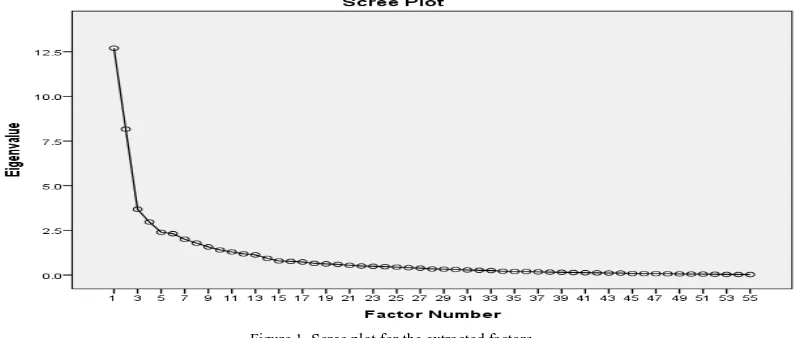
The second step of the factor analysis was to decide about how many factors could be extracted from the data. To obtain this, two criteria were adopted: Kaiser’s criterion and scree plot test. Maximum likelihood was run as the method to decide about the number of extracted factors. Those factors that have the eigenvalues of 1.0 or more should be retained based on Kaiser’s criterion and the total variance should be over 60% (Pallant, 2013). In the current study, the eigenvalue of thirteen factors in the questionnaire was above 1.0 and the total variance was estimated to 77.44%. The thirteen factors accounted for 23.09%, 14.84%, 6.69%, 5.39%, 4.35%, 4.20%, 3.63%, 3.25%, 2.86%, 2.54%, 2.35%, 2.15%, and 2.04% of the total variance (77.44%). Variable communalities were also taken into account and they were greater than 0.30 (acceptable) for all items. The second criterion in this step was scree plot which involves “plotting each of the eigenvalues of the factors and inspecting the plot to find a point at which the shape of the curve changes direction and become horizontal” (Pallant, 2013, p. 191). In the current study, scree plot (Figure 1) showed that thirteen factors could be retained.
Figure 1. Scree plot for the extracted factors.
The last step was factor rotation which was obtained through pattern matrix based on maximum likelihood method. Table 5 indicates how thirteen factors were rotated. Some items were rotated on more than one factor. For example, item 42 both rotated on factor 11 and factor 13. This occurred because of the large number of factors and variables. When we considered the content of the item, we understood that it should be allocated for factor 13.
TABLE 5
PATTERN MATRIX BASED ON MAXIMUM LIKKELIHOOD
Items Factors
1 2 3 4 5 6 7 8 9 10 11 12 13
33 37 30 35 22 25 4 11 40 38 31 34 49 55 53 43 44 46 26 3 21 9 20 10 8 27 14 18 2 28 24 17 6 7 36 29 32 39 15 19 1 13 .932 .657 .513 .497 .973 .677 .664 .600 .833 .813 .615 .390 .878 .787 .691 .665 .632 .568 -.956 -.768 -.725 -.706 .757 .746 .717 .677 .799 .735 .658 .652 .737 .723 .705 .670 .921 .894 .885 .865 .829 .662 .634 .485 12 50 5 16 23 51 52 41 47 48 54 45 42 .327 .335 -.345 .372 -.445 -.411 -.373 .378 .672 .678 .647 .580 .392 .599 .544 .502 .492
Extraction Method: Maximum Likelihood. Rotation Method: Oblimin with Kaiser Normalization.
IV. RESULTS AND DISCUSSION
As mentioned before the main questionnaire was administered to 516 respondents in the main phase of the study although 9 respondents were excluded from the study because of missing the data. The questionnaire was administered by hand and via email and the respondent rate was acceptable (0.71%). A confirmatory factor analysis (CFA) was run to see what a model might emerge for Iranian EFL teachers’ role identity based on the questionnaire data.
cross-sectional and multivariate statistical technique also deals with factor analysis, path analysis, and regression. Since SEM takes into account the relationship between unobserved (latent) and observed variables, the 55 items in the current questionnaire acted as observed variables and 13 factors designated as latent variables. In order to emerge and then test a conceptual model, Amos version 22 was run and maximum likelihood was employed as a method in order to analyze the data. In the current study, the results of SEM revealed poor fitness of the model initially. Then, some modifications, such as removing the personal background information and removing three items (16, 49, and 50) were exercised. These items were caused to decrease the measure of goodness-of-fit indices and personal background information was exacerbated the complexity of the model.
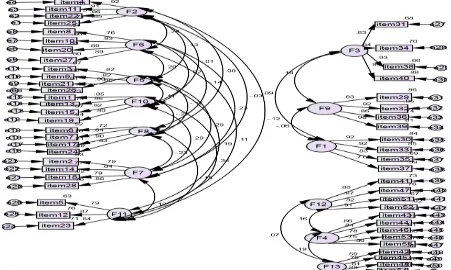
In the first-order of CFA, 13 factors were explained by 52 reminded items (Figure 2). Figure 2 presents the pathway from each latent variable (factor) to observed variable (item). Each observed variable has an error of variance indicated by arrow from error to item. Each single- headed arrow from latent variables (factors) to observed variables (items) shows factor loading. Items with factor loading greater than 0.3 show medium effect and items with factor loading greater than 0.5 indicate high effect. Figure 2 shows that all of the items have factor loadings from 0.59 to 0.94. This means that all of the items have an acceptable and high effect on factors. The relationship between each latent variable (F) is indicated by double headed- arrows (covariance). The figure also shows an acceptable ratio of covariance between each latent variable (F).
Figure 2. Model of 13 factors (first –order CFA) for Iranian EFL teachers’ role identity.
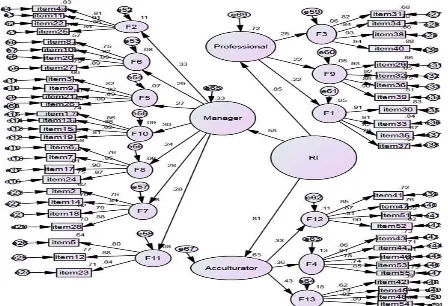
main role identity, i.e. manager, professional, and acculturator. Then, in the third order of CFA, these three main role identity explained role identity (RI) for Iranian EFL teachers (Figure 3).
Figure 3. Final model (second and third-order CFA) for Iranian EFL teachers’ role identity. Note: RI refers to Role Identity and F1-F13 refer to factors (see Table 3).
In order to accept a model, three criteria must be taken into consideration, including assessment of normality, estimation of factor loadings, and goodness-of-fit indices (Byrne, 2010). In order to meet the first criteria, the standardized kurtosis and skewness indices (β2) in a normal distribution have a value of +3 and -3 (Byrne, 2010). In the current study, the kurtosis and skewness indices were 1.57and -0.59, respectively. This means that the data were normally distributed. The second criterion estimated the factor loadings for each item. Items with factor loadings greater than 0.3 show medium effect and with greater than 0.5 show high effect. In the current study, all of the items had acceptable factor loadings. These factor loadings (single-headed arrows from F to items (Figure 3) were between 0.62 and 0.94. To meet the goodness-of-fit indices, four indices from absolute fit indices were taken into account. These four indices were: x2 (Chi-square), x2/df, goodness-of-fit index (GFI), and the root mean square error of approximation (RMSEA). Table 6 shows accepted level (based on Kline, 2011; Byrne, 2010) and the current level for the final fit model.
TABLE 6
FIT MEASURES FOR FINAL MODEL
Index Current level Accepted level
x2 3857.06 p>0.05
x2/df 3 < 5
RMSEA 0.06 <0.08
GFI 0.73 >0.90
The output of the SEM also indicates df (degree of freedom) =1270 and p (significant value) =0.00. To explain Table 6, x2 is a badness of fit index and it is sensitive to sample size (N>200). To remedy x2 (Chi-square) problem, x2/df is employed which is 3857.06/1270= 3. So, x2/df shows an acceptable level (3<5) for the model. The third index is RMSEA which shows an acceptable level 0.06. The last index is GFI which shows 0.73. It seems that this index indicates an unaccepted level. This occurs because of the influence of the large number of factors and variables in the current study (Lacobucci, 2010). In such situation that an index is not an acceptable level and all of the other requirements are met and the model also fit the data, it is recommended to accept the fit model (Byrne, 2010; Kline, 2011). Therefore, the fit model was accepted and proposed for Iranian EFL teachers’ role identity.
of Iranian teachers’ role identity, namely professional identity subcategorized to pundit, collaborator, and learner. These sub-role identities were in line with Bijaared et al. (2000) professional identity from the domains of expertise, Wenger’s (1998) community of practice, and Farrell’s (2011) teachers’ professional identity. Therefore, teacher as professional referred to the role identity of Iranian teachers as one who dealt with their teaching professionally, taking their job seriously, negotiating their knowledge with their colleagues, expanding their general and professional teaching knowledge, and learning from everyone in their own field. The third theme of the role identity for Iranian EFL teachers was teacher as acculturator. It encompassed both social and cultural aspects of teachers’ role identity and sub-categorized to social panacea, cultural adapter, and tutelage-provider. The social panacea as a sub-role identity took into consideration the role of Iranian EFL teachers’ as one who supported their students and solved their problems regarding social matters. This role was in line with what Hawkins and Norton (2009) assigned the role of social mediators and what Farrell (2011) called the social worker. Considering and respecting different cultures and custom by Iranian EFL teachers was another emergent sub-role identity under the title of cultural adapter which was in line with Duff and Uchida (1997) who assigned the role of cultural workers for teachers and what Farrell (2011) called the socializer. Finally, Iranian EFL teachers’ sub-role identity as a tutelage-provider was in concert with Farrell’s (2011) care-provider sub-role identity for teachers.
V. CONCLUSION
The aim of the current study was to develop a questionnaire and to explore a model for Iranian EFL teachers’ role identity. At the first step, based on the literature, theoretical framework, and finding on the qualitative phase2 of the study, the questionnaire was designed. The questionnaire enjoyed an acceptable degree of reliability and validity though it is developed for the first time in Iran as an EFL context. Regarding the first question of the study, Iranian EFL teachers’ conceptualized their managerial roles in the classroom as knowledge transmitter, trader, juggler, interaction supervisor, entertainer, arbiter, and promoter. They perceived their professional dimension of their teaching as pundit, collaborator, and learner. The cultural and social side of Iranian EFL teachers’ role identity under the main category of acculturator sub-divided into social panacea, cultural adapter, and tutelage-provider. Pertaining to the second question of the study, a model emerged in three order of CFA based on the developed questionnaire. Although the model was not fit the data initially, it was fit the data with some modifications in it, eventually. In the final fit model, thirteen factors of role identity explained three main role identities and these three main identities in their own turn explained Iranian EFL teachers’ role identity (Figure 3). It is worth to mention if the questionnaire and the model of the current study intend to be used in other ESL and EFL contexts, ‘local exigencies’ (Kumaravadivelu, 2012) must be taken into consideration. This means that with some reasonable modifications in the model’s factors and checking the reliability and validity of the questionnaire again, the model and questionnaire can be employed in other contexts. The next matter that can be take into consideration in the future study can be an exploring the relationship between demographic information and Iranian EFL teachers’ role identity.
Notes
1. Corresponding Author, Moslem Sadeghi Mob: +98 917 367 6636
Fax: +98 763 224 8005
Email: [email protected]
2. This is a part of a larger Ph.D. project conducted in a qualitative phase of the study.
APPENDIX
TABLE 2
RESPONDENTS’ DEMOGRAPHIC INFORMATION.
Gender Work status Years of teaching experience
Male Female Permanent Part-time Below 3 3-5 6-10 More than 10
N 231 276 201 306 107 137 141 122
Mean 45.6% 54.4% 39.6% 60.4% 21.1% 27% 27.8% 24.1%
Major of study Degree (level of study)
English Language Teaching
English Literature
English Translation
B.A. M.A. student
M.A. Ph.D. candidate
Ph.D.
N 296 69 142 128 123 171 62 23
Mean 58.4% 13.6% 28% 25.2% 24.3% 33.7% 12.2% 4.5%
Geographical districts Educational contexts
North West South East Center University School Institute
N 90 78 141 82 116 117 106 284
Mean 17.8% 15.4% 27.8% 16.2% 22.9% 23.1% 20.9% 56%
REFERENCES
[1] Abednia, A. (2012). Teachers’ professional identity: Contributions of a critical EFL teacher education course in Iran. Teaching and Teacher Education, 28(5), 706-717.
[2] Akerman, S. F., & Meijer, P. C. (2011). A dialogical approach to conceptualizing teacher identity. Teaching and Teacher Education, 27, 308-319.
[3] Arikoski, J. (1999). Interaction in teaching. In P. Räsänen, J.Arikoski, P. Mäntynen, & J. Perttula. (Eds.). Teaching psychology
(2nd ed.). Public Administration Training Centre Ltd.
[4] Beijaard, D., Verloop, N., & Vermunt. J. D. (2000). Teachers' perceptions of professional identity: An exploratory study from a personal knowledge perspective. Teaching and Teacher Education, 16, 749-764.
[5] Ben-Peretz, M., Mendelson, N., & Kron, F. W. (2003). How teachers in different educational contexts view their roles.
Teaching and Teacher Education, 19(2), 277-290.
[6] Burns, A., & Richards, J.C. (Eds.). (2009). The Cambridge guide to second language teacher education. New York: Cambridge University Press.
[7] Byrne, M. B. (2010). Structural equation modeling with Amos: Basic concepts, application, and programming (2nd ed.). London: Routledge.
[8] Canagarajah, S. (1999). Resisting linguistic imperialism in English teaching. Oxford: Oxford University Press. [9] Clark, U. (2013). Language and identity in English. London: Routledge.
[10] Coldron, J., & Smith, R. (1999). Active location in teachers’ construction of their professional identities. Journal of Curriculum Studies, 31(6), 711-726.
[11] Connelly, F. M., & Clandinin, D. J. (1999). Shaping a professional identity: Stories of educational practice. New York: Teachers College Press.
[12] Cooper, K. and M. R. Olson (1996). The multiple 'I's' of teacher identity. In M. Kompf, W. R. Bond, D. Dworet, & R. T. Boak.,
Changing research and practice: Teacher's professionalism, identities and knowledge. London: The Falmer Press, 78-89. [13] Dörnyei, Z., & Taguchi, T. (2010). Questionnaires in second language research: Construction, administration, and processing
(2nd ed.). London: Routledge.
[14] Duff, P., & Uchida, Y. (1997). The negotiation of teachers’ sociocultural identities and practices in postsecondary EFL classrooms. TESOL Quarterly, 31, 451-486.
[15] Farrell, T.S.C. (2008). Reflective language teaching: From research to practice. Continuum, London: UK.
[16] Farrell, T. S.C. (2011).Exploring the professional role identities of experienced ESL teachers through reflective practice.
System, 39, 54-62.
[17] Fisherman, Sh. (2015). Professional identity and burnout among pre-school, elementary, and post-elementary school teachers in Israel. Journal of Curriculum and Teaching 4(1), 1-13.
[18] Hawkins, M., & Norton, B. (2009). Critical language teacher education. In A. Burns, & J. Richards (Eds.). Cambridge Guide to Second Language Teacher Education (pp. 30-39). Cambridge: Cambridge University Press.
[19] Kline, R. B. (2011). Principles and practice of structural equation modeling (3th ed.). New York: The Guilford Press. [20] Kumaravadivelu, B. (2012). Language teacher education for a global society. UK: Routledge.
[21] Lacobucci, D. (2010). Structural equations modeling: Fit Indices, sample size, and advanced topics. Journal of Consumer Psychology, 20, 90-98.
[22] Masoumpanah, Z., & Zarei, Gh.(2014). EIL, Iranian teachers’ professional identity and perception of professional competence. International Conference on Current Trends in ELT, Procedia - Social and Behavioral Sciences, 98, 1100 – 1109.
[23] Moore, M., & Hofman, J. E. (1988). Professional identity in institutions of higher learning in Israel. Higher Education, 17(1), 69-79.
[24] Noonan, H. W. (2007). Identity eliminated. Analysis, 67, 122-127.
[25] Norton, B. (2013). Identity and language learning: Extending the conversation(2nd ed.). Bristol, UK: Multilingual Matters. [26] Pallant, J. (2013). SPSS survival manual: A step-by-step guide to data analysis using IBM SPSS (5th ed.). McGraw Hill
Education: Open University Press.
[27] Tajfel, H., & Turner, J. C. (1986). The social identity theory of intergroup behavior. In S. Worchel, & W. G. Austin (Eds.),
Psychology of intergroup relations. Chicago: Nelson-Hall, 7-24.
[28] Wenger, E. (1998). Communities of practice. Learning, meaning and identity. Cambridge: Cambridge University Press. [29] Wright, T. (1987). Roles of teachers and learners. Oxford: Oxford University Press.
Moslem Sadeghi is a Ph.D. candidate in the Department of Foreign Languages and Linguistics at Shiraz University, Shiraz, Iran. He has published and presented papers both nationally and internationally. His areas of interest include Teacher Education, Critical Pedagogy, and Critical Discourse Analysis.