ISSN: 2501 - 1235 ISSN-L: 2501 - 1235 Available on-line at: www.oapub.org/edu
doi: 10.5281/zenodo.2556309 Volume 5 │ Issue 4 │ 2019
GAME ANALYSIS OF
THE LAST FIVE WORLD CHAMPIONSHIP
IN WOMEN’S HANDBALL
Skoufas Dimitriosi
School of Physical Education and Sport Sciences, Aristotle University of Thessaloniki,
Thermi, 54124, Greece
Abstract:
Female handball has been growing rapidly over the last decades. The development of women’s handball arises by the analysis of the data of the events of major competitions like world championships. Due to the physical development of the handball sport, the analysis of the statistics of the last five world women's handball championships constitutes a valuable tool for demonstrating the level of female handball improvement. The aim of this study was to conduct a technical analysis of women's handball characteristics which refer to technical and tactical skills and to determine factors related to the degree of improvement of the above characteristics. The main variables used to compare technical characteristics in the last five world women's handball championships were: the efficiency of attacks (TG), the efficiency of 6m position throws (6mG), the efficiency of wing position throws (WG), the efficiency of 9m position throws (9mG), the efficiency of 7m position throws (7mG), the efficiency of fast breaks throws (FB), the efficiency of break-through throws (BT), the efficiency of assist throws (A) and the efficiency of steals (S). Data where used for analysis was taken by the International Handball Federation. ANOVA were used for finding differences between participant teams in the above characteristics. The results showed that the efficiency of all characteristics improved over the years in all teams.
Keywords: women’s handball, world championships, technical characteristics
1. Introduction
Handball is a team-intensive Olympic sport that requires frequent physical contact between athletes as well as a high level of motor skills such as sprints, jumps, directional changes, accelerations and stops (Bencke et al., 2013). Also, improving team performance in handball requires a combination of abilities such as strength, speed and
flexibility (Michalsik, Aagaard, & Madsen, 2013). Thus, performance in handball can describe as a very complex situation which depends by many factors as referred above (Vila et al., 2012).
In world literature women’s handball has been a sharp increase in the last decade (Gholami & Rad, 2010; Granados, Izquierdo, Ibañez, Bonnabau, & Gorostiaga, 2007; Granados, Izquierdo, Ibàñez, Ruesta, & Gorostiaga, 2008). Furthermore, knowledge for elite women’s handball teams training is limited, although the necessity for the further development of women's handball is imperative (Manchado, Tortosa-Martínez, Vila, Ferragut, & Platen, 2013).
Handball contains a large number of motor skills, which makes it a complex sport (Rogulj, Srhoj, & Srhoj, 2004). The Wagner and colleagues (2014) reported that handball is a multi-factorial sport which presents difficulties in distinguishing elements is affected performance (Wagner et al., 2014).
Τhe achievement of high handball performance is inextricably linked to various factors such as tactics, technique and physical abilities and skills (Noutsos S. Konstantinos, Rousanoglou N. Elissavet, Meletakos G. Panagiotis, Bayios A. Ioannis, 2018). Performance measurement is one crucial indicator for training process and movement skills (Bilge, 2012). Moreover, assessment of performance could be a useful instrument in training planning and to treat each opponent (Taborsky F., 2011).
Necessary for the evolution of the handball game is the analysis of the world handball championships and other similar top events such as the Olympic Games and the European championships (Taborsky, 2007). Furthermore, analysis is the main factor of general assessment for a better planning of training process (König, 2010). The analysis of high-level matches allows both individual and team level performance assessments as well as the level of technical skills and tactics of each team (Bilge, 2012).
The examining and analysis of top sport events such as world championships and Olympic Games provide technical, practical and cognitive parameters for the evolution of handball as sport but also gives an overview of performance of athletes as well as the teams in general. The present study is an attempt to contribute to the evolution of women's handball through the analysis of the last five world championships from 2009 to 2017.
2. Material and Methods
Present investigation includes total team statistics of the teams which participated at the last five world women's handball championships among 2009 and 2017. The data used in this investigation for further analysis were taken from the International Handball Federation (IHF).
Finally, One Way ANOVA analysis and Post-Hoc Scheffe test was used to determine any differences between the variables has mentioned above in five different times.
3. Results
The variables where presenting in statistics of the present investigation were taken from the International Handball Federation (IHF) and more specifically they concern the last five world women's handball championships from 2009 to 2017.
The table below (Table 1) presents the descriptive statistics of the related variables obtained from the last five world women's handball championships which examined.
In this investigation were used One Way ANOVA analysis which showed statistically significant differences with F(32, 399.87)=6.15 and p<0.0001. Post-Hoc Scheffe
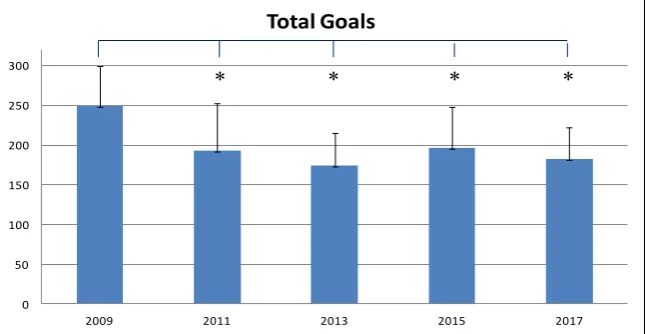
test showed statistically significant differences in the year 2009 with all the remaining years. Graphs of the results are presented separately below.
Table 1: General descriptive statistics of the related variables of the last five world men's handball championships
Technical characteristics Average SD Max Min
Efficiency of attacks 199.13 54.84 315 75
Efficiency of 9m position throws 40.91 15.01 78 12
Efficiency of 7m position throws 23.01 8.05 51 5
Efficiency of 6m position throws 49.59 17.08 100 18
Efficiency of wing position throws 27.6 10.19 63 7
Efficiency of fast breaks throws 37.69 20.43 101 4
Efficiency of break-through throws 20.31 9.81 44 2
Efficiency of assist throws 95.15 34.44 187 16
Efficiency of steals 33.66 15.78 88 5
Graph 1 refers to the efficiency of the attacks (total goals) and show statistically significant differences in the year 2009 with the other years 2011, 2013, 2015 and 2017.
Graph 1: Efficiency of the attacks (total goals) 0
50 100 150 200 250 300
2009 2011 2013 2015 2017
Total Goals
Graph 2 refers to the efficiency of the 9m position throws (9m Goals) and didn’t show significant differences between the above years of the world championships.
Graph 2: Efficiency of the 9m position throws (9m Goals)
Graph 3 refers to the efficiency of the 7m position throws (7m Goals) and there were minor variations without being statistically significant between the above years of the world championships
Graph 3: Efficiency of the 7m position throws (7m Goals)
Graph 4 refers to the efficiency of the 6m position throws (6m Goals) and there were minor variations without being statistically significant between the above years of the world championships.
Graph 4: Efficiency of the 6m position throws (6m Goals)
0 20 40 60 80
2009 2011 2013 2015 2017
9m Goals
0 10 20 30 40
2009 2011 2013 2015 2017
7m Goals
0 20 40 60 80 100
2009 2011 2013 2015 2017
Graph 5 refers to the efficiency of the wing position throws (Wing Goals) and there were small differences without being statistically significant between the above years of the world championships.
.
Graph 5: Efficiency of the wing position throws (Wing Goals)
Graph 6 refers to the efficiency of the fast breaks throws (Fast Breaks) and there were small differences without being statistically significant between the above years of the world championships.
Graph 6: Efficiency of the fast breaks throws (Fast Breaks)
Graph 7 refers to the efficiency of the breakthrough throws (Breakthrough) and didn’t show significant differences between the above years of the world championships.
Graph 7: Efficiency of the breakthrough throws (Breakthrough)
0 10 20 30 40 50
2009 2011 2013 2015 2017
Wing Goals
0 20 40 60 80 100
2009 2011 2013 2015 2017
Fast Breaks
0 10 20 30 40
2009 2011 2013 2015 2017
Graph 8 refers to the efficiency of the assist throws (Assists) and there were minor variations without being statistically significant between the above years of the world championships.
Graph 8: Efficiency of the assist throws (Assists)
Graph 9 refers to the efficiency of the steals (Steals) and there were small differences without being statistically significant between the above years of the world championships.
Graph 9: Efficiency of the steals (Steals)
4. Discussion
The aim of the current study was to analise the technical and tactical characteristics of women’s handball as they presented at the last five world handball championships and draw conclusions that will help to improve these technical and tactical features. Results show that most efficiency attacks is observed in the 2009 world championship in comparison with the other four world championships in 2011, 2013, 2015 and 2017, while no significant change occurred in any other of the investigated factors.
Performance is a crucial parameter which has motivated many coaches and researchers to link the success of the sport with the elements of tactics (Bilge, 2012). This could lead to more efficient team sports, which can be achieved by a deeper understanding of the logic of the elements of the particular sport and the development of the most effective training methods (Fernandez, Camerino, Anguera, & Jonsson, 2009). The assessment of performance in handball players include many tests such as
0 50 100 150 200
2009 2011 2013 2015 2017
Assists
0 20 40 60 80
2009 2011 2013 2015 2017
agility, strength, jump and sprint (Bautista et al., 2016) which have the objective to classified the handball athletes according to their particular skills (Ingebrigtsen, Jeffreys, & Rodahl, 2013; Vila et al., 2012).
According to Fry and collaborates (1991) the specific position of every player has been determined by performance and performance tests have been correctly classified the player positions. Given these requirements maybe it is necessary to become an assessment of the feedback of the athletes and the determination of performance as a better solution for sporting success (Sosa González, Francisco, Coronado, Maria, & Rosa, 2013).
Coaches must create training programs which will be described in harmonious growth and development of all those skills that are necessary for the respective sport and the avoidance of reduction in performance (Hermassi et al., 2018). Michalsik and collaborates (2013) report that successful performance in a handball match require by players a numerous of skills (strength, speed, agility and power). The training of these different skills in the course of the annual planning should be particularly taken into account with the ultimate aim of overall improvement in performance(Mazurek et al., 2018). Also, in elite handball players the strength training will increase most of the above performance skills (speed, strength, power and jump) as well as throwing velocity (Gorostiaga, Granados, Ibanez, Gonzalez-Badillo, & Izquierdo, 2006).
According to the aspect of Srhoj et al (2001) who investigated the importance of the athlete's final position in successful final attempts in handball, they show that the positions in sport of handball which was more likely to lead to the success of a goal were the pivot attack position, the break-through shoot and the fast break shoot.
4.1 Recommendations
Performance is the most important parameter in handball and especially women's handball which has developed rapidly in recent years both at global level and at individual national levels. In any case, performance consist of a set of technical and tactical features that need to be developed and connected in harmony to achieve the best possible result.
4.2 Conclusion
The results of the present study lead to the conclusion that the evolution of handball both at training level (jumps, strength, speed) and tactical (defense and attack) leads in the last years to a veritable improvement and progress of the sport. These results are in line with the data from other researches (Mazurek et al., 2018; Michalsik et al., 2013), which place particular emphasis on the development of the sport on many levels.
4.3 Acknowledgements
References
Bautista, I.J., Chirosa, I.J., Robinson, J.E., Van Der Tillaar, R., Chirosa, L.J., & Martín, I. M. (2016). A new physical performance classification system for elite handball players: Cluster analysis. Journal of Human Kinetics. https://doi.org/10.1515/hukin-2015-0177
Bencke, J., Curtis, D., Krogshede, C., Jensen, L.K., Bandholm, T., & Zebis, M.K. (2013). Biomechanical evaluation of the side-cutting manoeuvre associated with ACL injury in young female handball players. Knee Surgery, Sports Traumatology, Arthroscopy. https://doi.org/10.1007/s00167-012-2199-8
Bilge, M. (2012). Game analysis of Olympic, World and European Championships in men’s handball. Journal of Human Kinetics. https://doi.org/10.2478/v10078-012-0084-7
Fernandez, J., Camerino, O., Anguera, M.T., & Jonsson, G.K. (2009). Identifying and analyzing the construction and effectiveness of offensive plays in basketball by using systematic observation. Behavior Research Methods. https://doi.org/10.3758/BRM.41.3.719
Fry, A.C. and Kraemer, W. (1991)- Fry et al (1991)- Physical Performance Characteristics of American Collegiate Football Players. Journal of Applied Sport Science Research, 5(3), 126–138.
Gholami, M., & Rad, L.S. (2010). Anthropometric, body composition and somatotype differences of Iranian elite female basketball and handball players. British Journal of Sports Medicine. https://doi.org/10.1136/bjsm.2010.078725.114
Gorostiaga, E.M., Granados, C., Ibanez, J., Gonzalez-Badillo, J.J., & Izquierdo, M. (2006). Effects of an Entire Season on Physical Fitness Changes in Elite Male Handball Players. Medicine & Science in Sports & Exercise. https://doi.org/10.1249/01.mss.0000184586.74398.03
Granados, C., Izquierdo, M., Ibañez, J., Bonnabau, H., & Gorostiaga, E.M. (2007). Differences in physical fitness and throwing velocity among elite and amateur female handball players. International Journal of Sports Medicine. https://doi.org/10.1055/s-2007-964989
Granados, C., Izquierdo, M., Ibàñez, J., Ruesta, M., & Gorostiaga, E.M. (2008). Effects of an entire season on physical fitness in elite female handball players. Medicine and Science in Sports and Exercise. https://doi.org/10.1249/mss.0b013e31815b4905
Hermassi, S., Chelly, M. S., Wagner, H., Fieseler, G., Schulze, S., Delank, K.S., … Schwesig, R. (2018). Zusammenhänge zwischen der Maximalkraft der unteren Extremitäten, anthropometrischen Eigenschaften und der grundlegenden Explosivkraft bei Handballspielern. Sportverletzung-Sportschaden. https://doi.org/10.1055/s-0043-124496
Ingebrigtsen, J., Jeffreys, I., & Rodahl, S. (2013). Physical characteristics and abilities of junior elite male and female handball players. Journal of Strength and Conditioning Research. https://doi.org/10.1519/JSC.0b013e318254899f
Manchado, C., Tortosa-Martínez, J., Vila, H., Ferragut, C., & Platen, P. (2013). Performance factors in women’s team handball: Physical and physiological aspects-a review. Journal of Strength and Conditioning Research. https://doi.org/10.1519/JSC.0b013e3182891535
Mazurek, K., Zmijewski, P., Makaruk, H., Mróz, A., Czajkowska, A., Witek, K., … Lipińska, P. (2018). Effects of Short-Term Plyometric Training on Physical Performance in Male Handball Players. Journal of Human Kinetics, 63, 137–148. https://doi.org/10.2478/hukin-2018-0014
Michalsik, L.B., Aagaard, P., & Madsen, K. (2013). Locomotion characteristics and match-induced impairments in physical performance in male elite team handball players. International Journal of Sports Medicine. https://doi.org/10.1055/s-0032-1329989
Noutsos S. Konstantinos, Rousanoglou N. Elissavet, Meletakos G. Panagiotis, Bayios A. Ioannis, B.D.K. (2018). Performance indicators and competition ranking in women’s and men’s world. Journal of Physical Education and Sport, 18(3), 1761– 1766. https://doi.org/10.7752/jpes.2018.03256
Rogulj, N., Srhoj, V., & Srhoj, L. (2004). The Contribution of Collective Attack Tactics in Differentiating Handball Score Efficiency. Coll. Antropol (Vol. 28).
Sosa González, P. I., Francisco, J., Coronado, O., Maria, R., & Rosa, A. (2013). Assessment of psychological skills in young elite female handball players. Retrieved from http://www.eurohandball.com
Srhoj, V., Rogulj, N., & Kati, R. (2001). Influence of the Attack End Conduction on Match Result in Handball. Coll. Antropol (Vol. 25).
Taborsky, F. (2007). Playing Performance in Team Handball ( Summary Descriptive Analysis). Education.
Taborsky F. (2011). Competitive Loading in Top Team Handball and the Consequences for Training (Survey Study).
Vila, H., Manchado, C., Rodriguez, N., Abraldes, J.A., Alcaraz, P.E., & Ferragut, C. (2012). Anthropometric profile, vertical jump, and throwing velocity in elite female handball players by playing positions. Journal of Strength and Conditioning
Research, 26(8), 2146–2155. Retrieved from https://journals.lww.com/nsca-jscr Wagner, H., Finkenzeller, T., Würth, S., & Von Duvillard, S.P. (2014). Individual and
Creative Commons licensing terms