Public Administration 2015
CLOUD-BASED VS DESKTOP-BASED PROPERTY MANAGEMENT
SYSTEMS IN HOTEL
Prof. Dr. MustafaGULMEZ
Tourism Faculty, Akdeniz University, Antalya, Turkey [email protected]
PhD Candidate EdinaAJANOVIC
Institute of Social Sciences, Akdeniz University, Antalya, Turkey [email protected]
Ins. IsmailKARAYUN
Ayse Sak School of Applied Sciences, Akdeniz University, Antalya, Turkey [email protected]
Abstract:
Even though keeping up with the modern developments in IT sector is crucial for the success and competitiveness of a hotel, it is usually very hard for new technologies to be accepted and implemented. This is the case with the cloud technology for which the opinions between hoteliers are divided on those who think that it is just another fashion trend, unnecessary to be taken into consideration and those that believe that it helps in performing daily operations more easily, leaving space for more interaction with guests both in virtual and real world. Usage of cloud technology in hotels is still in its beginning phase and hoteliers still have to learn more about its advantages and adequate usage for the benefit of overall hotel operating. On the example of hotel property management system (PMS) and comparison between features of its older desktop-version and new web-based programs, this research aims at finding out at which stage and how effective is usage of cloud technology in hotels. For this, qualitative research with semi-structured interviews with hotel mangers that use one of these programs was conducted. Reasons for usage and advantages of each version are discussed.
Key words: Cloud benefits, Cloud technology, Cloud-based PMS, Desktop-based PM, Hotel PMS JEL classification: L83, M1, M150
1. INTRODUCTION
Constant innovation in hardware, software, and network developments and applications means that only dynamic organizations that can respond efficiently and effectively to these innovations, will be able to outperform their competitors and maintain their long-term prosperity. The more powerful and complex the Information technologies become, they will become more affordable and, user-friendly, enabling more people and organizations to take advantage of them.
Information communication technologies should be used for both operational and strategic management. ICT developments have direct impacts on the competitiveness of enterprises, they determine the two fundamental roots to competitive advantage, i.e. differentiation and cost advantage (Porter, 2001). It is crucial for tourism and hospitality practitioners to proactively incorporate new technologies into their businesses as these will improve service quality and differentiate their products and services.
In order to be able to follow the increasing guests' requests for qualitative services, it is mandatory for hotel management to constantly work on improving its functions and operations. For this it is necessary to keep track of innovations in sectors outside the hospitality, like IT sector that works on creating, developing and introducing new technologies. Humanity is becoming more dependable on Internet, mobile devices (smart phones and tablets) and our everyday and business activities are rapidly moving into virtual (Internet) environment. This is resulting in constant and fast changes in not only human habits but in the way how the business functions will be performed.
One of the developments in IT sector that have impact on our everyday Internet habits and behaviour is cloud technology. Idea of having your information of interest stored in a virtual environment -''cloud'' - is the starting point for many projects that are taking or will take place in IT sector. Hospitality is one of targeted sector that is considered appropriate for application of cloud technologies and services. Hotel Management System or widely known as Property Management System (PMS) is one of the system where IT practitioners saw the chance for improvement by ''moving it to the cloud''.
The topic of the cloud based PMS was already introduced and discussed in various international magazines in hospitality sectors such as- Hotel Management, Hotel Business, Lodging Hospitality, PhoCusWright Innovation, Hospitality Upgrade - as well as international exhibitions and fairs like HITEC 2013, HITEC 2012, WTM 2012 etc. Hotels will be forced to upgrade their current systems so that they can respond to various and changeable guests' habits and requirements. However, until today, there was not enough academic papers related to usage of cloud technology in hospitality industry even though this sector is under continuous changes caused by usage of new technologies which made search, evaluation and payment of the hotel rooms easier than ever.
In this paper, the short review on basic literature and benefits of cloud computing is presented. In continuation importance of PMS for hotels and method used in the research will be described. After comparing the two groups of hotels, from which one was using desktop PMS and other group cloud- based PMS, the results of the research were derived and presented. In conclusion of the paper, challenges with which the hotels are facing and which affect their decision of starting to use cloud- based technology as well as recommendation for future work will be discussed.
2. CLOUD TECHNOLOGY
In the work of Heart and Pliskin (2002), case study on the company, that enables small and medium sized tourism enterprises to have an internet presented by providing application service providers (ASP) for a fixed monthly fee, was conducted. In this research on usage of modern technology for that period, the authors shared the belief of Oracle company that "...in 10 years all business applications will be delivered via the Web as a software service, rather than shipped as a product that customers must implement, manage, and maintain.'' (Heart and Pliskin, 2002) Since 2002, when this paper was published, business applications were constantly developing and the rise of cloud computing proved that Oracle's forecast was correct. As stated by the Sharif (2010), cloud computing is the latest technology that is being introduced by the IT industry as the next (potential) revolution to change how the internet and information systems operate. The term “cloud” was probably inspired by IT text books’ illustrations which depicted remote environments (the Internet) as cloud images in order to conceal the complexity that lies behind them (Sultan,2010).
BASICS OF CLOUD TECHNOLOGY
Similar to traditional utilities such as water, electricity or gas, cloud computing is also being transformed to a model where users access services based on their requirements regardless of where the services are hosted or how they are delivered (Buyya et al., 2009). The goal of a new computing world is to develop software for millions to consume by easily accessing it over a network. Cloud service providers are making profit by charging consumers for accessing these services. In this way both individual and enterprise consumers are attracted by the opportunity to reduce and sometimes even eliminate costs of new software installation. Cloud computing services can provide seamless, convenient and quality-stable technology support for the user (Buyya et al., 2009 and Pyke, 2009).The services offered by cloud computing can be listed in three types (Miller and Veiga, 2009 and Sultan, 2010):
Infrastructure as a Service (IaaS): Products offered via this mode include the remote delivery (through the Internet) of a full computer infrastructure (e.g., virtual computers, servers, storage devices, etc.); the building blocks of an IT enterprise. Those who buy and use IaaS are
predominantly the IT/system administrator types charged with obtaining general processing, storage, database management, and other core IT resources and applications. Services provided in this category include CPU processing on demand, virtual Web hosting, and storage on demand. The most notable vendors are Amazon’s EC2, GoGrid’s Cloud Servers, and Joyent.
Platform as a Service (PaaS): With cloud computing, services and applications that were managed locally in the past requiring hardware, operating systems, web servers, as well as teams of network, database and system management experts are now provided remotely by cloud providers under this layer. PaaS is an emerging category of cloud services where developers can design, build, and test applications that run on the cloud provider’s infrastructure and then deliver those applications to end users from the provider’s servers. The early market leaders in this area include Google’s App Engine, Microsoft’s Azure, Amazon Web services, and Force.com (by Salesforce.com).
Software as a Service (Saas): Under this layer, applications are delivered through the medium of the Internet as a service. Instead of installing and maintaining software, access is provided via the Internet. This type of cloud service offers a complete application functionality that ranges from productivity (e.g., office-type) applications to programs such as those for Customer Relationship Management (CRM) or enterprise-resource management. Yahoo mail, Google Apps, Salesforce.com, WebEx, and Microsoft Office Live are all cloud service “products.”
Cloud computing services can be adopted by firms in three different forms (Goscinski and Brock, 2010):
Public clouds - online applications that are open to everyone for free, such as Google Docs (Stross, 2008),
Private clouds - involves firms deploying key enabling technologies, such as virtualization and multi-tenant applications, to create their own private cloud database (Low et al., 2011) which is less threatening and easy to handle (Tuncay, 2010) and
Hybrid clouds - mix of the previous two types that are emerging with the intention of providing clients with a level of “control” over their resources (Sultan, 2011)
BENEFITS OF THE CLOUD SERVICES
Positive sides of implementing cloud technology and usage of cloud services can be classified and presented (Figure 1) as follows (ISACA, 2009):
• Cost containment – The cloud offers enterprises the option of scalability without the financial commitments required for infrastructure purchase and maintenance.
• Immediacy – Many early adopters of cloud computing have cited the ability to provision and utilize a service in a single day.
• Availability – Cloud providers have the infrastructure and bandwidth to accommodate business requirements for high speed access, storage and applications.
• Scalability – With unconstrained capacity, cloud services offer increased flexibility and scalability for evolving IT needs.
• Efficiency – Reallocating information management operational activities to the cloud offers businesses a unique opportunity to focus efforts on innovation and research and development. This allows for business and product growth and may be even more beneficial than the financial advantages offered by the cloud.
• Resiliency – Cloud providers have mirrored solutions that can be utilized in a disaster scenario as well as for load-balancing traffic.
Figure 1. Benefits of the cloud technology
Source: Cloud Computing: Business Benefits With Security, Governance and Assurance Perspectives 2009, ISACA
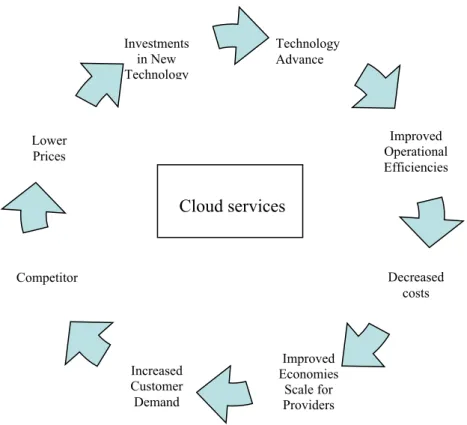
Figure 2. Circle of commodities cloud as a result of services
As cloud technology gains more popularity cloud services become commodities from which users can progressively benefit due to their involvement in circle of commodities (Miller and Veiga, 2009). This circle is presented in the Figure 2. Starting point in this circle is technology advancements that lower infrastructure costs and increase operational efficiency. Operational efficiency as a result, leads to the lower costs which enable providers to apply economies of scale. As natural consequence, economies of scale encourage and increase the customer demand. Strong
Technology Advance Improved Operational Efficiencies Investments in New Technology Improved Economies Scale for Providers Competitor Lower Prices Increased Customer Demand Decreased costs Cloud services
demand attracts competition which lowers the prices and spurs investments in new technology. These investments and efforts for a new technology to be presented open a new progress circle of technology advancements and it continues in the same way.
3. PROPERTY MANAGEMENT SYSTEM (PMS) IN HOTELS
Research papers related with E-tourism always emphasize that tourism and hotel organizations should pay special attention to ITs and their usage for business operations. Although, it seems as a very reasonable implication, practical integration of IT industry's way of thinking and working principles with those implemented in a hotel is not an easy work. When creating software or an application for a hotel, IT personnel have to possess a certain level of flexibility, openness and creativity. On the other hand, hotel employees are expected to have more insightful and open-minded approach towards new ways of performing business operations, sometimes take risks and have experiences with using different programs and applications.
Success for some hospitality companies has been achieved, in large part, by taking advantage of information technology (Siguaw and Enz, 1999). A hotel's PMS can gather and keep valuable information about hotel guests by incorporating business intelligence tools which help hoteliers organize and make sense of the gathered data. Regardless of whether room reservations come from Online Travel Agency, Global Distribution Systems or by telephone, all of them are gathered, stored and managed in the PMS. Many PMS offer extensive reporting on the collected data. Business intelligence options provide hoteliers with a three-dimensional view of guest data. PMS helps hotels with keeping a more comprehensive record of its reservations, guest's information and enables more coordination between different departments in the hotel as the record of important functions in hotel is also kept in this system.
In the past, company needed at least three requirements in order to install one hotel management system: software, server and data base system. With cloud based PMS there is no need for upgrades for both software and hardware because Cloud Servers are always updated to latest technology. Cloud Servers work at a very low cost; in fact no investment cost but, usually, reasonable monthly subscription fee is charged. Simplicity of the cloud based property management system allows it to be productive. Cloud based PMS's can operate on any advice that has a web browser and the companies are putting their efforts to make it even more friendly on smaller devices like tablets and smart phones. That is why customizing program to fit into mobile application is and will continue to be of great importance. It is recommendable for a company that intends to develop a cloud based PMS to open their system for clients inputs. These customer's inputs can help enhance the program and at the same time enable company to meet and exceed expectations.
PMS helps hotels with keeping a more comprehensive record of their reservations; guest information by keeping the record of important functions in hotel enables more coordination between different departments. Business intelligence options provide hoteliers with a three-dimensional view of guest data, which allows easily statistical reporting and increased hotel management efficiency.
4. RESEARCH OVERVIEW AND METHOD
The aim of this study was to investigate the difference in practical usage of the two types of PMS systems – cloud based and classical (desktop) ones. In order to obtain participants’ views and experiences of using one of these two PMS solutions as well as extracting key benefits and features of each system, a qualitative research with semi-structured interview was conducted. The questions were concentrated on examining the strong points of one particular system, reasons for using it, financial costs, support conditions and knowledge about the other systems and technologies in IT sector.
With the help of the software company offering both desktop and cloud based solutions to hotels in Turkey, authors managed to contact with general managers, IT supervisors, front office and
marketing managers of hotels that differed in size and location. Hotels were divided in two groups: Group A with hotels that use classical desktop PMS and Group B that use cloud version PMS. Group A, which hotels traditionally use classical desktop PMSs, was consisting of 5 hotels that were 5-star and 4-star categorized, resort type hotels with average room number of 300. In Group B there were 5 boutique and city hotels with category ranging from 3-star to 5-star and a room count that was not exceeding 50 rooms.
5. RESULTS
On the question about the reasons for using the current PMS type in hotels, answers of Group A were based on usage of their current PMS for years and on the fact that employees in all hotel departments were used to work on it. As time passed by, hotels upgraded their system to new versions for several times and additional customization was implemented with regard to hotel preferences. In one of the interviews it was mentioned, that “after technical trainings common when upgrading to the last version of the program, front office manager concluded it with 40 different extra features, processes or buttons that should be added to the new version provided by the developer of PMS”. After new version of PMS was tried for 30 days, 30 changes from the list were implemented and the rest were to be done in the future. This is time consuming for both parties as provider’s employees need extra time to work on additional features and hotel, has to wait a certain period for program to be customized according to its requirements.
Hotels from Group B were consisted of relatively new boutique hotels that operate for more than a year and from those that were not using any kind of PMS solution (they were using Excel tables and creating reservation records manually). The reason why hotels from this group wanted to use cloud PMS was a desire to try the latest technology used in hospitality industry. After the initial test period when some of their additional requirements were compensated, they started to use cloud based PMS. Other reasons for using it were: PMS could be reached from any place where Internet connection is available, simple but effective design with lots of visual solutions, more options to enter the important information and the fact that it is working not only on any PC but also on any mobile device due to its mobile applications.
When it comes to financial aspects, low investment costs were main reason for hotels from Group B to decide in favor of cloud based version. Initial investment in classical PMS starts from 10.000$ and goes up to 100.000$ depending on the system used and its provider. The similar amount of initial investments were confirmed by the Group A. Being considered as great amount of money for newly opened and small sized hotels to invest, management decided to try out the cloud version which allows access to this system based on monthly subscription with very little or no investment cost, depending on the solution provider. This ''pay as you use'' system, similar to those payments made for monthly usage of Internet, was more than affordable and acceptable for newly opened hotels.
For users of classical PMS system, license contracts are made on one-year basis and regulate maintenance and support issues. After initial investments in the system implementation, hardware, software and training of employees, every year hotel makes a one-year-based contract for additional support services and, if needed, extra training. Support is provided any time a hotel reports an issue or malfunction by directly connecting to hotel's computer through remote programs. Fixing a problem sometimes may take a couple of days. With cloud based versions there is no need for connecting with user's computer. By simply logging in to the system, any changes made from the support service will be automatically updated to all users of cloud PMS of this provider. With classical PMS there is no general application of changes to all users. Changes are made either for each hotel at a time, or after releasing new version, when provider try to convince all the current users to upgrade to it. Upgrade is provided by the extra charge, so these costs should be also considered during planning investments in classical PMS.
Regardless of which type of system they used, all participants were very careful about and interested in the matter of data security. For Group A, the fact that server is in the hotel, in place
where it can be controlled and with a certain number of people having access to it, provides a feeling of security for hotel managers. However, it is totally different situation with cloud based system, which is mainly open system where all authorized users and providers from outside have access to. Of course, it is up to hotel management to whom the authorization rights will be given and being an open system it makes support, development and innovation activities much easier. Cloud based PMS are hosted on some of the world's best known servers so there is no need for additional computers to be used as servers.
According to the data obtained from examining these two groups of PMS users, important differences and perceptions in function of classical desktop-based PMS and cloud-based PMS are presented in Table 1 (table no 1).
Table 1. Important differences in functions between classical and cloud based property management systems
Functions Classic PMS Cloud based PMS
Support
Problem notified to the provider of PMS is solved by distance connecting to the hotel's computer or within one or two days
No need for connection with hotel's server, all the support is given online instantly
Program Changes
Customization of the program according to needs and requirements of each individual hotel
General solution offered to all properties, requires constant working in improving its features to fit all clients
Type of
System In many cases close system that does not allow manipulation from outside System opened for all authorized users and providers from outside Server
Location
One server computer located inside the property. Without it or if it does not work program cannot work either
No need for special server computer, server is hosted outside
Financial Cost
First investment depending of the hotel 10.000 -100.000$ plus yearly support fee (1.000$) plus upgrading to new version
No first investment costs.
Monthly subscription of about 1€ per room
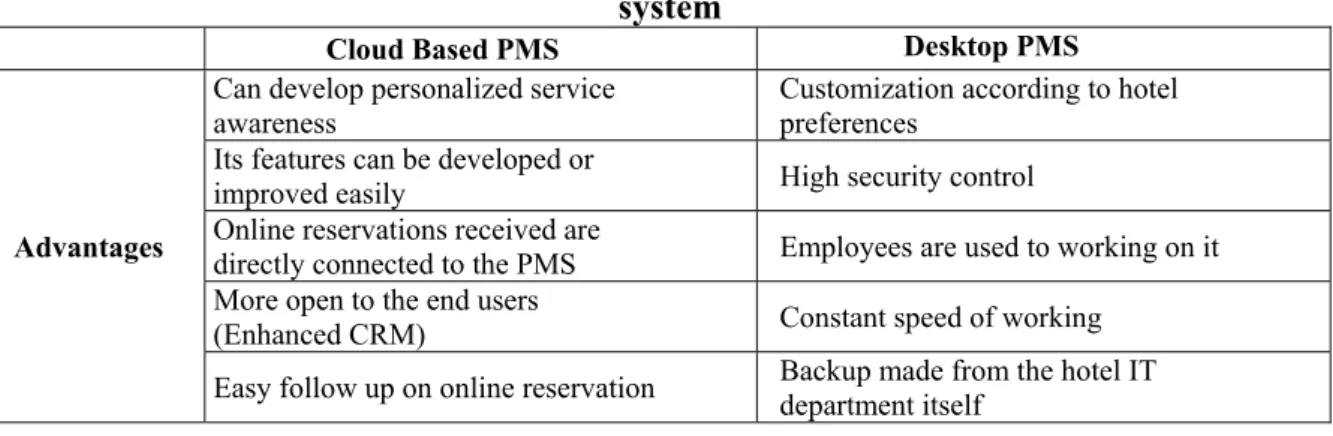
Although there are some great differences in functions and way of managing regarding classical and cloud based system, both have their advantages from which hotels do not want to give up. They are listed in Table 1 as summary of results obtained by this research.
Table 2. Main advantages of the cloud based versus classical property management system
Cloud Based PMS Desktop PMS
Advantages
Can develop personalized service
awareness Customization according to hotel preferences Its features can be developed or
improved easily High security control Online reservations received are
directly connected to the PMS Employees are used to working on it More open to the end users
(Enhanced CRM) Constant speed of working
One of the biggest advantages of cloud based PMS for the Group B is the fact that this system can be directly integrated with hotel online booking engine. This is considered as a great advantage for the hotels that besides having functional web site, wish to maximize use of its online booking engine, receive more online reservations directly from the guests and gain more profit. Due to integration between PMS and booking engine, prices and room availability information are automatically updated to hotel's booking engine and there is no concern of overbooking. Such a functional connection between hotel’s PMS and online reservation system allow hotels to have a social media integration as well. This means that hotels are able to receive online reservation through their Facebook page as well as receive direct links to its page from the biggest review sites such as TripAdvior.com. As mentioned by the group B, not only did cloud PMS enhanced CRM due to direct contact with potential guests but it also pushed hotels to work more on digital marketing and use the advantages on integration in easily managing its own and other selling channels as well.
6. CONCLUSIONS & RECOMMENDATIONS
In this paper two different approaches and perspectives on usage of cloud based and classical hotel management systems were exposed. Hotels from Group B have shown a tendency for usage of new technologies and readiness to adopt and continuously learn about them. Of course, when matter is considered from the perspectives of each hotel, advantages and options of both systems are valid. Among factors, affecting why hotel prefers one system over another, are type and size of hotel, through which channels are guest reservations coming, previous experience with IT stuff and different programs, etc. At least in Turkey, cloud based solutions at this phase can be implemented in small or medium size hotels which are highly working on receiving more direct online reservations. Cloud based program can help them in order to update prices and room availability information to hotel's booking engine. This prevents overbooking, provides easily management of CRM functions and information, with no first investment costs or extra expenses which results in revenue increase.
However, there are many challenges which cloud technology has to face and they are consisted with the ones mentioned by Miller and Viega (2009) such as question of security, lack of measurement standards for cloud-provided services, interoperability of cloud services with legacy systems and resistance of hotel employees to learn and use cloud-based software. Hotels that use classical PMS pay a great attention to the security issue because they do not want to risk opening their hotel for external intervention. In recent years we can find in media lots of evidence of information linkage from system that had much higher security measures than an average hotel. Cyber security is a burning topic and a matter of potential worry for every company that is considering moving its business online, not only in case of hotels. This is one point that developer of the web based PMS should take into consideration.
Measuring the performance of cloud-provided services is another challenge for the hotel management, primarily due to the lack of measurement standards. Once these standards are defined and they definitely will be, as the number of users is increasing, it will be easier to measure the benefits of cloud services as well as evaluating its negative and positive aspects. Their definition will be also beneficial for academic world as more research and case studies could be performed which will result in new opinions in further development and implementation of cloud technology.
Users and providers face the additional challenge of migrating functions and data from legacy systems to the cloud, as well as the interoperability of cloud services with legacy systems. Because of the significantly higher number of employees and labor intensity, once the stuff is accustomed to one system changing it can cause more difficulties.
While investigating the previous knowledge about the other system solutions, hotels in Group A have claimed lack of information about the cloud technology and its solutions. There is still simplified picture and prejudice among the hotel managers about cloud being a virtual place where one just uploads all kinds of information and takes it whenever it is needed. When cloud computing
logic is explained in this way, hotel managers do not see the point in going into an ''uncertain'' and ''unknown'' virtual area in the clouds when one can continue using current program with server being inside own property and under control. Even though IT stuff in these hotels has some basic knowledge about it, it is still not enough to convince the other managers about its benefits. Therefore it may be concluded that, besides trying to overcome the above mentioned challenges, developers of cloud based solutions to hotels should also work hard on training the potential clients about the positive aspects and correct usage of cloud technologies.
Being a pioneer paper on topic of cloud technology in hospitality, sample size is one of the limitations of this work. Also, the fact that in Turkey there is not such a large number of hotels that are using cloud based PMS, it is not easy to find the adequate number of managers that are willing to share their ideas and experience on this topic. Lack of measurement standards for cloud-provided services in general as well as for hotels is another important limitation due to which qualitative research was conducted. Authors’ recommendation is that academicians should focus more on topics of cloud computing, cloud solutions for other business operations and on defining measurements standards for cloud services.
BIBLIOGRAPHY
1. Buyya, R., Yeo, C.S, Venugopal S., Broberg J., & Brandic I. (2009). Cloud computing and emerging IT platforms: Vision, hype, and reality for delivering computing as the 5th utility. Future Generation Computer Systems 25, 599-616.
2. Goscinski, A. & Brock, M. (2010). Toward dynamic and attribute based publication, discovery and selection for cloud computing. Future Generation Computer Systems, 26, 947-70.
3. Heart, T. & Pliskin, N. (2002). Can Application Service Providers Enable Cost-Effective Information Technology for Travel & Tourism?'' Information and Communication Technologies in Tourism, Proceedings of the International Conference in Innsbruck, Austria 207-218.
4. ISACA (2009). Cloud Computing An Auditors Perspective. available from http://www.isaca.org [Accessed date: May 2014].
5. Low, C., Chen,Y. & Wu, M. (2011). Understanding the determinants of cloud computing adoption, Industrial Management & Data Systems, 111 (7), 1006 – 1023.
6. Miller, H.G. & Veiga J. (2009). Cloud computing: Will Commodity services benefit users long term?, IT Professional, 11 (7), 57–59.
7. Porter, M. (2001). Strategy and the Internet. Harvard Business Review, 79(3), 63–78.
8. Pyke, J. (2009). Now is the time to take the cloud seriously [online], white paper, available from http:// http://www.cordys.com/cordyscms_sites/objects/ [Accessed date: May 2014].
9. Siguaw, J. A. & Enz, C. A.(1999). Best Practices in Information Technology. Cornell Hotel and Restaurant Administration Quarterly, 40 (1999).
10. Sharif, A. M., (2010) It is written in the cloud: The hype and promise of Cloud Computing, Journal of Enterprise Information Management,23(2), 131-134.
11. Stross, R.E. (2008). Planet Google: How One Company is Transforming Our Lives. Atlantic Books.
12. Sultan, N. (2010). Cloud computing for education: a new dawn?. International Journal of Information Management, 30, 109-16.
13. Tuncay, E. (2010), Effective use of cloud computing in educational institutions. Proscenia Social and Behavioral Sciences, 2, 938-42.