Numerical Solution of the System of
Nonlinear Fredholm Integro-Dierential
Equations by the Operational Tau
Method with an Error Estimation
G. Ebadi
, M.Y. Rahimi
1and S. Shahmorad
1In this paper, the operational approach to the Tau method is used for the numerical solution of a nonlinear Fredholm integro-dierential equations system and nonlinear ODEs with initial or boundary conditions without linearizing. An ecient error estimation of the approximate solution is also introduced. Some examples are given to clarify the eciency and high accuracy of the method.
INTRODUCTION
In recent years, the operational approach to the Tau method has been developed to cover the numerical solution of ODEs, PDEs and linear integro-dierential equations [1-10]. Liu and Pan presented an extension of the operational approach to the Tau method for the numerical solution of a linear ODEs system with polynomial or rational polynomial coecients, together with initial or boundary conditions [11]. Ortiz et al. have solved nonlinear ODEs and PDEs using an operational approach to the Tau method, through an iteration process dened by a sequence of linear problems with variable coecients [1,4,5,8].
In this paper, Ortiz and Samara's operational approach to the Tau method is considered for the numerical solution of nonlinear ODEs and nonlinear Fredholm integro-dierential equations system without linearizing.
Consider the following nonlinear Fredholm integro-dierential equations system:
m
X
j=1
Dijyj(x) i
Z b
a ki(x;t)'i(y1(t);
;yn(t))dt
=fi(x);
i= 1(1)m; x2[a;b]; (1)
*. Corresponding Author, Faculty of Mathematical Science, University of Tabriz, Tabriz, I.R. Iran.
1. Faculty of Mathematical Science, University of Tabriz, Tabriz, I.R. Iran.
with the supplementary conditions:
m
X
j=1
ndj
X
k=1
(Ajkry(k 1)
j (a) +Bjkry(k 1)
j (b)) =dr;
r= 1(1)!; (2)
where:
[ndj = max1im
fndijg; !=
m
X
j=1
ndj];
and:
2 4Dij =
ndij
X
r=0
pijr(x)dxdrr = ndij
X
r=0
ijr
X
s=0
pijrsxsdxdrr
3 5:
For i = 1(1)m, fi(x) and ki(x;t) are polynomials in
x and inx,t, respectively and'i(y1(t);
;yn(t)) are
polynomials iny1(t);
;yn(t), otherwise, they can be
approximated by polynomials with suitable methods andijr is degree ofpijr(x).
In this paper, one assumes that, for i, j = 1(1)m, ij 2
N
, 'i(y1(t);
;yn(t)) = Qm
j=1y
ij
j (t),
otherwise, it can be written as a sum of this form by a suitable method, for example, Taylor expansion.
The organization of this paper is as follows: First, the operational approach to the Tau method for the numerical solution of Fredholm Integro-Dierential Equations (FIDEs) is explained. Then, the numerical solution of a linear FIDEs system by the Tau method is reviewed, and the operational approach to the Tau
method is applied to a nonlinear FIDEs system. After that, the nonlinear ODEs are solved and an error function is introduced. Some numerical results are given, also, to clarify the accuracy of the method and, nally, the contains conclusions are presented. Note that, the numerical results are computed by Maple programming.
Remark 1
Fori= 1(1)m, the following notations have been used throughout this paper:
x= (1;x;x2; )T;
xa = (1;a;a2; )T;
xb = (1;b;b2; )T;
e1= (1;0;0; )T;
yin= (yi0;yi1;
;yin;0;)T;
fi= (fi0;fi1;
;fin
fi;0;)T;
f = (f0;f1;
;fnf;0;)T;
yn= (y0;y1;
;yn;0;)T:
LINEAR AND NONLINEAR FIDES
The operational approach to the Tau method describes the reduction of given linear and nonlinear integro-dierential equations (IDEs) to a linear and nonlinear algebraic equations system, based on three simple matrices:
=
0 B B B B B @
0 1 0 0 0 1 0
0 1 ... 0 :::
1 C C C C C A
;
=
0 B B B B B @
0 1 0
0 2 0 ...
0 0 3 0 :::
1 C C C C C A
;
=
0 B B B B B @
0 1 0 0
0 1
2 0
0 1
3 ...
0 :::
1 C C C C C A
:
Linear FIDEs
Consider the linear FIDEs (the following result is quoted from [1,9,11]):
Dy(x) Z b
a k(x;t)y(t)dt=f(x); x2[a;b]; (3)
with the supplementary conditions:
nd
X
k=1
(Akjy(k 1)(a) +B
kjy(k 1)(b)
=dj;
j= 1(1)nd; (4)
where: D=Xnd
i=0
pi(x)dxdii =Xnd
i=0
i
X
j=0
pijxjdxdii;
is the dierential operator of ordernd.
Letyn(x) =Pn
j=0yjx
j =ynTx, then:
xryn(x) =Xn
j=0
yjxj+r=y
nTrx;
and: y(r)
n (x) = dxdrryn(x) =ynTrx: (5)
Theorem 1
Let yn(x) = ynTx 2 Cnd[a;b]; (the space of nd-times
continuously dierentiable functions on [a;b]) and: D=Xnd
i=0
pi(x)dxdii =Xnd
i=0
i
X
j=0
pijxjdxdii;
be a linear dierential operator of order nd with
polynomial coecients, then;
Dyn(x) =ynTx; (6)
where: =Xnd
i=0
ipi() =Xnd
i=0
i
X
j=0
pijij:
Theorem 2
If k(x;t) = Pni=0 Pn
j=0kijx
itj, kij 2
R
and y(x) =ynTx, then:
Z b
a k(x;t)y(t)dt=ynTfx; (7)
where f = Pn
i=0 Pn
j=0kij
ij
f is a matrix associated
uniquely withk(x;t) and constantsa;b, such that,ijf = j(xb xa)e
1
Lemma 1
Ifyn(x) =ynTx, then,
y(k)
n (a) =ynTkxa;
y(k)
n (b) =ynTkxb: (8)
Proof
By using Equation 5 one has: y(k)
n (a) =y(k)
n (x)jx
=a =ynT
kxjx
=a=ynT
kxa;
and: y(k)
n (b) =y(k)
n (x)jx
=b=ynT
kxjx
=b=ynT
kxb;
so, the proof is completed.
Applying Lemma 1 for supplementary Condi-tions 4, one has:
nd
X
k=1
Akjy(k 1)(a) +B
kjy(k 1)(b)
=Xnd
k=1
AkjynT(k 1)x
a+BkjynT(k 1)x
b
=ynTXnd
k=1
Akj(k 1)x
a+Bkj(k 1)x
b
: Let:
Ej=Xnd
k=1
Akj(k 1)x
a+Bkj(k 1)x
b
; thus, Ej 2
M
(n+1)(1) and Equation 4 is converted
intoynTEj=dj,j= 1(1)nd.
Now, by using Equations 6 through 8, the integro-dierential Equation 3 and supplementary Conditions 4 reduce to the following algebraic equations system:
(
ynTf =fT
ynTE=dT (9)
with f = f and:
E= (E1;E2;
;End)2
M
(n+1)(nd): (10)
By settingG= (E;f) andgT = (dT,fT), Equation 9
can be written asynTG = gT. To obtain yn(x), the
system of equationsynTGn =gnT must be solved for
the unknown coecients, y0;y1;
;yn, where Gn is
the matrix dened by considering the rst (n+1) rows and columns of G; and gn is the vector dened by
considering the rst (n+ 1) elements of the vector,g.
Nonlinear FIDEs
Consider the nonlinear Fredholm integro-dierential equation:
Dy(x) Z b
a k(x;t)'(y(t))dt=f(x);x2[a;b];
(11) with the supplementary Conditions 4, where D is dened as before and'(y(t)) is a polynomial in y(t), otherwise, it is approximated by a polynomial with suitable methods. In this paper,'(y(t)) =ym(t);m2
N
, is considered, since other types of '(y(t)) can be reduced to the sum of this form.Theorem 3
If u(x) = Pmj=0ujx
j =uTx and v(x) = Pm
i=0vix
i =
vTx, then, u(x)v(x) = uTv()x, where v() =
Pn
i=0vi
i.
Proof
See [9].
Lemma 2
Lety(x) =ynTx, then,ym(x) =ynTym 1()x. Proof
Letu(x) =ynTx and v(x) =ym 1(x) and Theorem 3
be applied.
Theorem 4
If yn(x) = Pni=0yinx
i = ynTx and k(x;t) =
Pn
i=0 Pn
j=0kijx
itj, then,
Z b
a k(x;t)ymn(t)dt=ynTfmx; (12)
where fm =ym 1
n ()f andf is the same matrix as
introduced in Theorem 2.
Proof
Use Lemma 2 and Theorem 2 for y(x) = ynTym 1()x.
If Equations 6, 10 and 12 are used for: Dy(x) Z b
a k(x;t)ym(t)dt=f(x); x2[a;b];
m2
N
;with supplementary Conditions 4, the following nonlin-ear system will be obtained:
(
ynTf =fT;
ynTE=dT; (13)
where f = fm and fm is the same matrix
and gT = (dT;fT), one has yTG = gT instead of
Equation 13, which is a nonlinear algebraic equations system, because Gcontains unknown elements of the vector yn. To nd yn(x), the nonlinear equations
systemynTGn=gnT must be solved, whereGnandgn
are dened by considering the (n+1)(n+1) leading
submatrix of G and the rst (n+ 1) elements of the vectorg, respectively.
LINEAR FIDES SYSTEM
Consider the system of linear FIDEs:m
X
j=1
Dijyj(x) ij
Z b
a kij(x;t)yj(t)dt
!
=fi(x);
x2[a;b]; i= 1(1)m; (14)
with the supplementary Conditions 2, whereDij,i;j=
1(1)m, are the same as that in Equation 1, fi(x) =
Pnfi
j=0fijx
j = fiTx. Now, applying Equations 6
through 8, for Equations 14 and 2, they are converted into a system of linear algebraic equations. Let yjn(x) = yjnTx j = 1(1)m, be the Tau approximates
and let ij,i;j= 1(1)mdenote the matrices associated
with Dij, i;j = 1(1)m by Theorem 1 and fij, i;j =
1(1)m be the matrices associated with kij(x;t);i;j =
1(1)mby Theorem 2. Then, one has:
m
X
j=1
Dijyjn(x) ij
Z b
a kij(x;t)yjn(t)dt
!
=Xm
j=1
yjnTijx ijyjnTfijx
=Xm
j=1
yjnT ij ijfij
x =Xm
j=1
yjnTijx; i= 1(1)m;
where:
ij = ij ijfij: (15)
Applying Lemma 1 to supplementary conditions:
m
X
j=1
ndj
X
k=1
Ajkry(k 1)
j (a) +Bjkry(k 1)
j (b)
=dr;
r= 1(1)!;
yields:
m
X
j=1
ndj
X
k=1
AjkryjnTk 1x
a+BjkryjnTk 1x
b
=Xm
j=1
yjnTXndj
k=1
Ajkrk 1x
a+Bjkrk 1x
b
=dr:
Assume that:
ndj
X
k=1
Ajkrk 1x
a+Bjkrk 1x
b
=Erj2
M
(n+1)(1);
then, one has:
m
X
j=1
yjnTErj=dr;r= 1(1)!;
and:
m
X
j=1
yjnTEj=dT;
with:
Ej= (E1j;E2j;E2j;
;E!j);
and:
dT = (d1;d2;d3;
;d!):
LetyMT = (y1nT;y2nT;y3nT;
;ymnT)2
R
M,M =m(n+ 1), where yjnT, j = 1(1)m are the coecients
vectors of yjn(x) in a standard basis. The problem
of determining yMT can be formulated as the linear equations system [11]:
yMT
G
=SMT; (16)with:
G
=0 B B B @
E1 Q11 Q21
Qm 1
E2 Q12 Q22
Qm 2
... ... ... ... ...
Em Q1m Q2m
Qmm 1 C C C A 2
M
m(n+1)m(n+1);
where Qij = (ij)(n+1)(n ndi+1) is the restriction of
ij (as dened in Equation 15) to its rst (n+1) rows
and (n ndi+ 1) columns and:
SMT = (dT;f1nd 1
T;f
2nd 2
T;
;fmn
dmT)2
R
M;where findiT is the restriction of fiT to its rst (n ndi + 1) components. By solving Equation 16,
NONLINEAR FIDES SYSTEM
Consider the nonlinear FIDEs system:m
X
j=1
Dijyj(x) i
Z b
a ki(x;t) m
Y
j=1
yjij(t)dt=fi(x);
x2[a;b]; i= 1(1)m; (17)
with the supplementary conditions:
m
X
j=1
ndj
X
k=1
Ajkry(k 1)
j (a) +Bjkry(k 1)
j (b)
=dr;
r= 1(1)!; where:
ndj = max
1im
fndijg; !=
m
X
j=1
ndj;
Dij = ndij
X
r=0
pijr(x)dxdrr = ndij
X
r=0
ijr
X
s=0
pijrsxsdxdrr;
for i;j = 1(1)m;ndij is the order of operator
Dij;fi(x);ki(x;t) are algebraic polynomials in x and
x;t, respectively, and;a;bare given constants.
Lemma 3
Letyi(x) =yinTx;i= 1(1)m then: m
Y
i=1
yrii(x) =y
1nTy
r1 1 1 ()
m
Y
i=2
yrii()x; ri 2
N
: ProofOne has:
m
Y
i=1
yrii(x) =y
1(x)y
r1 1 1 (x)
m
Y
i=2
yrii(x);
if one sets: v(x) =yr1
1 1 (x)
m
Y
i=2
yrii(x); u(x) =y
1(x);
then, by using Theorem 3, the proof is completed.
Theorem 5
If k(x;t) = Pn
i=0 Pn
j=0kijx
itj with kij 2
R
;i;j =1(1)mand yj(x) =yjnTx;j = 1(1)m, then:
Z b
a k(x;t) m
Y
i=s
yiri(t)dt=ysnTfsx;
where: fs=yrs 1
s () m
Y
i=s+1
yrii()Xn
i=0
n
X
j=0
kijj(xb xa)e1
Ti;
is a matrix associated uniquely withk(x;t).
Proof
Using Theorem 2 with y(x) = Pm
i=sy
ri
i (x) =
ysnTyrs 1
s ()Qm
i=s+1y
ri
i ()x and setting ynT =
ysnTyrs 1
s ()Qm
i=s+1y
ri
i (), the proof is completed.
Let yjn(x) = yjnTx, j = 1(1)m be the Tau
approximations, then for i = 1(1)m;1 x b, one
has:
m
X
j=1
Dijyjn(x) i
Z b
a ki(x;t) m
Y
r=s
yrnir(t)dt
=Xm
j=1
yjnTijx iysnTfsx
=Xm
j=1
yjnTijx;
where: ij =
(
ij j 6=s
is isfs j =s; (18)
fi(x) =Pnfi
j=0fijx
j =fiTxands= minf1;;mgfor
whichis6= 0.
In the same way as done in the previous section, one has Pm
j=1yjnTEj = d
T instead of Equation 2.
For determining the Tau approximations yjn(x) =
yjnTx;j = 1(1)m, Equations 17 and 2 are converted
into the system of nonlinear algebraic equations:
yMT
G
=SMT; (19)where yMT and SMT are the same notations as used
in Equation 16 and:
G
=0 B B B @
E1 Q11 Q21
Qm 1
E2 Q12 Q22
Qm 2
... ... ... ... ... Em Q1m Q2m
Qmm 1 C C C A 2
M
m(n+1)m(n+1);
withQij= (ij)(n+1)(n ndi+1), which is the restriction
of ijto its rst (n+1) rows and (n ndi+1) columns.
It should be noted that, in Equation 18, the elements of is contain the unknown coecients ofyjn(x);j =
1(1)m. By solving the nonlinear system (Equation 19), one nds the unknown coecients of yjn(x) for j =
1(1)m.
NONLINEAR ODES
In this section, the nonlinear dierential equation f(x;y;y0;y00) = 0 is considered, wheref is an analytic
function in terms of y;y0 and y00. Therefore, the
equation can be written as: f(x;y;y0;y00) =
r
X
i=0
pi(x)yni(y0)mi(y00)qi = 0;
where r;ni;mi;qi 2
N
Sf0g and pi(x) is an analytic
function in terms ofx. Using Theorem 3 and Lemma 3, one can write:
f(x;y;y0;y00) =
r
X
i=0
ynT(y())ni 1(y0())mi
(y
00())qip
i()x= 0Tx;
or: ynTXr
i=0
(y())ni 1(y0())mi(y00())qip
i() = 0T; (20)
where 0T = (0;0)
(1)(n+1). Equation 20 and the
supplementary Conditions 4 form a system of nonlinear algebraic equations. Each equation of this system is a polynomial, in terms of unknown elements of vectoryn.
ESTIMATION OF ERROR FUNCTION
In this section, an error function is obtained for the approximate solution of Equations 2 and 17. Let ejn(x) =yj(x) yjn(x),j= 1(1)mbe called the errorfunction of Tau approximationyjn(x) toyj(x), where
yj(x), j = 1(1)m is the exact solution. Substituting
yj(x) = ejn(x) +yjn(x), j = 1(1)m in Equations 2
and 17, forx 2[a;b], i= 1(1)mand s2
N
, they canbe written as:
m
X
j=1
Dij(yjn(x) +ejn(x)) i
Z b
a ki(x;t) m
Y
j=s
(yjn(t)
+ejn(t))ij(t)dt=fi(x); (21)
and:
m
X
j=1
ndj
X
k=1
Ajkr(yjn(a) +ejn(a))(k 1)
+Brjk(yjn(b) +ejn(b))(k 1) !
=dr;
r= 1(1)!:
By using (yjn(t) +ejn(t))p=Pp
k=0
k p
yjnp k(t)ekjn(t) in Equation 21 and because of satisfying yjn(x) in
Equation 2, forx25[a;b] andi= 1(1)m, one has:
m
X
j=1
Dijejn(x) i
Z b
a ki(x;t)'i
esn(t);e(s+1)n(t);
;emn(t)
dt= Hin(x);
and:
m
X
j=1
ndj
X
k=1
Ajkre(k 1)(a) +B
jkre(k 1)
jn (b)
= 0; r= 1(1)!;
where:
Hin(x) =Xm
j=1
Dijyjn(x) i
Z b
a ki(x;t) m
Y
j=s
yjnij(t)dt
fi(x);i= 1(1)m;
are the perturbation terms associated withyjn(x);j=
1(1)mand:
'i(esn(t);e(s+1)n(t);
;emn(t))
='1is
m
Y
j=s+1
(yjnij(t) +'
1ij)
+m 2 X
r=s
r
Y
j=s
yjnij(t)
'1i(r+1)
m
Y
j=r+2
(yjnij(t) +'
1ij)
+ m 1 Y
j=s
yjnij(t)
'1im;
with: '1ij=
ij
X
p=1
ij
p
yjnij p(t)epjn(t);
j=s(1)m; i= 1(1)!:
One proceeds to nd approximations ejn;N(x) to the
error functions, ejn(x), for j = 1(1)m and N 2
N
,in the same way as done before for solving problem in Equations 17 and 2. With problems in Equations 17 and 2, the Tau problem:
m
X
j=1
Dijejn(x) i
Z b
aki(x;t)'i
esn(t);e(s+1)n(t); ;
emn(t)
was associated for i = 1(1)m;a x b; with the
supplementary conditions:
m
X
j=1
ndj
X
k=1
Ajkre(k 1)(a) +B
jkre(k 1)
jn (b)
= 0; r= 1(1)!;
which denes ejn;N(x) forj = 1(1)m, whereN is the
degree of error polynomialejn(x).
NUMERICAL EXAMPLES
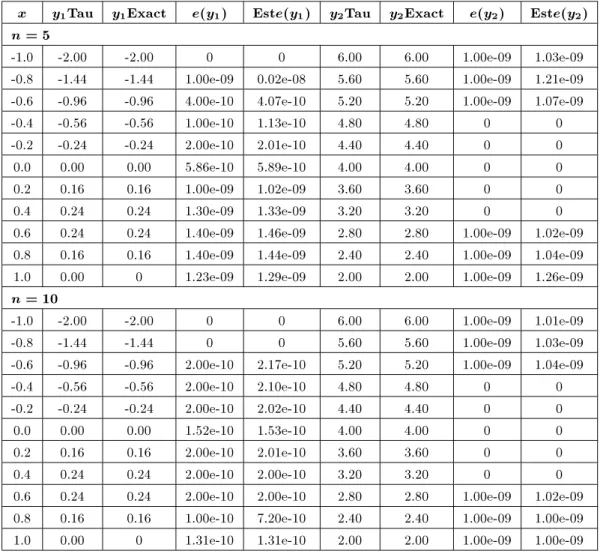
In this section, the eciency of the presented method is shown by some numerical results. Numerical results for Examples 1 to 3, were reported in Tables 1 and 2. In these tables, the terms yiTau, yiExact, e(yi) and
Est. e(yi) stand for Tau approximations ofyi(x), exact
solution, yi(x), their absolute error and estimation
error of yi for i = 1;2: It should be noted that, in
the following examples,N =n+ 2 has been used.
Example 1
Consider the following system of nonlinear FIDEs with the exact solutions,y1(x) =x x
2andy
2(x) = 4 2x.
y00 1(x) +x
2y0
1(x) + 3y
1(x) +y 0
2(x) 4y 2(x) Z
1 1
(3y2
1(t) + 2xy
1(t)y2(t))dt=f1(x);
y0
1(x) 2y
1(x) +y 00
2(x) 2y 0 2(x) +y
2(x) Z
1 1
((t x)y1(t) + 5t 2y2
2(t))dt=f 2(x);
with the supplementary conditions: y1( 1) +y
0
1( 1) = 1; y
1(1) +y 0
1(1) = 1;
y2( 1) +y 0
2( 1) = 4; y
2(1) +y 0
2(1) = 0:
where f1(x) = 116
5 + 19x 2x
2 2x3 and f 2(x) =
53 20 3x+2x
2. For the numerical results, see Table 1. Table1. Numerical results of Example 1.
x y1Tau y1Exact e(y1) Este(y1) y2Tau y2Exact e(y2) Este(y2) n=5
-1.0 -2.00 -2.00 0 0 6.00 6.00 1.00e-09 1.03e-09 -0.8 -1.44 -1.44 1.00e-09 0.02e-08 5.60 5.60 1.00e-09 1.21e-09 -0.6 -0.96 -0.96 4.00e-10 4.07e-10 5.20 5.20 1.00e-09 1.07e-09 -0.4 -0.56 -0.56 1.00e-10 1.13e-10 4.80 4.80 0 0 -0.2 -0.24 -0.24 2.00e-10 2.01e-10 4.40 4.40 0 0 0.0 0.00 0.00 5.86e-10 5.89e-10 4.00 4.00 0 0 0.2 0.16 0.16 1.00e-09 1.02e-09 3.60 3.60 0 0 0.4 0.24 0.24 1.30e-09 1.33e-09 3.20 3.20 0 0 0.6 0.24 0.24 1.40e-09 1.46e-09 2.80 2.80 1.00e-09 1.02e-09 0.8 0.16 0.16 1.40e-09 1.44e-09 2.40 2.40 1.00e-09 1.04e-09 1.0 0.00 0 1.23e-09 1.29e-09 2.00 2.00 1.00e-09 1.26e-09
n=10
-1.0 -2.00 -2.00 0 0 6.00 6.00 1.00e-09 1.01e-09 -0.8 -1.44 -1.44 0 0 5.60 5.60 1.00e-09 1.03e-09 -0.6 -0.96 -0.96 2.00e-10 2.17e-10 5.20 5.20 1.00e-09 1.04e-09 -0.4 -0.56 -0.56 2.00e-10 2.10e-10 4.80 4.80 0 0 -0.2 -0.24 -0.24 2.00e-10 2.02e-10 4.40 4.40 0 0 0.0 0.00 0.00 1.52e-10 1.53e-10 4.00 4.00 0 0 0.2 0.16 0.16 2.00e-10 2.01e-10 3.60 3.60 0 0 0.4 0.24 0.24 2.00e-10 2.00e-10 3.20 3.20 0 0 0.6 0.24 0.24 2.00e-10 2.00e-10 2.80 2.80 1.00e-09 1.02e-09 0.8 0.16 0.16 1.00e-10 7.20e-10 2.40 2.40 1.00e-09 1.00e-09 1.0 0.00 0 1.31e-10 1.31e-10 2.00 2.00 1.00e-09 1.00e-09
Example 2
Consider the nonlinear FIDEs system: y1(x) + 3xy2(x)
Z 1 2 0
(xty2 1(t) +t
2y3 2(t))dt
= 19 + 34x+ 3x3;
x2y
1(x) y2(x) Z
1 2 0
(ty3
1(t) xy 2(t))
2dt
= 19 + 27x 65x2+x3;
with exact solutiony1(x) =xandy2(x) =x
2. Table 2
presents the numerical results.
Example 3
Consider the nonlinear ODE: xy02 2yy0+x= 0;
with the supplementary condition y(0) = 1
2 and exact
solution y(x) = 1 2(x
2+ 1). For n = 4, the presented
method gives the system of nonlinear equations:
8 > > > > > > < > > > > > > :
y0= 1=2
2y0y1= 0
4y0y2 y 2 1= 1
6y0y3 2y1y2= 0
8y0y4 2y1y3= 0
; which has the solutionfy
0=y2= 0:5;y1=y3 =y4=
0gand leads toyn(x) = 0:5+0:5x
2and this is the exact
solution. For n = 7, one has the system of nonlinear equations:
8 > > > > > > > > > > > > > < > > > > > > > > > > > > > :
y0= 1=2
2y0y1= 0
6y0y3 2y1y2= 0
4y0y2 y 2 1= 1
8y0y4 2y1y3= 0
10y0y5 2y1y4+ 2y3y2= 0
12y0y6 2y1y5+ 3y 2 3+ 4y
4y2= 0
14y0y7 2y1y6+ 10y3y4+ 6y5y2= 0
and its solution isfy
0=y2= 0:5;y1=y3=y4=y5=
y6=y7= 0
g, which leads to the exact solution.
CONCLUSION
Nonlinear FIDEs systems are usually dicult to solve analytically, therefore, one needs to nd an approxi-mate solution. It has been shown that the operational approach to the Tau method is a suitable method of high accuracy for these problems.
The advantages of this method are, as follows: 1. It solves Nonlinear FIDEs systems and nonlinear
ODEs without linearization;
2. It gives an error estimator as a polynomial and improves accuracy by increasingnreasonably. In Tables 1 and 2, one can see that the accuracy of the Tau method at the end points of the intervals is less than the others. The authors will try to improve this in the future.
Table2. Numerical results of Example 2.
x y1Tau y1Exact e(y1) Este(y1) y2Tau y2Exact e(y2) Este(y2) n=5
0.0 0.00 0 2.170e-06 2.175e-06 0.00 0 2.170e-07 2.174e-07 0.1 0.10 0.10 1.797e-06 1.801e-06 0.01 0.01 3.765e-06 3.782e-06 0.2 0.20 0.20 3.352e-05 3.382e-05 0.04 0.04 1.192e-06 1.199e-06 0.3 0.30 0.30 4.990e-05 4.997e-05 0.09 0.09 3.512e-06 3.529e-06 0.4 0.39 0.40 6.818e-05 6.851e-05 0.16 0.16 7.563e-06 7.913e-06 0.5 0.49 0.50 8.945e-04 8.973e-04 0.25 0.25 1.432e-05 0.920e-04
n=10
0.0 0.00 0 2.170e-09 2.200e-09 0.00 0 2.170e-10 2.300e-10 0.1 0.10 0.10 2.101e-09 2.152e-09 0.01 0.01 7.494e-09 7.498e-09 0.2 0.20 0.20 6.997e-08 6.997e-08 0.04 0.04 2.294e-09 2.311e-09 0.3 0.30 0.30 1.828e-08 1.860e-08 0.09 0.09 4.275e-09 4.278e-09 0.4 0.40 0.40 4.837e-08 4.851e-08 0.16 0.16 5.634e-09 5.642e-09 0.5 0.50 0.50 7.004e-07 7.302e-07 0.25 0.25 5.808e-08 7.116e-08
ACKNOWLEDGMENT
The authors would like to thank the referee(s) for their careful considerations and valuable suggestions.
REFERENCES
1. Ortiz, E.L. and Samara, H. \An operational approach to the Tau method for the numerical solution of nonlinear dierential equations", Computing, 27, pp
15-25 (1981).
2. \Numerical solution of partial dierential equations with variable coecients with an operational approach to the Tau method",Comput. Math. Appl.,10(1), pp
5-13 (1984).
3. Rodrigues, M.J. and Matos, J. \Numerical solution of partial dierential equations with the Tau method", Departamento de Matematica de Universidade de Coimbra, Textos Matematica, Ser. B. 11, Fernanda Aragao Oliveira et al., Eds., pp 111-121 (1997). 4. Ortiz, E.L. and Pun, K.S. \Numerical solution of
nonlinear partial dierential equations with the Tau method",J. Comp. and Appl. Math., 12, pp 511-516
(1985).
5. Ortiz, E.L. and Aliabadi, M.H. \Numerical treatment of moving and free boundary value problems with the Tau method",Computers Math. Applic.,35(8), pp
53-61 (1998).
6. Pour-Mahmoud, J., Rahimi-Ardabili, M.Y. and Shah-morad, S. \Numerical solution of the system of Fredholm integro-dierential equations by the Tau method",Appl. Math. and Comput.,168, pp 465-478
(2005).
7. Ortiz, E.L. \The Tau method",SIAM J. Nume. Anal.,
6, pp 480-492 (1969).
8. \On the numerical solution of nonlinear and functional dierential equations with the Tau method", In Nu-merical Treatment of Dierential Equations in Appli-cations, Lecture Notes in Math., No. 679, Springer-Verlag, Berlin, pp 127-139 (1978).
9. Hosseini, S.M. and Shahmorad, S. \Numerical solution of a class of integro-dierential equations by the Tau method with an error estimation", Appl. Math. and Comput.,136, pp 550-570 (2003).
10. Shahmorad, S. \Numerical solution of a class of integro-dierential equations by the Tau method", Ph.D Thesis, Tarbiat Modarres University, Tehran, Iran (2002).
11. Liu, M.K. and Pan, C.K. \The automatic solution to systems of ordinary dierential equations by the Tau method",Computers and Mathematics with Applica-tions,17, pp 197-210 (1999).