ORIGINAL RESEARCH
’
AUTHORS
Pey-Lan Du PhD, Associate Professor Ing-Chung Huang PhD, Professor Yu-Hwa Huang PhD
Chao-Sung Chang MD, PhD, Professor *
CORRESPONDENCE
*Prof Chao-Sung Chang [email protected]
AFFILIATIONS
National Quemoy University, Department of Sport & Leisure, Jinning Township, Kinmen County 892, Taiwan, Republic of China National University of Kaohsiung, Department of Asia-Pacific industrial and Business Management, Nanzih District, Kaohsiung 811, Taiwan, Republic of China
Institute of Human Resource Management, National Sun Yat-Sen University, Kaohsiung, Taiwan, Republic of China
Department of Hematology-Oncology, E-Da Cancer Hospital, No. 21, Yi-Da Road, Jiao-Su Village, Yan-Chao District, 824, Kaohsiung City, Taiwan, Republic of China
PUBLISHED
7 February 2019 Volume 19 Issue 1
HISTORY
RECEIVED: 12 March 2018 REVISED: 25 October 2018 ACCEPTED: 25 October 2018
CITATION
Du P, Huang I, Huang Y, Chang C. Dual normative commitments mediating the relationship between perceived investment in employees’ development and intention to leave among the healthcare workforce in underserviced areas of Taiwan. Rural and Remote Health 2019; 19: 4837. https://doi.org/10.22605/RRH4837
ETHICS APPROVAL: These data-use has been granted an exemption from requiring ethics approval according to the regulations set by Ministry of Justice in Taiwan
Except where otherwise noted, this work is licensed under a Creative Commons Attribution 4.0 International Licence
Rural and Remote Health rrh.org.au
James Cook University ISSN 1445-6354
1 2 3
4
1 2
3 4
ABSTRACT:
Introduction: To study the factors affecting the intent to leave of healthcare workers who serve in underserviced areas of Taiwan, the authors tested the mediating role of both professional and organizational commitment in the relationship between perceived investment of employee development and intention to leave among these healthcare workers.
Method: This study was designed as a cross-sectional study using a well-organized questionnaire with major study variables consisting of perceived investment in employees’ development (PIED), Meyer’s occupational and organizational normative commitment, and intent to leave. In total, 692 healthcare workers from 48 health centers were enrolled for study; 616 people, including 415 (68.9%) from mountainous areas and 187 (31.1%) from isolated islands, responded and were valid for analysis. The response rate was 87%.
Results: The healthcare worker’s PIED was positively correlated
with both professional normative commitment and organizational normative commitment and negatively correlated with an individual’s intent to leave. The dual normative commitments mediate completely the relationship between PIED and intention to leave in those health workers with government subsidy, while no such effect was noted in those without.
Conclusion: The employee’s dual commitments of professional and organizational normative commitment mediated the relationship between perceived investment of employee
development and intention to leave. The government’s investment in on-the-job training and career planning for the healthcare workers in both remote areas and isolated islands is important to enforce their professional and organizational normative
commitment, and to retain the workforce in these underserviced areas.
Keywords:
employee development, intention to leave, perceived investment, professional commitment, Taiwan.
FULL ARTICLE:
Introduction
The Taiwan government and scholars in the field of health policy have long been concerned about the issues of health care among indigenous people and those living in remote areas or on isolated islands. Various factors including geographical barriers, health policies, health insurance, medical education, differences of culture background, gross domestic product and government financial allocation have impacts on the medical resource insufficiency and healthcare provision to these areas. Among these, the shortage of personnel in the healthcare workforce, especially physicians, and the lack of subspecialty services have been the most important factors influencing the provision of health care to these
underserviced areas. To improve the shortage of healthcare human resources in such areas, various undergraduate rural-oriented clinical programs and different financial-incentive programs focusing on several strategies aiming to recruit and nurture students have been implemented worldwide . In 1969 the Department of Health (DOH) of Taiwan initiated a government-subsidized program with service-requiring scholarship to nurture medical students and nurses from remote areas and isolated islands, and 206 medical students have since been recruited from these areas and have graduated. However, only 62% of physicians continue to practice and serve in their designated area. More than one-third of subsidized physicians leave after completing their term of service by contract with DOH . Lack of training and planning in career growth has been the major cause of the low retention rate of healthcare human resources in these
underserviced areas, especially in the remote and isolated islands . Improving the retention of subsidized physicians and other healthcare professionals to provide sufficient healthcare human resources to these underserviced areas has remained an important issue in health policy-making for the Taiwan
government.
Professional and organizational normative commitment Organizational commitment, a psychological state of binding the individual to the organization , and professional commitment, one’s belief in and acceptance of the values of a chosen occupation , have been a continual focus in the field of human resource practice in recent years . Many studies have shown employees with higher commitments in both organizational and occupational form have better work performance and lower intention to leave .
Normative commitment, an employee’s psychological attachment to their organization based on the socialization experience to remain loyal or a moral obligation to repay the organization, appears to have received renewed attention recently . Based on norms of reciprocity, employees will feel a moral sense of obligation to remain in the organization and not leave the occupation when they perceive the organization is committed to their career growth.
The traditionally affective commitment of Meyer and Ellen’s three-component conceptualization of organizational commitment was thought to be the best factor to predict employees’ attitudes and behavior. However, with more cross-cultural studies, it was noted that normative commitment has gained more attention in the research field, especially in eastern societies . Yao and Wang thought normative commitment was a better variable to predict employee’s behavior in the study of longitudinal study. Meta analysis performed by Meyer et al found that normative commitment is a strong and reliable factor to predict employees’ attitude, intra- and extra-role behaviors, and these findings are
1-5
6
6,7
8,9
10
11-13
14-16
17
8
11,18,19 20
also supported in later research . In addition, normative commitment can accurately predict higher job satisfaction and intention to leave .
Perceived investment in employee development, professional commitment and intention to leave
Perceived investment in employee development (PIED) refers to employees’ perception about their organizations’ commitment to develop their new skills and competencies . The central theme of investment in employee development is to equip employees with higher levels of knowledge and skills, ensure job readiness and motivate task performance . When employees perceive that organizations will help them to learn new knowledge and obtain new skills and competencies, they are willing to commit and devote themselves to their work, which in turn increases organizational performance. It has been used as a high
commitment strategy to motivate employee commitment and to enhance employee productivity and financial performance across various industries . It is an important human resource practice in developing and maintaining employee knowledge, skills, and abilities in the process of organized learning . In addition to enhancing employee work performance (eg organizational commitment, job involvement and job satisfaction), investment in employee development also offers organizations a competitive advantage through enhancing organizational continual learning to acquire new skills and competencies .
Based on social exchange theory, Lee and Bruvold developed a measure of PIED and tested this on a sample of nurses to investigate the relationship between PIED and commitment and job satisfaction. They found job satisfaction and affective commitment mediated the relationship between PIED and intention to leave, using both US and Singapore nurses as study samples. They stated that employees were more committed to and less likely to leave their organization when they perceived more internal training and development . Lee and Bruvold’s study showed that PIED was an important antecedent to develop and enhance employee’s work attitude (eg affective commitment and job satisfaction), and consequently affect employee outcomes. Kuvaas and Dysvik noted alternative relationships between PIED, intrinsic motivation, and work effort or organizational citizen behaviors. They found intrinsic motivation mediated the relationship between PIED and work effort, and moderated between PIED and organizational citizenship behavior . Based on this brief literature review, the authors argue that government investment in the development of healthcare workers’ knowledge and competencies is important to enhance their professional and organizational commitment and subsequently decrease their intention to leave underserviced areas. The authors consider that healthcare workers in underserviced areas would be more willing to stay and be more committed to their profession to provide healthcare services when they perceive PIED than those who don’t perceive.
In this study, the government was considered an organization and healthcare workers in an underserviced area were considered
employees. The authors hypothesized that the higher the
perception of government’s investment in employee development that healthcare workers have, the higher their organizational and professional commitment and the lower their intention to leave. The first aim was to investigate the relationship between PIED, employee commitments and intent to leave, and the second was to test the mediating role of professional and organizational commitment between PIED and intent to leave among health workers who serve in remote areas and isolated islands of Taiwan.
Methods
Sample
The underserviced areas of this study was defined according to the criteria of the DOH, Taiwan, which include 30 townships in
mountainous areas, and 18 townships in the isolated islands. A well-organized questionnaire including factors of PIED,
professional normative commitment and intention to leave were sent to 692 healthcare workers of health centers in the 48 health centers of these townships.
Measures and validity
Structural equation modelling with analysis of moment structures (AMOS) was used to examine the applicability of the hypothesized structural model. As a preliminary step in the analyses, the authors conducted the confirmatory factor analysis (CFA) to examine each scale. In order to maintain the principle of theoretical consistency and parsimony, the items were eliminated according to the modification index provided by AMOS to build a valid construct . Several goodness-of-fit indices were used to assess the model fit of each variable . Finally, construct reliabilities were calculated. For the construct reliability, values of 0.5 or above are acceptable. This step is necessary to ensure that the latent variables are adequately representing the observed variable.
Perceived investment in employee development: Perception of investment in employees’ development was measured using PIED . PIED is a nine-item questionnaire, which covers dimensions including skill training, career counseling, organizational support and information providence for employees. After conducting the CFA, there are five items left for the scale. The results of the CFA show the scale has good model fit: c =22.826 (degrees of freedom (df)=5), goodness of fit index (GFI)=0.985, non-normed fit index (NNFI)=0.980, root mean square error (RMSEA)=0.076,
standardized root mean square residual (SRMR)=0.0179. Values of RMSEA greater than 0.05 and less than 0.08, SRMR less than 0.05, and GFI and NNFI greater than 0.90 indicate a model with acceptable fit. The value of construct reliabilities is 0.9001 and the value of average variance extracted is 0.6441. The Cronbach’s α of PIED is 0.898. The results show the scale is acceptable.
Each participant was asked to indicate the extent to which he/she agreed with statements such as ‘My organization is fully supportive of a career-management program for the employees’, ‘My
organization provides support when employees decide to obtain ongoing training’, ‘My organization provides a systematic program
22,23
13,21 12,13,22
24
25,26
25,27
27
25,28
24 24 25 25 29 30 24 2
that regularly assesses employees’ skills and interests’ and ‘My organization trains employees on skills that prepare them for future jobs and career development’.
Professional and organizational commitment: Occupational normative commitment was measured using Meyer et al’s six-item professional commitment instrument . After conducting the CFA, there were four items left for the scale. The results of the CFA show the scale had good model fit: c =16.320 (df=2), GFI=0.987, NNFI=0.934, RMSEA=0.108, SRMR=0.0351. Values of RMSEA greater than 0.10, SRMR less than 0.05 and GFI and NNFI greater than 0.90 indicate a model with acceptable fit. The value of construct reliabilities was 0.7672 and the value of average variance extracted was 0.4624. The Cronbach’s α of occupational normative commitment was 0.752. The results show the scale was acceptable. Organizational normative commitment was measured using Meyer et al’s six-item organizational normative commitment instrument . After conducting the CFA, there were four items left for the scale. The results of the CFA show the scale had good model fit: c =4.029 (df=2), GFI=0.997, NNFI=0.992, RMSEA=0.041, SRMR=0.0134. Values of RMSEA and SRMR less than 0.05, and GFI and NNFI greater than 0.90, indicate a model with acceptable fit. The value of construct reliabilities was 0.7962 and the value of average variance extracted was 0.5048. The Cronbach’s α of occupational normative commitment was 0.778. The results show the scale was acceptable. Each participant was asked to indicate the extent to which he/she agreed with statements such as ‘I am in healthcare profession because of a sense of loyalty to it’, ‘I feel a responsibility to the healthcare profession profession to continue to it’, I believe people who have been trained in a profession have a responsibility to stay in that profession for a reasonable period of time’ and ‘I do not feel any obligation to remain in the healthcare profession’.
Intention to leave: Intention to leave was measured by a four-item scale, which covered the concept of leaving an organization and a profession . The results of the CFA show the scale had good model fit: c =4.029 (df=2), GFI=0.991, NNFI=0.988, RMSEA=0.087, SRMR=0.0210. Values of RMSEA greater than 0.08 and less than 0.10, SRMR less than 0.05, and GFI and NNFI greater than 0.90, indicate a model with acceptable fit. The value of construct reliabilities was 0.8003 and the value of average variance extracted was 0.5039. The Cronbach’s α of intention to leave was 0.797. The results show the scale was acceptable. Sample
statements are ‘I am serious thinking about quitting my healthcare profession and ‘I am seriously thinking to leave this organization’. Sociodemographic items included age, gender, marital status, number of children, education (less than junior high school = 0, at least junior high school level = 1), presence of government subsidy and personal monthly income (less than NT$20,000=0, more than NT$ 20,000=1).
Statistical methods
Descriptive statistical analysis was used to present the sample characteristics, and inter-correlations between variables were calculated using SPSS Statistics v17.0 (IBM; http://www.spss.com). Structural equation modeling was performed using AMOS v5 (Statistics Solutions; https://www.statisticssolutions.com/amos) to test whether the structural coefficients linking relationships between constructs in both government-subsidized and non-government subsidized samples were valid.
Ethics approval
This study was commissioned and granted by Department of Health, Taiwan with Grant no. DOH97-TD-M-113-97029 in 2008.
RESULTS
In total, 616 including 415 (68.9%) from mountainous areas and 187 (31.1%) from the isolated islands responded and were valid for analysis. The response rate was 87%. The features of these studied samples included gender: 140 (23.5%) males and 456 (76.5%) females with most aged 30–50 years; academic education: 43.4% college/university; marital and child status: 73.6% married, 37.7% with two children; and profession categories: 97 physicians (15.7%), 16 dentists (2.6%), 296 nurses (48.1%), 27 pharmacists (4.4%), 26 medical technologists (4.2%), and 154 other medical professionals (25.0%) such as physiotherapists, radiologists; 383 (61.3%) healthcare workers including 119 males and 264 females were subsidized by the government subsidy program, while 233 (38.7%) including 28 males and 205 females were not.
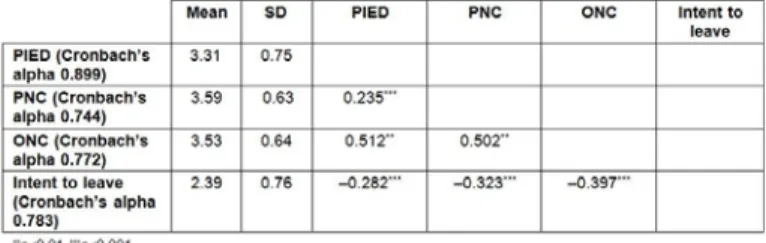
The means, standard deviations and correlation coefficient between variables are shown in Tables 1 and 2. PIED was positively correlated with both professional normative commitment (PNC) and organizational normative commitment (ONC) and negatively correlated with intent to leave. Both PNC and ONC were negatively correlated with intention to leave.
Table 1: Descriptive statistics, reliabilities and correlations among variables for government subsidized samples
10
2
9
2
31,32
2
Table 2: Descriptive statistics, reliabilities and correlations among variables for non-government subsidized samples
Structural equation model
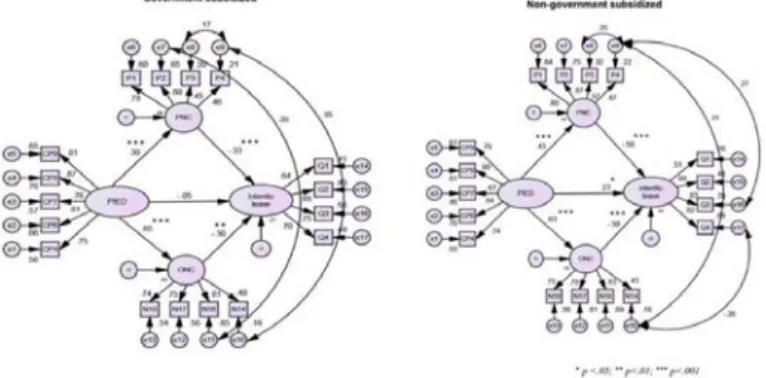
To test the mediating effect of normative commitment on the relationship between PIED and intent to leave, structural equation modeling was performed. The path results and model fit are shown in Figure 1 and Tables 3 and 4. In Figure 1, the factor loadings of all the observed variables show their t values are greater than 1.96 and reach the significance level (p<0.001). It indicates all the observed variables can effectively reflect the latent variables formed by them. Table 3 presents the parameter
estimates and model fit index in both government-subsidized and non-government-subsidized samples. Table 4 presents the direct, indirect and total effects between PIED, PNC, ONC and intent to leave. In these government-subsidized individuals, the results showed there was a complete mediating effect of dual normative commitment on the relationship between PIED and intention to leave. However, there were both direct and indirect effects on their intention to leave in those individuals without government subsidy.
Table 3: Model fit index of the standard error of the mean of interrelationships between perceived investment in employee development, and the professional normative commitment and intent to leave constructs across two samples
Table 4: Direct and indirect effect between perceived investment in employee development, professional normative commitment, organizational normative commitment and intent to leave
Figure 1: Structure equation model of interrelationships between perceived investment in employee development, and the professional normative commitment and intent to leave constructs.
Discussion
The retention of healthcare workers affects not only the volume but also the medical quality they provide in underserviced areas. It is also a major concerning healthcare issue in most countries. Among the various factors influencing the retention of healthcare workers in underserviced areas, lack of professional training and career growth appear to be the major concerning causes and important issues. Various health policies such as financial incentive programs have been implemented to improve the retention of subsidized physicians and other health professionals across countries. Research evidence shows financial incentive programs for healthcare workers increase willingness to stay in underserved and rural areas .
Employee development is one of the most important functions of human resource practice. Training and development directly influence employee behaviors in the workplace . Koster et al found that a firm’s investments in general training significantly contribute to the perceived support in employee development, and such perceived support is negatively related to employee intention to quit. Lee and Bruvold noted that PIED was positively associated with job satisfaction and affective commitment in a study analyzing data from 405 nurses from the USA and Singapore. In addition they found job satisfaction and affective commitment mediated the relationship between PIED and intent to leave .
In the present study, the authors found a difference in perception of employee development between healthcare workers with government subsidies and those without. The present study’s results showed a complete mediating effect of dual normative commitments on the relationship between PIED and intent to leave in those individuals with government subsidies, while no such effect was seen in those without. This implies that the higher the health worker’s perception of government support in their career development, the lower the intention to leave. The total effect of PIED on intent to leave was –0.345 in government subsidized health workers. The higher PIED with subsequent lower intent to leave was through commitment enhancement in both professional and organizational commitment. This result also signifies the importance of PIED in setting government health policy about
retaining healthcare workforce in rural and underserviced areas. Healthcare workers are more likely to leave rural areas when they perceive low PIED or unfairness of training and support from the organization. This might explain the positive association between PIED and intent to leave (r=0.19, p<0.05) in those health workers without government support. This also indicates the importance of organizational investment in employees’ career development to enforce their professional and organizational normative commitment and, further, to increase their intent to stay in this work field.
Conclusion
Since most health workers in remote or isolated islands were working independently or in a small group with mixed
professionals and lack of healthcare resources, these study results provide government health policymakers with empirical evidence of increasing retention strategy of health workers in underserved areas. First, when the government has good career planning for those health workers, they are more likely to stay and work in the underserved area. Second, to reinforce the health workers’ both professional and organizational commitment is an important issue in the human resource management to provide better health care in those underserviced areas.
In conclusion, the dual commitments completely mediate the relationship between employee PIED and individual intent to leave. Generalization of the dual commitment model warrants more studies.
Limitations
First, this cross-sectional analysis could not draw inferences of causality . A longitudinal research design is needed to draw causality inferences from the current results for future
studies. Second, the generalizability of the results might be limited due to the study samples being restricted to healthcare workers in underserviced areas.
The present study indicated the importance of organizational investment in employees’ career development to enforce their professional and organizational normative commitment and, further, to increase their intent to stay in this work field.
33
31 34
24
24
REFERENCES:
1Eley DS, Synnott R, Baker PG, Chater AB. A decade of Australian rural clinical school graduates – where are they and why? Rural and Remote Health2012; 12(1): 1937. Available: https://www.rrh.org.au /journal/article/1937(Accessed 4 January 2019).PMid:22394086
2Royston PJ, Mathieson K, Leafman J, Ojan-Sheehan O. Medical student characteristics predictive of intent for rural practice. Rural and Remote Health2012; 12(3): 2107. Available:
https://www.rrh.org.au/journal/article/2107(Accessed 4 January 2019).PMid:22873948
3Devine SG, Williams G, Nielsen I. Rural allied health scholarships: do they make a difference? Rural and Remote Health2013; 13(4):
2459. Available: https://www.rrh.org.au/journal/article/2459 (Accessed 4 January 2019).PMid:24152193
4Liu X, Dou L, Zhang H, Sun Y, Yuan B. Analysis of context factors in compulsory and incentive strategies for improving attraction and retention of health workers in rural and remote areas: a systematic review. Human Resources for Health2015; 13(1): 1-8. https://doi.org/10.1186/s12960-015-0059-6 PMid:26194003
5Spiers MC, Harris M. Challenges to student transition in allied health undergraduate education in the Australian rural and remote context: a synthesis of barriers and enablers. Rural and Remote Health2015; 15(2): 3069. Available: https://www.rrh.org.au/journal /article/3069(Accessed 4 January 2019).PMid:25916254
6Hou SM, Hsueh JY. Evaluation of public funded medical education program. Journal of Medical Education2007; 11(1):
21-26.
7Zimmerman M, Shah S, Shakya R, Chansi BS, Shah K, Munday D. A staff support programme for rural hospitals in Nepal. Bulletin of the World Health Organization2016; 94: 65-70.https://doi.org /10.2471/BLT.15.153619 PMid:26769998
8Meyer JP, Allen NJ. A three-component conceptualization of organizational commitment. Human Resource Management Review
1991; 1: 61-89.https://doi.org/10.1016/1053-4822(91)90011-Z
9Meyer JP, Kam C, Goldenberg I, Bremner NL. Organizational commitment in the military: application of a profile approach.
Military Psychology2013; 25(4): 381-401.https://doi.org/10.1037 /mil0000007
10Meyer JP, Allen NJ, Smith CA. Commitment to organizations and occupation: extension and test of a three-component conceptualization. Journal of Applied Psychology 1993; 78(4):
538-551.https://doi.org/10.1037/0021-9010.78.4.538
11Chang HT, Chi NW, Miao MC. ng the relationship between three-component organizational/occupational commitment and organizational/occupational turnover intention using a non-recursive model. Journal of Vocational Behavior2007; 70: 352-368. https://doi.org/10.1016/j.jvb.2006.10.001
12Hwang J, Hopkins K. Organizational inclusion, commitment, and turnover among child welfare workers: a multilevel mediation analysis. Administration in Social Work2012; 36: 23-39. https://doi.org/10.1080/03643107.2010.537439
13Yang J, Liu Y, Chen Y, Pan X. The effect of structural
empowerment and organizational commitment on Chinese nurses' job satisfaction. Applied Nursing Research2014; 27: 186-191. https://doi.org/10.1016/j.apnr.2013.12.001 PMid:24524954
14Juhdi N, Pa'wan F, Hansaram RMK. HR practices and turnover intention: the mediating roles of organizational commitment and organizational engagement in a selected region in Malaysia.
International Journal of Human Resource Management2013;
24(15): 3002.https://doi.org/10.1080/09585192.2013.763841
15Randhawa G, Kaur K. Organizational climate and its correlates: review of literature and a proposed model. Journal of Management Research2014; 14(1): 25-40.
16Kang H J, Gatling A, Kim J. The impact of supervisory support on organizational commitment, career satisfaction, and turnover intention for hospitality frontline employees. Journal of Human Resources in Hospitality & Tourism2015; 14: 68-89.https://doi.org /10.1080/15332845.2014.904176
17Meyer JP, Parfyonova NM. Normative commitment in the workplace: a theoretical analysis and re-conceptualization. Human Resource Management Review2010; 20(4): 283-294.
https://doi.org/10.1016/j.hrmr.2009.09.001
18Meyer JP, Allen NJ.Commitment in the workplace: theory. research and application.Thousand Oaks: Sage, 1997.
19Vandenberghe C. Application of the three-component model to China: issues and perspectives. Journal of Vocational Behavior
2003; 62: 516-523.https://doi.org/10.1016 /S0001-8791(02)00066-0
20Yao X, Wang L. The predictability of normative organizational commitment for turnover in Chinese companies: a cultural perspective. International Journal of Human Resource Management
2006; 17(6): 1058-1075.https://doi.org/10.1080 /09585190600696671
21Meyer J, Stanley D, Herscovitch L, Topolnytsky L. Affective, continuance, and normative commitment to the organization: a meta-analysis of antecedents, correlates, and consequences.
Journal of Vocational Behavior2002; 61: 20-52.https://doi.org /10.1006/jvbe.2001.1842
22Somers MJ. The combined influence of affective, continuance and normative commitment on employee withdrawal. Journal of Vocational Behavior2009; 74: 75-81.https://doi.org/10.1016 /j.jvb.2008.10.006
23Khattak AA, Sethi S. Organization normative commitment (ONC) has psychological positive effects on employees'
performance. Abasyn Journal of Social Sciences2012; 5(1): 99-110.
24Lee CH, Bruvold NT. Creating value for employees: investment in employee development. International Journal of Human Resource Management2003; 14: 981-1000.https://doi.org/10.1080 /0958519032000106173
25Kuvaas B, Dysvik A. Perceived investment in employee development, intrinsic motivation and work performance. Human
Resource Management Journal2009; 19(3): 217-236. https://doi.org/10.1111/j.1748-8583.2009.00103.x
26Alfes K, Shantz A, Truss C. The link between perceived HRM practices, performance and well-being: the moderating effect of trust in the employer. Human Resource Management Journal2012;
22: 409-427.https://doi.org/10.1111/1748-8583.12005
27Sung SY, Choi JN. Multiple dimensions of human resource development and organizational performance. Journal of
Organizational Behavior2014; 35: 851-870.https://doi.org/10.1002 /job.1933
28Boxall P. HR strategy and competitive advantage in the service sector. Human Resource Management Journal2003; 13: 5-20. https://doi.org/10.1111/j.1748-8583.2003.tb00095.x
29Noar SM. The role of structural equation modeling in scale development. Structural Equation Modeling2003; 10(4): 622-647. https://doi.org/10.1207/S15328007SEM1004_8
30Byrne BM.Structural equation modeling with AMOS: basic concepts, applications, and programming.Mahwah, NJ: Lawrence
Erlbaum Associates, 2001.
31Chang CS, Du PL, Huang IC. Nurses' perception of SARS infection as a moderator on the relationship between
commitments and intention to leave. Journal of Advanced Nursing
2006; 54(2): 171-179.https://doi.org/10.1111 /j.1365-2648.2006.03796.x PMid:16553703
32Krausz M, Koslowsky M, Shalom N, Elyakim N. Predictors of intentions to leave the ward, the hospital, and the nursing
profession: a longitudinal study. Journal of Organizational Behavior
1995; 16(3): 277-288.https://doi.org/10.1002/job.4030160308
33Matsumoto M, Inoue K, Kaja E. Policy implications of a financial incentive programme to retain a physician workforce in
underserved Japanese rural areas. Social Science & Medicine2010;
71(4): 667-671.https://doi.org/10.1016/j.socscimed.2010.05.006 PMid:20542362
34Koster F, de Grip A, Fouarge D. Does perceived support in employee development affect personnel turnover? International Journal of Human Resource Management2011; 22(11): 2403-2418. https://doi.org/10.1080/09585192.2011.584404
This PDF has been produced for your convenience. Always refer to the live site https://www.rrh.org.au/journal/article/4837 for the Version of Record.