Sharif University of Technology
Scientia IranicaTransactions E: Industrial Engineering www.scientiairanica.com
Supply chain channel coordination under sales rebate
return policy contract using simulation optimization
M. Darayi
a, H. Eskandari
a;and C.D. Geiger
ba. School of Industrial Engineering, Tarbiat Modares University, Tehran, P.O. Box 14117, Iran.
b. Department of Industrial Engineering and Management Systems, University of Central Florida, Orlando, FL 32816, USA. Received 25 May 2012; received in revised form 17 September 2013; accepted 14 January 2014
KEYWORDS Supply chain coordination; Return policy with sales rebate and penalty contract; Simulation; Price- and eort-dependent demand. SRP: Sales Rebate and Penalty;
RSRP: Return policy with Sales Rebate and Penalty;
LRSRP: Limited return policy with Sales Rebate and Penalty.
Abstract. This paper proposes a Stackelberg game-based approach for channel coor-dination for a supply chain consisting of one supplier and two competing retailers facing stochastic demand that is sensitive to both sales eort and retail price. In the proposed approach, the supplier, as the leader, denes the contract format and parameters, and the retailers determine the order quantity, retail price and sales eort. The literature primarily focuses on the design of the contract parameters to ensure channel coordination, whereas much less attention is given to the analysis of conditions supporting contract implementation. This study focuses on implementation of the Return policy with a Sales Rebate and Penalty (RSRP) contract as a coordination mechanism. The negotiation and trading procedure among supply chain members is modeled using a simulation optimization-based decision support tool. The possibility that retailers impose their own preferences that disturb channel coordination after signing the RSRP contract is analyzed, and a new Limited Return policy with a Sales Rebate and Penalty (LRSRP) contract, which helps the supplier guarantee channel coordination and control retailer decisions, is proposed.
© 2014 Sharif University of Technology. All rights reserved.
1. Introduction
The objective, in this paper, is to examine the use of sales rebates or penalties as contract incentives and their impact on channel relationships and decision-making among supply chain member rms. Supply chain channel coordination and decision-making are generally approached from two dierent relationship perspectives; decentralized or centralized, although hybrid shared partnerships exist. Decentralized sup-ply chain relationships involve several self-interested
*. Corresponding author. Tel.: +98 21 82884323; E-mail addresses: [email protected] (M. Darayi); [email protected] (H. Eskandari); [email protected] (C.D. Geiger)
members who use distributed local decision-making optimization strategies in order to make decisions considering their own preferences, their own constraints and their own objectives, and who only care about their monetary payos (generally, prots). This fo-cus on monetary payos results in the well-known phenomenon of double marginalization, where each member's prot is optimized but the overall integrated supply chain channel prot margin is suboptimal [1].
Centralized supply chains involve a single decision-maker who possesses information regarding the overall supply chain, and the supply chain members operate under a global decision-making optimization strategy. In general, better overall supply chain economic performance results, although the global optimization strategy causes economic penalties for
some local members. This is due to increased levels of information sharing among all supply chain members, and centralized planning and control, which ensures eective channel coordination. This supports not only aligning the preferences, constraints and objectives of the individual supply chain members, but also sup-ports overall system-wide performance. In centralized decision-making scenarios, supply chain contracts are coordination mechanisms that help to incentivize the independent members to engage and participate in centralized supply chain channel coordination.
In this research, the focus is centralized channel coordination exploring the use of channel sales rebate or penalties as sales incentives, specically in a two-tier supply chain, where the supply chain conguration consists of a single supplier and two competing retail-ers.
Coordination contract models have been studied and developed in recent years [1-8]. It is now becoming popular to model supply chains as agent-based sim-ulation systems, or to use discrete event simsim-ulation to learn more about their behavior or investigate the implications of alternative congurations [9]. Yu et al. [10] studied the impact of supply disruption on the supply chain system using simulation, where the researchers used two dierent distribution functions of random variables to characterize the disruption and its impact.
Many previous studies have investigated contracts for channel coordination within a supply chain, whereas much less emphasis has been placed on implementation of these contracts and the necessary supporting condi-tions for their maintenance. The focus in this paper is the implementation of a Return policy with a Sales and Rebate Penalty (RSRP) contract in a supply chain consisting of one supplier and two competing retailers facing stochastic demand, which is sensitive to both sales eort and retail price. The negotiation procedure among supply chain members is model optimized via simulation. The possibility of retailers imposing their own preferences after instituting the RSRP contract, which may potentially upset channel coordination, is analyzed, and a new Limited Return policy with a SRP (LRSRP) contract, which helps the supplier to ensure channel coordination, is proposed. In fact, in a RSRP contract, it is possible for retailers to readjust their order quantities, retail prices and sales eorts within the parameters of the contract.
In this research, the presence of two competing retailers with denite opinions on order quantity, eort level and retail price, and the stochastic nature of demand, make it dicult to model and solve the channel coordination problem analytically, due to its inherent complexity. Simulation optimization is used to model the stochasticity of demand and addresses this supply chain channel coordination problem. A major
advantage in using simulation is in its ability to model the uncertainty, interaction and non-linearity of rela-tionships between the dierent members. This allows relaxation of some simplifying assumptions made by previous researchers to increase the tractability of the problem, such as assuming independent deterministic demand, a monopoly market and no advertising, to name a few.
The main contributions of this research are the following. First, the channel coordination problem in a supply chain consisting of one supplier and two competing retailers facing stochastic demand that is sensitive to both sales eort and retail price, has not been studied in the literature to date. Second, by analyzing the implementation of the RSRP contract, a new exible LRSRP contract that can achieve ap-propriate channel coordination in the supply chain is proposed. Finally, the proposed contract design methodology, consisting of simulation optimization, can aid in investigating the coordination problem.
The remainder of this paper is organized as follows. In Section 2, the problem, model assumptions and notations are described. The proposed analytical models for cases of decentralized and centralized sup-ply chains are presented in Section 3. Coordination models for RSRP and LRSRP contracts are proposed in Section 4. The proposed simulation optimization-based methodology for contract design is presented in Section 5. Section 6 illustrates the proposed methodol-ogy via a numerical example, and Section 7 concludes the work, including discussion of future directions of this research eort.
2. Problem description
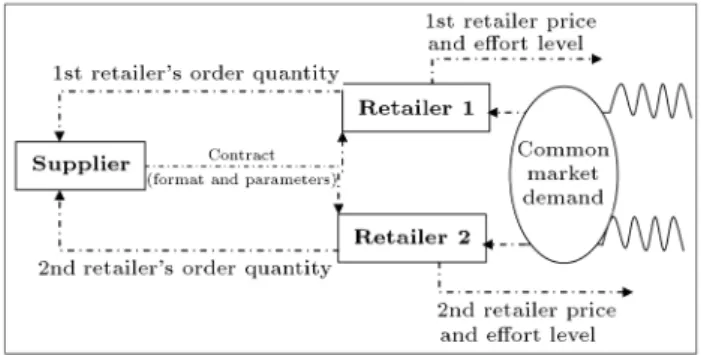
This research investigates a channel coordination prob-lem in a two-tier supply chain composed of a supplier and two competing retailers. The retailers face a random demand that is sensitive to not only sales eort, but also retail price. The supplier, with knowledge of the demand, denes the format of the contract and the requisite parameters to achieve the overall best performance of the supply chain that achieves a win-win situation for all participants in the contract. The information and logic ow of the sequence of events, shown pictorially in Figure 1, is as follows:
I. The supplier oers a contract to two retailers for an upcoming selling season.
II. The two competing retailers, upon reviewing and agreeing to the terms of the supplier's contract, determine their individual order quantities, retail prices and levels of eort.
III. The supplier production and delivery of the prod-uct to the two retailers are scheduled to occur before the selling season.
Figure 1. Information and logic ow in the two-tier supply chain with a single supplier and two competing retailers.
IV. The selling season commences and actual demand for the product at the retailers is then observed. V. Transfer payments are made between the supplier
and the two retailers, according to the terms of the contract.
2.1. Modeling assumptions and notation The proposed model has some important character-istics and assumptions that aect the modeling and analysis procedure. This section also summarizes important notations necessary for the proposed math-ematical model. The assumptions are as follows: The decision model is a single-period model; The model is based on price- and eort-dependent
stochastic (random) demand;
The product being supplied to the retailer has a relatively short lifecycle;
The supplier has enough capacity to satisfy the retailers;
The retailers competing factors aect the demand; The two retailers are equally powerful to compete in
one common market;
Any end-of-period inventory is considered as sal-vage.
The notations that represent the variables and param-eters used in the proposed model formulation are as follows:
Cost and price parameters
Ss: Salvage value per unit at the end of
period at the supplier;
Gs: Goodwill cost at supplier per shortage
unit;
Cs: Production cost per unit at the
supplier;
Sr: Salvage value per unit at the end of
period at the retailers;
Gr: Goodwill cost at retailers per shortage
unit;
Cr: Marginal cost at the retailers per unit;
W : Wholesale price.
Decision variables for the retailers Pr1: Retail price at Retailer 1;
Pr2: Retail price at Retailer 2;
er1: Eort level of Retailer 1 to promote
sales;
er2: Eort level of Retailer 2 to promote
sales;
Qr1: Order quantity for Retailer 1;
Qr2: Order quantity for Retailer 2.
Contract decision variables for the supplier : Return credit (buyback rate); T : Sales target;
: Rebate or penalty;
L : Limit of returned merchandise. Performance measures
i
j: expected prot of supply chain member j in
the case of contract/non-contract i, where j = fr1: Retailer 1, r2: Retailer 2, s: Supplier, sc: Supply Chaing and i = fRSRP: return policy with sales and rebate contract, LRSRP: limited return policy with sales and rebate contract, C: centralized supply chain, DC: decentralized supply chaing.
2.2. Modeling price- and eort-dependent demand
The price-dependent demand for two competing retail-ers, as dened in [11], is given by:
Dri(Pri+ Prj) = Pri+ Prj;
i = 1; 2 and j = 3 i; (1)
where Pri denotes the price at retailer i, represents
the original demand of the common market for retailer i, represents retailer i store-level factor that aects consumer sensitivity to retail price, and denotes the competitive factor. Since demand is inherently an un-certain parameter, a random variable, , with density function, f, and cumulative distribution function, F , is added to Eq. (1), or:
Xi= Dri(Pri; Prj) + ;
i = 1; 2 and j = 3 i: (2)
Although Eq. (2) does not satisfy all competitive mar-ket conditions, it can and has been used as an accept-able price-dependent demand function [12]. However, it is important to note here that in real markets, pricing levels directly impact the competitive factor. For instance, a rise of $1 in high selling prices of a
product decreases the primary demand for that product more than in the case of a rise of $1 when the selling price is lower. It is also important to note here that dierent pricing levels directly impact the store-level factor. When the selling prices at the retailers surpass market thresholds, then the retailers will lose more of their customers than when the selling prices at the retailers do not exceed those market thresholds. Eq. (2) does not consider the price-dependent nature of the competing factor and the store-level factor.
In this paper, the attempt is to improve the price-dependent stochastic demand function, such that competitive factors and store-level factors are updated through dierent price threshold levels. It is assumed that the store-level factor, ik, and the competitive
factor, il, change at three dierent price intervals,
i.e. (1; 2; 3). A new competitive price- and
eort-dependent stochastic demand function is presented as follows:
Dri(Pri; Prj; eri; erj) = ik(Pri k 1)
+ il(Prj Pri) + Ueri erj;
i = 1; 2; j = 3 i and k = 1; 2; 3; IF Pri 3 then K = 3;
IF Prj 3 then l = 3;
IF 2 Pri< 3 then K = 2;
IF 2 Prj < 3 then l = 2;
IF Pri< 2 then K = 1;
IF Pri< 2 then l = 1;
i1< i2< i3; i1< i2< i3;
1< 2< 3;
Xi(Pri; Prj; eri; erj; ") = Dri(Pri; Prj; eri; erj); (3)
where the notation is similar to that used in the tra-ditional price-dependent stochastic demand function, and k is the market selling price threshold. The
market is sensitive to the three-level incremental rise in price at the retailers. Therefore, the decision-makers can appraise at the price threshold levels, k(1; 2; 3).
The variable ik is the store-level factor at retailer
i, which is inuenced by the product selling price at the retailer. The variable, il, is a competitive
factor, which is aected by the selling price of a comparable product at the rival retailer. The variable, eri, represents a single eort level at retailer i that
shows the retailer activities that promote sales, and U and represent the eect of the retailer's sales eort level, and the rival retailer's sales eort level impact on primary demand at the retailer, respectively. The function, Xi, considers the randomness in market
demand. Here, is a random variable that represents the stochastic feature of the market demand, and f and F represent the probability density function and cumulative distribution function of , respectively. 3. Supply chain models for channel
coordination
3.1. Decentralized supply chains
In the case of decentralized supply chains, the retailers determine their local order quantities, retail prices and levels of sales eort regarding common market demand characteristics and costs. The supplier has no inuence over the decisions of the retailers, and the retailers make operational and logistical (i.e., inventory and scheduling) decisions based on their own local preferences, constraints and objectives (i.e., prots). So, now, formulation of the decentralized supply chain channel coordination problem begins with the following notations. Let:
Sri(Qri; Pri; Prj; eri; erj) represents the expected
sales of retailer i or j.
Iri(Qri; Pri; Prj; eri; erj) represents the expected
sur-plus inventory of retailer i or j, and
GWri represents the value equivalent to the loss of
goodwill in business at retailer i due to an inventory shortage.
The specic functions above are expressed in Eqs. (4), (5) and (6), respectively:
Sri(Qri; Pri; Prj; eri; erj)
= 8 > > > < > > > :
Qri
IF Qri Xi(Pri; Prj; eri; erj; )
Xi(Pri; Prj; eri; erj; )
IF Qri> Xi(Pri; Prj; eri; erj; )
(4)
Lri(Qri; Pri; Prj; eri; erj)
= 8 > < > :
Qri Sri(Qri; Pri; Prj; eri; erj; )
IF Qri> Xi(Pri; Prj; eri; erj; )
0 Otherwise
(5) GWri(Qri; Pri; Prj; eri; erj)
= 8 > < > :
Xi(Pri; Prj; eri; erj; ) Qri
IF Qri< Xi(Pri; Prj; eri; erj; )
0 Otherwise
The retailer prot function is given in Eq. (7). Here, g(eri) represents each retailer, i, cost of achieving eort
level, eri. The retailer prot per unit is the revenue
from selling a unit of a new product and a salvage unit to customers, minus the unit cost of lost goodwill, the cost of promoting sales and the cost of ordering units of the product from the supplier:
DC
ri =Pri(Sri(Qri; Pri; Prj; eri; erj))
Cr(Qri) Gr(GWri) W (Qri) g(eri)
+ Sr(Lri(Qri; Pri; Prj; eri; erj))
i = 1; 2 and j = 3 i: (7)
Thus, the optimal policy for each retailer is obtained by maximizing the expected prot function, which is shown in Eq. (8):
Maximize: E[DC
ri (Pri; eri; Qri)] i = 1; 2 and j = 3i;
Pri; Prj; eri; erj; Qri; Qrj;
S.t:
Pri; Prj; eri; erj; Qri; Qrj 0: (8)
3.2. Centralized supply chains
In centralized supply chains, the entire supply chain system can be considered a single entity, whose ex-pected prot needs to be optimized. So, the objective is to dene order quantities, sales eorts and retail prices in order to maximize the prot function of the overall supply chain. Hence, the decision variables are set, such that satisfy Eq. (10):
c
sc=PriSri(Qri; Pri; Prj; eri; erj)
+ SrLri(Qri; Pri; Prj; eri; erj) GrGWri
CrQri g(eri)
+ PrjSrj(Qrj; Pri; Prj; eri; erj)
GrGWrj CrQrj g(erj)
+ SrLrj(Qrj; Pri; Prj; eri; serj)
Cs(Qri+ Qrj) GsGWs;
i = 1; 2 and j = 3i: (9)
Maximize: E[c
sc] Pri; Prj; eri; erj; Qri; Qrj
S.t:
Pri; Prj; eri; erj; Qri; Qrj 0: (10)
It has been shown that in the case of centralized supply chains, the expected prot at each retailer is not maximized, as decisions are made in the best interest of all members of the supply chain; in eect, sharing the prot returns among all supply chain members. However, in the case of decentralized supply chains, retailers make marketing and logistics decisions only considering their own interests [13]. This is often the reason for retailers not entering into contracts where part of the agreement is to accept centralized decisions that consider all members in the entire supply chain.
4. Supply chain coordination
Supply chain contracts are coordination mechanisms dening the mutual sharing of the risks and rewards of coordination in order to satisfy supply chain members who take a part in channel coordination. A contract is viewed to eectively coordinate the supply chain, if the supply chain members' decisions lead not only to optimal local performance, but also to optimal system-wide performance. One approach to achieving channel coordination, which is a common method cited in the open literature, is to, rst, set the local decision variables to the values for a centralized case, then, to investigate a contract scheme, where the risks and benets are mutually shared across the supply chain, while simultaneously satisfying the individual members who enter into the agreement [14-16].
It has been shown that when considering price-and eort-dependent stochastic demprice-and, classical con-tracts such as revenue sharing or buyback do not lead to channel coordination [1,14]. Here, two competing retailers add more complexity to the problem and coordination conditions. He et al. [1] suggest that a combined contract consisting of a Return policy with Sales or Rebate Penalty (RSRP) can coordinate a supply chain with a supplier and a retailer. In the proposed coordination model by He et al. [1], it is assumed that the supplier oers the proposed contract to the retailer, and the retailer in return agrees to set the order quantity, the eort to promote sales and the retail price equal to that in the case of a centralized decision. In this paper, it is shown that this is not, in fact, a realistic assumption. We propose an improved Return policy with Sales and Rebate Penalty (RSRP) contracting scheme by adding a limit, L, for returned products, which determines the number of unsold products that the supplier accepts from the retailer, and payment of dollars for each of them. The proposed simulation optimization decision support tool, which assures the successful implementation of the LRSRP contract, is described in Section 5.
4.1. Return policy with Sales and Rebate Penalty (RSRP) contract
Under an RSRP contract, the supplier establishes a product target, T , for the retailer. If the retail sales are beyond the target, the supplier will oer a rebate, i.e. a reward of for each unit of product sold above T . Otherwise, the retailer has to pay the supplier a penalty, i.e. a payment of for each unit of product unsold below T . In addition, the retailer returns the unsold units of product at the end of the selling season to the supplier and receives a payment of for each product.
In this trading procedure, the supplier denes the contract parameters, consisting of , , T , and the retailers, with knowledge of the contract parameters, decide their order quantities, sales eorts and retail prices. Setting the values of the retailers' decision variables equal to those for a centralized case, the supplier pursues a contract setting on the condition that the supply chain members' prot is at least equal to that which would be realized in a decentralized case. It is a real assumption that the supplier searches for a contract that better realizes the supplier's prot. The retailers adjust their own decisions on order quantities, retail prices and sales eorts, seeking the settings that maximize their prot (see Eq. (12)):
RSRP
ri =Pri(Sri(Qri; Pri; Prj; eri; erj))
Cr(Qrj) Gr(GWri) W (Qri)
g(eri) + (Lri(Qrj; Pri; Prj; eri; erj))
(Sri(Qrj; Pri; Prj; eri; erj) T )
i = 1; 2 and j = 3i: (11)
Maximize: E[RSRP
ri (Pri; eri; Qri)];
i = 1; 2 and j = 3 i; Pri; Prj; eri; erj; Qri; Qrj:
S.t:
Pri; Prj; eri; erj; Qri; Qrj 0: (12)
4.2. Limited Return policy with SRP (LRSRP) contract
As previously mentioned, the RSRP contract allows retailers to not follow the centralized decisions on order quantities, retail prices and sales eorts, since the sup-plier guarantees the unsold units of products remaining at the retailer after the sale season. Furthermore, the supplier rewards the retailers; the more units the
retailers sell, the more they receive awards. So, it may be most protable for the retailers to increase their sales eorts or decrease the retail prices in order to sell as many units of their products as they can. In this research, we, in fact, suggest a limitation for the return guarantee made by the supplier. This limitation acts as a mechanism to restrict retailer inuence to reduce supplier prot margins. This limit, L, determines the upper limit for the number of unsold units of product that are guaranteed by, and returned to, the supplier, thus limiting transfer payments, , to the retailer for each returned unit. This limitation makes the retailers take into consideration the supplier and, ultimately, the system-wide supply chain channel prot in their decisions on order quantities, eort levels and prices, which is shown in Eq. (14):
LRSRP
ri =Pri(Sri(Qri; Pri; Prj; eri; erj))
Cr(Qrj) Gr(GWri) W (Qri) g(eri)
+ (max[Lri(Qrj; Pri; Prj; eri; erj); L])
(Sri(Qrj; Pri; Prj; eri; erj) T );
i = 1; 2 and j = 3i: (13)
Maximize: E[LRSRP
ri (Pri; eri; Qri)];
i = 1; 2 and j = 3 i Pri; Prj; eri; erj; Qri; Qrj
S.t:
Pri; Prj; eri; erj; Qri; Qrj 0: (14)
5. Proposed methodology
The complexity of the model, interactive eects of retailer decisions and random characteristics of demand make it dicult for the proposed problem to be solved analytically. Simulation modeling has been used quite successfully to study processes that are too complex or ill-dened to permit the application of analytical model formulation and/or evaluation. In this research, simulation optimization is embedded in a proposed decision support methodology. This assists the supplier in a centralized supply chain to tune the parameters of a contracting scheme in such a manner that satis-es the retailers participating in, and bound by, the contract. Also, the proposed decision support tool allows one to simulate the real Stackelberg dierential game conditions that exist between the supplier and the retailers. In general, Stackelberg dierential game
theoretic models have been used quite eectively to study supply chain competition and hierarchical or sequential decision-making in supply chains and mar-keting channel [17-22]. In a supplier Stackelberg game model, the supplier is the leader and the retailer is the follower in determining pricing strategies. In a retailer Stackelberg game model, the retailer is the leader and the supplier is the follower. This research considers the supplier the leader and designer of the contract, and the retailers are the followers, deciding on terms such as order quantities, sales eorts and retail prices.
The proposed contract designing methodology helps the supplier construct and then oer a contract to retailers that guarantees eective channel coordination, in which, supply chain members mutually share the risks and rewards of the coordination in order to maximize the local prot returns of the supply chain members, as well as system-wide prot. The steps of the proposed methodology are explained as follows:
I. Given the market demand, the decentralized supply chain is simulated and the retailers' decisions on order quantities, retail prices and levels of sales eort are determined.
II. Considering the decision variables determined in step I, the supplier-level, retailer-level and supply chain-level prots for the decentralized supply chain are calculated.
III. Next, the centralized supply chain is simulated and the centralized decisions on order quantity, retail prices and sales eorts are determined. IV. Considering the decision variables determined
in step III, the supplier-level, retailer-level and supply chain-level prots for the centralized supply chain are calculated.
V. After setting the decision variables to the values assuming centralized control, decisions on the contract parameters, T , and , are made, considering the preferences, constraints and ob-jectives of all supply chain members.
VI. After setting the contract parameters to the val-ues determined in step V, the retailers' decisions on order quantities, retail prices and sales eorts are determined.
VII. Considering the retailers new decisions at step VI, and contract parameters found in step V, the prots of all members in the chain are computed. VIII. The limit, L, for the unsold unit return policy is determined, where L is the maximum value or interval that does not let the retailers perturb the mutual channel coordination. In fact, steps VI and VII need to be iteratively repeated for dierent values of L in order to examine the goodness of the L that limits the inuence of
the retailers' decisions on the supplier's expected prots.
5.1. Simulation model
The mathematical model formulations presented in Sections 2 and 3 are too complex to solve analyti-cally to identify an optimal or a near optimal set of contract parameters to coordinate the supply chain. The added complexity is due to the stochastic nature of the market demand () and its interaction be-tween the decision variables (Pri; Prj; eri; erj; Qri; Qrj).
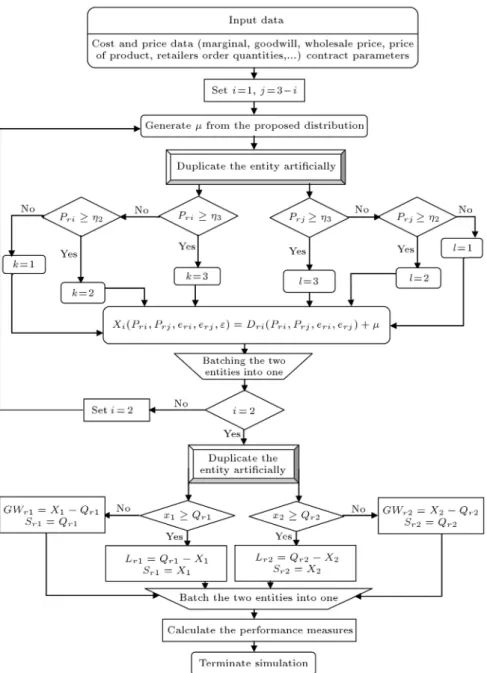
Simulation can eectively model the real-world sys-tems [23]. In this research, a simulation model is used to model the Stackelberg game conditions in a supply chain consisting of one supplier and two retailers, and then to compute the objective functions of the complex system. Arena® simulation software by Rockwell Automation is used to build the simu-lation model of the supply chain with a stochastic price-and eort-dependent competitive market demand shown earlier in Figure 1 [24]. Figure 2 shows the general conceptual logic of the proposed simulation model.
5.2. Proposed simulation optimization decision support methodology
The optimization of simulation models often deals with a situation in which the interest is to nd which of a large number of sets of model specications lead to optimal output performance [25]. One of the popular methods to optimize simulated systems is using meta-heuristics. In this mechanism, the simulation model is treated as a black-box, i.e. only the inputs and outputs of the simulation model are observed. At each iteration, the metaheuristic optimizer chooses a set of values for input variables and uses the output value generated by the simulation model to make a decision regarding selection of the next trial solution, with the goal of nding optimal values for decision variables.
In this study, OptQuestr optimization software by OptTek Systems, Inc. is used to nd the optimal or near-optimal set of supply chain contract parame-ters. OptQuest, which is integrated with many com-mercial software packages, including Arena, combines the metaheuristics of a Tabu search, scatter search and neural network into a single, composite search algorithm, to provide maximum eciency in identifying new scenarios.
In this problem, OptQuest searches for the best set of six decision variables (Pri; Prj; eri; erj; Qri; Qrj)
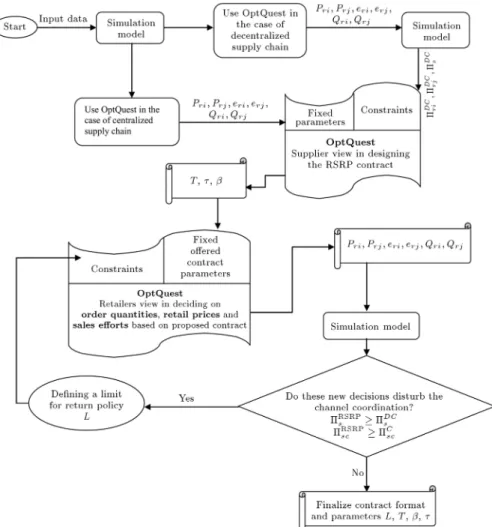
in cases of centralized and decentralized supply chain controls in order to maximize overall supply chain and retailer prots, subsequently (Figure 3). Then, the simulation model is run using these decision variables, and the outputs are recorded in each supply chain case. After setting the decision variables to their values, in the case of a centralized supply chain, and then using
Figure 2. The conceptual illustration of the proposed simulation model.
the outputs from the case of a decentralized supply chain as constraints for the optimization model, Opt-Quest searches for the best set of contract parameter values (i.e., T , and ) that coordinate the supply chain. Then, considering these contract parameter values, the retailers' new decisions on order quantities, retail prices and sales eorts that potentially increase their prots under the assigned contract are optimized. Simulating the retailers' decisions on order quantities, retail prices and sales eorts based on the proposed RSRP contract, the supplier investigates whether the retailers' new decisions perturb the channel coordi-nation. If yes, a limitation on return policies that restricts the retailers' inuence on jeopardizing the coordination by local decisions is sought. In the numerical example presented in Section 6, the
exi-bility and eectiveness of this proposed methodology is shown.
6. Numerical example
In this section, a numerical example is presented to illustrate how the developed contract designing algorithm, using simulation optimization, can help the supplier to oer a contract to the competing retailers. The simulation model input and control parameters and respective values are listed in Table 1. OptQuest is used to nd the decision variable values (Pri; Prj; eri; erj; Qri; Qrj) for both decentralized and
centralized supply chain prot functions, Eqs. (8) and (10), respectively. The number of independent simulation replications is set to 10,000 to assure the
Figure 3. Simulation optimization based decision support methodology. Table 1. Parameters set used in the numerical example.
Ss: 0 Gs: 10 Cs: 12
W : 20 Sr: 0 : UNIF (200, 300)
i1: 10 i2: 15 i3: 30
1: 23 2: 26 3: 30
U : 20 : 5 g(eri) = e2ri=2
: NORM (0, 30) Cr: 2 Gr: 14
i1: 5 i2: 10 i3: 15
: 100
reliability and the desired precision of the results. Some of the decision variables, such as Qriand Qrj, are set as
a discrete variable to represent the market condition. The resulting set of decision variable values is shown in Table 2.
Setting the decision variables to their values in the case of a centralized supply chain and using the simulation results from the case of a decentralized supply chain as constraints for the optimization model, Eq. (12), OptQuest is used to search for the best set of contract parameters (T , , ). Table 3 presents the set of RSRP contract parameters.
Signing the RSRP contract, retailers investigate the possibilities of improving their prots by readjust-ing the decisions on order quantity, sales eort and retail price. It is shown in Table 4 that RSRP contract conditions may allow retailers to improve their own expected prots, while reducing the supplier's expected prots, by rening the details of the contract.
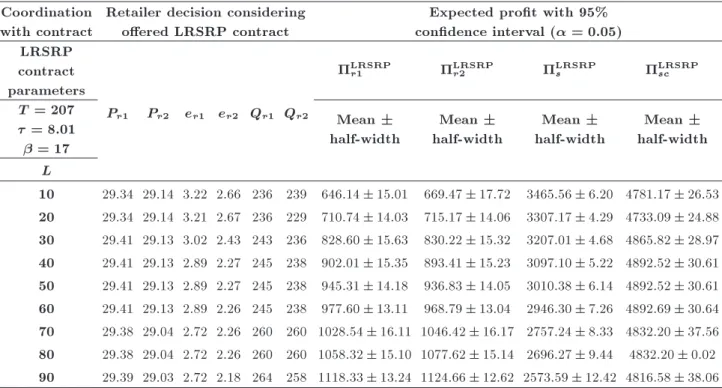
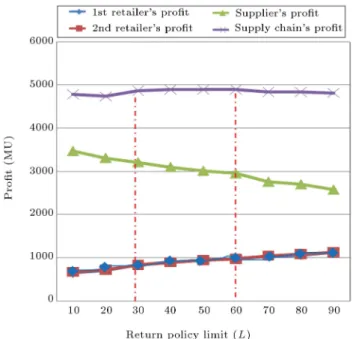
As shown in Table 4, the new decisions made by the retailers considering contracts' format and param-eters, endanger the supplier's prot. It may even cause the supplier's prot to decrease in comparison with the decentralized supply chain case. In order to limit the retailers' potential to reduce the supplier's planned prot, when adjusting the contract, we suggest that the supplier put a limit, L, for the return policy, which means that the supplier only guarantees a limited amount of unsold products that are returned with the payment of for each unit of product. To identify the most appropriate L, retailers' reactions to the dierent values of L are evaluated in order to identify a reliable interval for L that can assure channel coordination. The results from dierent L values are summarized in Table 5.
Table 2. Centralized and decentralized supply chain control.
Case
Retailer decision Expected prot with 95%
condence interval ( = 0:05) Pr1 Pr2 er1 er2 Qr1 Qr2
i
r1 ir2 is isc
Mean half-width
Mean half-width
Mean half-width
Mean half-width Decentralized
supply chain (i : DC)
32.96 32.37 2.33 1.22 164 154 768:9512:90 773:9612:68 2544:004:72 4086:9125:57 Centralized
supply chain (i : SC)
29.58 30.49 2.64 2.30 239 209 660:9713:71 617:0315:36 3584:003:68 4862:0028:99
Table 3. RSRP contract parameters dened by supplier.
Contract
Contract parameters Expected prot with 95%
condence interval ( = 0:05)
T
RSRP
r1 RSRPr2 RSRPs RSRPsc
Mean half-width
Mean half-width
Mean half-width
Mean half-width RSRP contract 207 8.01 17 1075:83 10:03 811:34 11:2 2856:23 10:30 4743:39 30:84
Table 4. Retailer decisions based on the oered RSRP contract.
Contract Retailer decision Expected prot with 95%
condence interval ( = 0:05) RSRP contract
= 17 = 8:01 T = 207
Pr1 Pr2 er1 er2 Qr1 Qr2
RSRP
r1 RSRPr2 RSRPs RSRPsc
Mean half-width
Mean half-width
Mean half-width
Mean half-width 29.39 29.03 2.72 2.18 264 258 1118:33 13:24 1124:66 12:62 2573:59 12:42 4816:58 38:06
Table 5. Retailers decision based on LRSRP contract. Coordination
with contract
Retailer decision considering oered LRSRP contract
Expected prot with 95% condence interval ( = 0:05) LRSRP
contract parameters
Pr1 Pr2 er1 er2 Qr1 Qr2
LRSRP
r1 LRSRPr2 LRSRPs LRSRPsc
T = 207 = 8:01 = 17
Mean half-width
Mean half-width
Mean half-width
Mean half-width L
10 29.34 29.14 3.22 2.66 236 239 646:14 15:01 669:47 17:72 3465:56 6:20 4781:17 26:53 20 29.34 29.14 3.21 2.67 236 229 710:74 14:03 715:17 14:06 3307:17 4:29 4733:09 24:88 30 29.41 29.13 3.02 2.43 243 236 828:60 15:63 830:22 15:32 3207:01 4:68 4865:82 28:97 40 29.41 29.13 2.89 2.27 245 238 902:01 15:35 893:41 15:23 3097:10 5:22 4892:52 30:61 50 29.41 29.13 2.89 2.27 245 238 945:31 14:18 936:83 14:05 3010:38 6:14 4892:52 30:61 60 29.41 29.13 2.89 2.26 245 238 977:60 13:11 968:79 13:04 2946:30 7:26 4892:69 30:64 70 29.38 29.04 2.72 2.26 260 260 1028:54 16:11 1046:42 16:17 2757:24 8:33 4832:20 37:56 80 29.38 29.04 2.72 2.26 260 260 1058:32 15:10 1077:62 15:14 2696:27 9:44 4832:20 0:02 90 29.39 29.03 2.72 2.18 264 258 1118:33 13:24 1124:66 12:62 2573:59 12:42 4816:58 38:06
Figure 4. Eects of retailers' decisions based on oered LRSRP contract on channel coordination.
L, plays an important role in the proposed contract. Keeping L between 30 and 60 assures that the retailers are inclined to participate in the contract with the supplier prot assurance in the channel coordination. As shown in Figure 4, dening the return policy limit, L, lower than 30 or higher than 60, perturbs the balance of prot returns at the retailers or supplier, respectively.
7. Conclusions
In this paper, using simulation optimization, a Limited Return policy with SRP (LRSRP) contract tuning methodology has been developed. This methodology assures channel coordination in a supply chain, consist-ing of one supplier and two competconsist-ing retailers facconsist-ing stochastic demand, which is sensitive to both sales eort and retail price. Due to the stochastic nature of market demand and interaction between the decision variables, supply chain members behavior is simulated to eectively analyze the supply chain situation in the presence of contracts. The proposed methodology can support the supplier's decisions on the contract format and parameters by simulating the retailers' reaction to the oered contract.
The proposed algorithm considers real-world con-ditions in the contracting procedure and lets the supplier design a reliable LRSRP contract that as-sures channel coordination. it has been shown that the RSRP contract provides retailers with a situa-tion in which they can increase their own prots by adjusting supplier protability. Adding a limit to the return policy in the RSRP contract, dened through an iterative procedure, during the proposed
contract designing algorithm, addresses the weaknesses of the RSRP contract and leads to a more reliable contract.
There are many interesting avenues for future research. In this research, a two-tier supply chain conguration is assumed. This contracting approach can be extended to consider a three-tier supply chain, consisting of a manufacturer, distributor and retailer facing a price- and eort-dependent stochastic demand. References
1. He, Y., Zhao, X., Zhao, L. and He, J. \Coordination a supply chain with eort and price dependent stochastic demand", Applied Mathematical Modeling, 33, pp. 2777-2790 (2009).
2. Padmanabhan, V. and Png, I.P.L. \Manufacturer's returns policies and retail competition", Marketing Science, 16, pp. 81-94 (1997).
3. Chen, J. and Chen, J. \Study on revenue sharing contract in virtual enterprises", Journal of System Science and System Engineering, 15(1), pp. 95-113 (2006).
4. Xiao, T., Yang, D. and Shen, H. \Coordinating a supply chain with a quality assurance policy via a revenue-sharing contract", International Journal of Production Research, 49, pp. 99-120 (2011).
5. Chen, H., Chen, Y., Chiu, C-H, Choi, T.M. and Sethi, S. \Coordination mechanism for the supply chain with lead time consideration and price-dependent demand", European Journal of Operational Research, 230, pp. 70-80 (2009).
6. Lian, Z. and Deshmukh, A. \Analysis of supply con-tracts with quantity exibility", European Journal of Operational Research, 196, pp. 526-533 (2009). 7. Halati, A. and He, Y. \Analysis of supply chains with
quantity based xed incentives", European Journal of Operational Research, 202, pp. 214-222 (2010). 8. Chaharsooghi, S.K. and Heydari, J. \Supply chain
co-ordination for the joint determination of order quantity and order point using credit option", European Journal of Operational Research, 204, pp. 86-95 (2010). 9. Tan, W., Chai, Y. and Liu, Y. \A message-driving
formalism for modeling and simulation of multi-agent supply chain systems", Journal of System Science and System Engineering, 20(4), pp. 385-399 (2011). 10. Yu, H., Sun, C. and Chen, J. \Simulating the supply
disruption for coordinated supply chain", Journal of System Science and System Engineering, 16(3), pp. 323-335 (2007).
11. Shugan, S.M. and Jeuland, A.P. \Competitive pricing behavior in distribution systems", Issues in Pricing: Theory and Research, T. Devinney, Ed., Lexington, Mass: Lexington Books, pp. 219-238 (1988).
12. Yao, Z., Wu, Y. and Lai, K.K. \Demand uncertainty and manufacturer return policies for style-good
retail-ing competition", Production Plannretail-ing & Control, 16, pp. 691-700 (2005).
13. Arshinder, Kanda, A. and Deshmukh, S.G. \Devel-oping of a decision support tool for supply chain coordination using contracts", Journal of Advances in Management Research, 5(2), pp. 20-41 (2008a). 14. Cachon, G.P. \Supply chain coordination with
con-tracts", In Handbooks in Operation Research and Man-agement Science, A.G. de Kok and S.C. Graves, Eds., Elsevier, Boston, pp. 229-340 (2004).
15. Arshinder, Kanda, A. and Deshmukh, S.G. \Supply chain coordination: perspectives, empirical studies and research directions", International Journal of Produc-tion Economics, 115(2), pp. 316-335 (2008b). 16. Arshinder, Kanda, A. and Deshmukh, S.G. \A
frame-work for evaluation of coordination by contracts: A case of two-level supply chains", Computer and Indus-trial Engineering, 56(4), pp. 1177-1191 (2009). 17. He, X., Prasad, A., Sethi, S.P. and Gutierrez, G.J.
\A survey of Stackelberg dierential game models in supply and marketing channels", Journal of System Science and Systems Engineering, 16(4), pp. 385-413 (2007).
18. Li, X. and Wang, Q. \Coordination mechanisms of sup-ply chain systems", European Journal of Operational Research, 179, pp. 1-16 (2007).
19. Iyer, G. \Coordinating channels under price and non-price competition", Marketing Science, 17, pp. 338-355 (1998).
20. Szmerekovsky, J.G. and Zhang, J. \Pricing and two-tier advertising with one manufacturer and one re-tailer", European Journal of Operational Research, 192, pp. 904-917 (2009).
21. Zhang, J. and Xie J. \A game theoretical study of cooperative advertising with multiple retailers in a distribution channel", Journal of System Science and System Engineering, 21(1), pp. 37-55 (2012).
22. Taylor, T.A. \Supply chain coordination under channel rebates with sales eort eects", Management Science, 48(8), pp. 992-1007 (2002).
23. Law, A.M., Simulation Modeling and Analysis, 4th Edn., McGraw-Hill, Boston (2007).
24. Kelton, W.D., Sadowski, R.P. and Sturrock, D.T., Simulation with Arena, 4rd Ed., McGraw-Hill, New York (2007).
25. April, J., Glover, F., Kelly, J.P. and Laguna, M. \Practical introduction to simulation optimization", In Proceedings of the Winter Simulation Conference, Piscataway, New Jersey, pp. 71-78 (2003).
Biographies
Mohamad Darayi obtained his MS degree in In-dustrial Engineering from Tarbiat Modares University, Tehran, Iran, in 2011, and his BS degree in Industrial Engineering from the University of Tabriz, Iran, in 2008. He is currently Research Assistant and PhD student of Industrial Engineering at University of Ok-lahoma, USA. His research interests include simulation modeling and analysis, simulation optimization, and supply chain coordination with contracts.
Hamidreza Eskandari obtained his BS degree in Electrical Engineering from the University of Tehran, Iran, in 1998, his MS degree in Socio Economic Sys-tems Engineering from Iran University of Science and Technology, in 2001, and his PhD degree in Industrial Engineering from the University of Central Florida, USA, in 2006. He is currently Assistant Professor of Industrial Engineering and Director of the Advanced Simulation Laboratory at Tarbiat Modares University, Tehran, Iran. His research interests include simulation modeling and analysis, simulation optimization, and evolutionary multi-objective optimization.
Christopher D. Geiger received his BS degree in Industrial Engineering from North Carolina A&T State University in Greensboro, NC, USA, and MS and PhD degrees in Industrial Engineering from Purdue University in West Lafayette, IN, USA. He is currently Associate Professor in the Department of Industrial Engineering and Management Systems, and Program Director of the Modeling & Simulation Graduate De-gree Program at the University of Central Florida (UCF), Orlando, FL, USA. His research and teach-ing interests include multiobjective simulation-based optimization and discrete event simulation modeling within the application areas of operations planning and control, and product and process design. He is also a long-time professional member of IIE and INFORMS.