Research report
January 2010
CREATING AN ENGAGED
WORKFORCE
This report has been written by: Kerstin Alfes, Kingston Business School Catherine Truss, Kingston Business School
Emma C. Soane, London School of Economics and Political Science Chris Rees, Royal Holloway, University of London
Mark Gatenby, University of Surrey
CREATING AN ENGAGED
WORKFORCE
FINDINGS FROM THE KINGSTON EMPLOYEE
ENGAGEMENT CONSORTIUM PROJECT
Executive summary
2
1 Introduction
4
2 The research study
5
3 Employee engagement in the UK
6
Case Study: ServiceCo
8
4 Engagement across different organisational contexts
12
Engagement strategies across the public and private sectors
12
Case Study: LocalGov
13
Engagement levels across the public and private sectors
16
Case Study: GovDep
18
5 Engaging different employees
21
6 Strategies for engagement
23
Meaningfulness
23
Case Study: ScienceCo
25
Management and leadership approaches
28
Perceptions of line managers
28
Perceptions of senior managers and employee engagement
29
Case Study: PlasticCo
30
Employee voice, involvement and communication
34
HR policies and practices
36
Case Study: EnvironmentCo
38
7 Outcomes of engagement
42
For organisations
42
Individual performance
42
Innovative work behaviour
43
Intention to stay
43
Case Study: NorthTrust
45
For individuals
49
Well-being
49
Sustainability
49
Case Study: ConstructionCo
51
8 Conclusions and management implications
55
9 References
57
10 Appendix
58
Methodology
58
Participants
59
EMPLOYEE ENGAGEMENT IN THE UK
We carried out research in eight organisations across the •
UK resulting in a dataset of 5,291 questionnaires and around 180 interviews.
Our measure of engagement incorporates three •
dimensions: emotional or affective engagement; intellectual or cognitive engagement; and social engagement, each measured in terms of extent and frequency.
Overall, 8% of respondents in our sample are strongly •
engaged with their work, with the majority falling into an intermediate category.
With respect to the frequency of engagement, 18% are •
engaged on a daily basis.
Comparisons across the three dimensions reveal that levels •
of social engagement are lowest.
ENGAGEMENT ACROSS DIFFERENT
ORGANISATIONAL CONTExTS
Many organisations measure engagement and have •
specific engagement strategies across the public and private sectors.
Public sector employees are more strongly but less •
frequently engaged than in the private sector.
Public sector employees show higher levels of social and •
intellectual engagement, whereas private sector employees are more engaged affectively.
ENGAGING DIFFERENT EMPLOYEES
Comparisons across employee groups reveal a variety of •
interesting differences with respect to demographics and job types.
Women are more engaged than men. •
Younger workers are less engaged than older workers. •
Those on flexible contracts are more engaged. •
Managers are more engaged than non-managers. •
STRATEGIES FOR ENGAGEMENT
Organisations can implement a range of workplace •
strategies that impact upon levels of engagement. Meaningfulness is the most important driver of •
engagement for all employee groups.
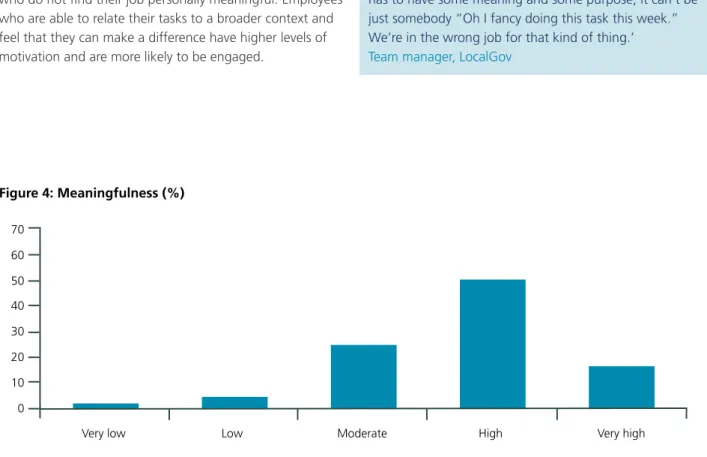
Two-thirds of all respondents in our study find meaning in •
their work.
Senior management vision and communication is a key •
driver of engagement, whereas senior management effectiveness is negatively related to employee engagement. Positive perceptions of one’s line manager are strongly •
linked with engagement.
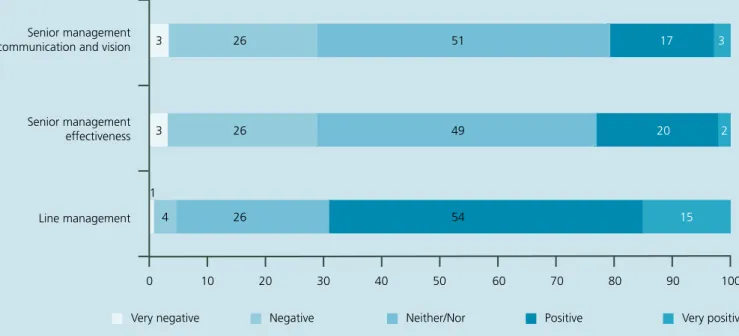
Respondents rate their line managers more positively •
compared with their senior managers, with 56% indicating that they have a good relationship with their line manager. • Employee voice is a strong driver of engagement.
Just 34% of employees are the ‘vocal-involved’, who •
perceive their work as meaningful and have opportunities to voice their views, yet this category of workers is the most engaged.
Most employees have negative views about their •
organisation’s HR policies and practices.
HR practices do not impact directly on engagement; •
the relationship is mediated by person–job fit and line management style.
OUTCOMES OF ENGAGEMENT
Employee engagement is associated with a range of •
positive outcomes at the individual and organisational levels.
Engaged employees perform better. •
The majority of our respondents were rated ‘good’ in their •
last appraisal.
Engaged employees are more innovative than others. •
Engaged employees are more likely to want to stay with •
their employer.
In our sample, 35% indicate that they would like to •
continue working for their employer for five or more years, compared with 17% who want to leave within the next two years.
Engaged employees enjoy greater levels of personal •
well-being.
Engaged employees perceive their workload to be more •
sustainable than others.
One-third of employees are ‘fit-performers’, enjoying high •
levels of personal well-being and performing well. Our data indicate that excessively high levels of •
engagement might lead to ill-health and burnout.
CASE STUDIES
In our two-year research project we analysed levels of •
engagement across eight different organisations, which are included as case studies in this report.
ServiceCo is a support services partner company with •
around 9,000 employees. An important factor influencing levels of engagement is the extent to which employees are given a platform to communicate their opinion about work-related topics. Further challenges include the integration of employees working remotely and the engagement of manual workers.
LocalGov is one of the largest local authorities in the •
UK, employing more than 50,000 employees. In 2006, LocalGov initiated a programme to empower employees and increase their levels of engagement, which runs very successfully. However, further improvements can be made in terms of communicating with employees, especially during change initiatives.
GovDep is a large government department that has been •
interested in employee engagement for several years. One of the major strengths in this organisation is work–life balance and the opportunities to work flexibly. An area for improvement is the way leadership capacity is developed within GovDep.
ScienceCo is a public sector organisation, supplying •
scientific information in the UK. Changes in the economic climate prompted ScienceCo to launch a new initiative to move from a very stable to a more dynamic workforce. Employees at ScienceCo find their jobs highly meaningful; however, senior management attitudes and behaviour could be improved to further raise levels of engagement. PlasticCo is a leading plastics manufacturer with a •
workforce of around 650 employees. Following the results from their engagement survey, PlasticCo undertook a major effort to change the culture and move towards a more open and integrative management style.
EnvironmentCo is a leading recycling and waste •
management company in the UK, employing almost 12,500 people in the UK. A major strength within EnvironmentCo is the clarity of objectives, as the vast majority of employees feels that they are clear about the tasks they have to perform to achieve their goals. An important area for improvement are HR practices, as many respondents express their dissatisfaction, especially with training and development opportunities, and the career and performance appraisal systems.
NorthTrust is an NHS foundation trust providing healthcare •
to a population of over 300,000 people. A consistently positive finding is that employees are generally satisfied working for the NHS. Future challenges for NorthTrust are communication and leadership style.
ConstructionCo is an international consultancy and •
construction firm. The company benefits from its entrepreneurial culture and the fair and consistent management style. An area for improvement is work–life balance as many employees feel compelled to work long hours due to the sheer amount of work.
MANAGEMENT IMPLICATIONS
The main drivers for engagement in our study •
are meaningful work, voice, senior management communication style and vision, supportive work environment, person–job fit and line management style. Understanding your workforce engagement profile is the •
first step to determining how to drive up engagement levels. Engagement is clearly associated, both in our report and •
in other studies, with high levels of performance, reduced intent to quit and raised levels of personal well-being. It is therefore legitimate from a corporate perspective to prioritise improving levels of employee engagement. There is a clear need to help create meaning for employees •
in their work; this can be achieved intellectually by articulating the links between individual jobs and the broader organisational aims, and emotionally through sharing an understanding of deeper levels of the purpose of the organisation.
Employees need to be given opportunities to express •
their views and to know that their opinions will be taken seriously. This is an activity that needs to involve both senior and line managers. Our case studies provide some examples of how organisations in the consortium have achieved this.
Senior managers have an important role to play in •
creating a vision for the organisation and sharing this with employees, and in being open, transparent and approachable.
Engagement levels are affected by the working •
environment. Where employees can see that they have support from others to help them do their job, there is a sense of teamwork and they can safely express themselves, then engagement will be higher.
Matching people to jobs is a critical driver of engagement. •
This is one area where HR professionals can play an important role helping line managers design jobs effectively, and develop selection processes that match individual skills to jobs.
Line managers act as the interface between the •
organisation and the employee, and can do much to impact on engagement. Another key HR role is therefore to pay close attention to the selection, development and performance management of line managers to ensure they maximise their potential to be engaging leaders.
The findings of the UK Government’s 2009 MacLeod Review into employee engagement (MacLeod and Clarke 2009) have underlined the critical role played by an engaged workforce in both organisational success and individual well-being. The study corroborates the findings of the earlier report commissioned by the CIPD into employee engagement (Gatenby et al 2009). This highlighted the relatively low levels of engagement in the UK workforce generally, together with evidence demonstrating the impact of engagement on performance, quality, innovation, levels of absenteeism, turnover and organisational advocacy. Engagement would seem to be beneficial to both employers and employees, as those with the highest levels of engagement also appear to enjoy greater personal well-being.
However, despite these and other studies, it remains true that, in theoretical, conceptual and empirical terms, we in fact know relatively little about the concept of employee engagement. Largely, this is because academic research has lagged significantly behind the wealth of interest shown by practitioners, HR professionals and consultants, who have been much quicker to note the importance of this relatively new concept. Consequently, many management consultancies and survey firms have developed a definition of employee engagement and associated measurement index, while their academic colleagues have been much slower off the mark and have thus far not agreed on a single, theoretically derived and empirically validated definition of engagement. In particular, we note one significant discrepancy. Most consultancies and survey firms regard engagement as something that is done to employees, in other words, ‘a workplace approach designed to ensure that employees are committed to their organisation’s goals and values, motivated to contribute to organisational success, and are able at the same time to enhance their own sense of well-being’ (MacLeod and Clarke 2009). In contrast, however they may actually define engagement, academics tend to agree that engagement is experienced by individuals, a state of being that may be affected by management strategies and approaches, but is not, in and of itself, such a strategy (May et al 2004).
It is the latter view of engagement as a state experienced by employees that has informed the work undertaken over the past two years by the Employee Engagement Consortium
based in the Centre for Research in Employment, Skills and Society (CRESS) at Kingston University. Working with the CIPD and the ten members of the consortium, we have undertaken a very thorough and detailed exploration of employee engagement, its antecedents and consequences, in a variety of different settings. Through this research, we have developed a new definition and conceptualisation of employee engagement that builds on prior academic studies but extends them in important ways, and we have studied the processes through which engagement levels can be raised or lowered through the actions taken by managers.
Introduction
We took as our starting point the first report we wrote on engagement for the CIPD in 2006 (Truss et al 2006). In this study, we were able to survey the views of 2,000 working adults from across the UK. This investigation yielded some important insights into engagement. However, we felt that there were still some unanswered questions. Most particularly, although the measure of engagement we used in that report was helpful (May et al 2004), we wanted to develop this conceptualisation further, drawing on wider academic studies and empirical evidence. We also wanted to explore, in more depth, how the engagement process works across different sectors and types of organisation.
The following year, in 2007, with support from the CIPD, we founded the Kingston Employee Engagement Consortium project in collaboration with ten public and private sector members. We set out to answer the following five questions: 1 What does engagement mean?
2 How can engagement be managed?
3 What are the consequences of engagement for organisations?
4 How does engagement relate to other individual characteristics?
5 How is engagement related to employee voice and representation?
We define employee engagement as: ‘being positively present during the performance of work
by willingly contributing intellectual effort, experiencing positive emotions and meaningful connections to others.’ We see engagement as having three core facets:
intellectual engagement
• , or thinking hard about the
job and how to do it better affective engagement
• , or feeling positively about doing a good job
social engagement
• , or actively taking opportunities to discuss work-related improvements with others at work. We also differentiate between the extent of engagement – the strength of feeling engaged – and the frequency of engagement – that is, how often individuals experience engagement. This approach has been used in studies of other psychological constructs such as burnout.
Thus, an engaged employee is someone who thinks hard about their work, feels positive when they do a good job and discusses work-related matters and improvements with those around them.
This definition of engagement derives from the work of earlier theorists and commentators such as Kahn (1990), May et al (2004) and Schaufeli and Bakker (2004), all of whom regard engagement as a psychological state experienced by employees in relation to their work, together with associated behaviours. Engagement therefore has intellectual, emotional and behavioural dimensions. Our definition of engagement draws specifically on the work of Kahn (1990) in its incorporation of the concept of social engagement, and suggests that the willingness of employees to discuss work-related improvements with those around them is an important dimension of engagement and which serves to differentiate engagement from other, similar constructs such as job satisfaction, organisational citizenship behaviour and ‘flow’. It is important to note that, following earlier theorists, our concern is with an individual’s engagement with their specific job, rather than with their organisation as a whole. We would argue that these notions of organisational commitment and advocacy are generally associated with high levels of engagement, but are distinct from it. Between 2007 and 2009, we collected data from eight organisations. Our preliminary findings were published by the CIPD in early 2009 (Gatenby et al 2009). In this, our final report, we extend our interim report and present the overall findings from this research project in the form of eight detailed case studies, together with an analysis of our entire dataset. Overall, we report on the findings of a study that has involved 5,291 questionnaire respondents and around 180 interviews.
First, we explore differences in engagement across organisational contexts and examine how different types of employee (for example, men/women; managers/non-managers) engage in their work. In the following section, we explain the key drivers of engagement, before we analyse the main outcomes of employee engagement at an individual and organisational level. Finally, we introduce our overarching model of engagement and highlight the management implications arising from our findings. In the Appendix, we explain the methodology used in our study.
The research study
We measured and analysed levels of engagement in a number of different ways. Individuals were asked a series of questions that were designed to evaluate how engaged they are with their work, each using a five-point response scale. These questions combine to create three separate scales each measuring social, affective and intellectual engagement. We measured these facets of engagement in terms of both extent – that is how engaged the person is – and frequency – that is how often they are engaged. We also analysed our data in terms of the overall extent and frequency of engagement, combining the three scales into an aggregate measure of engagement. This means that we are able to talk about engagement from various angles.
In terms of the overall extent of engagement, if we divide our respondents into five categories corresponding to our five-point response scale, we found that 8% of respondents are ‘strongly engaged’ with their work (that is, scoring 4.5 or over on the scale out of a possible 5). A further 70% can be described as ‘moderately’ or ‘somewhat’ engaged (scoring between 3.5 and 4.5 on the scale), and just 1% as very weakly engaged, with the remaining 21% neither engaged nor disengaged.
Our study is the first that has explored the frequency with which people are engaged with their work, which is an interesting addition to our understanding of how engagement works in practice. We found that fewer than one in five, 18%, are engaged on a daily basis. Fifty-nine per cent report being engaged ‘once a week’, and 22% ‘a few times a year’ or ‘once a month’, and just 1% report ‘never’ being engaged. These findings suggest that a substantial majority of employees are not engaged with their work on a daily basis but, equally, only a very small number are never engaged.
If we plot extent of engagement versus frequency, we find that just 5% of the sample overall can be described as very highly engaged (scoring a very high 4.51 or over on both extent and frequency). Conversely, just 4% report extremely low levels of engagement (scoring 2.99 or below on the extent and frequency scales).
Looked at in another way, the mean score for engagement extent is 3.8 and for frequency 3.9 out of a possible 5. Consequently, it would be true to say that the vast majority of employees can be described as falling into an intermediate category of engagement, which is largely what would be expected. This suggests that there is still considerable scope for organisations to raise levels of engagement overall. We can break this down further by looking at the three facets of engagement (see Table 1).
These findings comparing across the three facets of engagement provide an interesting insight into how engagement operates in practice. Scores for social
engagement are the lowest, which was reflected within each of the organisations individually, both in terms of extent and frequency. Levels of affective engagement are highest, with intellectual engagement occupying an intermediate position. The relatively low level of social engagement in terms of both extent and frequency is of concern. Social engagement is a measure of how much people at work participate in constructive dialogue with those around them about their work or how to improve working methods or skills. This is closely linked with notions of organisational social capital, which suggests that one of the most important resources at an organisation’s disposal is the network of relationships both within the organisation and beyond. Where levels of social engagement are low, this may mean that organisations are not capitalising on the unique strengths and knowledge of their workforce.
Table 1: Engagement extent and frequency (%)
Extent
strong
(over 4.0 out of 5)
Frequency
daily/once a week
(over 4.0 out of 5)
Social engagement
38
29
Affective engagement
58
77
Intellectual engagement
41
65
Employee engagement in the UK
3
However, overall, our findings broadly suggest that levels of engagement are moderate–high in the sample of organisations participating in our research. Of course, our sample is self-selected and chose to be members of the Employee Engagement Consortium, and so it is perhaps to be expected that the overall level of engagement in these organisations would be higher than average.
Nevertheless the findings are encouraging and compare favourably with other studies into engagement levels. For example, Truss et al (2006) found that 35% of employees are actively engaged, with 57% moderately engaged. Another study found that 29% of workers are engaged and 17% disengaged (Seijts and Crim 2006). A study by the Corporate Leadership Council (2004) found that just 24% of staff are highly engaged. The conclusion from the MacLeod Review (2009) is that levels of engagement in the UK workforce generally need to be raised. Although our findings are more positive, it is still the case that levels of engagement could be higher.
Why do studies of engagement reveal such a different picture? There are two main reasons for this. First, different studies use different questions to assess levels of engagement, based on how engagement is defined and operationalised. Measures of engagement that incorporate questions around employees’ understanding and awareness of organisational strategic objectives, for example, will always yield a more negative response as many employees lack this knowledge. However, it could be argued that this does not reflect the psychological state of engagement per se. Other studies, such as our report for the CIPD in 2006 (Truss et al – in this report we used the May et al (2004) measure of employee engagement), include questions on employees’ willingness to work overtime and take work home with them. However, we did not include questions such as these in this current measure, which is based on work we have undertaken since 2006 on the topic of engagement that extends prior understanding. We wanted to include questions capturing the extent to which people engage socially with their colleagues, feel positively about their work and think hard about how to do their jobs better,
rather than focus on long working hours. It is perfectly possible to be engaged with one’s work during working hours, but not work excessive overtime. Long working hours may be indicative of other factors, such as a culture of presenteeism in the workplace. Whereas engagement is associated with positive benefits for the individual, such as enhanced well-being, workaholism has been found to be linked with negative health outcomes.
The second reason that studies report differing levels of engagement is that different scales are used to record employees’ views and the data are analysed and coded in different ways. Here, we use a standard approach
recommended for academic research, giving respondents five possible responses to each question. This is one of the most common ways of recording and coding employees’ views. These divergent approaches to conceptualising, measuring and reporting on engagement can create a confusing picture for managers wishing to understand engagement and develop strategies for raising levels of engagement amongst their workforce. Everyone will form their own views as to how best to measure the engagement levels of their own employees based on what is important to them. It is, however, interesting that whatever the measure of engagement used, the range of drivers and outcomes of engagement tend to be quite similar across different studies, and the general conclusion is that the majority of employees are moderately engaged with scope to raise levels of engagement overall.
KEY FINDINGS
• Eight per cent are strongly engaged with their work,
with the majority falling into an intermediate category.
• Eighteen per cent are engaged ‘daily’.
• Our measure of engagement incorporates three
dimensions: emotional or affective engagement; intellectual or cognitive engagement; and social engagement, each measured in terms of extent and frequency.
ServiceCo is a support services partner in the UK providing business solutions for clients across the local government, transport, education, health and defence sectors. As a part of a large European infrastructure and services group, the company employs around 10,500 employees and is present in over 200 locations within the UK. In 2008, ServiceCo had a turnover of £1.49 billion and a profit of £86.5 million. ServiceCo’s vision is about transforming the nature of services to the public. A strategy has been developed to implement this vision, which focuses on being engaged throughout all work processes. Hence, ServiceCo encourages employees to take every opportunity to ‘go the extra mile’ for the customer. ServiceCo has been interested in engagement for several years. The company launched its first employee engagement survey in 2006 and has been conducting engagement surveys once a year since then. The surveys have been supported by action plans around the key issues arising. ServiceCo joined the Kingston University Employee Engagement Consortium to get a more detailed understanding of levels of engagement across different groups of the diverse workforce.
A total of 2,500 employees working for ServiceCo in the UK were encouraged to participate in the study. Those with email access (1,500 employees) were invited to complete an online questionnaire survey. A further 1,000 employees without Internet access were given a paper version of the questionnaire. A total of 1,157 questionnaires were returned, providing a response rate of 46%. Additionally, 33 interviews with managers and employees were carried out.
ENGAGEMENT LEvELS
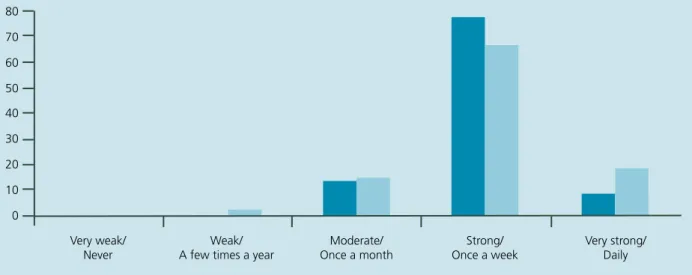
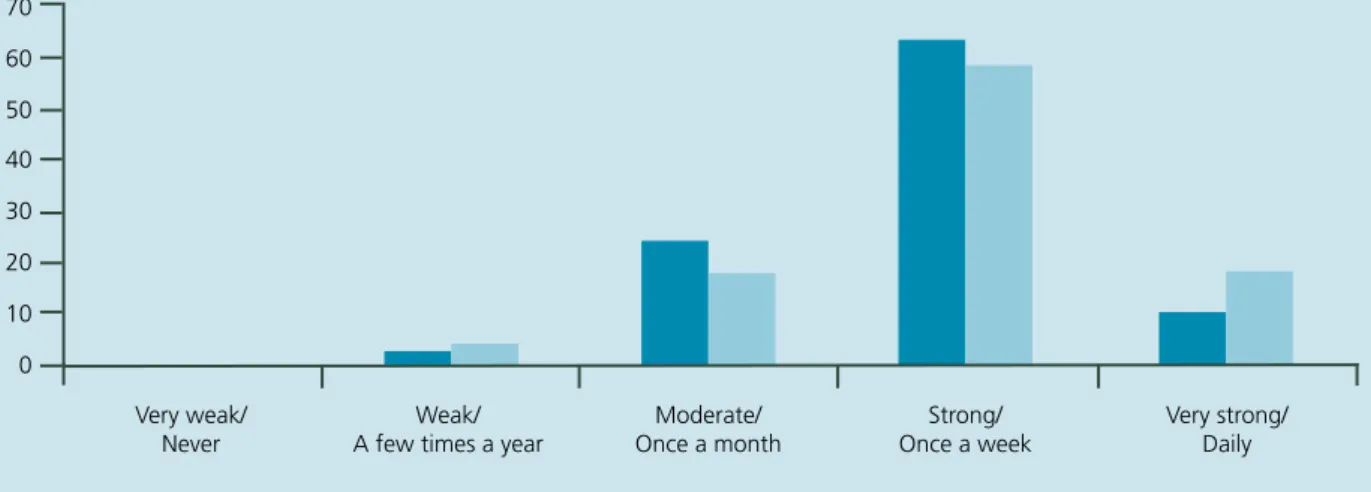
The results of the survey suggest that employees at ServiceCo generally have very high levels of engagement. Nine per cent are very strongly engaged and 77% are strongly engaged. Fourteen per cent have a moderate level of employee engagement.
‘I think on the whole most people would generally care about what they do and the company they work for. I think in my experience and the people I know and I work with, it’s not just a salary, it’s not just a job, they do believe in the company and their division and the work that they do.’ Development manager
Overall engagement frequency is even higher among employees at ServiceCo, with 19% being engaged on a daily basis and 66% being engaged once a week. Fourteen per cent are engaged once a month and only 1% said they are engaged only a few times a year. A director reflects upon the high levels of engagement and at the same time points out that it is important to continuously strive for higher levels.
‘ServiceCo does have an engaged workforce but you can
always engage more.’ Director
In the next sections we will consider three areas that are contributing to high levels of engagement in ServiceCo – employee voice, supportive environment and commitment – and three areas where there is still some room for improvement – engagement among manual workers, integration of workers working remotely and well-being in some roles.
Figure 1: Extent and frequency of employee engagement at ServiceCo (%)
Very weak/
Never Once a monthModerate/
Overall engagement extent Overall engagement frequency Weak/
A few times a year Once a weekStrong/ Very strong/Daily 40
70
10 80
20 50
30 60
0
CASE STUDY:
ServiceCo
EMPLOYEE vOICE
One of the most important factors impacting upon the high levels of employee engagement at ServiceCo is the extent to which employees participate in meetings and decisions that are directly related to their job and are given a platform to communicate their opinion about work-related topics. Most employees feel highly involved in work-related matters, could give their opinion and are listened to by management.
‘I think that culture encourages upward communication,
because I think people are very approachable.’ Director
‘We can always come up with something and it’s taken through and it’s dealt with. I certainly know on the projects they have regular meetings with the side teams where anyone who comes up with any initiatives or ideas, they are
always received and welcomed.’ Supply chain manager
ServiceCo has implemented an innovation library as one initiative to foster engagement across the organisation. The programme encourages employees to share success stories and ideas for improvement and relies on innovation champions who capture new ideas and feed them back into the innovation library. The innovation library is well received among office-based staff; however, as the following manager points out, ServiceCo could make even more use of this tool if operational roles could be informed about the innovation library and encouraged to use it more frequently.
‘We have got a best practice library with a lot of information. I think office-based staff probably [use it] because they know about it. I would query if operatives knew that we had an
innovation forum to put their ideas forward to.’
Marketing manager
SUPPORTIvE ENvIRONMENT
Another great strength at ServiceCo is the level of support in the working environment. This refers to the level of teamwork. As many employees at ServiceCo work in teams, a supportive working environment is important as it enables employees to feel comfortable at work and therefore has a major impact on levels of engagement. Employees at ServiceCo are very satisfied with the support they get from their colleagues in carrying out their jobs. They feel that colleagues help each other out whenever someone is experiencing a problem, and that generally all team members are committed to achieving common team goals.
‘Everybody is easy to get on with. Everybody works as a team; we’re all trying to achieve common goals. From other organisations I’ve worked in there was what I call politicking but there’s very little politicking within ServiceCo. Everybody has got a common objective, common understanding and people work in different ways and you need to understand
that but it’s very friendly, very approachable.’ Director
‘I think there’s a real teamwork ethos on a number of the
contracts.’ Director
Most employees also feel very comfortable saying that they could ‘be themselves’ at work.
‘I’ve always found it a very, very comfortable working environment with people I can actually get on with.’
Manager
‘Within my department, we’re almost like a family, we look after each other, we’re very good at making sure everybody’s
okay.’ Supply chain manager
‘I think the energy and the commitment that you get from individuals from being part of a team far outweighs the energy of the individuals as individual parts as it were.’
Manager
COMMITMENT
Following the positive comments above it is not surprising to find that ServiceCo employees have high levels of commitment to their department. Many employees indicate that they experience a strong sense of belonging to their department and would be happy to spend the rest of their career there. The high levels of commitment are closely associated with the good levels of teamwork and clearly contribute to the organisation’s high levels of engagement. Many employees are committed to do a good job and put a lot of effort into their work.
‘You go to any of our schools and you will find the cleaners are all very, very committed; if they can’t do something to the best of the quality that they want they get concerned
about it.’ Director
‘Generally, we have a very committed workforce who will
Commitment levels with respect to ServiceCo as a whole are slightly lower, but still on a satisfactory level. A good part of the workforce feels emotionally attached to ServiceCo and are proud to work for the organisation. Therefore, many employees do recommend ServiceCo as a good place to work to friends and family. This is mainly attributed to the development opportunities available and because they consider ServiceCo a ‘very dynamic and exciting place to be’.
Manager
Hence, related to the high commitment, employees show a very good level of advocacy for their company.
‘I think there are currently five people who are working in
ServiceCo that I have recommended.’ Director
‘People who work here will get people into the business, either friends or family even. I have a father and son team
working for me within my team.’ Manager
MANUAL WORKERS
Although engagement levels at ServiceCo are generally very high, manual workers are significantly less engaged than other employee groups within the company. This finding is consistent with other companies employing manual workers and ServiceCo are ready to address this within the coming months. Manual workers at ServiceCo indicated some major points of dissatisfaction. When asked about what could be improved in their working life, they expressed a need to improve communication between the workforce and management.
‘[The one thing which would help improve my working life is] better communications between employees and
managers.’ Manual worker
‘Communications with my line manager and project manager are very good, communications with higher
management are less effective.’ Manual worker
‘It would be nice for the senior management to meet the
staff.’ Manual worker
‘Understanding by senior managers of how difficult the job
can be would improve my working life.’ Manual worker
Manual workers at ServiceCo also indicated that they would like to get involved more in decision-making and also would like to get more training to improve the way they are working.
‘[I would like] to learn more skills.’ Manual worker
‘To better me for the job the organisation should provide me with regular training in health and safety, new techniques of
machinery and IT literacy.’ Manual worker
Further topics arose around the quality of the equipment, the role of line managers and better work–life balance. As a result of the lower levels of engagement among manual workers, ServiceCo has put an action plan in place to improve the work experience of manual workers.
EMPLOYEES WORKING REMOTELY
A second area for improvement, which is closely related to the previous topic, is about employees working remotely. As ServiceCo is present in over 200 locations across the UK, many employees work in small teams at some distance from the head office. In the survey, many remotely working employees feel that they received little attention and information from the head office. They indicate a strong preference to see their managers more often to increase mutual understanding of work objectives and work environment, raise awareness of problems occurring on remote jobs, and discuss new ideas or areas for improvement.
‘We’re out on a limb in the north of England and we very rarely have senior management come and visit so we don’t feel part of the whole with ServiceCo. It would be nice to see
more engagement from the senior management.’ Manager
‘You do hear of people who don’t get communicated to and feeling left out and I don’t know whether it’s the barriers or it’s the managers or whether they’re not given the talks, which may be the case. It’s especially in remote areas it could
be that there’s more work to do there.’ Manager
The implication of having employees working remotely and the difficulties in managing them are also recognised by some top managers.
‘Communication is not a challenge but something we have to work very hard at because we employ 8,500 people within the group and many of those are part-timers that are very remote from head office and quite remote from their
‘I encourage face-to-face meetings. I have two senior managers that work for me and even though the teams are quite remote they will meet with them on a face-to-face basis as regularly as possible, given the constraints of
travelling of course.’ Director
‘I just think it’s down to the simple kind of human need for that kind of contact and it is more difficult if you are managing remotely. It requires people to be more mature in their attitude and more self-contained and not everybody is
like that.’ Director
However, although individual top managers are aware of these challenges and take necessary steps to integrate remote workers by making efforts to meet them regularly, ServiceCo would benefit from organisation-wide processes considering the management of remote workers.
WELL-bEING
In general, employees at ServiceCo experience high levels of personal well-being. A large majority of staff feel that their work is highly sustainable and they are therefore able to continue working at their current pace. However, comparing the levels of well-being across different groups at ServiceCo reveals that contract managers experience significantly higher levels of stress. They feel burned out more often and also have a less favourable work–life balance. The reason for the high workload is that on top of being involved in managing their own contract, especially the most experienced and hard-working contract managers are often drawn into bidding for new contracts. Although employees generally like the team effort and the atmosphere during bidding periods, which they describe as motivating and exciting, the work–life balance goes wrong when they are involved in too many bids during the year.
‘I think people are willing to go the extra mile to put in the bid, they can be very hectic and very time-consuming and a lengthy process and I think that when push comes to shove people are willing to help out, step in and do what’s needed for the company and their team and for themselves.’
Manager
‘The work–life balance sometimes goes wrong, particularly around bids going in, you know they get very intense when there are very significant bids going in, so the work–life
balance probably goes the wrong way.’Director
‘We have gone through a period where we have been extremely stretched with the amount of bids that we’ve done and last year I think I’ve been involved with six, seven bids and some of these have been long days, long weeks, long months. Not only that, in my area I’ve had one contract that was not performing terribly well so we’ve been looking to improve the performance of that during the last year.’
Director
‘When there’s a lot of bidding it’s really poor, you have no
life.’ Manager
ServiceCo should therefore monitor these roles more closely to ensure that contract managers can cope with work demands, and measures such as stress management training courses and health initiatives should be considered where potential problems arise.
Fifty years ago, the American political scientist Wallace Sayre (1958) argued that public and private organisations are ‘fundamentally alike in all unimportant respects’. Since then, organisations have been transformed by new technologies, financial systems and management methods. In recent years, public organisations have been encouraged to become more ‘business-like’ by adopting the management style and processes used in private organisations (Boyne et al 1999). Research conducted by the CIPD has shown that work practices, such as carefully planned recruitment and selection, targeted training and equitable rewards, are significant drivers for organisational success. These practices are increasingly being implemented by managers in both the public and private sectors.
As this report shows, employee engagement has emerged as a useful way to measure the relationship between employee and employer. In this section, we compare the engagement levels of employees across the public and private sectors. We draw on the evidence from three public organisations – an NHS trust, local authority and central government agency – and five private sector organisations – including manufacturing and service industries. In particular, we consider similarities in the experience of work and explore how organisational context may contribute to differences in engagement levels.
ENGAGEMENT STRATEGIES ACROSS THE PUbLIC
AND PRIvATE SECTORS
Our research reveals that organisations in many parts of the UK economy are actively pursuing strategies to raise levels of employee engagement. The management initiatives we have observed take many different forms, paralleling the diversity of organisational needs. As the MacLeod Review recommended, organisations need to find their own definition and approach contingent with organisational context (MacLeod and Clarke 2009). We have observed two broad trends across the public and private sectors (Boyne 2002).
First, we found that many organisations now regard measures of engagement as the most significant measure of employee attitudes or experience. Based on either a single question or several questions to make a composite measure, engagement has been incorporated into annual employee attitude surveys. For example, the NHS annual survey includes questions such as ‘I am enthusiastic about my job’, ‘time passes quickly when I am working’ and ‘I often do more than is required’. The Civil Service has a measure
of engagement based on the ‘say, stay and strive’ model. Related survey questions focus on employee advocacy and whether employees are happy to remain with their organisation for the foreseeable future. Many organisations in the private sector are also incorporating measures of engagement into annual surveys. We have seen evidence of this in small, medium and large companies and across different industries.
Second, ‘engagement’ has been used within organisations as a more general term to describe workplace approaches to improvement. For example, several private companies we studied used suggestion schemes under the banner of engagement. A local authority we studied is using an ambitious programme of employee involvement to engage staff. Often, engagement initiatives are linked to training and mentoring. Our research suggests that there are no consistent or distinctive differences between public and private sector strategies around employee engagement. In some cases, there are more similarities between sectors than within them. Particular initiatives depend on senior management style and corporate strategy, but also on the size of the organisation, the type of workforce (for example skill level) and the type of work (for example work environment and location). Furthermore, external assistance is often provided by management consultancy and research organisations, in which case, particular approaches in both the public and private sectors reflect the preferred method of the consulting firm. Individual organisations have tended to give their employee engagement strategies distinctive branding, but the details and underlying initiatives are often very similar. One difference we did find was that public organisations are more likely to share and collaborate with the development of engagement methods. We found examples of groups being set up within local government, the NHS and the civil service, where managers are coming together to discuss employee engagement and sharing ideas for improvement. This has tended not to be the case in the private sector, where competitive pressures mean companies are more likely to pursue their own approach, often at considerable cost.
Engagement across different
organisational contexts
4
With more than 50,000 employees, LocalGov is one of the largest local authorities in the UK. Many local services are managed in ten geographic constituencies and decentralisation of duties is supposed to continue in the future. In collaboration with the community and local strategic partners, LocalGov has developed a strategic vision for the city, which centres around ‘being a global city with a local heart’. LocalGov has identified several areas of improvement to turn the vision into reality and works closely with its partners to achieve this.
The council has undergone significant changes and
restructuring initiatives in the past. A major change involved the revision and alignment of pay structures in accordance with new national guidelines following the Single Status Agreement, which was signed between local government and trade unions in 1997 to streamline all pay scales into one. Further changes will follow over the next few years. In 2006, internal employee surveys indicated that employees at LocalGov felt disempowered and were not very motivated. As a response to these findings, LocalGov became interested in the topic of employee engagement and decided to initiate the BEST (Belief – Excellence – Success – Trust) programme. This council-wide initiative aimed at involving employees in change management and decision-making by running workshops and empowering teams. The central idea behind BEST is to give employees a voice and provide them with a platform where they can give their opinion and share ideas for improvement. The initiative is generally well received from the employees; however, they also point out areas that still need more development.
‘The BEST team are really, really working hard to do it, because things have come and gone before. So I think it is starting to embed itself. There’s still a huge amount of cynicism out there and it’s so important to get it seen as something that’s integral as opposed to yet another thing we’ve got to tick the box on. But I think it’s moving that way but then you see I’m closer to it
than other people.’ Policy manager
‘If you’ve got enthusiastic leaders then it seems to work. Last year we had a leader that wasn’t particularly enthusiastic and nothing seemed to be carried forward from that. I think it is very indicative of who you’ve got doing the team leader
role.’Team manager
Following the launch of the BEST programme, LocalGov decided to join the Kingston University Employee Engagement Consortium to further strengthen their knowledge about engagement and identify areas that could be further improved to strengthen levels of engagement across the workforce.
All employees working for LocalGov in the UK were invited to participate in the engagement survey. A total of 1,198 questionnaires were returned, providing a response rate of 2.4%. Additionally, 21 face-to-face interviews were conducted with different managers, including HR managers, team managers and service area managers.
ENGAGEMENT LEvELS
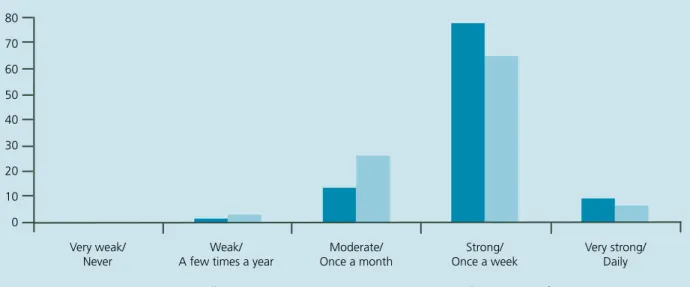
The results of the survey indicate that LocalGov generally has an engaged workforce. Seventy-five per cent of the respondents indicate that they are strongly engaged and 7% are very strongly engaged. Seventeen per cent have a moderate level with respect to the engagement extent. In terms of engagement frequency, the results are similarly positive, with 17% being engaged daily and 65% being engaged on a weekly basis.
‘Oh most of them would go the extra mile, there’s probably a couple who wouldn’t but the majority of them would always
go the extra mile.’Team manager
‘Eighty per cent [really care about job]. I know that for some of them, if we’d have been high up on that list of closures, it would have really affected them, particularly some of the older ones who just want to get to retirement now and enjoy
the job they’re doing and do it quite well.’Team manager
The high levels of engagement in LocalGov are closely related to the nature of work and the ethos of being a local government employee. As one manager puts it: ‘It’s the nature of the work as well, if you’re dealing face to face with the public or you’re a social worker or a childcare worker, so there’s that element.’
In this case study we will consider which engagement-related aspects LocalGov is managing well – job-related skills and flexible working opportunities – but also discuss which other engagement strategies could be implemented to further raise levels of employee engagement among the workforce – communication, appraisal process.
CASE STUDY:
LocalGov
JOb-RELATED SKILLS
One of the biggest strengths within LocalGov that clearly contributes to the level of engagement is a close match between the content of the individual roles and their level of skills. Almost two-thirds of respondents feel that they possess the necessary skills to carry out their job at the required standards. Employees appreciate the amount of training they are provided with, which they feel is exceptionally high compared to other organisations, especially in a difficult economic climate.
‘Yes, most of them [are right for their job], they’re quite good. What we find though is that as technology moves on we need to keep up to date you know and as new things come out, in the IT world that’s very regular and so people need to be acquiring skills. So for us training is quite a critical
thing.’Service manager
‘Training is offered, it must be one of the few organisations that still places a great emphasis on training its employees because the first thing in a recession that goes is the training
budget, isn’t it?’ Head of service
‘The training opportunities, I wouldn’t have got them
anywhere else.’ Head of unit
FLExIbLE WORKING OPPORTUNITIES
Flexible working opportunities have been linked to high levels of engagement in many studies. LocalGov offers a variety of opportunities for their employees to work flexibly. As one HR manager explained, LocalGov tries to comply with all employee requests within the limits set by the need for service within the council. Flexi-time is the most popular working arrangement employees apply for and about two-thirds of the respondents have the possibility to work under a flexi-time arrangement. Other popular working arrangements include homeworking, shorter working weeks, annualised or compressed hours and term-time contracts.
‘The head-office-based staff, we try and fit in with what people want. If they want to do a nine-day fortnight, we try
and arrange that.’ Head of service
‘I think generally we encourage flexible working. There’s nothing about what I see that doesn’t realise that people
need to be flexible.’ Manager
‘Flexible working arrangements for people who need it,
they’re quite sympathetic to people’s needs.’ Manager
Figure 2: Extent and frequency of employee engagement at LocalGov (%)
Very weak/
Never Once a monthModerate/
Overall engagement extent Overall engagement frequency Weak/
A few times a year Once a weekStrong/ Very strong/Daily 40
70
10 80
20 50
30 60
But also within the regular set of working hours, managers have some discretion to give employees some flexibility if needed, which is also appreciated by the employees.
‘If ever my son is ill and I ring up and say “look we’re taking him to the doctor,” I would never get a “well, that’s not acceptable.” I’ve always, always had a positive response in that regard and I likewise would do the same with my staff.’
Manager
‘If they want to take some of their time owed, time in lieu I always try and help them, so I guess there’s flexibility there.’
Manager
COMMUNICATION
There are many changes and restructuring initiatives going on at LocalGov. In general, employees feel that communication processes around these changes do not always function optimally. For example, a major change had been reported in the media before the news of the change had been given to the workforce, so that the staff got their information from a local newspaper. Employees indicate that they often were not informed thoroughly about the details of the change and were only given information sporadically instead of on a regular basis. Also, employees perceive communication as inconsistent across different teams depending on the level of information and communication abilities of their respective line manager.
‘We’ve all had a briefing that explained why the restructure was taking place. The only problem is the length of time, I mean we’re talking about April and this was October time that this was communicated to us. And it’s a long time to have in the back of your mind – “what’s going to happen,
what’s going to happen?”’Team manager
‘So you’d report back and I know some managers just didn’t report back to their staff, didn’t tell them what was going on at
all and didn’t make any attempt to interpret it.’ Unit manager
Consequently, communication processes around the restructuring and downsizing of the workforce have a somewhat negative effect on the relationship between managers and employees. Trust between both has worsened considerably following the changes, which impacts levels of engagement among the workforce.
‘I think a lot needs to be done on trust, working on trust. In fact we had a conversation about that this morning at one of the meetings we had, you know that there’s still huge amounts to do to actually empower and build the self-esteem of the staff, you know it’s a uphill battle really and particularly when messages are coming out from the leadership about, you know, flex systems, getting rid of middle management, sloth, getting rid of sloth, you know, so I think there’s messages that are not about trust.’
Policy manager
APPRAISAL PROCESS
Although HR practices and policies are perceived well within LocalGov, the appraisal process is a concern throughout the organisation. Almost half of the respondents indicate that they are either dissatisfied or very dissatisfied with their appraisal process. One of the major concerns is that objectives are often abstract and not broken down adequately to the individual level.
‘The council has very aspirational, abstract objectives which I don’t really know what they mean. We’re going to have a “greener city”, well what does that mean? They’re sound-bites, they’re political sound-bites. From a practical point of view, to convert that into something that’s meaningful to the staff, that’s very difficult. So I think one big improvement would be to have clearer meaningful objectives set by the council that can be more easily interpreted and adopted by, you know, as this thing cascades down. So that’s a practical
problem I find.’ Manager
Managers are unhappy with the appraisal process as well. They feel that it was too rigid and does not allow for enough flexibility. They also respond that they do not have enough time to effectively conduct an appraisal with all team members.
‘Performance management is not very successful because it’s very prescriptive at the moment, although again it’s going through a review at the moment so it may improve. But at the moment it’s very prescriptive, you have to have done x, y, z by this time and if you haven’t there’s no leeway whereas everybody develops at different levels, at different speeds and in different ways and if you could be more flexible in the way that you can develop the members of staff then it
ENGAGEMENT LEvELS ACROSS THE PUbLIC AND
PRIvATE SECTORS
We now consider what our research can tell us about differences in engagement levels across public and private organisations. Here we distinguish between engagement ‘extent’ – the overall strength of experience – and engagement ‘frequency’ – how often employees feel engaged at work. The results suggest that public sector employees are slightly more engaged on the extent measure, with 72% being engaged compared with 69% in the private sector. However, the difference is small. When looking at the frequency measure, there is a more pronounced difference, with private sector employees being engaged more often. Twenty per cent of private sector employees say they are engaged every day, whereas 16% of public sector employees feel this way. We can look into these findings in more detail by considering how the different dimensions of engagement – social, intellectual and affective – compare between the two sectors.
Our findings for social engagement suggest that employees in public organisations experience a stronger connection to work colleagues and with more frequency than those in the private sector. For instance, public organisations are more likely to have cross-department meetings to discuss problems and potential solutions. Government organisations at both local and central levels are keen to get teams and departments actively thinking about solving local problems through improvement initiatives such as ‘lean’.
One possible reason for this is the inherent ‘openness’ and ‘permeability’ of public organisations. In contrast to private organisations, where it is possible to create a relatively direct organisational hierarchy in which senior managers enjoy considerable decision-making power, public organisations must keep their boundaries open to the scrutiny of politicians and the public. We found that it is often the role of public managers to promote organisational communication and knowledge-sharing, frequently through the use of IT. Public organisations are increasingly looking to consult and involve their employees in a way that is enhancing the transparency of organisational processes. Furthermore, the interdependence of many public organisations, such as civil service agencies, may create a need for public organisations to collaborate more than private organisations. Although there has been a move towards targets, league tables and public ‘choice’ throughout English public services in particular, there is significantly less competition than in the private sector, where companies compete for limited market share.
Although public organisations display higher levels of social engagement than their private sector counterparts, this does not mean public organisations are all highly effective at socially engaging their staff. We saw instances of low take-up of involvement initiatives among some employees in both local and central government. In particular,
managers reported that because of the permeability of some government workplaces, employees had become apathetic to the influence of involvement initiatives. Organisations in the public sector have more formal procedures for decision-making, and are less flexible and more risk-averse than their private sector counterparts. Conversely, private organisations are less likely to place significant emphasis on knowledge- and idea-sharing but, in the pockets where this is occurring, it is often more successful due to the flexibility and control of senior managers.
The findings for affective engagement suggest that private sector employees are more strongly and more frequently emotionally connected to their work. This finding may stand in contrast to theoretical predictions of ‘public service motivation’ – the idea that public sector employees are intrinsically motivated by a concern to serve public citizens. For example, we might expect the prime motivation for clinical staff working in the NHS to be the immediate health needs of patients under their care. While public sector employees do show a strong emotional attachment to their work, private employees appear to experience a stronger connection. A possible explanation for this is again the competitive pressure of private sector working environments. Rather than through a concern for service users, private sector employees must face constant pressures to survive economically in the marketplace, which can place a psychological burden on them. We spoke to employees who felt a persistent emotional pressure to take work home because of work demands and the competitive culture of their organisation.
Our interviews with staff suggested that workloads are increasing in many areas of the public and private sectors, with particular strain being placed on first-line managers. The time-frame of our research has picked up the effects of the economic recession on employee experiences. This has had a more immediate effect in the private sector over the last few years but is likely to have increasing ramifications for public employees in the near future.
The results suggest, on average, that public sector employees are more strongly and frequently intellectually engaged than private sector employees. This measure varies widely in both sectors depending on the type of work and the seniority of staff. Senior managers are almost always more intellectually engaged than junior staff. We found that employees in manufacturing and administrative roles are often the least engaged on the extent measure and that professional groups, such as hospital physiotherapists or accountants, tend to be more engaged.
This research has suggested that employee experiences across public and private organisations are becoming increasingly alike. There are few consistent differences in engagement strategies and initiatives between the two sectors, and survey evidence shows that the overall engagement levels are comparable. If Wallace Sayre could comment today, he might argue that public and private organisations are becoming alike in all important respects. Nevertheless, we have found some differences in the dimensions of engagement. In particular, public organisations are more likely to engage their staff socially whereas private organisations provide an environment where employees are more likely to be emotionally engaged. In the next section, we explore the relationship between individual factors, such as age, gender, job status and contractual arrangements, and employee engagement.
KEY FINDINGS
• Many organisations measure engagement and have
specific engagement strategies across the public and private sectors.
• Public sector employees are more strongly but less
GovDep is a large government department that covers several customer-facing business areas. This case study is based on one of the larger agencies within the department. The agency has offices in various locations across England, including the south-east, the midlands and the north. Core values of the agency include ensuring an accurate, rapid and joined-up service based around customer need; improving value for money for the taxpayer; and reducing levels of service error. At the time of the survey, the agency employed over 16,000 people and their services are used by around 15 million customers in the UK.
The agency has recently undergone considerable change as a result of a merger between two previously separate business units. This has led to a new management structure and around 1,000 job cuts. Like many areas of the civil service, there is an efficiency drive with overall reduction in financial allocation for the next three years.
The department has been interested in employee engagement for several years. This interest stems from a drive to renew employment practices and processes as part of a wider agenda of government modernisation. The agency now conducts an annual staff survey that feeds into improvement activities and has an increased focus on employee involvement initiatives. The majority of the agency’s employees work in an office environment. There is an emphasis on employee development, coaching and teamwork. There is also careful attention paid to diversity and equal opportunities. Sickness absence rates have been relatively high in the agency over recent years and a new performance standard for sickness has been put in place with the aim to reduce sickness absence to fewer than 8.3 average working days.
GovDep joined the Kingston Business School Employee Engagement Consortium to help develop new initiatives around employee engagement as part of recent changes in the agency. The department already has a policy on engagement and this research process is intended to feed into that work. The engagement research was conducted in two stages. First, a sample of 1,400 employees was invited to complete an online questionnaire. From this sample, 571 online questionnaires were returned, providing a total response rate of 41%. Second, 20 face-to-face interviews were conducted with a range of managerial staff. There are standardised management grades across the agency, including: Executive Officer (EO), which is the first management level responsible for teams of operational staff; Higher Executive Officer (HEO), which is the next level up from EO and has responsibility for groups of operations or decision-making teams; Senior Executive Officer (SEO), which has responsibility for wider units of operation; and Grade 7, which is a middle management grade.
ENGAGEMENT LEvELS
The results of the survey suggest that GovDep has a generally engaged workforce. Seventy per cent are ‘highly’ or ‘very highly’ engaged overall. Twenty-nine per cent are moderate or unsure, while very few people had low levels of engagement. Findings with respect to engagement frequency are similar. Almost 70% are engaged on a regular basis; however, 28% engage only once a month. These results may in part reflect the uncertainty at this time of change within the organisation. Early analysis of the data from GovDep uncovered two main areas of strength that contribute to engagement – work–life balance and a supportive social environment – and two areas that could benefit from some attention to improve engagement – leadership development and employee involvement uptake.
Figure 3: Extent and frequency of employee engagement at GovDep (%)
Very weak/ Never
Moderate/ Once a month
Overall engagement extent Overall engagement frequency Weak/
A few times a year
Strong/ Once a week
Very strong/ Daily 40
70
10 20 50
30 60
0