F O C U S
A Regional Nonprofit Sector ReportNOvembeR 2009
F O C U S
Research reportWork-Based Learning
in California
Opportunities and Models for Expansion
Svetlana Darche, Senior Research Associate Nara Nayar, Research Associatep a g e 1 | t h e j a m e s i r v i n e f o u n d a t i o n
f o c u s W o r k - B a s e d L e a r n i n g i n c a L i f o r n i a
foreword 2
Why Work-Based Learning? 3
What is Work-Based Learning? 5
What’s needed for success and expansion 14
Looking to the future 27
acknowledgments 28
references 30
p a g e 2 | t h e j a m e s i r v i n e f o u n d a t i o n
f o c u s W o r k - B a s e d L e a r n i n g i n c a L i f o r n i a
In a state facing myriad challenges, education is a vital lever of change with lasting impact on the quality of life for Californians. For this reason, the Youth program of The James Irvine Foundation seeks to increase the number of low-income youth in California who complete high school on time and attain a postsecondary credential by age 25.
To ensure access to better educational and economic opportunities for a diverse group of students, the Foundation has made a multi-year investment in a promising approach to high school education called California Multiple Pathways. This approach connects strong academics with real-world experience in a wide range of fields, such as engineering, arts and media, and biomedicine and health. Used in schools throughout California, this integrated approach helps students build a strong foundation for success in college and career — and life. By linking learning with student interests and job preparation, multiple pathways contribute to higher graduation rates, increased college enrollment and higher earning potential.
A central component of multiple pathways is work-based learning, where students apply what they’ve learned in the classroom to the world of work. This promising strategy calls for serious exploration and investment. For this reason, Irvine commissioned this study of the work-based learning landscape in California and beyond. We hope that it will serve as the contextual foundation for a growing body of work-based learning resources.
Our thanks go to the WestEd research team and the many educators, statewide initiative leaders, scholars and consultants who informed this study. We share it with all in the education field who wish to better understand work-based learning, how it is implemented today and how it may be expanded to reach, teach and engage more students in California.
James E. Canales
President and Chief Executive Officer The James Irvine Foundation
November, 2009
Foreword
Contents
p a g e 3 | t h e j a m e s i r v i n e f o u n d a t i o n
f o c u s W o r k - B a s e d L e a r n i n g i n c a L i f o r n i a
Increasing concern about the high school dropout rate and student academic achievement, as well as rapidly changing demographic and economic conditions, have sparked renewed interest in how best to engage students and prepare them for the complex future they face. For many, completing high school is not enough. To succeed in their continued educational endeavors and careers, all students should have opportunities to develop cognitively and socio-emotionally, and to obtain workplace competence and career management skills. Access to a variety of work-based learning experiences can facilitate this growth.
Work-based learning is an educational strategy that links school-based instruction with activity that has consequences and value beyond school. Work-based learning is informed by professional workplace standards. It uses the workplace, or in-depth experience that includes employer or community input, to engage high school students and intentionally promote learning and access to future educational and career opportunities. Work-based learning can include internships, apprenticeships, workplace simulations, student-led enterprises and other opportunities in the business or nonprofit arena.
While not a solution to all educational challenges, work-based learning offers opportunities and benefits that school-based academic programs typically do not. By introducing students to “communities of practice” in their areas of career interest, or providing occasions for solving problems and demonstrating skills in authentic settings, work-based learning can motivate, reinforce and augment student learning in ways not available to traditional classroom instruction.
Work-Based Learning and multiple pathways
While work-based learning, in and of itself, is a powerful tool for enhancing student learning, it holds particular promise within the context of multiple pathways. A comprehensive approach to high school reform in California, multiple pathways connect strong academics with real-world experiences to ensure that students recognize the relevance of a high school education to their futures, both in college and the workplace.
p a g e 4 | t h e j a m e s i r v i n e f o u n d a t i o n
f o c u s W o r k - B a s e d L e a r n i n g i n c a L i f o r n i a
As one of four program elements that distinguish the multiple pathways approach, work-based learning is part of a larger effort that seeks to prepare young people for academic and career success. The four multiple pathways components follow:
Challenging academics
• — A core academic component of college-preparatory instruction in essential
subjects, including English, math, science, social studies, foreign language, and visual and performing arts
Technical skills and knowledge
• — A demanding technical component, emphasizing the practical
application of academic learning and preparing youth for high-skill, high-wage employment
Work-based learning
• — A work-based learning component that offers opportunities to learn through
real-world experiences, such as internships, apprenticeships and school-based enterprises
Support services
• — Supplemental services, such as counseling and additional instruction in reading,
writing and mathematics
about this report
This report summarizes the findings of a study conducted by WestEd with support from The James Irvine Foundation. In order to gain a deep understanding of the content and application of work-based learning, researchers reviewed the literature, interviewed scholars and practitioners, and conducted 13 site visits with a variety of schools and programs throughout California. This report mines the data gathered during this exploration in order to describe the characteristics and benefits of work-based learning, and the elements of high-quality implementation. In addition, it invites state and local practitioners and decision makers to consider what it will take to expand successful work-based learning models for the benefit of California’s young people.
p a g e 5 | t h e j a m e s i r v i n e f o u n d a t i o n
f o c u s W o r k - B a s e d L e a r n i n g i n c a L i f o r n i a
Work-based learning, as defined in this research report, requires a set of minimum characteristics.
Direct, systematic employer and/or community input. This study concludes that direct employer or community involvement is an essential characteristic of based learning. This characteristic sets work-based learning apart from the applied learning that takes place within career technical education and the project-based learning that occurs in academic classrooms. Direct involvement provides students with important exposure to industry or professional standards and makes the experiences authentic. It requires the purposeful linking of education with the world outside the classroom and active mediation between the culture of school and the cultures of work and community. For students, this intentional mediation provides a bridge from their roles as students to their roles as contributing members of society.
Depth of experience. Work-based learning also requires in-depth engagement. As a defining criterion, this sets work-based learning apart from career exploration, though career exploration may be one of the purposes of work-based learning. While workplace tours and job shadowing occur in workplaces, and are therefore often listed as types of work-based learning, these activities, though valuable, do not build or reinforce technical, academic or workplace skills or build real communities of practice. In addition, labeling these experiences “work-based learning” also has implications for quality control. A workplace tour and an internship are as different from each other as a classroom field trip is from a unit of classroom instruction. If the contribution of work-based learning to student learning overall is to be examined, it will be important to demarcate exploratory and substantive experiences and evaluate each separately using distinct criteria.
Connection to the curriculum. All experiences referred to as “work-based learning” in this report are also connected to curriculum, which may include academic and/or career technical education curricula. Learning in this context is intended to include academic and/or technical content knowledge, as well as higher-order thinking skills and workplace interpersonal and other skills — all with varying degrees of emphasis, depending on the primary purpose of the experience for particular students.
Work-Based Learning in context
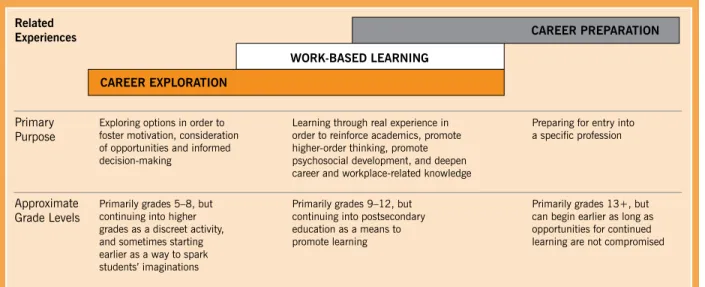
Work-based activities fall along a continuum of experiences for students and exhibit increasing levels of intensity over time. The continuum often begins with career speakers and tours appropriate for students as early as the elementary years, followed by job shadowing, which can begin in middle school and the early high school years. It then progresses to internships, service learning, or various kinds of school-based enterprises in high school — all of which may lead to further education and career preparation activities, such as apprenticeships, beyond high school.
p a g e 6 | t h e j a m e s i r v i n e f o u n d a t i o n
f o c u s W o r k - B a s e d L e a r n i n g i n c a L i f o r n i a
These experiences are scaffolded from one level to the next and vary in purpose. At the first level are less intense activities, such as workplace tours and job shadowing, intended primarily to foster career exposure and exploration. At the second level are work-based learning experiences — internships, service learning and school-based social and commercial enterprises — which provide opportunities for more in-depth engagement with activities that have consequences beyond the classroom and create a platform for multiple options after high school. At this level, students may learn and use employable skills, but the primary goal is ongoing learning, not only employment. Beyond work-based learning is career preparation, comprising the most technically-focused activities such as apprenticeships and professional training programs intended to prepare students for entry into the workplace.
The focus of this study is on those opportunities in the second category — those that foster in-depth, first-hand engagement with the tasks required of a given enterprise or occupation, that are intentionally designed to promote learning, and that prepare high school students for both further education and careers.
figure 1. Work-Based Learning along a continuum of experiences
CAREER EXPLORATION
WORK-BASED LEARNING
CAREER PREPARATION
Approximate Grade Levels Primary Purpose Related Experiences
Exploring options in order to foster motivation, consideration of opportunities and informed decision-making
Primarily grades 5–8, but continuing into higher grades as a discreet activity, and sometimes starting earlier as a way to spark students’ imaginations
Learning through real experience in order to reinforce academics, promote higher-order thinking, promote psychosocial development, and deepen career and workplace-related knowledge Primarily grades 9–12, but
continuing into postsecondary education as a means to promote learning
Preparing for entry into a specific profession
Primarily grades 13+, but can begin earlier as long as opportunities for continued learning are not compromised
What Is Work-Based Learning?
p a g e 7 | t h e j a m e s i r v i n e f o u n d a t i o n
f o c u s W o r k - B a s e d L e a r n i n g i n c a L i f o r n i a
p a g e 7 | t h e j a m e s i r v i n e f o u n d a t i o n
f o c u s W o r k - B a s e d L e a r n i n g i n c a L i f o r n i a
the purposes of Work-Based Learning
Researchers and advocates have generated multiple lists of purposes for work-based learning.1 A
synthesis of these yields nine distinct though interconnected purposes.
To engage and motivate students in learning by connecting classroom work to students’ personal 1.
and career interests2
To reinforce and improve academic learning (as defined by the content of core academic classes) 2.
To engage students in new modes of thought (e.g., higher-order critical thinking and problem-3.
solving) or otherwise facilitate learning through contextualization and the enculturation offered in social learning and communities of practice
To develop students’ career/technical skills as a means to learning 4.
To advance students’ social and emotional development toward adulthood, including their identity 5.
formation and their sense of self-efficacy
To expand students’ social networks and access to opportunities 6.
To enhance students’ general workplace competencies, such as communication, teamwork and 7.
project planning
To enable career exploration through breadth of exposure at the worksite 8.
To enhance students’ understanding of particular careers through depth of experience 9.
The benefits of using applied learning approaches such as work-based learning within an overall educational program are multidimensional. Because applied learning enables youth to learn and master skills and competencies through problem-solving, it can help address students’ diverse learning styles. Work-based learning can add relevance to the curriculum by showing students how classroom learning is applied in the world and exposing students to diverse career options. Work-based learning can also promote psychological and social development. In linking students with mentors and other caring adults, work-based learning offers young people opportunities to gain confidence and to understand the impact they may have in the world they will enter following school (NRC, 2004, Benard, 2004).
components of Work-Based Learning
To ensure a quality work-based learning experience (as work-based learning is defined in this report), programs must incorporate the components that follow.
Engagement in the workplace.To be effective, workplace engagement must encompasses three interlocked yet distinct components: in-depth engagement, communities of practice and rotation. Situated experience is central to work-based learning. According to researchers Bailey, Hughes and Moore, “If a student is to learn about a concept, then he or she must experience that concept in practice. So, if educators want students not only to learn new ideas and skills, but also learn to use them in authentic settings, then the theory [of situated learning] supports the claim that direct experience in the workplace will engage students with that knowledge more effectively than will book oriented, teacher-driven, abstract instruction” (2004, p. 215). The researchers caution, however, that students must be actively engaged with the knowledge and skills to be learned — they cannot simply be bystanders. Further, as Stasz and
1
Urquiola, cited in Stasz & Sterns, 1998; Stern, 1997; bailey, Hughes, and moore, 2004; Pearlman 1998; Aring and brand, as cited in Pearlman, 1998.
2
p a g e 8 | t h e j a m e s i r v i n e f o u n d a t i o n
f o c u s W o r k - B a s e d L e a r n i n g i n c a L i f o r n i a
p a g e 8 | t h e j a m e s i r v i n e f o u n d a t i o n
f o c u s W o r k - B a s e d L e a r n i n g i n c a L i f o r n i a
Stern (1998) state, “teachers and administrators need to consciously look at the workplace as a learning environment. That is, each workplace setting needs to be evaluated as a community of practice with a defined social context and a way of teaching.” Finally, researchers stressed the importance of “rotation” among tasks and supervisors at the workplace, which fosters both career development and a more complete grasp of workplace issues (Hamilton and Hamilton, 1997; N. Grubb, personal communication, December 19, 2007).
Connection of the workplace to the classroom. Linking the workplace to the classroom is central to high-quality work-based learning. The literature revealed three important stages in the creation of these connections:
Identification of learning opportunities in the workplace and alignment with standards:
• Observations
in the workplace before students are placed, called “workplace audits” by Jobs for the Future (2001), enable teachers to have a full understanding of the learning potential in a given workplace, informed by first-hand experience and conversations with employers. Alignment of the skills and knowledge to be gained in the workplace with standards is the next step. This alignment has long been a tenet of high-quality work-based learning (Hamilton and Hamilton, 1997). In California, both academic and career technical education standards can be used3 to ensure that work-based
learning furthers the goal of success for all students.
Development of learning plans:
• Agreed upon by the teacher and the employer, learning plans identify
the skills and knowledge areas that students will focus on while in the workplace. It is important for all agencies and people involved to be clear about the learning objectives, expectations and time commitment for activities that the work-based learning program involves (MDRC, 1994).4
Ongoing supervision and communication:
• Teacher supervision and close communication between the
teacher and the employer ensure that learning is, in fact, tied to standards and students’ learning objectives.5
Reflection in the classroom. Reflection is critical in allowing students to step back from their experiences and connect what they are learning in the workplace with their classroom experiences. It enables transfer of knowledge and coordination of academic learning with the worksite experience, and it helps students see the workplace as a “subject of inquiry, not just the location for learning.” (Bailey, Hughes and Moore, 2004, p. 216). For example, the seminars conducted in conjunction with New York’s LaGuardia Community College model Cooperative Work Experience program served three purposes for the participating students: opportunity for career exploration and validation, opportunity to raise issues about the workplace and the nature of work, and opportunity to “present certain skills and competencies required on the job,” including making the link to academic competencies (Grubb and Badway, 1998).
3
California has adopted model Curriculum Standards in career technical education, in each of 15 identified industry areas, which include both content standards and foundation standards comprising relevant academic standards, higher order thinking, problem-solving, communication skills, and other skills similar to those identified by the Secretary’s Commission on Achieving Necessary Skills (SCANS).
4
P. Ainsworth, e. Washor, and L. Adler, interviewed for this study, all independently stressed this. The learning plan is central to all ROCP placements in California and to the internships that are at the heart of learning in all The big Picture schools. At these schools, not only employers, teacher/advisors and students agree to the learning plan, but also parents are party to the plans. Grubb (personal communication, December 19, 2007) also agreed that plans were necessary, but stressed the overriding importance of a “great coordinator” and close communication between the employer and the teacher.
5
L. Adler (personal communication, January 8, 2008) also stressed this point, as did P. Ainsworth (personal communication, December 17, 2007), and highlighted this as a feature of California’s ROCP programs. Rose (2007) writes, “The best of the real-world environments are modified, however, by the presence of supervision and some explicitly pedagogical interaction. So expert professionals determine what tasks the students do, in what order, provide guidance, pose questions, and guide performance.”
p a g e 9 | t h e j a m e s i r v i n e f o u n d a t i o n
f o c u s W o r k - B a s e d L e a r n i n g i n c a L i f o r n i a
Assessment of learning. Authentic engagement in the workplace and classroom reflection processes requires assessment of learning. Real feedback from the “clients” or recipients of the students’ work is a defining characteristic of work-based learning, and is key to motivating learning. Rose (2007) emphasizes the importance of tasks “with consequences” and Washor (personal communication, January 28, 2008) points out that the world outside the classroom requires real performance, not “seat time.” Further, work-based learning enables students to “earn their way up the ladder” to paying jobs or other motivating results through increased mastery and responsibility (S. Piha, personal communication, January 23, 2008).
In an increasingly standards-driven environment, assessment also must be tied to academic standards, career technical education standards and classroom requirements. Among Hamilton and Hamilton’s Ten Principles of Work-based Learning is “Expectations and Feedback: Workplace teachers convey clear expectations to youth and assess progress toward achieving them.” Susan Goldberger, Richard Kazis and Mary Kathleen O’Flanagan highlight assessment among their Ten Principles as well (MDRC, 1994).
p a g e 1 0 | t h e j a m e s i r v i n e f o u n d a t i o n
f o c u s W o r k - B a s e d L e a r n i n g i n c a L i f o r n i a
engagement in the WorkpLace
• Palmdale Careers Academy at Palmdale High School offers clinical internships that allow students to provide real services in their junior and senior years. Students rotate among experiences before deciding on an internship.
• Build San Francisco allows students to solve real design problems through mentorships in area architecture and design firms.
• The Tracy Wilbur Continuation High School Automotive Program enables students behind in earning high school credits to accelerate their coursework and get hands-on experience working on donated cars.
• ACME Animation links students to the world of animation professionals.
• Tulare Joint Union High School District Farm and FFA program immerses students in the world of agriculture, including dairy farming and raising hogs and sheep.
• Y-PLAN of emery Secondary School builds a community of practice focused on urban planning that includes students, community members and government agencies working on efforts of common interest.
• The Met San Diego promotes exposure by providing a series of multiple internships in which students complete authentic projects to deepen learning and promote academic growth. connection of the WorkpLace to the cLassroom
• Center for Advanced Research and Technology, which is a stand-alone facility serving 11th- and 12th-graders, aligns all of its curricula with both industry and academic standards.
• Virtual Enterprise program at benicia High School aligns its curriculum with the state career technical education standards for business and finance.
• The Stanley E. Foster Construction Tech Academy at Kearny High School aligns its program to both academic and construction industry standards.
• The Met San Diego uses a learning plan that encompasses both school- and work-based activities and includes projects overseen by advisors to participating students.
• Palmdale Careers Academy at Palmdale High School uses the ROCP learning plan, which includes specific learning objectives and is overseen by an ROCP instructor.
refLection in the cLassroom
• YouthBuild, a construction program at the San Diego County Office of education Court School, builds reflection into its curriculum.
• The Met San Diego students have advisors and an internship coordinator who provide ongoing opportunity for reflection.
• A World Fit for Kids at belmont High School places great emphasis on reflection as students connect their mentoring work experience to academic learning and goals.
assessment of Learning
• San Diego County Office of Education Juvenile Courts School students receive support and guidance from a variety of staff members working together to ensure their success.
• Tulare Joint Union High School District Farm and ffa program students develop close relationships with their teachers who also work closely with employers in agriculture.
• A World Fit for Kids and Y-PLAN students receive mentoring from college students as well as teachers; coordinators in both programs interact continuously with “client” sites.
• Y-PLAN students at emery Secondary School do final presentations of their work in authentic public settings, before community, parents, school and district administrators, and city officials.
• East San Gabriel Valley Regional Occupational Program/Training Center students receive assessments of their work by the employer through a systematic review process.
Work-Based
Learning
Components
in
practicep a g e 1 1 | t h e j a m e s i r v i n e f o u n d a t i o n
f o c u s W o r k - B a s e d L e a r n i n g i n c a L i f o r n i a
types of Work-Based Learning
The fundamental purpose of work-based learning activities is to reinforce and expand students’ classroom learning, as well as to offer socio-emotional and career-related benefits. Following are brief descriptions of the types of work-based learning currently underway in California.
Career-related student competitions. Career-related student competitions are work-based learning activities that require students to demonstrate mastery of career-related skills through presentations or competitions that are juried by professionals. Presentations represent culminations of student effort over time, often involving teamwork. Career technical student organizations sponsor such competitions in the fields of agriculture, business, health, hospitality and industrial technology. Other programs such as Project Lead the Way do the same in engineering-related fields and robotics.
Internships. Internships are sustained work-based learning experiences designed to enrich and expand classroom learning, showing students how their learning is applied in the world outside of school, and offering access to tools, equipment, facilities and expertise that generally are not available at school. Learning objectives are specified and student performance is assessed. Internships can be unpaid opportunities, often offered as “community classrooms” for students in Regional Occupational Centers and Programs (ROCPs). They also can be paid opportunities, offered as “cooperative career technical education” for students in ROCPs.6 In paid internships where students are required to meet the employers’
expectations for productive work, these expectations are developed and discussed in advance with the employers to ensure that they also address the students’ learning goals. In either scenario, students receive class credit for participation.
School-based enterprises. School-based enterprises produce goods or services for sale to or use by people other than the students involved. Examples include student-run cafes or video production studios that serve clients and generate revenue. Benefits include the development of entrepreneurial, technical and academic skills in a school-based environment.
Social enterprises for learning.7 Similar to school-based enterprises, social enterprises for learning
(SEfL) focus on social rather than commercial activity. They build communities of practice that provide authentic and reciprocal learning experiences in which all parties inform the process in some important way. To the extent possible, students initiate, plan, design and manage their own projects, and often begin with community needs assessments. As they do in school-based enterprises, students in social enterprises for learning create real products or services for real “customers” or clients. Social enterprises for learning can be either group or individual projects.
6
There is no formal definition of “internship” in the California education Code, only of “community classroom” and “cooperative vocational education” (now “cooperative career technical education”), implemented primarily, but not exclusively, by ROCPs, which then become the vehicles for offering internships. Work experience education can also be used to offer internships although the monitoring requirements are less stringent than they are in ROCPs.
7
Dr. David Stern and Dr. Deborah mcKoy, in coining the term “social enterprises for learning,” place these enterprises as learning experiences at the nexus of educational, social and economic sectors —‑‑ in contrast to service learning, which spans education and social sectors, and more traditional work-based learning or school-based enterprises, which span education and economic sectors. For more information see Stern, D. (2002). The Seventh Sector: Social enterprise for Learning in the United States, in Istance, D., Schuetze, H. G., and Schuller, T. (eds), International Perspectives on Lifelong Learning: From Recurrent education to the Learning Society (pp. 91-104). buckingham, UK: Open University Press.
p a g e 1 2 | t h e j a m e s i r v i n e f o u n d a t i o n
f o c u s W o r k - B a s e d L e a r n i n g i n c a L i f o r n i a
Service learning. Service learning is a work-based learning activity in which the method of teaching and learning combines academic work with service. Students complete a planned series of activities and apply their skills and knowledge to help meet a need in the school or greater community. Service learning involves structured time for students to reflect on their service experience and may include recognition of the students’ contributions. It differs from “community service” in emphasizing students’ learning as much as service to the community. It is also generally a sustained rather than a one-time activity.
Simulated workplace experiences and enterprises. Simulated workplace experiences are work-based learning activities that simulate work environments in any field. Examples include automotive or construction programs in which sustained industry involvement allows students to develop and apply their skills in the context of industry standards and expectations. Simulations may be necessary when labor laws or logistics make “real” experiences difficult; they are considered work-based learning to the extent that they still include direct input and feedback from employers.
Some industries, such as business, lend themselves readily to online simulated enterprises. Online simulated enterprises are work-based learning activities involving simulated businesses that are set up and run by students to prepare them for working in a real business environment. With the guidance of a teacher who acts as “consultant” and business partners outside the classroom, the students determine the nature of their business, its products and services, its management and structure, and they engage in the daily operations of running a business. Emphasis is placed on using current business software, communications and the Internet for business transactions.
Technical mentoring.8 In contrast to career mentoring, whereby outside professionals provide
guidance and support to students for their career and personal development, technical mentoring offers direct, systematic outside professional input to students’ actual work products. It may occur in the workplace as part of an internship or in a classroom if preferable. It may also occur through videoconferencing or web-based applications, in which case it is sometimes referred to as “virtual
apprenticeship.” The use of electronic means to connect professionals and students enables more students to have access to this kind of real input from professionals.
8
p a g e 1 3 | t h e j a m e s i r v i n e f o u n d a t i o n
f o c u s W o r k - B a s e d L e a r n i n g i n c a L i f o r n i a
Work experience. Work experience offers students the opportunity to explore careers and understand the nature of work through first-hand exposure to the workplace. Traditionally a means to prepare
students for employment, work experience is considered work-based learning in this study to the extent that it is connected to classroom curriculum and/or is used to enhance or extend students’ in-school learning. Students also receive class credit for participation in work experience education. In the California Education Code, work experience education falls into these two categories:
Exploratory work experience
• is unpaid and focuses primarily on exposure to a variety of occupations
for the purposes of building workplace competence and facilitating career exploration. This type of work experience is not necessarily tied to students’ career technical education or academic classes; however, there is nothing in the Education Code that prevents it from being connected to academics or offering rich learning opportunities, including internships — particularly for freshmen and sophomores who do not have access to Regional Occupational Centers and Programs.9
Paid work experience education
• can be general or vocational, focusing respectively on general
workplace skills or career preparation activities within a specific industry or career area. While general work experience is not necessarily tied to career technical education or academic courses, vocational work experience is linked to students’ career-related coursework, offering students the opportunity to take the first steps into the workforce in their area of career interest with the support and guidance of a teacher who has knowledge in the field.
Youth apprenticeships. Youth apprenticeships combine classroom and workplace experience to provide opportunities for high school students to try out one or more crafts or trades. They allow students to explore essential workplace skills, strengthen their academic and technical skills, explore careers in the trades, and enter apprenticeship training when they complete high school.
9
Some schools use exploratory work experience as the vehicle to place students in the workplace and use the opportunity to provide internships. This study includes exploratory work experience in the category of work-based learning rather than career exploration because it can involve in-depth engagement and feedback from employers.
p a g e 1 4 | t h e j a m e s i r v i n e f o u n d a t i o n
f o c u s W o r k - B a s e d L e a r n i n g i n c a L i f o r n i a
settings for Work-Based Learning
With the increasing integration of programs, the distinctions among those based in high schools, in Regional Occupational Centers and Programs, and in the workplaces are operationally less clear than they have been in the past, though they retain distinct meanings in the education Code and labor law. These boundaries have been blurred, in part, with the advent of technology that can bring professionals into the classroom through videoconferencing or place students into workplaces through web-based applications. In reality, work-based learning takes place across a continuum of locations, ranging from the traditional classroom to the workplace, each of which may be conducive to certain kinds of work-based learning, as follows:
1. the traditional career technical education or academic classroom: conducive to simulated work, in cases where labor law prevents student placement at a worksite but where no significant equipment is needed (e.g., in business or accounting); similarly adequate as a “home base” for community-based projects and service learning experiences that do not require equipment (though students still venture into communities)
Example: accounting services provided to clients during tax season
2. the classroom lab: appropriate in cases where labor law prevents student placement at a worksite and/or where students need “practice” before entering the workplace, but where equipment is needed, such as in the culinary arts; appropriate for school-based enterprises
Example: a school‑based catering service
3. the off-site lab: appropriate to obtain a “critical mass” of students to make a program financially feasible and when students can benefit from a location away from their school site; conducive to simulated work in cases where labor law prevents student placement at a worksite and/or where students need practice before entering the workplace but where large or expensive equipment is needed (e.g., in construction) but may not be affordable by a single school site
Example: YouthBuild, a construction program
4. the workplace: appropriate in cases where onsite placement is key to demonstrating relevance of schoolwork and providing career exploration opportunities, and where students can benefit socio-emotionally from engaging in a professional environment; students either have or are provided with transportation; in social enterprises and service learning, the workplace may be the community (though “home base” may still be in the classroom)
p a g e 1 5 | t h e j a m e s i r v i n e f o u n d a t i o n
f o c u s W o r k - B a s e d L e a r n i n g i n c a L i f o r n i a
p a g e 1 5 | t h e j a m e s i r v i n e f o u n d a t i o n
f o c u s W o r k - B a s e d L e a r n i n g i n c a L i f o r n i a
In order for work-based learning to produce measurable student outcomes, this strategy must be expanded to reach more students — with care given to achieving and maintaining highest standards of quality in implementation. This section summarizes implications and opportunities for future expansion in California.
student engagement
Facilitate access to ensure equity.In response to high-stakes testing and other pressures, many schools have eliminated career technical education programs and created schedules that limit student access to work-based learning (WestEd, 2007; N. Grubb, personal communication, December 19, 2007). Both the ConnectEd Expanding Pathways Policy Guide (2008) and the California State Plan for Career Technical Education (California Department of Education and California Community Colleges Chancellor’s Office, 2008) call for schedules that facilitate student access to work-based learning. This encompasses pathway development, space in the master schedule for career technical education classes and block scheduling. Additional ways to expand equitable access include:
Redefining work-based learning. Expanding the definition of work-based learning to include opportunities that can be based at the school site, in itself, can encourage more schools and teachers to consider work-based learning as a feasible pedagogical strategy. Simulated workplaces, school-based enterprises, social enterprises for learning, and CTSO and other industry-juried student competitions can all be implemented with minimal need for student transportation and other logistical arrangements. In addition, school-based commercial and social enterprises can teach vital entrepreneurial skills that may not be learned in more traditional forms of work-based learning.
Taking advantage of technology. Better and more widespread use of technology holds promise for programs that can authentically use technology to enhance learning. While not every industry lends itself to the use of technology for “virtual experiences,” technology offers cost-effective vehicles for expanding work-based learning and maintaining equitable access to opportunities. For example, videoconferencing can allow for professional input on student work or otherwise establish technical mentoring relationships. Virtual experiences can also broaden work-based learning options for students whose local or regional economies are limited, enabling many more to engage in experiences that match their interests.
Exploring both group and individual student placements. The degree to which schools employ group versus individual activities was cited as a key decision (Stern, 1997) requiring attention at the outset of any new work-based learning initiative. Group activities hold promise for expanding access to opportunities outside the classroom as they are cost-effective and have the potential to multiply learning through the building of communities of practice. These activities may be particularly conducive to learning in settings or situations where group approaches are actually used in industry. However, even small-group approaches are not appropriate in all instances, particularly when it is important for individual students to perform on their own, or when students would benefit from direct exposure to the workplace or one-on-one relationships with mentors.
p a g e 1 6 | t h e j a m e s i r v i n e f o u n d a t i o n
f o c u s W o r k - B a s e d L e a r n i n g i n c a L i f o r n i a
p a g e 1 6 | t h e j a m e s i r v i n e f o u n d a t i o n
f o c u s W o r k - B a s e d L e a r n i n g i n c a L i f o r n i a
Providing compensation. Whether work-based learning is compensated or not is a programming consideration — unpaid opportunities focus primarily on the student benefit of learning, whereas paid opportunities focus primarily on productive work, benefiting employers as well as students — but this also affects access. Some students cannot afford to participate in unpaid experiences after school or during the summer. Time-intensive unpaid experiences such as unpaid internships may conflict with, or take time away from, the paid jobs of students who need to work. If employers do not cover salaries, then other sources of funding may need to be sought to ensure that economically disadvantaged students can participate in rich learning experiences. These students are also less likely to have access to personal transportation, narrowing their options for work-based learning opportunities to those offered at the school site or for which the school provides transport. While the programs featured in this study have largely offered unpaid opportunities due to the emphasis on student learning rather than employer value, programs successfully combining paid experiences with pathways and substantive learning support could reach a whole population of students who currently cannot afford to engage in unpaid work-based learning programs.10
Providing transportation. If students are to have greater access to work-based learning, especially individual placements in workplaces, then resources must also be allocated to transportation, either to pay for buses and vans or to provide subsidies for public transportation. Time must also be allocated for travel. Other solutions include bringing employers into classrooms.
Rethink where and how work-based learning is delivered.The flip side of suggesting that high quality work-based learning can occur at — or be launched from — the school site is that good “classrooms” can exist away from the high school campus. If work-based learning as a pedagogical strategy is going to expand, it may be important to rethink assumptions about where students learn best and how “classroom” is defined. For example, Senate Bill 740 places some limitations on work-based learning for charter schools, because work-based learning is not considered “classroom-based instruction.” Further, the high cost of purchasing and maintaining state-of-the-art equipment requires high schools to leverage resources and build strategic partnerships with organizations that may be better equipped to provide students with rich experiences than the high school. The use of ROCPs by nearly all of the case study sites attests to the fact that good learning can occur away from the traditional comprehensive high school. Partnerships with community colleges, through middle/early college or dual enrollment strategies, may also improve access to high-quality facilities and equipment.
Connect work-based learning to themes and student interests.11 Many high-quality work-based
learning programs link work-based learning to a themed program within a school (N. Grubb, personal communication December 19, 2007) or to career pathways (Hamilton and Hamilton, 1997). Themes may be either occupational or non-occupational.12
10
See billett, Stephen, Learning About the World of Work: Co-opting Students’ Work experience to maximize Learning, Griffith University, The Australian educational Researcher, volume 32, Number 1, April 2005.
11
In enrolling in career-themed programs, students are expressing a priori interest in a particular career area. beyond this, student interest must also be taken into consideration in specific work-based learning placements. Discussion of interests can occur through classroom activities or one-on-one discussions with teachers, and optimally, with the participation of staff trained in career development theory.
12
p a g e 1 7 | t h e j a m e s i r v i n e f o u n d a t i o n
f o c u s W o r k - B a s e d L e a r n i n g i n c a L i f o r n i a
Themed programs enable schools to organize teaching and learning in ways that are inherently interesting to students, promote depth of knowledge across disciplines, and support strategic engagement of industry (Grubb and Oakes, 2007). For schools with career themes, better organization of industry information would facilitate linkages with employers. Regional strategies, such as those recommended in the ConnectEd policy paper on multiple pathways (ConnectEd, 2008) and by the new State Plan for Career Technical Education, should be supported.
Content-driven themes, especially occupational themes, provide the advantage of facilitating strategic relationships with industry. These relationships, in turn, facilitate the placement of students into internships, which may lead to employment opportunities as well as further education. They also help to address the workforce development needs of industry, taking the relationship out of the realm of “philanthropy” and into the realm of mutual self-interest, which improves prospects for sustainability (Bailey, Hughes and Moore, 2004).
High-quality work-based learning is not always connected to programs with content themes, but in these cases, other structures exist to actively connect the learning to the students’ interests and ensure communication at the school site. Helping students identify their interests in some kind of systematic way requires the focused attention of counselors, teachers or staff who have some orientation to or experience in the field of career development, in addition to education. This suggests that counselors and career staff should be brought into the process of placing students in work-based learning programs, that career development issues should be incorporated into pre-service and professional development programs, and/ or that schools should employ staff with this training or form partnerships with organizations that can assist with this function.
Sequence work-based learning activities.Students also benefit when experiences are sequenced, beginning with activities that are exploratory in nature, moving to internships or entrepreneurial activities, and then eventually to career preparation and paid jobs. This sequencing may also occur within a single internship if it is of sufficient duration. Indeed, Bailey, Hughes and Moore (2004) state “the difference between effective placements and those that are more constrained, apparently, has to do with possibilities for role expansion.” Students’ ability to perceive next steps, and to have the opportunity to take those steps13 was cited as a prime student motivator for many (S. Piha, personal communication, January 23,
2008).
Next steps may include progressively focused career preparation, postsecondary education or both. Sequencing career development activities can require alignment and cooperation between a host of individuals and agencies. Not only must the workplace and the program coordinator be on the same page, but counselors and teachers in earlier grades must be as well (MPR, 1998).
Strategic alliances with postsecondary organizations — formalized through course alignments, articulation agreements, training agreements and various transition strategies — are necessary to ensure that students can readily progress to their next steps (ConnectEd, 2008). In addition, partnerships with industry-based organizations or job training programs may facilitate work-based learning placements and eventual transitions to employment (S. Piha, personal communication, January 23, 2008).
13
While “seeing the possible next steps” can and should be facilitated through the reflection process discussed earlier, this section concerns itself with ensuring that those next steps are actually available to students.
p a g e 1 8 | t h e j a m e s i r v i n e f o u n d a t i o n
f o c u s W o r k - B a s e d L e a r n i n g i n c a L i f o r n i a
teacher engagement
Prepare participating teachers. All teachers working in the realm of integrated career technical education and work-based learning need a basic understanding of the requirements of the workplace that their students will enter. Academic teachers with no previous experience in a particular workplace need exposure to sites where their academic content is being applied outside the classroom. Likewise, career technical education teachers need to remain current with changes in their industries. According to interviews conducted for this study, this knowledge engenders the respect of both students and employers (D. Guido, personal communication, April 24, 2008; S. Piha, personal communication, January 23, 2008). Teachers with industry experience share a culture with the employers, which facilitates communication. When working with these knowledgeable teachers, employers also trust that students will be adequately prepared for their placements.
Where teachers do not have industry experience, teacher externships are considered highly valuable (Stasz and Stern, 1998; ConnectEd, 2008; WestEd, 2007). Externships are also recommended for academic/non-career technical education teachers as a means for these educators to find practical applications of their subject matter. These experiences can serve the additional purpose of convincing academic teachers of the value of work-based learning (Stern, 1997; California Department of Education and California Community Colleges Chancellor’s Office, 2008).
Select teachers with the necessary combination of skills. The teachers selected to implement high-quality work-based learning programs must not only understand the world outside of school, but be flexible, innovative and willing to work the hours required to meet students’ and employers’ needs. Interviews also revealed other teacher characteristics useful for effective coordination of work-based learning, including personal experience working in communities and outside of school, the ability to work both independently and in groups, teachers’ interest in their own learning, and an ability to deal with uncertainty.
Another important teacher skill that is implicit in Bailey, Hughes and Moore’s call for reflection and explicit in Grubb and Badway’s research on the La Guardia seminars, is the ability to facilitate reflection. According to Grubb and Badway (1998), the purposes of seminars “go far beyond information transfer”; they are “to allow students to think about their career options, to understand the nature of their work and work in general, to analyze the value of classroom learning on the job, and to explore the larger humanistic and social issues surrounding employment — all activities that are intrinsically interpretive, and that cry out for more student-centered, constructivist approaches to teaching in the tradition of
meaning-making.”
Integrate academic and technical content. It is important to ensure that academic teachers, as well as career technical education teachers, are involved in based learning (Stern, 1997). Traditionally, work-based learning has been associated with career technical education exclusively. If work-work-based learning is to serve broader educational purposes and a broader cross-section of students, it will have to be linked to instruction in the core academic subjects of English, mathematics, science and social studies, as well as foreign language.
p a g e 1 9 | t h e j a m e s i r v i n e f o u n d a t i o n
f o c u s W o r k - B a s e d L e a r n i n g i n c a L i f o r n i a
As reflected in their varying credentials, content area and career technical education teachers each bring unique strengths that should be leveraged for the benefit of student learning. Better coordination with ROCPs and coordination between ROCP and academic teachers — if not full-on team teaching — is essential as work-based learning programs expand. Some teachers may have both types of credentials and experience, and more joint credentialing or mixed academic/industry experience could be desirable. But it might be more effective, and ultimately better for students, if teachers were to work together more closely across disciplines. For this to occur, however, school structures and scheduling must support collaboration.
In effective programs, the various responsibilities associated with preparing for, delivering and following up on work-based learning experiences are taken on by those with the greatest qualifications to do so, but staff and agencies work together to ensure coherence. For example, career advisors or counselors working closely with classroom teachers may take on career exploration and guidance activities. Some of the activities may occur in after-school programs, in addition to school-day programs. Coordination among these entities requires close communication (S. Piha, personal communication, January 23, 2008).
Ensure sufficient staff time to coordinate work-based learning activities. Dedicating staff to the work-based learning coordination function is paramount. Work-work-based placements, and the seminars associated with them, require adequate resources for coordination and instruction and cannot simply be added to the existing responsibilities of instructors or administrators (Grubb and Badway, 1998). Researchers have found that even when employers are interested in participating in work-based learning activities (Bailey, Hughes and Moore 2004; WestEd, 2001), the outreach, recruitment and orientation functions necessary to engage them are time-consuming. In addition, creating and nurturing relationships with employers, as well as placing and monitoring students requires a significant amount of time and attention. Indeed, the lack of dedicated staff or supportive third-party organizations has posed significant barriers to work-based learning in California (WestEd, 2007). A high level of staff involvement in the development, selection and monitoring of work-based learning experiences can strengthen alignment, connections to the classroom and employer interactions in significant ways, and forms the core of a strong, stable program (MPR, 1998). In addition, capacity can be built — and quality strengthened — through mutual learning, communication and sharing of responsibilities among school staff.
employer engagement
Make and maintain meaningful connections. When opportunities are well-designed, employers report high levels of satisfaction and even return on investment. Designing opportunities to the
maximum benefit of all, however, requires that all invest sufficient staff time. Successful internships, for example, require close partnership with employers in all aspects of the process: to structure the learning opportunities; to facilitate placements and plans within workplaces to maximize student benefit; to clarify mutual expectations and employers’ roles; to ensure that employers are adequately oriented and supported; to maintain ongoing, clear communication; and to ensure learning-rich opportunities in the workplace (Hamilton and Hamilton, 1997, pp.13-51). Regional or even statewide work-based learning systems may generate broad-based support, help to identify labor market needs and connect industry with school districts — but personal connections must be made to establish and maintain specific opportunities
p a g e 2 0 | t h e j a m e s i r v i n e f o u n d a t i o n
f o c u s W o r k - B a s e d L e a r n i n g i n c a L i f o r n i a
for students. The role of the coordinator in engaging employers is critical. Once opportunities are established, further collaboration is required to create effective learning plans for students that also meet employers’ needs.
Use third-party “connectors.” Third-party involvement in work-based learning can be essential, especially when schools and employers do not have the staff or communication channels needed for strong work-based learning connections. Third parties such as employer organizations, workforce development programs or community-based organizations can provide time, resources, knowledge and a focus on work-based learning that schools and employers often cannot. They can recruit employers to participate in the work-based learning programs, design curricula, broker the connections and student placements, aid school-employer communication, and help monitor student experiences.
Regional Occupational Centers and Programs in California — with their mandatory industry advisory committees and employer linkages — can be said to play such a role to the extent that their programs are closely coordinated with school districts, programs and classrooms. In turn, the ROCP advisory committees can serve as the third-party intermediaries between ROCP programs and the employers themselves. Business advisory boards — organized by career area or linked to multiple career areas, such as those associated with the education committee of a local chamber of commerce — can play this important linking role outside of ROCPs as well (J.D. Hoye, personal communication, January 28, 2008).
• Build San Francisco is supported by the san francisco architectural foundation. • Emery Secondary School’s Y-PLAN program is supported by the
University of California Berkeley Center for Cities and Schools. • The Verdugo Hills High School animation program is supported by
ACME Animation, a program of The ACme Network, a nonprofit organization. • Belmont High School’s afterschool mentoring program is supported by
A World Fit for Kids, a nonprofit organization.
• Tulare High School’s agriculture program works with The National FFA Organization, a national career technical student organization.
• Benicia High School uses the Virtual Enterprise program supported by the california network of virtual enterprise.
Third-Party
Organizations
in
actionp a g e 2 1 | t h e j a m e s i r v i n e f o u n d a t i o n
f o c u s W o r k - B a s e d L e a r n i n g i n c a L i f o r n i a
For effective engagement, however, third-party organizations need to “meet conditions for equitable and quality implementation,” and criteria are needed to determine whether organizations meet those conditions (J.D. Hoye, personal communication, January 28, 2008).
Balance student and employer needs. Employer responsibilities in a well-constructed work-based learning program are significant. Employers must devote staff time to planning, placement, assessment and review, and workplace supervision and training. Ideally, the employer will also allocate some time to “train the trainers,” working with education partners to help employees understand best practices for interacting with and managing the students under their supervision. Employers must balance their own needs to create value with the students’ needs for learning and exploration, and ensure that sufficient resources are available to support the program (ERIC, 2001; Hamilton and Hamilton, 1997; MPR, 1998). To help employers realize benefits from participating in work-based learning, Taylor (2001, as cited in ERIC, 2003) suggests the following guidelines:
Provide input to educators on planning the learning program so that the resulting arrangement is in 1.
tune with business needs.
Work with educators to ensure that learners have prior knowledge of the job and are equipped with 2.
essential skills from the start.
Outline the benefits that supervision, guidance and mentoring skills can afford employees who must 3.
use these skills with students in internships or apprenticeships.
Provide advice on health, safety and equity legislation that has implications for work-based learning. 4.
Market the value of work-based learning. Employers participate in work-based learning for a variety of reasons, whether to recruit future employees or to help motivate their own incumbent workers. It is thought that, over the long term, if for-profit entities are to participate meaningfully, they will have to do so for more than philanthropic reasons. This is particularly the case if educators hope to place the students of alternative education programs in the workplace, given the increased levels of support that could be required (Bailey, Hughes and Moore, 2004).
With respect to expanding work-based learning, research has shown that additional marketing to employers is required, particularly marketing that includes “bottom-line” arguments for participation. In general, however, researchers concluded that employer participation is not a primary barrier to work-based learning. Rather, there is a need for a “widespread conviction that work-based learning has significant educational value for a large number of students” (Bailey, Hughes and Moore, 2004, p. 90).
Explore industry’s potential for advocacy and funding. Strong industry relationships can form the foundation of a stable program and even mitigate inconsistencies in internal (administrative or district) support. Examples of what corporations can accomplish when they join forces on a statewide, or even a regional level, are instructive; if work-based learning is to expand, a major motivational push could come from statewide organization of industry. Unifying the discussion of industry goals and needs regarding education partnerships within and across industry sectors, as well as advocacy for initiatives such as those achieved by the agricultural industry, can have an impact on the spread of work-based learning on a scale far beyond many interventions that might come from within the education system.
p a g e 2 2 | t h e j a m e s i r v i n e f o u n d a t i o n
f o c u s W o r k - B a s e d L e a r n i n g i n c a L i f o r n i a
Manage industry-specific issues. Legal issues vary from industry to industry and have unique implications for how, and the extent to which, work-based learning programs can be replicated. Each industry also has its own attributes and concerns, which must be represented authentically if that industry is to provide the kind of concrete, relevant learning opportunities students need to prepare for postsecondary education and employment. The involvement of industry in the development of work-based learning programs is central to understanding the unique needs and limitations within each industry or career area and to designing programs that will optimize student learning opportunities.
systemic change
Shift Culture and Build Commitment. Essential to the widespread adoption of quality work-based learning is the creation of a culture that expects work-work-based learning to occur as a natural aspect of learning, as is the case at La Guardia Community College and in the city of Cincinnati (Grubb and Badway, 1998; Grubb and Villeneuve, 1995). Grubb and Badway end their article about La Guardia with the following:
The only way in which School-to-Work programs can find a permanent place in schools and colleges, then, is for the work-based component to become so central in the educational purposes of the institutions that it becomes as unthinkable to give it up as it would be to abandon math, English, or science.
If work-based learning is to expand through the public school system, teacher unions must be engaged as allies in the discussions. Further, if programs are to be sustained long term, leadership must be shared, and preparation and professional development offered to administrators in building partnerships and managing new kinds of organizations.
Institutionalize practice. Also highly important is the need to standardize, document or otherwise institutionalize educational practices across the state to ensure consistent quality, as the Regional Occupational Centers and Programs have done with a statewide handbook (L. Adler, personal
communication, January 8, 2008). This kind of broad quality control is also beneficial for students, allowing them to share a common core of learning, irrespective of teacher idiosyncrasies. Researchers warn,
however, that instruction ought not be “teacher-proofed” (Grubb and Badway, 1998), but rather allow for adaptation to effectively meet student needs.
Beyond the classroom, standardization involves categorizing workplaces, both with regard to industry clusters and the types of meaningful opportunities available to students (J.D. Hoye, personal communication, January 28, 2008). Good and consistent workplace categorization facilitates the alignment of educational programs to the needs of industry, as well as alignment of the demand from students to the supply of opportunities for learning in the workplace. Third-party organizations and business advisory boards can play an important role in this cataloguing. Organizing workplaces by industry clusters would also facilitate the creation of links between national employer organizations and schools.
p a g e 2 3 | t h e j a m e s i r v i n e f o u n d a t i o n
f o c u s W o r k - B a s e d L e a r n i n g i n c a L i f o r n i a
Assess progress. Assessment of progress in work-based learning is critical but challenging.
Programmatically, little data currently exist on the extent of work-based learning because outside of Work Experience Education it is, for the most part, considered an instructional methodology rather than a separate program. Therefore, it is not subject to reporting requirements. With regard to student outcomes, measurement is also challenging. In fact, one of the most significant policy barriers to work-based learning is the current emphasis on high-stakes standardized testing as the foundation of educational accountability. According to Grubb and Oakes (2007), current accountability systems limit the definition of “rigor” to what can be measured on standardized tests, thus deemphasizing activities that may in fact be more rigorous but which are more difficult or less efficient to measure.14
In addition, the standards against which achievement is assessed tend to emphasize breadth rather than depth, whereas work-based learning is intended to promote depth of understanding. While the emphasis on breadth may be counterproductive,15 under the current systems, schools are nevertheless
compelled to ensure coverage of the curriculum. The use of “pacing guides” in many schools that have “program improvement” status exacerbates this problem by requiring teachers to cover the full breadth of the standards in their area at a specified pace, making it difficult to offer enriched hands-on instruction that integrates multiple disciplines. Under these circumstances, advocates of work-based learning and integrated programs may need to demonstrate that work-based learning can contribute both to student academic success as currently measured, and to other measures of student success, or that academic measures at least do not decline while other outcomes improve.
policy change
Clarify legal definitions. A number of sections of the California Education Code and Code of Regulations require examination if work-based learning is to be expanded. Of particular interest is the way “classroom” is currently defined.
The redefinition of “classroom” to encompass a wider range of valid locations for learning could, for example, allow charter schools more flexibility to explore work-based learning and other alternative learning strategies. The original intent of Senate Bill 740 was to prevent abuse in the charter school system, but one unintended effect has been to restrict the flexibility of legitimate institutions to better serve their students. Holding them to a strict definition of a “classroom” challenges the value of hands-on contextual experiences for learning. This issue requires further investigation.
Additionally, the current definition of Community Classroom that references “entry level employment” does not reflect more recent conceptions of career technical education and work-based learning as preparing all students for both further education and future careers. This language could signal to educators that this methodology may not be appropriate for students pursuing postsecondary education or other broader aims, and may therefore unintentionally constrain implementation.
14
See Grubb, Norton and Oakes, Jeannie, ‘Restoring Value’ To The High Diploma: The Rhetoric And Practice Of Higher Standards, Education Policy Research Unit, Arizona State University and education and Public Interest Center, University of Colorado, October 2007.
15
In its annual survey of college faculty, Aligning Postsecondary Expectations and High School Practice: The Gap Defined, Policy Implications of the ACT National Curriculum Survey® Results 2005–2006, ACT found that “State learning standards are often too wide and not deep enough…They are trying to cover too much ground — more ground than colleges deem necessary — in the limited time they have with students. As a result, key academic skills needed for success in college get short shrift. This is a serious problem that states must address to better prepare our young people for success after high school” (ACT 2007).