ISSN: 2252-8938 37
Improvement of Power Quality for Microgrid Using Fuzzy
Based UPQC Controller
Abdul Rasheed, G. Keshava RaoDepartment of Electrical and Electronics Engineering, KL University, Vaddeswaram, Guntur A.P, India.
Article Info ABSTRACT
Article history: Received Feb 3, 2015 Revised April 6, 2015 Accepted May 7, 2015
Generally, the power systems are mainly effected by the continuous changes in operational requirement and increasing amount of distributed energy systems. This paper proposes a new concept of power-control strategies for a micro grid generation system for better transfer of power. The micro grids are obtained with the general renewable energy sources and this concept provides the maximum utilization of power at environmental free conditions with low losses; then the system efficiency is also improved. This paper proposes a single stage converter based micro grid to reduce the number of converters in an individual ac or dc grid. The proposed micro grid concept can work in both stand-alone mode and also in grid interfaced mode. The distortions that occur in power system due to changes in load or because of usage of non-linear loads, can be eliminated by using control strategies designed for shunt active hybrid filters such as series and shunt converters. A conventional Proportional Integral (PI) and Fuzzy Logic Controllers are used for power quality enhancement by reducing the distortions in the output power. The simulation results are compared among the two control strategies, that fuzzy logic controller and pi controller.
Keyword: Fuzzy controller Grid control Micro-grid, UPQC
Wind power generation
Copyright © 2015 Institute of Advanced Engineering and Science. All rights reserved. Corresponding Author:
Abdul Rasheed,
Department of Electrical and Electronics Engineering, KL University,
Vaddeswaram, Guntur A.P, India.
1. INTRODUCTION
Over the past few years, the growth in the use of nonlinear loads has caused many power quality problems like high current harmonics, low power factor and excessive neutral current. Nonlinear loads appear to be current sources injecting harmonic currents into the supply network through the utility’s Point of Common Coupling (PCC). This results in distorted voltage drop across the source impedance, which causes voltage distortion at the PCC. Other customers at the same PCC will receive distorted supply voltage, which may cause overheating of power factor correction capacitors, motors, transformers and cables, and mal-operation of some protection devices [12].
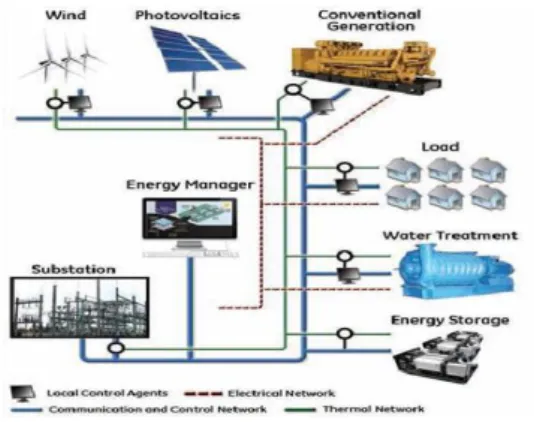
The Distributed Energy Resources (DES) are one of the power generations systems in small scale range they are renewable energy resources examples, are photovoltaic cell, wind energy generation system or hydro energy. Placing the microgrid concept near to the load centers have the advantage of improving efficiency by reducing the transmission line losses or voltage drops.
The increasing load demand, such as domestic and commercial appliances and loads, causes growing electricity consumption. In order to overcome this problems, this paper proposes the concept of micro grids. Generally, these micro grids are distributed energy sources. These DES sources are basically renewable energy sources such as photovoltaic or wind energy generation systems. The construction of these DES is generally a combination of generating sources, maximum power point tracking and inverters. This
type of micro-grid systems generate electrical power under normal or abnormal. However, power electronic based converters are proposed in this paper for controlling purpose.
Generally, harmonics and reactive power are two of the serious problems associated with the grid. They are caused by nonlinear loads, including saturated transformers, arc furnaces, and semiconductor switches. The presence of harmonics and reactive power in the grid is harmful, because it will cause additional power losses and malfunctions of the grid components [1]–[5]. To prevent the inflow of harmonic and reactive currents and to improve the operating ability of the transmission systems, a kind of Flexible AC Transmission System (FACTS) has been proposed [6]–[10]. The static var compensator (SVC) is an important component of FACTS.
The paper is organized as follows: Section 2 deals with distributed energy as a part of microgrid and it’s inter connection with main grid. Section 3 explains the unified power quality controller as a compensating device. Also given here are the fuzzy logic controller which includes the fuzzy membership functions and the rule base. Section 4 deals with simulation results. Section 5 concludes the paper with critical analysis of results of simulation.
2. GRID INTERFACING SYSTEM
In the present scenario, the integration of grid with the renewable energy sources such as photovoltaic system is the most important application. These advantages include the favorable incentives in many countries that impact straightforwardly on the commercial acceptance of grid connected PV systems. This condition imposes the necessity of having good quality designing tools and a way to accurately predict the dynamic performance of three-phase grid-connected PV systems under different operating conditions in order to make a sound decision on whether or not to incorporate this technology into the electric utility grid.
Figure 1. Microgrid Power System
2.1. Photovoltaic Cell
Photovoltaic energy system is one of the methods for generating electrical power by the direct conversion of solar irradiation into electrical energy using power semiconductor devices. These photovoltaic power generation systems consists of series and parallel connected solar cells. The power generated from the photovoltaic system is varied as changes occur in the input of solar panel i.e. sun radiation, in order to get maximum output at any instant of time.
With increasing commercial or domestic appliances such as sensitive or non-linear loads they cause the changes in the transmission system parameters such as voltage or current unbalances or harmonics in current and other power quality problems. In order to meet the requirement of power quality standards, it is necessary to use some sort of compensating techniques. Basically, from the first generation the reactive elements are used for compensating purposes. Later, a power electronics control based devices are implemented.
3. UNIFIED POWER QUALITY CONTROLLER
One of the compensating devices form the FACTS family, called Unified Power Quality Conditioner, is the efficient method improving of the power quality [4]. The Unified power quality controller is a combination of series and shunt controller separated by a common dc-link for exchanging reactive power.
A shunt device is one of the compensated equipment which is connected at the transmission system. This shunt compensated system has the capability of either absorbing or generating active power at the point of connection thereby controlling the voltage magnitude. Because the bus voltage magnitude can only be varied within certain limits, controlling the power flow in this way is limited and shunt devices mainly serve other purposes. A device that is connected in series with the transmission line is referred to as a ‘series device’. Series devices influence the impedance of transmission lines. The principle is to change (reduce or increase) the line impedance by inserting a reactor or capacitor. To compensate for the inductive voltage drop, a capacitor can be inserted in the line to reduce the line impedance.
The series compensated device is connected in series with the line for controlling the transmission parameters such as transmission impedance by controlling reactance, fluctuations in system voltage.
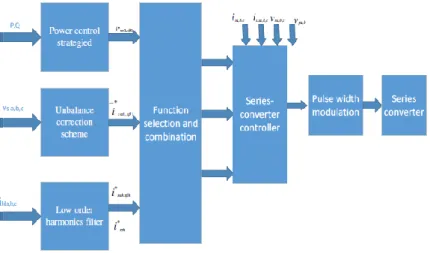
Figure 3. Block Diagram of Overall Control Structure with Series Converter
The series controller which is explained in the previous section is used for compensating the power quality problems. It is controlled with help of three phase converter. The gate pulses for this series converter are generated with the help of closed loop control diagram as shown in Figure 4. In this control technique, first the voltages are compared and the error obtained from this is converted to two phase orthogonal vectors. With the help of this vectors the pulses for the series converter are calculated.
3.1. Closed loop Control Diagram for Shunt Converter
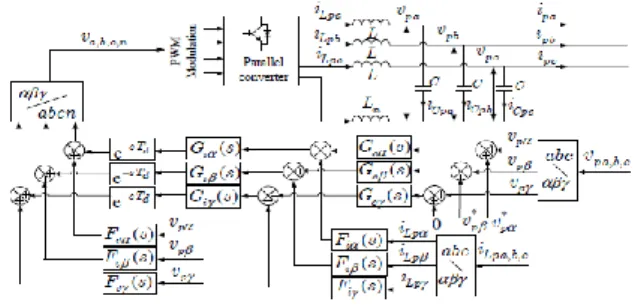
The closed loop control circuit of the shunt converter which is used for generating gate pulses for three phase voltage source converter is as shown in Figure 5 [6]. From this figure the reference vector currents are obtained by comparing the actual load currents with the current signals obtained from the PQ theory control diagram. Based on the error obtained from this concept, the gate triggering pulses are generated and given to the VSC of shunt converter.
Figure 4. Closed Loop Control Diagram for Shunt Converter.
Figure 5. Closed Loop Block Diagram for α
3.2. Fuzzy Inference System
The fuzzy logic controller is one of the advanced soft computing controller which is used for controlling the system output. As compared with the other conventional controllers, fuzzy logic controller has the advantage of fast computing, better response, low settling time and high running response. The fuzzy logic controller operation can be explained in mainly four ways i.e 1. Fuzzification, 2. Membership function, 3. Rule-base formation and 4. Defuzzification.
Figure 6. Block Diagram of Fuzzy Logic Controller
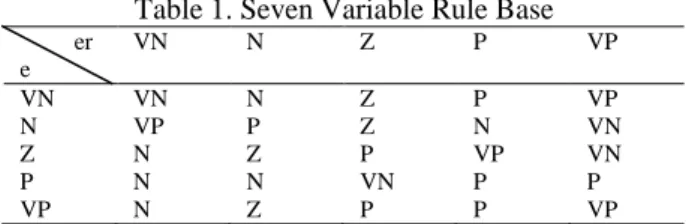
The basic block diagram for the fuzzy logic controller as shown in figure 6. The rule base taken for this system is shown below in Table 1. The input variables such as error and error rate are expressed in terms of fuzzy set with the linguistic terms VN, N, Z, P, and VP.
In this type of mamdani fuzzy inference system the linguistic terms are expressed using triangular membership functions.
Table 1. Seven Variable Rule Base er
e
VN N Z P VP
VN VN N Z P VP
N VP P Z N VN
Z N Z P VP VN
P N N VN P P
VP N Z P P VP
The inputs for the fuzzy system are represented as error and error rate and its rule base formations are shown in above table. The fuzzy rules are obtained with the statement of if-then statements. The given fuzzy inference system is a combination of two inputs and one output. These two inputs are related with the logical AND/OR operators. AND logic gives the output as minimum value of the two inputs and OR logic produces the output has maximum value of two inputs. I.e if the input1 is zero and input2 is zero then the output is zero.The membership function for the input error is as shown below.
Figure 7. Membership Function Representation for Input 1
Figure 8. Membership Function Representation for Input 2
The type of membership functions used here are Triangular type and the membership function range is -1 to 1 i.e., universe of discourse. The defuzzification is done by using Centroid method. The seven variable rule base consisting of 49 rules and are of If –Then type.
4. SIMULATION AND RESULTS
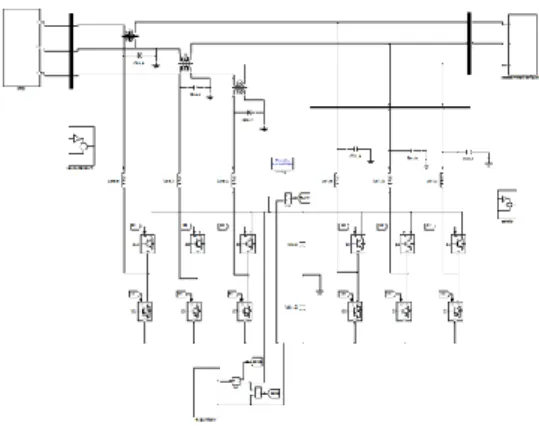
Figure 9. Simulation Implementation of Micro Grid with and without Fuzzy Controller.
In this paper the simulation is done for micro grid and the results are compared with two cases. Case 1: with PI Controller
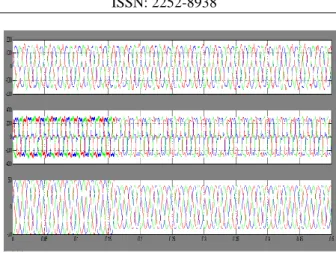
In this the conventional PI controller is used for series and shunt controllers. The obtained results are shown in below figures.
Figure 12. Simulation result for Grid, Series Converter and Micro-Grid Current
Figure 13. Simulation result for Active Power under Islanded condition
Figure 14. FFT Analysis
Case 2: with fuzzy controller:
5. CONCLUSION
This paper has successfully implemented the microgrid based unified power quality conditioner along with the fuzzy logic controller. Generally, the microgrid concept mainly concentrates on the reduction of transmission losses and the power quality problems associated with the system, the later are compensated by unified power quality controller. The fuzzy logic controller is used for getting better performance by the reduction of total harmonic distortion in the system.
The simulation results are obtained for the Grid interfacing using series and parallel converter system with conventional PI controller and Fuzzy logic controller. Due to the presence of non-linearity in the system, harmonics are produced which lead to voltage distortions. By using conventional PI controller in the system we can reduce these distortions. However, it is found, through the simulation results, that fuzzy logic controller can do better in mitigating harmonics in improving THD.
REFERENCES
[1] F Wang, JL Duarte, MAM Hendrix. Grid-Interfacing Converter Systems with Enhanced Voltage Quality for Microgrid Application Concept and Implementation. IEEE. 2011; 26(12).
[2] F Wang, JL Duarte, MAM Hendrix. Pliant active and reactive power control for grid-interactive converters under unbalanced voltage dips. IEEE Transactions on Power Electronics, in press, 2010; 26(5).
[3] H Farhangi. The path of the smart grid. IEEE Power Energy Mag., 2010; 8(1): 18-28.
[4] H Fujita, H Akagi. The unified power quality conditioner: the integration of series- and shunt-active filters. IEEE Trans. Power Electron. 1998; 13(2): 315-322.
[5] S Silva, PF Donoso-Garcia, PC Cortizo, PF Seixas. A three phase line-interactive ups system implementation with series-parallel active power-line conditioning capabilities. IEEE Trans. Ind. Appl., 2002; 38(6): 1581-1590. [6] B Han, B Bae, H Kim, S Baek. Combined operation of unified power-quality conditioner with distributed
generation. IEEE Trans. Power Delivery. 2006; 21(1): 330-338.
[7] H Tao. Integration of sustainable energy sources through power electronic converters in small distributed electricity generation systems. PhD dissertation, Eindhoven University of technology, 2008.
[8] JM Guerrero, LGD Vicuna, J Matas, M Castilla, J Miret. A wireless controller to enhance dynamic performance of parallel inverters in distributed generation systems. IEEE Trans. Power Electron. 2004; 19(5): 1205-1213.
[9] YW Li, CN Kao. An accurate power control strategies for power-electronic-interfaced distributed generation units operating in a low-voltage multi bus micro grid. IEEE Trans. Power Electron. 2009; 24(12): 2977-2988.
[10] F Wang, JL Duarte, MAM Hendrix. Reconfiguring grid interfacing converters for power quality improvement. in Proc. IEEE Benelux Young Researchers Symposium, in Electrical Power Engineering. 2008: 1-6.
[11] Sungwoo Bae, Alexis Kwasinski. Dynamic Modeling and Operation Strategy for a Microgrid with Wind and Photovoltaic Resources. IEEE TRANSACTIONS ON SMART GRID. 2012; 3(4).
[12] LH Tey, Member, IEEE, PLSo, Senior Member, IEEE, YC Chu, Member, IEEE Improvement of Power Quality Using Adaptive Shunt Active Filter. IEEE TRANSACTIONS ON POWER DELIVERY. 2005; 20(2).
BIOGRAPHY AUTHOR
Mr. Abdul Rasheed received his B.tech degree in Electrical and Electronics Engineering from Gudlavalleru Engineering College, Gudlavalleru and he is pursuing M.Tech degree in Power Systems from K.L.University Vaddeswaram, Guntur .His area of intrest are power system Protection, machines, renewable energy systems, Distribution Systems and FACTS Controllers.