Performance Characteristics of n-Butanol-Diesel Fuel
Blend Fired in a Turbo-Charged Compression Ignition
Engine
Lennox Siwale1, Lukács Kristóf2, Torok Adam2, Akos Bereczky2, Antal Penninger2, Makame Mbarawa3, Kolesnikov Andrei1
1
Department of Mechanical Engineering, Tshwane University of Technology, Private Bag X680, Pretoria, South Africa; 2Department of Energy Engineering, Budapest University of Technology and Economics, Budapest, Hungary; 3Ministry of Communication, Science and Technology, United Republic of Tanzania Department of Energy, Dar-es-Salaam, United Republic of Tanzania. Email: [email protected], [email protected], [email protected], [email protected],
[email protected], [email protected], [email protected] Received October 2013
ABSTRACT
In this study, n-butanol-diesel blends were burned in a turbo-charged, direct injection diesel engine where the brake thermal efficiency, (BTE) or brake specific fuel consumption, (BSFC) was compared with that of ethanol-diesel or me-thanol-diesel blends in another study by other authors. The test blends used were B5, B10 and B20 (where B5 is 5% n-butanol by volume and 95% diesel fuel-DF). In this study, the BTE was higher and the BSFC improved more than in the other study. Because of improved BTE with increasing brake mean effective pressure, BMEP, the BSFC reduced, however the increased shared volume of n-butanol in DF increased BSFC. Adding n-butanol in DF slightly derated the torque, brake power output with increasing speed, and caused a fall in exhaust gas temperatures, (EGT) which improves the volumetric efficiency and reduces compression work. Therefore, a small-shared volume of n-butanol in DF fired in a turbo-charged diesel engine performs better in terms of BTE and BSFC than that of ethanol or methanol blending in DF.
Keywords: Brake Specific Fuel Consumption; Brake Thermal Efficiency; Exhaust Gas Temperature; n-Butanol/Diesel
1. Introduction
The depletion, price uncertainty and negative effect of fossil fuels on the environment are some of the key is-sues that have led to a worldwide search or move to-wards alternative, renewable energy sources with lesser and greener emissions. The transport sector consumes about 58 percent of the primary energy consumption in the world. These fossil fuels which are becoming ex-hausted are the major contributors to greenhouse gas, (GHG) and climatic change [1]. The promising alterna-tive types of fuel for petroleum oil in transportation are biofuels. These are biodegradable and do not have the same negative effect as the petroleum based fuels on the environment. Oxygenated fuels such as alcohols are one of the biofuels that have attracted research for many years because they burn cleaner than fossil fuels [2]. The advantages of alcohol as a fuel includes the following [3]. Alcohols, (a) have a lower viscosity than diesel and so improve injection, atomisation and vaporisation of the charge,(b) have less emission to the environment than
compari-son of properties of n-butanol, ethanol with diesel is listed in Table 1 [13,14]. Rakopoulos et al. [10] conducted experiments on a hydra engine and found a higher brake specific fuel consumption, (BSFC) at low brake mean effective pressure (BMEP) than at high BMEP for all the fuels using the blends 8%, 16% and 24% of n-butanol in DF. The BSFC slightly decreases with increasing load for all the fuels whereas BSFC increases with retarded main injection timing using the blends 8% and 16% of n-butanol in DF [15]. The BSFC increases when main injection timing is retarded using isobutanol, ISB15 and ISB20. The brake thermal efficiency, (BTE), was similar for all the fuels and increased with increasing BMEP using blends 8% and 16% of n-butanol in DF. The BTE slightly improved at high speed for blends up to 10% isobutanol [16]. It can be observed from the preceding cited studies that it is not quite clear which blends, whether ethanol-diesel, methanol-diesel blends or n-bu- tanol-diesel blends would produce superior performance characteristics when burned in the compression ignition (CI) engine.
The purpose of this work was to evaluate the perfor-mance characteristics of the small volume ratios of n-bu-
tanol-in DF in a diesel engine and compare results with a similar study by other authors [3] who used ethanol-di- esel and methanol-diesel blends.
2. Methods and Materials
2.1. Experimental Set up
Figure 1 illustrates the engine layout for the experiments. The study was conducted on a four-cylinder piston, 1.91 L - 66 kw Turbo-Direct Injection (TDI) Volks Wagen diesel engine. This study is a continuation of the earlier study carried out by the authors on combustion [12]. A fixed electronic diesel control unit (EDU) was used to maintain stiochiometric engine performance. The diesel fuel, D2 was used as reference fuel. The test torque was varied from 100%, 75% and 50% to 25% of full load. The specifications of the measuring equipment used for the experiments are listed in Table 2. The engine was ran on steadystatecondition for about two minutes for every measuring point before recording values. Three blends were used namely: B5, B10, or B20, and reference fuel B0 (B0 is the reference diesel, D2.
[image:2.595.58.541.383.724.2]The blends were prepared on the same day using in-
Table 1. Properties of diesel, n-butanol and ethanol.
Fuel properties Diesel fuel n-butanol C4H9OH Ethanol C2H5OH
Density at 20 (˚C, kg/m3) 837 810 788
Cetane number 50 ~25 ~8
Lower calorific value, MJ/kg 43 33.1 26.8
Kinematic viscosity at 20˚C, mPas 3.4a 3.6b 1.52b
Boiling point ˚C 180-360 118 78
Latent heat of evaporation, kJ/kg 250 585 840
Oxygen, %wt. 0 21.6 34.8
Stoichiometric air-fuel ratio 15.0 11.2 9.0
Molecular weight 170 74 46
[image:2.595.173.421.409.718.2]Source [13,14]
Table 2. Data measuring equipment.
Eddy current dynamometer Type: FE350s-BORGHI and SAUERI
Pressure transducer Type: KISTLER KIAG 600
TDC and crank angle speed pick up Type: OPTICAL ENCODER HENGSTLER RI 32-0/1024.ER.14KA
Thermocouple Type K
Fuel measurement Type: AVL 7131-12
tank method with standard laboratory glassware. Operat-ing the engine for 20 to 30 minutes usOperat-ing the reference fuel (D2) warmed it up. The initial fuel in the tank and delivery system was nearly emptied before a new test fuel was fed into the fuel tank. The engine was ran on high load for a short period in order to speed up the re-moval of the fuel in the fuel delivery lines. The engine was ran using the test blend for another 20 minutes in order to stabilize the engine on the new test fuel.
The fuel mass-flow rate was measured using the AVL 7131-12 dynamic fuel consumption measuring equip-ment. The fuel balance works on the gravimetric mea-suring principle. This instrument enables the highest temperature stability of the fuel conditioning system with measuring accuracy of 0.12%; including self-calibration according to ISO 9001. Fuel is supplied to the engine from a measuring vessel the weight of which is conti-nuously measured.
The torque was measured by a Borghi and Saveri eddy current dynamometer, type FE-350S and the crank angle and speed were measured by an encoder or sensor (placed on the dynamometer shaft connected to the TDI diesel engine). The engine parameters are listed in Table 3.
2.2. Materials
The n-butanol fuel was manufactured by VWR Prolabo (BDH), of 99.99% purity, density of 809 kg/m3 (20˚C), molecular formula:C4H9OH, molecular mass: MW 74.12
kg/kmol, boiling point: 118˚C (at 101.3 kPa), melting point: −89.8˚C, and flash point: 30˚C. The type of DF used for the experiments was: D2, standard EN 590, CN: 51, sulphur content of ≤10 mg/kg; water content of ≤200 mg/kg; and kinematic viscosity of 2.00 to 4.5 (mm2/s) at 40˚C, specific density at 15˚C, ≥0.82; and flash point of >55˚C. The reference fuel was DF, (D2).
3. Results and Discussion
A study was conducted where a small-shared volume of ethanol with diesel (E5 and E10) was compared with methanol/diesel blends: M5, M10 (M5 is 5% by volume of methanol in DF). The test was based on a naturally aspirated engine with bore size of 98 mm and stroke 100 mm and compression ratio 17:1. [3]. The cited study is hence designated as study A.
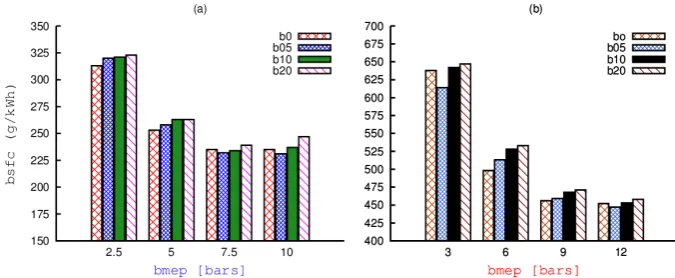
Figure 2 illustrates the effect of blends on BSFC. It is well established that the lower energy content of the al-
Table 3. Engine parameters.
Bore 79.5 [mm]
Stroke 95.5 [mm]
Compression ratio 19.5 -
Maximum Torque 202 [Nm]/1800 [rpm]
Maximum power 66 [kW]/4000 [rpm]
Fuel system:
Injector pump Distributor-type
(Bosh VP37)
Combustion chamber Bowl in piston
Injector type andpressure 5 hole, 180 [bars]
cohols increases the BSFC. Therefore, alcohols having a higher heating value than others will have a lower BSFC. For this reason, the minimum BSFC in study A was 298 g/kwh compared with 237 g/kwh in the current study where n-biutanol/diesel blends were used at 1500 RPM.
Figures 3(a) and (b) depict the BTE at speeds 1500 and at 3000 RPM respectively. The oxygenated fuels such as alcohols are well known to improve combustion when blended with DF because of the oxygen atoms attached to their structural composition. In order to determine which blends have a better performance with regards to thermal efficiency, the BTE between study A and this study were compared. The value of BTE in study A was in the range of: 0.22 to 0.28 for the speed range of 1000 to 1600 RPM. In the current study, the BTE fell into the range: 0.25 to 0.35 with 1500 RPM.
Figure 2. Brake specific fuel consumption (BSFC) vs. BMEP (a) at 1500 rpm (b) at 3000 rpm.
Figure 3. (a) Brake thermal efficiency (BTE) vs BMEP (a) at 1500 rpm (b) at 3000 rpm. viscosity and density, jet diameter or Sauter Mean
[image:4.595.126.472.261.393.2]Di-ameter (SMD), relative velocity of the jets and its sur-roundings and turbulence [18]. High viscosity of the liq-uid fuel, leads to poor atomisation and break-up, which increases the SMD and reduces the spray angle. The droplets reaching the surface of the cylinder wall can cause dilution of the lubricating oil [18]. This can reduce the friction torque by improving the lubricity around the piston rings during the compression stroke [17]. Howev-er, the spray of oxygenated fuel presents a finer droplet, a stronger interface between the fuel spray and the sur-rounding gas, and a more violent vortical motion. There-fore, the viscosity of the oxygenated fuels exerts a sig-nificant effect on the improvement of atomisation beha-vior [19]. This action causes a slightly improved BTE.
Figure 4 depicts the effect of the blends on torque and power as the speed is increased. The lowered power and torque with engines operating on n-butanol-diesel blends is attributed to changes to the heating value (which is lower than that of pure DF) brought about by the blends.
Another contributing factor is the control system. This determines the level of the fuel-control ring position, which changes depending upon the load applied to the engine. Algorithms used for the maps of the EDC are tailored for DF. When the fuel is changed, the EDC in-terprets that the fuel in use is diesel if not modified. The
[image:4.595.311.537.425.575.2]Figure 4).
Figures 5(a) and (b) illustrate the effect on the EGT, at 1500 and 3000 RPM respectively. Whereas the load (BMEP) caused EGT to increase, blends, which have a higher heat of evaporation than DF, lowered EGT through evaporative cooling. Therefore, the EGT using DF was higher than that of the blends. The lower EGT of the blends than DF contributes to increasing the volumetric efficiency and in turn reducing compression work during the compression stroke.
[image:5.595.130.468.420.554.2]Figures 6(a) and (b) illustrate the effect of the blends on manifold boost (air) pressure at 1500 and 3000 RPM. The boost (air) pressure level is a measure that helps to improve the BTE as the fuel-air ratio is reduced. Air pressure boosted in this way by the turbo-charged device at the intake side of the engine is not a parasitic work because the turbo-charged device as is well known is driven by the waste exhaust gas. Therefore, the volume-tric efficiency is again improved and the compression work (parasitic work of the engine) reduced. This con-sequently improves the BTE of the engine.
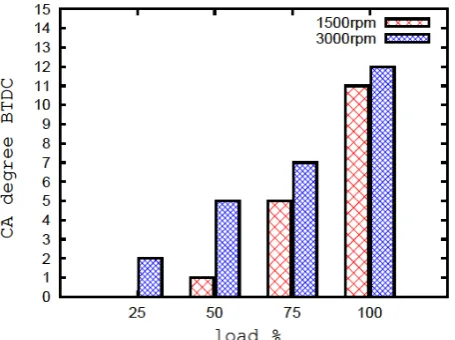
Figure 7 illustrates the effect of all the test fuels on the injection timing or start of injection (SOI) in the crank angle degrees, (CADs) with 1500 and 3000 RPM. The injection timing was more advanced at the speed of 3000 RPM than at the speed of 1500 RPM. This was expected, owing to the reduced (CADs) that the fuel mixture was
permitted to burn at high speed. However, the EDC re-tarded the timing of SOI on partial loads in order to match the operating conditions. The fuel-injection tim-ings of the blends and DF controlled by the EDC for dif-ferent speeds of 1500, 2500, 3000 and 3500 RPM were: 11˚ 11˚, 12˚ and 15˚ CAD before top dead centre (BTDC) respectively.
4. Conclusions
The purpose of this work was to compare the perfor-mance characteristics of small fractions (v/v) of n-buta- nol-diesel blends fired in a turbo-charged, direct injection diesel engine with a similar study by other authors using ethanol-and methanol-diesel blends.
• The BSFC was lower and BTE was higher in our study than in the other study.
• The reduction of exhaust gas temperature (EGT) im-proves the volumetric efficiency, which in turn re-duces the compression work during the compression stroke.
[image:5.595.130.469.583.719.2]• Applying small-shared volumes of n-butanol to diesel fuel improves the BTE and BSFC requiring no engine modification compared with that of ethanol-or me-thanol-diesel blends. The boost pressure improves brake thermal efficiency (BTE) whereas the start of injec-tion is retarded at low speed.
Figure 5. Exhaust gas temperature, (EGT) vs BMEP (a) at 1500 rpm and (b) at 3000 rpm.
Figure 7. Crank angle advance for start of injection (SOI) timing for DF and blends at different loads and speed.
5. Acknowledgements
The authors wish to acknowledge and are greatly indebted for the financial support: (UID 72384 and TÉT_10-1- 2011-0005) and facilitation by the joint research colla-boration between two Universities: Tshwane University of Technology, Pretoria, South Africa and Budapest Uni-versity of Technology and Economics, Budapest, Hun-gary, where the engine experiments were conducted in the laboratory facility, Jendrassik Gyorgy hotechnikai
Laboratorium in Budapest BME.
REFERENCES
[1] P. Singh and A. Singh., “Production of Liquid Biofuels from Renewable Sources,” Progress in Energy and Com- bustion Science, Vol. 37, 2011, pp. 52-68.
[2] D. Oguzhan, “The Influence of n-Butanol/Diesel Fuel Blends Utilization on a small Diesel engine Performance and Emissions,” Fuel, Vol. 90, No. 7, 2011, pp. 2467- 2472.
[3] C. Sayin, “Engine Performance and Exhaust Gas Emis- sions of Methanol and Ethanol-Diesel Blends,” Fuel, Vol. 89, No. 11, pp. 3410-3415.
[4] X. Gu, Z. Huang, S. Wu and Q. Li, “Laminar Burning Velocities and Flame Instabilities of Butanol Isomers-Air Mixtures,” Combustion and Flame, Vol. 157, No. 12, 2010, pp. 2318-2325.
[5] S. Szwaja and J. D. Naber, “Combustion of n-Butanol in a Spark-Ignition IC Engine,” Fuel, Vol. 89, No. 7, 2010, pp. 1573-1582.
[6] P. D’urre, “Fermentative Butanol Production Bulk Che- mical and Biofuel,” Annals of the New York Academy of Science, Vol. 1125, 2008, pp. 353-362.
[7] J. Dernotte, M. Rouselle, F. Halter and P. Seers, “Evalua- tion of Butanol-Gasoline Blends in a Port Fuel-Injection, Spark-Ignition Engine,” Oil Gas Science Technology. Re- view, Vol. 65, No. 2, 2010, pp. 345-351.
[8] M. D. M. Singliar, “Emerging Technologies for Second Generation of Biofuels,” MOL Scientific Magazine, SD and HSE special, 2008, pp. 67-80.
[9] W. Bryan, K. Kumar,Y. Zhang and J. Sung-chin., “Au- toignition of n-Butanol at Elevated Pressure and Low-to- Intermediate Temperature,” Combustion and Flame, 2011, Vol. 158, pp. 809-819.
[10] D. C. Rakopoulos, C. D. Rakopoulos, E. G. Giakoumis, A. M. Dimaratos and D. C. Kyritsis, “Effects of Butanol- Diesel Fuel Blends on the Performance and Emissions of a High-Speed DI Diesel Engine,” Energy Conversion and Management, Vol. 51, No. 10, 2010, pp. 1989-1997.
[11] C. Murat, F. Yuksel and H. Hus, “Emission Characteris- tics of a Converted Diesel Engine using Ethanol as Fuel,” Energy for Sustainable Development, Vol. 13, 2009, pp.
250-[12] L. Siwale, L. Kristóf, T. Adam, A. Bereczky; A. Pennin- ger, M. Mbarawa and A. Kolesnikov, “Combustion and Emission Characteristics of n-Butanol/Diesel Fuel Blend in a Turbo-Charged Compression Ignition Engine,” Fuel, Vol. 107, No. 2013, 2013, pp. 409-418.
[13] Y. Liu, W. Jiao and G. Qi, “Preparation and Properties of Methanol-Diesel Oil Emulsified Fuel under High-Gravity Environment,” Renewable Energy, Vol. 36, No. 5, 2011, pp. 1463-1468.
[14] S. Pukalskas, Z. Bodanovicius, V. Makareviciene, E. Send- zikiene and P. Janulis, “The Mixture of Biobutanol and Petrol for Otto Engines,” Transport, Vol. 24, No. 4, 2009, pp. 301-307.
[15] D. C. Rakopoulos, C. D. Rakopoulos, D. T. Hountalas, E. C. Kakaras, E. G. Giakoumis and R. G. Papagiannakis, “Investigation of the Performance and Emissions of Bus Engine Operating on Butanol/Diesel Fuel Blends,” Fuel, Vol. 89, No. 10, pp. 2781-2790.
[16] M. Yao, H. Wang, Z. Zheng and Y. Yue, “Experimental study of n-Butanol Additive and Multi-Injection on HD Diesel Engine Performance and Emissions,” Fuel, Vol. 89, No. 9, 2010, pp. 2191-2201.
[17] T. Kikuchi, I. Shinichiro and N. Yoshinori, “Piston Fric- tion Analysis Using a Direct-Injection Single-Cylinder Gasoline Engine,” Japan Society of Automotive Engineers, No. 1, 2003, pp. 53-58.
[image:6.595.61.289.86.256.2][19] Z. Wu, Z. Zhu and Z. Huang, “An Experimental Study on the Spray Structure of Oxygenated Fuel Using Laser- Based Visualization and Particle Image Velocimetry,”