Sharif University of Technology
Scientia IranicaTransactions E: Industrial Engineering www.scientiairanica.com
Merged automobile parts maintenance delivery problem
using an improved articial bee colony algorithm
B. Yao
a;, P. Hu
a, L. Yu
b, M. Zhang
aand J. Gao
aa. School of Automotive Engineering, Dalian University of Technology, Dalian, 116024, China.
b. School of International Trade and Commerce, Yanching Institute of Technology, 065201, Beijing, China. Received 28 November 2013; received in revised form 27 March 2014; accepted 29 September 2014
KEYWORDS Automobile maintenance parts delivery problem; Multi-depot vehicle routing problem; Voronoi diagram; Adaptive strategy; Articial bee colony algorithm;
Merged.
Abstract. The merged automobile parts maintenance delivery problem has attracted interest from merged companies due to reduced delivery costs by collaborative delivery between several automobile part depots. Since the delivery problem is very complex, a Voronoi diagram is adopted to simplify it by splitting customers into several sets, and by attempting to solve it using the articial bee colony algorithm. To improve the performance of the articial bee colony algorithm, an adaptive strategy is used to control the proportion of scouts and leaders. Finally, the computational results for 23 benchmark problems indicate that the proposed algorithm is an eective method for solving multi-depot vehicle routing problems. Furthermore, the results of the merged automobile parts maintenance delivery problem also indicate that the improved articial bee colony algorithm with the Voronoi diagram is feasible for solving this kind of delivery problem.
c
2015 Sharif University of Technology. All rights reserved.
1. Introduction
During recent years, the automotive industry has become conceivably the largest growth industry in China. Commensurate with this growth are increasing demands for automobile maintenance parts, like lubri-cating oils, antifreeze, transmission uids, coolants and so on, to assure the maintenance of automobiles after being sold. The increasing demands have caused many small suppliers for automobile parts maintenance to emerge. However, due to high oil prices, labor costs and erce competition, many small money-losing auto-mobile parts maintenance suppliers who cannot endure high operational costs will merge or go bankrupt. To nd outlets for their survival, a company merger is one major method for solving this problem.
Since distribution costs have become a signicant part of the operational costs of automobile parts maintenance suppliers, the term \merger", especially
*. Corresponding author. Tel./Fax: 86-411- 84706475 E-mail address: :[email protected] (B. Yao)
in the same kinds of enterprise, has a positive eect on achieving economy of scale, debt osetting or reduced business cyclicality. In the current situation, each sup-plier (depot) needs to serve these maintenance stations, respectively, to meet the requirements of automobile maintenance stations. Therefore, the merged company needs to consider how to serve the stations collabora-tively from these depots to minimize the total travelling and vehicle operating costs of distribution [1]. Thus, this paper endeavors to solve the merged automobile parts maintenance delivery problem.
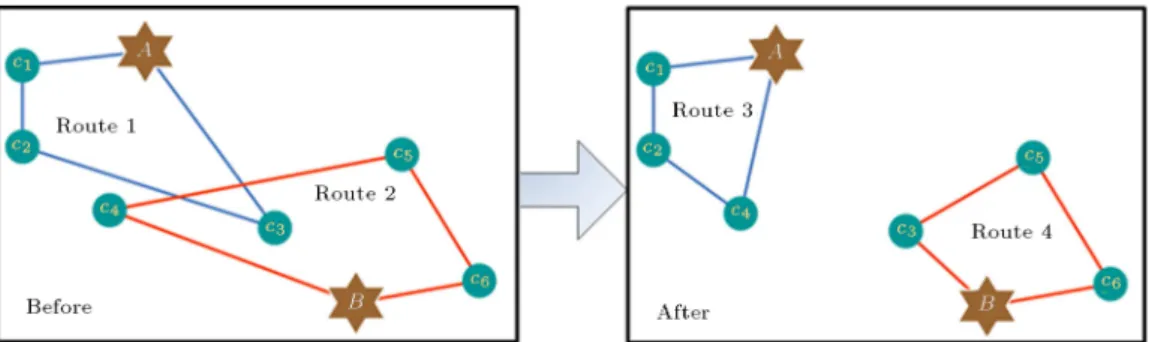
First, this paper seeks to describe the problem. There are several automobile parts maintenance depots to serve a set of automobile maintenance stations (customers), and thus the merged automobile parts maintenance delivery problem attempts to nd a set of minimum cost routes to deliver the automobile main-tenance parts from the automobile mainmain-tenance parts depots to a set of customers. In the merged automobile parts maintenance delivery problem, it is assumed that there are several depots to store the goods and deliver to a set of customers. Figure 1 describes the dierence
Figure 1. Comparison between the automobile maintenance delivery problems before and after company merger. between the automobile maintenance delivery problem,
before and after a company merger, based on a simple example.
In Figure 1, assume that there are two automobile maintenance depots (A and B), and six customers (c1,
c2, c3, c4, c5, c6). Originally, company A is responsible
for serving three customers (c1, c2, c3), while company
B is responsible for serving the other three customers (c4, c5, c6). The delivery routes (routes 1 and 2) can
be seen in Figure 1 (originally). When companies A and B are merged, the six customers are served by the two depots collaboratively. There may be new delivery routes (routes 3 and 4) acquired, which can be seen in Figure 1 (subsequently). From Figure 1, it is obvious that the length of route 3 + route 4 < route 1+ route 2. Therefore, the collaborative method can eectively reduce delivery costs. Thus, from a modeling viewpoint, the merged automobile parts maintenance delivery problem can be thought of as a Multi-Depot Vehicle Routing Problem (MDVRP).
The Multi-Depot Vehicle Routing Problem (MD-VRP) is an extension of the vehicle routing prob-lem and MDVRP is also a NP-hard probprob-lem. The heuristic algorithm is often the rst choice for solving complicated problems [2-15], and recently, there have been many heuristic algorithms to solve MDVRP. Cornillier et al. [16] proposed a procedure based on a heuristic process to solve the multi-depot petrol station replenishment problem with time windows. Mirabi et al. [17] presented a hybrid heuristics for solving the multi-depot vehicle routing problem, using hybrid heuristics, constructive heuristic searches and improvement techniques to improve the performance of the algorithm. Dondo and Cerda [18] attempted to solve the multi-depot vehicle routing problem using a time window with an improved algorithm. Yu et al. [19] aimed to solve the multi-depot vehicle routing problem using an improved ant colony optimization, where a coarse-grain parallel strategy, ant weight strategy and mutation operation are used to improve the searching ability of ant colony optimization. Ho et al. [20] attempted to solve the multi-depot routing problem with a hybrid genetic algorithm. The initial solutions of the algorithm are generated randomly in
one hybrid genetic algorithm and the initialization procedure is performed in the other hybrid genetic algorithm. Tu et al. [21] proposed a Voronoi diagram-based metaheuristic to solve the multi-depot vehicle routing problem. Luo et al. [22] aimed to solve the multi-depot vehicle routing problem using a shued frog leaping algorithm in which a power law extremal optimization neighborhood search is used to rectify the positions for all frogs. Rahimi-vahed et al. [23] proposed a path relinking algorithm to solve a multi-depot periodic vehicle routing problem; in the problem, vehicles were considered homogeneous. Yu et al. [24] used ant colony optimization for solving a dynamic multi-depot vehicle routing problem, and an ant-weight strategy and mutation operation were presented to improve the performance of ant colony optimization.
The Articial Bee Colony (ABC) algorithm sim-ulates the process of bees looking for nectar, and has proven to be a generally applicable technique for optimizing real-world problems [25,26]. As a relatively novel heuristic algorithm, the ABC algorithm has achieved success in solving a series of complex com-binational optimization algorithms. Szeto et al. [27] proposed an enhanced articial bee colony to solve the capacitated vehicle routing problem. Ozbakir et al. [28] successfully applied an articial bee colony algorithm to solve generalized assignment problems with an ejection chain neighborhood mechanism. Liu and Liu [29] presented a hybrid discrete articial bee colony algorithm to minimize the makespan in permu-tation owshop scheduling problems. Koudil et al. [30] attempted to use an articial bee colony algorithm to solve an integrated partitioning/scheduling problem in code sign. Other literature on the ABC algorithm can be found in [31,32,33]. These successful applications motivated us to apply the ABC algorithm to solve the merged automobile parts maintenance delivery problem in this paper.
Generally, the merged automobile parts mainte-nance delivery problem has been recognized as a MD-VRP, which is more complicated due to the embedded VRP. Thus, solving the merged automobile parts main-tenance delivery problem to optimality is extremely time-consuming, and it is necessary to simplify it to
at-tain optimization results in an acceptable time. There is a feasible way to change the merged automobile parts maintenance delivery problem into several one-depot merged automobile parts maintenance delivery problems, which can be thought of as VRPs. In this paper, the Voronoi diagram [34] is used to split customers into several sets by the depots. For each depot and its counterpart customer set, it may be considered as a sequence of VRPs. This can greatly reduce the computational complexity of the merged automobile parts maintenance delivery problem.
The focus of this paper is to solve a real-life delivery problem, the merged automobile parts main-tenance delivery problem, which can be thought of as a Multi-Depot Vehicle Routing Problem (MDVRP) from a modeling viewpoint. Due to the complexity of automobile maintenance, the Voronoi diagram is used to simplify this problem, and then, ABC, a relatively new meta-heuristic, is applied to solve it. Thus, the remainder of this paper is organized as follows. In Section 2, we describe the merged automobile parts maintenance delivery problem and how the Voronoi diagram is used to simplify it. Section 3 presents the ABC algorithm and some improved strategies. Some computational results are discussed in Section 4, and lastly, conclusions are provided in Section 5.
2. Problem description
Currently, most suppliers of automobile maintenance in a certain area are independent operators. As an independent operator, the company tends to manage a privately-owned motorcade to deliver the products, although it is ineective and unnecessary. It is obvious that the amalgamation of small or middle scale automobile maintenance companies would achieve economy of scale, debt osetting and reduced business cyclicality. The model of the merged automobile parts maintenance delivery is proposed based on advantages that would come with enterprise merger, and it could be concluded that in the long run, the model would help in the long-term healthy growth of the industry of automobile maintenance.
2.1. The merged automobile parts maintenance delivery problem
The merged automobile parts maintenance delivery problem is described as follows: There are M automo-bile maintenance part depots, each of which owns Ki
vehicles with the capacity of w (i = 1; :::; M), and all of which are responsible for services for n customers; the demands of customers i are qi (i = 1; :::; n), and
qi < w. The distance between two customers or
between customers and delivery points is described as the vertex set, C, which is partitioned into two subsets: Cd= fc1; :::; cHg is the set of automobile parts
maintenance depots, and Cc = fcH+1; :::; cH+Ng is the
set of customers, respectively. The distance matrix is a real symmetric one, satisfying the triangle inequality principle, that is cik cij+ cjk. Each customer can be
served by only one vehicle from any depot. Each vehicle can serve several customers whose demands must not overpass the transportation capacity of this vehicle. All vehicles start from one automobile parts maintenance depot, which it must return to.
Thus, the model of the merged automobile parts maintenance delivery problem is described as follows:
Min X X X XCijxmkij ; (1)
s:t: 8 > > > > > > > > > > > > > > > > > > > > > > > > > > > > > > > > > > > > > > > > > > < > > > > > > > > > > > > > > > > > > > > > > > > > > > > > > > > > > > > > > > > > > :
PKm
k=1
PN
j=1xmkij Km for
i = m 2 fN + 1 + N + 2; :::; N + Mg (1a) PN
j=1xmkij =PNj=1xmkji 1 for
i = m 2 fN + 1; N + 2; :::; N + Mg;
k 2 f1; 2; :::; kmg (1b)
PN+M
j=1
PM
m=1
PKm
k=1xmkij = 1 for
i 2 f1; :::; Ng (1c)
PN+M
j=1
PM
m=1
PKm
k=1xmkij = 1 for
j =2 f1; :::; Ng (1d)
PN
i=1qiPN+Mj=1 xmkij qmk for
m 2 fN + 1; N + 2; :::; N + Mg;
k 2 f1; 2; :::; kmg (1e)
PN+M
j=N+1xmkji =PN+Mj=N+1xmkij = 0 for
i = m 2 fN + 1; N + 2; :::; N + Mg;
k 2 f1; 2; :::; kmg (1f)
where: xmk ij = 8 > < > :
1 the link from customer i to j is visited by vehicle k from depot m 0 otherwise
Cij in formula (1) stands for the costs from customer
i to j; in this paper, it is the delivery distance from customer i to j; k is the number of vehicles; m is the number of automobile parts maintenance depots; qmk
is the capacity of vehicle k from depot m; Km is the
maximum number of vehicles at depot m; and km is
vehicle k from depot m.
The objective of the merged automobile parts maintenance delivery problem is to minimize the total delivery distance or time spent in serving all customers, while meeting the following constraints: Constraint
Figure 2. An example of the merged automobile maintenance part delivery problem.
(1a) ensures the maximum number of vehicles. Con-straint (1b) makes sure that each vehicle starts and ends at the same depot. Constraint (1c) and (1d) assumes that each customer can be served exactly once by one vehicle. Constraint (1e) assumes that the quantity of goods in a vehicle cannot exceed its capacity. Constraint (1f) guarantees that there are no connections between these depots.
The merged automobile maintenance parts de-livery problem can be described as in Figure 2. As shown, it is similar to a multi-depot vehicle routing problem. In the problem, the customers that are known in advance are represented by blue circles, while the brown stars represent depots. The objective of the merged automobile parts maintenance delivery problem is to nd the least number of routes to deliver goods from several depots to these customers.
2.2. Simplication of merged automobile parts maintenance delivery problem with
Voronoi diagrams
In the merged automobile parts maintenance delivery problem, the number of depots and customers is more complex than classical VRP, and thus, it is extremely time consuming for solving it to optimality. To simplify the problem eciently, it is usual to divide the customers belonging to one depot and, thus, MDVRP becomes several VRPs.
The Voronoi diagram is a simple mathematical construction and one of the most important branches in computational geometry. A usual generic denition of the Voronoi diagram can be described as follows. Let S denote a set of n points (called sites) in the plane. The Voronoi cell V (p) of p is the set of points that is closer (or equal) to p than to other sites of S.
The Voronoi diagram has been much studied in the past two decades by practitioners of computational geometry, and it has been proven useful in elds as diverse as associative le searching, cluster analysis,
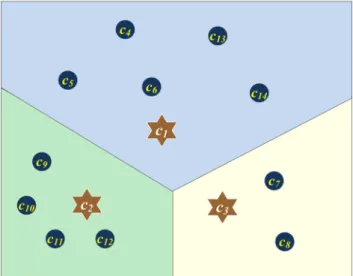
Figure 3. Voronoi diagram for simplifying the merged automobile maintenance part delivery problem.
scheduling record accesses and collision detection [34]. Burge and Monagan [35] applied a Voronoi diagram to extract words and symbols from map images.
These successful applications of the Voronoi dia-gram motivate our use of it in simplifying the merged automobile parts maintenance delivery problem. An example of simplication is presented in Figure 3. As shown, there are three sites where the depots are used to split customers. Thus, the merged automobile parts maintenance delivery problem is partitioned into three Voronoi cells. Each Voronoi cell is then regarded as a VRP.
3. Improved articial bee colony algorithm 3.1. The traditional articial bee colony
algorithm
The articial bee colony algorithm is a new population-based metaheuristic approach which simulates the pro-cess of bees gathering honey [31]. The bee population is classied into three categories: scouts, leaders and on-lookers. The searching activities of the ABC algorithm can be summed up as follows: When the leader nds a new food resource located in their neighborhood, they return to the hive to inform the onlookers by dancing. The onlookers will search for the new food resource in their neighborhood of the selected resource. Those leaders who have abandoned the food resource will become scouts and begin to look for a new food resource randomly.
In the ABC algorithm, each food resource position represents a possible solution of the optimization prob-lem, and the amount of honey in each food resource corresponds to the tness of each solution. Firstly, the ABC algorithm will produce SN original solutions randomly, which means SN honey bees and food resources. Each solution, named xi (i = 1; 2; :::; SN),
is a D dimensional vector, and D is the number of optimization parameters. After initialization, the leaders begin to conduct a cyclical search for all the original solutions. During each search, every leader looks for a food source in the neighborhood and decides its tness. If the tness of the new food resource is better than the original food resource, the leader will replace the old one with it; otherwise, it will retain the old food source. When all the leaders have nished their searching tasks and return to the hive, they share the information of the food resources with onlookers. Onlookers select a food source according to its tness. The probability, pi, of selecting a food source, i, is
determined by the following expression [7,34]: pi= PfSNi
n=1
fn; (2)
where, fi is the tness of the food resource position,
1 i SN.
In order to produce a competitive food position compared with the old position, the ABC algorithm uses the following expression:
vi= xi+ i(xi xk); (3)
where, i is a parameter which is a random number
in the range of [-1,1]. It can control the new solution falling in an acceptable range. Then, the tness of the new solution is compared with the old. If the new tness is better than the old, then, abandon the original food source and choose the new food source into the next iteration. If the new tness is worse than the old, then, reserve the original food source.
If the food source cannot be improved after a limited number of cycles, it will be abandoned. The leaders of this food source will turn into scouts. The operation wherein scouts nd a new food source and replace the original, xi, is as follows:
xi= xmin+ rand(0; 1)(xmax xmin): (4)
The specic steps of the ABC algorithm are as follows:
Step 1. Generating the initial solution set, i = 1; 2; :::; N, j 2 (1; 2; :::; D).
Step 2. Calculating the tness of each solution.
Step 3. The initial value of the external circulation, m = 1.
Step 4. The initial value of the internal circulation, l = 1.
Step 5. The leading bee searches for new solutions in the neighborhood based on Eq. (3) and calculates the tness of the new solution.
Step 6. If the tness of the new solution is better than that of the old, then the new solution replaces it, otherwise, the old solution will be retained.
Step 7. Calculating the tness, then, probability pi
can be acquired based on Eq. (2).
Step 8. The following bees select food resource i (solution i), according to probability pi, then
search for new solutions in the neighborhood based on Eq. (2), and calculate the tness of the new solution.
Step 9. Update the old solutions as that in Step 6, and then turn to Step 7.
Step 10. After all the bees nish the searching tasks, the best solution has been acquired.
Step 11. l = l + 1.
Step 12. m = m + 1.
Step 13. If l < L (the maximum iteration in the internal circulation), then, turn to Step 5.
Step 14. After L iterations in the internal circulation, judge whether there is a solution to be aban-doned or not. If true, a new solution, found by the scout based on Eq. (3), will replace the old.
Step 15. If m < M (the maximum of times in the external circulation), then turn to Step 4. 3.2. Adaptive strategies
In the ABC algorithm, PScout is the ratio of scouts
in the bee colony, which plays an important role in the search process of the ABC algorithm. If the value of PScout is higher, it will widen the search space of
the ABC algorithm, but also take more computation time. PLeaderstands for the proportion of leading bees,
which is also a signicant parameter in controlling the convergence of the ABC algorithm. If the value of PLeader is higher, it will enhance the search speed, but
easily lead to local optimum.
Generally speaking, PScout with a larger value
would lead to the ABC algorithm searching in a large space early in the iterations. In the later iterations, PScout with a smaller value would lead to the ABC
algorithm carefully searching for new solutions in a small space. PLeaderwith a smaller value would help the
ABC algorithm exploit more search space in the early iterations. In the later iterations, PLeaderwith a larger
value would speed up the search for a new solution in the population. Thus, an adaptive strategy is proposed in this paper to improve the search ability of the ABC algorithm. This strategy ensures that PScout
and PLeader of the ABC algorithm can be adjusted,
adaptively, with the searching process, based on the following formula:
PScout= PScout0 N
X
k=1
(fmax f)
(fmax f)
[(t2)=N]+1
PLeader= PLeader0 + N
X
k=1
jf fj (fmax f)
[(t2)=N]+1
; (6) where, fmax and f represent the best tness and
the average tness, respectively, f is the tness of the current solution. The initial values of PScout
and PLeader are PScout0 and PLeader0 , respectively. t
stands for the number of the current iteration of the algorithm and N represents the maximum iteration of the algorithm.
4. Numerical analysis
This paper attempts to use an improved ABC to solve a real-life delivery problem, which is the merged automobile parts maintenance delivery problem. Since there are several depots in this delivery problem, for comparison, some well-known benchmark problems of MDVRP were applied to examine the feasibility and performance of the Improved ABC algorithm (IABC). Then, the IABC is used to solve the merged automobile parts maintenance delivery problem. The following will describe the two examples, respectively.
4.1. The classical MDVRP
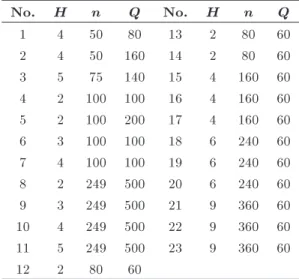
In order to examine the performance of the proposed IABC in this paper, the benchmark problems of MD-VRP from the literature [36-38] are selected. The main characteristics of these test problems are summarized in Table 1.
In this paper, VC++.NET 2003 is used to achieve the IABC, and the operating environment is a Pentium IV 2.93 GHz processor and 3 GB for the Windows platform. The large number of experiments to de-termine the parameters is as follows: The number of food sources is 50, the amount of population is 100 (half the bees are leaders and the remainder are onlookers), the maximum iteration is 1000, P0
Scout =
Table 1. The information of the test problems.
No. H n Q No. H n Q
1 4 50 80 13 2 80 60
2 4 50 160 14 2 80 60
3 5 75 140 15 4 160 60
4 2 100 100 16 4 160 60
5 2 100 200 17 4 160 60
6 3 100 100 18 6 240 60
7 4 100 100 19 6 240 60
8 2 249 500 20 6 240 60
9 3 249 500 21 9 360 60
10 4 249 500 22 9 360 60
11 5 249 500 23 9 360 60
12 2 80 60
0.5 and P0
Leader = 0.5. In order to test the performance
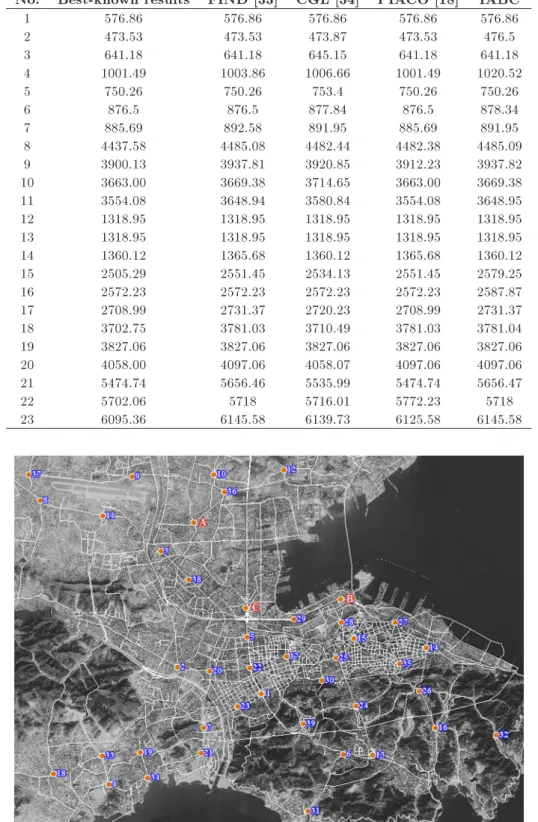
of the algorithm, the results of the proposed IABC algorithm are compared with the FIND algorithm [39], the CGL method [40] and PIACO [18]. These in-stances and the best known solutions are available at http://www.bernabe.dorronsoro.es/vrp/. Table 2 shows the results of these algorithms for solving the MDVRP.
From Table 2, it can be found that most results of the IABC algorithm are close to well-known best solutions. Even several solutions are better than the best solutions among these algorithms. The results indicate that the IABC algorithm is suitable for solving MDVRP.
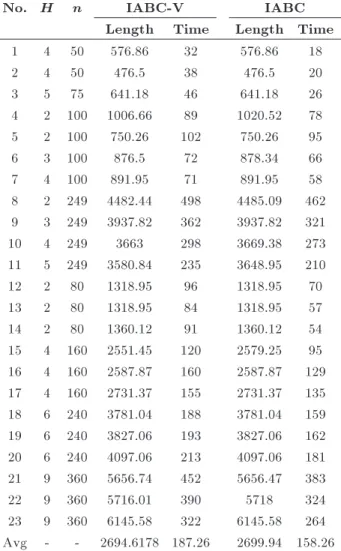
To evaluate the performance of the Voronoi dia-gram proposed in this paper, the computational results of the IABC without Voronoi (IABC-V) compared with IABC are shown in Table 3.
It can be observed from Table 3 that the solutions and computation times of the two algorithms are almost the same for solving some simple problems, such as test problems 1, 2, 3. However, with the larger number of depots or customers of the test problems, the computational results and times of the two algorithms are obviously dierent. Compared with the IABC-V, it can be seen that the Voronoi diagram can greatly reduce computation time. However, it also worsens the quality of the solutions. Based on the results in Table 3, it can be attained that the computation time can be reduced by 78%, respectively. At the same time, the quality of the solutions can be worsened by 1%, respectively.
Since, in a real-life delivery route problem, cus-tomers cannot wait for service for any length of time, the real-time feature in MDVRP is very important. Therefore, the computation time and quality of the solution should be considered simultaneously. To further validate the performance of the IABC, we add a bound in IABC and IABC-V, where each time step cannot exceed 200s of processing time. If the algorithm cannot complete its searching in the bound, the best solutions found in the 200s are noted in Table 4.
It can be observed from Table 4 that the solution quality of IABC-V obviously descends under the 200s constraint. This indicates that IABC-V is not suitable for a real-life multi-depot delivery route problem in a relatively smaller time constraint. Meanwhile, it can be observed that IABC can gain most optimum solutions. Therefore, this is expected that incorporation of the adaptive strategy for ABC and the Voronoi diagram can ensure better optimization.
4.2. The merged automobile parts maintenance delivery problem
The IABC algorithm is veried by the benchmark problem of the classical MDVRP, which shows that
Table 2. Computational results using IABC algorithm and some well-known published results. No. Best-known results FIND [33] CGL [34] PIACO [18] IABC
1 576.86 576.86 576.86 576.86 576.86
2 473.53 473.53 473.87 473.53 476.5
3 641.18 641.18 645.15 641.18 641.18
4 1001.49 1003.86 1006.66 1001.49 1020.52
5 750.26 750.26 753.4 750.26 750.26
6 876.5 876.5 877.84 876.5 878.34
7 885.69 892.58 891.95 885.69 891.95
8 4437.58 4485.08 4482.44 4482.38 4485.09
9 3900.13 3937.81 3920.85 3912.23 3937.82
10 3663.00 3669.38 3714.65 3663.00 3669.38
11 3554.08 3648.94 3580.84 3554.08 3648.95
12 1318.95 1318.95 1318.95 1318.95 1318.95
13 1318.95 1318.95 1318.95 1318.95 1318.95
14 1360.12 1365.68 1360.12 1365.68 1360.12
15 2505.29 2551.45 2534.13 2551.45 2579.25
16 2572.23 2572.23 2572.23 2572.23 2587.87
17 2708.99 2731.37 2720.23 2708.99 2731.37
18 3702.75 3781.03 3710.49 3781.03 3781.04
19 3827.06 3827.06 3827.06 3827.06 3827.06
20 4058.00 4097.06 4058.07 4097.06 4097.06
21 5474.74 5656.46 5535.99 5474.74 5656.47
22 5702.06 5718 5716.01 5772.23 5718
23 6095.36 6145.58 6139.73 6125.58 6145.58
Figure 4. The location information of the merged automobile maintenance part delivery problem. IABC is suitable for solving MDVRP. Then, a real-life
problem is needed to be solved by the IABC algorithm. In the real-life routing problem, a road network is used to suggest the length of vehicle routing, and the least cost is the optimized objective of any network. Thus, vehicle capacity is 200 for a real-life delivery problem.
Information regarding a real-life delivery route problem with the spatial characteristics of Dalian is described in Figure 4. Specic information of automobile parts maintenance depots and the automobile maintenance stations is shown in Tables 5 and 6, respectively. From Figure 4, there is a merged automobile parts
Table 3. Comparison results between IABC-V and IABC
No. H n IABC-V IABC
Length Time Length Time
1 4 50 576.86 32 576.86 18
2 4 50 476.5 38 476.5 20
3 5 75 641.18 46 641.18 26
4 2 100 1006.66 89 1020.52 78
5 2 100 750.26 102 750.26 95
6 3 100 876.5 72 878.34 66
7 4 100 891.95 71 891.95 58
8 2 249 4482.44 498 4485.09 462 9 3 249 3937.82 362 3937.82 321
10 4 249 3663 298 3669.38 273
11 5 249 3580.84 235 3648.95 210
12 2 80 1318.95 96 1318.95 70
13 2 80 1318.95 84 1318.95 57
14 2 80 1360.12 91 1360.12 54
15 4 160 2551.45 120 2579.25 95 16 4 160 2587.87 160 2587.87 129 17 4 160 2731.37 155 2731.37 135 18 6 240 3781.04 188 3781.04 159 19 6 240 3827.06 193 3827.06 162 20 6 240 4097.06 213 4097.06 181 21 9 360 5656.74 452 5656.47 383
22 9 360 5716.01 390 5718 324
23 9 360 6145.58 322 6145.58 264 Avg - - 2694.6178 187.26 2699.94 158.26 maintenance delivery problem, where there are sev-eral automobile maintenance parts depots and some maintenance stations in Dalian city. The problem is how to send the automobile maintenance parts to the maintenance stations with the least delivery cost.
As shown in Figure 4, the letters (A, B and C) stand for three automobile maintenance parts depots in Dalian, and the numbers (1, 2,..., 39) represents the thirty-nine automobile maintenance stations in Dalian. 4.2.1. The process of distance matrix construction
based on road networks
As is the case in practice, the distance traveled by vehicles should be measured based on the road network. Thus, a method is adopted to measure actual distance and transfer it to the distance matrix. Figure 5(a) describes the \initial" scenario of an example with three points on the route network. There are three points selected: point A, point 3, and point 38, and we attempt to acquire the distance matrix based on a real road network. The following will describe the process of how to transfer the actual route distances into rectilinear distances.
Table 4. Comparison results between IABC-V and IABC in the time constraint (200s).
No. H n IABC-V IABC
Length Time Length Time
1 4 50 576.86 32 576.86 18
2 4 50 476.5 38 476.5 20
3 5 75 641.18 46 641.18 26
4 2 100 1020.52 89 1020.52 78
5 2 100 750.26 102 750.26 95
6 3 100 876.5 72 878.34 66
7 4 100 891.95 71 891.95 58
8 2 249 5571.2 200 4511.6 200 9 3 249 6122.4 200 4284.62 200 10 4 249 5987.6 200 3815.6 200
11 5 249 6058.9 200 3733 200
12 2 80 1318.95 96 1318.95 70 13 2 80 1318.95 84 1318.95 57 14 2 80 1360.12 91 1360.12 54 15 4 160 3092.99 120 2579.25 95 16 4 160 3299.43 160 2587.87 129 17 4 160 3310.4 155 2731.37 135 18 6 240 5012.7 188 3781.04 159 19 6 240 5034.9 193 3827.06 162 20 6 240 5443.21 200 4097.06 181 21 9 360 6712.24 200 5791.5 200 22 9 360 6533.14 200 5857.3 200 23 9 360 7465.3 200 6494.6 200 Avg - - 3429.4 136.39 2753.28 121.87 Table 5. The information of automobile part suppliers.
Depots A B C
Longitude 121.578 121.637 121.6 Latitude 38.959 38.9337 38.932
Vehicle number 3 3 3
Firstly, the route distance between two points should be calculated. For example, if there are two routes from point A to point 3, to calculate these distances, the shortest route length is considered the route length between point A and point 3 (Figure 5(b) shows the road routes between these two points). If there are two routes (red and yellow lines, respectively) between point A and point 3, it is necessary to determine the true routes rst. Since the length of the yellow line between point A and point 3 is less than that of the red line, the length of the yellow line is considered the route length between point A and point 3.
Secondly, based on the route length between point A and point 3, the rectilinear distance between them can be attained by moving point 3 to point 30. While
Figure 5. The construction of the distance matrix based on road network.
meeting, the rectilinear distance between point A and point 30 is equal to the actual route length between
point A and point B (see Figure 5(c)). Thus, the rectilinear distance between point A and point 30 can
represent the route length between point A and point 3. In the same way, the rectilinear distance between point A and point 380can represent the route length between
point A and point 38 (see Figure 5(c)). Therefore, the
Figure 6. Computing the results of IABC after running 10 times.
distance matrix based on a real road network can be attained based on this method.
Thirdly, when point 30 represents point 3, one
should measure the rectilinear distance between point A and point 30, and when point 380 represents point
38, one should measure the rectilinear distance between point A and point 380. In the same way, the rectilinear
distance between lots of points based on real road networks can be attained correspondingly. Figure 5 shows the process of the method to transfer actual distance into a symmetric distance matrix.
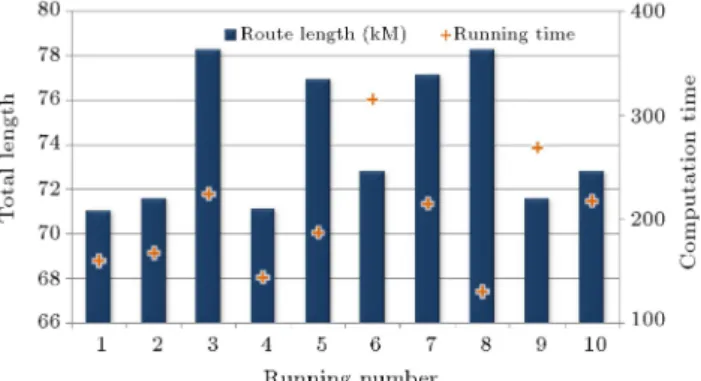
4.2.2. The computational results of a real-life merged automobile parts maintenance delivery problem The IABC will continue calculating 10 times, and the results are shown in Figure 6. We can see that the results are very stable, and the dierence between the optimum and the worst plan is less than 10%, which shows that this algorithm has excellent convergence performance. Meanwhile, the computing time, from 130 to 320 seconds, is relatively short for a real-life problem. An understanding of the optimization quality and computing time of this algorithm shows that the proposed IABC can solve the automobile maintenance parts supply delivery problem in optimizing delivery routes for automobile maintenance part supply services to maintenance stations in Dalian city. The length of the routes is 70.97 kM and the optimized routes are shown in Figure 7.
From Figure 7, it can be observed that the optimization results of the distribution routes can result in more customers and the positions of customers seem to be highly concentrated. This is because the automobile maintenance parts delivery formulation can assign tasks collaboratively to acquire the least delivery routes. The results also prove that the automobile maintenance parts delivery formulation is feasible and the improved ABC is an eective measure to optimize the merged automobile parts maintenance delivery problem.
To examine the eectiveness of the proposed method in this paper, the solution of the current
Table 6. The information of the automobile maintenance stations in Dalian.
Customers 1 2 3 4 5 6 7 8
Longitude 38.9072 38.9118 38.9489 38.876 38.9224 38.884 38.8939 38.9679 Latitude 121.608 121.574 121.567 121.548 121.601 121.639 121.584 121.519
Demand 10 24 20 12 10 12 10 38
Customers 9 10 11 12 13 14 15 16
Longitude 38.9742 38.9796 38.9633 38.9758 38.8846 38.9184 38.9212 38.8919 Latitude 121.557 121.587 121.546 121.612 121.651 121.674 121.642 121.676
Demand 18 80 50 50 24 36 20 30
Customers 17 18 19 20 21 22 23 24
Longitude 38.9156 38.8772 38.8846 38.9109 38.885 38.9124 38.9008 38.8987 Latitude 121.616 121.527 121.56 121.587 121.584 121.601 121.599 121.644
Demand 16 18 16 18 22 10 15 15
Customers 25 26 27 28 29 30 31 32
Longitude 38.9149 38.9055 38.9263 38.9264 38.9276 38.9089 38.8646 38.8872 Latitude 121.636 121.666 121.658 121.638 121.619 121.63 121.626 121.7
Demand 15 60 30 20 28 20 16 18
Customers 33 34 35 36 37 38 39
Longitude 38.8837 38.8766 38.9148 38.9687 38.9755 38.9404 38.8936 Latitude 121.546 121.564 121.66 121.59 121.513 121.577 121.623
Demand 20 13 20 60 22 40 10
Figure 7. Distribution routes of the merged automobile maintenance part delivery problem based on ABC. situation (before company merger) is compared with
the optimized solution of the proposed method, which can be seen in Table 7.
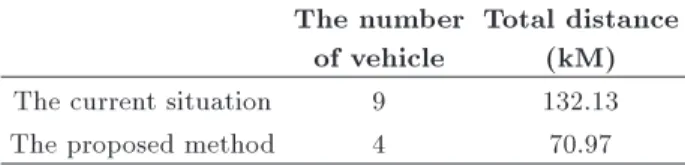
From Table 7, it can be found that the total distance from the current situation is obviously longer
than that of the proposed model. This is because the proposed delivery routing model can provide a new way for solving the delivery problem simultaneously, which can greatly shorten delivery routes and complete deliveries. Furthermore, the number of vehicles is
Table 7. The number of vehicles and the total distance between the current situation and the proposed method.
The number of vehicle
Total distance (kM) The current situation 9 132.13
The proposed method 4 70.97
obviously less than that of the current situation. This is because, in the current situation, each company needs to serve its customers, respectively. In this situation, to meet customer demands, each vehicle is often with a partly empty container, which greatly wastes the xed costs of retaining vehicles. Therefore, our proposed method is eective and the improved ABC is an eective method to solve the merged automobile parts maintenance delivery problem.
5. Discussion and conclusion
The results show that the merged automobile parts maintenance delivery problem proposed in this paper can eectively integrate with several smaller companies to keep their competitiveness in the market by reducing delivery costs. As expected, the use of the Voronoi dia-gram and the improved articial bee colony algorithm could eectively reduce the complexity and increase the application availability of large scale MDVRP, especially the MDVRP problem that requires a fast solution. However, the model can eectively reduce delivery costs after company merger. It will also bring some problems, like prot assignment, between these sub-companies. Moreover, the transportation cost only corresponds to transportation distance. In fact, under real-life conditions, transportation costs would be related to trac conditions (time-of-day, weather and so on). Further study may consider other aspects of real-life problems, in order to enhance the performance of the proposed methods.
Therefore, the objective of the merged automobile parts maintenance delivery problem is to minimize total delivery distance in serving all maintenance sta-tions in the city. Since the merged automobile parts maintenance delivery problem is dicult to solve, in this paper, the Voronoi diagram is rstly used to split maintenance stations into several sets using automobile maintenance parts depots. Then, an ABC is presented to solve the multi-depot automobile parts maintenance supply delivery problem. To improve the performance, an adaptive method is used. The computational results of the benchmark problems suggest that the proposed adaptive ABC is eective for solving MD-VRP. Implementation of the multi-depot automobile parts maintenance supply delivery problem, in the design of delivery routes for several automobile parts maintenance depots to serve some service stations in
Dalian, can provide suitable results. Therefore, the proposed adaptive ABC can be considered an eective method for the merged automobile parts maintenance delivery problem.
Acknowledgment
This work was supported by the National Natural Science Foundation of China, 51208079 and 11272075, Ministry of Housing and Urban-Rural Development, K520136, and the Fundamental Research Funds for Central Universities, 3013-852019.
References
1. Yao, B.Z., Hu, P. and Yang, S. \An improved par-ticle swarm optimization for the automobile spare part warehouse location problem", Mathematical Problems in Engineering, (2013). http://dx.doi.org /10.1155/2013/726194.
2. Chen, B.Y., Lam, W.H.K., Sumalee, A. and Li, Z.L. \Reliable shortest path nding in stochastic networks with spatial correlated link travel times", International Journal of Geographical Information Science, 26, pp. 365-386 (2012).
3. Chen, B.Y., Lam, W.H.K., Sumalee, A., Li, Q.Q., Shao, H. and Fang, Z.X. \Finding reliable shortest paths in road networks under uncertainty", Networks & Spatial Economics, 13, pp. 123-148 (2013).
4. Chen, B.Y., Lam, W.H.K., Li, Q.Q., Sumalee, A. and Yan, K. \Shortest path nding problem in stochastic time-dependent road networks with stochastic rst-in-rst-out property", IEEE Transactions on Intelligent Transportation Systems, 14(4), pp.1907-1917 (2013).
5. Chen, G., Govindan, K. and Yang, Z.Z. \Managing truck arrivals with time windows to alleviate gate con-gestion at container terminals", International Journal of Production Economics, 141(1), pp. 179-188 (2012).
6. Yao, B.Z., Yao, J.B., Zhang, M.H. and Yu, L. \Im-proved support vector machine regression in multi-step-ahead prediction for rock displacement surround-ing a tunnel", Scientia Iranica, 21(4), pp. 1309-1316 (2014).
7. Yao, B.Z., Hu, P., Zhang, M.H. and Wang, S. \Arti-cial bee colony algorithm with scanning strategy for periodic vehicle routing problem", Simulation (6), pp. 762-770 (2013).
8. Yao, B.Z., Yang, C.Y. and Yao, J.B. \Tunnel surround-ing rock displacement prediction ussurround-ing support vector machine", International Journal of Computational In-telligence Systems, 3(6), pp. 843-852 (2010).
9. Yu, B., Lam, W.H.K. and Lam, T.M. \Bus arrival time prediction at bus stop with multiple routes", Transportation Research Part C, 19(6), pp. 1157-1170 (2011).
10. Yu, B. and Yang, Z.Z. \An ant colony optimization model: The period vehicle routing problem with time
windows", Transportation Research Part E, 47(2), pp. 166-181 (2011).
11. Yu, B., Yang, Z.Z. and LI, S. \Real-time partway dead-heading strategy based on transit service reliability assessment", Transportation Research Part A, 46(8), pp. 1265-1279 (2012).
12. Yu, B., Yang, Z.Z. and Yao, B.Z. \An improved ant colony optimization for vehicle routing problem", European Journal of Operational Research, 196(1), pp. 171-176 (2009).
13. Yao, B.Z., Hu, P., Lu, X.H., Gao, J.J. and Zhang, M.H. \Transit network design based on travel time reliability", Transportation Research Part C, 43, pp. 233-248 (2014).
14. Yao, B.Z., Hu, P., Zhang, M.H. and Tian, X.M. \Improved ant colony optimization for seafood product delivery routing problem", Promet - Trac & Trans-portation, 26(1), pp. 1-10 (2014).
15. Ghaari-Nasab, N., Ahari, S.G. and Ghazanfari, M. \A hybrid simulated annealing based heuristic for solv-ing the location-routsolv-ing problem with fuzzy demands", Scientia Iranica, 20(3), pp. 919-930 (2013).
16. Cornillier, F., Boctor, F. and Renaud, J. \Heuris-tics for the multi-depot petrol station replenishment problem with time windows", European Journal of Operational Research, 220(2), pp. 361-369 (2012).
17. Mirabi, M., Fatemi Ghomi, S.M.T. and Jolai, F. \E-cient stochastic hybrid heuristics for the multi-depot vehicle routing problem", Robotics and Computer-Integrated Manufacturing, 26(6), pp. 564-569 (2010).
18. Dondo, R. and Cerda, J. \A hybrid local improvement algorithm for large-scale multi-depot vehicle routing problems with time windows", Computers & Chemical Engineering, 33(2), pp. 513-530 (2009).
19. Yu, B., Yang, Z.Z. and Xie, J.X. \A parallel improved ant colony optimization for multi-depot vehicle routing problem", Journal of the Operational Research Society, 62(1), pp. 183-188 (2011).
20. Ho, W., Ho, G.T.S., Ji, P. and Lau, H.C.W. \A hybrid genetic algorithm for the multi-depot vehicle routing problem", Engineering Applications of Articial Intel-ligence, 31(4), pp. 548-557 (2008).
21. Tu, W., Fang, Z.X., Li, Q.Q., Shaw, S.L. and Chen, B.Y. \A bi-level Voronoi diagram-based metaheuristic for a large-scale multi-depot vehicle routing problem", Transportation Research Part E, 61, pp. 84-97 (2014).
22. Luo, J.P. and Chen, M.R. \Improved shued frog leaping algorithm and its phase model for multi-depot vehicle routing problem", Expert Systems with Applications, 41(5), pp. 2535-2545 (2014).
23. Rahimi-Vahed, A., Crainic, T.G., Gendreau, M. and Rei, W.A. \Path relinking algorithm for a multi-depot periodic vehicle routing problem", Journal of Heuristics, 19(3), pp. 497-524 (2013).
24. Yu, B., Ma, N., Cai, W.J., Li, T., Yuan, X.T. and Yao, B.Z. \Improved ant colony optimisation for
the dynamic multi-depot vehicle routing problem", International Journal of Logistics-Research and Appli-cations, 16(2), pp. 144-157 (2013).
25. Karaboga, D. and Basturk, B. \A powerful and e-cient algorithm for numerical function optimization: Articial bee colony (ABC) algorithm", Journal of Global Optimization, 39(3), pp. 459-471 (2007).
26. Karaboga, D. and Basturk, B. \On the performance of articial bee colony (ABC) algorithm", Applied Soft Computing, 8, pp. 687-697 (2008).
27. Szeto, W.Y., Wu, Y.Z. and Ho, S.C. \An articial bee colony algorithm for the capacitated vehicle routing problem", European Journal of Operational Research, 215(1), pp. 126-135 (2011).
28. Ozbakir, L., Baykasoglu, A. and Tapkan, P. \Bees al- gorithm for generalized assignment problem", Applied Mathematics and Computation, 215(11), pp. 3782-3795 (2010).
29. Liu, Y.F. and Liu, S.Y. \A hybrid discrete articial bee colony algorithm for permutation owshop scheduling problem", Applied Soft Computing, 13(3), pp. 1459-1463 (2013).
30. Koudil, M., Benatchba, K., Tarabet, A. and Sahraoui, E.B. \Using articial bees to solve partitioning and scheduling problems in codesign", Applied Mathemat-ics and Computation, 186(5), pp. 1710-1722 (2007).
31. Karaboga, D. \An idea based on honey bee swarm for fumerical optimization", Technical Report-TR06, Erciyes University (2005).
32. Nakrani, S. and Tovey, C. \On honey bees and dynamic server allocation in internet hosting centers", Adaptive Behavior, 12, pp. 223-240 (2004).
33. Li, X. and Yin, M. \A discrete articial bee colony algorithm with composite mutation strategies for per-mutation ow shop scheduling problem", Scientia Iranica, 19(6), pp. 1921-1935 (2012).
34. Aurenhammer, F. \Voronoi diagrams - A survey of a fundamental geometric data structure", ACM Com-puting Surveys, 23(3), pp. 345-405 (1991).
35. Burge, M. and Monagan, G. \Using the Voronoi tessellation for grouping words and multipart symbols in documents", Technical Report, pp. 131-95 (1995).
36. Chao, M.I., Golden, B.L. and Wasil, E.A. \A new heuristic for the multi-depot vehicle routing problem that improves upon best known solutions", American Journal of Mathematical and Management Sciences, 13(3-4), pp. 371-406 (1993).
37. Christodes, N. and Eilon, S. \An algorithm for the ve-hicle dispatching problem", Journal of the Operational Research Society, 20, pp. 309-318 (1969).
38. Gillett, B.E. and Johnson, J.G. \Multi-terminal vehicle-dispatch algorithm", Omega, 4(6), pp. 711-718 (1976).
39. Renaud, J., Laporte, G. and Boctor, F.F. \A tabu search heuristic for the multi-depot vehicle routing problem", Computers & Operations Research, 23(3), pp. 229-235 (1996).
40. Cordeau, J.F., Gendreau, M. and Laporte, G. \A tabu search heuristic for periodic and multi-depot vehicle routing problems", Networks, 30, pp. 105-119 (1997).
Biographies
Baozhen Yao received her PhD degree from Beijing Jiaotong University, Beijing, China, in 2011, and is cur-rently Associate Professor in the School of Automotive Engineering, Dalian University of Technology, Dalian, China. Her current research interests include articial intelligence, and logistics systems.
Ping Hu is Professor in school of Automotive En-gineering, Dalian University of Technology, Dalian, China. The scope of his research interests is very broad, covering intelligent algorithms, automotive technology, computer software and network technology.
Lan Yu received her MS degree from Helsinki School of Economics, Helsinki, Finland, and is currently lecturer at Yanching Institute of Technology, China. Her current research interests include articial intelligence, data processing and analysis.
Mingheng Zhang received his PhD degree from Jilin University, Changchun, China, in 2007, and is currently lecturer in the School of Automotive Engineering, Dalian University of Technology, Dalian, China. His current research interests include articial intelligence, intelligent vehicle navigation, and image processing. Junjie Gao received his PhD degree, in 2009, from Dalian University of Technology, Dalian, China, where he is currently lecturer in the School of Au-tomotive Engineering. His current research interests include knowledge engineering and articial intelli-gence.