Building Information
Building Information
Systems
Systems
Chapter 13
VIDEO CASES
Video Case 1: IBM: Business Process Management in a SaaS Environment Video Case 2: IBM Helps the City of Madrid With Real-Time BPM Software Instructional Video 1: BPM: Business Process Management Customer Story: Besthome Store
Management Information Systems, Global Edition Chapter 13: Building Information System
•
Explain how building new systems produces
organizational change.
•
Describe the core activities in the systems
development process.
•
Describe the principal methodologies for modeling
and designing systems.
•
Describe the alternative methods for building
information systems.
•
Describe new approaches for system building in the
digital firm era.
Management Information Systems, Global Edition Chapter 13: Building Information System
•
Problem:
Inefficient manual processes, legacy
systems
•
Solutions:
Enterprise suite to centralize data and
replace legacy software, changes to corporate
culture and organization
•
Demonstrates the use of information systems to
streamline and redesign business processes
•
Illustrates need to address and make changes in
culture and organization to support new systems
Management Information Systems, Global Edition Chapter 13: Building Information System
•
Structural organizational changes enabled by IT
1. Automation
• Increases efficiency
• Replaces manual tasks
2. Rationalization of procedures
• Streamlines standard operating procedures
• Often found in programs for making continuous
quality improvements
– Total quality management (TQM) – Six sigma
Management Information Systems, Global Edition Chapter 13: Building Information System
•
Structural organizational changes enabled by IT
3. Business process redesign
• Analyze, simplify, and redesign business processes
• Reorganize workflow, combine steps, eliminate
repetition
4. Paradigm shifts
• Rethink nature of business
• Define new business model
• Change nature of organization
Management Information Systems, Global Edition Chapter 13: Building Information System
The most common forms of organizational change are automation and rationalization. These relatively slow-moving and slow-changing strategies present modest returns but little risk. Faster and more
comprehensive change—such as redesign and paradigm shifts —carries high rewards but offers substantial chances of failure.
FIGURE 13-1
Management Information Systems, Global Edition Chapter 13: Building Information System
•
Business process management (BPM)
– Variety of tools, methodologies to analyze, design, optimize
processes
– Used by firms to manage business process redesign
•
Steps in BPM
1. Identify processes for change.
2. Analyze existing processes.
3. Design the new process.
4. Implement the new process.
5. Continuous measurement.
Management Information Systems, Global Edition Chapter 13: Building Information System
Purchasing a book from a physical bookstore requires many steps to be performed by both the seller and the
FIGURE 13-2
Management Information Systems, Global Edition Chapter 13: Building Information System
Using Internet technology makes it possible to redesign the process for purchasing a book so that it requires
FIGURE 13-3
Management Information Systems, Global Edition Chapter 13: Building Information System
•
Various BPM tools used to:
–
Identify and document existing processes.
• Identify inefficiencies
–
Create models of improved processes.
–
Capture and enforce business rules for performing,
automating processes.
–
Integrate existing systems to support process improvements.
–
Verify that new processes have improved.
–
Measure impact of process changes on key business
performance indicators.
Management Information Systems, Global Edition Chapter 13: Building Information System
•
Systems development:
–
Activities that go into producing an information system
solution to an organizational problem or opportunity
1.Systems analysis
2.Systems design
3.Programming
4.Testing
5.Conversion
6.Production and maintenance
Management Information Systems, Global Edition Chapter 13: Building Information System
Read the Interactive Session and discuss the following questions
Interactive Session: Organizations
• Analyze Burton using the value chain and competitive
forces models.
• Why are the business processes described in this
case such an important source of competitive
advantage for Burton?
• Explain exactly how these process improvements
enhance Burton’s operational performance and
decision making.
Management Information Systems, Global Edition Chapter 13: Building Information System
Building a system can be broken down into six core activities.
FIGURE 13-4
Management Information Systems, Global Edition Chapter 13: Building Information System
•
Systems analysis
–
Analysis of problem to be solved by new system
• Defining the problem and identifying causes
• Specifying solutions
– Systems proposal report identifies and examines alternative solutions
• Identifying information requirements
–
Includes feasibility study
• Is solution feasible and good investment?
• Is required technology, skill available?
Management Information Systems, Global Edition Chapter 13: Building Information System
•
System analysis (cont.)
–
Establishing information requirements
• Who needs what information, where, when,
and how
• Define objectives of new/modified system
• Detail the functions new system must perform
–
Faulty requirements analysis is leading cause of
systems failure and high systems development
cost
Management Information Systems, Global Edition Chapter 13: Building Information System
•
Systems design
–
Describes system specifications that will deliver
functions identified during systems analysis
–
Should address all managerial, organizational, and
technological components of system solution
–
Role of end users
• User information requirements drive system building
• Users must have sufficient control over design process to ensure system reflects their business priorities and information needs • Insufficient user involvement in design effort is major cause of
system failure
Management Information Systems, Global Edition Chapter 13: Building Information System
Overview of Systems Development Table 13.1 Design Specifications
Table 13.1 Design Specifications
OUTPUT Medium Content Timing INPUT Origins Flow Data entry USER INTERFACE Simplicity Efficiency Logic Feedback Errors DATABASE DESIGN
Logical data model Volume and speed requirements
File organization and design Record specifications PROCESSING Computations Program modules Required reports Timing of outputs
MANUAL PROCEDURES
What activities Who performs them When
How Where
CONTROLS
Input controls (characters, limit, reasonableness) Processing controls (consistency, record counts) Output controls (totals, samples of output)
Procedural controls (passwords, special forms)
SECURITY Access controls Catastrophe plans Audit trails DOCUMENTATION Operations documentation Systems documents User documentation CONVERSION Transfer files
Initiate new procedures Select testing method Cut over to new system
TRAINING
Select training techniques Develop training modules Identify training facilities
ORGANIZATIONAL CHANGES
Task redesign Job redesign Process design
Management Information Systems, Global Edition Chapter 13: Building Information System
•
Programming:
– System specifications from design stage are translated into
software program code
•
Testing
– Ensures system produces right results
– Unit testing: Tests each program in system separately
– System testing: Test functioning of system as a whole
– Acceptance testing: Makes sure system is ready to be used
in production setting
– Test plan: All preparations for series of tests
Management Information Systems, Global Edition Chapter 13: Building Information System
When developing a test plan, it is imperative to include the various conditions to be tested, the requirements for each condition tested, and the expected results. Test plans require input from both end users and information systems
FIGURE 13-5
Management Information Systems, Global Edition Chapter 13: Building Information System
•
Conversion
–
Process of changing from old system to new system
–
Four main strategies
1. Parallel strategy
2. Direct cutover
3. Pilot study
4. Phased approach
–
Requires end-user training
–
Finalization of detailed documentation showing how
system works from technical and end-user standpoint
Management Information Systems, Global Edition Chapter 13: Building Information System
•
Production and maintenance
–
System reviewed to determine if revisions needed
–
May include post-implementation audit document
–
Maintenance
• Changes in hardware, software, documentation, or
procedures to a production system to correct errors,
meet new requirements, or improve processing efficiency
– 20% debugging, emergency work
– 20% changes to hardware, software, data, reporting
– 60% of work: User enhancements, improving documentation, recoding for greater processing efficiency
Management Information Systems, Global Edition Chapter 13: Building Information System
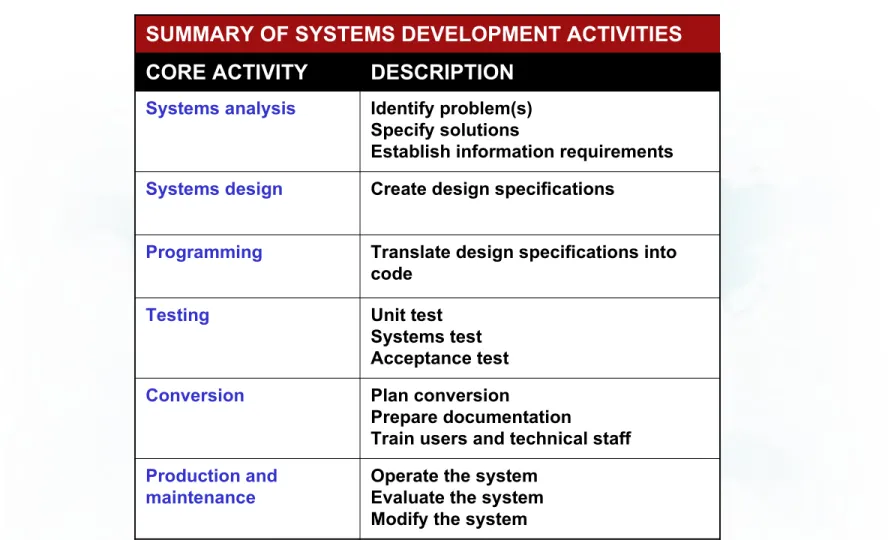
Table 13.2 Systems Development
SUMMARY OF SYSTEMS DEVELOPMENT ACTIVITIES CORE ACTIVITY DESCRIPTION
Systems analysis Identify problem(s) Specify solutions
Establish information requirements
Systems design Create design specifications
Programming Translate design specifications into code
Testing Unit test Systems test Acceptance test
Conversion Plan conversion
Prepare documentation
Train users and technical staff
Production and maintenance
Management Information Systems, Global Edition Chapter 13: Building Information System
•
Most prominent methodologies for modeling
and designing systems:
1. Structured methodologies
2. Object-oriented development
•
Structured methodologies
–
Structured:
Techniques are step-by-step, progressive
–
Process-oriented:
Focusing on modeling processes
or actions that manipulate data
–
Separate data from processes
Management Information Systems, Global Edition Chapter 13: Building Information System
•
Data flow diagram (DFD):
– Primary tool for representing system’s component processes and
flow of data between them
– Offers logical graphic model of information flow
– High-level and lower-level diagrams can be used to break processes
down into successive layers of detail
• Data dictionary: Defines contents of data flows and data stores
• Process specifications: Describe transformation occurring within lowest level of data flow diagrams
• Structure chart: Top-down chart, showing each level of design, relationship to other levels, and place in overall design structure
Management Information Systems, Global Edition Chapter 13: Building Information System
The system has three processes: Verify availability (1.0), Enroll student (2.0), and Confirm registration (3.0). The name and content of each of the data flows appear adjacent to each arrow. There is one external entity in this system:
FIGURE 13-6
Management Information Systems, Global Edition Chapter 13: Building Information System
This structure chart shows the highest or most abstract level of design for a payroll system, providing an
FIGURE 13-7
Management Information Systems, Global Edition Chapter 13: Building Information System
•
Object-oriented development
–
Object is basic unit of systems analysis and design
• Object:
– Combines data and the processes that operate on those data
– Data encapsulated in object can be accessed and modified only by operations, or methods, associated with that object
–
Object-oriented modeling based on concepts of class
and inheritance
• Objects belong to a certain class and have features of that class • May inherit structures and behaviors of a more general,
ancestor class
Management Information Systems, Global Edition Chapter 13: Building Information System
This figure illustrates how classes inherit the common features of their superclass.
FIGURE 13-8
Management Information Systems, Global Edition Chapter 13: Building Information System
•
Object-oriented development
–
More iterative and incremental than traditional
structured development
• Systems analysis: Interactions between system and users analyzed to identify objects
• Design phase: Describes how objects will behave and interact; grouped into classes, subclasses and hierarchies
• Implementation: Some classes may be reused from existing library of classes, others created or inherited
–
Because objects reusable, object-oriented development
can potentially reduce time and cost of development
Management Information Systems, Global Edition Chapter 13: Building Information System
•
Computer-aided software engineering (CASE)
–
Software tools to automate development and reduce
repetitive work, including
• Graphics facilities for producing charts and diagrams • Screen and report generators, reporting facilities • Analysis and checking tools
• Data dictionaries
• Code and documentation generators
–
Support iterative design by automating revisions and
changes and providing prototyping facilities
–
Require organizational discipline to be used effectively
Management Information Systems, Global Edition Chapter 13: Building Information System
•
Alternative systems-building methods
–
Traditional systems life-cycle
–
Prototyping
–
End-user development
–
Application software packages
–
Outsourcing
Management Information Systems, Global Edition Chapter 13: Building Information System
•
Traditional systems life-cycle:
–
Oldest method for building information systems
–
Phased approach:
• Development divided into formal stages
• “Waterfall” approach: One stage finishes before next stage begins
–
Formal division of labor between end users and
information systems specialists
–
Emphasizes formal specifications and paperwork
–
Still used for building large complex systems
–
Can be costly, time-consuming, and inflexible
Management Information Systems, Global Edition Chapter 13: Building Information System
•
Prototyping
–
Building experimental system rapidly and
inexpensively for end users to evaluate
–
Prototype: Working but preliminary version of
information system
• Approved prototype serves as template for final system
–
Steps in prototyping
1. Identify user requirements. 2. Develop initial prototype. 3. Use prototype.
4. Revise and enhance prototype.
Management Information Systems, Global Edition Chapter 13: Building Information System
The process of developing a prototype can be broken down into four steps. Because a prototype can be developed quickly and inexpensively, systems builders can go through several iterations, repeating steps 3 and 4, to refine and enhance the
prototype before arriving at the final operational one.
FIGURE 13-9
Management Information Systems, Global Edition Chapter 13: Building Information System
•
Advantages of prototyping
–
Useful if some uncertainty in requirements or design
solutions
–
Often used for end-user interface design
–
More likely to fulfill end-user requirements
•
Disadvantages
–
May gloss over essential steps
–
May not accommodate large quantities of data or
large number of users
• May not undergo full testing or documentation
Management Information Systems, Global Edition Chapter 13: Building Information System
•
End-user development:
–
Uses fourth-generation languages to allow end-users
to develop systems with little or no help from
technical specialists
–
Fourth generation languages: Less procedural than
conventional programming languages
• PC software tools • Query languages • Report generators • Graphics languages • Application generators
• Application software packages
• Very high-level programming languages
Management Information Systems, Global Edition Chapter 13: Building Information System
•
End-user development (cont.):
–
Advantages:
• More rapid completion of projects
• High-level of user involvement and satisfaction
–
Disadvantages:
• Not designed for processing-intensive applications
• Inadequate management and control, testing,
documentation
• Loss of control over data
–
Managing end-user development
• Require cost-justification of end-user system projects
• Establish hardware, software, and quality standards
Management Information Systems, Global Edition Chapter 13: Building Information System
•
Application software packages
–
Save time and money
–
Many offer customization features:
• Software can be modified to meet unique requirements without destroying integrity of package software
–
Evaluation criteria for systems analysis include:
• Functions provided by the package, flexibility, user friendliness,
hardware and software resources, database requirements, installation and maintenance efforts, documentation, vendor quality, and cost
–
Request for Proposal (RFP)
• Detailed list of questions submitted to packaged-software vendors • Used to evaluate alternative software packages
Management Information Systems, Global Edition Chapter 13: Building Information System
•
Outsourcing
–
Several types
•
Cloud and SaaS providers
– Subscribing companies use software and computer hardware provided by vendors
•
External vendors
– Hired to design, create software
– Domestic outsourcing
» Driven by firms need for additional skills, resources, assets
– Offshore outsourcing
» Driven by cost-savings
Management Information Systems, Global Edition Chapter 13: Building Information System
•
Outsourcing (cont.)
–
Advantages
• Allows organization flexibility in IT needs
–
Disadvantages
• Hidden costs, for example:
– Identifying and selecting vendor
– Transitioning to vendor
• Opening up proprietary business processes to
third party
Management Information Systems, Global Edition Chapter 13: Building Information System
If a firm spends $10 million on offshore outsourcing contracts, that company will actually spend 15.2 percent in extra costs even under the best-case scenario. In the worst-case scenario, where there is a dramatic drop in productivity along with exceptionally high transition and layoff costs, a firm can expect to pay up to 57 percent in extra costs on top of the $10 million outlay for an offshore contract.
FIGURE 13-10
Management Information Systems, Global Edition Chapter 13: Building Information System
•
Rapid application development (RAD)
–
Process of creating workable systems in a very short period
of time
–
Utilizes techniques such as:
• Visual programming and other tools for building graphical
user interfaces
• Iterative prototyping of key system elements
• Automation of program code generation
• Close teamwork among end users and information systems
specialists
Management Information Systems, Global Edition Chapter 13: Building Information System
•
Joint application design (JAD)
–
Used to accelerate generation of information
requirements and to develop initial systems
design
–
Brings end users and information systems
specialists together in interactive session to
discuss system’s design
–
Can significantly speed up design phase and
involve users at intense level
Management Information Systems, Global Edition Chapter 13: Building Information System
•
Agile development
–
Focuses on rapid delivery of working software by
breaking large project into several small subprojects
–
Subprojects
• Treated as separate, complete projects
• Completed in short periods of time using iteration and
continuous feedback
–
Emphasizes face-to-face communication over written
documents, allowing collaboration and faster
decision making
Management Information Systems, Global Edition Chapter 13: Building Information System
•
Component-based development
–
Groups of objects that provide software for common
functions (e.g., online ordering) and can be combined
to create large-scale business applications
–
Web services
• Reusable software components that use XML and open Internet standards (platform independent)
• Enable applications to communicate with no custom programming required to share data and services
• Can engage other Web services for more complex transactions • Using platform and device-independent standards can result in
significant cost-savings and opportunities for collaboration with other companies
Management Information Systems, Global Edition Chapter 13: Building Information System
•
Mobile application development
–
Special requirements for
• Smaller screens, keyboards
• Multitouch gestures
• Saving resources (memory, processing)
–
Responsive Web design
• Web sites programmed so that layouts change
automatically according to user’s computing device
–
Three main platforms
• iPhone/iPad, Android, Windows Phone
Management Information Systems, Global Edition Chapter 13: Building Information System
Read the Interactive Session and discuss the following questions
Interactive Session: Technology