AN OFFER YOU CAN’T REFUSE: PRIVATE SECURITY AND STATE PROTECTION IN POST-SOVIET RUSSIA
Dawes Cooke
A thesis submitted to the faculty of the University of North Carolina at Chapel Hill in partial fulfillment of the requirements for the degree of Master of Arts in the Department of Russian
and East European Studies
Chapel Hill 2011
ii ABSTRACT
DAWES COOKE: An Offer You Can’t Refuse: Private Security and State Protection in Post-Soviet Russia
(Under the direction of Robert Jenkins)
iii
ACKNOWLEDGEMENTS
This thesis would have been impossible without the support and guidance of a large number of people. Vadim Volkov’s treatment of private security in Russia as violent
iv
TABLE OF CONTENTS
LIST OF TABLES………v
Chapter INTRODUCTION……….1
I. COLLAPSE AND REFORM………...4
Introduction………..4
Privatization, Reform, and the Post-Communist State……….5
Privatized Security………...12
Conclusion……….34
II. COMPETING TO PROTECT………..35
Introduction………35
Yeltsin’s Limitations……….35
The Post-1995 Private Security Market………38
Competition for Clients………41
The End of the 1990s – The State Returns……….53
III. PUTIN GETS THE JOB………..55
Introduction………55
Putin in Charge……….56
Soft Power……….66
Developments in Putin-Era Private Security………71
Conclusion……….77
CONCLUSION………...79
v
LIST OF TABLES
Table
1.1 Extortion, Racketeering, and Protection………16 1.2 Crime Increase in the Russian Federation………24 1.3 Services Offered by ISOs (Illegal Security Organizations), PPEs (Private
INTRODUCTION
STATE PROTECTION AND PRIVATE SECURITY IN RUSSIA
As I exited the Primorskaya Metro Station in Saint Petersburg one summer day, I noticed a police car parked along the row of kiosks lining the square in front of the station. Two bored policemen leaned against the car and casually scanned the crowd coming and going from the metro. Upon closer inspection, however, their uniforms lacked the Ministry of Internal Affairs badges that Russian policemen typically wore. In their places were badges displaying a shield emblem with the words “Okhrannaya Firma ‘Titan’” emblazoned on top – “Protection Firm ‘Titan.’” The symbol matched the sticker that was affixed to the front
window or door of many shops, businesses, and apartment buildings in the area. The two private security guards were employees of the private protection enterprise “Titan,” which specializes in physical security for businesses, apartments, cargo, and individuals
(Okhrannaya Firma Titan, 2010). The two guards themselves, however, were not protecting a private entity. Instead, they were contributing to public security by watching the crowd around the metro station for anything suspicious. The questions that were raised by this situation, such as why the police were not watching the metro station, and why a private company was obliged to do it, led directly to the questions asked in this paper.
2
feel that the government is not providing sufficient protection. Supply of security is affected partially by the availability of personnel, but primarily by the willingness of the government to allow the de-monopolization of its security contract with its citizens and its ability to limit private providers of security. Therefore, private security serves as an effective case study through which to examine state’s willingness and ability to protect its citizens and to demand the loyalty of domestic actors.
This paper consists of three chapters. The first two chapters correspond largely with Boris Yeltsin’s time as the President of the Russian Federation. In the first chapter,
privatization, liberalization, and post-Communist state-building theory will serve as the starting point from which Russia’s political and economic transformation between 1991 and 1995 will be examined. In this period, Yeltsin struggled to turn Russia into a democratic, free-market system while maintaining his own position against state and non-state actors that fought for political influence. Weak property rights, unreliable court systems, faltering law enforcement bodies, and lax regulation of the private security industry during this period allowed organized crime to capture a large share of the private security market. The second chapter covers the period from 1995 until the end of Yeltsin’s term in 1999. During this time, Yeltsin laid the political framework for a strong state system in which the President
3
The third chapter corresponds with Vladimir Putin’s first Presidential term. His reforms centralized the Russian government’s authority, improved the reliability of state protection apparatuses, and reduced tolerance for competition with the state government. Although this should theoretically have harmed the private protection industry, it will be argued that, by instituting soft power controls over the industry, the state was able to
CHAPTER I
COLLAPSE AND REFORM Introduction
The subject of this chapter is the liberalization of the state between 1991 and 1995, and the extent to which liberalization weakened the Russian state and allowed a private security industry to thrive. The political and economic upheavals that accompanied the collapse of the Soviet Union in 1991 resulted in nearly a decade of state decentralization, in which most of the former Soviet State’s functions were de-monopolized and the power of the new Russian state was eclipsed by that of private actors. Although the transition from this period began in the latter years of Boris Yeltsin’s presidency, it was under Vladimir Putin’s presidency that the predominance of state authority over the private sector was reasserted.
5
Privatization, Reform, and the Post-Communist State
The formal dissolution of the Soviet Union in 1991 was expected by many in the West to be the transition point at which the former communist countries moved from centralized authoritarian states with planned economies to Western-style free-market democracies. However, this assumption overlooked the fact that Western countries had reached their current models over the course of centuries, whereas former communist states were expected to do so in a matter of years and amid the ruins of their former communist governments.
Anna Grzymala-Busse and Pauline Jones Luong (2002) urge a re-conception of what is to be expected in the transition from communism. They argue that traditional scholarship has concentrated on political, economic, and civil transition, and ignored the process of state building itself. The construction of post-communist states from their communist predecessors is different from traditional state-building in that the process is rapid (though in many cases incomplete); it is dominated by a number of actors of various origin and wielding various sources of power; and it is influenced by international groups that often have an ideal societal model that they wish to see implemented. The process of post-communist state formation, they say, is “elite competition over the authority1
1 The term “authority,” when used throughout this paper, will refer to its usage in this definition.
6 Privatization
During the first half of the twentieth century, mass disillusionment in the benefits of capitalism and free enterprise caused by two world wars and a global depression resulted in a number of nationalization efforts. If the first half of the twentieth century can be associated with nationalization, then the last part can be associated with privatization. William
Megginson and Jeffry Netter argue that the most important modern privatization effort is that undertaken by Margaret Thatcher’s Conservative government in the United Kingdom in the 1980s, during which a number of large, inefficient, state-run industries were sold to private controllers and during which the term “privatization” came into existence to describe what was previously referred to as “denationalization” (Megginson and Netter, 2003: 31).
However, the most dramatic privatization efforts by far accompanied the liberalization of the previously state-controlled communist economies, particularly in Eastern Europe and the Soviet Union
7
compete in the market by producing superior-quality goods and services at lower costs. By exposing a firm to market forces, it must either become competitive or shut down and be replaced by a firm that will be competitive (Megginson and Netter, 2003: 30).
Privatization movements tend to happen for these reasons. The desire to combat inefficiency is a major one. However, ideological reasons may also produce a shift toward a free market, as was the case with Thatcher’s Conservative government. Additionally, the sale of state assets produces a great, although one-time, amount of revenue (Megginson and Netter, 2003: 32).
If common motives for privatization can be identified, however, little else is similar between the Western privatization efforts and the post-Communist movements. In the United Kingdom, as well as in other countries that privatized industries in the twentieth century such as Germany and Chile, privatized firms went on to occupy a position in a market economy that was already well-defined, and in which they could be subjected to preexisting market forces. In transition economies, however, no such markets existed. Privatization took place while the market into which these firms would be released was still under construction (Hare and Muravyev, 2003: 347). Some exceptions exist – for example, criminal or even small legal markets existed alongside the state-controlled Soviet economy - but they will be discussed in detail later, after the overall framework of post-Communist privatization is established.
Political Reform
For many post-Communist states, the difficulty of attempting an economic transition is compounded by the uncertainty of undergoing a simultaneous political transition. Russia in particular is a prime example. During the early 1990s, two forces were at work
8
restructuring the state. The first step was to dismantle the immense Soviet power structure. During the course of his reforms Yeltsin banned the Communist party, and subordinated and eventually abolished the Soviet Congress of People’s Deputies and the Soviet presidency, effectively eliminating the institutionalized sources of state strength. The next step would have been to build a new democratic Russian state. However, Michael McFaul argues that Yeltsin missed his opportunity to do this. He forwent the construction of new
state-strengthening institutions such as a new constitution, the creation of a new political party, and a call of new national elections, likely over the fear that these new democratic
institutions would oust him and his reformers before the reforms could be completed (McFaul 1998: 195).
Yeltsin instead opted to concentrate first on economic reforms, the second transforming force at work in Russia at that time. In order to transition from a planned economy to a market economy, old Soviet market controls had to be lifted and the state had to relinquish its control over the majority of enterprises. The former was accomplished through a number of policies, including the price liberalization, and the latter was
accomplished through privatization. Most attention was paid during this time to medium and large industrial enterprises, the firms that had formed the backbone of the late Soviet economy. However, despite efforts to create a wide base of shareholders, control of these firms often went to the small number of elites who, at the time of the Soviet collapse, were in positions to consolidate control over such enterprises (Hare and Muravyev, 2003: 347-349). The democratic institutions of the transitioning Russian state were not strong enough to resist the influence of these elites. The result was a system that, in name, was a free
9
exemption or import and export permits, rather than direct cash subsidies. In addition, the management of these firms largely consisted of the same people who had managed them during Soviet times, and who had little understanding of how to run a competitive, profitable company (Rutland, 1997). Because the market forces that would have closed
underperforming firms were weak in the new Russian economy in the first place and
because many of the largest underperforming firms were protected by their owners from the market forces that did exist, the economy stagnated.
Yeltsin had experienced little resistance from the Russian parliament in disbanding the former Soviet institutions and ministries and in lifting controls over the economy. However, he began to face opposition in implementing measures to rebuild the economy, such as privatization or attempting to raise taxes. His attempts to implement drastic stabilization or reform measures were often foiled by the parliament, which backed a more modest plan, and in December, 1992, the parliament forced Yeltsin’s Prime Minister, Yegor Gaidar, to resign (Rutland, 1997). Facing an impasse concerning the adoption of a new Constitution in 1993, Yeltsin dissolved the parliament in a dramatic series of events resulting in the siege of the White House in October of that year. Popular support for Yeltsin’s new Constitution led to its approval in December, granting extensive powers to the executive branch and tipping the balance of power in the national government away from the
parliament and toward the President (Willerton, 1997). This shift of power marked a major step toward the supremacy of the Russian Presidency and, by association, a first step toward the strengthening of the Russian state as a whole.
The Post-Communist Russian State
10
was not competing. Yeltsin took the vital first step to state transformation of abolishing the old Soviet sources of power, particularly the Communist Party, so the previous formal power structures were not competing. The 1993 Constitution, as well as the President’s show of strength in overpowering the parliament to see it passed, strengthened the former in relation to the latter and, although the parliament was not powerless after 1993, its ability to block the President’s policies was weakened. Additionally, as Grzymala-Busse and Jones Luong argue, the division between Soviet state and Soviet society was blurred compared to the division of state and society in Eastern European communist states. This means that there was little room for civil society to form its own organizations independent of the state. When the state collapsed, then, representatives of civil society were not in a position to compete for authority (Grzymala-Busse and Jones Luong, 2002).
11 Other Considerations
Federico Varese suggests that the lack of property rights in Russia is also a major source of problems for the economy. In a simplified world, he argues, “an individual has a ‘natural control’ over an asset and aspires to consume or exchange it, and keep the income flow (profit) it generates” (Varese, 2001: 23). An individual’s ability to enjoy the benefits of his property is directly related to the security of that property, which in turn is a product of the ability or desire by others to relieve him of that property. The essence of protection, then, is to ensure that an individual is not deprived of his property. This role has traditionally gone to the state, and the ideal protective state is one that protects an individual’s property not just against seizure by others but also by the state itself. In order for property rights to be effective, the state must not only protect against seizure, but also provide regulations that ensure that the owner can make use of his property and implement a criminal penalty that will deter attempts at theft (Varese, 2001: 23).
12 was not a mass of property owners.2
Although it seems that the powerful were able to protect themselves in the early 1990s through the manipulation of state policy or of those enforcing it, the state was either unable or unwilling to provide property protection to society as a whole. It was this disparity that fueled the market for security organizations that were capable of protecting, for a fee, not just the physical property and body of a client but his property rights and security in doing business.
This shortcoming was a product of a socialist system that frowned upon the concept of individual property ownership. The property rights that were provided strongly favored those who were in a position to argue for them – primarily, those who already owned or at least controlled large amounts of property. Statistics of firm ownership tend to reflect this legal bias. Varese notes that, in 1994, it was a common trend for the manager of a privatized firm to maintain ownership and control of the firm between himself and a small group of trusted shareholders and to direct the firm with little regard to the desires of minor shareholders (Varese, 2001: 28-33).
Privatized Security
The privatization of security in Russia resembled the privatization of other aspects of the former state-controlled society in that what was once the monopoly of the state was now open to the private sector. Although security during the Soviet era was not an economic asset, its de-monopolization produced profit-seeking firms that are similar to any other service-oriented firm.
However, the privatization of security differed from other privatization efforts in a number of ways. The first of these was that security, unlike other industries, was privatized into a market in which market forces were already strong. With varying degrees of legality,
2 Stefan Hedlund suggests that the concept of property rights itself was “seriously underdeveloped” in Russian
13
other actors had been competing in the security market since before the fall of Communism. Second, security was not privatized for ideological reasons, but rather as a side effect of political reforms. The original law allowing for the creation of private security companies was designed to mitigate unemployment caused by the downsizing of state security structures for reasons related to the Soviet collapse rather than the de-monopolization of security. Third, security is a sector of society in which the government has a vested interest, and either does not need to or simply should not allow competition due to the risks to overall state security. Finally, security was not privatized in its entirety - the state did not abandon its stake in the security market. Instead, it continued, and continues, to compete with both legitimate and illegitimate organizations in the provision of security.
The Pre-existing Post-Soviet Security Market
During privatization, most industries were introduced into markets in which competition was new and market forces were not very strong. However, private security predated the de-monopolization of state security. In the final years of the Soviet Union, enterprising groups of people illegally offered their protection services to those who needed it.
14
Extortion existed in the Soviet Union just as it did in any society. A popular extortion habit was for criminals to attempt to identify individuals with a large hidden wealth and then to threaten to turn them in to the state unless they surrendered a portion of their illegal holdings (Volkov, 2002). The emergence of kooperators – specifically, the emergence of a number of profitable businesses that did not receive government protection – created an irresistible opportunity for extortion for such criminal groups. Additionally, a new type of criminal group appeared around the same time. Many students, particularly athletes, in the late Soviet period found themselves with fewer opportunities and, in the case of athletes, less funding for sports activities. Some groups of student athletes, taking advantage of their physical abilities and their pre-existing group cohesion and hierarchy, turned their attention to the emerging kooperators, and themselves became criminal gangs. These gangs often named themselves after whatever shared trait allowed the first members to bond. For example, the infamous Tambovskaya crime syndicate of Saint Petersburg was started by a group of students from the town of Tambov who were studying in Leningrad at the time. Rather than engage in theft, black market dealings, or outright extortion, as their criminal predecessors did, these new groups – referred to as bandits rather than thieves – engaged the defenseless private businesses in protection rackets (Volkov, 1999).
15
criminal group. The case also satisfies Volkov’s definition of extortion. This level of extortion, however, is strictly an illegal activity, and is a large enough departure from the definition of a protection racket to be outside the bounds of this discussion.
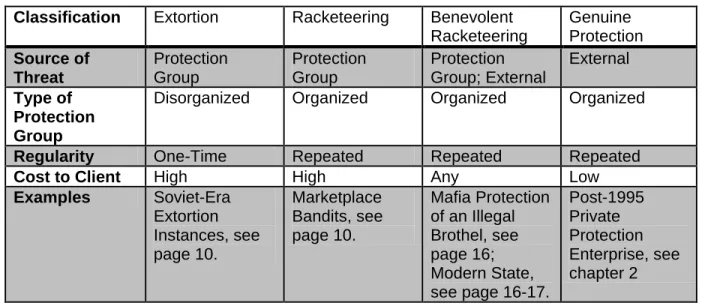
A clear-cut case of protection, on the other hand, would be an instance of one protection organization offering to provide for the security of a small business that had experienced trouble from local criminal gangs. The threat that the victim is being protected from is being levied by a third party, the action is recurring, and a genuine service is being provided. Because of this the protection organization’s arrangement, while not necessarily legal, is a protection racket that benefits both parties. For an organized comparison of extortion, racketeering, and protection activities, see Table 1.1.
However, the nature of the vast majority of protection deals in the late years of the Soviet Union and the early years of the Russian state were not so clearly beneficial. Protection organizations generally cooperated to share marketplaces and did not fight between themselves for territory or threaten businesses protected by rival organizations. However, every unprotected private business was fair game, and business owners generally had to accept the first protection offer with which were presented or else face
consequences. Protection gangs would patrol marketplaces, both reinforcing the sense of security of their own clients and providing a visible reminder of the threat facing other organizations’ clients. In this way, a number of protection organizations cooperated to exercise a form of extortion without actually threatening their own clients (Volkov, 2002).
The market, willing or unwilling, for protection organizations exploded following the collapse of the Soviet Union, the growth of the private sector, and the retreat of state
16
that legal private security companies appeared in Russia, the saying that “every businessman has to have a roof” was already a truism (Volkov, 2000: 495).
Table 1.1 – Extortion, Racketeering, and Protection
Classification Extortion Racketeering Benevolent Racketeering Genuine Protection Source of Threat Protection Group Protection Group Protection Group; External External Type of Protection Group
Disorganized Organized Organized Organized
Regularity One-Time Repeated Repeated Repeated
Cost to Client High High Any Low
Examples Soviet-Era Extortion Instances, see page 10. Marketplace Bandits, see page 10. Mafia Protection of an Illegal Brothel, see page 16; Modern State, see page 16-17.
Post-1995 Private Protection Enterprise, see chapter 2
Privatization of State Security
17
could hope to control the state without first courting the force ministries, a lesson which Gorbachev learned during the attempted coup of August 1991 (Volkov, 2002).
The role of the force ministries as a pillar of Soviet strength, however, marked them as a clear target for Yeltsin’s political reforms following the fall of the Soviet Union. He divided the departments of the former Soviet KGB into a number of smaller organizations with the explicit purpose of decentralizing and weakening it. By 1993, what was once the KGB had been split into five distinct services, four of which were permitted to retain armed units and to carry out law enforcement work. This right was also extended to the MVD (which survived the Soviet collapse), the Tax Police, and the Federal Customs Service, bringing the number of groups with the right to armed enforcement from three, as in the Soviet era, to seven. Many of these agencies had overlapping duties. For example, between the MVD and the FSB3
The liberalization of politics as a whole and the fragmentation of the security
structures greatly decreased the prestige of state security professions. At the same time, the ailing state budget and rapid inflation reduced wages for these professions. Largely for these reasons, related to the end of the Soviet Union, over 20,000 KGB officers left state service either voluntarily or due to job cuts between September 1991 and June 1992. Additionally, between 1991 and 1996, roughly 200,000 employees left the MVD every year. The MVD, which was facing organizational problems even before the fall of the Soviet Union, lost 37,000 commissioned officers in 1989 alone. Tens of thousands of men and
, four separate directorates were tasked with fighting the same type of criminal activity. This forced competition between organizations weakened the force structures as a whole, as organizations often refused to share intelligence, failed to cooperate, and even undermined each other (Volkov, 2002).
3 The FSB, or Federalnaya Sluzhba Bezopasnosti, is the Russian successor to the Soviet KGB in domestic
18
women, many of whom had no marketable skills other than the application of force, were unemployed in the early years of the new Russian state (Volkov 2002: 131).
Groups of these former security operatives began to offer commercial protection services, much like organized criminal groups had already been doing. Concern existed in the government, particularly in the MVD, that these commercial protection services would become criminal groups themselves, and this concern was well-founded – a 1993 MVD report claimed that of the 12,600 policemen who had left the force during the previous year, twenty per cent had joined the ranks of organized crime (Varese, 2001: 68). In order to combat this turnover, the federal law “On Private Detective and Protection Activity” was enacted on March 11, 1992. Intended as a long-term solution about how to absorb the large number of newly unemployed state security officers into society, the law allowed civilians to form protection businesses with enforcement capabilities legally unavailable to other
organizations. These capabilities included not just physical protection of clients and property but also security consulting, gathering of intelligence on lawsuits, providing information on potential business partners or employees, counteracting commercial espionage, searching for missing persons, and performing market research for client companies (Volkov, 2000).
Such security companies fall under the jurisdiction of the MVD. Licenses for firm formation are issued by the MVD Department for Licenses and Permissions, and
19
organizations. Additionally, although the head of the agency is required to have state experience, many former members of the state law enforcement and security are drawn to such agencies as employees. Of the 156,169 licensed security employees in Russia in 1998, 22.6 percent had previous experience with the MVD, 7.9 percent had experience with the KGB or FSB, and 0.8 percent had come from other security organizations. While the majority of private security personnel did not have state security experience, the 31.3 percent that did have that experience occupied the top positions in their respective companies (Volkov, 2000, 486-487).
20
protection enterprises also exist for private security services. For example, another Alpha commander, V. Zaitsev, became the head of security for Stolichnyi bank (Volkov, 2000).
With the creation of legal private security companies, then, the security apparatus of the former Soviet state was privatized. Private entrepreneurs were permitted to offer, in a competitive marketplace, many of the same security services that had formerly been monopolized by the state. The fragmentation of the state security structures and the weakening of their ability to offer these services was an important step in the political transition of the Russian state. However, the creation of private, competing commercial security companies was not a purposeful part of the economic privatization effort but rather a side effect of this political transition.
Security and State-Building
21
Tilly argues that the contract between the state and its citizens is a protection racket. Essentially, he says, the process of building a state consists of four steps. The first step is war making, in which the government neutralizes external threats to its authority, such as foreign powers. The second step is state making, in which the government neutralizes internal threats, such as dissidents, separatists, bandits, or competing claimants for control of the state. The third step is protection, in which the government neutralizes the enemies of its clients (generally speaking, its citizens). Finally, the government engages in extraction, which is the process of acquiring the resources to repeat the first three steps indefinitely. The first two steps are carried out for the benefit of the government. While the state’s citizens may benefit from successful war making and state making, it is primarily for the survival of the government that they are carried out. The third and fourth steps, on the other hand, form the government’s protection contract with its citizens (Tilly, 1985: 181).
The fairness of the protection contract is a matter of degree. If the services that the government offers its citizens in fulfillment of step three are minimal but the price extracted in step four is high, then the government is a burden on its citizens and has more in
22
to cede this protection monopoly is to cede some of its power to internal, or possibly external, forces. That is not to say that de-monopolization of security does not happen, however. Private protection is neither a uniquely Russian nor a uniquely modern
phenomenon. However, when protection is de-monopolized, it sends a message that the state is either unable or unwilling to protect its citizens.
In a modern state such as the Soviet Union or the Russian Federation, the protection services offered by the government are not carried out by one single institution. For
example, the task of neutralizing foreign threats falls to a number of organizations, including but not limited to the armed forces, intelligence services, and the diplomatic corps.
Additionally, for a state to protect its citizens means more than shielding them from physical violence, although this is an important task. The government should also protect its citizens’ property. In Varese’s definition of property rights, citizens must be allowed to use and benefit from their property without the fear of that property being unfairly reallocated by another party (Varese, 2001: 18). The task of ensuring that that a citizen is not unfairly deprived of his property falls to the law enforcement and judicial bodies of the Russian state.
23
the only concern. The prevalence of unreported crimes can reduce the usefulness of crime rates as an indicator of police effectiveness. Therefore, the public opinion concerning law enforcement and judicial bodies will also be taken into account. Even if law enforcement and judicial bodies are operating effectively, clients will still seek protection from a non-state provider if some other factor causes them to believe that their safety is at risk.
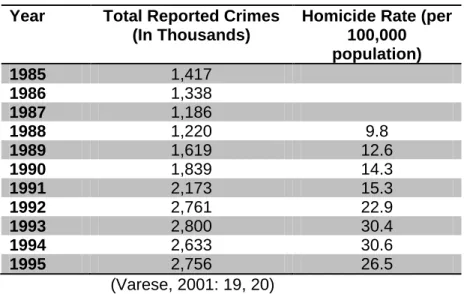
In the first few years of the Russian state, the state security structures tasked by the state with stopping domestic crime, including the MVD, were fragmented and reorganized, greatly reducing their effectiveness, particularly in combating organized crime. The MVD itself saw high rates of employee turnover in the late 1980s and early 1990s. The lost personnel were quickly replaced, but this turnover meant that many of the agents charged with law enforcement were relatively inexperienced (Volkov, 2002). The ultimate official report card for the MVD’s law enforcement capability, however, is in crime rates, as reflected in Table 1.2. Official MVD-reported crime rates increased by 194.5 percent between 1985 and 1995, with the sharpest increase in 1989 and a leveling out in 1993. However, this statistic only reflects reported crimes, and according to one study, somewhere between 40 percent and 70 percent of crimes went unreported from 1991 to 1993. Similarly, homicide rates jumped from 15.3 per 100,000 inhabitants in 1991 to 30.4 per 100,000 in 1993. Corruption at all levels of society was also rampant during this time. In a 1996 international study, Russia ranked 47th out of the 54 countries surveyed, revealing a high level of
corruption, and its position only worsened in the next two years (Varede, 2001: 19-20). The clear implication of these statistics is that law enforcement was not protecting society from crime as effectively as it had done in the Soviet period.
24
was often seen as dishonest, and for good reason. In the stock exchanges of the early 1990s, it became commonplace for brokers to list a product on several different exchanges and honor only the most valuable contract. One survey showed that 30 percent of contracts made in Russian exchanges were not honored (Frye, 2002a).
Table 1.2 – Crime Increase in the Russian Federation
Year Total Reported Crimes (In Thousands)
Homicide Rate (per 100,000 population)
1985 1,417
1986 1,338
1987 1,186
1988 1,220 9.8
1989 1,619 12.6
1990 1,839 14.3
1991 2,173 15.3
1992 2,761 22.9
1993 2,800 30.4
1994 2,633 30.6
1995 2,756 26.5
(Varese, 2001: 19, 20)
25
abroad became common practice. In an interview in July 1996, a court enforcer in Saratov admitted that only five of the 25 rulings waiting for enforcement stood a chance of being collected. This lack of enforcement, in addition to newer and higher court fees, meant that many businessmen would not risk taking their complaints to court (Hendley, 1998).
In response to this business atmosphere, private protection organizations began offering additional services beyond physical protection. Among these, debt recovery, contract enforcement, and dispute settlement became very important to businessmen, who often felt as if they could not rely on the state to perform these services. In 1993 and 1994, roughly 70 percent of contracts were enforced through private means rather than through state enforcement bodies (Volkov, 2000: 491).
The clear implication of these shortcomings is that the state institutions tasked with fulfilling the state’s end of the protection contract with its citizens were failing to do so. This failure was a direct result of the fragmentation of the state security structures and the poor implementation of property laws, both of which were in turn results of the collapse of the Soviet Union, Yeltsin’s reforms, and Yeltsin’s inability to consolidate authority over policy-making in the central government. Whether or not it was an intention of Yeltsin or his reformers to reduce the state’s capacity to fulfill its protection contract, however, is unclear.
The Players in the Security Market
26 Services Offered
All security providers offer a number of common services to their clients. Some services exist, however, that are unique to their particular type of protection organization. For example, only the state has the manpower, material capacity, and diplomatic clout to offer protection against foreign threats. Illegal protection organizations can also offer many additional services to their clients. Some businessmen report being provided with physical renovation labor and money loans by strangers with evident ties to organized crime. The acceptance of such offers would assuredly be taken as evidence by the criminal groups in question that they could force the protection arrangement on their client permanently. Other clearly criminal acts such as assassinations and physical intimidation are tools used by such organizations to aid their clients’ businesses. In one incident, for example, a Krasnoyarsk businessman ordered the murder of his business partner by a hired mafia assassin upon realizing that killing his partner would actually be cheaper than buying him out. In Vorkuta, a criminal group intervened to stop a workers’ strike by threatening the strike leader at
gunpoint. These services are in addition to the multitude of illegal activities in which Russian criminal groups may participate that do not fall under the loose definition of protection (Varese 2001). Legal private security companies also offer services not provided by either the state or illegal security organizations. For example, a 1999 article from the Russian business journal Profil notes that the PPEs Bayard, MIG, and Fond “Pravoporyadok-Tsentr” have capitalized on their brand recognition by selling automated security systems and establishing training schools for security guards (Inna Lukyanova and Olga Kazanskaya, 1999).
27
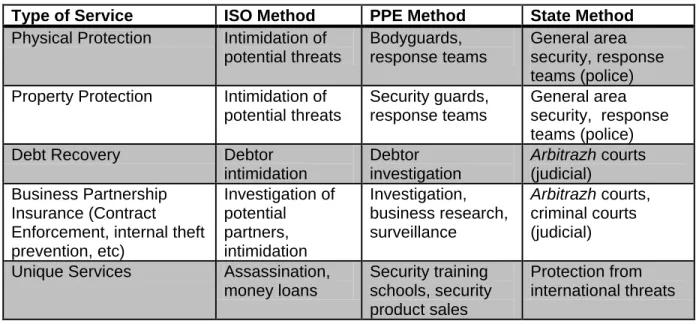
the broad sphere of personal and property protection, specifically in the prevention, discouragement, and correction of unfair or unlawful action against a person or his or her property. The sphere of personal protection includes bodyguard services and the stationing of security guards. The sphere of property protection, however, is a much wider category, encompassing essentially any action that protects the integrity and usefulness client’s personal and business property. Services offered under the category of property protection include debt recovery, building or real property protection, cargo escort and protection, investigation of potential business connections, internal theft prevention, and so on. Not every organization offers every form of protection, and some even specialize in one form in particular. For example, the PPE Alternativa-M specializes in international financial
investigations, particularly in debt recovery when the sum in question is being stored abroad (Lukyanova and Kazanskaya, 1999). However, these services are common to state, illegal private, and legal private protection organizations in general that compete to offer them to potential clients. Table 1.3 outlines a list of services typically provided by security
organizations.
Table 1.3 – Services Offered by ISOs (Illegal Security Organizations), PPEs (Private Protection Enterprises), and the state
Type of Service ISO Method PPE Method State Method Physical Protection Intimidation of
potential threats Bodyguards, response teams General area security, response teams (police) Property Protection Intimidation of
potential threats
Security guards, response teams
General area security, response teams (police)
Debt Recovery Debtor
intimidation
Debtor investigation
Arbitrazh courts (judicial)
Business Partnership Insurance (Contract Enforcement, internal theft prevention, etc) Investigation of potential partners, intimidation Investigation, business research, surveillance
Arbitrazh courts, criminal courts (judicial) Unique Services Assassination,
28 To Whom Services Are Offered
Who are the clients for protection services? For the purpose of this comparison, a client is a small, non-industrial, commercial enterprise. Private citizens are not relevant to the discussion because they take advantage of only a small number of protection services – primarily, physical protection services such as bodyguards. Large enterprises are also not relevant. The inadequate property rights that existed in Russia at the time of this comparison tended to more thoroughly protect the interests of such enterprises. Additionally, larger enterprises tend to be capable of maintaining their own sizeable and effective private security services which are also not central to this comparison, as will be explained shortly. Finally, manufacturing firms also do not need the full range of protection services offered by security organizations. Although the need for physical security for the purpose of facility protection still exists, Timothy Frye points out that only 3 percent of these firms had hired a non-state protection organization for the purpose of debt collection (Frye 2002b: 576).
29
third-party arbitration is simply not necessary for manufacturing firms to do business, they have no reason to choose a type of protection service that offers debt recovery or contract enforcement over one that does not.
Who Offers Services?
There are three basic types of organizations that are involved in competition for the security market: illegal security organizations, private protection organizations, and the state. Illegal protection organizations are, by definition, not defined by law. They often offer services similar to those offered by legal protection organizations, but they engaged in illegal activities to the extent that they must hide the majority of their organization from law
enforcement. Protection services are just one of the many profitable enterprises into which an organized criminal group can enter. Any organized criminal group that participates in illegal racketeering or offers any security services in general can be referred to as an illegal security organization, or ISO. Understandably, the line between illegal and legal private security is a vague one. There have been attempts by some criminal groups to become licensed as PPEs by the MVD or to create sub-groups that are so licensed in order to legalize the group’s protection actions, such as the carrying of firearms, and legitimize the group’s protection racket and thus attract employees from the state law enforcement. Two such example of criminal organizations that obtained security licenses are the PPE
“Scorpion,” headed by A. Efimov of the Tambovskaya gang, and the PPE “Adris,” operated by the Malyshevskaya gang, and which protected companies including Baskin-Robbins in Russia (Volkov, 2000).
30
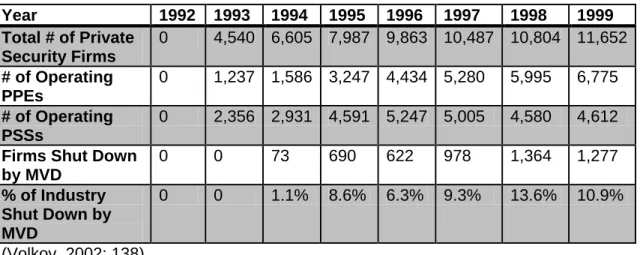
of legal private security companies. The second type of company, private detective agencies, is not important to this discussion. They are relatively few in number; their services are expensive; and they offer services that are outside the scope of security and protection. The third type of private security company is a private security service, or PSS, which is established and owned by a parent company. A PSS does not operate freely on the security market, as do ISOs and PPEs. Instead, it is only legally permitted to provide its services to its parent company, from which it in turn receives funding.
Table 1.4 – Private Security Firm Numbers in the 1990s
Year 1992 1993 1994 1995 1996 1997 1998 1999 Total # of Private
Security Firms
0 4,540 6,605 7,987 9,863 10,487 10,804 11,652 # of Operating
PPEs
0 1,237 1,586 3,247 4,434 5,280 5,995 6,775 # of Operating
PSSs
0 2,356 2,931 4,591 5,247 5,005 4,580 4,612 Firms Shut Down
by MVD
0 0 73 690 622 978 1,364 1,277
% of Industry Shut Down by MVD
0 0 1.1% 8.6% 6.3% 9.3% 13.6% 10.9%
(Volkov, 2002: 138)
31
There are several explanations for the trend. First, PSSs are less efficient than PPEs, which are generally larger and benefit from an economy of scale. Additionally, whereas PSSs have a guaranteed client in their parent company, PPEs are forced to compete openly on the market, and thus tend to offer better services for lower prices (Volkov, 2000). Furthermore, the fates of PSSs are tied to that of their parent companies. For example, during the economic burst of 1995, 125 banks went bankrupt, taking their security services down with them. The instability of PSSs worried the MVD, which had to hurry to disarm the now-unemployed former private security personnel who had worked for these services (Pogonchenkov, 1997). The MVD had already been suspicious of the potentially subversive capacity of PSSs, since such organizations were more strongly responsible to the interests of their parent companies than to that of the state or any other body. As a result, when MVD scrutiny over and regulation of all forms of legal private security intensified in 1995, PSSs were particularly popular targets (Volkov, 2000).
32
play a large role in the competition for the security market and are not important to this comparison.
The third and final section of the security market is the state. The state’s role in security provision has already been discussed, and it retains a large share of the security market by offering the services of its law enforcement and judicial institutions. However, the state does not act like a market actor, so an explanation for why the state is being treated as a competitor in the security market is in order. As Charles Tilly stated, “governments are in the business of selling protection, whether the people want it or not” (Tilly, 1985: 175). In theory, a client cannot opt out of the state’s protection contract. The state’s biggest strength is that entering into its protection contract is required by law. Most of the analysis here will be devoted to explaining why clients choose another type of protection, if any, in addition to the state. In practice, however, it is completely possible for a client to at least partially opt out of its contract with the state, as evidenced by the fact that the Russian government collected only 60 percent of its projected tax revenue in 1994(Newcity, 1997: 42). A businessman who avoids paying his taxes will still receive many of the benefits of state protection. However, it is in his best interest to avoid any type of state protection – such as taking a lawsuit to court – that will invite state scrutiny into his dealings, as scrutiny is likely to uncover evidence of his tax evasion.
Time Period
clear-33
cut as splitting the 1990s in half. However, the transition point that is relevant for this analysis of competition in the security market occurred in 1995.
The pre-1995 period, with which this chapter is concerned, was one of relative chaos, or what Volkov calls a “state of nature” (Volkov, 2002: 127). The fragmentation of the security structures and legal reforms concerning private property weakened the state’s capacity to offer physical or legal protection to its citizens, as previously argued, at a time when a new private sector was emerging that needed new forms of property protection. Criminal organizations fulfilled these new protection needs on a large scale and maintained a sizeable share of the security market, as well as control of much of the entire business market itself. Because the services offered by private protection organizations were already firmly planted in the realm of crime, and since profit was the only motivating factor of these organizations, the next logical step from securing a business as a client was taking over the business completely. MVD statistics from January 1994 claim that 40,000 businesses, including 2,000 state-run businesses, were controlled or owned by criminal groups, and that 55 percent of capital was controlled by these same groups. Other sources dispute these statistics, arguing that this number actually exceeds the number of profitable businesses in Russia at the time (Volkov, 1999). The general consensus, though, seems to be that the vast majority of private businesses in Russia in the early 1990s were protected or controlled by criminal groups.
34
unwilling or unable to provide effective security services, and organized crime controlled a large section of the security market through coercion. Because success in the pre-1995 security market was granted not by effective competition but by exploitation, as is the main reason for the predominance of ISOs, market competition prior to 1995 is not worth
examining. ISOs dominated the market, and PPEs did not yet have the post-1995 advantages that will be introduced in the next chapter and which allowed them to break ISOs’ control of the private security market.
Conclusion
The Soviet collapse, the struggle to create a new Russian state, and the reformation of the state security structures caused the early 1990s to be a period of turmoil. Although elites were able to take care of themselves, the government was unable satisfactorily protect the property, rights, and physical security of its citizens. This situation created demand for private organizations that were willing to do so. However, lack of regulation over this market meant that those organizations that were willing to rely on illegal measures to promote their services enjoyed strong advantages over those organizations that were not. As a result, organized crime dominated the private security market and used this position of power to assert control over much of the Russian economy.
Toward the end of Yeltsin’s first term in office, the government began to get back on its feet. A number of events in the early- to mid-1990s signaled this attempted assertion of authority by Yeltsin’s government, beginning with the President’s favorable position following the Constitutional crisis of 1993. The most important of these events for the purposes of this paper occurred in 1995, when the MVD responded to a Presidential decree demanding that it tighten regulation methods over the private security industry. These regulations
CHAPTER II
COMPETING TO PROTECT Introduction
The private security market changed fundamentally in 1995 due to a seemingly minor occurrence. In that year, the Presidential administration asked the MVD to strengthen its regulatory practices over private security firms. This change increased the public’s trust in PPEs and, just as importantly, increased the MVD’s trust in them. Perceived as honest and professional organizations and utilizing the resources made available to them by
cooperating with the MVD, PPEs became strong competitors to ISOs in the post-1995 security market.
As Yeltsin struggled with other actors vying for influence over Russia’s policymaking process, the state continued to be unable to satisfactorily protect the property, rights, and physical security of most of its citizens. Small businesses had to make the choice of either entrusting their security to the state, relying on the protection of a criminal organization, or hiring services of a private protection firm. The factors that might lead a business to choose one provider over the others, as well as the political events that allowed the private security industry to continue to thrive, are the subject of this chapter.
Yeltsin’s Limitations
coherent set of laws and regulations toward whatever ideological or institutional ends it sees fit (Tompson, 2001).
The Yeltsin government largely failed to satisfy these requirements. In competition for authority that existed within the national government, Yeltsin was strong. After the failed 1991 coup, he saw the opportunity to capitalize on his popularity by consolidating authority in his position in order protect his administration while he pushed forward with potentially unpopular reform efforts (White, 1997). Throughout its early existence, Yeltsin’s
administration preferred speed over the creation of a coalition that would provide support while undergoing slow reforms over a longer period of time. However, the Russian
parliament supported a more moderate set of reforms, and tension between the legislature and the executive branch grew. William Tompson called Yeltsin’s government under Gaidar a “kamikaze cabinet” after its intentions to drive drastic and unpopular reforms at the cost of its own survival (Tompson, 2001: 174) After the Constitutional Crisis of 1993, however, Yeltsin’s 1993 Constitution created a government in which authority was concentrated in the executive branch. It essentially gave the President the right to direct legislation, to form his own administration, and to issue legal decrees (White, 1997).
37
prices and then resell them for much more after prices were freed (Tompson, 2001). Some of the wealthiest and most influential oligarchs, however, were able to take advantage of the loans-for-shares program of the mid 1990s to obtain large shares of a natural resource production company for relatively low prices (Guriev and Rachinsky, 2005). Yeltsin accrued a political debt to these people after the 1996 Presidential election when, faced with
dropping popularity, he made a figurative deal with the devil and asked the oligarchs for help with his reelection. They used their formidable monetary and media resources to support a successful reelection campaign, with the understanding that they would hold much influence of Yeltsin during his second term in office (Braguinsky, 2009). Having made their money largely through rent seeking, many of the oligarchs used this influence to block any policy that limited their ability to continue to rent seek. In order to pass legislation, Yeltsin’s
administration generally had to make concessions to these oligarchs, meaning that attempts at liberalization often resulted in further entrenching their power (Tompson, 2001).
38
Although Yeltsin’s administration had effectively pushed the balance of authority in the national government toward the Presidency, there were many influential non-central government actors – specifically, regional authorities and the oligarchs – who also had the ability to affect policy, and liberalization and the improvement of property and physical protection for Russian citizens as a whole was generally not in these actors’ best interests. Yeltsin had laid the framework for a strong, centralized government during his first term in office, and the Russian state had begun to more strongly assert its control over domestic affairs. However, in securing his political position, he had ceded much of his authority to other actors, ensuring that the national government’s power would be hobbled through the end of the 1990s.
The Post-1995 Private Security Market
As Hare and Muravyev note, there are three steps for market growth. First, new firms must enter the market. Second, existing enterprises – particularly, as in Russia’s case, firms that had operated differently under communist control – must restructure for growth. Finally, underperforming firms must be shut down (Hare and Muravyev, 2003: 347). In the pre-1995 security market, the first step was certainly true, particularly following the adoption of the 1992 “On Private Detective and Protection Activity” Law. The extent to which restructuring took place is questionable. The market failed to force underperforming firms out of business, however. A large number of private security services existed, which did not respond to market forces. ISOs also controlled a large section of the market. The state law enforcement organs were not strong or efficient enough to force ISOs out of operation, and the
continuation of a protector-client relationship was generally the ISO’s decision rather than the client’s.
39
overt coercion or lack of options, decided what type of provider a potential client would choose. PSSs, which are not responsive to market forces, declined in popularity during this period relative to PPEs, which do respond to market forces. More importantly, in 1995, a ministerial decree was issued demanding that the MVD increase its control over the activity of private security organizations. This decree resulted in stricter licensing controls and tighter monitoring of existing PPEs, including the creation of electronic accounting and identification systems and more diligent attempts to revoke the licenses of private security firms that broke MVD regulations. Statistics clearly illustrate the results of this decree. No security firms were shut down in 1993, and 73 firms, or roughly 1.1 percent of the firms in operation, were closed in 1994. However, in 1995, 690, or roughly 8.6 percent of the firms in operation, were closed by the MVD. That number continued to stay high, hitting a high point in 1998 when 1,364 closures meant that the MVD had shut down 13.6 percent of all legal private security firms (Volkov, 2002: 138). It should not immediately be assumed, however, that these closures primarily targeted inefficient or underperforming firms. MVD regulations tend to favor large, efficient, well-supervised agencies with experienced employees rather than smaller organizations (Zarubin, 2001). It seems, then, that underperforming
organizations are more likely to be targeted, although profitability is not necessary the criterion by which the MVD targets a firm for investigation. Additionally, these new regulations made it difficult for criminal organizations fronting as PPEs to continue to operate. The PPE Scorpion, which was run by the Tambovskaya criminal group, was shut down by the MVD in 1996 and its chairman Efimov was arrested a year later (Volkov, 2000).
40
inundated with small, inexperienced, and legally questionable firms, the post-1995 market was highly regulated both by market forces and by MVD authorities, clearing up much of the distrust that state organs held toward these firms and thus allowing a mutually beneficial alliance between the two groups. PPEs with state ties could coordinate with state law enforcement in such ways as sharing case information and providing force where state coverage was thin. In return, law enforcement agencies could provide PPEs with
compensation in the form of money or equipment (Volkov, 2000). Additionally, and just as importantly, cooperation with state agencies provides the ultimate in brand recognition for a PPE. If a PPE advertises its cooperation with a state agency or agencies in general, it assures potential clients that the organization is legitimate, non-criminal, and professional. Thus, the incentive of an instant positive market reputation encourages PPEs to follow MVD regulations and to work closely with state agencies (Aleksandrov, 2001). Such is the
cooperation between post-1995 PPEs and the state that A.I. Gurov, the chairman of the Security Committee of the Russian Federation State Duma, referred to the former as the “reserve, partner, and ally” of the latter (Gurov, 2001: 103).
An unintentional but beneficial side effect of the alliance between state agencies and PPEs, which further increased the role of market forces after 1995, was the breaking of criminal control over businesses in Russia. ISOs had essentially cornered the protection market in Russia by 1994. However, disrupting this control was an interest shared by both the state and legitimate PPEs. To state law enforcement agencies, ISOs were essentially organized crime, which by definition they were expected to combat. To a PPE, though, ISOs are competition in the protection market. The circumstances and process by which a client could rid itself of ISO protection required the legal capacity of the state and the physical protection capabilities of a PPE. The general consensus among law enforcement
41
weakened since the middle of the 1990s. The head of the PPE Argus lists as a selling point for his company that none of his clients fall under the protection of the mafia (Volkov, 2000). Government sources, too, cite the cooperation between PPEs and the state as one of the primary reasons that “main types of activity and main enterprises [of Russian business] are free from the criminal influence in the Russian Federation” (Gudkov, 2001: 124). Although the assertion that Russian business is completely free from criminal influence is debatable, the general statement that criminal control of the economy has weakened seems to be true.
Competition for Clients
The security capabilities of the Soviet state were privatized following the collapse of the Soviet Union. However, the new Russian state did not cease to offer similar protection services to those offered by ISOs and PPEs. Each sector of the security market had unique benefits and risks, and one can predict that a number of factors might determine whether a client will choose to enlist illegal or legal private security or to rely solely on the state.
42
(Pogonchenkov, 1997). It will be assumed, however, that all organizations that attempt to make a profit from providing security services will compete against each other in some way for clients, and they do so by offering a variety of services that fulfill a number of general protection needs, as illustrated in Table 1.3 in the previous chapter.
The State
The state can be thought of as the discount option. Taking for granted that acceptance of the state’s protection and payment for its services is mandatory for all, the state is the cheapest option. However, a business enlisting the state’s protection services and only the state’s protection services is getting what it pays for: although the state is by far the largest and the most capable protection firm, to the individual it can only offer semi-reliable security and unsemi-reliable arbitration. In practice, a business can opt out of the state’s protection contract by withholding taxes. However, this is illegal, and has negative
consequences even if the practice is not discovered.
Illegal Security Organizations
43
play a role in ensuring that all sides play fair. In fact, simply admitting to the state that such a contract exists is to admit to a criminal act. The protection organization can use this leverage to extort higher protection fees from its clients and to lessen the extent to which they fulfill their protection duties. Additionally, it can be extremely difficult for the client to end the protection contract. Finally, competition among private protection organizations actually increases rather than decreases the cost to the client. Unencumbered by state regulation, ISOs find it more profitable to decrease supply by violently subduing competitors rather than by offering improved services, and to increase demand by causing the threats that make potential clients seek protection rather than by lowering prices (Frye, 2002a).
Private Protection Enterprises
44
However, contracting with a PPE has two major limitations. The first of these is that many small businesses just do not have the money to hire a PPE. The second is that PPEs simply cannot legally offer some of the services that ISOs can. Debt recovery, one of the services so desired by businessmen who operate in an unregulated economy, is one of these services. MVD authorities have attempted to stop the practice of debt recovery as part of their increased regulation of the PPE market. If a PPE wishes to secure the cooperation of state agencies that makes it so attractive to clients, then it must offer restricted debt recovery services to its clients (Volkov, 2000). This service usually consists of investigations into debtors’ alternate, undisclosed, and often foreign-based accounts and holdings in order to present proof that the individual or firm in question is capable of repaying its debts. These measures are often enough to force a repayment, and if they are not, then the PPE can present its evidence to an arbitrazh court (Lukyanova and Kazanskaya, 1999). Although doing so is often effective, one imagines that ISOs have much more effective methods in their arsenals to persuade an individual to repay his debts.
Why would a client choose form of protection over another?
When the benefits, risks, and limitations of each type of protection are examined, a number of expectations can be formulated. They are as follows:
1. If respect for state judicial institutions is high and the state-imposed cost of doing
business is low, the state is chosen as the only protector.
45
by the state. Second, if the cost of doing business is high, more clients will opt out of state protection. This cost includes not just taxes, but overbearing regulations that might decrease the efficiency or profitability of a business (Frye, 2002b).
2. An ISO is often chosen when the client is already engaged in illegal activities.
It stands to reason that if a client is engaged in activities that disinvite state scrutiny such as tax evasion or illegal trading, it will turn to an ISO for protection. The state cannot be relied on because turning to the state for help would invite scrutiny that could reveal the client’s illegal activities. Additionally, PPEs in Russia that wish to maintain their alliance with state security agencies would likely not cooperate with clients engaged in illegal practices. Thus, if the high cost of business or weak judicial institutions invite illegal practices, it can be expected that ISOs form an important, if not the primary, form of protection enlisted by clients.
3. A PPE is often chosen when a client has the money, or when a client feels that the PPE is
well regulated.
The current situation in Russia provides a prime example of a well-regulated body of PPEs. The marketing benefits of working closely with the state provide a strong incentive to do so, and the legal regulations enforced by the MVD provide a release valve for the
46 4. A switch from an ISO to the state is uncommon.
A switch from an ISO’s protection to the state’s protection would entail the client removing itself from the ISO. Such a switch would appear difficult, if not impossible, as an unregulated ISO has far stronger means of keeping a profitable business under its
protection than the business has of removing itself. Such an action might only be remotely possible in the case of a business that is no longer profitable enough to warrant an ISO’s attention.
5. A switch from an ISO to a PPE is likely only when the benefits exceed the risks, the client
is not engaged in illegal activities, and a suitably strong PPE can be found.
One of the operations undertaken by many PPEs is the removal of mafia (ISO) control from private businesses. There are three conditions that must be true for this to happen, however. First, the potential business benefits of removing ISO protection must exceed the risks of doing so. If a business has high profit potential then this is true.
47 Other Considerations
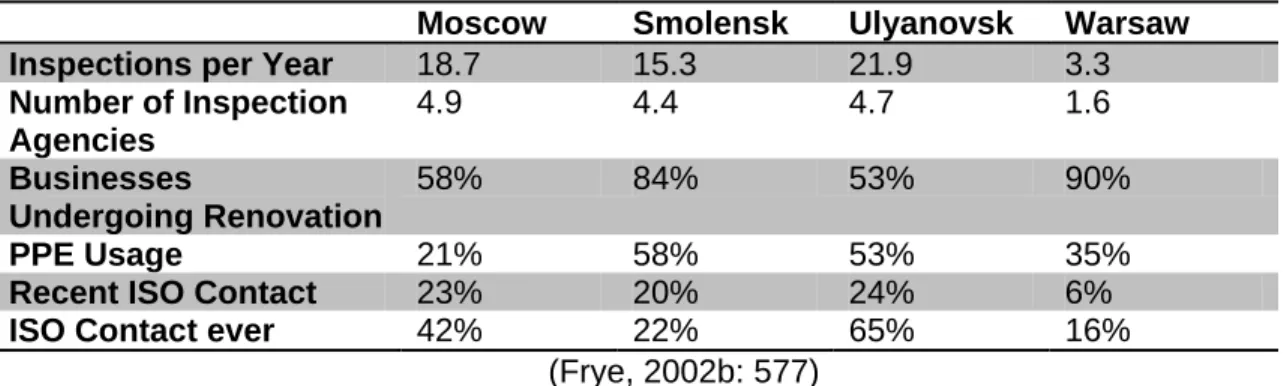
Of course, there might be other factors that could affect which type of protection a client chooses. An argument exists that, in the case of ISOs, the client’s desires may not be the driving factor in deciding whether or not a client enlists an ISO’s services. Evidence does exist to support the suggestion that ISOs actively seek out clients rather than the other way around. Businesses that undergo costly renovations, thus revealing an availability of capital, are more likely to be contacted by ISOs. If it is the ISO rather than the clients that drive the proposal of protection contracts, they would certainly be able to create the threats that would ensure such contracts are accepted by their clients (Frye, 2002b). If this general argument holds true, the strongest factors for determining whether or not a client chooses an ISO over another type of protection would be apparent wealth of the client and strength of the ISO in relation to available PPEs rather than what has already been suggested.
Case Studies
In order to test the validity of the enumerated expectations, the protection market in four different cities in 1996 will be examined. Moscow, as the center for both commerce and state authority in Russia, will serve as the Russian benchmark case to which other Russian cases can be compared. Smolensk, which offers relatively little state interference in
48
Many of the statistics used are adapted from Frye’s Private Protection in Russia and Poland. Some of his findings are reproduced here in Table 2.1. The number of inspection agencies and the inspections made per year will be considered, with the assumption that more inspection agencies doing the same job on multiple occasions is a symptom of regulation inefficiency and will raise the cost of doing business. When available, the percentage of businesses using the services of a PPE will also be used. ISO usage is extremely difficult to determine, as few clients will implicate themselves in having a relationship with a criminal organization. However, a rough statistic can be determined by asking clients if and how recently they have had any contact at all with an ISO. The
assumption can be made that, if a client has had contact with an ISO within the six months prior to the survey, it is likely that the client has enlisted its protection services.
Table 2.1 – State Regulation and Usage of Private Security Among Small Businesses, 1996
Moscow Smolensk Ulyanovsk Warsaw Inspections per Year 18.7 15.3 21.9 3.3 Number of Inspection
Agencies
4.9 4.4 4.7 1.6
Businesses
Undergoing Renovation
58% 84% 53% 90%
PPE Usage 21% 58% 53% 35%
Recent ISO Contact 23% 20% 24% 6%
ISO Contact ever 42% 22% 65% 16%
(Frye, 2002b: 577) Moscow