BRDSNBZ: A MIXED METHODS STUDY EXPLORING ADOLESCENTS’ USE OF A SEXUAL HEALTH TEXT MESSAGE SERVICE
Jessica Fitts Willoughby
A dissertation submitted to the faculty of the University of North Carolina Chapel Hill in partial fulfillment of the requirements for the degree of Doctor of Philosophy in the School of Journalism and Mass Communication.
Chapel Hill 2013
© 2013
iii ABSTRACT
JESSICA FITTS WILLOUGHBY: BrdsNBz: A mixed methods study exploring adolescents’ use of a sexual health text message service
(Under the direction of Dr. Jane D. Brown)
Sexual health text message services are becoming increasingly popular, but little is known about who uses such services and why. This project details the implementation of a campaign promoting a state-wide sexual health text message service that allows teens to text directly with a health educator and uses a mixed method design to assess who uses the service, what motivates use, and potential barriers to using the service. A theory of information seeking through text messaging is posited based on previous information seeking and communication theory and tested with adolescents.
A social marketing campaign was created promoting a North Carolina sexual health text message service and conducted in six middle and high schools in the North Carolina Piedmont region in Fall 2012. More than 2000 students in four schools
completed online questionnaires that assessed awareness of the service, perceptions, and use. Focus groups and in depth interviews were then conducted with middle and high school students.
v
ACKNOWLEDGMENTS
There are a number of people I wish to thank for their contributions to this project. I am incredibly thankful for my advisor, Dr. Jane D. Brown, for the guidance, support, and encouragement she provided throughout the project. I feel privileged to have had the opportunity to work with her. Thank you also to my committee members: Dr. Kelly L’Engle, Dr. Carolyn Halpern, Dr. Brian Southwell and Dr. Seth Noar. Their feedback throughout the project has been detailed, informative and thought provoking. Thank you for taking the time to contribute in such a meaningful way.
My thanks also go out to the individuals at the Adolescent Pregnancy Prevention Campaign of North Carolina, especially Kennon Jackson, Jr. who runs the BrdsNBz service. Working with him earlier in my doctorate program helped to spark my interest in this research area, which I still find fascinating. I also wish to thank the health educators and administrators in the various schools in Stokes and Cabarrus counties who helped make this project and evaluation possible.
I would also like to thank everyone who helped make the campaign a reality, including the individuals at the Lalor Foundation who felt this project was worth funding; Cyrus Huneycutt, the graphic designer who helped create the campaign promotional items; the teachers who promoted the BrdsNBz service in their schools; and the people at APPCNC who helped recruit participants for the formative research. Thank you.
vii
TABLE OF CONTENTS
ABSTRACT ... iii
ACKNOWLEDGEMENTS ... v
LIST OF TABLES ... ix
LIST OF FIGURES ... x
CHAPTERS 1. NEW MEDIA FOR SEXUAL HEALTH PROMOTION ... 1
Introduction ... 1
BrdsNBz ... 3
Project Scope ... 8
2. EVERYONE HAS QUESTIONS: EFFECTIVENESS OF A SOCIAL MARKETING CAMPAIGN PROMOTING USE OF A SEXUAL HEALTH TEXT SERVICE BY TEENS ... 10
Introduction ... 10
Everyone has Questions ... 12
Implementing the Campaign ... 15
Methods ... 16
Results ... 18
Discussion and Conclusions ... 21
3. TESTING A MODEL OF SEXUAL HEALTH INFORMATION SEEKING VIA TEXT MESSAGING………....25
Introduction ... 25
Literature Review ... 26
Hypotheses ... 36
Methods ... 37
Results ... 40
Discussion ... 44
Conclusions ... 48
Introduction ... 50
Literature Review ... 52
Research Questions ... 56
Methods ... 57
Results ... 60
Discussion ... 63
Conclusions ... 66
5. “HOW DOES THIS WHOLE BRDSNBZ THING WORK?” TEENS’ MOTIVATIONS AND BARRIERS FOR USING A SEXUAL HEALTH TEXT MESSAGE SERVICE ... 68
Introduction ... 68
Literature Review ... 69
Methods ... 73
Results ... 75
Discussion ... 83
Conclusions ... 86
6. DISCUSSION AND CONCLUSIONS ... 87
Limitations ... 91
Future Research ... 94
Conclusions ... 95
APPENDICES A. Promotion materials ... 96
B. Response rate table ... 98
C. Text based questionnaire ... 99
D. Online survey questionnaire ... 100
E. Focus group guide ... 117
ix
LIST OF TABLES
Table
1. Schools receiving campaign and data collected………..…8
2. School exposure to service and campaign……….20
3. Correlation matric of SEM model variables………..42
4. Demographic characteristics of BrdsNBz service users………61
5. Demographic characteristics of research participants………....77
LIST OF FIGURES
Figure
1. Example poster used in Everyone has Questions campaign………..14
2. BrdsNBz service use, June 2012-December 2012………...………..18
3. Theory of Motivated Information Management (Afifi & Weiner, 2004)………..28
4. Proposed model of motivators of sexual health information seeking………....36
CHAPTER 1
New media for sexual health promotion
Adolescence is a time of emotional, cognitive, and physical changes (Archibald, Graber, & Brooks-Gunn, 2008).1 Teens experience physical changes such as the
development of secondary sex characteristics and increased hormones. Their capacity to regulate emotions increases and more abstract thinking is possible (Yurgelun-Todd, 2007). Adolescents also often experience changes in their social environment associated with these factors, such as when others find them physically attractive and parents begin to allow more independent decision-making.
Adolescents often have questions about their physical development, relationships, and sex (Kang, Cannon, Remond, & Quine, 2009; Kang & Quine, 2007; Vickberg, Kohn, Franco, & Criniti, 2003; Willoughby & Jackson, 2013). Adolescents have indicated that they would like to get information about sex from their doctors (Boekeloo, Schamus, Cheng, & Simmens, 1996), parents, and peers (Boyer, Levine, & Zensius, 2011), but adolescents do not always turn to these resources for information. When adolescents do attempt to get sexual health information, they may face barriers such as lack of access, embarrassment, or lack of confidentiality (Ackard & Neumark-Sztainer, 2001; Boekeloo
1 Adolescence is the transitional stage between childhood and adulthood typically marked by the onset of puberty. Although some of the physical changes of puberty can begin earlier than adolescence (U.S. Department of Health and Human Services, 2012),
et al., 1996; Klein & Wilson, 2002). Adolescents have said that they feel uncomfortable bringing the topic of sex up with a physician, for example, although they want to talk about body changes, contraception, STDs and pregnancy. Girls report being more uncomfortable than boys in discussing such topics, and younger teens are more reluctant than older teens (Ackard & Neumark-Sztainer, 2001).
With the difficulty associated with getting health information from such interpersonal sources, teens often turn to other sources of information, including the Internet. According to representative surveys, half of all 8-to-18-year-olds in the United States have used the Internet for health information (Rideout, Foehr, & Roberts, 2010). More than 40 percent of online teens have specifically sought information on topics related to sexual health, such as pregnancy, birth control, HIV/AIDS or other STDs (Rideout, 2001). Information on the Internet may contain inaccuracies, however, and some websites that young people use may not be as high quality as commercial sites (Buhi et al., 2010). Additionally, adolescents may have trouble finding the information they want when using the Internet to search for sexual health information (Buhi, Fuhrmann, & Smith, 2009; Hansen, Derry, Resnick, & Richardson, 2003).
Practitioners who work to improve adolescents’ sexual health have been looking for new ways to provide teens with accurate and timely sexual health information and have begun focusing on providing information in channels and media, such as cell
3
average, 1.5 hours a day sending and receiving text messages (Rideout et al., 2010). About half of U.S. adolescents send on average 1,500 text messages a month (Lenhart, Ling, et al., 2010), and one in three sends more than 100 text messages a day -- 3,000 text messages a month. Because of such active use, text messaging has become an
increasingly popular way to reach teens with sexual health information (Levine, 2011). Three main types of text messaging services provide sexual health information for adolescents and young adults. One involves the use of an automated service in which the teen texts the service to opt in and then receives a menu with instructions to text certain prompts for specific information. One example of this is the San Francisco SexINFO service (Levine, McCright, Dobkin, Woodruff, & Klausner, 2008). Another type allows teens to opt in to the service and receive messages related to sexual health on a regular basis (e.g., the Hookup). This type of service has been shown to significantly increase knowledge and possibly influence behaviors (Gold et al., 2011). A third type, known as two-way text message services, allows for a teen to text any question to a sexual health educator who replies with factual information (Phillips, 2010). An example of this is the North Carolina BrdsNBz service.
BrdsNBz
quickly and confidentially (Phillips, 2010). The service is anonymous, with a system de-identifying the sender before the health educator receives the question and responds.2
BrdsNBz has received national acclaim and been promoted in various news outlets, including a New York Times article (J. Hoffman, 2009). The service received the Healthy Teen Network’s National Outstanding Emerging Innovation Award in 2010, an award for Best Practice by the National Clearinghouse for Families and Youth, and was runner up for the Southeastern Council of Governments’ Innovation Award in 2010. The service now offers licenses to organizations in other states (e.g., Maryland, Texas, South Carolina and Washington) so that they can provide the service in their area without incurring startup costs.
The purpose of BrdsNBz is to provide adolescents with information about sexual health with the hope that accurate information will help reduce negative sexual health outcomes such as teen pregnancy and sexually transmitted diseases (STDs). Teen pregnancy and STDs are problematic in the United States—the United States has one of the highest teen birth rates of all developed countries (Martinez, Copen, & Abma, 2011) and adolescents and young adults in the United States frequently contract STDs (Centers for Disease Control and Prevention, 2010). Teens acquire nearly half of all STDs, but are only about a quarter of those who are sexually experienced (Weinstock, Berman, & Cates, 2004).
A variety of physical and psychosocial variables have been found to be associated with negative sexual health outcomes in adolescents. For example, teens from a lower
5
socioeconomic status or those who develop earlier than their peers may initiate sex younger, and be at greater risk for teen pregnancy and contracting STDs (Udry, 1979; Young, Turner, Denny, & Young, 2004). Other factors such as frequent exposure to sexual media content, lack of parental monitoring, and weak connection to schools have been found to be associated with sexual risk behaviors (Brown et al., 2006; Collins et al., 2004; Kirby, 2002a, 2002b; Lohman & Billings, 2008).
Similar to BrdsNBz, other sexual health text message services are also targeted to populations that may be more likely to experience negative sexual health outcomes. For example, SexINFO targeted ads promoting their service to African Americans in
neighborhoods of lower socioeconomic status (Levine et al., 2008). An evaluation of the promotion found that awareness of the service was higher with members of the target audience—young African Americans.
sent on a regularly scheduled basis as a form of mobile advertising. In Australia,
individuals can agree to receive mobile advertisements in exchange for access to certain Internet sites on their phones.
A randomized controlled trial evaluating a similar service in Australia recruited young adults at a music festival and placed them either in a control group or an
intervention group that received messages about sexual health through email and text messages (Lim et al., 2012). After 12 months, knowledge about sexually transmitted infections was higher in the treatment group and women in the intervention group were more likely to have had an STI test or talked to a doctor about sexual health.
7
Another study focused on evaluating a campaign promoting the San Francisco-based SexINFO service (Levine et al., 2008). Surveys were conducted at local clinics to which the service referred texters. The evaluation mainly assessed service awareness and did not include an evaluation of who used the service or impacts of service use.
Awareness of the service was highest among the targeted audience – young African Americans with cell phones in the target neighborhoods. The study found that only 10% of people who heard about the service had used it, but no additional information was provided on users. The evaluation did not consider who actually used the service and their motivations for use.
Theories of information seeking suggest various motivating factors for seeking information (Afifi & Weiner, 2006; Kahlor, 2010), but little of this theorizing has been applied to text messaging services for health. Research is needed to understand what motivates an adolescent to use a sexual health text message service and to evaluate their impact and efficacy (Noar & Willoughby, 2012; Willoughby & Jackson, 2013). This project is designed to move the study of mobile sexual health research forward by examining who uses such services and why in the context of theories of information seeking. Additionally, studies previously conducted have looked primarily at the impact of text message services that send messages to adolescents on a regularly scheduled basis. This study will instead look at a different and increasingly common type of service that allows teens to seek out information related to sexual health.
Limited promotion has occurred in health education classes in a few schools and in targeted MySpace advertisements when the program was first available, but little else has been done since to promote use of the service by teens in North Carolina. This project first promoted the service to N.C. adolescents in three middle schools and three high schools and then assessed which adolescents used the service and what motivated use. Project scope
This project used a sequential explanatory mixed methods design, specifically a post-test only field experiment followed by focus groups and interviews, to examine: (1) which factors influence an adolescent’s decision to use a sexual health text message service; (2) whether adolescents at greater risk for negative sexual health outcomes use a sexual health text message service; and (3) why adolescents may or may not use such a service. As part of this project, existing theories of information seeking were modified and applied to help explain adolescents’ sexual health information seeking via text messaging.
In this dissertation the evaluation of the in-school campaign promoting the BrdsNBz service is discussed first (Chapter 2). The campaign was conducted in six schools in the North Carolina Piedmont. All students in four of the schools were invited to complete online questionnaires, with students in one middle school completing a shortened questionnaire due to time restrictions (See Table 1 for details on schools). Table 1. Schools receiving campaign and data collected
School City, County Complete
survey taken N Chapter in which data are used
West Stokes HS King, Stokes Yes 802 2, 3, 4, 5
Chestnut Grove MS King, Stokes Yes 596 2, 3, 4, 5
9
In the following chapters, the main research questions of why a teen might choose a sexual health text message service, who is using such services, and what barriers may prohibit use, are addressed. Each of these chapters is written as a stand-alone article suitable for submission to a peer-reviewed journal; targeted journals are listed at the beginning of each chapter.
In Chapter 3, the motivations behind use of a sexual health text messaging service are explored, specifically examining the role of uncertainty, affect, credibility, efficacy and attitudes on intent to use. The chapter discusses various theoretical models of information seeking, and posits a new model applied to sexual health text message services, based on teens’ use of the BrdsNBz service.
CHAPTER 2
“Everyone has questions:”
Effectiveness of a social marketing campaign promoting use of a sexual health text
service by teens
Sexual health text services are becoming an increasingly popular way to provide sexual health information to adolescents (See Lim, Hocking, Hellard and Aitken, 2008 and Levine, 2011 for a review of these types of services). More than three-fourths of adolescents have cell phones, and most teens use text messaging. On average, about half of teens send 1,500 text messages a month, or 50 text messages a day. About one third of teens send 100 text messages a day or more (Lenhart, Ling, et al., 2010). Research with teens also demonstrates that cell phones and text messaging are a way that teens are interested in accessing information on sexual health (Gold et al., 2010; Wright et al., 2011).
11
Little research to date has focused on the promotion of sexual health text message services. An exception is the San Francisco SexInfo service that allows young people to access an automated service menu that provides prompts so that the texter can text for information on topics such as sexually transmitted diseases and contraception (Levine, et al., 2008). The SexInfo service was promoted to teens and young adults in San Francisco, encouraging awareness of the service. Promotions included posters, palm cards and bus shelter ads that were placed in locations populated by African American youth (the target audience). Palm cards were distributed on the street and in school and banner ads targeted youth ages 18-24 on a website (Yahoo). In an evaluation of the campaign that used a convenience sample of young adults in three clinics to which SexInfo users were referred, researchers found service awareness high among the target population.
Although the SexInfo campaign was found to increase awareness, to date, no other articles have been published about promotions of sexual health text message services, and none have focused on the promotion of a service that allow teens to interact directly with a health educator. Such services are becoming increasingly popular due to low start up and maintenance costs (R. Adler, 2009; Fogg & Allen, 2009). This article discusses and assesses the effectiveness of a social marketing campaign that was created to promote a state-wide text message service connecting adolescents to health educators. BrdsNBz
BrdsNBz is a two-way text messaging service created and run by a non-profit organization in central North Carolina (Phillips, 2010). The organization created
information about sexual health. BrdsNBz has received coverage in the New York Times (J. Hoffman, 2009) and a number of awards.3
The purpose of BrdsNBz is to provide adolescents with information about sexual health with the hope that accurate information will help reduce negative sexual health outcomes such as teen pregnancy and sexually transmitted diseases (STDs). More than one-third (39%) of teens have indicated that health information they acquire online has influenced health behaviors (Rideout, 2001) and accurate information is an important component for adolescents’ sexual health decision making (Bearinger, Sieving, Ferguson, & Sharma, 2007). Although the BrdsNBz service has been available in North Carolina since 2009, it has not been well-promoted. Targeted MySpace ads were used in 2009 to increase awareness, but most marketing has been limited to word of mouth efforts by health educators in schools. Thus, a social marketing campaign was created to promote the North Carolina BrdsNBz sexual health text message service.
Everyone has Questions
The Everyone has Questions campaign was developed using a social marketing strategy. Social marketing uses marketing principles and techniques to convince a target audience to voluntarily change behavior (Kotler, Roberto, & Lee, 2002). Social
marketing campaigns are built on the idea of exchange theory, focusing on the views of the consumer and the benefits that can be provided to them (Lefebvre & Flora, 1988). The product being marketed in this case was a service – BrdsNBz, a sexual health text-messaging service. The goal of the campaign was to increase awareness of the BrdsNBz
13
service and to encourage teens to use it if they had questions they wanted answered by a health educator. Price associated with BrdsNBz could include the actual cost of text messaging. Although the service is free and available to all teens in North Carolina (Phillips, 2010), cell phone providers may charge individuals for each text message sent or received. Additionally, there could be a cost of embarrassment at using such a service or having questions related to sexual health.
Formative research was conducted with the target audience - teens in North Carolina - to better assess perceived price issues and other elements of the marketing mix (i.e., the 4 Ps). The target audience in this case was fairly broad. While the text message service was designed for all North Carolina teens, it is intended mainly for teens aged 13-18 (who are most likely to be sexually active or approaching an age where they will become sexually active). In-depth interviews, followed by focus groups, were used to gain insight into what teens perceived as both the benefits and costs of using such a service. The information gathered from this formative research was then used to develop the campaign promoting the service.
were conducted after the messages had been created to garner feedback on attractiveness, comprehension, and relevance of the specific messages.
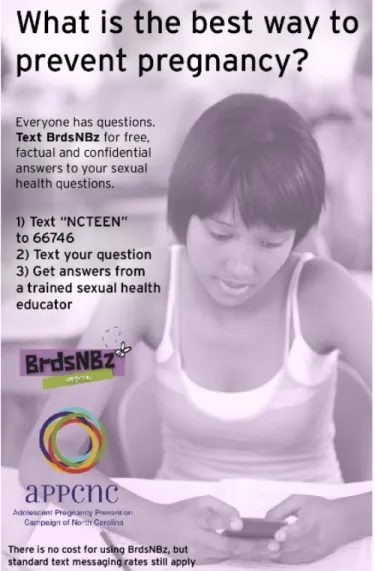
Figure 1: Example poster used in Everyone has Questions campaign
15
with information on the BrdsNBz service were distributed at school events and in classes. These promotional items included pens and highlighters, water bottles, sticky notes, lip balms, flyers, and wallet cards (See Appendix A for examples of the promotional materials).
Promotional items were developed and distributed because they allowed teens to have access to information about the BrdsNBz service with them at any time, and to see these items being used by others and be reminded about the service. The items were meant to serve as a “cue to action” (a concept from the Health Belief Model (Champion & Skinner, 2008)), reminding and encouraging teens to use the service if they had a question about sexual health. Formative research and feedback from an advisory group of teens in one of the target schools provided information on which promotional items would be seen as most interesting to teens.
Implementing the campaign
The campaign began in Fall 2012 and was implemented by health educators in the schools that participated. The purpose of the evaluation was to assess the effectiveness of the campaign, in the hopes of creating a campaign that could be prepared and distributed to other schools in North Carolina to increase service awareness and use. Health
The schools’ health educators were provided with materials to promote the service in the participating schools. One health educator served as the main contact in each county. The campaign began in September, with the start of the school year. Each middle school received 10 copies of three different posters; high schools received 10 copies of four different posters.4
Health educators were then provided with pens and wallet cards (~2,500) that had information on the BrdsNBz service including procedures for use and contact
information. In October and November, additional promotional items were provided including lip balms (~ 500), water bottles (~ 200), and sticky note pads (~200). Health educators distributed items as they saw fit; at the alternative high school and middle school promotional items were distributed at school events (i.e., football games); the other schools distributed items primarily in homeroom classes.
The health educators also encouraged awareness of the service in other ways. One health educator encouraged students to save the BrdsNBz number to their cell phones and gave promotional items to teens who did. One school included information about
BrdsNBz in the morning announcements. Another health educator had the students in her health class create commercials promoting BrdsNBz that aired on the local school cable channel.
Methods
Three methods of evaluation were used to assess campaign effectiveness: a text message survey of service users; service use data from the organization that runs the
17
BrdsNBz service; and an in-school online questionnaire in the schools receiving
promotions. Service use data included how many new users accessed the service and how many texts were sent to the service. When individuals used the service for the first time, they first had to “opt in.” To opt-in, the texter sent the code word (NCTeen) to a phone number that allowed users to access the terms of use and then be able to use the service. The number of opt-ins thus represented new service users.
A short text message questionnaire was sent every two weeks to all new service users. An open-ended question asked about where they heard about BrdsNBz. Of the 173 new service users who were sent a text questionnaire over the campaign period, 76 responded for a response rate of 43.9%.
The in-school online questionnaire was conducted in December-January in four of the six schools in which the campaign was run. Questions asked about awareness, use and perceptions of the service. In the middle schools, students typically took the survey during a specific class period (i.e., physical education) and in the high school, computer labs were set up to allow students to access the online questionnaire during a specific class period (i.e., second block). Of the six schools, four (three middle schools and one high school) asked students to complete the online questionnaire. Students in one of the middle schools that participated completed a shortened questionnaire due to time
Results
Service use did increase during the campaign (See Figure 2, which shows the number of new BrdsNBz users and the number of texts the service received per month). Figure 2: BrdsNBz service use, June 2012-December 2012
As can be seen in Figure 2, promotion of the service began in September, although one school was promoting the service as early as late August, which is when a brief spike in use and texts sent to the service occurred. In September, schools began displaying the posters, which also was associated with an increase in use. Later in
19
and to opt in to the service. Her students may have opted in but not asked a question. The use data dropped off in December after all promotional items had been distributed and only the posters remained.
According to the text-based survey, 67.1% of new users (N= 51) said they heard about BrdsNBz through the campaign or through their school.
In the school-based on-line survey, more than half (50.4%) of respondents said they had heard of BrdsNBz. Almost two-thirds (63.7%) of teens who had heard of BrdsNBz reported hearing about it or seeing advertising for it in the last three months. Additionally, teens were able to not only recognize that they had heard of BrdsNBz, but a number of teens were able to recall information about the service.5 Of participants who said they had heard of a sexual health text service, 55.8% correctly identified the name of the service as “BrdsNBz”6 and 46.3% correctly identified the purpose of the service as answering teens’ questions about sexual health via text message.7
Most teens who reported hearing of BrdsNBz in the last three months (n=651) reported hearing about BrdsNBz through posters (59.8%, n=389), a class (50.4%, n=328), from giveaway items (37.2%, n=242), from flyers or handouts in school (25.5%, n=166) or from friends (21.4%, n=139).8 Of all the teens in the schools surveyed, regardless of
5 Only data from three of the schools was used in this analysis because one middle school required a shortened questionnaire. The open-ended recall questions were omitted from the shortened questionnaire and instead a recognition question was asked.
6 Or some spelling variation of BrdsNBz.
7 Responses that indicated BrdsNBz answered sexual health questions via text were coded as correct.
their awareness of the BrdsNBz service, 6.7% (n=144) used the BrdsNBz service. Of participants who indicated they had heard of BrdsNBz, 14.1% used the service.
To examine whether service use differed by school, a series of variables related to awareness were assessed. The high school in the analysis appeared to have been the most successful at promoting the service with more teens in the high school having heard about BrdsNBz (62.5%) and using the BrdsNBz service (11.2%) (See Table 2). Teens in the high school also reported receiving more promotional items such as pens (26.3%) and water bottles (17.7%).
Table 2. School exposure to service and campaign Heard
about BrdsNBz
Saw posters promoting
service
Received pen Received water bottles
Used BrdsNBz
School name % (n) % (n) % (n) % (n) % (n)
High School A (802) 62.5 (501) 44.3 (355) 26.3 (211) 17.7 (142) 11.2 (90) Middle School A (596) 54.5 (325) 11.9 (71) 9.1 (54) 5.4 (32) 2.9 (17) Middle School B (311) 53.1 (165) 28.3 (88) 17.7 (55) 7.4 (23) 7.7 (24) Middle School C (416) 11.8 (49) 4.8 (20) 1.7 (7) 2.2 (9) 3.1 (13)
To examine differences in service awareness and use by school, z tests of proportion were used. Service awareness differed by school, with significantly more students in High School A reporting awareness of the service than students in any other school (p<.001). Students in Middle School A and Middle School B were also
21
significantly more awareness of the service and more use, had a health educator who served as a champion for the campaign. Teens in Middle School B, which also had a higher service use, also had a health educator who was a proponent of the service. Middle School C, which had the least awareness and service use, had a health educator who served as a champion for the service but who worked with the school only on a part-time basis.
Discussion and Conclusions
The three types of data used to assess the effectiveness of the campaign document that the campaign successfully informed teens about the BrdsNBz service and increased use. Although not all teens in all the schools were aware of the service, the use data suggests a correlation between campaign-related activities and use. The text message survey data indicate that the majority of teens who used the service for the first time during the campaign heard about the service from the campaign.
less enthusiastic campaign facilitators. Descriptive statistics of how students heard of the service supports this conclusion, as about half of the students who said they had heard of BrdsNBz also said they had heard about it in a class. Middle school C also had a health teacher who supported the project and worked to promote the service, but since her work at the school was part time, this could have limited interaction with students and lessened the level of campaign awareness. This campaign relied heavily on health educators who typically are the school employee most likely to be communicating with students about health issues. One purpose of this evaluation was to assess whether providing schools through their health educators with items to promote a sexual health text service would increase use and awareness. The results suggest that it is important to enroll health educators in the project to ensure endorsement and distribution of materials.
23
conducted participated in the post-exposure survey, which could limit the generalizability of findings.
It also should be noted that the campaign was expensive (approximately $5000) when the relatively small number of users is taken into account. Clearly, promotion of the service was helpful in generating use but return on investment is also important to
consider, especially for low-budget non-profit organizations such as the organization running BrdsNBz. This extensive campaign that included posters, word of mouth, and promotional items cost approximately $833 per school. Based on the in school survey, four of the schools had 144 BrdsNBz service users. This means that the campaign cost approximately $24 per user ($833/144).
Mass communication campaigns to promote health often do not focus on cost effectiveness, but campaign planners probably should think more about how they can get the most for their often scarce funds (Bertrand, O'Reilly, Denison, Anhang, & Sweat, 2006). Noting that the posters and in class information about BrdsNBz were two of the most common ways teens indicated they had heard of the service suggests that perhaps focusing future in-school campaigns on posters and word of mouth would be sufficient to increase use. Relatively expensive promotional items, such as water bottles and pens, may not be worth the cost.
what influences teens’ decisions to use such services and why they might not use such services when they are aware of them. Since more than 85% of the students in the school survey sample said they send text messages, clearly this medium is a viable option for reaching teens, but it will be valuable to learn more about service perceptions and motivations for use. The following chapters in this dissertation help to address some of these questions.
CHAPTER 3
Testing a model of sexual health information seeking via text messaging
Text message services that provide sexual health information to adolescents are becoming increasingly popular, although it is unclear when a teen might turn to such a resource for sexual health information. Teens have indicated that they are interested in obtaining sexual health information from parents, peers, and physicians (Boyer et al., 2011), but they often face barriers such as embarrassment (Ogle, Glasier, & Riley, 2008) or a lack of confidence in the information provided (Boyer et al., 2011). Since sexual health text services provide teens access to information in an anonymous and convenient format, such services might be a way to overcome such barriers.
Although specific theories related to adolescents’ sexual health information seeking do not yet exist, the current literature provides insight into what motivates someone to seek information more generally. Information seeking is also becoming an increasingly popular area of study within health communication, with researchers focusing on when and why a person will seek health information.
A number of models of information seeking exist (e.g., the Planned Risk Information Seeking Model, the Comprehensive Model of Information Seeking, the Theory of Motivated Information Management, etc.) but it is not clear in the interactive media environment which factors are most important for information seeking by
sexual health, but they often do not feel that they can go to health care professionals or their parents for information (Boekeloo et al., 1996; Ogle et al., 2008). The majority of teens have sought health information online, and many online teens (44% in one
nationally representative sample) have sought information about pregnancy, birth control, HIV/AIDS or other STDs (Rideout, 2001). More than one-third (39%) of teens who have searched for health information online indicated that they changed their behavior because of the health information they found (Rideout, 2001), and having accurate information about sexual health is important for adolescent sexual health decision making (Bearinger et al., 2007). Although many teens are searching online for sexual health information, Jones and Biddlecom (2011) found from interviews with a small sample of adolescents that the Internet was not seen as a main source of information about contraception and abstinence, in part because the adolescents did not trust the information they could find.
It currently is not clear what affects an adolescent’s decision to use a new media resource, such as a text messaging service, for sexual health information. This paper proposes a theoretically grounded model of what influences teens’ decisions to use an interactive sexual health text message service and tests the model with a sample of adolescents.
Information seeking models
27
Afifi & Weiner (2004) proposed the Theory of Motivated Information Management (TMIM) to address information seeking in interpersonal contexts. The model has been applied to a number of topics including partner discussions about sexual health (Afifi & Weiner, 2006) and family discussions about organ donation (Afifi et al., 2006). Other theories, such as the Planned Risk Information Seeking Model (PRISM), proposed by Kahlor (2010), do not specify the context in which the model applies, suggesting that the model is relevant for both interpersonal and mediated communication.
Theoretical linkages
Because text messaging is a kind of computer-mediated communication that involves elements of interpersonal communication (one person texts and another person responds), interpersonal communication models are relevant. One theory that has empirical support is the Theory of Motivated Information Management (See Figure 3) (Afifi & Weiner, 2004). According to TMIM, uncertainty about information can lead to anxiety that prompts individuals to evaluate the possible outcomes of seeking the desired information and to assess whether they are able to acquire the information they desire (Afifi et al., 2006; Afifi & Weiner, 2004; Afifi & Weiner, 2006). The most recent
revision of the model (Afifi & Morse, 2009) includes emotion as a mediator influencing information seeking, instead of only anxiety.
Figure 3: Theory of Motivated Information Management (Afifi & Weiner, 2004)
TMIM, similar to other information seeking theories (i.e., Uncertainty
Management Theory) posits that the information seeking process begins with uncertainty. According to Brashers (2001), uncertainty exists when “details of the situation are
29
of knowledge in general” (p. 478). TMIM does not use the general concept of
uncertainty, however, and focuses instead on the specific role of uncertainty discrepancy, which is the difference between a person’s current level of uncertainty and his or her desired level of uncertainty (Afifi & Weiner, 2004). Other researchers have used similar concepts in their information seeking models. The Planned Risk Information Seeking Model (Kahlor, 2010), for example, includes the concept of “information insufficiency.” Information insufficiency is the “perceived need for additional information, which is the difference between perceived current knowledge and knowledge needed to deal
adequately with the risk” (p. 374).
Information insufficiency, like uncertainty discrepancy, is derived from the concept of a sufficiency threshold (Chaiken, 1980) postulated in the Heuristic-Systematic Processing Model (Chaiken, 1987). That model of information processing proposes that how individuals process information depends on the distance between a person’s actual confidence about an issue and their desired confidence level (Afifi & Afifi, 2009). This gap between the actual level of confidence and the desired level of confidence can be closed when one has sufficient information about the desired topic. Although information insufficiency is not referred to as “uncertainty,” it fits with Brashers’ (2001) definition as it focuses on insecurity about levels of knowledge. Here the term “uncertainty
discrepancy” will be used because more empirical research has documented the existence of this concept.
emotions such as fear and hope may stimulate information seeking (Afifi & Morse, 2009). Discrete emotions are believed to result from unique combinations of cognitive appraisals of a situation (Lazarus, 1991; Scherer, Schorr, & Johnstone, 2001). These appraisals are often automatic (Zemack-Rugar, Bettman, & Fitzsimons, 2007) and involve assessing how an individual’s goals may be impacted by a situation. This can result in tendencies to think or act in certain ways (Fredrickson, 1998; Frijda, Kuipers, & ter Schure, 1989; Lazarus, 1991). Appraisal theories of emotion predict that higher levels of uncertainty lead to discrete emotions, such as fear, anxiety, or hope (Lazarus, 1991; Smith & Ellsworth, 1985).
Other information seeking theories also are based on elements of the appraisal theories of emotions. The Risk Information Seeking and Processing Model (RISP) posits that perceptions of risk are associated with emotions (Griffin, Dunwoody, & Neuwirth, 1999; ter Huurne, Griffin, & Gutteling, 2009). Previous research has indicated that there are significant and positive associations between risk perceptions and affective responses and perceived need of additional knowledge (ter Huurne et al., 2009). These theories indicate that when an adolescent is more uncertain about a sexual health topic than he would like to be, he is likely to feel some sort of affect,9 and this affective response may occur automatically and impact future behaviors. In Kahlor’s (2010) test of PRISM, affect, which in her study captured elements of worry and fear, was found to be a significant predictor of information seeking.
31
According to the TMIM, after experiencing some type of affect, an individual will progress through a series of stages, cognitively assessing (although this may be done subconsciously) outcome expectancies and efficacy evaluations. Outcome expectancies are defined as the benefits and costs that a person expects will result from action (Afifi & Weiner, 2004). Outcome expectancies are similar to attitudes, only more specific in terms of the context of information seeking. One example of an attitude toward seeking would be a person’s perception that seeking information about his sexual health is useful. Research has found mixed results in the relationship between information seeking and outcome expectancies (e.g. Afifi et al., 2006). Attitudes toward seeking have been found to significantly predict seeking behaviors, however (Kahlor, 2010), and research has found that attitudes toward behaviors are strong predictors of actual behavior (Ajzen & Fishbein, 2005). Because of the amount of research that has been done on attitudes and the stronger understanding of their relationship to behavior, this model will include attitudes toward seeking instead of outcome expectancies.
Self-efficacy is also similar to the concept of perceived behavioral control from the Theory of Planned Behavior, which Kahlor (2010) uses in the PRISM information-seeking model. In Kahlor’s model, perceived behavioral control is a significant predictor of information seeking. Similar concepts related to self-efficacy have been studied in new media environments. Internet self efficacy, which is a person’s perceived ability to use the Internet to get health information, has been found to be a mediator between health and web variables and information seeking behaviors (Rains, 2008). In Dutta-Bergman’s (2006) model of Internet use for health care, efficacy is predicted to impact Internet use behaviors and more distal health outcomes.
Based on these various findings, it is likely that communication efficacy related to text messaging would mediate the connection from uncertainty discrepancy and
emotional response and information seeking behaviors. For example, an adolescent who has some knowledge about STDs, but doesn’t feel that she knows enough about STDs to adequately protect herself, may experience anxiety about her lack of knowledge. She may then evaluate whether she thinks she is capable of accessing the information she desires. This decision about whether she has the ability to get the desired information will influence her information seeking behaviors.
The second type of efficacy in TMIM is coping efficacy, which is related to the individual’s judgment of whether he or she has the resources to deal with the outcomes of using a particular information management strategy. An example of this would be
33
(Afifi & Weiner, 2006). Although the TMIM makes a case for this type of efficacy, it does not seem to fit in a mediated situation and is more tied to some of the interpersonal contexts in which TMIM has previously been studied. It will therefore not be included in the model or this study.
Target efficacy in TMIM is related to an individual’s assessment of whether the target the person hopes to acquire information from has “access to the sought-after information and is likely to be honest in her or his transmission of information” (Afifi & Morse, 2009, 89). The concept of target efficacy is similar to the concept of credibility, which is often examined in the study of computer-mediated communication (Eysenbach, 2007; Yifeng & Sundar, 2010) and has been found to be a significant predictor of
information seeking behaviors online (Lemire, Paré, Sicotte, & Harvey, 2008). Three dimensions of credibility have been identified: medium credibility (the level of trust people have in a specific medium); source credibility (the perceived ability and motivation of the source within the medium to provide accurate information); and message credibility (elements of the message itself are examined and determined to be credible or not) (Yifeng & Sundar, 2010).
be included as independent concepts in the model and empirical tests. These elements of attitude, self-efficacy evaluation, and credibility assessment likely influence one’s intent to and experience with seeking information.
Connecting the model to text messaging for sexual health information
In the example of using a text message service for sexual health information, it is proposed that even before an adolescent experiences uncertainty, individual factors will predispose him or her to some level of uncertainty (See Figure 4). Other models have posited that predisposing factors, such as demographics, personality or situation may impact evaluations and then outcomes indirectly (Dutta-Bergman, 2006; Josefsson, 2006). Adolescence as a developmental stage is a time of physical, cognitive, and
emotional growth (Archibald et al., 2008). Teens may be more predisposed to experience uncertainty if they are from certain backgrounds, or if they are experiencing the changes associated with adolescence differently than their peers. For early maturing females, for example, the mass media have been found to be important sources of information, sometimes even serving as a kind of “sexual super peer” (Brown, Halpern, & L'Engle, 2005). Early maturing teens may be more likely to have additional levels of uncertainty because of the timing in which they are experiencing changes, and may turn to the media for information because other sources such as peers and parents may not recognize their interest in sexual topics.
35
Jackson, & Brown, 2006). Adolescents with a higher cognitive susceptibility to sex have been found to have greater sexual desire, increased perceptions of the amount of sex in which their peers are engaged and more confidence in having sexual relationships than their abstinent peers (L'Engle et al., 2006). Pubertal timing and cognitive susceptibility, as well as various demographic factors, could impact the adolescent’s level of uncertainty discrepancy, indicating that there is more information the teen would like to know.
According to the TMIM, uncertainty discrepancy will generate an emotional response. Depending on the adolescent’s immediate context, this emotional response could involve perceptions of risk or anxiety, as many information-seeking models posit (e.g. TMIM, RISP), or could increase interest or confusion, which could encourage health information seeking. Motivated by emotions, the adolescent will assess his or her attitude toward seeking, in this case the benefits and drawbacks of seeking sexual health
information from a text service. The adolescent will also assess efficacy levels associated with seeking information from a particular source. This includes assessing their personal efficacy, which is whether they are confident in their ability to get the desired
Figure 4: Proposed Model of Motivators of Sexual Health Information Seeking
Based on the proposed model the following hypotheses and research questions will be addressed:
H1: Adolescents who experience early pubertal timing will have increased levels
of uncertainty discrepancy.
H2: Adolescents who have higher levels of cognitive susceptibility to sexual
behavior will have increased levels of uncertainty discrepancy.
H3: Uncertainty discrepancy will lead to an affective response (e.g., anxiety,
worry).
H4: Uncertainty discrepancy, as mediated by affect, will be related to (a) attitude
evaluations, (b) efficacy evaluations, and (c) credibility evaluations.
H5: Positive evaluations will be associated with greater intent to use a sexual
health text message service for sexual health information. Uncertainty
Discrepancy
Affect (e.g. worry)
Attitudes (e.g. good, helpful)
Efficacy
Credibility
Intent to use sexual health text service Evaluations of Sexual Health
Text Service
Pubertal Timing
37
RQ1: Does the proposed model, as applied to sexual health information seeking
among adolescents, provide a good fit for the data? Method
A three-month long campaign promoting a local sexual health text message service was conducted in three middle and three high schools in one Southeastern state in Fall 2012. The campaign promoted the sexual health text service BrdsNBz, which allows teens to text a sexual health question to a trained health educator (Phillips, 2010).
BrdsNBz has been available in the state since 2009, but promotion had been limited. Students in three of the schools (two middle and one high school) completed a
questionnaire through Qualtrics, an online survey management program.10 All students were asked to assent before completing the survey, and parents could opt their student out of participating when forms went home with school information at the beginning of the year. The survey took approximately 20 minutes and was conducted during a time at school that administrators deemed appropriate (e.g., during the second block period in the library). For participating in the project, teens could provide their name and email address at the end of the otherwise anonymous survey for a chance to win gift cards for students in their school. The University’s Institutional Review Board approved all procedures.
Of the students in the three schools whose data are used in this study, 1,709 participated in the survey out of 2,040 who would have been able to complete it on any given date for the response rate of 87%. Data were entered first into PASW 18.0 for
cleaning and preliminary analysis. Cases then were selected for inclusion in the sample if participants indicated that they sent text messages (“Do you send text messages?”) and they had heard of the BrdsNBz service (“Have you heard of a sexual health text message service called BrdsNBz?”). These two criteria were necessary because lack of the use of text messaging would impact intent to use a text message service and participants who had not heard of BrdsNBz were not asked the intent to use question. This left a sample of 870 participants.
Measures
Uncertainty discrepancy was measured with three items. Teens were asked to select the statement that best described them from the following options: “Which of the following statements best describes you: I know everything I want to about sexual health; I know a lot about sexual health, but I would like to know a little more; I know some about sexual health, but there is still some I would like to know; I know a little about sexual health, but there is still a lot I would like to know; I know nothing about sexual health, but there is very much I would like to know.” The other two items were on a five-point Likert-type scale (1 = completely disagree, to 5 = completely agree) “I want to know more about sexual health topics than I do” and “I wish I knew more about sexual health.”
Previous research has used a change score to assess uncertainty discrepancy (Afifi & Weiner, 2004; Afifi & Weiner, 2006) and the related concept of information
39
adolescents indicated that the items were unclear and confusing. Additionally, previous research has indicated that calculating a change score can be problematic (Rosenthal, 2012). Given that other researchers have successfully measured the similar construct of information insufficiency without a change score, a similar strategy was employed here. The scale was found to be reliable (α=.79).
Demographic characteristics such as age (how old are you?), gender (what is your gender?) and race were measured. Pubertal timing was measured with the question “Do you think your body development is earlier or later than most girls/boys your age? Much earlier, somewhat earlier, about the same, somewhat later, much later.” This item has been found to be a strong proxy for other measures of pubertal timing such as breast development and age at menarche (Halpern, Kaestle, & Hallfors, 2007).
Cognitive susceptibility was measured with five items on five point scales (L'Engle & Jackson, 2008; L'Engle et al., 2006) with items such as “If you had a boyfriend/girlfriend, how sure are you that you could refuse to have sex with him/her if you didn’t feel like it? Extremely sure to not at all sure” and “How likely is it that you will have sex while in high school? Very unlikely to very likely.” The scale was found to be reliable (α=.84).
Attitudes toward the sexual health service were measured with three items, measured on a five-point Likert-type scale ranging from completely disagree to
completely agree: “Services that let you text a sexual health question to a health educator can be…helpful; good; useful.” The scale was found to be reliable (α=.94).
Efficacy evaluations were measured with three items on a five-point Likert-type scale ranging from completely disagree to completely agree (e.g. “I am confident I know how to use the BrdsNBz service.”). The scale was found to be reliable (α=.84).
Credibility of the service was measured with three items on a five-point Likert-type scale ranging from completely disagree to completely agree (e.g. “I can trust information from BrdsNBz.”). The scale was found to be reliable (α=.91).
Intent to use the service was measured with one item: “Suppose you had a question about a sexual health topic. How likely is it that you would use the BrdsNBz service? Very unlikely, somewhat unlikely, somewhat likely, very likely.” Intent to use the service was chosen as the dependent variable because the campaign promoting the service had been in schools for only three months. In such a short amount of time, not all teens may have had a question related to sexual health. Using intent allowed us to use all cases. The intent and use variables (whether participants used the BrdsNBz service) were moderately correlated (r=.26, p<.01).
Results
41
Asian, and 1% Other. These demographic distributions were similar to the characteristics of the surveyed population (Proximity, 2013; United States Census Bureau, 2010).
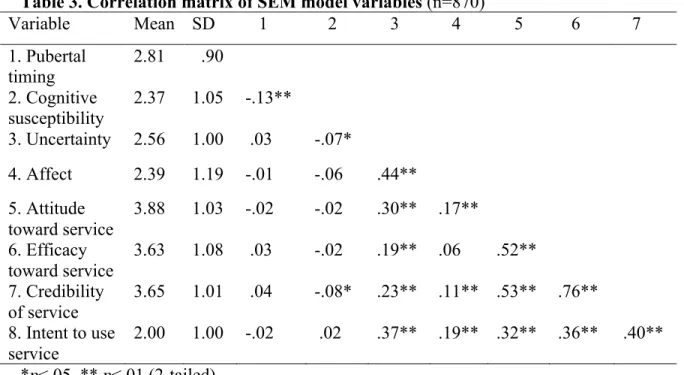
Preliminary tests of the data indicated that skewness and kurtosis were not problematic, as all variables had a skew of less than 1.5 and kurtosis less than 1.5, meeting acceptable standards (Kline, 2010). A missing data analysis revealed that every variable had less than 5% missing, so missing data points were corrected for with expectation maximization imputation in PASW 18.0. Data were then entered into the IBM structural equation modeling software program AMOS. To test for mediation in addition to the direct paths in the model, bootstrapping procedures using 2,000 bootstrap samples and bias-corrected confidence intervals were used.11 The zero-order correlation matrix with the means and standard deviations for all variables included in the SEM model analysis are presented in Table 3.
Hypothesis 1, which predicted that adolescents who experience early pubertal timing would have increased levels of uncertainty discrepancy, was not supported (β = -.01, ns).
Hypothesis 2, which predicted that adolescents with higher levels of cognitive susceptibility would have increased levels of uncertainty discrepancy, was also not supported (β =-.06, ns).
Table 3. Correlation matrix of SEM model variables (n=870)
Variable Mean SD 1 2 3 4 5 6 7 1. Pubertal
timing
2.81 .90 2. Cognitive
susceptibility 2.37 1.05 -.13** 3. Uncertainty 2.56 1.00 .03 -.07*
4. Affect 2.39 1.19 -.01 -.06 .44** 5. Attitude
toward service
3.88 1.03 -.02 -.02 .30** .17** 6. Efficacy
toward service
3.63 1.08 .03 -.02 .19** .06 .52** 7. Credibility
of service
3.65 1.01 .04 -.08* .23** .11** .53** .76** 8. Intent to use
service
2.00 1.00 -.02 .02 .37** .19** .32** .36** .40** *p<.05, ** p<.01 (2-tailed)
Hypothesis 3, which predicted that uncertainty discrepancy would lead to an affective response, was supported, as greater levels of uncertainty discrepancy about sexual health were associated with increased affect (β = .58, p<.001).
Hypothesis 4, which predicted that uncertainty discrepancy, as mediated by affect, would be related to (a) attitude evaluations, (b) efficacy evaluations, and (c) credibility evaluations, was also supported. The bootstapping analysis revealed a significant indirect effect for affect as a mediator of (a) uncertainty discrepancy to attitudes (β = .17,
p<.001); (b) uncertainty discrepancy to efficacy evaluations (β = .13, p<.001); and (c) uncertainty discrepancy to credibility evaluations (β = .14, p<.001).
43
p<.01) as was the path between efficacy evaluations and intent (β = .16, p<.05) and credibility (β = .24, p<.01).
RQ 1 asked if the proposed model, as applied to sexual health information seeking among adolescents, provided a good fit for the data. The model did not provide a good fit for the data, as evidenced by a significant chi-square (χ2 = 1662.10, p<.001). Although the chi-square measure of fit is sensitive to large sample sizes, other measures of model fit also were less than ideal (RMSEA=.097; confidence interval at 90% =.093-.101; p-close=.000; Standardized RMR=173; CFI=.862).
The program AMOS provides modification indices that can help indicate where additional paths might be useful. The modification indices indicated a number of possible options, two of which were supported by previous literature. The modification indices encouraged a path between attitudes and efficacy, which is similar to the path in TMIM between outcome expectancies and efficacy that has been found to be significant in previous research with adolescents (Afifi & Afifi, 2009). Additionally, the model indicated that a path between efficacy and credibility would benefit the model. Such a relationship is also supported by previous TMIM work that has looked at the concept of target efficacy, similar to credibility, as part of efficacy evaluations (Afifi & Weiner, 2004). Given the supportive literature, the two additional paths were added and the model was run again.
of fit were used. In the revised model, most of the paths in the original model were still significant (See Figure 5). Affect no longer had a direct effect on efficacy (β = .12, ns), however, and efficacy no longer had a direct effect on intent to seek information from the service ((β = .09, ns). The indirect effects of attitudes on credibility through efficacy were significant (β = .46, p<.001) as were the indirect effects of efficacy on intentions to use BrdsNBz through credibility (β = .08, p<.01).
Figure 5: Revised Model of Motivators for Sexual Health Information Seeking
Discussion
Adolescents gather sexual health information from a number of sources, including new media (Boyer et al., 2011; Lenhart, Purcell, Smith, & Zickuhr, 2010). We have not yet determined what may motivate such information seeking, however. Theories of
Uncertainty Discrepancy
Affect (e.g. worry)
Attitudes (e.g. good, helpful)
Efficacy
Credibility
Intent to use BrdsNBz Evaluations of BrdsNBz Service
.55***
.23***
ns
.06*
ns
.61***
.87***
.27** .12**
Model Fit Indices: RMSEA=.053, Confidence Interval at 90% = .046-.059,
p-close=.258; Standardized RMR=.078; CFI=.976, χ2=278.77, p<.001. n=870
45
information seeking from interpersonal communication, mass mediated communication and computer mediated communication can provide an important starting point for looking at possible motivators of information seeking behaviors in adolescents. The constructs examined here came from a variety of theories, and many were found to be predictive of intentions to use a sexual health text message service to seek sexual health information.
Uncertainty discrepancy was found to be strongly associated with affect, with adolescents who desired an increased level of sexual health knowledge being more likely to have anxiety or worry associated with the lack of sexual health knowledge. Although the original model did not provide a good fit for the data, two simple modifications that were grounded in previous literature and empirical research improved the fit
considerably, indicating that the affective response was then associated with attitudes toward the text service, which impacted efficacy evaluations and credibility assessments. Positive assessments of credibility and attitudes toward a sexual health text service were associated with an increased intent to use the service.
information seeking behaviors, sometimes predicting seeking behaviors more strongly than other efficacy evaluations (Afifi & Weiner, 2006).
Efficacy, in this case, also may not have had a direct effect on information
seeking because of the new media angle—teens may have felt confident in their ability to use a sexual health text service because of extensive experience with text messaging. Only participants who send text messages were included in the sample, and the median number of text messages study participants sent daily was 100 (mode=100).12 Although being able to text does not necessarily mean they would know how to use the service— teens need to first opt-in to the service using a code word, and then may text the service directly—teens may feel confident that they could use such services easily and effectively if they so desired. This could make efficacy less of a motivator behind intent to use the service than other evaluations such as attitudes toward the service and credibility assessments. Future research should continue to examine the impact of efficacy evaluations on intentions to use various new media resources for sexual health information.
Understanding the motivations behind adolescent information seeking in new media is important for a number of reasons. First, it is important to identify the processes that may lead to information seeking. For example, understanding that credibility
perceptions of a sexual health text service are associated with teens’ intent to seek
information from such a source indicates that teens do believe where they get information is important. However, this does not necessarily mean teens are good judges of source credibility. Establishing credibility may be difficult for youth, especially in new media
47
contexts (Eysenbach, 2007). This study finds that perceptions of credibility impact intentions to use a sexual health text message service for information, but it does not provide insight about how teens assess credibility of the source. In this specific example, credibility perceptions could have been higher since the promotion of the service
occurred in schools, often through word-of-mouth from health educators as well as the promotional campaign.
Second, practitioners and health educators could use the patterns identified in this study to increase health information seeking by teens. If attitudes and credibility are two of the primary factors associated with seeking intentions, with efficacy having an indirect impact on intentions, targeting these key variables could increase use of resources. Health educators could provide information to teens about the credibility of certain websites or services, helping them to access information of higher caliber.
Although seeking information on sexual health can be beneficial because it may provide teens with accurate information that they can use in their decision-making processes, caution needs to be taken with the focus on information seeking. Not all information sources are created equal, and individuals may assess the credibility of information gathered based on peripheral cues, deeming misinformation as credible (Kim, Park, & Bozeman, 2011). Some sources of information online may contain
Although this study provides insight into what motivates adolescents to use a sexual health text message service, there are a number of limitations. First, the sample was from a cross-sectional study, using data only from one county in North Carolina. Although the sample is sufficient to look at relationships between key constructs, results may not be generalizable to other populations. Additionally, the study examines intent to use the service as opposed to actual behavior. While in some cases and many theories, intent is considered a predictor of actual behavior (e.g. the Theory of Planned Behavior (Ajzen, 1991)), and use of the service was moderately correlated with intentions to use, actual use data were not used because the short length of time teens were aware of the service may have limited actual use (e.g., teens may not have had a specific sexual health question within that time frame). Longitudinal studies could provide additional evidence of the motivations that influence use of sexual health text message services.
Conclusions
49
sexual health. Attitudes, efficacy and credibility assessments about the text message service then influence adolescents’ intentions to use the service to reduce that