APPLICATION OF MULTI-LEVEL PARALLEL-HIERARCHIC
SYSTEMS BASED ON GPU IN LASER BEAM SHAPING
PROBLEMS
1LEONID TIMCHENKO, 1NATALIYA KOKRIATSKAIA, 2ANDRIY YAROVYY, 1ALYONA
DENYSOVA
1
Department of Telecommunication Technologies and Automatics, State University of Transport Economy and Technologies, Ukrainе
2Department for Computer Science, Vinnytsia National Technical University, Ukraine
E-mail: [email protected], [email protected] , [email protected], [email protected]
ABSTRACT
The paper presents a method of parallel-hierarchical transformations for rapid recognition of dynamic images using GPU technology. Direct parallel-hierarchical transformations based on cluster CPU-and GPU-oriented hardware platform.
Mathematic models of training of the parallel hierarchical (PH) network for the transformation are developed, as well as a training method of the PH network for recognition of dynamic images.
This research is most topical for problems on organizing high-performance computations of super large arrays of information designed to implement multi-stage sensing and processing as well as compaction and recognition of data in the informational structures and computer devices.
This method has such advantages as high performance through the use of recent advances in parallelization, possibility to work with images of ultra dimension, ease of scaling in case of changing the number of nodes in the cluster, auto scan of local network to detect compute nodes.
Keywords: Parallel-hierarchical (PH) Network, Laser Beam Spot Images, Parallel-hierarchical (PH)
Transformation, Fast Recognition of Dynamic Images, GPU Technology.
1.
INTRODUCTIONRapidly growing requirements to modern computational media encourage development of new intelligent methods of information transfer and processing. Rigid requirements to real-time information processing systems force scientists to regularly create and upgrade data transfer systems. Today most internet channels cannot provide data exchange of the required quality between such systems, which, in turn, results in the congestion of those channels and formation of the so-called digital bottlenecks. This problem can be solved through application of the laser-based technologies [1-3], one of the most promising models of information transfer for the near future.
One of the most efficient methods of processing of large data arrays is their parallel processing based on specialized system solutions, in particular, on the neural-like parallel hierarchical systems. A hierarchic transformation is an important and powerful computing operation.
A goal of this paper is to develop and apply the suggested method and means of parallel hierarchical transformation for fast recognition of dynamic images – images of laser beam spots. To increase a speed of computational structures, it is makes sense to apply a method based on the normalizing equation, because, unlike prevalent types of video information encoding, an approach suggested here uses a principle of the distributed processing in the space-time domain of results of the data array encoding.
Another advantage of the use of the normalizing equation is that it allows a quite simple implementation of a preliminary procedure of image classification by forming tuning coefficients, thus performing a procedure of determination of weighting coefficients for each class [4].
2.
DIRECT PARALLEL-HIERARCHICALCONVERSION BY CLUSTERED CPU-ORIENTED HARDWARE PLATFORM
ISSN: 1992-8645 www.jatit.org E-ISSN: 1817-3195
from the anticipated result - a set of tail elements vectors that uniquely characterize the input image. The general algorithm of the software system is as follows [5]:
1. The user loads the input image to be processed, and indicates the set of nodes in the network, which are necessary to perform computation.
2. Right after the start of computation the complex automatically creates a package for each computing node and launches them for execution;
3. Upon completion of the computation the complex gathers the results of individual nodes on the main (custom) server and shows the results to the user.
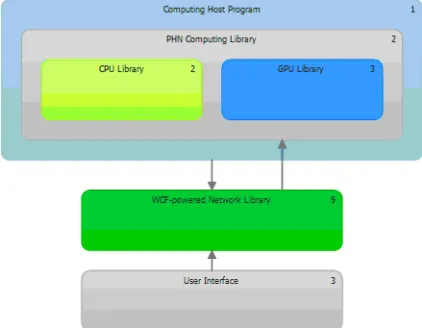
In general, the scheme of interaction between components of the complex is shown in Fig. 1.
Algorithm of cluster image processing by direct parallel-hierarchical transformations can be described as follows:
- The input image is divided into a set of tasks for each of the compute nodes as follows:
a) The image is divided into a set of handle fragments with the dimension 128 ×128 pixels each;
[image:2.612.90.301.493.657.2]b) The first processing fragment is assigned to the first computing node, the second one – to the second node, etc. Fragment N +1 (where N is the number of computing nodes) is assigned to the first node again, etc., taking into account that the number of computing nodes in general case is much smaller than the number of the tasks.
Figure 1: Scheme of the Components Interaction
- Each computational node processes its own set of tasks by direct parallel-hierarchical transformations and generates multiple sets of tail elements as the result of transformation.
- The results of processing of each node accumulate at the main (control) node and form the overall result of image processing [6].
The software system is designed regarding the above scheme of window components, in the following stages:
On the most general meta-level the software system “DirectPHT::Cluster” should upload and identify the arbitrary dimension images using the direct parallel-hierarchic transformation implemented on the computer cluster.
On the second detail level the software system “DirectPHT:Cluster” should automatically detect the topology of the computing cluster, identify the accessible computational nodes, assign individual tasks for them and collect the results. It is also necessary to determine and allocate a package of tasks for each computational node.
On the third detail level it is necessary to determine an optimal size of parts into which the output image will be divided for creating a the package of tasks for each computational node. It is also necessary to determine a software structure of the control server and computational nodes. If possible, the software system should be independent on the cluster topology.
On the fourth detail level a technology for communication between the nodes and the server is selected. In this case there were two options - Microsoft .NET Windows Communication Foundation and the programming language Erlang with a package of libraries OTP.NET. Microsoft .NET Windows Communication Foundation was preferred for convenience of its integration with already available project of direct parallel-hierarchic transformation on one of the computational nodes [2,3].
when the number of results is equal to the initial computation tasks.
On the sixth detail level the made decisions are coded on the basis of the communication technology and possibilities of the programming language С#.
[image:3.612.91.300.324.457.2]We perform direct parallel-hierarchical transformations for the computing cluster with two compute nodes. As an input image we select an image with the dimension of 1024 × 1024 pixels filled with a radial gradient in grayscale which corresponds to idealized image of the laser beam. Let us compare the computing performance on the physical and the virtual cluster running on a single physical machine, each cluster consisting of two nodes. Fig. 2 shows the results of direct parallel-hierarchical transformations performed on the virtual cluster.
Figure 2: Emulation of Computing Cluster With Two Computing Nodes
Comparison of the processing results allows concluding that the processing speed of response on one node increased by 27.7%. Therefore, the main results are presented on the development of a distributed computing cluster control system by using the component networking technology, which allows performing direct image PHT, thus improving the processing time and proving a possibility for fast processing with increased amount of the image dimensions [7].
3.
THE METHOD OFPARALLEL-HIERARCHICAL TRANSFORMATION WITH FORMATION OF THE
NORMALIZING EQUATION FOR FAST IMAGE RECOGNITION
The above-described algorithm and software package realize the method of parallel hierarchical transformation with formation of the normalizing
equation for fast image recognition, which is described in details in the previous works.
The research based on a masking method of information processing for purposes of fast recognition of laser beam spot images [8] suggests the need to improve a method of the parallel hierarchical transformation.
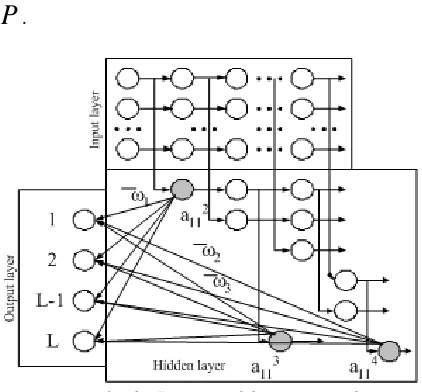
A task of suggested PH network training by analogy with the training in the RBF networks is practically brought down to an idea of the controlled training of elements of the initial layer of the network. By using a common idea of the structural organization of artificial neural networks as “input layer – hidden layer – output layer”, it is possible to produce a trainable PH network, where the first network level should be used as an input layer; levels 2÷
k
, where k is a number of levels of the hidden layer, should be used as the hidden layer; and the output layer, which is traditionally used in artificial neural networks, should be used as an output layer (Fig. 3).A number of hidden layer elements can be determined from the length of the network algorithm, accordingly formalizing a procedure for calculation of the number of hidden layer elements. Averaged values of weighting coefficients are determined by formula (1):
( )
1
,
1,
1
N p t p t
w
w
t
k
N
=
=
∑
=
−
(1)where
N
is a dimensionality of the taught sampleP
.Figure 3: The Structure of the PH Network
[image:3.612.315.526.488.684.2]ISSN: 1992-8645 www.jatit.org E-ISSN: 1817-3195
where:
1. 11
2 k t t
a
=∑
are reference components of the frame of the extended route being recognized;2. ik
i
a
∑
anda
112÷
a
11k are current components of the frame of the extended route being recognized.11 2
1 2 2
11
2 11
2 1 11
2 3 3 3 3
11 11
2 3 2
11
2 1 11 2 11 3 11
2 1 1 1 1
11 11
2 11
2 1 11 2
1 11 , ( ) , ( ) ( ) , ( ) ( ) ( ) k t t i i k t t i i i i k t k t k
k k k k k
i i
i i
k t t
k k k
i i a w a a a w a w
a a a a
a
w a w a w a
w
a a a a
a
w a w a w a a = = − = − − − − − − = − = + = − + + + + + = − + + + = − +
∑
∑
∑
∑
∑
∑
∑
∑
∑
∑
3 111 2 11
11 , ( ) k k k k i i w a a a − − + + +
∑
(2)After finding values
w
1÷
w
k−1, a normalizing equation (3) can be formed:1
2 3
2 11 2 11 1 11 2 11
11 11 11 11
2 2 2 2
1 11 2 11 2
.
k k k kk k k k
t t t t
t t t t
k t t t k t t
w
a
w
a
w a
w a
d
a
a
a
a
w a
a
− − − = = = = − = ==
+
+ +
+
=
=
∑
∑
∑
∑
∑
∑
(3) To normalize results of the PH network with tuning coefficients (2), the main property of the PHnetwork will be used: 11
2 k t i t i
a
a
==
∑
∑
[8]. With the correct recognition of images of laser beam spots, this normalized measured
→
1
.Using the normalizing equation of form (3), where
w
1=
w
2=
...
w
k−2=
w
k−1=
1
, it is possible, by accepted values ofd
, to formulate quite easily a preliminary procedure of image classification, and then, according to system (2), to form tuning coefficients1 1
÷
w
k−w
, thus performing a procedure of determination of weightingcoefficients for each class [9].
In particular, if the real-time classification is performed and adjacent frames of extended laser beam routes are analyzed, the normalizing equation of form (3) acquires form (4):
( )
2 1( )
3 1( )
111 11 11
11 11 11
2 2 2
,
j j k j
j j j
k k k
t t t
t t t
a
a
a
d
a
a
a
+ + + = = =
=
+
+ +
∑
∑
∑
(4)where: 11
2 j k t t
a
=
∑
is a sum of k-1 tail elements,j
is a frame number,j
=
1,
m
−
1
,( ) ( )
1 12
11 11
j j
k
a
+÷
a
+ is a value of tail elements ofimages of the previous
(
j
th)
and followingth
(
j
+
1)
frames respectively.Given the above-mentioned property of the PH network, the normalizing equation (3) acquires form (5):
( )
( )
( )
( )
( )
( )
1 1 1
1 2
11 11 11
2 2 2
.
j j j
N
j j j
k k k
t t t
t t t
a
a
a
d
a
a
a
+ + +
= = =
=
+
+ +
∑
∑
∑
(5)Because in calculating expression (5), there is no need to determine tail elements
( ) ( )
a
112 j+1÷
a
11k j+1 in processing the(
j
+
1)
thframe, a time of the recognition procedure significantly decreases when processing results of input data(
a
1÷
a
N)
are normalized. In comparison with the known neural networks, where input data of the(
j
th)
frame cannot be used for the procedure of recognition in the initial layer of the(
j
+
1)
thframe, it can be realized here [10].To realize a parallel hierarchical transformation for fast recognition of images of laser beam spots, the most appropriate is a selection from the available digital information of the average value
t i
this case for each of those PH networks, a system of equations can be formed, whose roots for all equations except for the first one are pairs of tuning coefficients of the form (2):
- for positive difference components:
( ) ( )
1 1
(w+ ÷wk+− ),
- for negative difference components:
( ) ( )
1 1
(
w
−÷
w
k−−)
.For the first layer of the PH network, only the tuning coefficient
w
1(+) is being calculated, because there are only positive difference components here.When processing a sequence of images of extended laser routes, it will be more appropriate to use a normalizing equation for two adjacent frames of images, where the first image is taken as a reference one. Then the normalizing equation will have a form (6):
2 3 -1
1 11 2 11 -1 11
-1 -1 -1
11 11 11
2 2 2
11 1 11 -1 -1 11 11 2 2
(
)
(
)
(
)
(
)
(
)
(
)
(
)
(
)
,
(
)
(
)
j j k j
k
k k k
t j t j t j
t t t
k t j t k j k t k k
t j t j
t t
w a
w a
w
a
d
L
a
a
a
w a
w a
a
a
= = = = = ==
+
+ +
+
+
=
∑
∑
∑
∑
∑
∑
(6)where:
w
1÷
w
k are tuning coefficients obtained during the preliminary processing on the first images of the set;(
a
11t) , (
ja
11t)
j-1 are tail elements of the current and previous images respectively [11].Usually, when processing a sequence of images of extended laser routes, it is necessary to detect “bad” images, or those whose internal and external contours are most distorted by atmosphere, and exclude those from the route analysis. Because the normable criterion of the form (6) can be found for both a single frame of the laser route, and for the laser route as a whole, we can form a set А from coefficients di(7):
(
1,
2,...
N)
,
A
=
d d
d
(7)where N is a number of frames of the laser route.
Because d is a measure of correspondence of tuning coefficients of the reference PH network and
tuning coefficients of the current network, the іth elements of the set of form (7), which have low values, can be classified as “bad” images:
( ) ( )
, ,
" " ,
( ) ( ) ,
" "
i k k
i j e i j n
good image if d a a
bad image otherwise
χ
≥
∩ =
(8)
where
χ
is a determined threshold criterion. As0
≤ ≤
d
1
, then0
≤ ≤
χ
1
.For the quality classification and processing of a sequence of frames of extended laser routes, this threshold criterion may be used in “tighter”
limits:
0,8
≤ ≤
χ
1
. For those laser routes which contain imagessignificantly distorted by atmospheric agents, it is recommended to set less strict limits of the
threshold value:
0, 4
≤ ≤
χ
1
[12]. Having compared the efficiency of the parallelhierarchical transformation and known transformations by a number of computational operations used, a conclusion can be made that a number of operations for the PH transformation is
N(N+1), where N is a total number of elements processed. For comparison, a number of operations used in other transformations widely applied in practice, e.g. for orthogonal transformations, are:
N
N
2 2log
4
for fast Fourier transformation,2
2 2
log
2
N
N
for Hadamard, and4
N
(
N
+
1
)
for Haar [13].Absence of time-consuming operations says about a sufficient simplicity of the computational procedure that realizes the parallel hierarchical transformation, and makes it an efficient method for use in various applied areas requiring a combination of the high level of the parallelism and a compact form of data representation.
4.
PROGRAM MODELING ANDEFFICIENCY OF APPLICATION OF THE PARALLEL-HIERARCHICAL TRANSFORMATION FOR FAST RECOGNITION OF IMAGES OF LASER BEAM SPOTS
ISSN: 1992-8645 www.jatit.org E-ISSN: 1817-3195
[image:6.612.91.301.132.248.2]and the right one – that of the current frame of the route of images of laser beams spots.
Figure 4: Screen Form of PH Network Facility for Fast Recognition of Laser Beam Image Spots
Information about the frame parameters is exhibited in the upper part: frame width, pixels; frame height, pixels; information about the route containing the frame; frame file name; number of frames in the route.
The bottom part contains tabs: construction of the network graph, which can be obtained and saved as a PH network graph file; processing of route fragments, where a route fragment can be processed; image comparison, where images of laser beam spots are being compared and classified; determination of energy centers, where energy centers of laser beams spots are determined and the PH network is trained.
To estimate efficiency of use of algorithms developed and hardware and software developed on their basis, let us describe technical advantages of means of the parallel hierarchical transformation based on the results of the developed products work and conducted experimental research.
A conclusion can be made that the suggested method, algorithms, software and hardware permit to measure coordinates of energy centers of images of laser route fragments on the basis of the normalizing equation with accuracy of no more than 0,01 decomposition elements, thus exceeding the known ones, e.g. based on determination of the gravity center using the method of moment characteristics [14-17], by accuracy, 1.5 times on average. A time necessary for preliminary and network processing of images of laser route fragments decreases, too.
5.
EXPERIMENTAL RESULTS ANDPHYSICAL MODELING OF THE
PARALLEL-HIERARCHICAL
TRANSFORMATION FOR FAST RECOGNITION OF IMAGES OF LASER BEAM SPOTS
Four routes were used in experimental research of the parallel hierarchical transformation for fast recognition of images of laser beam spots. Each route contains 100 frames.
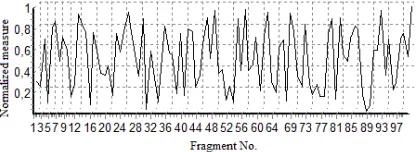
Using the normalizing equation (6), let us determine normalized measures for route 1 (Fig.5).
An average percentage of “good” images in this case is 40% and 59% respectively. Then the PH network is trained for repeated processing of “bad” route fragments [18].
The physical modeling of the method of the parallel hierarchical transformation for fast recognition of images and determination of coordinates of images of extended laser routs and use of the graphic adapter Radeon X1300 demonstrates that it takes about 0.6 s to process one image.
Figure 5: Normalized Measures for Route 1
Image processing is based on the GPU with cores realized at all elements covered by the initial region. The only obvious way to calculate a scalar of the input vector is a representation of 1x1 initial elements and use of the core read in all values from the input texture. This approach has several drawbacks [19, 20]. First, only one of parallel elementary processors would be busy. Second, that would probably exceed a maximum permitted by shader length and static instruction of calculation for some hardware. That is why we will perform a parallel operation of reduction based on global methods of communication on parallel computers.
[image:6.612.314.522.349.425.2]“scalar” texture through a logarithmic series of repetitions [21-23].
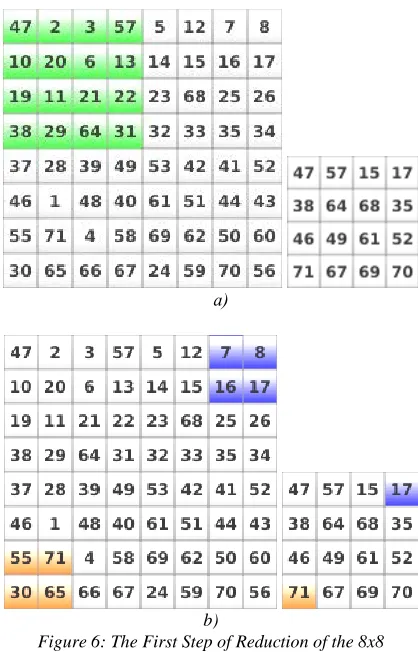
Next series of images finalize the first step of reduction of the 8x8 algorithm of the input texture (Fig. 6). The left image demonstrates the input texture. Initial elements are marked in green (Fig. 6a). The right image is a result of the first round of reduction. Each initial element contains a local maximum of transfer of the 2x2 subregion in the input texture. This relation, in addition, is distinguished in the second line of images (Fig. 6b).
а)
[image:7.612.313.524.74.199.2]b)
Figure 6: The First Step of Reduction of the 8x8 Algorithm of the Input Texture
Let us determine coordinates of energy centers of the fragment of route 1 (Fig. 7).
A graphical interpretation of the distribution of coordinates of energy centers is shown in Fig. 8.
After the training of the PH network, a portion of “good” images was 83% (as compared to 18%).
[image:7.612.89.298.234.560.2]The graphical interpretation of the determination of energy center coordinates after the PH network training is demonstrated in Fig. 9.
Figure 7: Graph of "Good" and "Bad" Images Formation in the Track Number 1.
Figure 8: A Graphic Interpretation of the Distribution of Coordinates of Energy Centers
[image:7.612.314.523.237.322.2]After training of the PH network percentage of "good" images on track number 2 was 76% (12% before training), Fig.10.
Figure 9: Determination of the Energy Centers Coordinates for the Fragments of Route Number 2
Figure 10: Determination of the Energy Centers Coordinates for the Fragments of Route Number 2 After
PH Network Training
The graphical interpretation of the determination of energy center coordinates for route number 3 is demonstrated in Fig. 11.
[image:7.612.312.521.393.617.2]ISSN: 1992-8645 www.jatit.org E-ISSN: 1817-3195
After training of the PH network percentage of "good" images on track number 2 was 83% (17% before training), Fig.13.
Computer simulation showed that the percentage of correctly recognized images was 92.5%, moreover 74% of "good" images and 60% of "bad" ones. During recognition the sample of 140 spots-images of laser route by neural network based on RBF, modeled in the package Statistica Neural Networks 4.0, 92% of correctly recognized images received.
[image:8.612.90.298.234.604.2]Figure 11: Determination of the Energy Centers Coordinates for the Fragments of Route Number 3
Figure 12: Determination of the Energy Centers Coordinates for the Fragments of Route Number 3 After
PH Network Training
Figure 13: Determination of the Energy Centers Coordinates for the Fragments of Route Number 4 After
PH Network Training
6.
CONCLUSIONSThe paper deals with a topical problem of increasing efficiency of recognition of dynamic images. The analysis of development of the PH transformation allows to attribute the suggested parallel hierarchical approach to neural methods of transformation with a network of direct recognition
and the space-time organization of connections. A method of the PH transformation with formation of the normalizing equation is developed. A method of PH transformation containing measures of tuning coefficients correspondence of the reference PH network and current network, was developed, as well as with finding a measure of correspondence of two networks as a whole.
Algorithms of processing and recognition of images of laser beam spots were developed. The developed algorithms allow determining a position of energy centers, classifying frames of images of the laser route.
On the basis of the developed algorithms, software was created for modeling a neural-like PH network. This software is used for classification and fast processing of images.
The method of PH transformations for rapid recognition of dynamic images using GPU technology has such advantages as high performance through the use of recent advances in parallelization, possibility to work with images of ultra dimension, ease of scaling in case of changing the number of nodes in the cluster, auto scan of local network to detect compute nodes [24, 25]. Decreasing of time required for pre-processing and network processing of laser routes image fragments should also be noted.
In [14-17] analysis of neural network technology using for extended laser route image classification was held. Computer simulation showed that the percentage of correctly recognized images was 92.5%, moreover 74% of "good" images and 60% of "bad" ones. In [15] simulation of recognition system based on neural network MLP and neural network based on radial basis function (RBF) was conducted. During recognition the sample of 140 spots-images of laser route by neural network based on RBF, modeled in the package Statistica Neural Networks 4.0, 92% of correctly recognized images received. Comparing the results of [14, 15] and the results of this paper we can talk about the availability of the last one.
REFRENCES:
[1] J. M. Khosrofian, B. A. Garetz, Measurement of a Gaussian laser beam diameter through the direct inversion of knife-edge data, J. Appl. Opt. 22 (1983) 3406–3410.
of Near Earth Space and Possbilities for Removal of Space Debris from Orbit with Explosive Photo-Dissociation Lasers with Phase Conjugation, Proc. GCL/HPL 98, SPIE Symposium, St-Petersburg (Russia), vol. 3574, 219-228 (1998).
[3] L. I. Timchenko, Y. F Kutaev, V. P. Kozhemyako, Method for Training of a Parallel-Hierarchical Network, Based on Population Coding for Processing of Extended Laser Paths Images, Proceedings of SPIE, vol. 4790, 465-479 (2002).
[4] Timchenko L. I., Kokryatskaya N. I., Melnikov V.A method of organization of a parallel-hierarchical network for image recognition, J. Cybernetics and systems analisis, 47(1) (2011) 140-151.
[5] Yarovyy A.A. Image processing by direct parallel-hierarchical transformation based on cluster systems with distributed information processing, J. Visnyk of Vinnitsya Technical Institute, No 3 (2011), pp.133-140..
[6] D.M. Chitty, A data parallel approach to genetic programming using programmable graphics hardware, GECCO ’07: Proceedings of the 9th annual conference on genetic and evolutionary computation, vol. 2, pp. 1566-1573, Jul., (1991).
[7] Z. Luo, H. Liu and X. Wu, Artificial neural network computation on graphic process unit, IJCNN ’05. Proceedings of the IEEE International Joint Conference on Neural Networks, vol. 1, pp. 622-626, Jul, (2005). [8] Timchenko L. I., Kokryatskaya N. I., Melnikov
V.A method of organization of a parallel-hierarchical network for image recognition, J. Cybernetics and systems analisis, 47(1) (2011) 140-151.
[9] J.M. Li, D.L. Wan, Z.X. Chi and X.P. Hu, 2006, A parallel particle swarm optimization algorithm based on fine-grained model with GPUaccelerating, Harbin Gongye Daxue Xuebao/Journal of Harbin Institute of Technology, vol. 38, no. 12, pp. 2162-2166, Dec.,
[10]R. Xu and D.C. Wunsch II, Clustering. IEEE / Wiley Press, Hoboken, NJ, (2008).
[11]D. Everitt, S. Landau and M. Leese, Clustering analysis, 4th edition. Arnold, London, UK, (2001).
[12]D.C. Wunsch II, ART properties of interest in engineering applications, Proc. IEEE/INNS International Joint Conference on Neural Networks, Atlanta, GA, (2009).
[13]D. Knuth, The Art of Computing Programming: Fundamental Algorithms, 3rd Edition, vol. 1, Addison-Wesley, (1997). [14]Sung Uk Jung, Yun Su Chung, Jang Hee Yoo,
Kyo II Chung Patent № US007697734B2 Method and apparatus of detecting eye using symmetry and moment characteristics of object, Apr, 13, (2010).
[15]Sung Uk Jung, Yun Su Chung, Jang Hee Yoo, Kyo II Chung Patent № US007697734B2 Method and apparatus of detecting eye using symmetry and moment characteristics of object, Apr, 13, (2010).
[16]Simon Xinmeng Liao Image Analysis by Moments A Thesis Submitted to the Faculty of Graduate Studies in Partial Fulfillment of the Requirements for the Degree of Doctor of Philosophy the University of Manitoba Winnipeg, Manitoba, Canada, 1993.
[17]R.J.Prokop and A.P.Reeves, A Survey of Moment-Based Techniques for Un occluded Object Representation and Recognition, J. Graphical Models And Image Processing, Vol. 54, №5, (1992) 438-460.
[18]C.H.Teh and R.T. Chin, , On image analysis by the methods of moments, J. IEEE Trans. Pattern Anal. Machine Intell. Vol. PAMI-10 (1988) 496-512.
[19]Sejun Kim, A GPU based Parallel Hierarchical Fuzzy ART Clustering, Advanced Res, (2003). [20]R.J.Prokop and A.P.Reeves, A Survey of
Moment-Based Techniques for Un occluded Object Representation and Recognition, J. Graphical Models And Image Processing, Vol. 54, №5, (1992) 438-460.
[21]Simon Xinmeng Liao Image Analysis by Moments A Thesis Submitted to the Faculty of Graduate Studies in Partial Fulfillment of the Requirements for the Degree of Doctor of Philosophy the University of Manitoba Winnipeg, Manitoba, Canada, 1993.
[22]Sung Uk Jung, Yun Su Chung, Jang Hee Yoo, Kyo II Chung Patent № US007697734B2 Method and apparatus of detecting eye using symmetry and moment characteristics of object, Apr, 13, (2010).
ISSN: 1992-8645 www.jatit.org E-ISSN: 1817-3195
[24]M. Gorchetchnikov, H. Ames, M. Versace, Simulating Biologically Realistic Neural Models on Graphics Process Units, ICCNS 2008, Boston, MA, (2008).