SUBNATIONAL UNDEMOCRATIC REGIME CONTINUITY AFTER DEMOCRATIZATION: ARGENTINA AND MEXICO IN COMPARATIVE
PERSPECTIVE
Agustina Giraudy
“A dissertation submitted to the faculty of the University of North Carolina at Chapel Hill in partial fulfillment of the requirements for the degree of Doctor of Philosophy in the Department of Political Science.”
Chapel Hill 2009
Approved by:
© 2009
Subnational Undemocratic Regime Continuity After Democratization: Argentina And Mexico In Comparative
Perspective
ABSTRACT
AGUSTINA GIRAUDY: Subnational Undemocratic Regime Continuity After Democratization: Argentina And Mexico In Comparative Perspective
(Under the direction of Dr. Jonathan Hartlyn)
ACKNOWLEDGEMENTS
During the long process of researching and writing this dissertation, I have incurred many intellectual and personal debts. First, I wish to acknowledge my teachers at the University of North Carolina at Chapel Hill. I am deeply grateful to my advisor, Jonathan Hartlyn, who from the very start of my graduate education encouraged me to study patrimonial rule. Over the years, Jonathan has been an exceptional mentor. His profound knowledge about Latin American politics, as well as his sharp mind and tough questions not only helped me gain clarity about my research but also helped me to see Latin America and Argentina from a different, and more complex, standpoint. Evelyne Huber not only
During my years as a graduate student, I had the good fortune of making true friendship with Mireya Dávila, Juan Pablo Luna, and Jenny Pribble. Life in Chapel Hill could not have been as pleasant and as interesting as it was, had it not been for Jenny, Mireya, and Juan. Jenny’s companionship was also very important while I was away from campus. She has been a terrific friend and also a major source of intellectual guidance and inspiration. Upon my return from the field, I was lucky to meet Juan Bogliaccini, Sara Niedzwiecki, and Lucía Genta. They not only made me feel as if I had never left Chapel Hill, but most importantly, were there with me as I began the difficult and lonely process of writing this dissertation.
While conducting fieldwork in Mexico and Argentina, many people opened doors for me. Andreas Schedler at CIDE (Mexico), and my former mentor, Catalina Smulovitz at Universidad Torcuato Di Tella (Argentina), provided me with institutional and academic support. Andreas’ sharp mind and conceptual clarity were critical to help me refine many of the project’s original categories. Cary not only gave insightful comments about my research project but above all reminded me that with dedication, rigorousness, and hard work women can also succeed in the Argentine academia. I am also indebted to the numerous politicians, officials, and social organizers, who in Buenos Aires, Mexico City, Puebla, Oaxaca, La Rioja, and San Luis were willing to talk to me. Without them this research simply could not have been possible.
graciously shared hard-to-find data with me. Without Hernán Gullco’s guidance I simply could not have been able to code subnational judiciary systems. Paulina Sánchez, Paula Bonessi, and Victoria Paniagua helped me get and crunch subnational data that I thought I would never be able to obtain. Florencia Guerzovich’s sharp comments also contributed to improve several aspects of the theoretical framework. Finally, I must give credit where credit is most due: my interest in patrimonial rule would not have arisen if not for Sebastián
Mazzuca’s passionate teachings about state-building and patrimonial administrations which lit that first light bulb in my head while I was still an undergraduate.
During my months of fieldwork in Mexico, I was extremely fortunate to get to know phenomenal colleagues and, above all, true friends. Alejandra Armesto, Juan Olmeda, Matt Ingram, Sandra Ley, and Jason Lakin are, by far, the most valuable ‘unintended
consequence’ of this research project. The long conversations with Matt about how to figure out causal mechanisms while interviewing Mexican politicians, as well as his invaluable methodological advice before and during the writing-up phase helped me navigate through the tough process of going back and forth between theory and data. Juan’s work has been a constant source of inspiration. His knowledge and challenging questions about Mexican and Argentine intergovernmental relations have profoundly influenced my understanding of the Mexican and Argentine federal systems. Finally, the intense correspondence with Jason about Mexican subnational politics not only pushed me to think harder about the southern states, but made all the difference during the never-ending and lonely moments of fieldwork.
been great friends and wonderful companions while I was in Washington DC, and Mexico City. Their warmth and encouragement have meant a lot to me.
Generous funding from a variety of sources helped support fieldwork in Argentina and Mexico. The Horowitz Foundation for Social Policy, the Inter-American Foundation with the Institute of International Education, the Graduate School at the University of North Carolina at Chapel Hill, as well as the Mellon Foundation, all allowed me to cover expenses and tickets during more than one year of fieldwork. A Dissertation Completion Fellowship from the Graduate School at UNC-CH made it possible to complete the dissertation writing-up phase during the 2008-2009 academic year.
TABLE OF CONTENTS
Chapter 1: Introduction ... 1
Chapter 2: An analytic framework to explain subnational undemocratic regime continuity ... 16
I. Existing literature: contributions and limitations... 23
II. Explaining SUR continuity in contemporary Latin America: control, autonomy, and trajectories of SUR continuity... 28
III. Control and autonomy across levels of government ... 32
IV. A two-level framework to explain trajectories of SUR continuity ... 45
V. An integrated analytical framework to explain SUR continuity across countries ... 50
Chapter 3: Political regimes and state administrations in the subnational world: conceptualization, measurement, and typologies ... 52
I. The access-exercise framework ... 54
II. Subnational political regimes and access to (state) power... 56
III. Subnational state administrations and exercise of political power ... 75
IV. Access to state power vs. exercise of state power: a new classification of subnational political regimes... 85
V. Conclusion... 89
Chapter 4: Fiscal and partisan instruments of territorial control: Argentina and Mexico in comparative perspective ... 91
I. Fiscal instruments of territorial and political control ... 94
II. Partisan instruments of territorial and political control... 116
III. Paths of fiscal, partisan, and fiscal/partisan presidential control ... 122
IV. Conclusion... 125
Chapter 5: Subnational undemocratic regime’s reproduction from above: quantitative evidence ... 127
I. SUR reproduction from above ... 128
II. Hypotheses ... 130
III. Variables and operationalization... 133
IV. Data and analytic technique ... 139
V. Results ... 142
VI. Conclusion... 160
Chapter 6: Subnational undemocratic regime continuity in Mexico (2000-2006). Oaxaca and Puebla in comparative perspective... 167
II. OAXACA: A case of SUR self-reproduction ... 170
III. PUEBLA: A case of SUR reproduction from above ... 198
IV. Conclusion... 222
Chapter 7: Subnational undemocratic regime continuity in Argentina (2002-2006). La Rioja and San Luis in comparative perspective ... 224
I. Subnational case selection... 226
II. LA RIOJA: A case of SUR reproduction from above ... 229
III. SAN LUIS: a case of SUR self-reproduction ... 253
IV. Conclusion... 276
Chapter 8: Conclusion ... 278
METHODOLOGICAL APPENDIX I ... 297
METHODOLOGICAL APPENDIX II... 312
REFERENCES... 325
LIST OF TABLES
Table 1.1: Summary of research design and case selection...14
Table 2.1: Governors and presidents’ instruments of territorial and political autonomy/control (in absolute terms) ...36
Table 4.1: Mexico’s revenue-sharing system and main intergovernmental transfers (as of 2006) ...100
Table 4.2: Size of provincial and national shareable revenues in Argentina...106
Table 4.3: Main institutional changes to revenue-sharing systems and effects on presidential power/discretion in Argentina and Mexico...114
Table 4.4: Fiscal, partisan, and fiscal/partisan paths in Argentina and Mexico ...123
Table 5.1: Mexico: Determinants of Pafef, funds for public works, and Oportunidades with Robust Cluster Standard Errors ...144
Table 5.2: Argentina: Determinants of ATN and Employment programs (Menem) with Robust Cluster Standard Errors ...151
Table 5.3: Argentina: Determinants of Funds for Public Works and Employment programs (Kirchner/Duhalde and De la Rúa) with Robust Cluster Standard Errors ...156
Table 5.4: MEXICO: Dependent and independent variables, description, and sources...163
Table 5.5: ARGENTINA: Dependent and independent variables, description, and sources ...164
Table 5.6: Mexican states scoring below 0.1 on the access index (2000-2006)...165
Table 5.7: Argentine provinces scoring below 0.1 on the access index (1989-2006) ...166
Table 6.1: Oaxaca’s indicators of democracy...172
Table 6.2: Oaxaca’s governors, policy-orientation, and constituencies ...174
Table 6.3: Oaxaca’s indicators of neopatrimonialism ...179
Table 6.4: Percentage of municipalities under PAN, PRI, and PRD control...181
Table 6.5: PAN’s electoral performance in Oaxaca ...189
Table 6.6: Puebla’s indicators of democracy ...199
Table 6.7: Puebla’s governors, policy-orientation, and constituencies ...201
Table 6.9: Percentage of municipalities under PAN, PRI, and PRD control...209
Table 6.10: PAN’s electoral performance in Puebla...216
Table 7.1: La Rioja’s indicators of democracy...230
Table 7.2: La Rioja’s governors...231
Table 7.3: La Rioja’s indicators of neopatrimonialism ...237
Table 7.4: Percentage of municipalities under PJ control...239
Table 7.5: San Luis indicators of democracy...253
Table 7.6: San Luis’ governors ...254
Table 7.7: San Luis’ indicators of neopatrimonialism...257
Table 7.8: Percentage of municipalities under PJ control...262
Table I.1: Access Indicators (Argentina) ...302
Table I.2: Access Indicators (Mexico)...303
Table I.3: Exercise Indicators (Argentina)...306
Table I.4: Exercise Indicators (Mexico) ...306
LIST OF FIGURES
Figure 1.1: An integrated analytical framework to explain trajectories of SUR continuity
across countries...9
Figure 2.1: A model of trajectories of SUR continuity...31
Figure 2.2: A two-level (sub-)model of presidential territorial and political control ...48
Figure 2.3: An integrated analytical framework to explain trajectories of SUR continuity across countries...51
Figure 3.1: The “Access - Exercise” conceptual framework ...56
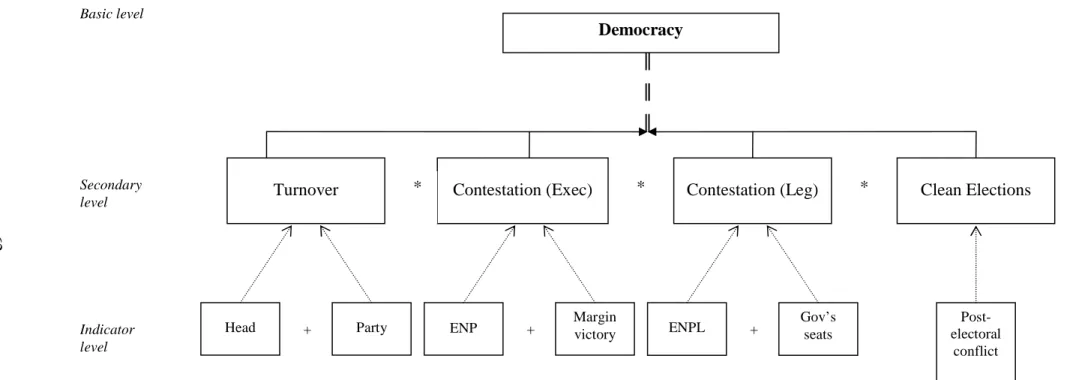
Figure 3.2: A necessary and sufficient concept structure of subnational democracy ...62
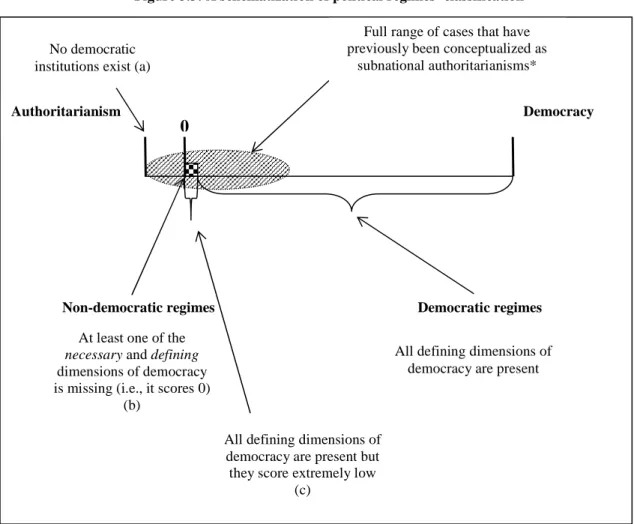
Figure 3.3: A schematization of political regimes’ classification...66
Figure 3.4: A family resemblance concept structure of neopatrimonialism ...80
Figure 4.1: Intergovernmental distribution of taxes subject to sharing in Mexico ...102
Figure 4.2: Distribution of total (taxable and non-taxable) revenues across levels of government in Mexico ...104
Figure 4.3: Intergovernmental distribution of taxes subject to sharing in Argentina ...109
Figure 4.4: Distribution of total (taxable and non-taxable) revenues across levels of government in Argentina ...111
Figure 4.5: Share of total revenues not subject to revenue-sharing in Argentina and Mexico...115
Figure 4.6: Presidential party nationalization in Argentina and Mexico ...119
Figure 6.1: Oaxaca: Income sources ...187
Figure 6.2: Oaxaca: Participaciones, Aportaciones, and Other federal revenues as a share of total federal revenue ...187
Figure 6.3: Oaxaca: Total income – total expenditures (1997-2007)*(in millions of Mexican pesos) ...187
Figure 6.4: Oaxaca: Debt as percentage of state GDP (1997-2007)...187
Figure 6.5: Puebla: Income sources ...214
Figure 6.7: Puebla: Total income – total expenditures (1997-2007)* (in millions of
Mexican pesos) ...214
Figure 6.8: Puebla: Debt as a percentage of state GDP (1997-2007) ...214
Figure 7.1: La Rioja: Income sources ...244
Figure 7.2: La Rioja: Type of federal revenues as a share of total federal revenue ...244
Figure 7.3: La Rioja: Total income – total expenditures (1997-2007) ...244
Figure 7.4: La Rioja: Debt as percentage of provincial GDP (2001-2006) ...244
Figure 7.5: Export/import duties as a share of total central government’s revenues...246
Figure 7.6: San Luis: Income sources...267
Figure 7.7: San Luis: Type of federal revenues as a share of total federal revenue ...267
Figure 7.8: San Luis: Total income – total expenditures (1997-2007) ...267
LIST OF GRAPHS
Graph 3.1: Political regimes --access to state power (Argentina 1983-2006) ...68 Graph 3.2: Political regimes --access to state power (Mexico 1997-2006) ...69 Graph 3.3:Subnational state-administrations --exercise of state power (Argentina
1983-2006) ...82 Graph 3.4: Subnational state-administrations --exercise of state power (Mexico 1997-2006) ....83 Graph 3.5: Neopatrimonial vs. bureaucratic regimes in Argentina (1983-2006 avg.) ...87 Graph 3.6: Neopatrimonial vs. bureaucratic regimes in Mexico (1997-2006 avg.) ...87 Graph 7.1 Levels of democracy and financial dependency in the Argentine provinces (avg.
LIST OF MAPS
Map 3.1: Subnational Democracy (avg. 1983-2006)...68
Map 3.2: Subnational democracy (1997-2006) ...69
Map 3.3: Subnational neopatrimonialism (average 1983-2006)...82
Map 3.4: Subnational neopatrimonialism (average 1997-2006)...83
Map II.1: Subnational democracy (Argentina, 1980s)*...315
Map II.2: Subnational democracy (Argentina, 1990s)...316
Map II.3: Subnational democracy (Argentina, 2000s)*...317
Map II.4: Subnational democracy (Mexico, 1990s)* ...318
Map II.5: Subnational democracy (Mexico, 2000s)* ...319
Map II.6: Subnational neopatrimonialism (Argentina, 1980s)* ...320
Map II.7: Subnational neopatrimonialism (Argentina, 1990s)* ...321
Map II.8: Subnational neopatrimonialism (Argentina, 2000s)* ...322
Map II.9: Subnational neopatrimonialism (Mexico, 1990s)* ...323
LIST OF ABBREVIATIONS
Acronym Original name English translation
ATN Aportes del Tesoro Nacional Contributions of the National Treasury
FC Fondo de Compensaciones Fund for Compensations
FFM Fondo de Fomento Municipal Fund for Municipal Promotion Fondo de
Compensación
FGP Fondo General de Participaciones Participaciones General Fund FIES Fideicomiso para la Infraestructura de los
Estados
Trusteeship for States’ Infrastructure
IPF Inversión Pública Federal Federal Infrastructural Development
LC Ley de coparticipación Coparticipation law
LCF Ley de Coordinación Fiscal Law of fiscal coordination
Pafef Programa de Apoyos para el Fortalecimiento de las Entidades Federativas
Program of Subsidies to Strengthen the States
PAN Partido de Acción Nacional
PJ Partido Justicialista Peronist party
PJ-FpV PJ-Frente para la Victoria
PPSL President’s party strength at the local level PRD Partido de la Revolución Democrática PRI Partido Revolucionario Institucional
PRONASOL Programa Nacional de Solidaridad National Solidarity Program RPI Régimen de Promoción Industrial Industrial Promotion Regime
SA State-administration
SNCF Sistema Nacional de Coordinación Fiscal National System of Fiscal Coordination SUR Subnational undemocratic regime
MAPS
Chapter 1: Introduction
During the past two decades a growing number of countries have transitioned away from autocracy and authoritarianism towards democracy. Yet, much of this democratic advancement has been territorially uneven and mostly limited to the national level. Indeed, one persistent aspect of these new democracies is the existence of what scholars have referred to as “regime juxtaposition” –that is, the prevalence of subnational undemocratic regimes (SURs1) alongside a democratic national government.
Latin American countries have certainly not escaped this trend. Quite the contrary, as numerous studies show, many countries in the region combine nationally democratic regimes with subnational undemocratic regimes.2 The existence of regime juxtaposition has
presented analysts with the challenge of advancing explanations about SUR continuity. Despite the fact that recent scholarship has begun to generate knowledge about the conditions that foster SUR’s survival, most explanations still remain partial. This may be explained by the tendency of analysts of regime juxtaposition to generate explanations based on evidence drawn from a small number of either national or subnational cases (i.e., many subnational cases within a single country, or one single subnational unit across different countries). As a
1 Unless otherwise specified, the term “subnational” only refers to state/provincial-level (rather than municipal
or lower-tier) governments/regimes/politicians.
2 See Fox 1994; Rodríguez and Ward (1995); Eisenstadt 1999, 2004; Snyder 1999, 2001; Solt 2003; Gibson
result, the scope of these explanations has been limited because it fails to account for SUR continuity occurring across subnational units and across countries. Thus, from a theoretical point of view, the issue of how and why SURs are still alive despite national democracy still looms large.
This dissertation seeks to advance a new analytic framework to better understand the conditions and factors that facilitate the continuity of subnational undemocratic regimes in contemporary Latin America. The framework I develop in this study builds on and integrates existing approaches to regime juxtaposition. By building on existing works, I acknowledge that current scholarship provides valuable analytic tools to explain SUR continuity. Yet, by refining these models, I also recognize that current approaches are limited and incomplete, in that they do not have explanatory power beyond a selected set of case studies.
The analytic framework developed in this study is tested in contemporary Argentina and Mexico, two federal countries that have recently experienced national democratization processes, although in a territorially uneven way.3 These two countries, as I will show in chapter 3, offer a wide variety of SURs and thus constitute excellent country cases to test the theoretical propositions outlined in this dissertation. To assess the validity of my theoretical premises, I use a variety of methodologies, including cross-country and within-country comparisons, as well as a combination of both quantitative analysis and in-depth, qualitative case studies. Before turning to present and briefly discuss the building blocks of the analytic framework, some clarifications are in order.
SUR continuity versus SUR origins and change
In this dissertation I am only concerned with understanding the factors that allow SUR continuity. For this reason, I look at the provinces/states that continue to be or became undemocratic and remained so (i.e., survived), despite national democratization. This means that my study does not look at SUR origins or SUR change. In other words, I do not seek to explain how subnational political regimes became undemocratic –be it before or after national democratization began its course. Nor am I interested in putting forward an explanation about how subnational units that were undemocratic when national democracy first ensued managed to move away from non-democracy to (subnational) democracy.
There are two primary reasons for focusing on regime continuity rather than regime change. As I will show in chapter 3, subnational nondemocratic regimes tend to be far “stickier” than previously thought. Indeed, the evidence that I present in this dissertation indicates that once in place, the vast majority of SURs stay alive for long periods of time, with only few of them making strides towards democracy. Thus, the conditions that facilitate the sustainability or stickiness of SURs deserve careful attention, as they seem to be more important than the conditions that spark regime change, which occurs rarely.
The second reason that justifies my focus on subnational regime continuity rather than regime change responds to the fact that, as I will show throughout this dissertation, national incumbents are only seldom in a strong political position to pursue strategies of wholesale SUR dismantlement. In general, presidents are prevented from promoting
democratization in subnational arenas because the costs of doing so outweigh the benefits of keeping these regimes alive (Gibson 2005). This is especially so in the case of weak
divided, or do not reach the peripheries; or who face deep economic crises and social/ethnic uprisings. Under these circumstances, presidents may find it politically costly to dismantle SURs, as nondemocratic governors may become key partners to strengthen president’s political positioning.
Explaining SUR continuity in contemporary Latin America
Regime juxtaposition, and more specifically SUR continuity, has usually been analyzed from an intergovernmental perspective (see Snyder 1999, 2001; Cornelius 1999; Gibson 2005, 2008; Gervasoni 2006). This view assumes that in large-scale systems of territorial governance, such as occurs in federal countries, political institutions are entangled across space, and precisely for that reason, political action and political outcomes (such as the continuity of SURs) are not limited to a single arena. Indeed, the unfolding of politics within subnational units is strongly determined by the dynamics that play out at the intersection of national and state-level arenas.4
Several works illustrate how intergovernmental relations affect SUR continuity. For example, Snyder (1999; 2001) shows that the implementation of market reforms at the national level contribute to SUR strengthening. These reforms, as he notes, trigger
reregulation projects in the states through which incumbent nondemocratic elites generate rents and resources to remain in power. Alternatively, Gibson (2005) shows that national incumbents’ strategic needs may lead federal politicians to foster SUR continuity. As long as subnational nondemocratic rulers meet these needs, national democratic incumbents have
4 An alternative view, found in the works by Montero (2007) and McMann (2006), contends that factors specific
incentives to prevent democracy from trickling down. Similarly, in an analysis of Argentina, Gervasoni (2006) argues that the institutions of fiscal federalism shape the prospects for democratization in subnational arenas, as provinces that are highly dependent on federal transfers are better equipped to maintain SURs in place. Finally, Cornelius (1999) and Montero & Samuels (2004) argue that processes of decentralization, which shifts political, fiscal, and administrative power away from the national government toward subnational units, give nondemocratic state-level rulers greater autonomy, resources, and leverage to strengthen and maintain SURs alive.
Underlying most explanations about SUR continuity, however, is the idea that
nondemocratic subnational regimes are essentially all of one type.5 As a result, scholars have assumed that all SURs interact with the federal government in similar ways and that
precisely for that reason they are affected by political events occurring at the federal level of government in ways that are basically similar. This assumption, in turn, has led analysts to provide incomplete and underspecified accounts of SUR continuity, as they have attributed the same set of causes or causal processes to explain the continuity of all SURs.
One of the findings of this dissertation is that there are different types of subnational nondemocratic regimes, and these differences strongly shape the pattern of interaction with the central government in ways that determine whether and how SURs reproduce themselves over time. In fact, as the qualitative subnational case-studies presented in chapters 6 and 7 demonstrate, contrary to what most explanations on regime juxtaposition have posited, that there are multiple trajectories rather than a single trajectory of SUR continuity.
The central argument of this dissertation is that trajectories of SUR continuity are primarily determined by the capacity (or lack thereof) of national incumbents to exert
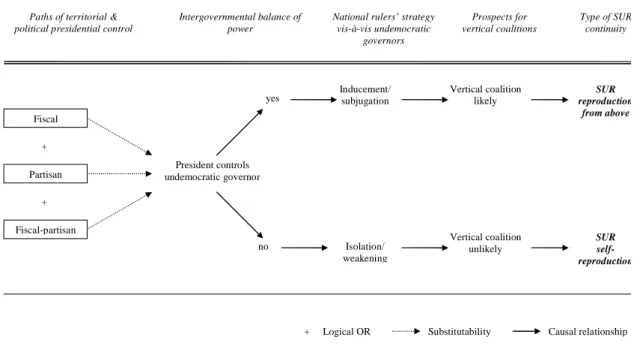
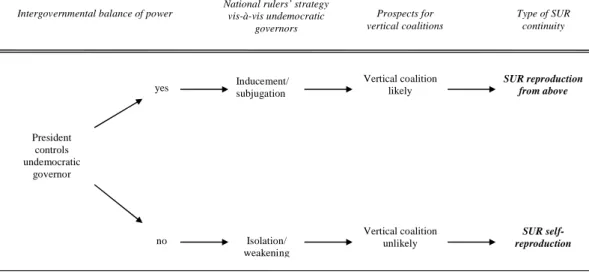
control, and thus discipline, subnational nondemocratic rulers. An undemocratic subnational ruler who is subject to presidential manipulability and control can in fact be very beneficial for a president needing political support. With their tight control over voters and national legislative delegations, subservient undemocratic governors can provide important benefits to national incumbents (Gibson 2005). If presidents can successfully induce governors to cooperate with the center, the latter might find it very convenient to engage in mutually beneficial vertical coalitions6. When this occurs, I contend that a first type of SUR continuity ensues, namely, SUR reproduction from above7. The trajectory leading to this outcome is schematized in figure 1.1 below.
However, presidential penetration and control over nondemocratic
incumbents/arenas, is not always attainable. In fact, recalcitrant and powerful undemocratic governors may stand in a position to prevent and/or neutralize presidential leverage and control. When this occurs, presidents may have few incentives to promote the continuity of SURs upon which they cannot exercise any control, much less induce their rulers to join in vertical coalitions. In such a context, the center not only will avoid reproducing SURs from above, but whenever possible, it will seek to weaken these regimes. Nonetheless, the entrenched position of autonomous and non-controllable undemocratic incumbents, coupled with presidents’ weak disciplining power, allows the former to maintain the status quo and
6 By vertical coalitions I mean electoral, legislative, and governing coalitions built across different levels of
government.
7 By reproduction I mean that presidents deliberately act in ways that are favorable to SURs’ survival. The
keep their regimes alive. When this occurs, a different trajectory of SUR continuity ensues, namely, SUR self-reproduction (see figure 1.1).
The capacity of presidents to exercise control over nondemocratic subnational incumbents, as well as the nondemocratic governors’ ability to resist this control, are central building blocks for explaining how intergovernmental interactions shape SUR continuity. Hence, one of the principal tasks of this study is to identify and subsequently analyze the major instruments that both governors and presidents can use to increase their power, control, and autonomy vis-à-vis other levels of government.
Building on the literature on political parties and fiscal federalism, I identify two major instruments through which presidents can penetrate and control SURs. National incumbents can control nondemocratic rulers via their party structures, and/or fiscal leverage or through both of these instruments of territorial and political control. I thus identify three possible paths through which presidents can exert leverage and control over SURs, namely, the fiscal path of presidential control, the partisan path of presidential control, and a combined fiscal-partisan path of presidential control.
These paths are presented in figure 1.1 with dotted arrows, which denote substitutability. The three paths of territorial and political control are schematized as substitutable because there are multiple paths through which presidents can control or penetrate provincial arenas and any one can be sufficient to attain territorial/political control over SURs. In fact, as I will show in chapters 4, 6, and 7, these paths vary across countries and over time.
neutralized or enhanced depending on the capacity of each SUR to avert or succumb to control from the central government. Regardless of how control is exercised (i.e., via partisan, fiscal, or both instruments) presidents can only gain leverage over subnational politics and rulers if a combination of national and subnational variables is present. To be able to politically/territorially penetrate, and thus exert control over undemocratic provincial arenas, presidents need to have the means necessary to subjugate undemocratic governors to their rule and the undemocratic governors’ capacity to resist penetration from above must be minimal. Neither of these two conditions alone (except at the extremes) is sufficient for a president to gain leverage over subnational arenas.
Building on the literature of fiscal federalism and state building, I contend that nondemocratic governors can counterbalance control from the central government provided they are financially autonomous, and/or stand in a position to exercise tight control over their territory, the local population, and state-resources. The first source of gubernatorial
autonomy is determined by subnational incumbents’ financial situation, whereas the second is shaped by the nature of the state/province’s state-administration8. These instruments of gubernatorial autonomy, which vary across SURs, strongly shape the prospects of
presidential control, unleashing in turn different trajectories through which SURs can survive, and eventually determining the type of SUR continuity.
In light of the varied access to instruments of control across levels of government, subnational units, countries, and time, I build a theoretical framework that captures
8 State administrations are here understood in the Weberian sense, as the set of rules and procedures through
SUR differences, their interactions with the center, and demonstrates how these interactions vary across federations and over time. Such a complex and dynamic framework is better equipped to explain how presidents exercise (political and territorial) control over governors, and thus how trajectories of SUR continuity persist.
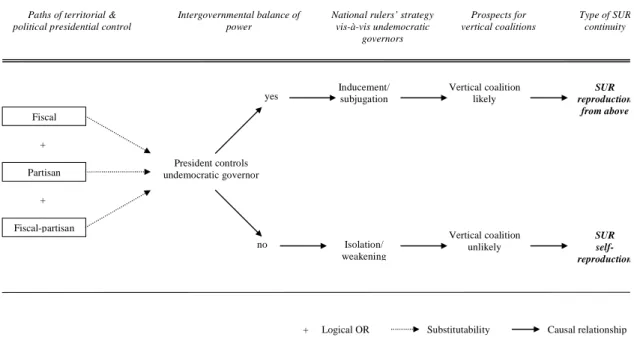
Figure 1.1: An integrated analytical framework to explain trajectories of SUR continuity across countries
Case selection, research design, methodology, and outline of the study
The analytic framework put forward in this study is tested in Argentina and Mexico. I have chosen Argentina and Mexico as the two country cases because they both have federal systems within which SURs maintain a persistant presence. These types of systems grant subnational territorial units considerable legal and political autonomy to design local rules and institutions, and to insulate local electoral processes from the influence of national incumbents. As a result, federal systems raise the likelihood of regime juxtaposition.
President controls undemocratic governor yes no Inducement/ subjugation Isolation/ weakening Vertical coalition likely Vertical coalition unlikely SUR reproduction from above SUR self-reproduction
Intergovernmental balance of power
National rulers’ strategy vis-à-vis undemocratic
governors
Prospects for vertical coalitions
Type of SUR continuity Fiscal Partisan Fiscal-partisan + +
Paths of territorial & political presidential control
The countries also exhibit many socioeconomic commonalities (such as level of economic and social development), institutional similarities (such as a presidential system and a bicameral system), and more recently, political similarities (such as the type of the national political regime), and thus allow for controlled cross-national comparisons. In addition, as I will show in chapter 3, Argentina and Mexico offer a wide variation in terms of SURs, thus allowing testing the different trajectories of SUR continuity. Finally, the two country cases have in common the hypothesized causal factors that explain trajectories of SUR continuity. Yet, Argentina and Mexico vary in other ways that are theoretically relevant, specifically with regards to how SUR continuity is possible –either through fiscal, partisan, and/or fiscal-partisan means. A comparison of these two countries, therefore, allows testing the relative importance of the primary explanatory variables outlined in the analytic framework.
The dissertation is divided into 6 empirical chapters. In chapter 2, I present the general analytic framework, and discuss each of its components parts. In the first part of the chapter I review the two main theoretical approaches that have been used so far to explain SUR continuity. One of the main claims of this study is that these approaches provide merely partial explanations of SUR continuity. However, a second central assertion of this dissertation is that each of these approaches emphasizes different and important elements of the national-subnational reality, and that precisely for that reason each of them should be synthesized into a more satisfying model. Thus, the framework I develop and test in this study builds on and integrates these two (apparently) opposing approaches to the study of subnational politics in contemporary Latin America. This framework is discussed
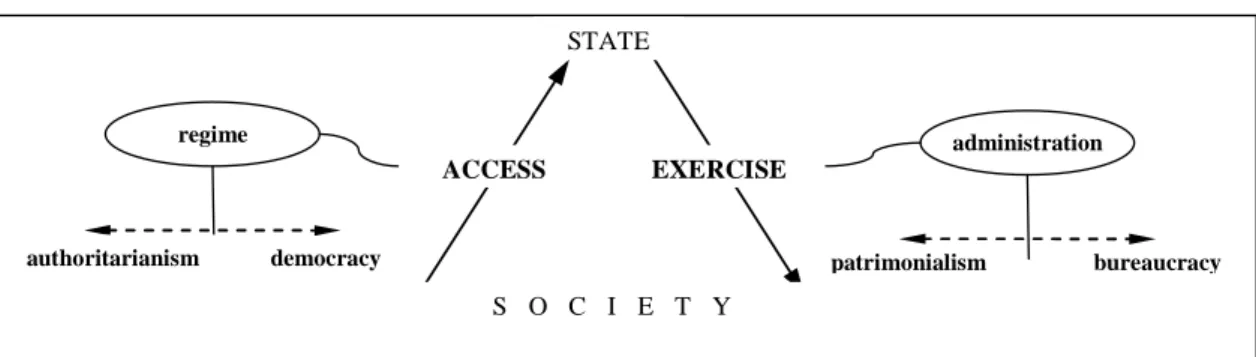
In chapter 3, I assess the territorial extension of democracy in Argentina (1983-2007) and Mexico (1997-2006). To do so, I first engage in an extensive and detailed discussion of the concept of subnational democracy. Building on on Mazzuca’s (1998, 2007) conceptual framework, I then turn to refine existing conceptualizations of subnational political regimes. I conceptualize subnational political regimes along the access to political power and exercise of political power dimensions, which is why I adopt a minimalistic definition of democracy and treat all other liberal attributes of democracy as attributes of a new concept, i.e., the state-administration.
Building on this conceptual framework I proceed to measure democracy in all 24 Argentine provinces and 32 Mexican states. Using an original data set, I present maps of subnational democracy which not only reveal the extension of democracy in these two countries, but perhaps more interestingly, show how subnational political regimes have evolved over time. In the second part of the chapter I use the access-exercise framework to advance a new classification of SURs in contemporary Argentina and Mexico. This
classification, which reveals that SURs vary systematically regarding the type of state-administration they posses, is central to understanding how different trajectories of SUR are eventually unleashed.
In chapter 4, I measure and compare fiscal and partisan instruments of presidential control in Argentina and Mexico. An examination of each of the post-1983 presidencies in Argentina reveals that presidents used multiple paths to secure their control. While Peronist President Menem followed the fiscal/partisan path, thus exerting control over governors using two types of instruments, Peronist Presidents Duhalde and Kirchner disciplined governors using fiscal instruments. By contrast, president Fox in Mexico followed the partisan path of presidential control.
After establishing the specific path of control through which presidents constrict undemocratic governors, I carry out an intra-country comparison and explore whether different trajectories of SUR continuity were contingent upon undemocratic governors’ capacity to resist (or succumb to) presidential control. In chapter 5, I test the more general claim of my argument, namely, that presidential control leads to SUR reproduction from above. To do so, I perform different cross-sectional time-series analyses, each of which tests if presidential control leads to SUR reproduction from above. The chapter analyzes the administrations of president Fox (2000-2006) in Mexico, and the administrations of Menem (1989-1999), De la Rúa (1999-2002), and Duhalde/Kirchner (2003-2007) in Argentina.9 The analyses confirm that whenever presidential control over SURs is possible, national
incumbents opt to reproduce these regimes.
Because quantitative anlyses do not permit the testing and substantiation of the specific mechanisms through which presidential control leads to SUR reproduction, the second goal in this (second) phase of research is to reconstruct the causal chain that links the cause (i.e. the specific instruments and paths of national politicians for controling SURs)
with the effect (i.e., the type of SUR continuity that ensues). To do so, I conduct a “causal process observation, ” as proposed by Brady & Collier (2004), through which I seek to identify pieces of data that provide information about the context, processes, and mechanisms through which the initial case conditions are translated into case outcomes (George &
Bennett 2005). More specifically, following Van Evera’s (1997) recommendations, I break down the causal chain of events into its component parts using evidence gathered from over 150 in-depth interviews, archival documents, and newspapers articles. I, then, flesh out and analyze how each component part of the two trajectories of SUR continuity unfolds to produce the hypothesized outcome.
In chapter 6, I analyze SUR continuity in Mexico under the presidency of Vicente Fox (2000-2006). Evidence presented in chapter 4, indicates that if SUR reproduction from above is to take place, it should occur via a partisan path of presidential control. In order to explore how partisan presidential control (lack thereof) triggers different trajectories of SUR continuity, I conduct an in-depth qualitative analysis of Puebla and Oaxaca, two
undemocratic states that underwent different trajectories of SUR continuity.10 Puebla, which did not have sufficient instruments of autonomy to resist presidential control, represents a case of SUR reproduction “from above,” and Oaxaca, which managed to neutralize national incumbents’ partisan control, illustrates the trajectory of SUR “self-reproduction.”
In chapter 7, I examine SUR continuity in Argentina during the presidency of Néstro Kirchner (2003-2007). As demonstrated in chapter 4, if SUR reproduction from above is to take place, it should occur via the fiscal path of presidential control. I study San Luis and La Rioja, two undemocratic provinces that have resisted and succumbed to federal penetration,
respectively, and consequently experienced different trajectories of SUR continuity.11 Whereas San Luis represents a case of SUR self-reproduction, La Rioja illustrates the alternative trajectory of regime continuity –SUR reproduction from above.
Despite the fact that the theoretical framework outlines a third path of presidential control, which occurs when a combination of fiscal-partisan instruments is present, I do not carry out an in-depth analysis of its effect on SUR continuity. The reason for doing so is because the specific mechanisms that operate to trigger different trajectories of SUR survival are extensively spelled out in chapters 6 and 7 where I analyze the fiscal and partisan paths individually.
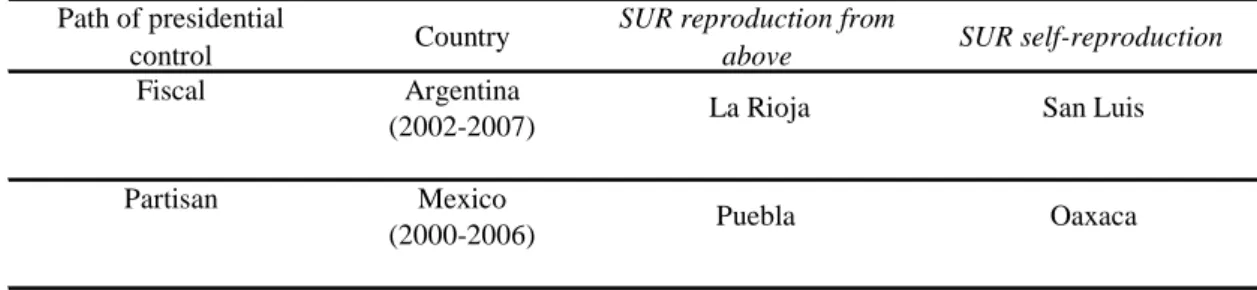
Table 1.1 below summarizes the research design of this study as well as the national and subnational cases selected to test the analytic framework. The left hand side column presents information about the paths of presidential control existent in each country during two different administrations. The remaining columns oultine the subnational cases studied in this dissertation and the type of SUR continuity observed in each of them.
Table 1.1: Summary of research design and case selection
Path of presidential
control Country
SUR reproduction from
above SUR self-reproduction
Fiscal Argentina
(2002-2007)
Partisan Mexico
(2000-2006)
La Rioja San Luis
Puebla Oaxaca
The final chapter of this dissertation presents a summary of the argument, as well as a discussion of the study’s findings and primary contributions. I conclude the chapter
Chapter 2: An analytic framework to explain subnational undemocratic
regime continuity
“This is my state,” yelled the Oaxacan Priísta governor to one of the federal officials held hostage in ‘his’ state, “and I decide who meets with whom, and whether or not you hold meetings in Oaxaca” (interview Lepine). In August 2002, two years after Mexico’s national democratization took place, a group of federal officials from the Ministry of Social
Development (Sedesol) were kidnapped in the Oaxacan city of Mitla. The federal officials had travelled down south from Mexico City to answer the PAN mayors’ claims that the Sedesol programs, which were administered by the PRI state government, were not being distributed according to eligibility criteria. Instead, the mayors argued the programs were allocated to political and partisan allies, and consequently did not reach PAN ruled mayoralties. The kidnapping occurred when the group of Sedesol officials and the PAN mayors were discussing strategies to cope with the discretional distribution of social programs. “All of a sudden”, as one of the kidnappees reported, “the doors of the meeting room were opened and Ulises Ruiz [then, federal senator of Oaxaca, today governor of the state], leading a crowd of 100 PRI mayors, burst into the room, violently apprehended the federal officials and took us away in a pick up truck, holding us hostages for one day” (interview Lepine). This episode, which vividly illustrates Oaxacan non-democratic entrenched practices, had important implications for both the state and the federal
‘treaties of social development’ (Convenio de Desarrollo Social) with the federal
government,12 which is why Oaxacans did not benefit from some of Fox’s social programs” (interview Lepine).
This incident and its implications reveal important aspects of the relationship between an undemocratic regime and the federal government. For one, it shows President Fox’s incapacity to trespass Oaxacan borders, his inability to discipline and control recalcitrant governors, and his determination to cut off ties (i.e., social programs) with Oaxaca’s
governor. Furthermore, the episode not only shows the governor’s unwillingness to maintain a collegial relationship with the federation, but also his resolve to confront the president.
A different pattern of intergovernmental relations can be observed in Oaxaca’s neighboring state: Puebla. Unlike Oaxaca, where federal political penetration is scarce and intergovernmental relations are confrontational, PRI-ruled Puebla –also one of the least democratic states of Mexico (see chapter 3), has experienced far greater federal infiltration. Much of this penetration has occurred at the municipal level where, beginning in 1995, the political presence of the PAN increased; and more recently (e.g. early 2000s) at the
legislative level, when the PAN has began to control federal legislative slots that were previously monopolized by the PRI.13 The PAN in Puebla, as many interviewees reported, was, and remains, an actual threat to the PRI hegemony, which has controlled the
governorship since the 1930s. Yet despite the growing and challenging presence of the PAN in Puebla, Poblano governors, unlike their Oaxacan counterparts have always have
12 Every year each Mexican state signs these treaties with the federal government in which both parties stipulate
what social programs will be co-financed by the state and the federal government.
13 In the mid-term elections of 2006, Puebla elected 2 PAN federal senators (out 3), and 14 PAN
maintained a “smooth” relation with PAN presidents. Not only have they let federal officials cross provincial borders and make inroads into their state, but they also have supported many of the (i.e., Panista) federal legislative and gubernatorial initiatives. In turn, as I will show in this study, PAN presidents have rewarded Puebla with abundant federal programs and transfers. This collegial and mutually beneficial relationship is possible, as one interviewee noted, “because of the existence of an informal deal through which PRI governors are left untouched provided they do not interfere in electoral local processes, and give the PAN room of maneuver to compete and keep on winning local and legislative positions” (interview 25).
Similar dramatic differences across adjoining subnational undemocratic regimes can also be found in Argentina. The neighboring provinces of San Luis and La Rioja, two of the most undemocratic provinces of the country (see chapter 3), maintain diametrically different relationships with the federal government. La Rioja is located in one of the least
economically developed regions of Argentina and is one of the most financially dependent provinces of the country on the federal government. As a result of this dependence, Riojano governors have virtually no room to maneuver vis-à-vis the central government. This lack of autonomy from the central government has obliged La Rioja’s incumbents to act in
agreement with the president’s agenda and will. An example of this subordination occurred in the mid-term elections of 2005, when former President Néstor Kirchner forced then Peronist Governor Ángel “Didí” Maza to campaign for a seat in the national senate .
Kirchner’s imposition on Governor Maza was a reaction to Menem’s decision to run for one of the three Riojano seats in the senate.14 Kirchner and Menem, close allies in the early 1990s, had become strong enemies after they both had competed for the presidency in 2003,
when the Peronist party went to the polls with split-tickets. Kirchner not only wanted to avoid Menem’s victory in La Rioja, but most importantly wanted a landslide victory for Maza in Menem’s own stronghold. To that end, he compelled Governor Maza, the 10-year governor whose political fate and career depended on Menem’s power, to run against his very own political mentor (interviews Maza (a), Maza (b)). Had Maza not done so, as a top rank national official and close friend of President Kirchner told the governor, “La Rioja would not receive a single penny from the federal government” (interview with Maza (b)).
Such a presidential imposition and intrusion in provincial affairs would be impossible in the undemocratic province of San Luis. During his 18-year administration, Peronist Adolfo Rodríguez-Saá ruled the province along Prussian standards. Not only did he keep his iron grip on power, but, like his European ‘counterparts’, also developed a modern and efficient state bureaucracy, passing several bills all aiming at maintaining provincial finances in check. Moreover, “el Adolfo,” as the former governor is named, followed a balanced-budget policy, according to which he destined 50 percent of the provincial balanced-budget for public works and infrastructure development. This financial austerity and orderly budgetary execution allowed him to diligently build a local proto-type of a “developmentalist state.” One of the unintended consequences of the province’s sound economy and balanced financial situation was that the governor managed to neutralize political and partisan impositions from the center. Not only have presidents found it hard to make inroads in the state and thus meddle in local politics, but, most importantly, they have also been victims of the political impudence of the Rodríguez-Saá brothers.15 These have included, among others, the fierce opposition to numerous presidential iniatives, such as Senator Alberto Rodríguez Saá’s vote
against Menem’s most desired project, i.e., the constitutional reform in 1994 through which he intended to introduce the consecutive reelection of presidents, and the numerous claims filed with the federal Supreme Court against the Kirchner administration denouncing the government for its unfair political practices vis-à-vis San Luis province.
All together, these examples reveal important aspects of how undemocratic regimes operate within nationally democratic countries. First, the examples show that there are important political, partisan, and economic cross-SUR differences. These differences in turn, have important implications for placing undemocratic subnational units and governors in diverse positions vis-à-vis the center, as they enhance or limit the capacity of subnational rulers to prevent federal intromission. These cross-subnational differences, which determine undemocratic governors’ clout in their dealing with the center, are key to understanding how, and under what conditions, SURs continue to survive.
Second, and perhaps more important, the examples listed above suggest that there are different types of political dynamics between SURs and the center. Whereas some SURs seem to provide strategic benefits to the needs of federal incumbents, as exemplified by the cases of Puebla and La Rioja, some others inflict substantive damage on federal incumbents. This is illustrated by the cases of Oaxaca and San Luis, whose governors have managed to impose their own conditions on the federal government. Acknowledging that there are different relationships between SURs and the federal government is key to discovering the causal mechanisms that underpin the SUR continuity.
Third, the examples listed above further underscore another important factor regarding intergovernmental relations and SUR continuity in particular, namely, that
indicates that presidential control cannot be exerted equally across subnational units. These facts, as I will show in the next chapters, denote the incapacity of the central state to
penetrate and win over undemocratic subnational areas and rulers, and are decisive in explaining types and trajectories of SUR continuity.
Finally, the examples enumerated earlier reveal that there are important cross-country differences with regard to how presidents can penetrate and control nondemocratic arenas and exert control over recalcitrant undemocratic rulers. Whereas in some cases political and territorial control can occur through partisan structures, as shown by the Mexican case of Puebla, in others it can be exercised via economic and financial means –as illustrated by the Argentine province of La Rioja. These examples reveal that any cross-national explanation of SUR continuity must acknowledge the varied instruments that facilitate (or prevent) the broadcasting of presidential power into the peripheries, and which, in turn, shape
intergovernmental relations within and across countries.
In summary, the examples listed above reveal that (a) SURs are not all of one kind and that these differences have important implications for intergovernmental realtions, (b) they are not all functional to the center, in that they do not provide strategic benefits to national incumbents, (c) they cannot be equally subjugated and controlled by the federal government, and (d) the instruments that federal incumbents employ to exert control over some SURs differ cross-nationally and cross-temporally.
grounds, existing works have taken for granted that all SURs interact with the federal
government in similar ways (see Cornelius 1999, Gibson 2005, Gervasoni 2006).16 Precisely for this reason, this literature has advanced general explanations of SUR continuity that do not apply well to all nondemocratic regimes. In other words, current explanations only account for the dynamics of continuity observed in a selected number of SURs, not in the totality of them. In effect, it would be misleading to claim that all SURs survive because they meet the strategic needs of national incumbents (Gibson 2005), since there are some SURs that survive in spite of being ‘functional’ to the central government.
Another central assumption of current works on regime juxtaposition is that national incumbents’ capacity to exert control over governors is the same (i.e., does not vary) across provinces. This misconstruction, in turn, has prevented scholars from assessing the fact that presidents are limited in their capacity to discipline and control recalcitrant governors, and are constrained regarding the strategies they employ to take advantage of, or weaken, nondemocratic subnational arenas/governors. Finally, scholars studying subnational nondemocratic regimes have only summarily explored the instruments that structure
intergovernmental relations and precisely for that reason have not been able to fully spell out the mechanisms through which national incumbents may facilitate or prevent the continuity of SURs.
In order to address these issues, this study takes cross-subnational differences seriously. Even more importantly, I pay close attention to how these differences shape the pattern of interaction between nondemocratic areas/governors and the national incumbents. Moreover, the analytic framework developed in this dissertation to explain how and why
SURs continue to exist despite national democratization, is built in such a way as to capture cross-SUR differences, their multiple interactions with the center, and how these interactions vary across federations and over time. In identifying and theoretically addressing these key features, the theoretical framework presented in this study explains both SUR continuity across federations, and trajectories of SUR continuity within federations and through time.
In what follows, I outline the two main theoretical approaches (i.e., “the territorial politics approach,” and “the provincial approach”) that have been employed to explain SUR continuity in developing countries. After discussing their contributions and limitations, I synthesize, in section II, the best elements of these two approaches in an integrated
framework to explain SUR continuity. The integrated analytic framework and its components parts are analyzed in detail in sections III and IV of this chapter.
I. Existing literature: contributions and limitations
Two different analytical approaches have tackled the issue of regime juxtaposition. The first approach, which I term the “territorial politics approach,” focuses on how the politics and political conflict that play out at the intersection of national and provincial arenas affect SUR continuity.17 A core assumption of this literature is that central governments and their territorial subunits are politically linked. Thus, the linkages18 between the center and
17
Territorial politics, as Tarrow (1978) notes, “is not about territory, but is about how politics is fought out across territory (1978:1). The territorial approach to politics has been used extensively in the subfield of European politics, especially within the literature of state building, political parties, and regionalism (see the works by Rokkan 1970, Rokkan and Urwin 1982, 1983; Keating 1998; Tarrow 1978; Tarrow, Katzenstein and Graziano 1978, among others). Recent works inspired by the territorial approach to politics are Gibson (1997, 2005, 2008); Falleti (2003, 2005, forthcoming); Eaton (2004), Wibbels (2005), among others.
18 Linkages, as Gibson (2005:112) notes, can include all types of institutions regulating intergovernmental
periphery of the political system, as well as the skills and resources of the politicians who serve as gatekeepers between each level of government, are central to understanding how different sub-systems (i.e., higher and lower arenas of government) interact with each other, and in turn, how national political events shape political outcomes occurring in subnational arenas (Tarrow 1978; Rokkan & Urwin 1983; Gibson 2005, 2008).
Several works illustrate how the interconnectedness of higher and lower arenas affects SUR continuity. For instance, Snyder (1999; 2001) shows that events occurring at the federal level of government, such as the implementation of neoliberal (market) reforms, can contribute to the maintenance and strengthening of SURs. These reforms, as he notes, trigger reregulation projects in the states through which incumbent nondemocratic elites generate rents and resources to survive. Alternatively, Gibson (2005) contends that national
incumbents’ strategic needs may lead federal politicians to foster SUR continuity. As long as subnational nondemocratic rulers meet these needs, national democratic incumbents have incentives to prevent democracy from trickling down. On a similar note, in an analysis of Argentina, Gervasoni (2006) argues that the institutions of fiscal federalism shape the prospects for democratization in subnational arenas, as provinces that are highly dependent on federal transfers are better equipped to maintain SURs in place. Finally, Cornelius (1999) and Montero & Samuels (2004) argue that processes of decentralization, which shift political, fiscal, and administrative power away from the national government toward subnational units, give nondemocratic state-level rulers greater autonomy, resources, and leverage to strengthen and maintain SURs alive.
intergovernmental connections possible are not always prevalent. As a result, this strand of reasoning holds that it would be wrong to assume that political outcomes unfolding at the subnational level are a direct consequence of events occurring at higher levels of
government. Advocates of this approach argue that SUR continuity is better understood by looking at specific provincial factors present in each SUR.
Echoing this approach, Montero (2007) claims that, in countries such as in Brazil, where subnational politicians neither have the desire (i.e., progressive career ambition) nor the resources (i.e. party structures) to venture into national politics, SUR continuity cannot be explained by looking at the intersection of national and provincial arenas. Instead, he argues that the level of provincial capitalist development and citizens’ economic autonomy from the (provincial) state are the main factors explaining SUR continuity in Brazil (Montero 2007).19
Each of these two approaches separately offers key analytical and theoretical insights to better understand the prospects for subnational undemocratic regimes continuity in
contemporary Latin America. Yet, because each of them views subnational politics from rather opposing viewpoints, they fail to provide a comprehensive and accurate explanation of the political dynamics that unfolds in the subnational world and that feeds SUR continuity. For instance, the “territorial politics approach” is correct in assuming that in any large-scale system of territorial governance, such as federal states, political institutions are entangled across space and precisely for this reason political outcomes and political action are not limited to a single arena.
19 McMann (2006) offers a similar argument to explain subnational undemocratic regimes in Russia and
Yet, with its emphasis on intergovernmental interactions, this approach underplays the influence of provincial factors on the prospects for SUR continuity. In fact, many of the elements that shape the interaction between higher and lower-level incumbent politicians are determined by provincial variables. The leverage that national politicians can exercise over subnational arenas, as well as undemocratic incumbents’ capacity to thwart national leverage in subnational arenas is, to a large extent, determined by structural subnational variables (such as the level of economic provincial/state independence from the center, and the type of state-administrations –which facilitate or hinder political penetration from federal actors and institutions). Thus, by focusing on the processes (i.e., intergovernmental interactions), rather than the structural subnational variables that shape national and subnational actors’ ability to feed SURs, the territorial approach misses an important part of the explanation of subnational regime continuity.
By the same token, the provincial approach, which centers exclusively on the effect of subnational variables, overlooks key “exogenous” (i.e. national) factors, such as the incidence of national parties, institutions, and actors in subantional arenas, all of which may drive political continuity in subnational units. The provincial approach assumes that
the political and institutional incidence of the national government on subnational political dynamics (as suggested by the territorial politics approach).
Given that each of these two approaches emphasizes different and important elements of the national-subnational reality, which should be taken into consideration when studying SUR continuity, the analytic framework I develop and test in this dissertation synthesizes the central building blocks of each of these approaches into a more satisfying model. From the territorial politics approach, I borrow the idea that SUR continuity should be understood from an intergovernmental and “system-based” perspective. As mentioned before, given the interconnectedness between higher and lower levels of government (i.e., subsystems), and the constant interplay between these arenas, political outcomes in the subnational world are necessarily shaped by what happens in higher (and also cross-provincial) levels of
government. Thus, any theory about SUR continuity should incorporate the interactive dynamics that take place at the intersection of national and provincial politics (see Gibson 2005, 2008).
From the provincial approach I borrow the idea that provincial variables play an important and decisive role in shaping SUR continuity. As I will show in the coming sections of this chapter, structural provincial variables such as the nature of state
administrations20, and the fiscal/financial autonomy of provinces from the center, are key to understanding how the interconnectedness across levels of government operates, and, in turn,
20 State administrations are here understood as the set of institutions and rules that organize government. These
how SUR continuity and reproduction ensues.21 Put differently, the politics that play out at the intersection of national and subnational arenas, which is central to determine the
territorial strategies that give way to SUR continuity, cannot be understood without taking into consideration political, institutional, and economic subnational factors.
II.Explaining SUR continuity in contemporary Latin America: control, autonomy, and
trajectories of SUR continuity
Before turning to present and discuss the analytic framework, a word about partisan affiliation and ideology is in order. The analytic model developed in this chapter does not assume that presidential control is more likely when presidents and governors belong to the same political party or share the same ideology. Rather, it assumes that both opposition-governed and co-partisan-ruled provinces are prone to be controlled from above (i.e., by the central government) under certain circumstances, and that as result of this control presidents may opt to reproduce both opposition-governed and co-partisan-ruled SURs.22 That is,
21 Note that my hypothesis, contrary to what the provincial approach claims (see Montero 2007, McMann
2006), rules out socioeconomic variables as potential driving forces behind SUR continuity. I do so, because as I will show in the next chapter, socioeconomic variables are misleading predictors of SUR continuity, as both less developed and poor, and mid developed and rich undemocratic provinces have managed to outlast national democracy. This assertion does not deny the fact that socio-economic variables may play a key role at explaining SUR origins or SUR change (but not regime continuity, which is the central topic of this dissertation).
22 To illustrate this point take the case of an opposition-governed undemocratic province undergoing a profound
economic crisis and which at the same does not have sufficient local resources (i.e., provincial taxes) to meet its fiscal and financial imbalances. This province, which is highly dependent on federal transfers for its
partisanship and shared ideology at both levels of government do not ensure, in and of themselves, greater presidential control over provincial incumbents.
One central assertion of the territorial approach is that the degree to which the boundaries of a periphery can be penetrated has important consequences for its internal structuring (see Tarrow 1978, Rokkan & Urwin 1983, Gibson 2005). Despite the fact that this contention has received wide acceptance within the literature, few studies have
substantiated it empirically. In contrast, this dissertation carefully investigates the different mechanisms through which this penetration can be achieved (or prevented), and by piecing out evidence I explore how this penetration affects the prospects and types of SUR
continuity.
Drawing on this insight, I argue that the capacity of national incumbents to penetrate subnational undemocratic arenas as well as the ability of provincial incumbents to resist and neutralize that penetration strongly determines the prospects for SUR continuity. I thus hypothesize that nationally democratic politicians who can effectively penetrate in provincial arenas, and threaten the autonomy and power of recalcitrant nondemocratic governors, will have incentives to promote SUR continuity.23 Underlying this hypothesis is the idea that controllable and inducible undemocratic governors can become valuable partners for
coalition building (Gibson 2005). Indeed, if presidents can successfully induce governors to cooperate with the center, the latter might find it very convenient to engage in mutually beneficial vertical coalitions. An undemocratic subnational ruler who is subject to
23
It should be noted that these very same conditions may lead national incumbents to promote subnational democratization. Yet, the extent to which national politicians embark in SUR reproduction or SUR
presidential control and manipulability can in fact be very beneficial for a president seeking political support. With their tight control over voters and national legislative delegations, subservient undemocratic governors can provide important benefits to national incumbents. Under these circumstances, the costs of promoting the democratization of undemocratic enclaves outweigh the cost of dismantling them. To be clear, unless presidents can not wield power and influence over undemocratic governors, limit their autonomy, and thus induce or subjugate them, they will not have incentives to reproduce SURs. 24
“Controllable and weak” undemocratic governors, for their part, also reap the benefits stemming from siding with presidents. Not only do they avoid having their regimes
dismantled, but most importantly, they ensure that their regimes will be strengthened “from above.” When this occurs, I contend that both presidents and undemocratic governors engage in a mutually functional relationship of cooperation, establishing mutually functional vertical political coalitions.25 This chain of events leads to a first trajectory of SUR continuity, what I here refer to as SUR reproduction from above. This trajectory benefits both national and subnational rulers.
Yet, presidential penetration and control over nondemocratic incumbents/arenas, is not always attainable. Recalcitrant and powerful undemocratic governors may stand in a
24 By reproduction I mean that presidents deliberately act in ways that are favorable to SURs’ survival. There
are different mechanisms through which presidents can reproduce these regimes. For instance, they may veto legislative pieces, such as a declaration of federal intervention seeking to overturn undemocratic regimes in specific states/provinces. Presidents can also discourage bills or veto laws intended to enhance subnational democratization in a given SUR, or prevent independent (federal) agencies of control such as the Supreme Court, the Constitutional Tribunals, or federal auditing agencies from sanctioning undemocratic governors. Similarly, presidents can actively contribute to SUR reproduction by rewarding SURs with economic benefits, such as federal transfers and federally funded programs, all of which contribute to enrich the coffers of undemocratic regimes.
25 By vertical coalitions I mean electoral, legislative, and governing coalitions built across different levels of