Megan O’Connor
A DNP project submitted to the faculty at the University of North Carolina at Chapel Hill in partial fulfillment of the requirements for the degree of Doctor of Nursing Practice, (Nurse
Executive) in the School of Nursing.
Chapel Hill
2014
Approved by;
Gwen Sherwood
Carol Durham
Grace Hubbard
iii ABSTRACT
Megan O’Connor: Changing Organizational Culture through Gaming (Under the direction of Gwen Sherwood)
This purpose of this project was to examine the impact of an experiential learning activity
on staff nurse perceptions of organizational culture following a low cost gaming simulation,
Friday Night at the ER®, at a large academic medical center in the Southeast United States. The
key content concepts include discussion of organizational culture and patient care, description of
the Friday Night at the ER®, and impact of the game on organizational culture scores and staff
perceptions.
There is a need for innovative methods that communicate elements (trust,
communication) of organizational culture to staff to promote patient safety. Patient care has
been negatively affected by communication lapses and poor choices that occur when health care
employees are uninformed, have poor handoff processes, or make decisions out of fear. Health
care costs continue to rise in the United States without a subsequent increase in quality
outcomes. Innovative methods for educating staff are needed to improve communication and
team processes in an effort to provide efficient and effective patient care.
Forty staff nurses participated in Friday Night at the ER® and recorded their perceptions
of organizational culture using a pre- and post-survey design through the Diagnosing
Organizational Culture Instrument (DOCI). In the post-game survey participants were also
iv
culture following the learning activity. However, results were not statistically significant. A
Likert survey conducted post-game play revealed that participants strongly recommend the game
Friday Night at the ER® for colleagues, felt that it was a useful learning activity, learned new
things about their organization, and felt that it helped them to be better prepared to provide high
quality care.
The board game Friday Night at the ER® is a low cost method that can be used to
capitalize on team training and lead to improved organizational culture scores that can
v
TABLE OF CONTENTS
LIST OF TABLES...vii
LIST OF FIGURES...viii
CHAPTER 1. CHANGING ORGANIZATIONAL CULTURE THROUGH GAMING...1
Background and Significance...3
Literature Review...5
Organizational Culture...5
Experiential Learning...7
Simulation and Games...8
Theory...12
Theory of Organizational Culture...12
Experiential Learning Theory...13
Purpose...16
Questions...16
Project Description...17
Game Description...17
Assessment of Resources...18
Methods...19
Setting...19
Sample...19
vi
Instruments...21
Diagnosing Organizational Culture Instrument...21
Post-Assessment...23
Data Analysis...23
Results...24
Demographic Data...25
Diagnosing Organizational Culture Instrument Data...27
Relationship Data...28
Impact Survey...30
Survey Comments...31
Discussion...31
Study Questions...33
Limitations...40
Future Implications...41
Dissemination Plan...43
Conclusion...45
APPENDIX A: PERMISSIONS...47
APPENDIX B: DEMOGRAPHIC DATA……...48
APPENDIX C: IMPACT SURVEY...50
APPENDIX D: CONSENT FORM...51
vii
LIST OF TABLES
Table 1. Demographic characteristics...26
Table 2. DOCI histogram frequency data...28
Table 3. Years of experience and cultural index score compared to finance and quality scores...29
Table 4. Years of experience, clinical ladder and cultural index score...29
viii
LIST OF FIGURES
1
In healthcare a great deal of time is spent on orienting, training, and providing resources
for clinical practice. However, education on the tenets and practices of positive and effective
organizational cultures is omitted from most training programs. Organizational culture has
various definitions but generally encompasses informal values, beliefs, and norms that shape
how staff provides patient care (Scott, Mannion, Davies, & Marshall, 2003). Organizational
culture is important when assessing an organization’s ability to change and implement new
practices (Sinkowitz-Cochran et al, 2012). It is necessary for organizations to be able to learn
and adapt to rapidly changing environments in order to effectively provide services. In order to
affect change it is important to have organizational members identify their frames of reference.
Understanding shared mental models among staff provides a means for the system to
learn and adapt to the rapidly changing environment (Senge & Sterman, 1992). Mental models
are individual interpretations of the environment that provide a framework for one to assess and
explain occurrences in their surroundings (Van den Bossche, Gijselaers, Segers, Woltjer, &
Kirschner, 2011). Shared mental models are the “overlapping mental representations of
knowledge by members of a team (Van den Bossche et al., 2011, p 285).” The process of
developing shared mental models occurs through changes in knowledge and working
relationships that happen at the group level (Mohammed & Dunville, 2001). It is proposed that
shared mental models can enhance team communication and effectiveness in completing
2
focused on safe quality patient care. There is a need for innovative methods to educate staff
about elements (trust, communication, knowledge sharing) of organizational culture in an effort
to promote patient safety. Patient safety has been defined as “an integrated pattern of individual
and organizational behavior based upon shared beliefs and values that continuously seek to
minimize patient harm that may occur from the care delivery process” (Aspden et al., 2004, p.
174). Reason (1997) describes four areas of focus for patient safety: justice, learning, flexibility,
and systematic reporting. Team training, with a focus on communication processes, is often less
expensive and more effective than spending money on complex technological solutions to
organizational issues (Reason, 1995). Simulation is one method that can be used for team
training and communication. Open participation in an organizational learning process, such as
simulation, can lead to a more positive culture, innovative solutions, and better working
relationships (Carroll & Edmondson, 2002). Gaming is a safe method for exploring mental
models and current assumptions that may block organizational goals.
Engagement in an organizational game that allows staff an opportunity to work together
to acquire new knowledge and change mental models through a group process was used to assess
changes in perception of organizational culture. Friday Night in the ER® is an organizational
learning game that provides an experiential learning experience for staff to examine mental
models. The goal of this game is to bring together people within an organization to examine
beliefs regarding systems and workflow, and the impact these topics have on organizational
3
Background and Significance
Culture is expressed through the social interactions of group members and reflects
acceptable behavior within the system (Schall, 1983). Culture has been described in the
literature as resulting from communication; it comes alive in the interactions of its members
(Schall, 1983). Weick (1969) suggests that organizations would not exist in the absence of
communication. Culture and communication are intertwined so tightly that they do not exist
without the other. Organizations have continuous communication activity where all members
receive, interpret, and evaluate all input from the system (Schall, 1983). The knowledge,
expectations, and shared mental models communicated to, and by, staff within an organization
can significantly shape actions and reactions within the system. This culture is then
communicated to other members of the system. Cultures are created, changed, and sustained
through communication activity, including modeling, instruction, storytelling, confrontation, and
observation (Schall, 1983).
Health care organizations are characterized as suffering from multiple communication
failures and errors that impact patient care. The Joint Commission cites communication failures
(written, oral, and electronic) as a major contributor to reported sentinel events based on root
cause analyses (The Joint Commission, 2011). While many sentinel events have multiple
contributors, communication failures were present in 60% of the events reported to The Joint
Commission from January to September of 2011 (The Joint Commission, 2011). The interplay
between healthcare cultural norms, medical complexities, and personal factors creates
opportunities for communication mistakes (Dayton & Henriksen, 2007). Patient care has been
negatively affected by communication lapses when employees are uninformed, have poor
4
urgency as difficulty in this area can lead to poor patient care and contribute to waste in the
system (Dayton & Henriksen, 2007). Low cost interventions may be able to target these areas of
health care waste to provide a more efficient and effective system. For example, educational
uses of simulation aim to increase trust, teamwork, and knowledge sharing within teams
(Kuehster & Hall, 2010).
The rising cost of health care is a frequent topic of discussion worldwide. The United
States spends approximately 51% more per capita than the next highest spending country
(Norway) with negligible return on health outcomes (Kaiser Family Foundation, 2014). A
portion of this spending can be attributed to waste in the health care system. Berwick and
Hackbarth (2012) identify six categories of health care waste: failures of care delivery, failures
of care coordination, overtreatment, administrative complexity, pricing failures, and fraud and
abuse. The categories of failures of care delivery, failures of care coordination, and
administrative complexity are estimated to cost between $234-$588 billion dollars in 2011
(Berwick & Hackbarth, 2012). Failures of care delivery occur when organizations fail to adopt
best care processes or poorly execute the delivery of care (Berwick & Hackbarth, 2012). This
may be seen by a failure to adopt best practices, like TeamSTEPPS communication, coordinated
care, or failure to provide adequate discharge instructions. Failures of care coordination occur
when patients “fall between the cracks” of the fragmented health care system (Berwick &
Hackbarth, 2012). Patients are often cared for by multiple team members in a chaotic and
pressured system. Administrative complexity results from misguided government and regulatory
rules (Berwick & Hackbarth, 2012). Hospitals focus on strategies to meet regulatory
requirements, particularly when funding is attached to the outcome, while coordinated patient
5
Literature Review
This project seeks to impact organizational culture through gaming, a simulated
experiential learning activity, with the overall goal of improvement of safe quality patient care
and decreased health care waste. The literature review will examine three central themes;
organizational culture, experiential learning, and simulation, while threading through related
topics of quality care and health care waste.
Organizational Culture
Organizational culture can be elusive and difficult to define. Schein (1990) includes
three elements to culture: artifacts, espoused values, and assumptions (Schein, 1990). This
encompasses informal values, beliefs, and norms that shape how staff provide patient care and
build relationships (Scott, Mannion, Davies, & Marshall, 2003; Scholl, 2003). Consistency in
the way that tasks are performed and problems are solved is also a part of culture (Scholl, 2003).
Organizational culture is a social construct based on shared experiences (Bellot, 2011).
Al-Alawi, Al-Marzooqi, and Mohammed (2007) describe culture as the interplay of structure,
reward systems, people, information systems, leadership, and processes. They further divide the
category of people to include the elements of motivation, trust, knowledge sharing, and
communication. One must understand the interactions of each element to be able to understand
and describe the whole of an organization’s culture (Gupta & Govindarajan, 2000).
It is important for organizations to promote a culture of learning at all levels, particularly
when patient care is at stake (Firth-Cozens, 2001). Barriers to organizational learning include
poor communication and feedback processes and a lack of purpose (Firth-Cozens, 2011).
6
change and successfully implement new practices (Sinkowitz-Cochran, Garcia-Williams,
Hackbarth, Zell, Baker, McCannon, Beltrami, Jernigan, McDonald, & Goldmann, 2012). Bowie
(2010) discusses enhanced team communication, open reporting of errors, and learning from
mistakes as components of promoting a culture of safety.
There is a growing body of literature on creating and/or improving patient safety cultures
within healthcare organizations. Hellings, Schrooten, Klazinga, and Velugels (2010) surveyed
five hospitals in Belgium using the Hospital Survey on Patient Safety Culture in 2005. Managers
and frontline staff were given feedback from the survey and asked to develop interventions to
improve targets identified in the survey. Interventions included implementing a patient safety
committee, education on the role of culture in promoting a safety culture, and projects aimed at
increasing communication and error reporting and analysis. A repeat survey conducted in 2007
reported moderate improvement in perceptions of management support of safety activities and
communication openness. Limitations in this study include a non-random sample, time gap may
have led to change in staff, and lack of detailed descriptions of the interventions increasing the
possibility that they were inconsistently implemented throughout the different organizations. It
may also be that the tool, a Belgian adaptation of the Hospital Survey of Patient Safety Culture
questionnaire, was not sensitive enough for the measure of culture or that more time is needed to
promote lasting and significant culture change.
Sinkowitz-Cochran at al. (2012) found that executive level staff were significantly more
likely than frontline staff to report agreement on the importance and personal impact of quality
improvement activities. In practice, frontline staff attitudes about change activities often differ
from executive staff. Activities that help frontline staff have a better understanding of
7
Hartmann, Meterko, and Rosen (2009) found group cultures, rather than hierarchical cultures,
provide the best environment for promoting patient safety. Strategies, like improvement oriented
teamwork and openness to innovation, are ways to promote a group oriented culture. Deilkas
and Hofass (2010) provide further evidence with the Safety Attitudes Questionnaire that safety
cultures can vary within an organization, particularly at the unit level. Results of the survey
varied by individuals and by unit, more so than between departments. Results suggest that
interventions aimed at the individual and unit level, are more effective in creating safety cultures
with clinicians that are closest to the delivery of patient care, although the study was
non-randomized and job classes were unequally represented.
Experiential Learning
Experiential learning is a holistic learning model that involves a cyclical process of
experiencing an activity, reflecting on that activity, applying it to real life situations, and then
evaluating the impact of the activity for future actions (Oxendine, Robinson, & Willson, 2004).
There are many examples of experiential learning activities including field courses, study abroad,
internships, and computer simulation (Oxendine et al., 2004). To be most effective, adequate
time for reflection and discussion are necessary for effectiveness of the learning experience
(Oxendine et al., 2004). Steps to integrate a successful experiential learning experience in the
classroom include: 1) introduce the experience, 2) engage in a realistic experience, 3) allow
discussion of the experience including emotional aspects, 4) allow learners to experiment with
new concepts through discussion, 5) and connect experience to real life applications (Oxendine
8
Two examples of innovative experiential learning are “hip pocket learning” and
participation in health fairs and legislative hearings as part of classroom activities. One large
university integrated Kolb’s experiential learning model by developing “hip pocket learning” in
an associate degree program (Onge, Hodges, McBride, & Parnell, 2013). Hip pocket learning
involves having short and structured teaching plans ready for use in the moment, when a
particular teaching moment presents itself in a clinical situation (Onge et al., 2013). Students
and faculty expressed satisfaction with the hip pocket guides and course evaluations improved
following the introduction of the guides (Onge et al., 2013). Senior nursing students at another
university were asked to participate in a variety of policy activities including state health fairs
and legislative hearings (Byrd et al., 2012). Students scored higher on political astuteness survey
questions after completing the learning activities.
These examples demonstrate ways in which experiential learning provides a method for
presenting vital information in a way that allows for different learning styles and is adaptable for
changing environments. Because it provides a unique and specific experience that can be
tailored to groups and organizations, it is likely perceptions of culture could also be changed
through experiential learning activities, such as board games that focus on systems thinking
concepts.
Simulation and games
Simulation has been used for training within complex and high risk organizations like
aviation, healthcare, and the military (Galloway, 2009). Nursing education programs have
adopted numerous simulation methods including role playing, standardized patients, and
9
skills (Galloway, 2009). Advantages of simulation include experiential learning, learning
without fear of failure, learner centered, and promotion of independence and skill development
(Campbell, Gantt, & Congdon, 2009). Role playing provides immersive training without
elaborate set up and is relatively low cost, and beneficial for team training and changing attitudes
(Galloway, 2009). Games can provide a simplistic model that allows for a focus on subject
matter central themes and provides a common experience to launch discussion (Eisenack, 2012).
Games are also often visually appealing and viewed positively by players, which can encourage
open communication of difficult topics (Eisenack, 2012).
For example, seventy health services and health information management students
participated in a simulated experience based on experiential learning techniques in an effort to
teach the complex concepts of workflow analysis and lean thinking (Campbell et al., 2009). The
researchers developed a video simulation focused on a procedure for surgical repair of congenital
heart defects in infants. Students received lectures throughout the semester on various topics
related to reducing error in healthcare. They were then instructed to divide into groups, view the
video, and then discuss any errors, and possible ways to correct the errors. It is unclear why the
students had to divide into groups to complete the activity. Eighty-five percent of students
surveyed felt this exercise helped them conceptualize and practice error reduction concepts.
Eisenack (2012) developed and used a game called KEEP COOL, which uses the topic of
climate control to teach inter- and intra-disciplinary communication, stakeholder discussion, and
communication. Scientists, students, and the general public are the intended audience. The
game seeks to raise awareness and provide education about climate issues, but also focuses on
communication and team building. Players represent countries and must react to climate impacts
10
and then debriefed as a team. Players reported satisfaction with the learning experience, felt that
they could connect aspects to their personal and professional lives, and altered internal
frameworks. These outcomes support the ability of simulation to change perceptions.
A literature search on games in education and games in healthcare produced eight
additional articles that report the use of games to teach or to change beliefs. Basole, Bodner, and
Rouse (2013) reported improved decision-making accuracy with forty-four health care students
after use of a game called Health Advisor. Frederick, Corvetto, Hobbs, and Taekman (2011)
used resident physician self-report to demonstrate that a game used to teach anesthesia skills
could reduce resident anxiety and improve skills. Stanley and Latimer (2011) examined a game
called The Ward used to teach nursing students critical thinking, decision making, and teamwork
skills. Focus groups of nursing students (n=76) gave positive reports that the game was related
to necessary skills, fun, and a useful learning activity. Respondents rated positively that they felt
the activity improved their practical nursing knowledge and critical thinking skills. Uhles,
Weimer-Elder, and Lee (2008) used a game (name of game was not provided) to teach business
information to healthcare leaders. Post-test results of knowledge were higher than on the pre-test
and participants also reported that the game was useful as an educational activity. Pasin and
Giroux (2011) were able to demonstrate that undergraduate business students reduced mistakes
that led to profit loss using a progressive game experience. Cook, McAloon, O’Neill, and Beggs
(2011) used a computer simulation game to teach undergraduates life support training. Using a
Likert scale questionnaire, 78.6% of participants felt that the simulation was a useful platform for
education of life training material. Students that used simulation also had higher skill scores for
checking equipment, airway assessment, and defibrillator use than students who did not use the
11
Bays and Hermann (1997) studied student test scores to determine differences in learning
content using gaming simulation or traditional lecture. They found no difference in test scores
among groups. Sward, Richardson, Kendrick, and Maloney (2008) compared medical student
test scores between a group that used a game to study material versus a group that used
self-study flash cards. They found no significant differences between groups on test scores or
perceptions of comfort with the material. Student perceptions favored the game group over the
self-study group. Students in the game group looked forward to the activities, prepared for them,
and felt that the interactivity was valuable for learning. Neither study showed any difference
between groups on test scores whether using a gaming experience or a different method of
teaching. It may be that test scores are not the best measure of the value of simulation, or
simulation may target other aspects of learning that are equally important scoring knowledge
well on tests. Games may be more useful in teaching complex skills, like teamwork or systems
thinking, which are difficult to evaluate, and may help retain knowledge over time.
However, all of the studies reported are limited by non-random samples, small sample
sizes, limited generalizability due to specific study populations ie: students in healthcare or
business, and no control/comparison group. Some studies also provided pre-teaching or
preparation before simulation, which makes it difficult to determine if results are related to the
simulation intervention or the pre-teaching/preparation. The literature offers beginning support
for low cost interventions for education, like games, to increase participant satisfaction with
12 Theory
This project is based on a theory of organizational culture derived by Edgar Schein. It
originated in the disciplines of business, management, and psychology, with roots in
anthropology (Hatch, 1993). According to Schein (1990) culture is difficult to define because it
intersects at many disciplines including anthropology, social psychology, organizational
behavior, and sociology.
Theory of Organizational Culture
Schein’s (1990) theory of culture has three elements; artifacts, espoused values, and
assumptions. Artifacts are the clearly visible aspects of culture including dress codes,
organizational structures, emotional intensity, and processes (Schein, 1990). These elements of
culture are readily witnessed and recognized by people that are outside of the organization. The
second element is espoused values (Schein, 1990). Espoused values are the values that are
connected to and reflected in an organization’s leaders. This may include philosophies, goals,
and strategies that are supported by leader actions. Assumptions are the shared values among
members of the culture (Schein, 1990). They may not be readily apparent even to members of
the organization. Assumptions and espoused values may not correlate, which can lead to
problems of inefficiency and lack of morale. It is important for leaders to understand the
organizational culture so that that they can encourage and manage needed change when
necessary.
Schein (1990) also argues that organizations can have many subgroups with their own
identity and cultural equilibrium coexisting within a broader organizational culture. This may be
13
including by unit, service line, or committee. Culture is a learned experience that takes place
within groups (Schein, 1990). Learning is formed by various mechanisms including witnessing
behavior in critical events and modeling leader behaviors. Behavior that leads to survival and
success within the organization is passed on to new members and forms the assumptions of the
organization (Hatch, 1993). Schein (1990) also views organizations as open systems that are
constantly being challenged to change as external and environmental pressures produce strain
and new members bring new beliefs and assumptions. Organizational culture theories seek to
help organizations nurture and enhance cultural elements that are deemed effective and efficient
while unlearning dysfunctional patterns (Schein, 1990). However, it is important to ensure that
an organization is prepared to support newly learned behaviors, concepts, and assumptions or
learners will revert to previous cultural assumptions (Schein, 1986).
Limitations of this theory include that it is broad and abstract; it doesn’t provide a
roadmap for changing organizational culture but rather offers explanations for understanding
where change needs to start within culture. This project seeks to promote positive and effective
cultural elements by exploring and reflecting on the espoused values and assumptions of the
organization at various levels.
Experiential Learning Theory
A theory that supports the intervention is David Kolb’s Experiential Learning Theory
(ELT). Kolb developed Experiential Learning Theory in the 1970s with research first published
in the management literature. Experiential learning is a holistic learning model that involves a
cyclical process of experiencing an activity, reflecting on that activity, applying it to real life
14
& Willson, 2004; Kolb et al., 2000). ELT holds experience as the key part of the learning
process (Kolb, 1984). This differentiates ELT from cognitive theories of learning that focus on
acquisition and manipulation of information and behavioral theories that fail to acknowledge the
subjective experience of the learner (Kolb, 1984). Cognitive and behavioral theories focus on
the outcomes of learning; the ability to repeat delivered information (Kolb, 1984). ELT views
learning as a process rather than a destination (Kolb, 1984). Thoughts and ideas are viewed as
flexible and changing based on experiences (Kolb, 1984).
Kolb (1984) points out the importance of remembering that people come into all
situations with beliefs, values, and expectations that may or not be valid and the role of the
educator is not only to offer new knowledge but to also dispose of or modify old ideas. Ideas
that are accepted through a process of integration with existing schemas are more stable and
likely to be retained than ideas that require the learner to substitute the knowledge in place of an
old schema (Kolb, 1984). If the learning process requires substitution of knowledge the learner
is more likely to revert to a previous pattern when faced with conflicting situations.
Knowledge arises from grasping, which includes concrete experience (CE) and abstract
conceptualization (AC), and transforming, which includes reflective observation (RO) and active
experimentation (AE) (Kolb et al., 2000). This four-stage learning cycle requires that immediate
or concrete experiences serve as the basis for observation and reflection. Reflections are then
assimilated and transformed into abstract concepts serving as a basis for action that can be tested
and used for new experiences (Kolb et al., 2000). This theory provides for a method of learning
that appeals to different learning styles by incorporating both action and reflection (Kolb et al.,
15
Early in educational development people choose a preferred method for learning in either
the grasping or transforming domains (Mainemelis, Boyatzis & Kolb, 2002). However, as
people continue to learn they move from choosing a specialized method to a more integrated
style involving all four learning modes; CE, AC, RO, and AE. Thus creating the learning cycle
of experiential learning where learners experience, reflect, apply, and evaluate (Mainemelis et
al., 2002). Without adequate time for reflection and discussion the learning activity may be less
effective (Oxendine et al., 2004). Experiential learning provides a method for presenting vital
information in a way that compensates for different learning styles and is adaptable for changing
environments. It provides a unique and specific experience that can be tailored to groups and
organizations.
Experiential learning is a process that incorporates the four different learning styles into a
four step learning process. ELT can be depicted as a circle with the four steps occurring over
and over, as learning is a non-linear process. These steps of the ELT process are illustrated by
participating in the board game Friday Night at the ER®. This game allows staff to have a
concrete experience by experimenting with executive decision making to determine the flow of
patients through the simulated hospital. After game play participants are asked to provide their
quality and financial scores. They reflect on the experience and are challenged by disclosure of
previously unknown information that would have helped them to play the game. The last part of
the debriefing involves identification of ways in which this experience can and will affect their
future practice. It is anticipated that structuring this learning experience using the tenets of ELT
will assist staff to successfully assimilate organizational information into their mental models
16
This project focuses on an experiential learning activity that aims to change perceptions
of organizational culture. Schein’s organizational culture theory stresses the importance of
understanding how culture is formed and repeated throughout the organization. Assumptions are
deeply held and not often apparent, but serve as the starting point for successful change in
culture. Kolb’s experiential learning theory is a foundation for the intervention phase of this
project. Kolb describes learning as a continuous process that requires experience and reflection
to accommodate various learning styles. Information, including the delivery and receipt of that
information, is a key element for promoting positive organizational culture.
Purpose
The purpose of this project was to examine perceptions of organizational culture before
and after the use of a low cost gaming simulation, Friday Night at the ER®. The project aimed
to impact organizational culture by focusing on trust, communication, and knowledge sharing
through the use of an experiential learning game and debriefing.
Questions
The study questions were answered using scores from the Demographic Data tool
(Appendix B), both the pre- and post- administration of the Diagnosing Organizational Culture
Instrument, the game scores for finance and quality, and questions from the Impact survey
(Appendix C).
1. What is the impact of the experiential learning game Friday Night at the ER® on
perceptions of organizational culture as measured by the Diagnosing Organizational
17
2. What are the differences in organizational culture perceptions following game play based
on job class and years of nursing practice?
3. Do groups with higher scores on finance and quality have higher cultural index scores?
4. What impact does Friday Night at the ER® have on patient care as measured by staff
report?
Project Description
The project assessed the impact of playing a game that simulates a day in the life of a
hospital. A pre- and post-test design using the Diagnosing Organizational Culture Instrument
(DOCI) developed by Harrison and Stokes (1992) was administered. Participants also
responded to questions about the impact of Friday Night at the ER® and provided demographic
data.
Game Description
This project uses a game from Breakthrough Learning called Friday Night at the ER®
(used with permission from Breakthrough Leaning; Appendix A). The purpose of the game is to
improve systems thinking so that staff are better able to link actions and decisions with
consequences and outcomes. The game mimics a simplistic view of hospital function involving
four hospital units: emergency room (ER), critical care, surgery, and stepdown. The game
requires two actual hours of game play segmented to simulate 24 hours during which patients
move through the hospital system. The game is conducted with small groups of bedside staff to
offer an experiential learning environment and robust discussion. One game board is used for a
group of four participants; each game board represents a unique hospital. Participants choose a
18
game participants are given instruction cards regarding the hospital system which affects flow
throughout the hospital. Throughout the game, participants at each table are responsible for
moving their patients through their hospital and making choices for resource allocation.
However, just like in real life, they cannot always see the impact of their decisions on outcomes.
At the end of game play each group calculates a quality and financial score. Two trained
facilitators lead a debriefing following game play, which is specific to the organization where the
game is played. The debriefing is facilitated according to provided instructions. The debriefing
is an opportunity to discuss myths, rules, opportunities for improvement, and possibilities for
improving future practice. The debriefing focuses on team dynamics and the relationship to
system function. The debriefing is allowed to unfold based on direction from participants and
may include issues like throughput, admission placements, emergency room diversion, and other
related topics. Communication and education about the health care system, and education that
seeks to explain why we do the things we do may result in a more positive culture that can
improve patient safety, staff satisfaction, and reduce waste.
Assessment of Resources
Other than the cost of the game, the project is relatively low budget. The game is
available at UNCH and permission to use the game was obtained from Breakthrough Learning.
Staff received paid education time by the organization to participate in the activity, so staff time
is the biggest investment. Rooms that were conveniently located and had the necessary seating
19 Methods
Setting
The practice setting for this project was the University of North Carolina Hospitals
(UNCH). UNCH is a part of the UNC Health Care System, which includes hospitals on the main
Chapel Hill campus and other affiliated institutions throughout North Carolina (NC) (University
of North Carolina (UNC) Health Care System, 2013). UNCH is an 803 bed facility that serves
the 100 counties in NC, as well as regions to the Southeast, accounting for 37,000 patient visits a
year (UNC Health Care System, 2013). UNCH is a state supported level III trauma center with
research and teaching components. The UNC Health Care System has a vision “To be the
nation’s leading public academic health care system. Leading. Teaching. Caring (UNC Health
Care System, 2013).” There are four components to the mission statement, which include a
focus on meeting customer health needs through excellent service, provide leading programs
with a research component, meet the needs of the people of NC, and maintain financial viability
to be able to complete the mission (UNC Health Care Systems, 2013).
Sample
The population for this study was inpatient nursing staff at UNCH. The target population
consisted of all levels of registered nurse (RN) staff, including clinical nurse I, II, III, and IV, and
nurse manager. Clinical nurse I is the novice level in the professional practice model and clinical
nurse IV is the highest level of expertise. The selected game dates were placed into the
electronic learning system at UNCH and nurses self-selected to participate, as they do for other
20
game includes a minimum of 12 participants and a maximum of 24 for a potential sample size of
60 RNs to 120 RNs.
Recruitment
The game dates and times were selected based on organizational need and resource
availability. Once the dates were chosen a flyer was distributed to nurse managers within the
organization with the title, dates, course code, and objectives of the learning activity through an
electronic listserve. Distribution of the flyer in this manner was the standard method of
advertising the activity. Nurses were recruited for this study based on those who signed up to
play the game, therefore a convenience sample. One week prior to a game date the pre-survey
was sent to the nurses who were registered for the class and the post-survey was sent to the same
group of registered participants one week following game play.
Participants’ responses were coded by the individual so that pre and post assessment data
could be matched for data analysis while allowing for anonymity. Participants were asked to
generate their own identification code by answering the following set of questions: first letter of
own first name (A-Z), first letter of mother’s first name (A-Z), first letter of the state you were
born in (A-Z), birthday (01-31), birth month (1-12), last digit of your phone number (0-9).
Participants were asked the same set of coding questions on each survey request including
pre-survey and post-pre-survey to allow the data responses to be matched for analysis.
This project was reviewed by the University of North Carolina Institutional Review
Board (IRB) to assure the protection of human subjects. The project was approved on August
15, 2015 with IRB number 14-1767. IRB approved an embedded consent form provided in
21
were informed that by clicking on the survey link and subsequently submitting their answers that
they were consenting to participate in the study. The embedded consent was used to protect
participant anonymity. The project was also reviewed and approved by the UNCH Research
Council.
Instruments
Diagnosing Organizational Culture Instrument (DOCI). Perceptions of
organizational culture were assessed pre- and post-game play using the DOCI (with permission
from John Wiley and Sons Inc.; Appendix A) by Harrison and Stokes (1992). The DOCI
included 15 questions designed to provide information about how people treat each other within
the organization, their values, motivation, and the use of power within the organization (Harrison
& Stokes, 1992). Each question began with a prompt followed by four sentence ending
statements. Respondents were asked to rank the four sentence ending statements with a “4” next
to the statement that most closely describes the way things are in the organization and a “1” next
to the statement that is the least descriptive of the organization (Harrison & Stokes, 1992).
Respondents were asked to provide answers for the existing culture, which is the way things are
currently in the organization. They were then asked to answer the same 15 questions thinking
about the way they would like things to be in the organization; this provided the score for the
preferred culture.
The 15 items were categorized into four subscales of organizational culture: power, role,
achievement, and support (Harrison & Stokes, 1992). For each question on the DOCI, the
22
culture, all “b” answers correspond to a role culture, “c” answers correspond to an achievement
culture, and “d” answers correspond to a support culture.
A power culture is based on control of resources, like money, and working conditions
(Harrison & Stokes, 1992). Leadership is paternalistic, firm but fair, and has an obligation to
their subordinates. Drawbacks are that it can shift to rule-by-fear or an abuse of power. The role
culture is about rules, procedures, and structure (Harrison & Stokes, 1992). Duties and rewards
are explicitly stated and the organization and its’ members adhere to this contract. Role cultures
have order and consistency, but may have trouble keeping up with rapid environmental change
and offer little autonomy or creativity to members. The achievement culture uses rewards and
punishments to encourage behavior (Harrison & Stokes, 1992). Achievement cultures are often
found in new, high energy situations like intensive care units and political campaigns. However,
this high stress and high commitment environment can be difficult to maintain and members may
suffer from disillusionment. The support culture is built on a foundation of mutual trust
(Harrison & Stokes, 1992). Support cultures focus on member relationships and interactions. It
is the least likely culture orientation found in business because it may lack the drive to survive.
The scores for each culture domain, power (a responses), role (b responses), achievement
(c responses), and support (d responses), are aggregated to provide an overall culture index that
indicated the degree of openness, trust, and empowerment within the organization (Harrison &
Stokes, 1992). The total number of a and b responses were subtracted from the total number of c
and d responses for both existing and preferred culture answers to provide a culture index score,
which can then be compared to other participant scores. Harrison and Stokes (1992) provided
information from their research to compare the average scores of 190 mid-level managers.
23
Pre-assessment of the participant’s perceptions of organizational culture using the DOCI
was completed one week prior to game play via the DOCI. They were asked to answer both the
existing and preferred culture assessments. Additionally, participants were asked to provide
general demographic information, using the Demographic Data form (Appendix B) including age
range, practice area, number of years as a nurse, number of years with the organization, and job
class as part of the pre-survey.
Post-Assessment. Post-assessment included three components. One week after
completion of the game and debriefing, the participants received a follow-up email to respond to
the DOCI, answering the same questions as the pre-assessment via Qualtrics. Post-assessment,
however, only included questions for the existing culture to determine if there was any change in
perceptions of current organizational culture following the activity. In the second part of the
post-assessment survey participants were asked about their perceptions of the personal impact of
the activity. An 8 question Likert scale questionnaire was developed, the Impact Survey, for
participants to reflect on the impact of the game play on their own practice. Each of the six
questions was answered with a 5-point Likert scale with a space available for free text comments
(Appendix C). Participants were also asked to provide their group finance and quality data that
is determined after game play. The finance and quality data was then compared to job class,
years at the organization, and DOCI scores to determine if there were any relationships that
impacted group performance.
Data Analysis
Demographic data was analyzed via Qualtrics using descriptive statistics. Frequency
24
in Appendix B. One week post game play a survey, the Impact Survey, was emailed to all
participants to examine the impact of the game on nursing practice using participant self-report.
Data was collected using a 5 point Likert scale with the values 1-stongly disagree, 2-disagree,
3-neither agree/disagree, 4-agree, and 5-strongly agree. Descriptive measures, including means
and standard deviations, for each were used to analyze the Likert items.
Pre- and post-assessment data were analyzed using descriptive statistics, mean and
standard deviation, to analyze culture index scores from the DOCI and were examined by
nursing job class and years of nursing practice. A two-tailed paired t-test was used to analyze
pre- and post-game play data to determine if there was a statistical change in organizational
culture perceptions before and after game play.
Each group that plays the game also calculates financial and quality scores. This
supplemental data was used to examine correlations between the groups with higher scores and
the makeup of the group associated with general demographic data. Pearson’s Coefficient was
used to examine the positive and/or negative relationships between group financial and quality
scores compared to years of nursing experience and organizational culture scores from the
DOCI.
Pearson’s Coefficient was used to examine correlations between culture scores from the
DOCI and years of nursing and job class. Data was examined to determine if the number of
years on job or experience from job class has any impact on organizational culture scores.
Results
Five games were held between September and October with a total of 79 participants in
25
survey and a total of 40 (50.6%) completed both the pre- and post-game surveys. Reported data
is from only those that completed both the pre- and post-game surveys.
Demographic Data
Demographic data included age group, gender, hospital service line, patient population,
years as a nurse, years at the institution, and level on the clinical ladder. The majority of
participants were 30-39 years of age (55.0%), female (90.0%), in the medicine service (77.5%),
worked with adult populations (95.0%), and in the inpatient setting (92.5%). Fifty-five percent
(55.0%) of participants had 0-5 years of nursing experience with 70.0% having worked at the
institution for 0-5 years. All levels of the clinical ladder were represented with CNIs at 22.5%,
CNIIs at 42.5%, CNIIIs at 15.0%, CNIVs at 17.5%, and nurse managers at 2.5%. Table 1
26
2
6
Frequency Percentage Frequency Percentage Frequency Percentage
20-29 12 30.0% Female 36 90.0% Medicine 31 77.5%
30-39 22 55.0% Male 4 10.0% Surgery 5 12.5%
40-49 4 10.0% Psychiatry 2 5.0%
50-59 2 5.0% Oncology 1 2.5%
60+ 0 0.0% Cardiac 1 2.5%
Neurology 0 0.0%
Practice Population Population Years as Nurse
Frequency Percentage Frequency Percentage Frequency Percentage
Adult 38 95.0% Inpatient 37 92.5% 0-5 years 22 55.0%
Other 1 2.5% Outpatient 3 7.5% 6-10 years 10 25.0%
Women’s Health 0 0.0% Other 0 0.0% 11-15 years 4 10.0%
Pediatrics 1 2.5% 16-20 years 3 7.5%
21-25 years 0 0.0%
26-30 years 0 0.0%
31+ years 1 2.5%
Years at Organization Job Class
Frequency Percentage Frequency Percentage
0-5 years 28 70.0% CNI 9 22.5%
6-10 years 9 22.5% CNII 17 42.5%
11-15 years 2 5.0% CNIII 6 15.0%
16-20 years 0 0.0% CNIV 7 17.5%
21-25 years 0 0.0% Nurse Manager 1 2.5%
26-30 years 1 2.5% Other 0 0.0%
31+ years 0 0.0%
27
The mean pre-survey cultural index score was 16.76 (SD 23.26) and the post-survey
cultural index score mean was 22.45 (SD 25.68). For comparison, the preferred culture index
score mean for the sample was 29.6 (SD 22.71). A two-tailed paired t test was conducted to
determine if the change in mean cultural index scores was significant. While there was an
improvement in the DOCI scores following Friday Night at the ER® game play, there was no
statistically significant difference between the pre- and post- culture index scores (t=1.17, p =
.25, p ≤ .05). Further descriptive statistics show the pre-survey median to be 19 and the modes to
be 16, 22, and 40. The post-survey median was 25 and the modes 24, 34, and 56. A histogram
of the pre- and post-survey data is included below in Figure 1 and frequency data are found in
Table 2.
Figure 1. Pre-and Post-Survey DOCI Culture Index Scores Histogram
0 2 4 6 8 10 12 14
(-36)+ (-35)-0 1-15 16-30 31-45 41+
F r e q u e n c y
DOCI Culture Index Score
Pre- and Post-Survey DOCI Culture Index
Scores Histogram
Pre-Survey
28 Table 2. DOCI Histogram Frequency Data
Pre-Survey DOCI Histogram Frequency Data Post-Survey DOCI Histogram Frequency Data
DOCI Culture Score Frequency DOCI Culture Score Frequency
(-36)+ 1 (-32) 1
-35-0 7 -35-0 8
1-15 8 1-15 5
16-30 13 16-30 9
31-45 7 31-45 9
46+ 4 46+ 8
Relationships Data
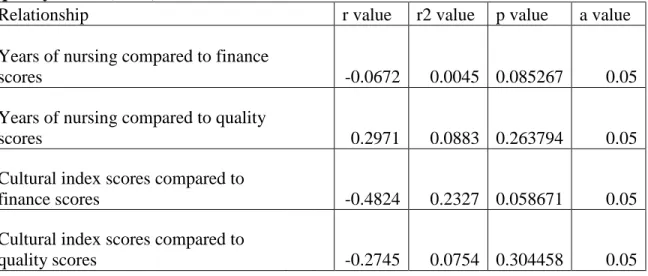
Pearson’s Correlation Coefficient was used to examine relationships between years of
nursing experience and finance and quality scores. Post-survey cultural index scores were also
examined in relation to finance and quality scores. Sixteen of the forty participant surveys
(40.0%) provided finance and quality data. None of these relationships proved to have
significance at p<.05 (See Table 3). The scores, while not statistically significant, showed a weak
inverse relationship between years of nursing experience and finance score and a positive
relationship between years of nursing experience and quality scores. Cultural index scores
29
Table 3. Years of experience and cultural index score compared to finance and quality scores (n=16)
Relationship r value r2 value p value a value
Years of nursing compared to finance
scores -0.0672 0.0045 0.085267 0.05
Years of nursing compared to quality
scores 0.2971 0.0883 0.263794 0.05
Cultural index scores compared to
finance scores -0.4824 0.2327 0.058671 0.05
Cultural index scores compared to
quality scores -0.2745 0.0754 0.304458 0.05
Pearson’s Correlation Coefficient was also used to examine the relationship between
years of nursing experience and clinical ladder level with post-survey cultural index scores.
There was a weak inverse correlation that as years of nursing experience increases, post-survey
cultural index scores decrease; this score is statistically significant at p<.05. The relationship
between clinical ladder level and cultural index scores proved to be a weak inverse correlation
that was not statistically significant at p<.05 (See Table 4).
Table 4. Years of experience, clinical ladder
and cultural index score (n=40)
Relationship r value r2 value p value a value
Years of nursing compared to cultural
index score -0.3177 0.1009 0.045751 0.05
Clinical ladder level compared to cultural
30 Impact Survey
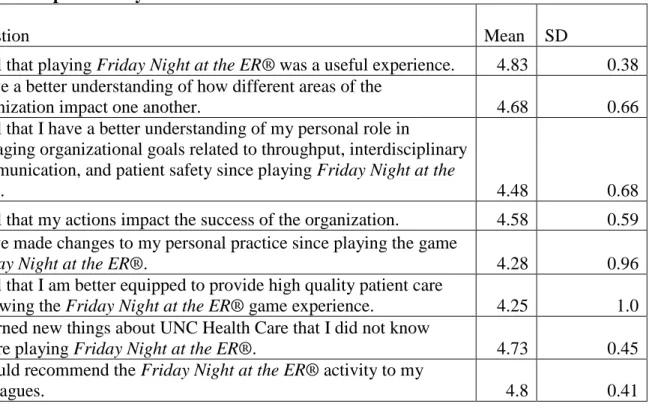
Eight questions in the post-survey, the Impact Survey, were asked of survey participants
to elicit information about personal feelings regarding the impact of the game. The Likert scale
used a 5 point rating system with the values 1-strongly disagree, 2-disagree, 3-neither
agree/disagree, 4-agree, and 5-strongly agree. Table 5 provides the mean and standard
deviations for each question. All questions on the Impact Survey had a mean rating above four.
Participants either agreed or strongly agreed that the game was a useful experience, that they
learned new things about the organization, and that they would recommend the activity to their
colleagues. The lowest scoring items were that the participants made personal changes to their
practice and that they felt better equipped to provide high quality patient care.
Table 5. Impact Survey Data
Question
Mean SD
I feel that playing Friday Night at the ER® was a useful experience. 4.83 0.38 I have a better understanding of how different areas of the
organization impact one another. 4.68 0.66
I feel that I have a better understanding of my personal role in
managing organizational goals related to throughput, interdisciplinary communication, and patient safety since playing Friday Night at the
ER®. 4.48 0.68
I feel that my actions impact the success of the organization. 4.58 0.59 I have made changes to my personal practice since playing the game
Friday Night at the ER®. 4.28 0.96
I feel that I am better equipped to provide high quality patient care
following the Friday Night at the ER® game experience. 4.25 1.0 I learned new things about UNC Health Care that I did not know
before playing Friday Night at the ER®. 4.73 0.45
I would recommend the Friday Night at the ER® activity to my
31 Survey Comments
The post-survey offered an opportunity for open-ended comments for participants to
share their thoughts. The majority of comments were positive. Comments included:
“It was a great learning tool, lots of interactions.”
“Great class. Recommend for everyone in the organization that deals with throughput to attend.” “Great fun and learned a lot about the way patients are transferred between departments.”
“Great game. Very informative.”
“I think the game is great and should continue to be used as an educational tool for all staff.”
Halfway through game play, participants are told that the ER managers have been
recruited to the hospital next door. Having participants change game tables in the middle of the
game is a deliberate action. This is intended to have players experience an organizational change
in the structure of their hospital. New ER managers may come with new ideas or different ways
of playing/interpreting the game. It allows for discussion in the debriefing about how this
change impacted game play and how staff manage such changes. One participant expressed
frustration about being required to change tables in the middle of the game because he/she felt
their performance would have been better with his original “hospital” team. Overall, these
comments illustrate the value experienced by the staff and supported the use of the game as a
tool for all staff to gain a better understanding of the organization and their own role in providing
high quality, fiscally responsible patient care.
Discussion
The demographic data provides a great deal of information about the participants in the
survey regarding Friday Night at the ER®. The sample was not as diverse as desired to be an
32
were 20-39, resulting in nurses older than 39 significantly underrepresented. Ninety percent of
the sample was female. While the male gender is underrepresented in the nursing profession as
whole, 10% for this sample is still a small number of male respondents. It would be difficult to
make any conclusions related to gender differences based on this breakdown of females and
males in the sample. The nurses were overwhelmingly from the medicine service, worked with
adult patient populations, and on the inpatient side of the hospital. It would be useful to seek out
a more diverse sample including responses from more of the hospital services, pediatrics, and
outpatient areas of the hospital. The results may be different if more areas were represented
within the sample. Eighty percent of the respondents had 0-10 years of experience. This is
particularly problematic for study questions that were focused on differences between years of
nursing and other indicators. Nurses with the greatest amount of experience (11-31+) are
underrepresented and this impacts the study questions. There may have been no statistically
significant relationships found merely from the lack of higher experienced nurses in the sample.
Seventy percent of the sample had been with the organization for less than five years. This could
impact their view of the organization’s culture, particularly nurses that have one year or less of
experience, as they may not have had the chance to fully understand and experience the
subtleties of the culture. There was representation from all job classes (CNI, CNII, CNIII,
CNIV, and nurse manager) with the most respondents being a CNII. Level within the
organization can impact organizational culture perceptions, with executive staff more in line with
the espoused values of an organization. Results may have been impacted by the
33 Study Questions
1. What is the impact of the experiential learning game Friday Night at the ER® on
perceptions of organizational culture as measured by the Diagnosing Organizational
Culture Instrument (DOCI)?
The data did not produce a significantly different mean score on the Diagnosing
Organizational Culture Instrument for the pre- versus the post-survey. This could mean that
playing the game Friday Night at the ER® did not change or alter the perceptions of
organizational culture for the participants. Organizational culture is a very difficult construct to
measure as it contains many different concepts including communication, teamwork,
management, structure, etc. Davies, Nutley, & Mannion (2000) state that there are often
competing interpretations of organizational culture with no consensus on the definition of
organizational culture, citing one review that offered up to 15 different definitions of the
construct.
The DOCI tool may have been ineffective at measuring the construct of organizational
culture. It was a long survey and reading intensive for participants. Several participants started
the survey but did not finish, likely due to the length/time. Those who finished the survey may
have tired and become less attentive to prompts as they progressed through the lengthy survey
questions which could have skewed the results. The DOCI allowed for mathematically positive
and negative scores, which correspond to types of organizations. The different types of
organizations are not inherently negative or positive but reflect certain ways of communication
and leadership. This project did not take into account what type of organization participants
34
of preferred culture to the perception of actual culture. The pre-survey asked participants to not
only report on the existing culture but also on their preferred culture. The data could be
examined to see if participants had post-activity culture index scores that were more aligned with
their scores for preferred culture. If after the activity participants moved more in line with what
they feel is the preferred culture then that may be an acceptable and valuable change. As culture
is a very personal and individually experienced construct it may be more important that
employees feel that an organization is aligned with their values, and that those positive feelings
will then lead to effective and efficient actions on the part of the employee. The survey also
asked for a ranking from 1-4 with 4 as the “most like” current culture. The use of the number 4
for the most like something may have been counterintuitive for some participants. It is quite
possible that participants ranked backwards from what they really thought due to confusion of
the ranking system and thus produced very negative numbers on the DOCI when perhaps they
meant something different. There were a few instances when a pre-survey score was a low
positive and the post-survey score was very negative, which could lead to the possible
conclusion of confusion with the scale. Some participants commented that they misunderstood
the survey and ranked items using the same number more than once. For example, if they felt
that all items were equally important they used the number 4 for each ranking instead of
choosing 1-4 for each set of items. Those surveys were not used for the data of this project, but
if the instructions had been more explicit the N may have been higher.
It is also possible that unit subcultures interfere with clean scoring on an organizational
culture survey. While participants were asked to rate their organization as a whole, for some
people their only experience within that organization is from a micro perspective at the unit
35
global organizational perspective. Subcultures can react to inputs to the system differently, with
some subcultures more open to change while others are less malleable (Davies, Nutley, &
Mannion; 2000). Thus, unit subcultures could impact the way the participants viewed and
processed the information provided by game play in different ways.
The N for this sample is small considering the number of staff nurses eligible to play the
game within the organization. The scores do trend to a more positive number and it may be that
if the N was larger the trend would continue and become significant. While ultimately these
results were not statistically significant, it is promising to note that the scores had a positive trend
after game play. This suggests that participants perceived the existing culture as more
achievement and support oriented after completing Friday Night at the ER®.
The real value of this game and debriefing may be the sharing of information and
knowledge. There can be significant challenges and delays in communication in all
organizations, particularly in large organizations, and finding new ways to deliver the volume of
information is important for promotion of effective change. Providing guided reflection on what
the impact of their actions are on the organization and the care of patients allows the participant
to bridge the game experience to areas of their real life practice. Allowing conversations to
examine a variety of perspectives about patient care and flow is one of the meaningful impacts of
the game.
It is also important to note the DOCI score is not saying that a culture is more negative or
positive than another. The scores that are provided can be negative or positive which indicates
whether a culture is more of a power/role culture or an achievement/support culture. Power/role
36
Achievement/support cultures focus more on member relationships, high-energy, and mutual
trust (Harrison & Stokes, 1992). All culture types have positive and negative aspects. For this
project, the underlying belief is that health care organizations need to find a balance of behaviors
that are more in line with achievement/support cultures in order to be able to respond to and
survive the particular pressures and changes inherent in the health care system in the United
States. A focus on staff, through knowledge, skills, and support, will hopefully lead to increased
patient safety and efficiency within the system. Thus the focus is on the mathematically positive
scores from the DOCI as the positive scores represent the achievement/support culture in the
survey design.
2. What are the differences in organizational culture perceptions following game play based
on job class and years of nursing practice?
There were no statistical differences between DOCI scores based on job class of CNI,
CNII, CNIII, CNIV, and Nurse Manger. The sample was predominantly CNII level nurses.
With a disproportionate breakdown of job classes it is difficult to make conclusions using this
data set regarding whether or not job class impacts organizational culture perceptions. It could
be hypothesized that the higher the job class the higher/more positive the DOCI score. As staff
achieve higher administrative levels within the organization they are often exposed to a wider
view of the organization. They are able to interact with more people, both internal and external
to the organization. They have increased responsibilities that necessitate working and
communicating with more parts/departments of the organization. This change in understanding
of the organizational goals related to position could increase the perception of fit between actual
37
responsibility it is conceivable that their preferred culture aligns more strongly with the actual
culture.
There was a statistically significant negative inverse relationship between years of
nursing and DOCI score. As years of nursing experienced increased the DOCI score decreased.
It is not entirely surprising to see a negative inverse relationship between years of nursing and
organizational culture scores. It is possible for people to become jaded or dissatisfied the longer
they function within a system. Systems change and health care in particular changes often and
quickly. Nurses experience many changes with their practice and in their environment. The
longer they are a nurse the more dissatisfied they may feel over time.
3. Do groups with higher scores on finance and quality have higher cultural index scores?
There were no significant relationships between finance and quality scores when
compared to DOCI scores. Only 40% of survey respondents provided their team quality and
finance scores from game play. Of those 40%, it is possible that participants wrote incorrect
scores into the survey. This question was asked on the post-survey sent one week following
game play. Participants may not have remembered their scores accurately. Some participants
may have misreported because they wanted to be sure that they could not be identified by their
answers. This data set comes with issues of inaccuracy due to recall bias or personal/participant
bias. Several participants commented that they could not remember their scores from game play.
It would have been useful to have a way to record these scores for participants to aid in recall;
however, the data provided revealed insignificant and weak relationships. As nursing experience
increased finance scores decreased while quality scores increased. In the game low quality and