doi: 10.3389/fpsyg.2016.01132
Edited by: Darya Zabelina, Northwestern University, USA
Reviewed by: Renata Melinda Heilman, Babe ¸s-Bolyai University, Romania Fabio Del Missier, University of Trieste, Italy
*Correspondence: T. Sophie Schweizer [email protected]
Specialty section: This article was submitted to Cognition, a section of the journal Frontiers in Psychology
Received:16 May 2016 Accepted:15 July 2016 Published:03 August 2016 Citation: Schweizer TS, Schmalenberger KM, Eisenlohr-Moul TA, Mojzisch A, Kaiser S and Funke J (2016) Cognitive and Affective Aspects of Creative Option Generation in Everyday Life Situations. Front. Psychol. 7:1132. doi: 10.3389/fpsyg.2016.01132
Cognitive and Affective Aspects of
Creative Option Generation in
Everyday Life Situations
T. Sophie Schweizer1*, Katja M. Schmalenberger1, Tory A. Eisenlohr-Moul2,
Andreas Mojzisch3, Stefan Kaiser4and Joachim Funke5
1Institute of Medical Psychology, Medical Faculty, University of Heidelberg, Heidelberg, Germany,2Department of
Psychiatry, University of North Carolina at Chapel Hill, Chapel Hill, NC, USA,3Institute of Psychology, Department of
Educational and Social Sciences, University of Hildesheim, Hildesheim, Germany,4Department of Psychiatry, Psychotherapy
and Psychosomatics, Psychiatric Hospital, University of Zurich, Zurich, Switzerland,5Institute of Psychology, University of
Heidelberg, Heidelberg, Germany
Which factors influence a human being’s ability to develop new perspectives and be creative? This ability is pivotal for any context in which new cognitions are required, such as innovative endeavors in science and art, or psychotherapeutic settings. In this article, we seek to bring together two research programs investigating the generation of creative options: On the one hand, research on option generation in the decision-making literature and, on the other hand, cognitive and clinical creativity research. Previous decision-making research has largely neglected the topic of generating creative options. Experiments typically provided participants with a clear set of options to choose from, but everyday life situations are less structured and allow countless ways to react. Before choosing an option, agents have to self-generate a set of options to choose from. Suchoption generationprocesses have only recently moved to the center of attention. The present study examines the creative quality of self-generated options in daily life situations. A student sample (N=48) generated options for action in 70 briefly described everyday life scenarios. We rated the quality of the options on three dimensions of creativity- originality, feasibility, and divergence -and linked these qualities to option generation fluency (speed and number of generated options), situational features like the familiarity and the affective valence of the situation in which the options were generated, and trait measures of cognitive performance. We found that when situations were familiar to the participant, greater negative affective valence of the situation was associated with more originality and divergence of generated options. We also found that a higher option generation fluency was associated with a greater maximal originality of options. We complete our article with a joint research agenda for researchers in the decision-making field focusing on option generation and, on the other hand, researchers working on the cognitive and clinical aspects of creativity.
INTRODUCTION
“In any given moment we have two options: To step forward into growth, or to step back into safety.” Maslow
Which factors influence a human being’s ability to develop new perspectives and be creative? This ability is pivotal for any context in which new cognitions are required (e.g., in psychotherapeutic settings) and something new needs to be developed (e.g., innovative endeavors in science and art). What is it that makes us revert to previously generated, existing options stored in our long-term memory (LTM), and what makes us step forward into thinking of new and creative options? Previous research on human decision-making has largely neglected the topic of creative option generation. Experiments have typically examined how people decide when facing an externally provided, multiple choice list of options (Glimcher and Rustichini, 2004;
Rangel et al., 2008). This type of pre-structured decision situation sheds light on crucial decisional processes like option evaluation and option selection. However, generalizing these findings to decisions in everyday life poses a problem: Our complex world is full of decision situations that are not only far less structured but also under-constrained. They usually do not specify a finite and clear set of options to select from, but instead allow countless possible ways to react. Thus, in everyday life situations, before deciding what option to choose, one typically has to generate a set of options to choose from. Consider, for example, the following scenario: You are at home and want to cook when the power suddenly goes out. You can respond to the power blackout in endless ways, ranging from eating nothing at all to roasting marshmallows over a candle. The quality of the generated options determines the quality of the subsequent decision. Therefore, the preliminary process ofoption generationis of vital importance for decision-making in everyday life.
The present study aims at extending our research program on option generation in simple decision-making situations in everyday life (Kalis et al., 2008, 2013;Kaiser et al., 2013;Häusser et al., 2014). Several research groups have recently argued that the process of generating options should be added to existing decision-making models as apre-decisional phase(e.g.,Fellows, 2004;Kalis et al., 2008;Porcelli and Delgado, 2009;Kaiser et al., 2013). Lately, a growing number of publications has addressed the process of option generation on a theoretical level (e.g.,Kalis et al., 2008;Smaldino and Richerson, 2012). An informative and concise review of publications on option generation is provided by Del Missier et al. (2015) who also present an overview of research on memory-based versus ideation-based views on the process of option generation. Memory-based views argue that option generation is based on the associative retrieval of choice options from LTM. By contrast, ideation-based views consider option generation as a process not only depending on associative retrieval but also requiring an ideation component. Recent research suggests that both retrieval and ideation processes play an important role for option generation, although it is far from clear how retrieval supports ideation and what kinds of ideation processes are used depending on the features of the situation in which the options are generated.
The present paper builds upon these theoretical approaches by also regarding situational features that dictate the generation and consideration of an option (Kalis et al., 2008): First, if the situation is highly constrained, one can choose only from the options defined by the situation (e.g., the abovementioned multiple choice task typically employed in decision-making research). Highly constrained situations can also be familiar situations. Second, inunconstrainedsituations that arefamiliar, one is most likely to generate options by retrieving them from LTM. Third, if the situation is unconstrained and unfamiliar, new options have to be generated which potentially involves creative processes. AsDel Missier et al. (2015)also state: Besides basic associative memory retrieval, it is ideation processes (based on search and thinking processes) that contribute to option generation, mainly in this latter type of situation. In the present study, we take a closer look at these creative processes in the type of option generation occurring in unconstrained and unfamiliar situations as described above. In particular, we investigate which factors facilitate creative option generation processes by rating the quality of options among others with respect to their originality.
In order to investigate the process of option generation in simple, everyday life situations, we recently developed an experimental paradigm (Kaiser et al., 2013). Participants are presented with short vignettes of decision-making situations from various living domains and are required to name possible reactions (e.g., “You are in a new city and you have lost your way. What could you do?”). So far, this paradigm has been used to investigate option generation solely in terms of two fluency indicators, namely, how fast the generation process is initiated (generation onset time) and how many options are generated (quantity). Specifically, the quantity of generated options has been correlated with a cognitive test battery and, in a second part, with the results from functional magnetic resonance imaging (Kaiser et al., 2013). The present study extends this work by addressing thequalityaspect of the generated options. To this end, options generated for an everyday scenario were rated in terms of their originality, feasibility, and divergence.
So far, the quality of self-generated options has been investigated by only a few studies. Previous work has defined quality in terms of the extent to which the option is useful for pursuing or achieving a clear goal. For instance, studies on option generation in sports conceived option quality as a situation-specific appropriateness when pursuing the goal of winning the competition (Johnson and Raab, 2003;Raab and Johnson, 2007;
Hepler and Feltz, 2012). In a study byWard et al. (2011), law enforcement officers naturally pursued the goal of ensuring the safety of the victim and of themselves. Similarly, a study by
of the option generation task byKaiser et al. (2013): “Today is your first day of vacation on a tropical island. What could you do?” In this scenario, option generation is determined by the individual’s preferences rather than a clear goal that would be similar across individuals (e.g., whether the individual prefers to relax, do sports, or engage in cultural activities). In such real-world scenarios without a clear and unambiguous goal, it is impossible to rate the quality of the generated options in reference to their utility or to their effectiveness for solving a decision problem. Consequently, the present study defines an option’s quality in terms of its creative value.
Creativity is considered a multidimensional and hetero-geneous concept (for an overview, see Runco, 2014). There is a general consensus on two defining features as suggested by
Sternberg and Lubart (1999): A work is considered creative if it is novel (i.e., in the sense of original and unexpected) and
appropriate(i.e., in the sense of usefulness). Whether something is appropriate or useful helps us to distinguish the creative from the absurd (Fink et al., 2014). Another aspect of creativity is the divergence of ideas, or the extent to which a set of generated options for a given situation differ from each other (Guilford, 1959). Furthermore, it has been argued that creativity arises from the interplay between different levels including, on the one hand, the person level which includes individual talents, traits and skills as well as their conative skills, and on the other hand, a social level in which the ideas and products presented are received and an evaluation or rating as to their creativity takes place (Schweizer, 2004, 2006). After decades of creativity research that struggled with conceptual heterogeneity, recent articles on the creativity topic reflect agreement on the fact that creativity needs to be broken down into various cognitive sub-processes (e.g.,
Akbari Chermahini and Hommel, 2011). In line with key aspects discussed in the creativity literature, we employ three quality dimensions: First, each option is rated in terms of howoriginal
it is, meaning the extent to which the option reflects an inventive idea in the situation, and, second, howfeasibleit is, that is, the extent to which the option is appropriate in the situation and, third, howdivergentthe set of options generated for this situation is, mirroring the extent to which the options generated for one situation differ from each other. The present work is based on the theoretical assumption that one of the decisive features of generating creative options is the ability to generate options that are new in the sense that they are different from what one would typically draw from LTM.
In the present study, we generated qualitative data comple-menting our quantitative data presented inKaiser et al. (2013). This new qualitative data set represents an assessment of the creative quality of options; options were rated in terms of their divergence, originality, and feasibility. The present study was guided by three main questions: First, how quickly are options generated and how many options are generated when they are more creative compared to less creative ones? Second, under which situational circumstances do people generate more creative options? And third, what is the link between the creativity of the options generated and the cognitive performance of the option generator on various cognitive measures that could be related to option generation abilities?
Concerning option generation speed and creativity, it could be argued that people who generate more creatively also generate faster and more options due to, for example, higher general cognitive functioning acting as a mediator variable. On the other hand, it could also be argued that generating fewer options more slowly might lead to more creative options because it might take more time and cognitive resources to generate a creative option than a default option drawn from LTM. In line with these thoughts, two conflicting positions can be found in the option generation literature (Del Missier et al., 2015): Some researchers argue that generating fewer options leads to a higher average quality of the options (Johnson and Raab, 2003). Other researchers have argued that ‘quantity breeds quality’—that more options generated leads to a higher quality (Rietzschel et al., 2007). The findings of Del Missier et al. (2015) indicate that generating more options may increase the quality of the best
option (in terms of its potential utility in solving a problem effectively), but decreases the mean quality of the options in the generated set. Evaluating the links between option generation fluency and option creativity is therefore an additional goal of the present study.
to potentially function as a form of ‘negative social support’ to creative processes depending on the individual characteristics of the creator (Schweizer, 2007). For instance, individuals scoring high on the personality trait neuroticism may react completely different to negative versus positive forms of support to their creative endeavors than individuals scoring low on neuroticism. Also, complex problem solving researchers have shown that negative affect improves creative problem-solving in complex situations (Barth and Funke, 2010). In the present study, we focus on situational factors. Assuming that unpleasant scenarios in the option generation task tend to evoke negative affect while pleasant situations lead to positive affect, it will be interesting to determine under which situational conditions participants generate more creative options.
Our third research question addresses the link between the creative quality of the options generated and a set of cognitive functions measured by a cognitive test battery. The cognitive test battery provided measures of creative problem solving, creative idea generation, verbal fluency, cognitive set shifting, and LTM performance. In Kaiser et al. (2013), we found significant positive correlations between the number of generated options and performances in the LTM retrieval task and the category fluency task. Regarding the options’ quality, we now hypothesize the performance in creativity tests referring to divergent cognition capabilities to be positively associated with the generation of creative options. The cognitive set shifting test and verbal fluency test could reflect measures for the participants’ flexibility (i.e., the ability to switch mental sets easily; Brown, 1989) and fluency (i.e., the ability to generate grand numbers of ideas; Brown, 1989). Flexibility and fluency are generally considered to be associated with creative thinking (e.g.,Torrance, 1990), which is why we hypothesize a positive association between performance in these two tests and the creativity of generated options. The correlation between the options’ creativity and LTM performance will be investigated in an exploratory manner.
MATERIALS AND METHODS
Participants and Procedure
Our sample for this option generation quality study comprised 52 undergraduate students from the University of Göttingen from which we had to exclude four participants due to incomplete data (see also Kaiser et al., 2013 for our option generation quantity study). We carried out our analysis with the remaining 48 students (71% female) who were between the ages of 19 and 30 years (M=22,SD=2.37). The study was conducted in a single session during which participants first completed the option generation task followed by the cognitive test battery. The session lasted approximately 70 min. Prior to testing, the procedure was fully explained and all participants signed a written informed consent. For the time spent at the institute, participants either received extra course credit or a financial compensation of 10 €. The study received the institutional review board’s approval. With the sample size ofN=48, we are able to detect a significant two-tailed correlation rho=0.4, given alpha=0.05, with power
(1–beta) = 0.80 (computed with G-Power 3 from Faul et al., 2007).
Materials
Option Generation Task
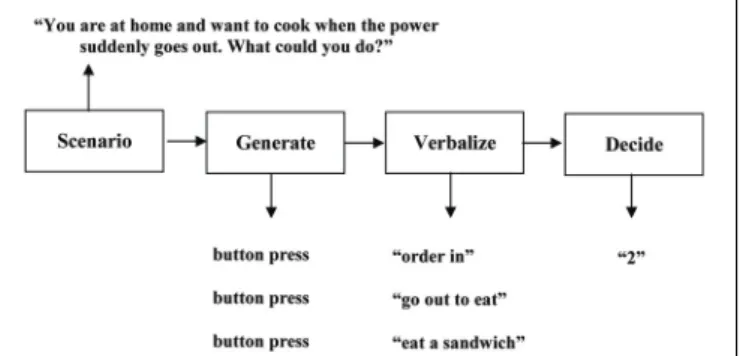
Our option generation task (Kaiser et al., 2013) was implemented in Presentation (Neurobehavioral Systems Inc., Albany, NY, USA) and carried out on a computer with a microphone attached. The stimulus material consisted of 70 short scenarios reflecting ill-structured real-world situations (see Supplementary Material for a complete list of the situations). After being presented for 4 s on the notebook screen, the scenario disappeared and the word “generate” automatically appeared. Participants were instructed to immediately start with the mute generation of options regarding what one could do in this situation. Participants were given 8 s for this option generation phase, and were instructed to indicate the generation of each option by pressing a button on the notebook (mute option generation phase). In the following 8 s, participants had to verbalize the previously generated options (option verbalization phase). Next, the automatic change to the word “decide” asked participants to choose the preferred option out of the just generated ones (decision phase). The decision was made by pressing the number button on the notebook that reflected the preferred option’s generation rank (e.g., button “1” if the first generated option is chosen). An exemplary trial is displayed in Figure 1. All trials were separated by a fixation cross. Participants were initially familiarized with the procedure by performing 10 test trials. After generating options in all 70 scenarios, participants were asked to rate the familiarity and the valence of each scenario on two bipolar 9-point Likert scales (very unfamiliar vs.very familiar; very unpleasantvs.very pleasant). Based on these ratings, we later carried out two median splits per participant, thus separating familiar from unfamiliar and pleasant from unpleasant scenarios.
Generation onset time was attained by measuring the time span between the appearance of the word “generate” on the notebook screen and the first pressing of the button, which indicated the first mutely generated option. The number of generated options was directly derived from the number of clicks in this mute option generation phase. In order to test whether
the number of button presses in the mute option generation phase (i.e., the variable number of generated options used in the analyses) corresponds to the number of named options in the subsequent option verbalization phase, these numbers were correlated per scenario. The mean correlation across all 70 scenarios reached r =0.62, SD =0.12. Following Cohen’s (1988) conventions to interpret the magnitude of correlation coefficients, this correlation represents a strong correlation. Since the number of button presses in the mute generation phase consistently exceeded the number of verbalized options, this result points to the fact that 8 s for the option verbalization phase may not have been long enough to name all of the generated options. However, note that participants were given no incentive to create a high number of options and, hence, ‘honest button presses’ could be expected, which means that it is very likely that participants only pressed the button in the mute option generation phase if they also had an idea for an option.
Creative option quality and rating procedures
Thecreative quality of generated optionsis based on the named options in the option verbalization phase. It was assessed by trained raters and followed a highly standardized protocol. Firstly, the non-redundant and valid options per scenario were derived from the transcriptions of the audio files. An option was labeled valid when it comprised an action (and not only an emotion or cognition), when it was concrete (and not abstract, e.g., “I would do something.”), and when it was feasible in the broadest sense (e.g., it is just impossible to turn back the time when you forgot your best friend’s birthday and undo your mistake). Secondly, two raters independently examined these valid and non-redundant options in terms of their divergence, originality, and feasibility. The divergence of all options generated per scenario, that is, the extent to which the options differ from each other, was assessed with a single score. In contrast, every option generated was rated separately in terms of its originality (the degree to which the option displays an inventive idea in the situation) and feasibility (the extent to which the option is realizable in the situation). These scores were averaged in order to derive the mean originality and mean feasibility of all options per scenario. The quality dimensions were rated on 5-point Likert scales. Two-way mixed, average-measures, consistency intra-class-correlations reached 0.42 for divergence, 0.46 for originality, and 0.47 for feasibility, which, according to Cicchetti (1994), indicates fair interrater-reliability. The mean values across raters were used to test our hypotheses.
Cognitive Correlates
We employed a set of five cognitive tests that provided measures for creative problem solving, creative idea generation, LTM performance, verbal fluency, and cognitive set shifting (Kaiser et al., 2013). The tests were either paper–pencil based or performed orally in interaction with a trained member of the research team. In particular, the following instruments were carried out.
Creativity Test: Remote Associating
A modified version of theRemote Associates Test(RAT;Mednick, 1962) was employed to assess creative problem solving. Each of the 16 trials comprised three stimulus words that were loosely associated to one another (e.g., “salt, deep, foam”). Participants’ task was to name a fourth word that linked the three (e.g., “sea”). The number of correct answersbuilt the outcome measure. To complete the test, participants were given 15 min, which they could allocate freely across trials.
Creativity Test: Idea Generation
In order to measure creative idea generation, participants completed theProduct Names Task(Marsh et al., 1999). This task required imagining oneself in an interview for a marketing job during which one had to create new labels for new products. Specifically, participants were asked to generate up to three new labels for each of the three product categories (pasta, nuclear element, and pain reliever). The instructions provided benchmark examples for each category (e.g., “Aspirin, Dolormin, Fortral, Ibuhexal, Tomaperin, Tramal”), along with the explicit request not to use or copy properties of the examples when forming new labels.Rubin et al. (1991)suggested that benchmark examples compromise the generation of novel and unique ideas. Thus, the measure for creative idea generation was derived from the number of product labelsthat did not have the same word ending as the examples (e.g., “-in,” “-al”). Participants were bound to no time limit when completing this task.
Verbal fluency and verbal set shifting
Four tasks of the Regensburg word fluency test (RWT;
Aschenbrenner et al., 2000) were employed to capture participants’ verbal fluency: two letter fluency tasks and two category fluency tasks. The letter fluency tasks asked participants (1) to list as many words as possible that started with the letter “S” (measure for the variableletter fluency with one letter) and (2) to list as many words as possible that alternately started with the letters “G” and “R” (measure for the variableletter fluency with two letters). The variable cost of change in letter fluency
was calculated by subtracting the number of words starting alternately with G/R from the number of words starting with an S and constitutes a measure for verbal set shifting. The category fluency tasks asked participants (3) to name as many words as possible belonging to the category “animal” (measure for the variablecategory fluency with one category) and (4) to alternately name as many words belonging to the categories “sport” and “fruit” (measure for the variable category fluency with two categories). The variablecost of change in category fluency, also a measure for verbal set shifting, was calculated by subtracting the number of alternately listed sports and fruits from the number of listed animals. Participants were given 60 s for completing each of the four tasks. A member of the research group counted the number of correct answers per task.
Numerical set shifting
add 3 to each number on the first list, to subtract 3 from each number on the second list, and to alternately add and subtract 3 to and from the numbers on the third list. All answers were written down immediately and next to the corresponding number. A member of the research team recorded the time needed to complete each list. Thecost of numerical set shifting, that is, the difference between the average time span for the addition and subtraction lists and the time span for the alternating list, was the variable of interest.
Long-Term memory performance
The Verbal Learning and Memory Test (VLMT; Helmstaedter et al., 2001) provided measures for LTM performance. Participants were asked to learn a list of 15 words that was read to them three times by a member of the research team.
Kaiser et al. (2013)reduced the original presentation frequency of five times to three times in order to avoid ceiling effects in the highly educated and healthy sample. Following the three learning trials, participants were presented with an interference list. Free recall of the learned list was assessed directly after interference (measure for the variable LTM performance after interference) and a 15 min delay (measure for the variableLTM performance after delay). Two additional variables of interest were theLTM loss through interference(number of recalled words after learning phase minus number of recalled words after interference list) and
LTM loss through delay(number of recalled words after learning phase minus number of recalled words after delay).
Analytic Plan
Primary analyses were conducted in SAS PROC MIXED in two-level multilevel regression models (with 70 situations/items nested within each of the 48 individuals). First, we examined null multilevel models for each repeated measures variable (familiarity, valence, divergence, originality, maximum originality, feasibility, number of options, and generation onset time) and report null model intercepts and associated standard errors (which are a more accurate approximation of sample mean and standard deviation in the multilevel framework;Singer and Willett, 2003) andintraclass correlations
(ICCs; i.e., the percentage of variance in the outcome attributable to between-person clustering; trait-like variance). We also examined Pearson correlations between aggregated person means for all variables. Next, we used multilevel models to examine the impact of familiarity, valence, and their interaction on the creative qualities of options (divergence, originality, and feasibility) and option generation fluency (number of options generated, generation onset time) for each situationi. In order to isolate the within-person variance in these situational predictors, each situation’s ratings of familiarity and valence were ipsatized within each person (also known as centering within cluster; Enders and Tofighi, 2007; e.g., the value of familiarity for situation i minus the person’s mean rating for familiarity across all of the 70 situations). This allows us to interpret effects of familiarity and valence in a personalized way for each individual, as these scores are centered around each person’s mean: values above 0 indicate that a given situation was rated by this individual as relatively more familiar (or pleasant)
than other situations, whereas values below 0 indicate that a given situation was rated by this individual as relatively less familiar (or pleasant) than other situations. Finally, we also explore correlations among cognitive task results and person mean values for option quality and option generation fluency variables. Throughout, we employed a significance level of
p=0.01.
RESULTS
Preliminary Analyses
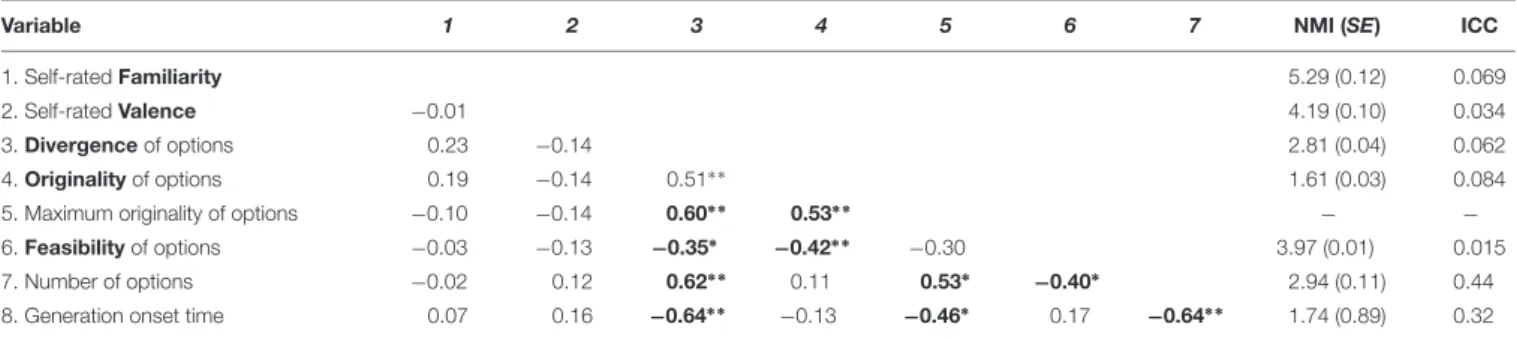
Forty-eight individuals each contributed 70 situations to these analyses. Table 1 describes null model intercepts (in lieu of sample means given our nested data structure; Singer and Willett, 2003) and ICCs. ICCs generally indicated that person-level clustering of familiarity, valence, divergence, originality, and feasibility were low, with just 1.5–8.4% of the variance in these ratings attributable to between-person factors. This indicates that these qualities of options tended to be more state-like than trait-like, and were mostly determined by situation-level factors. In contrast, option generation fluency variables were characterized by a larger degree of trait-like variance, with roughly 44% of the variance in number of options due to between-person factors, and roughly 32% of the variance in generation onset time due to between-person factors. Although the amount of between-person variance was small for some variables (see above), Table 1 also describes the correlations among person means (each individual’s mean scores for each variable across all trials) for primary study variables. An individual’s mean divergence of options was positively associated with their mean originality of options (r = 0.51, p < 0.001), as well as mean number of options (r =0.62,p<0.001) and generation onset
time (r = −0.64, p < 0.001). Mean feasibility was negatively correlated with mean divergence (r = −0.35,p< 0.01), mean originality (r = −0.42, p < 0.001), and the mean number of options generated (r= −0.40,p<0.01). Mean number of options was negatively associated with mean generation onset time (r=0.64,p<0.001). In addition, average maximum originality of options was positively associated with mean divergence of options(r=0.60,p<0.001), mean number of options (r=0.53,
p < 0.001), and negatively with mean generation onset time (r= −0.46,p<0.01).
Creative Option Quality as a Function of
Situational Features
Next, we utilized two-level regression models to investigate whether situational circumstances (familiarity, valence, and their interaction) influenced the creative qualities of generated options. Results of all models are shown in Table 2. Random intercepts were included; random slopes were omitted due to lack of significance, which indicates that the fixed effects of familiarity and valence presented below did not vary strongly across individuals. However, inclusion of random slopes did not substantively alter any result presented below.
TABLE 1 | Between-person correlations among person means, null model intercepts, and intraclass correlations for option quality (divergence, originality, and feasibility) and option generation fluency (number of generated options and generation onset time in seconds).
Variable 1 2 3 4 5 6 7 NMI (SE) ICC
1. Self-ratedFamiliarity 5.29 (0.12) 0.069
2. Self-ratedValence −0.01 4.19 (0.10) 0.034
3.Divergenceof options 0.23 −0.14 2.81 (0.04) 0.062
4.Originalityof options 0.19 −0.14 0.51∗ ∗ 1.61 (0.03) 0.084
5. Maximum originality of options −0.10 −0.14 0.60∗ ∗ 0.53∗ ∗ − − 6.Feasibilityof options −0.03 −0.13 −0.35∗ −0.42∗ ∗ −0.30 3.97 (0.01) 0.015 7. Number of options −0.02 0.12 0.62∗ ∗ 0.11 0.53∗ −0.40∗ 2.94 (0.11) 0.44 8. Generation onset time 0.07 0.16 −0.64∗ ∗ −0.13 −0.46∗ 0.17 −0.64∗ ∗ 1.74 (0.89) 0.32
∗
p<0.01,∗ ∗
p<0.001. NMI, null model intercept (in lieu of sample mean); ICC, intraclass correlation. Bolded values in the table indicate statistical significance at p<0.01.
TABLE 2 | Multilevel models: creative quality and option generation fluency in a given situation as a function of the participants’ PERSON-centered (CWP) familiarity and valence ratings for that situation.
Situation-level outcome
Situation-level predictors
Divergence Originality Feasibility Number of options Generation onset time
γ SE 0 SE γ SE γ SE γ SE
Intercept 2.81 0.045 1.61 0.031 3.97 0.015 2.94 0.11 1.74 0.089
FamiliarityCWP 0.032 0.020 −0.041∗ ∗ 0.012 0.045∗ ∗ 0.010 0.058∗ ∗ 0.014 −0.006 0.015
ValenceCWP −0.050 0.020 −0.028∗ ∗ 0.011 0.19∗ ∗ 0.011 0.026∗ ∗ 0.005 −0.007 0.015
FamiliarityCWP×
ValenceCWP
−0.032∗ ∗ 0.009 −0.013∗ ∗ 0.002 −0.025∗ ∗ 0.006 0.006 0.013 0.024 0.011
Bolded values in the table indicate statistical significance at p<0.01.
∗ ∗p<0.001.
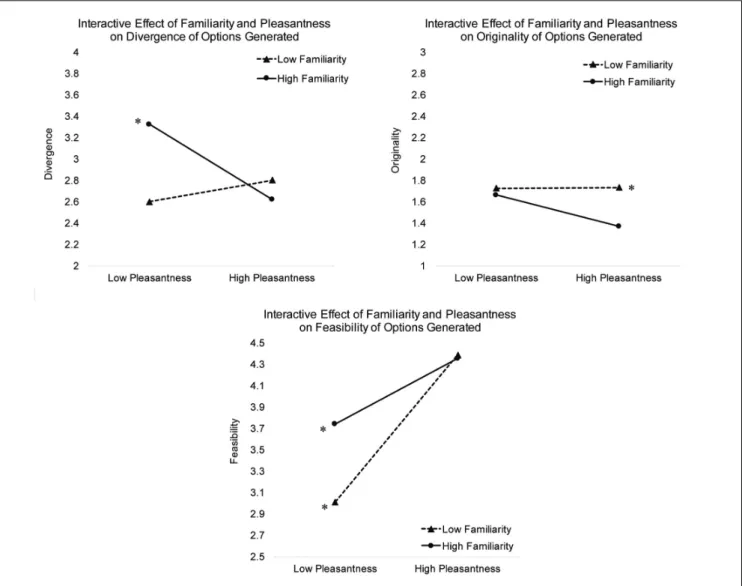
in Figure 2). In order to understand the nature of these
interactions we conducted follow-up simple slope analyses to determine the effects of situation valence on option qualities at high and low values of situation familiarity. Simple slopes that were significant are indicated by an asterisk in Figure 2. Simple slope analyses for divergence and valence revealed similar patterns. At one standard deviation above the mean of person-centered familiarity, person-centered valence was associated with decreased divergence of options (Estimate for the effect of person-centered valence at +1 SD above the mean of person-centered familiarity: γ= −0.065,SE= 0.029,
t(3208) = −2.26, p = 0.024) and decreased originality of
options (Estimate for the effect of person-centered valence at +1 SD above the mean of person-centered familiarity:
γ= −0.037,SE=0.010,t(3208)= −2.21,p=0.027). Effects of valence on divergence and originality were not significant at one standard deviation below the mean of familiarity (all
p’s > 0.26). Simple slope analyses for feasibility indicated that person-centered valence predicted the feasibility of options at both high and low familiarity, although the impact of valence on feasibility was stronger at low familiarity (Estimate for the effect of person-centered valence at −1 SD below the mean of person-centered familiarity: γ = 0.22, SE = 0.012,
t(3216) = 17.28, p < 0.0001; Estimate for the effect of person-centered valence at +1SD above the mean of person-centered familiarity: γ = 0.17, SE = 0.015, t(3227) = 11.52,
p<0.0001).
Option Generation Fluency as a Function
of Situational Features
Next, we examined similar two-level regression models to investigate whether situational circumstances (familiarity, valence, and their interaction) influenced the option generation fluency. Results of models are also shown inTable 2. There were no significant effects of familiarity, valence, or their interaction on generation onset time. However, there were main effects of both familiarity and valence on the number of options generated, with greater familiarity and valence each uniquely predicting a greater number of options generated.
Correlations between Creative Option
Quality, Option Generation Fluency, and
Other Cognitive Measures
FIGURE 2 | Depiction of the interactive effects of familiarity and valence on creative qualities of generated options.Asterisk denotes that the depicted simple slope is significant at∗
p<0.01.+.
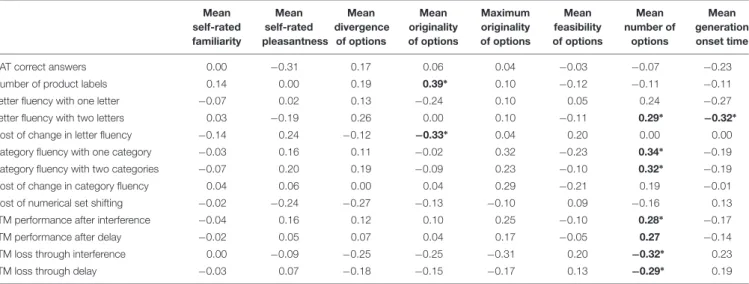
assessed by the variable cost of change in letter fluency) was associated with less originality [r(48) = −0.33, p = 0.002]. Average maximum originality of options was not significantly associated with any of the cognitive tasks (p>0.05)
Several of the cognitive tasks were also associated with option generation fluency. Average number of options generated per situation was positively associated with letter fluency with two letters[r(48)=0.29,p=0.007],category fluency with one category
[r(48)=0.34,p=0.009], andcategory fluency with two categories
[r(48)=0.32,p=0.006], andLTM performance after interference
[r(48)=0.28,p=0.007], and negatively associated withLTM
loss through interference[r(48)= −0.32,p=0.004] andLTM loss through delay[r(48)= −0.29,p=0.009]. Finally,letter fluency with two letters was associated with a faster generation onset time [r(48)= −0.32,p=0.001].Table 3presents an overview of the intercorrelations between performances in the cognitive test battery and option generation fluency, option quality, and reported familiarity and valence of the situation.
DISCUSSION
The present study aimed at extending our research program on option generation in simple decision-making situations in everyday life (Kalis et al., 2008, 2013; Kaiser et al., 2013;
Häusser et al., 2014). We analyzed ratings of thecreative quality
(i.e., divergence, originality, and feasibility of options) of freely generated options in the context of our recently developed option generation paradigm (Kaiser et al., 2013).
TABLE 3 | Overview of the intercorrelations between generation fluency and creative quality of the options, familiarity and valence of the situation, and performances in the cognitive test battery.
Mean self-rated familiarity
Mean self-rated pleasantness
Mean divergence
of options
Mean originality of options
Maximum originality of options
Mean feasibility of options
Mean number of
options
Mean generation onset time
RAT correct answers 0.00 −0.31 0.17 0.06 0.04 −0.03 −0.07 −0.23 Number of product labels 0.14 0.00 0.19 0.39∗ 0.10 −0.12 −0.11 −0.11 Letter fluency with one letter −0.07 0.02 0.13 −0.24 0.10 0.05 0.24 −0.27 Letter fluency with two letters 0.03 −0.19 0.26 0.00 0.10 −0.11 0.29∗ −0.32∗ Cost of change in letter fluency −0.14 0.24 −0.12 −0.33∗ 0.04 0.20 0.00 0.00 Category fluency with one category −0.03 0.16 0.11 −0.02 0.32 −0.23 0.34∗ −
0.19 Category fluency with two categories −0.07 0.20 0.19 −0.09 0.23 −0.10 0.32∗ −
0.19 Cost of change in category fluency 0.04 0.06 0.00 0.04 0.29 −0.21 0.19 −0.01 Cost of numerical set shifting −0.02 −0.24 −0.27 −0.13 −0.10 0.09 −0.16 0.13 LTM performance after interference −0.04 0.16 0.12 0.10 0.25 −0.10 0.28∗ −
0.17 LTM performance after delay −0.02 0.05 0.07 0.04 0.17 −0.05 0.27 −0.14 LTM loss through interference 0.00 −0.09 −0.25 −0.25 −0.31 0.20 −0.32∗
0.23 LTM loss through delay −0.03 0.07 −0.18 −0.15 −0.17 0.13 −0.29∗
0.19
Bolded values in the table indicate statistical significance at p<0.01.
∗
p<0.01.
each other, and the more difficult their typical generated option would be to enact. There were no significant between-person correlations between mean originality and mean option generation fluency, which, at first glance, would suggest that an individual’s quantitative performance in option generation does not strongly influence the creative quality of the options; importantly, however, a person’s average maximumoriginality was strongly positively associated with his or her average number of options generated and a shorter generation onset time. This finding is interesting since it informs the debate regarding the association between option generation fluency and option generation quality (Del Missier et al., 2015). Our results strengthen the position of those who argue that ‘quantity breeds quality’ (e.g.,Osborn, 1953;Rietzschel et al., 2007) in that greater fluency was associated with greater maximum option originality. This is similar to the findings of Del Missier et al. (2015), who report that greater option generation fluency was linked to greater usefulness of the best option in a generated set.
Secondly, we investigated whether situational circumstances (i.e., situational familiarity, affective valence, and their interaction) influence the creative quality of the options generated. In general, less familiar situations (independently from their valence) were associated with more original and less feasible options. In situations with a more negative valence (independently from their familiarity), options were also more original and less feasible. In addition to these main effects of familiarity and valence, significant interactions between these two situation-level predictors emerged. In summary, situations with a negative valence (i.e., situations that evoke more negative affect for that individual) were associated with more creative options (in terms of both divergence and originality),but only in situations that were relatively familiar to the individual. In less familiar situations, valence of the situation did not significantly impact divergence or originality. Further, situations with a negative valence were associated with less feasible options, and
this was particularly true when situations were not familiar to the individual. We also found a main effect concerning the quantity of the generated options and the valence of the situation. Familiarity and positive valence led to generating more options, but options were only more creative when the situation was marked by both familiarity and a negative valence. This pattern of findings is particularly interesting in the context of emotion and personality research, which found that inducing worry in people scoring high on neuroticism was supportive to creative processes (Leung et al., 2014). Also, in recent personality research on self-generated thought and neuroticism, it has been argued that people scoring high in the neuroticism dimension could be more creative (Perkins et al., 2015). Future work is needed to understand whether situations with a negative valence have a different impact on the creative performance of people scoring high or low on neuroticism.
Under challenging situational circumstances (as indicated by negative valence), the individual could have been more strongly motivated to engage in effortful cognitive processes, which could account for the finding of more original and less feasible options. At the same time, it seems that some degree of situational safety, indexed here by the familiarity of the situation, seems conducive to creative thought in negative affect-inducing situations. Future studies could further investigate the link between the options’ divergence and the situations’ valence, since several studies named byDavis (2009)suggest that a playful, effortless approach evoked by positive affect facilitates divergent thinking performance.
reported that the performance in an LTM task was positively associated with the number of generated options. Our additional analyses revealed that performance in several verbal fluency and verbal set shifting tasks also shows a positive correlation with both indicators of option generation fluency.
Regarding the options’ originality, individuals with better verbal set shifting skills and individuals who show better creative idea generation listed more original options. While, we found the expected association between the options’ originality and the idea generation performance on the product names task (Marsh et al., 1999), we did not find an association with the remote association task, another creativity test used by creativity researchers. This is not surprising, because the latter creativity test captures a very different set of cognitive processes, which activates rather convergent than divergent cognitive processes. This once more confirms the relevance of one of the main caveats in creativity research: In the very heterogeneous creativity literature, one of the main problems is that creativity is operationalized in many different ways. Researchers need to be very clear about which specific cognitive processes supporting creativity they wish to address. Creative option generation clearly draws on divergent cognitive processes.
Finally, our findings make a contribution to the conceptual level of creativity research; we investigated the options’ creativity when creativity is defined as the combination of novelty and usefulness as proposed by Sternberg and Lubart (1999). The dimensions of divergence and originality represent novelty, while usefulness is represented by feasibility. Our analysis revealed that the definition of Sternberg and Lubart (1999) remains problematic: Options high in divergence and options high in originality turned out to be generally low in feasibility. This issue should be considered further as the definition of creativity continues to be clarified.
Limitations
The results of the present study are challenged by a number of caveats. First, although it represents a substantial methodological improvement in several aspects, our option generation task (Kaiser et al., 2013) is not without limitations. The task marks an important step in the analysis of self-generated options in everyday life situations, but the question remains of how close to everyday life the employed situations actually are. The scenarios are only briefly described, and participants are provided with very little information in order to accurately represent option generation in under-constrained, real-life conditions. However, even though everyday life is characterized by few constraints, a great deal of information is available to us in daily life that may not be present in this laboratory task. Thus, the short descriptions of the scenarios might facilitate option generation since an effortful process of separating necessary from unnecessary information is not needed. On the other hand, one could argue that it becomes harder to generate options when information is missing. Consider the initial example: “You are at home and about to cook when the power suddenly goes out. What could you do?” When generating options, participants were missing information about what they were cooking, potential visitors they were expecting, the content of their refrigerator,
and a host of other factors. Future studies could modify the task by enriching the scenarios with more details and subsequently compare the option generation processes in situations rich in detail with the ones in simplistic situations.
endocrinological aspects of creative option generation presented in the research agenda below.
CONCLUSION AND RESEARCH AGENDA
Previous studies on decision-making have typically investigated how people choose from an externally provided clear set of options (i.e., multiple choice options). However, our complex world is filled with under-constrained decision-making situations that are unlikely to specify a finite and well-known set of options, instead allowing endless possible ways to react. Consequently, before being able to choose an option, we ourselves have to generate the set of options to choose from. The present study provides further insight into option generation processes in everyday life situations. Analyses revealed that generating more options does improve the quality of the best option in terms of its creativity and also that creativity changes as a function of situational features. These findings indicate that decision-making processes can be affected by situational influences in their initial option generation phase and that we may make more creative decisions if we make the effort to generate more options. Future studies should examine additional qualities of generated options, include additional situational features taking their affect-inducing qualities into account, and modify features of the option generation task in order to further approach the question of how options are generated. Furthermore, when it comes to the definition of creativity, the aspect of usefulness needs to be revisited.
In our follow-up studies to the work at hand we seek to deepen our insights into how situational influences affect the creative option generation process, particularly social affiliative aspects of the situation and the positive or negative affect they may induce. We also seek to better understand the role that individual level factors like a tendency toward negative affect may play in the creative process. This touches research on the link between creativity and psychopathology, which has been debated for thousands of years and has recently evolved into a scientific hotspot (Kaufman, 2014;Abraham, 2015). We propose that this work on creative option generation could also be relevant for clinical research in the realm of daily decision-making in line with recent research arguing that creativity can serve as a pathway out of maladaptive, psychopathological cognitions (Forgeard and Elstein, 2014). Additional studies will be needed in order to obtain a more complete understanding of the factors relevant in this link between creativity and psychopathological tendencies. In future studies, the interaction of person-level factors such as personality and situation-level factors should be further investigated. What personality type and which person-level profile benefit most from what type of situation when it comes to creative performance? Neuroticism, openness to experience and conscientiousness/obsessive-compulsive tendencies (Schweizer et al., 2006) as well as the need for cognition will be particularly interesting factors in this context.
Furthermore, we have recently started to include a completely new aspect of our neurocognitive research on creative processes: the role of neuroendocrinological factors. Which hormonal
collective effort of using our own creative cognition for finding answers to the above questions.
AUTHOR CONTRIBUTIONS
All authors listed, have made substantial, direct and intellectual contribution to the work, and approved it for publication.
FUNDING
This work was supported by grants from the German Volkswagen Foundation ‘Stiftung Volkswagen’ (grant number 85528) and the United States National Institute of Mental Health (T32MH093315).
ACKNOWLEDGMENTS
We wish to thank our student assistants Anna Lena Münch and Angelina Teresa Schneider for data collection and classification work. Also we acknowledge the financial support of the Deutsche Forschungsgemeinschaft and Ruprecht-Karls-Universität Hei-delberg within the funding program Open Access Publishing. Finally we wish to thank our reviewers for their very insightful comments on our paper.
SUPPLEMENTARY MATERIAL
The Supplementary Material for this article can be found online at: http://journal.frontiersin.org/article/10.3389/fpsyg. 2016.01132
REFERENCES
Abraham, A. (2015). Editorial: madness and creativity—yes, no or maybe?Front. Psychol.6:1055. doi: 10.3389/fpsyg.2015.01055
Akbari Chermahini, S., and Hommel, B. (2010). The (b)link between creativity and dopamine: spontaneous eye blink rates predict and dissociate divergent and convergent thinking. Cognition115, 458–465. doi: 10.1016/j.cognition. 2010.03.007
Akbari Chermahini, S., and Hommel, B. (2011). Creative mood swings: divergent and convergent thinking affect mood in opposite ways.Psychol. Res.76, 634– 640. doi: 10.1007/s00426-011-0358-z
Akbari Chermahini, S., and Hommel, B. (2012). More creative through positive mood? Not everyone! Front. Hum. Neurosci. 6:319. doi: 10.3389/fnhum. 2012.00319
Aschenbrenner, S., Tucha, O., and Lange, K. W. (2000). Regensburger Wortflüssigkeits-Test: RWT [Regensburg Word Fluency Test: RWT]. Göttingen: Hogrefe.
Baas, M., De Dreu, C. K., and Nijstad, B. A. (2008). A meta-analysis of 25 years of mood-creativity research: hedonic tone, activation, or regulatory focus?Psychol. Bull.134, 779–806. doi: 10.1037/a0012815
Barth, C. M., and Funke, J. (2010). Negative affective environments improve complex solving performance. Cogn. Emot. 24, 1259–1268. doi: 10.1080/02699930903223766
Brown, R. T. (1989). “Creativity: what are we to measure?,” in Handbook of Creativity,eds J. A. Glover, R. R. Ronning, and C. R. Reynolds (New York, NY: Plenum Press), 3–32. doi: 10.1007/978-1-4757-5356-1_1
Cohen, J. (1988).Statistical Power Analysis for the Behavioral Sciences,2nd Edn. Hillsdale, NJ: Lawrence Erlbaum Associates.
Cicchetti, D. V. (1994). Guidelines, criteria, and rules of thumb for evaluating normed and standardized assessment instruments in psychology. Psychol. Assess.6, 284–290. doi: 10.1037/1040-3590.6.4.284
Davis, M. A. (2009). Understanding the relationship between mood and creativity: a meta-analysis.Organ. Behav. Hum. Decis. Process.108, 25–38. doi: 10.1016/j.obhdp.2008.04.001
Del Missier, F., Visentini, M., and Mäntylä, T. (2015). Option generation in decision making: ideation beyond memory retrieval.Front. Psychol.5:1584. doi: 10.3389/fpsyg.2014.01584
Enders, C. K., and Tofighi, D. (2007). Centering predictor variables in cross-sectional multilevel models: a new look at an old issue.Psychol. Methods12, 121–138. doi: 10.1037/1082-989X.12.2.121
Faul, F., Erdfelder, E., Lang, A. G., and Buchner, A. (2007). G∗Power 3: A
flexible statistical power analysis program for the social, behavioral, and biomedical sciences. Behav. Res. Methods39, 175–191. doi: 10.3758/BF031 93146
Fellows, L. K. (2004). The cognitive neuroscience of human decision making: a review and conceptual framework.Behav. Cogn. Neurosci. Rev.3, 159–172. doi: 10.1177/1534582304273251
Fink, A., Benedek, M., Unterrainer, H.-F., Papousek, I., and Weiss, E. M. (2014). Creativity and psychopathology: are there similar mental processes involved in creativity and in psychosis-proneness?Front. Psychol.5:1211. doi: 10.3389/fpsyg.2014.01211
Forgeard, M. J., and Elstein, J. G. (2014). Advancing the clinical science of creativity.Front. Psychol.5:613. doi: 10.3389/fpsyg.2014.00613
Glimcher, P. W., and Rustichini, A. (2004). Neuroeconomics: the consilience of brain and decision.Science306, 447–452. doi: 10.1126/science.1102566 Guilford, J. P. (1959). Traits of creativity.Creat. Cultiv.10, 141–161.
Häusser, J. A., Schlemmer, A., Kaiser, S., Kalis, A., and Mojzisch, A. (2014). The effects of caffeine on option generation and subsequent choice. Psychopharmacology 231, 3719–3727. doi: 10.1007/s00213-014-3506-5
Helmstaedter, C., Lendt, M., and Lux, S. (2001). VLMT: Verbaler Lern-und Merkfähigkeitstest. Göttingen: Beltz Test.
Hepler, T. J., and Feltz, D. L. (2012). Take the first heuristic, self-efficacy, and decision-making in sport. J. Exp. Psychol. Appl. 18, 154–161. doi: 10.1037/a0027807
Johnson, J. G., and Raab, M. (2003). Take the first: option-generation and resulting choices.Organ. Behav. Hum. Decis. Process.91, 215–229. doi: 10.1016/S0749-5978(03)00027-X
Kaiser, S., Simon, J. J., Kalis, A., Schweizer, T. S., Tobler, P. N., and Mojzisch, A. (2013). The cognitive and neural basis of option generation and subsequent choice.Cogn. Affect. Behav. Neurosci.13, 814–829. doi: 10.3758/s13415-013-0175-5
Kalis, A., Kaiser, S., and Mojzisch, A. (2013). Why we should talk about option generation in decision-making research. Front. Psychol.4:555. doi: 10.3389/fpsyg.2013.00555
Kalis, A., Mojzisch, A., Schweizer, T. S., and Kaiser, S. (2008). Weakness of will, akrasia, and the neuropsychiatry of decision making: an interdisciplinary perspective. Cogn. Affect. Behav. Neurosci. 8, 402–417. doi: 10.3758/CABN.8.4.402
Kaufman, J. C. (2014).Creativity and Mental Illness. Cambridge: University Press. doi: 10.1017/CBO9781139128902
Krug, R., Finn, M., Pietrowsky, R., Fehm, H.-L., and Born, J. (1996). Jealousy, general creativity, and coping with social frustration during the menstrual cycle. Arch. Sex. Behav.25, 181–199. doi: 10.1007/BF02437935
Krug, R., Stamm, U., Pietrowsky, R., Fehm, H. L., and Born, J. (1994). Effects of menstrual cycle on creativity. Psychoneuroendocrinology19, 21–31. doi: 10.1016/0306-4530(94)90056-6
Leung, A. K.-Y., Liou, S., Qiu, L., Kwan, L. Y.-Y., Chiu, C.-Y., and Yong, J. C. (2014). The role of instrumental emotion regulation in the emotions–creativity link: how worries render individuals with high neuroticism more creative. Emotion14, 846–856. doi: 10.1037/a0036965
Mednick, S. (1962). The associative basis of the creative process.Psychol. Rev.69, 220–232. doi: 10.1037/h0048850
Osborn, A. F. (1953).Applied Imagination. Oxford, NY: Charles Scribner’s Sons. Perkins, A. M., Arnone, D., Smallwood, J., and Mobbs, D. (2015). Thinking too
much: self-generated thought as the engine of neuroticism.Trends Cogn. Sci. 19, 492–498. doi: 10.1016/j.tics.2015.07.003
Porcelli, A. J., and Delgado, M. R. (2009). “Reward processing in the human brain: insights from fMRI,” in Handbook of Reward and Decision Making, eds J.-C. Dreher and L. Tremblay (London: Academic Press) 165–184.
Raab, M., and Johnson, J. G. (2007). Expertise-based differences in search and option-generation strategies. J. Exp. Psychol. Appl.13, 158–170. doi: 10.1037/1076-898X.13.3.158
Rangel, A., Camerer, C., and Montague, P. R. (2008). A framework for studying the neurobiology of value-based decision making.Nat. Rev. Neurosci.9, 545–556. doi: 10.1038/nrn2357
Rietzschel, E. F., Nijstad, B. A., and Stroebe, W. (2007). Relative accessibility of domain knowledge activation on the quantity and originality of generated ideas. J. Exp. Soc. Psychol.43, 933–946. doi: 10.1016/j.jesp.2006.10.014
Rubin, D. C., Stoltzfus, E. R., and Wall, K. L. (1991). The abstraction of form in semantic categories.Mem. Cogn.19, 1–7. doi: 10.3758/BF03198491
Runco, M. A. (2014).Creativity: Theories and Themes: Research, Development, and Practice. Amsterdam: Elsevier.
Schönbrodt, F. D., and Perugini, M. (2013). At what sample size do correlations stabilize?J. Res. Pers.43, 609–612. doi: 10.1016/j.jrp.2013.05.009
Schwarz, N. (1990). Feelings as Information: Informational and Motivational Functions of Affective States. New York, NY: Guilford Press.
Schweizer, T. S. (2004).An Individual Psychology of Novelty-Seeking, Creativity and Innovation.Rotterdam: ERIM Series.
Schweizer, T. S. (2006). The psychology of novelty-seeking, creativity and innovation: neurocognitive aspects within a work-psychological perspective. Creat. Innov. Manag.15, 164–172. doi: 10.1111/j.1467-8691.2006.00383.x Schweizer, T. S. (2007). “Neuropsychological support to novelty-seeking and
creativity,” inAesthetics and Innovation, eds L. Dorfman, and C. Martindale (Cambridge: Cambridge Scholars Publishing).
Schweizer, T. S., Deijen, J., Heslenfeld, D., Nieuwenhuis, S., and Talsma, D. (2006). “Functional magnetic resonance imaging of brain activity during rigid versus creative thought processes in obsessive-compulsive patients,” inPoster Presented at the Cognitive Neuroscience Society Conference, San Francisco, CA.
Schweizer, T. S., Schmalenberger, K. M., Eisenlohr-Moul, T. A., and Ditzen, B. (2016). “Die Rolle des Menstruationszyklus bei der Generierung von Optionen im Entscheidungsprozess,” inProceedings of the Jahrestagung der Deutschen Gesellschaft für Medizinische Psychologie (DGMP), (Berlin: Charité – Universitätsmedizin).
Singer, J. D., and Willett, J. B. (2003). Applied Longitudinal Data Analysis: Modeling Change and Event Occurrence.Oxford: Oxford University Press. doi: 10.1093/acprof:oso/9780195152968.001.0001
Smaldino, P. E., and Richerson, P. J. (2012). The origins of options.Front. Neurosci. 6:50. doi: 10.3389/fnins.2012.00050
Spector, A., and Biederman, I. (1976). Mental set and mental shift revisited.Am. J. Psychol.89, 669–679. doi: 10.2307/1421465
Sternberg, R. J., and Lubart, T. I. (1999). “The concept of creativity: prospects and paradigms,” inHandbook of Creativity,eds R. J. Sternberg (New York, NY: Cambridge University Press), 3–15.
Thys, E., Sabbe, B., and De Hert, M. (2014). Creativity and psychopathology: a systematic review. Psychopathology 47, 141–147. doi: 10.1159/0003 57822
Torrance, E. P. (1990).Torrance Tests of Creative Thinking: Manual For Scoring And Interpreting Results. Bensenville, IL: Scholastic Testing Service.
Ward, P., Suss, J., Eccles, D. W., Williams, A. M., and Harris, K. R. (2011). Skill-based differences in option generation in a complex task: a verbal protocol analysis.Cogn. Process.12, 289–300. doi: 10.1007/s10339-011-0397-9 Zabelina, D. L., Colzato, L., Beeman, M., and Hommel, B. (2016). Dopamine
and the creative mind: individual differences in creativity are predicted by interactions between dopamine genes DAT and COMT. PLoS ONE 11:e0146768. doi: 10.1371/journal.pone.0146768
Conflict of Interest Statement: The authors declare that the research was conducted in the absence of any commercial or financial relationships that could be construed as a potential conflict of interest.