William G. Osborne. Collection Analysis of Sex Education Print Materials in North Carolina Public Libraries. A Master’s Paper for the M.S. in L.S degree. April, 2019. 55 pages. Advisor: Mary Grace Flaherty
Sex education print materials serve an important function in public libraries, as they provide youth with a safe, confidential way to obtain information regarding sexual health and behavior. However, public libraries have faced challenges developing these
collections. This study compiles a checklist of sex education titles recommended by professional sources. Public library collections in North Carolina are selected through purposive sampling to account for library size and geographic region; titles from the checklist are searched for in these collections via electronic catalog. Results reveal that little uniformity exists between sex education collections in North Carolina public libraries, with no apparent correlation between collected recommended titles and collection size or regional location.
Headings:
Collection development in public libraries – North Carolina Collection management
Sex education
COLLECTION ANALYSIS OF SEX EDUCATION PRINT MATERIALS IN NORTH CAROLINA PUBLIC LIBRARIES
by
William G. Osborne
A Master’s paper submitted to the faculty of the School of Information and Library Science of the University of North Carolina at Chapel Hill
in partial fulfillment of the requirements for the degree of Master of Science in
Library Science.
Chapel Hill, North Carolina April 2019
Approved by
Table of Contents
Introduction ... 2
Research Questions ... 4
Literature Review ... 5
Consumer Health Information in Public Libraries ... 5
Sex Education Information for Teens in Public Libraries ... 6
Challenges in Public Library Collection Assessment ... 9
Methods ... 11
Collection Analysis and the Checklist Method ... 11
Checklist of Recommended Materials ... 13
Determining the Sample ... 20
Results ... 24
Discussion ... 42
Analysis of Data Findings ... 42
Limitations and Suggestions for Future Research ... 46
Conclusion ... 48
Introduction
Sex education materials are important resources in public library collections. Often an area of health that is glossed over or simply not taught in schools, it is especially important for public libraries to provide quality materials to fill this gap (Cohen, 2008). Moreover, library users find libraries to be a vital source for this kind of information, with numerous studies revealing that public libraries are important hubs for health information, including both print materials and online resources (Rubenstein, 2017, p. 38). Thus, it is important that collection development librarians provide sex education materials in their collections that are up to date, unbiased, culturally competent, and authoritative. Television shows and Internet sites provide many consumers with information that is false or lacking appropriate context. Unfortunately, it is easy for consumers lacking health knowledge to be deceived, thus providing them with inaccurate information (Zionts, Apter, Kuchta & Greenhouse, 2010).
of print materials in library collections is a way to overcome this obstacle. Teen public library users have been found to use print and media sources along with online sources to gather sex education information (Marshall, 2016).
However, the ability of public libraries to provide consumer health information in the form of print materials has proven difficult in recent years. In North Carolina public libraries specifically, a statewide assessment found outdated materials in the subject area of diabetes and in general consumer health reference collections (Flaherty & Kaplan, 2016). Furthermore, many public libraries do not have a systematic method for collecting or weeding materials for teenagers (Cohen, 2008).
Research Questions
• RQ1: What print materials about sex education are recommended by professional sources for public libraries?
• RQ2: What print materials about sex education are currently held in public library collections in North Carolina? What materials are missing from these collections? • RQ3: Do the print materials available on sex education vary depending on
Literature Review
Consumer Health Information in Public Libraries
Sex education materials are typically cataloged in public library collections as either consumer health information (610-619) or home and family management information (640-649) under the Dewey Decimal system. The literature relating to consumer health information is prevalent, with several studies examining the
dissemination of this information through both collections and services to the general public (Harris, Henwood, Marshall, & Bennett, 2010; Rubenstein, 2017).
Public libraries have traditionally played a vital role in the dissemination of general health information in their communities. Since the late 1800s, library missions have addressed public health concerns and most incorporated health information into their services by the 1930s (Rubenstein, 2012). As health awareness and news relating to health issues increased in prominence throughout the twentieth century, public libraries expanded their services and collections to meet these needs. However, the lack of subject area expertise has remained a barrier to consumer health services in public libraries (Rubenstein, 2017).
Although online health information is increasingly prevalent, print resources are still commonly used to gather health information (Fox, 2011). Moreover, due to
internet at home or has the requisite computer literacy skills to find such information (Gillaspy, 2005). It is noted that it is important for patrons to have access to print
materials to help alleviate these access barriers. Nevertheless, print materials assessments in various libraries have discovered outdated or unreliable health information on library shelves (Flaherty & Kaplan, 2016). However, the literature reveals that patrons
commonly identify public libraries as trusted sources of health information (Harris et al., 2010). Thus, it is important for public libraries to keep current, reliable health
information in their collections.
Furthermore, public libraries have been able to fill an information gap in many communities with regard to health information. The need for health information in the library setting, whether through print materials or internet access, is far-reaching. Patrons who cannot afford to visit or connect with healthcare providers or educational resources often depend on libraries to meet their information needs. In many cases, particularly in rural communities, public libraries are one of the only accessible locations to find health information (Borman & McKenzie, 2005). Even in urban communities, the urban poor in particular lack access to health care, health services, and information about health-related issues (Hughes-Hassell, Hanson-Baldauf, & Burke, 2008). Regardless of geographic location, the health information gap persists.
Sex Education Information for Teens in Public Libraries
workshops with a specific focus on teenage sexuality were first presented during this time to offer an overview for librarians to improve services and resources (Rubenstein, 2012). In 1978, the American Library Association (ALA) released a statement on “Sex
Education Materials in Libraries”, declaring:
“ALA affirms the right of youth to comprehensive, sex-related education, materials, programs,
and referral services of the highest quality; affirms the active role of librarians in providing such;
and urges librarians and library educators to reexamine existing policies and practices and assume
a leadership role in seeing that information is available for children and adolescents, parents, and
youth-serving professionals” (Cohen, 2008).
This emphasis on sex education continued into the 1980s, as libraries continued to create plans for developing collections of sex education materials (Chelton, 1981). However, in the following decades, an increase in the number of challenges against materials related to sexuality dramatically increased along with the variety and diversity of sex education materials being published (Cornog & Perper, 1996).
There have been challenges for librarians in providing this information to teenagers. Although many libraries have developed websites and libguides specifically for teen sexual health information, there is great variability in the quality of information provided. Censorship concerns also remain a prevalent issue, with many libraries unwilling to risk challenges to materials and subsequent negative publicity (Hughes-Hassel, et al., 2008; Cohen, 2008). Many libraries have gone so far as to restrict access to sex education materials for minors and segregate these resources to a section of
materials; “while the library already had a juvenile-only card, it added a Minor – Collection and Sex Education Restricted card, which allows minors to borrow E or J
materials, but none identified as ‘sex education’” (Oder, 2005, p. 20). However, in many libraries, teens have access to sex education print materials, though these materials may be shelved in either young adult collections or adult nonfiction collections (Cohen, 2008).
Teenagers themselves have been receptive to sex education resources in the public library setting. The literature notes that the primary print materials valued and used by teenagers in the public library setting tend to be education resources (Asemi, 2018). Moreover, sex education information has been found to be of particular interest to teenagers, especially on areas of sexual safety and identity (Hughes-Hassel, et al., 2008). This is particularly notable due to the decline in comprehensive school-based sex
education curricula, as well as the rise of the internet. Although the internet is a primary information source for this population, studies have noted reservations among teenagers on the subject of searching for sexual health information on the internet, noting that it is not filling a gap in sexual health education for many of them (Jones & Biddlecom, 2011). This is a contrast to much of the literature about sex education information for teenagers in the public library setting, which focuses primarily on online information-seeking for sex education information. Although the internet allows a simple, confidential, and even supportive environment for teenagers to find sex education information, concerns about the quality and provenance of online resources have been raised by healthcare
Challenges in Public Library Collection Assessment
Insufficient collection assessment and collection development practices are recurring problems in public library collections, particularly core collections focusing on sex education. An insufficiency of technology to assess collections has been found as a barrier to collection assessment of health materials, as well as a lack of knowledge by staff about health issues (Rubenstein, 2016). Sex education collections present a unique challenge, as each library will have a different philosophy on what should be included. Community assessments, stakeholder influence, librarian bias, and fear of challenges can all influence selection, evaluation, and assessment of sex education materials and
collections. The literature suggests that each library should have its own philosophy, plan, and policy for assessing sex education collections (Cornog & Perper, 1996). However, issues with materials and the lack of concrete policy abound.
The limitations of the health information materials found in libraries is noted in the literature, particularly hindering the ability of librarians to provide successful reference transactions (Perryman, 2016). This limitation extends to public library collections specifically about sexuality as well, as these collections tend to lack variety. The lack of availability for titles regarding sexuality is thought to be the result an
Furthermore, many libraries lack written collection development policies, particularly on the subject of sex education materials. A print materials assessment utilizing a random selection of thirty North Carolina public libraries revealed that twenty of those libraries do not have a collection development policy available online (Flaherty & Kaplan, 2016). In these cases, it is often up to librarians to rely on outside sources to select materials and to use their best judgment to weed materials, if they are weeded at all. Many libraries that collect sex education information do not include a written plan for either selecting or weeding materials. With regard to selection, a few of the collection development sources noted in the literature specifically regarding sex education
collections are reputable book lists and patron requests (Cohen, 2008). Tools like Library Journal are commonly used as authoritative guides to acquire new titles for consumer
health collections (Flaherty & Kaplan, 2016). However, a master list of current recommended materials specifically for sex education is not present in the literature, although some general core collection resources are available, such as the Public Library Core Collection for nonfiction titles recommended by librarians (Spires, Toth, & Wyatt, 2017). Cornog and Perper’s (1996). For Sex Education, See Librarian: A Guide to Issues and Resources includes a checklist for evaluating sex education books in libraries,
Methods
Collection Analysis and the Checklist Method
Collection analysis is an important component of library collection management (Torres, 2017). It is the common method for assessing which materials are owned by a library system. Collection analysis can help libraries identify minimum requirements and standards for collections. It can also be used to “measure the value of an existing
collection against a set standard, to identify the strengths and weaknesses of a collection, and to compare collections across different libraries” (Torres, 2017, p. 21). It has been used as the primary method of collection evaluation in several studies of multiple library settings (Flaherty & Kaplan, 2016; Torres, 2017).
In order to carry out this collection analysis, the checklist method was employed. The checklist method is a method commonly used by librarians to “ensure the quality of resources” (Torres, 2017, p. 20). Notably, the checklist method is one of the most popular methods used by librarians and researchers to qualitatively evaluate library collections (Faigel, 1985). Also known as a “test of collection strength”, a list is created of important books relating to a topic. Next, library collections are measured to determine how many titles from the list are included (Schneider & Hutchison, 2015).
collection sex education materials recommended by professional sources. Various secondary sources were consulted to create this list including:
• Public Library Core Collection: Nonfiction (Collection Development Recommendations by Librarians for Librarians), Sixteenth Edition
• Kirkus Reviews
• Library Journal
• School Library Journal
• Publisher’s Weekly
• National Public Radio (NPR)
• Los Angeles Review of Books
• “Let’s talk about....Sex education” staff-curated list from Burnaby Public Library (British Columbia)
• Recommended book lists focused on sex education from National Sex Ed
Conference, the Sexuality Information and Education Council of the United States (SIECUS), and Advocates for Youth
These sources are commonly used for resource selection and evaluation of consumer health collections in both public and health sciences libraries (T. Ottosen, personal communication, November 9, 2018). Although many comprehensive lists exist on the topic of sex education print materials, I made a conscious effort to use multiple sources. If a title appeared in multiple recommendations or lists, it was included as part of the checklist.
transmitted diseases, reproductive health, consent, relationships, gender identity, sexual orientation, and more. For the purposes of this study, emphasis was placed on general sex education manuals and guides. However, efforts were made to include materials
specifically aimed at marginalized groups, such as queer and disabled populations. Although there are few recommended resources solely published for these user groups (whether due to a lack of visibility or a dearth of published material), many of these materials contain content that is affirming and inclusive of multiple sexual identities and modes of sexual expression.
Preference is given to newer materials; recommendations or lists from prior to 2010 were disregarded. Science regarding sexuality, attitudes toward
non-heteronormative identities, and concerns about the content of materials has changed in this time period. Thus, it is important that these materials are not only recommended by professionals, but contemporary as well. I also sought to be as inclusive of age and reading ability as possible. Furthermore, although there is a plethora of material
published outside of the United States and online, I limited the checklist to only include print books published in the United States. I focused on general manuals and guides, but also seeking to address other topics relating to sexual health and behavior, such as puberty.
Checklist of Recommended Materials
Below, I have included titles of resources I searched for in each library, listed in alphabetical order by title including authors, illustrators, publishers, and year of
recommended, including the sources of recommendation and a description of that resource’s contents is also included. The checklist of resources is as follows:
1. Caution: Do Not Open Until Puberty!: An Introduction to Sexuality for Young Adults with Disabilities by Rick Enright. Devinjer House. (1996).
Caution is one of the few sex education resources in print focusing on young adults with disabilities. This resource is particularly useful for teenagers and educators with spina bifida, cerebral palsy, and other mobility disorders (Boyse, 2010). Although published in 1996, this resource still appears on more recent recommended lists from SIECUS and Planned Parenthood (“Resources for Families”, n.d.).
2. Come As You Are: The Surprising New Science of Women’s Sexual Wellbeing by
Emily Nagowski, Ph.D. Simon & Schuster. (2015).
This resource, suggested by Public Library Core, discusses sex instruction for women. Sexual hygiene and wellbeing are among the topics covered, with
research from multiple disciplines incorporated into the text. More than simply an instruction manual, emotions and feelings related to sexual intercourse are
explored in depth. Public Library Core states the volume is “[a]n essential
purchase for consumer health and women’s health collections” (Spires et al., 2017, p. 615).
3. Does This Happen to Everyone? A Budding Adult’s Guide to Puberty by Jan von Holleben and Antje Helms. Gestalten. (2014).
Frequently asked questions about sex, colloquial terms, and thorough discussion are all present in this volume, translated from the original German text.
empathetic and respectful approach to sex education” (“Children’s book review: Does This Happen to Everyone?”, 2014).
4. Doing It: Let’s Talk About Sex by Hannah Witton. Hachette Kids Hodder Children. (2017).
Written by sex educator and YouTube vlogger Hannah Witton, this resource is recommended by Kirkus Reviews for its accepting tone and expansive overview of topics, including emergent considerations such as asexuality and nonbinary genders. Anecdotes and testimonials are also contained in this volume, including a discussion of consent in deaf-hearing relationships with deaf Youtube activist Rikki Poynter. Recommended for older teenagers, this resource contains a multitude of unique perspectives regarding sexuality (“Doing It – Kirkus Review”, 2018).
5. Doing It Right: Making Smart, Safe, and Satisfying Choices About Sex by Bronwen Pardes. Simon & Schuster/Simon Pulse. (2013).
Sexual pleasure for both genders, masturbation, consent, and a discussion of the differences between sex and gender are among the topics discussed in this manual. The author’s validation of the reader’s right to make choices about sex for themselves, as well as “the spirit and verve of the writing” are among the reasons for recommendation in reviews (Willey, 2016).
6. Drawn to Sex: The Basics by Erica Moen and Matthew Nolan. Limerence Press. (2018).
The only resource in this checklist written entirely in graphic novel format,
Drawn to Sex covers a myriad of topics including definitions of sex,
resource as a “gulp of fresh air” and “friendly, cheerful, and encouraging” (“Drawn to Sex: The Basics”, 2018).
7. For Goodness Sex: Changing the Way to Talk to Teens About Sexuality, Values, and Health by Al Vernacchio. HarperCollins. (2014).
Although this checklist’s primary focus is on sex education materials specifically for teenage users, parents, educators, and other mentors who may discuss the subject of sex with teenagers are also public library users. Thus, resources aimed at parents that benefit teenage users are important as well. For Goodness Sex
provides exercises for parents to discuss sex-related topics with their children in a positive and proactive way, making it a recommended resource for public library sex education collections (Willey, 2016).
8. Girl Sex 101 by Allison Moon & K.D. Diamond. Lunatic Ink. (2015).
Primarily a material for girls and women, but also inclusive of transgender, genderqueer, and intersex identities, this manual acts as an introduction to sexuality and gender. This includes unique and valuable information about not only sexual behavior and performance, but relationships and bodies as well. This inclusive approach to female sexuality makes this book a recommended resource (Anders, 2015).
9. The Go Ask Alice Book of Answers: A Guide to Good Physical, Sexual, and Emotional Health by Columbia University’s Health Education Program. Holt &
Co. (1998).
Although this resource was written in 1998, it is recommended in the latest edition of Public Library Core Collection. The Go Ask Alice Book of Answers
contains bibliographic sources for further reading on select topics (Spires et al., 2017, p. 618).
10. Growing Up, Inside and Out by Kira Vermond. Illustrated by Carl Chin. Owlkids Books. (2013).
Covering the topics of not only the physical changes that occur during puberty, but emotional ones as well, this handbook is recommended by Kirkus Reviews
and Publisher’s Weekly. Bullying, domestic violence, depression, and
pornography are among the social and emotional components of sex education that Vermond discusses. Publisher’s Weekly praises the “off-the-cuff tone of straightforward information” (“Children’s book review: Growing Up, Inside and Out”, 2013).
11.It’s Perfectly Normal: A Book About Changing Bodies, Growing Up, Sex, and Sexual Health by Robie H. Harris. Illustrated by Michael Emberley. Candlewick. (2014).
Harris has written a number of books regarding puberty, and It’s Perfectly Normal is among the most widely reviewed materials in this checklist. This resource contains subjects such as birth control, sexually transmitted diseases, sexual orientation, abuse, body image, and intercourse. Cartoon comic panels are used to disseminate this information rather than text alone. Although it was originally published in 1994, it is currently in fourth edition with revised and updated content included. Publisher’s Weekly describes the book as “intelligent, amiable and carefully researched” in a starred review, while Kirkus pronounces it “a terrific teaching tool” (“Children’s book review: It’s Perfectly Normal”, 1994; “It’s Perfectly Normal – Kirkus Review”, 2010).
Recommended by School Library Journal and Kirkus Reviews, this volume is aimed at younger readers and is part of a collection of sex education books by Robie Harris (It’s So Amazing – Kirkus Review, 2010). Illustrations and cartoon characters are used as visual aid to discuss a multitude of topics, including conception, HIV/AIDS, and sexual preferences. Varied topics and accessible language are stated to be the main reasons this resource is recommended (Willey, 2016).
13.Our Bodies, Ourselves by Boston Women’s Health Collective. Boston Women’s
Health Collective. (2011).
Our Bodies, Ourselves is among the most prominent sex education resources in print (T. Ottosen, personal communication, November 9, 2018). This resource includes professional information about women’s reproductive health and sexuality. Various topics are covered, including sexual orientation, birth control, pregnancy, birth, abortion, safe sex, and other issues. Hundreds of writers and reviewers collaborated to ensure the comprehensiveness of this volume, and it also includes description of political and social contexts regarding sexual health. Originally published in 1976, the 2011 edition is the newest available in print and was chosen by Library Journal as one of the best books of 2011 (“Our Bodies Ourselves 2011”, n.d.).
14. S.E.X.: The All-You-Need-To-Know Progressive Sexuality Guide to Get You Through High School and College by Heather Corrina. Da Capo Press. (2016).
Recommended by the National Sex Ed Conference and School Library Journal, this resource acts as a guide on a number of topics regarding sexual and
reproductive health (Willey, 2017). Consent, boundaries, and respect in sexual relationships are especially noted. Originally published in 2007, a second edition was published in 2016 with expanded and updated information. In reviews, this material is recommended for older teenagers (Harris, 2015).
Acting as an introductory text on the topic of sex, this manual discusses a myriad of topics, including sexual fantasies and how the internet affects sexual behavior.
School Library Journal describes this resource as “[w]ritten for kids of all genders
and orientations, up-to-date, and browsable, with lots of eye-catching Q&As and sidebars” (Willey, 2016).
16.Sex is a Funny Word: A Book About Bodies, Feelings, and You by Cory Silverberg. Illustrated by Fiona Smyth. Seven Stories. (2015).
An ALA Notable book and Stonewall Award winner, this resource is a visual introduction to discussions of sex, gender, and bodies. In a starred review, Kirkus Reviews describes the book as having “carefully thought-out explanations” that “should be widely appreciated” (Sex is a Funny Word – Kirkus Reviews, 2015). With its lively visual design and inclusive approach to different meanings of sex and sexuality, this is a highly recommended resource for older children and younger teenagers.
17. The V-Word: True Stories About First-Time Sex edited by Amber J. Keyser. Beyond Words/Simon Pulse/Simon & Schuster. (2016).
Different from other resources included in the checklist, this resource compiles memoirs from authors about their first sexual experiences. Discussions about the idea of sexual “firsts”, diverse perspectives including trans representation, and a professional list of recommended resources are present in this work. These attributes make this a unique and potentially reassuring resource for teenagers (Couri, 2016).
18. What’s Going on Down There? A Boy’s Guide to Growing Up by Karen
Gravelle. Bloomsbury Children’s Books. (2017).
safety. Physical changes and sexual choices remain the key themes discussed (Stewart, 2017).
19.The “What’s Happening to My Body?” Book for Boys by Lynda Madaras & Area Mandaras. HarperCollins. (2007).
20.The “What’s Happening to My Body?” Book for Girls by Lynda Madaras & Area Mandaras. HarperCollins. (2007).
These resources focus on gender-specific body changes caused by the onset of puberty. Both titles discuss sexual attraction (including same sex attraction), growth spurts, acne, and other hormonal changes. Although both of these titles are over a decade old, they are still recommended by professional sources and contain in-depth information about sex within the context of puberty and the different changes bodies go through (Barnaby Public Library, 2019).
Beyond the titles themselves, I also collected data on shelving location of each material found in a sampled library. This was done to determine which user group these libraries consider the audience of these materials, as well as how accessible they are to children and young adults. Data regarding older editions of check-listed titles was also collected. I noted whether a title contained an older edition, as well as the publication year of the older edition. This was done in order to determine relevance and recency of check-listed titles that are collected in these libraries.
Determining the Sample
with statistics gathered from North Carolina’s public libraries; the report dated “2016-2017” was the most recent and, thus, library selection was determined using data from those years (“Library Statistics”, 2019).
Among the statistics listed in the report is information relating to collection development. Statistics regarding the number of total print volumes for each library system were sorted in descending order. Next, the median of libraries sorted by descending collection size was determined. Using NCpedia’s map of North Carolina regions by county (reprinted from the North Carolina Department of Public Instruction), the two libraries from each region closest to the median were selected for inclusion in the sample (“Our State Geography”, n.d.). This was an attempt to find “mid-size” library collections to include as part of the sample. Libraries with the largest and smallest print collection sizes in their regions were also selected.
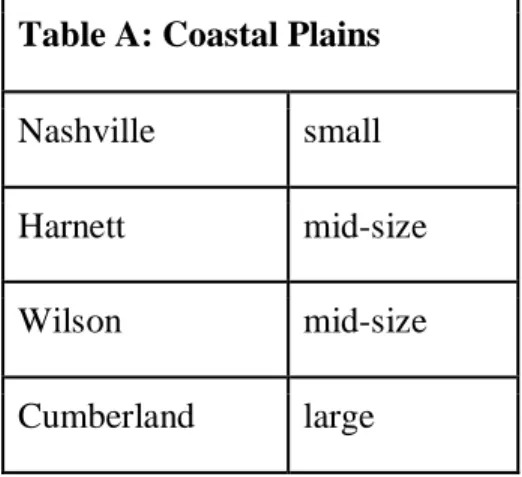
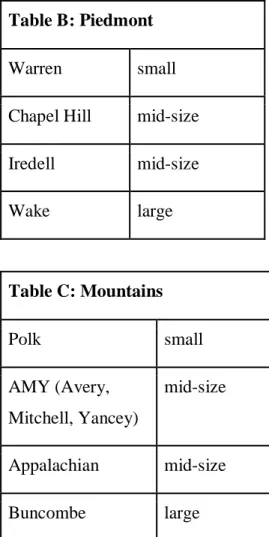
The sampled library systems are grouped by region with collection size relative to the median of all libraries in North Carolina and are listed as follows:
Table A: Coastal Plains
Nashville small
Harnett mid-size
Wilson mid-size
Table B: Piedmont
Warren small
Chapel Hill mid-size Iredell mid-size
Wake large
Table C: Mountains
Polk small
AMY (Avery, Mitchell, Yancey)
mid-size
Appalachian mid-size
Buncombe large
• Family life education
• Health education
• Human sexuality
• Schools
• Sex education
• Sex instruction for youth
• Sexual abstinence
• Sexual behavior
• Teenage pregnancy
• Teenage pregnancy -- Prevention
• Teenagers
• Teenagers -- Sexual behavior
Results
Nashville Public Library
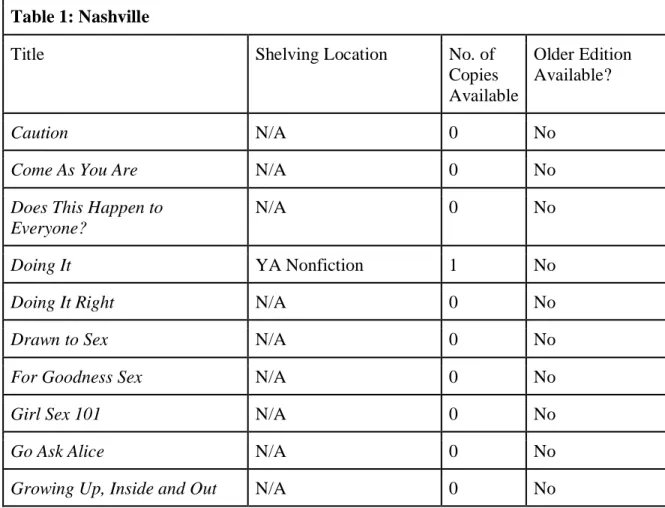
The Nashville municipal library contains only one physical location: the Harold D. Cooley Library in Nashville, North Carolina. It is located in the Coastal Plain area of the state. It contains the second smallest legal service population area for a public library system in North Carolina with about five thousand residents living in Nashville. It also contains the smallest collection of total print books in the state with around nineteen thousand volumes as of 2017 (“Library Statistics”, 2019).
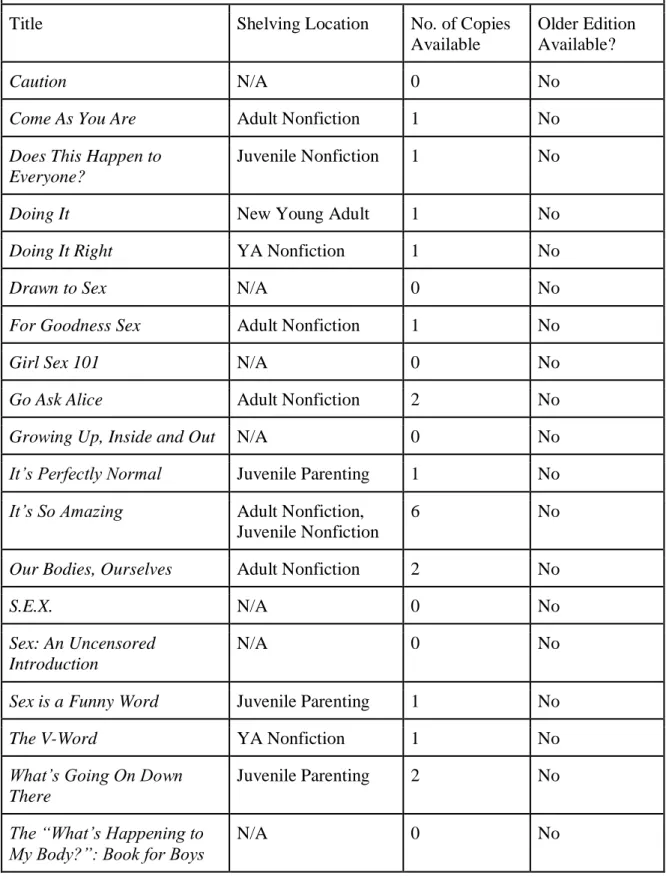
Table 1: Nashville
Title Shelving Location No. of
Copies Available
Older Edition Available?
Caution N/A 0 No
Come As You Are N/A 0 No
Does This Happen to Everyone?
N/A 0 No
Doing It YA Nonfiction 1 No
Doing It Right N/A 0 No
Drawn to Sex N/A 0 No
For Goodness Sex N/A 0 No
Girl Sex 101 N/A 0 No
Go Ask Alice N/A 0 No
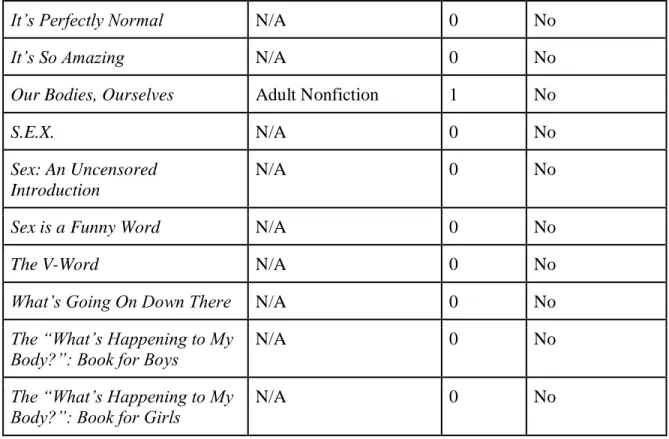
It’s Perfectly Normal N/A 0 No
It’s So Amazing N/A 0 No
Our Bodies, Ourselves Adult Nonfiction 1 No
S.E.X. N/A 0 No
Sex: An Uncensored Introduction
N/A 0 No
Sex is a Funny Word N/A 0 No
The V-Word N/A 0 No
What’s Going On Down There N/A 0 No
The “What’s Happening to My Body?”: Book for Boys
N/A 0 No
The “What’s Happening to My Body?”: Book for Girls
N/A 0 No
Harnett County Public Library
The Harnett County Public Library system is located in eastern North Carolina with a collection spread across seven libraries. This system serves a population of about 129,000 with a print book collection size of about 182,000 volumes (“Library Statistics”, 2019).
Table 2: Harnett
Title Shelving Location No. of
Copies Available
Older Edition Available?
Caution N/A 0 No
Come As You Are N/A 0 No
Does This Happen to Everyone?
Doing It N/A 0 No
Doing It Right YA Nonfiction 1 No
Drawn to Sex N/A 0 No
For Goodness Sex N/A 0 No
Girl Sex 101 N/A 0 No
Go Ask Alice N/A 0 No
Growing Up, Inside and Out N/A 0 No
It’s Perfectly Normal Juvenile Nonfiction 1 No
It’s So Amazing YA Nonfiction 1 No
Our Bodies, Ourselves Adult Nonfiction 1 No
S.E.X. N/A 0 No
Sex: An Uncensored Introduction
N/A 0 No
Sex is a Funny Word YA Nonfiction 1 No
The V-Word YA Nonfiction 1 No
What’s Going On Down There Juvenile Nonfiction 2 No
The “What’s Happening to My Body?”: Book for Boys
YA Nonfiction 2 No
The “What’s Happening to My
Body?”: Book for Girls YA Nonfiction 2 No
Wilson County Public Library
Table 3: Wilson
Title Shelving Location No. of Copies
Available
Older Edition Available?
Caution N/A 0 No
Come As You Are Adult Nonfiction 1 No
Does This Happen to Everyone?
Juvenile Nonfiction 1 No
Doing It New Young Adult 1 No
Doing It Right YA Nonfiction 1 No
Drawn to Sex N/A 0 No
For Goodness Sex Adult Nonfiction 1 No
Girl Sex 101 N/A 0 No
Go Ask Alice Adult Nonfiction 2 No
Growing Up, Inside and Out N/A 0 No
It’s Perfectly Normal Juvenile Parenting 1 No
It’s So Amazing Adult Nonfiction,
Juvenile Nonfiction
6 No
Our Bodies, Ourselves Adult Nonfiction 2 No
S.E.X. N/A 0 No
Sex: An Uncensored Introduction
N/A 0 No
Sex is a Funny Word Juvenile Parenting 1 No
The V-Word YA Nonfiction 1 No
What’s Going On Down There
Juvenile Parenting 2 No
The “What’s Happening to My Body?”: Book for Boys
The “What’s Happening to My Body?”: Book for Girls
Juvenile Nonfiction 2 No
Cumberland County Public Library & Information Center
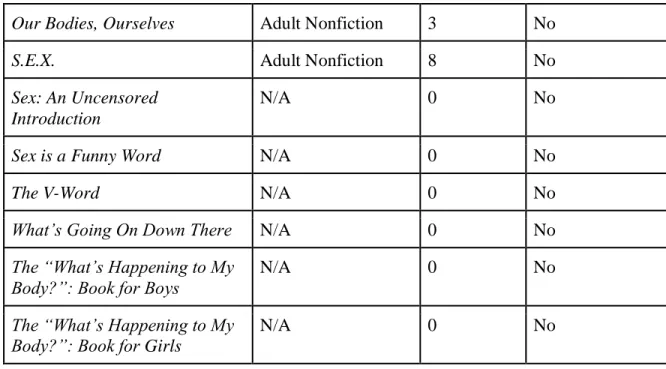
The Cumberland County Public Library & Information Center serves a population of about 330,000 residents with a print book collection of about 474,000 total volumes, making it the largest library system in the Coastal Plains region in terms of population and collection size (“Library Statistics”, 2019). There are nine physical locations in this library system.
Table 4: Cumberland
Title Shelving Location No. of
Copies Available
Older Edition Available?
Caution N/A 0 No
Come As You Are Adult Nonfiction 6 No
Does This Happen to Everyone?
N/A 0 No
Doing It N/A 0 No
Doing It Right Adult Nonfiction 5 No
Drawn to Sex N/A 0 No
For Goodness Sex Adult Nonfiction 4 No
Girl Sex 101 N/A 0 No
Go Ask Alice N/A 0 No
Growing Up, Inside and Out Juvenile Nonfiction 7 No
It’s Perfectly Normal Juvenile Nonfiction 8 Yes, 2009
Our Bodies, Ourselves Adult Nonfiction 3 No
S.E.X. Adult Nonfiction 8 No
Sex: An Uncensored Introduction
N/A 0 No
Sex is a Funny Word N/A 0 No
The V-Word N/A 0 No
What’s Going On Down There N/A 0 No
The “What’s Happening to My Body?”: Book for Boys
N/A 0 No
The “What’s Happening to My
Body?”: Book for Girls N/A 0 No
Warren County Library
Located in Warrenton, NC, the Warren County Memorial Library contains the smallest print collection in the Piedmont region with about 31,500 total book volumes. The library serves a population of about 20,000 residents (“Library Statistics”, 2019). There is only one physical location in this library system. This is also the only library system included in the sample that separates its catalog into “Kids” and “Adult” sections; materials were searched for using both. However, the materials that were found in this library system are viewable through both catalogs.
Table 5: Warren
Title Shelving Location No. of Copies
Available
Older Edition Available?
Caution N/A 0 No
Come As You Are N/A 0 No
Doing It N/A 0 No
Doing It Right N/A 0 No
Drawn to Sex N/A 0 No
For Goodness Sex N/A 0 No
Girl Sex 101 N/A 0 No
Go Ask Alice N/A 0 Yes, 1998
Growing Up, Inside and Out N/A 0 No
It’s Perfectly Normal N/A 0 No
It’s So Amazing Adult Nonfiction 1 No
Our Bodies, Ourselves N/A 0 No
S.E.X. N/A 0 No
Sex: An Uncensored Introduction
N/A 0 No
Sex is a Funny Word N/A 0 No
The V-Word N/A 0 No
What’s Going On Down There N/A 0 No
The “What’s Happening to My Body?”: Book for Boys
N/A 0 No
The “What’s Happening to My
Body?”: Book for Girls N/A 0 No
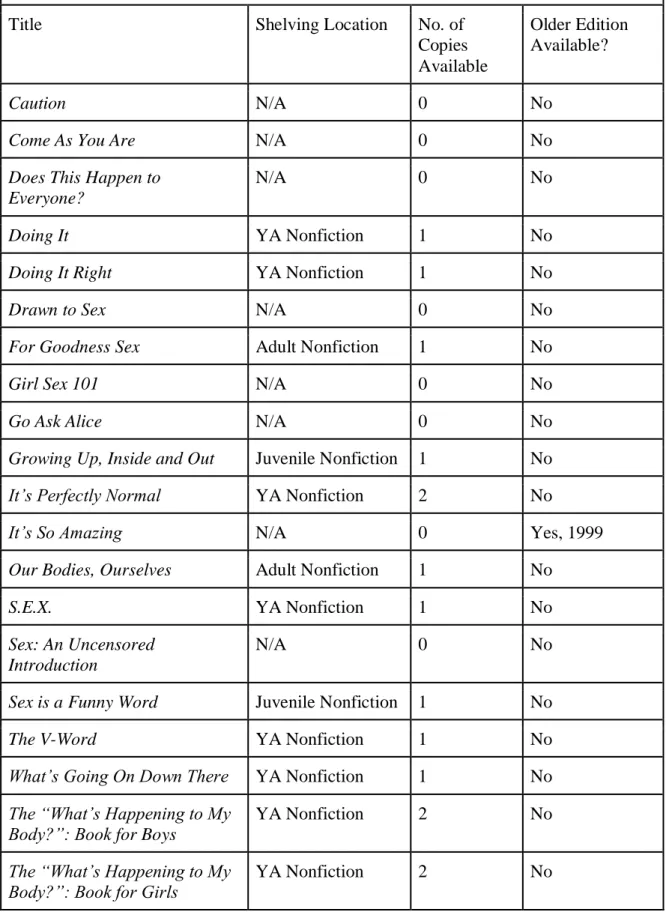
Chapel Hill Public Library
Table 6: Chapel Hill
Title Shelving Location No. of
Copies Available
Older Edition Available?
Caution N/A 0 No
Come As You Are N/A 0 No
Does This Happen to Everyone?
N/A 0 No
Doing It YA Nonfiction 1 No
Doing It Right YA Nonfiction 1 No
Drawn to Sex N/A 0 No
For Goodness Sex Adult Nonfiction 1 No
Girl Sex 101 N/A 0 No
Go Ask Alice N/A 0 No
Growing Up, Inside and Out Juvenile Nonfiction 1 No
It’s Perfectly Normal YA Nonfiction 2 No
It’s So Amazing N/A 0 Yes, 1999
Our Bodies, Ourselves Adult Nonfiction 1 No
S.E.X. YA Nonfiction 1 No
Sex: An Uncensored Introduction
N/A 0 No
Sex is a Funny Word Juvenile Nonfiction 1 No
The V-Word YA Nonfiction 1 No
What’s Going On Down There YA Nonfiction 1 No
The “What’s Happening to My Body?”: Book for Boys
YA Nonfiction 2 No
The “What’s Happening to My
Iredell County Public Library
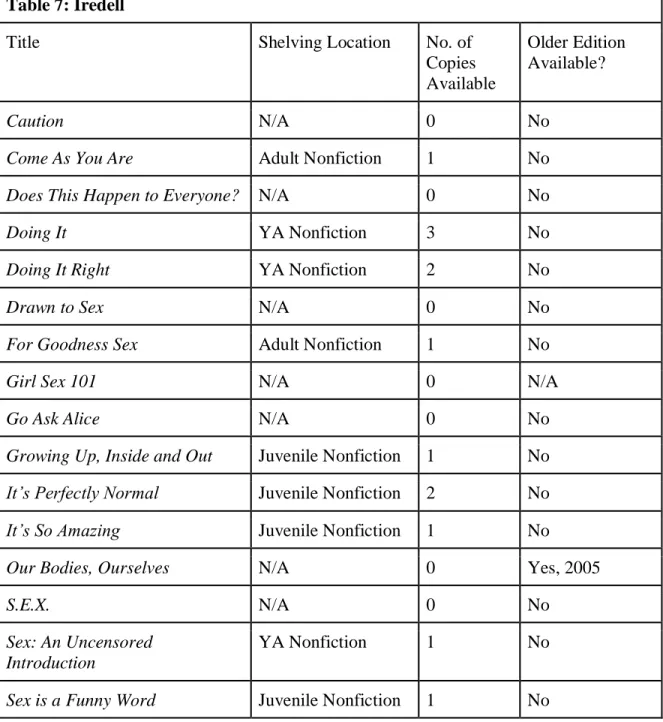
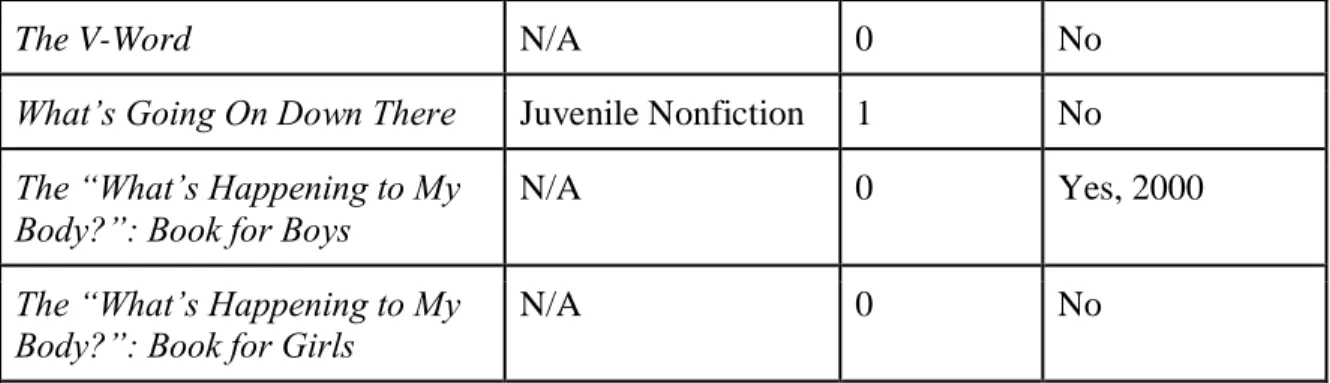
Located in the middle west Piedmont region of the state, Iredell County Public Library serves about 134,000 residents. It possesses a mid-size collection of print materials with around 225,000 total book volumes (“Library Statistics”, 2019). These materials are available in three physical libraries.
Table 7: Iredell
Title Shelving Location No. of
Copies Available
Older Edition Available?
Caution N/A 0 No
Come As You Are Adult Nonfiction 1 No
Does This Happen to Everyone? N/A 0 No
Doing It YA Nonfiction 3 No
Doing It Right YA Nonfiction 2 No
Drawn to Sex N/A 0 No
For Goodness Sex Adult Nonfiction 1 No
Girl Sex 101 N/A 0 N/A
Go Ask Alice N/A 0 No
Growing Up, Inside and Out Juvenile Nonfiction 1 No
It’s Perfectly Normal Juvenile Nonfiction 2 No
It’s So Amazing Juvenile Nonfiction 1 No
Our Bodies, Ourselves N/A 0 Yes, 2005
S.E.X. N/A 0 No
Sex: An Uncensored Introduction
YA Nonfiction 1 No
The V-Word N/A 0 No
What’s Going On Down There Juvenile Nonfiction 1 No
The “What’s Happening to My Body?”: Book for Boys
N/A 0 Yes, 2000
The “What’s Happening to My Body?”: Book for Girls
N/A 0 No
Wake County Public Libraries
Wake County Public Libraries contains the largest library print collection in North Carolina with more than 1,300,000 total print books, 500,000 more books than the second largest collection in Mecklenburg County (“Library Statistics”, 2019). These volumes are spread throughout twenty-two physical library locations of varying sizes (regional, large community, community, and special collections). It also contains the second highest total library operating income in North Carolina. The county itself contains the North Carolina state capital, a population of over one million residents, and is one of the fastest growing counties in the United States (“Learn About Wake County”, 2016).
Table 8: Wake
Title Shelving Location No. of
Copies Available
Older Edition Available?
Caution N/A 0 No
Come As You Are N/A 0 No
Does This Happen to Everyone?
N/A 0 No
Doing It Right N/A 0 No
Drawn to Sex N/A 0 No
For Goodness Sex Adult Nonfiction 15 No
Girl Sex 101 N/A 0 No
Go Ask Alice N/A 0 No
Growing Up, Inside and Out N/A 0 No
It’s Perfectly Normal Juvenile Nonfiction 29 No
It’s So Amazing Juvenile Nonfiction 42 No
Our Bodies, Ourselves Adult Nonfiction 8 No
S.E.X. N/A 0 No
Sex: An Uncensored Introduction
N/A 0 No
Sex is a Funny Word N/A 0 No
The V-Word N/A 0 No
What’s Going On Down There N/A 0 No
The “What’s Happening to My Body?”: Book for Boys
N/A 0 Yes, 2000
The “What’s Happening to My Body?”: Book for Girls
N/A 0 Yes, 2000
Polk County Public Libraries
Table 9: Polk
Title Shelving Location No. of
Copies Available
Older Edition Available?
Caution N/A 0 No
Come As You Are Adult Nonfiction 1 No
Does This Happen to Everyone?
YA Nonfiction 1 No
Doing It N/A 0 No
Doing It Right N/A 0 No
Drawn to Sex N/A 0 No
For Goodness Sex N/A 0 No
Girl Sex 101 N/A 0 No
Go Ask Alice N/A 0 No
Growing Up, Inside and Out N/A 0 No
It’s Perfectly Normal Juvenile Nonfiction 1 No
It’s So Amazing N/A 0 Yes, 1999
Our Bodies, Ourselves N/A 0 Yes, 2005
S.E.X. YA Nonfiction 1 No
Sex: An Uncensored Introduction
YA Nonfiction 1 No
Sex is a Funny Word YA Nonfiction 1 No
The V-Word N/A 0 No
What’s Going On Down There N/A 0 No
The “What’s Happening to My Body?”: Book for Boys
N/A 0 No
The “What’s Happening to My
AMY (Avery-Mitchell-Yancey) Regional Library
The AMY (Avery-Mitchell-Yancey) library system serves Avery, Mitchell, and Yancey counties in western North Carolina, as well as their total population of about 51,500 residents. The library’s collection is made up of approximately 161,000 print books (“Library Statistics”, 2019). This system is made up of four physical locations and a bookmobile.
Table 10: AMY (Avery-Mitchell-Yancey)
Title Shelving Location No. of
Copies Available
Older Edition Available?
Caution N/A 0 No
Come As You Are N/A 0 No
Does This Happen to Everyone?
N/A 0 No
Doing It N/A 0 No
Doing It Right N/A 0 No
Drawn to Sex N/A 0 No
For Goodness Sex N/A 0 No
Girl Sex 101 N/A 0 No
Go Ask Alice N/A 0 No
Growing Up, Inside and Out N/A 0 No
It’s Perfectly Normal N/A 0 No
It’s So Amazing N/A 0 No
Our Bodies, Ourselves N/A 0 No
Sex: An Uncensored Introduction
N/A 0 No
Sex is a Funny Word N/A 0 No
The V-Word N/A 0 No
What’s Going On Down There N/A 0 No
The “What’s Happening to My Body?”: Book for Boys
N/A 0 Yes, 1987
The “What’s Happening to My Body?”: Book for Girls
N/A 0 No
Appalachian Regional Library
A mid-size collection located in the mountain region of North Carolina, the Appalachian Regional Library system contains three physical locations across three counties: Ashe County Public Library, Watauga County Public Library, and Wilkes County Public Library. The system serves a population of about 205,000 residents and houses a collection of about 152,500 print books (“Library Statistics”, 2019).
Table 11: Appalachian
Title Shelving Location No. of
Copies Available
Older Edition Available?
Caution N/A 0 No
Come As You Are N/A 0 No
Does This Happen to Everyone?
N/A 0 No
Doing It N/A 0 No
Doing It Right Juvenile Nonfiction 1 No
For Goodness Sex N/A 0 No
Girl Sex 101 N/A 0 No
Go Ask Alice N/A 0 No
Growing Up, Inside and Out N/A 0 No
It’s Perfectly Normal Adult Nonfiction 1 Yes, 1994
It’s So Amazing N/A 0 Yes, 1999
Our Bodies, Ourselves N/A 0 Yes, 1998, 2005
S.E.X. N/A 0 No
Sex: An Uncensored Introduction
N/A 0 No
Sex is a Funny Word N/A 0 No
The V-Word N/A 0 No
What’s Going On Down There N/A 0 No
The “What’s Happening to My Body?”: Book for Boys
N/A 0 No
The “What’s Happening to My Body?”: Book for Girls
N/A 0 Yes, 1987
Buncombe County Public Libraries
Buncombe County Public Libraries is made up of thirteen physical library locations. This system serves a population of about 259,000 residents with a print book collection of about 500,000 total volumes (“Library Statistics”, 2019).
Table 12: Buncombe
Title Shelving Location No. of
Copies Available
Caution N/A 0 No
Come As You Are Adult Nonfiction 2 No
Does This Happen to Everyone?
Juvenile Nonfiction 3 No
Doing It YA Nonfiction 2 No
Doing It Right YA Nonfiction 1 No
Drawn to Sex N/A 0 No
For Goodness Sex N/A 0 No
Girl Sex 101 Adult Nonfiction 1 No
Go Ask Alice N/A 0 No
Growing Up, Inside and Out N/A 0 No
It’s Perfectly Normal Juvenile Nonfiction 4 Yes, 2009, 2004, 1994
It’s So Amazing Juvenile Nonfiction 3 Yes, 2002, 1999
Our Bodies, Ourselves Adult Nonfiction 6 No
S.E.X. Adult Nonfiction 1 No
Sex: An Uncensored Introduction
N/A 0 No
Sex is a Funny Word Juvenile Nonfiction 1 No
The V-Word YA Nonfiction 1 No
What’s Going On Down There
YA Nonfiction 2 No
The “What’s Happening to My Body?”: Book for Boys
Juvenile Nonfiction 4 Yes, 2000
The “What’s Happening to My Body?”: Book for Girls
Summary Table
This table functions as a summary table that combines collected data from all libraries, listing the total number of library collections where a check-listed title appears. This is done to display the frequency of recommended titles in the twelve sampled libraries.
Table 13: Summary
Title No. of Libraries
Caution 0
Come As You Are 5
Does This Happen to Everyone? 3
Doing It 5
Doing It Right 7
Drawn to Sex 0
For Goodness Sex 5
Girl Sex 101 1
Go Ask Alice 1
Growing Up, Inside and Out 3
It’s Perfectly Normal 9
It’s So Amazing 7
Our Bodies, Ourselves 7
S.E.X. 5
Sex: An Uncensored Introduction 2
Sex is a Funny Word 6
What’s Going On Down There 5 The “What’s Happening to My
Body?”: Book for Boys
3
The “What’s Happening to My Body?”: Book for Girls
Discussion
Analysis of Data Findings
Among the assumptions I had prior to data collection was the supposition that libraries would have few, if any, of the titles available on the checklist. Moreover, I believed that the majority of these collections would contain titles that have not been updated or weeded. Studies of public library consumer health collections in North
Carolina have demonstrated the need for further development and deselection of material (Flaherty & Kaplan, 2016). I also assumed that the larger the library collection, the more varied the selection of material would be, thus containing more titles on the checklist. Furthermore, if a library did contain these updated materials, I expected them to all share the same shelving location; whether they all be shelved in juvenile, young adult, or adult collections, I expected each library to catalogue them similarly. However, analysis of the data collected reveals a more complicated answer to what materials exist in these
collections, as well as how visible and available these materials are to users. First, none of the sampled libraries contained every material on the checklist.
each sampled library contained at least one matched title of the twenty on the list. The average of matched title per each sampled library is about seven titles of the twenty on the list per library.
Buncombe County Public Libraries contains the highest number of titles from the checklist with fourteen of the twenty titles available. Wilson County Public Library and Chapel Hill Public Library follow with thirteen and twelve titles available, respectively. Each of these libraries exists in a different geographic region of the state. Warren County Library and AMY Regional Library contain the fewest titles, with only one title
appearing in each library collection.
reviewed titles that appeared on the list and the data appears to confirm the popularity of the title relative to similar resources.
Another important finding is that, although larger libraries contain more copies of titles on the checklist, they do not contain more recommended titles. For example, even though their collection only contains four titles from the checklist, Wake County Public Libraries contains the most copies per book of the titles in its collection. In the same region, Chapel Hill Public Library and Iredell County Public Library contain more titles on the checklist; they have a greater diversity of recommended titles despite having fewer copies. Conversely, in the mountain region libraries, Buncombe County Public Libraries contains the most titles from the checklist, while both mid-size library collections (AMY and Appalachian Regional) contain the fewest. Thus, collection size does not appear to be a factor contributing to a library’s percentage of matched title despite an increased chance of having a title. This contrasts with Torres’ (2017) findings when implementing the checklist method in medical libraries, as that study found that larger collections had more title matches.
and juvenile collections depending on the collecting library. There does not appear to be any trend based on library size or geographic location when accounting for a title’s shelving location. It is likely that each library has its own criteria for determining shelving location for these titles due to the amount of variability in cataloging.
However, geographic region may be a factor in determining recency of titles. Nineteen titles in the total sampled libraries were outdated editions of check-listed materials with newer editions. The oldest of these editions were the first editions of The“What’s Happening to My Body?”: Book for Girls and The“What’s Happening to My Body?”: Book for Boys, both with publication dates of 1987, the oldest edition of a title
from the checklist. These older editions appear in three of the four libraries sampled from the mountain region. In fact, of the older editions found in the sampled libraries, eleven of nineteen were found in mountain region libraries, six found in piedmont region libraries, and two included in coastal plain region collections. Collection size could also be a factor, as all three of the libraries noted as having large collections contained at least two older editions of recommended titles.
Keyword searches were used in each library catalog to determine other titles in library collections that were not included on the checklist. Of the keywords used to search for general sex education materials, ‘Sex education’, ‘Sex instruction for youth’, and ‘Teenagers – Sexual Behavior’ returned the most relevant results. Meanwhile,
recent titles related to sex education, while libraries with fewer titles (four or less) contained less recent titles.
Limitations and Suggestions for Future Research
The checklist method is a useful tool for analyzing what library collections actually contain. However, it does not provide a concrete answer for exactly why library collections contain the materials that they do. Questionnaires or interviews with
collection development librarians could provide insight into the rationale for acquisition and deselection of sex education materials and whether library policy, librarian bias, or some other factor affects the data. This could also determine whether certain libraries fear community or administrative pushback for collecting sex education materials or shelving them in a specific collection like in Cohen’s (2008) study, or whether library-specific considerations like collection budget or lack of subject area expertise play a role in what materials libraries collect. This could also more definitively determine whether collection size or geographic region are factors in determining recommended sex education titles.
considered for this study; libraries may be turning to these formats instead of print materials to account for potential issues with collection space.
Conclusion
Despite a widely recognized method of determining sex education materials for public libraries, these materials continue to be reviewed by professional publications as scientific discovery and cultural norms evolve. As a result, public libraries in North Carolina contain widely variable collections of recommended sex education titles, without apparent correlation to collection size or geographic location. However, geographic location may be a factor in the recency of sex education materials collected by these libraries. Shelving locations also vary depending on each individual library’s interpretation of the title’s audience. Further research about the culture and perspective of libraries and collection development librarians, respectively, is recommended to
Bibliography
Anders, C.J. (2018, September 25). “Girl Sex 101” is a total joy. [Review of the book Girl Sex 101]. Los Angeles Review of Books. Retrieved from
https://lareviewofbooks.org/article/girl-sex-101-is-a-total-joy/
Barnaby Public Library. (2019). Let’s talk about…sex education. Retrieved January 22, 2019 from https://seattle.bibliocommons.com/list/share/83430610/92996222 Borman, C. B., & McKenzie, P. J. (2005). Trying to help without getting in their faces:
Public library staff descriptions of providing consumer health information. Reference & User Services Quarterly, 133-146.
Boyse, K. (2010). Sexuality education for youth with disability or chronic illness: a resource list. Retrieved from
http://www.med.umich.edu/yourchild/topics/disabsex.htm
Campbell, P. J. (1979). Sex education books for young adults, 1892-1979. Rr Bowker Llc.
Chelton, M. K. (1981). The public library as a sex education resource for adolescents. Collection Building, 3(1) Retrieved from
http://libproxy.lib.unc.edu/login?url=https://search-proquest-com.libproxy.lib.unc.edu/docview/57194304?accountid=14244
Children’s book review: Does This Happen to Everyone?. (2014, July 7). [Review of the book Does This Happen to Everyone? A Budding Adult’s Guide to Puberty]. Publisher’s Weekly. Retrieved from https://www.publishersweekly.com/978-3-89955-521-9
Children’s book review: Growing Up, Inside and Out. (2013, July 15). [Review of the book Growing Up, Inside and Out]. Publisher’s Weekly. Retrieved from https://www.publishersweekly.com/978-1-77147-004-9
Cohen, R. J. (2008). Sex education and the American public library. Young Adult Library Services, 6(3), 40-45. Retrieved from
http://libproxy.lib.unc.edu/login?url=https://search-proquest-com.libproxy.lib.unc.edu/docview/217689238?accountid=14244
Cornog, M., & Perper, T. (1996). For sex education, see librarian : a guide to issues and resources (p. xxi, 403 p.). Westport, Conn: Greenwood Press.
Couri, S. (2016, September 23). The v-word [Review of the book The V-word]. School Library Journal. Retrieved from https://www.slj.com/?detailStory=the-v-word
Doing It – Kirkus Review. (2018, April 10). [Review of the book Doing It]. Kirkus Reviews. Retrieved from https://www.kirkusreviews.com/book-reviews/hannah-witton/doing-it-witton/
Drawn to Sex: The Basics. (2018, October 8). [Review of the book Drawn to Sex: The Basics]. Publisher’s Weekly. Retrieved from
https://www.publishersweekly.com/978-1-62010-544-3
Faigel M. (1985). Methods and issues in collection evaluation today. Libr Acquis Pract Th; 9(1), 21–35. https://doi.org/10.1016/0364-6408(85)90039-0
Flaherty, M. G. & Kaplan, S. (2016). Health information: print materials assessment in public libraries. Reference Services Review. 44(2), 163-177.
https://doi-org.libproxy.lib.unc.edu/10.1108/RSR-02-2016-0010
Fox, S. (2011). The social life of health information, 2011. Washington, DC: Pew Internet & American Life Project. Retrieved from
https://assets0.flashfunders.com/offering/document/e670ae83-4b9a-40f0-aac7-41b64dbc7068/PIP_Social_Life_of_Health_Info.pdf
Gillaspy, M.L. (2005), Factors affecting the provision of consumer health information in public libraries: the last five years. Library Trends. 53(3), 480-495.
Harris, R., Henwood, F., Marshall, A., Burdett, S. (2010). “I'm not sure if that's what their job is”: Consumer health information and emerging “healthwork” roles in the public library. Reference and User Services Quarterly, 49(3), 239-252. Harris, B. (2015). Sex education books for teens. Retrieved from
https://sexedconference.com/sex-education-books-for-teens/
It’s Perfectly Normal – Kirkus Review. (2010, May 20). [Review of the book It’s Perfectly Normal: Changing Bodies, Growing Up, Sex, and Sexual Health]. Kirkus Reviews. Retrieved from https://www.kirkusreviews.com/book-reviews/robie-h-harris/its-perfectly-normal/
It’s So Amazing – Kirkus Review. (2010, May 20). [Review of the book It’s So Amazing!: A Book About Eggs, Sperm, Birth, Babies, and Families]. Kirkus Reviews. Retrieved from https://www.kirkusreviews.com/book-reviews/robie-h-harris/its-so-amazing/
Jones, R. K., & Biddlecom, A. E. (2011). Is the internet filling the sexual health information gap for teens? an exploratory study. Journal of Health Communication, 16(2), 112-123. doi:10.1080/10810730.2010.535112
Learn About Wake County. (2016). Retrieved from
http://www.wakegov.com/about/facts/Pages/default.aspx
Library Statistics. (2019). Retrieved from https://statelibrary.ncdcr.gov/ld/about-libraries/data/library-statistics
Marshall, K. (2016). Sex in the Stacks: Teenager Sex Education Information Seeking Behavior and Barriers to the Use of Library Resources. Journal of Research on Libraries & Young Adults. 7(1), 1-13. Retrieved from: https://auth-lib-unc-edu.libproxy.lib.unc.edu/ezproxypass:[_]auth.php?url=http://search.ebscohost.co m.libproxy.lib.unc.edu/login.aspx?direct=true&db=lls&AN=115415653&site=eh ost-live&scope=site
Moss, E. (2008). An inductive evaluation of a public library GLBT collection. Collection Building, 27(4), 149-156.
doi:http://dx.doi.org.libproxy.lib.unc.edu/10.1108/01604950810913715
Oder, N. (2005). FL Commissioners Segregate Books. Library Journal. 130(13), 20-20. Retrieved from
https://auth-lib-unc-edu.libproxy.lib.unc.edu/ezproxypass:[_]auth.php?url=http://search.ebscohost.co m.libproxy.lib.unc.edu/login.aspx?direct=true&db=lls&AN=17910372&site=eho st-live&scope=site
Our Bodies, Ourselves 2011. (n.d.) Retrieved from
https://www.ourbodiesourselves.org/publications/our-bodies-ourselves-2011/ Our State Geography in a Snap: Three Regions Overview. (n.d.). Retrieved from
Perryman, C. (2016). Evaluation of Self-Ratings for Health Information Behaviour Skills Requires More Heterogeneous Sample, but Finds that Public Library Print
Collections and Health Information Literacy of Librarians Needs Improvement. Evidence Based Library and Information Practice, 11(1), 82-84.
Resources for Families. (n.d.). Retrieved from
https://www.plannedparenthood.org/planned-parenthood-maryland/education-training/parents/resources-families
Rubenstein, E. (2012). From social hygiene to consumer health: Libraries, health information, and the American public from the late nineteenth century to the 1980s. Library & Information History. 28(3), 202-219.
https://doi.org/10.1179/1758348912Z.00000000016
Rubenstein, E. L. (2016). Breaking health barriers: How can public libraries contribute?. Public Library Quarterly, 35(4), 331-337.
https://doiorg.libproxy.lib.unc.edu/10.1080/01616846.2016.1245006
Rubenstein, E. L. (2017). "I didn't learn that in library school"-experiential learning in consumer health for future public librarians. Library Trends, 66(1), 37-51. http://dx.doi.org.libproxy.lib.unc.edu/10.1353/lib.2017.0027
Schneider, E. & Hutchison, B. (2015). Referencing the Imaginary: An Analysis of Library Collection of Role-Playing Game Materials. The Reference Librarian, 56(3), 174-188.
https://doi-org.libproxy.lib.unc.edu/10.1080/02763877.2014.1002716 Sex Education. (n.d.). Retrieved from
https://guides.library.illinois.edu/c.php?g=348412&p=2347515
Sex is a Funny Word – Kirkus Review. (2015, April 1). [Review of the book Sex is a Funny Word: A Book About Bodies, Feelings, and You]. Kirkus Reviews. Retrieved from https://www.kirkusreviews.com/book-reviews/cory-silverberg/sex-is-a-funny-word/
Smith, M., Gertz, E., Alvarez, S., & Lurie, P. (2000). The Content and Accessibility of Sex Education Information on the Internet. Health Education & Behavior, 27(6), 684–694. https://doi.org/10.1177/109019810002700603
Stewart, D. (2017). What’s going on down there? A boy’s guide to growing up. [Review of the book What’s Going on Down There? A Boy’s Guide to Growing Up]. Common Sense Media. Retrieved from
https://www.commonsensemedia.org/book-reviews/whats-going-on-down-there-a-boys-guide-to-growing-up
Torres, E. (2017). Collection-based analysis of selected medical libraries in the Philippines using doody's core titles. Journal of the Medical Library Association, 105(1), 20-26.
http://dx.doi.org.libproxy.lib.unc.edu/10.5195/jmla.2017.103
Willey, P. (2017). Puberty, consent, and sexuality: a few new titles. Retrieved from https://www.slj.com/?detailStory=puberty-consent-sexuality-new-titles Willey, P. (2016). Sex education: covering the bases. Retrieved from
https://www.slj.com/?detailStory=sex-education-covering-the-bases-focus-on Zionts, N. D., A. Apter, J. Kuchta, & P. K. Greenhouse (2010). Promoting Consumer