РУХОМИЙ
СКЛАД
І
ТЯГА
ПОЇЗДІВ
UDC 629.463.077:625.143.58
V. L. HOROBETS
1, L. H. MASLEIEVA
2, L. V. URSULIAK
3*, V. V.ARSONOV
4 1ARL DSRS, Dnipropetrovsk National University of Railway Transport named after Academician V. Lazaryan, Lazaryan St. 2, Dnipropetrovsk, Ukraine, 49010, tel. +38 (056) 776 72 44, fax +38 (056) 776 72 44,e-mail [email protected], ORCID 0000-0002-6537-7461
2Dep. «Theoretical Mechanics», Dnipropetrovsk National University of Railway Transport named after Academician V. Lazaryan, Lazaryan St. 2, Dnipropetrovsk, Ukraine, 49010, tel. +38 (056) 776 72 44, fax +38 (056) 776 72 44, e-mail [email protected], ORCID 0000-0002-5128-0095
3*Dep. «Structural Mechanics», Dnipropetrovsk National University of Railway Transport named after Academician V. Lazaryan, Lazaryan St. 2, Dnipropetrovsk, Ukraine, 49010, tel. +38 (056) 776 72 44, fax +38 (056) 776 72 44, e-mail [email protected], ORCID 0000-0001-5957-6926
4Insurance corporation «Таsо – Garantiya», Transportna St.,3, Odesa, Ukraine, 65039, tel. +38 (048) 267 77 10, fax +38 (048) 264 54 56, e-mail [email protected], ORCID 0000-0002-6202-2657
ABOUT THE EVALUATION OF THE LONGITUDINAL FORCES
LEVEL EFFECTING THE TRACK DISPLACEMENT
AT TRANSIENT MODES OF TRAIN MOVEMENT
Purpose. Study the transient modes effect of movement on the track displacement for the freight train safety control is supposed in this paper. For this it is necessary to investigate the longitudinal dynamics of a train on the track displacement. Simultaneously to assess the longitudinal forces level of a track and rolling stock interaction. Methodology. The level of the longitudinal forces, effecting the track displacement, was evaluated using mathe-matical modeling of longitudinal vibrations of the trains at transient modes of motion caused by braking. It was con-sidered that each train vehicle consists of a body (solid) and the wheel sets, connected with the body by friction bearings (inelastic link). It was believed that during the movement of each train vehicle the vertical plane of its symmetry coincident with the vertical plane of symmetry of the assembled rails and sleepers. At simulation it was also supposed that in the process of translational motion of the vehicle body wheels make pure rolling along the rail without slipping on it. Findings. In the results of calculations the values of the longitudinal forces at different types of braking were obtained (it is regenerative braking and pneumatic one) under quasi-static and shock transients. For this various initial state of clearances in the inter-car connections up to beginning of transient was considered. The level of dynamic additives to longitudinal forces of interaction between wheel and rail that are substantially depending on vehicle accelerations was assessed. Originality. The transient regimes effect of trains movement caused by braking on the level of the longitudinal forces of track and rolling stock interaction was investigated. The longitudinal load of freight trains with regenerative and pneumatic braking was researched. The effect of the initial state of the train and different modes of braking on a dynamic additive to the longitudinal forces of the inter-action between the track and rolling stock, which may effect the displacement of assembled rails and sleepers, was estimated. Practical value. The obtained results can be used to select rational modes of braking of freight trains, especially on lengthy down grade, from the positions prevent possible track displacement.
Keywords: mathematical modeling; transient modes of train movement; pneumatic braking; recuperative
Introduction
As the experience of freight trains operation shows, track displacement occurs when traction- braking running is applied in order to keep given speed of mode, especially on an excessive gradient and downhill length accordingly [2, 3, 6−7, 11−15].
Purpose
Freight trains safety control requires studying the effect of transient mode of their movement on track displacement.
Methodology
Processes of longitudinal forces occurrence of interaction between the track and rolling stock, caused by transient modes of trains movement, were studied by mathematical modeling of longi-tudinal vibrations of the train using known meth-ods of numerical integration of nonlinear differen-tial equations describing its motion [1, 4, 5, 9, 10]. As a simplified model of the train a chain of bodies (vehicles), interconnected by links (inter-car links) was considered. At this it was assumed that each train vehicle consists of a body (solid) and the wheel sets, connected with the body by friction bearings (inelastic link). The elastic properties of the track and wheel sets were not taking into ac-count. It was thought that during the movement of each train vehicle the vertical plane of its symme-try coincident with the vertical plane of symmesymme-try of the assembled rails and sleepers.
At simulation it was also supposed that in the process of translational motion of the vehicle body wheels make pure rolling along the rail without slipping on it. Such wheel motion was considered as compound, consisting of translational motion with rate VC and acceleration aC of center of body masses (Fig. 1) and rotary motion about the axis of the wheel set with an angular velocity ω and
angu-lar acceleration ε. Then during pure rolling VC
r
ω =
and aC
r
ε = , where r – wheel radius (Fig. 2).
It was supposed that longitudinal force Q actson each vehicle of the train (Fig. 1), which includes a component of the vehicle gravity on the slope of the track, the efforts in the links between vehicles (in inter car links), resistance force of translational motion, for example, from the wind load.
Fig. 1. The computational model of the train vehicle
At this resistance forces moment ws res
M , arising in bearings, acts on each wheel set of the vehicle (Fig. 2), and braking moment ws
brak
M can act in the result of regenerative and pneumatic (locomotives) braking of the vehicle.
Fig. 2. Force load wheeled of vehicle wheelset
It can be shown that the dynamic equation which describes the motion of the train vehicle in these cases has the form:
2
( )
ws ws ws
O brak res
v C
I M M
m N a Q N N
r r
r
+ ⋅ ⋅ = − ⋅ − ⋅ ,
where mv – body mass of the vehicle, N – wheel set number of the vehicle, ws
O
I – inertia axial mo-ment of the wheel set.
It should be taken into consideration that brak-ing moment w
brak
M and moment of resistance force w
res
M , applied to the wheel of the vehicle (Fig. 2), one can change with corresponding mo-ment of forces pair, one of which is attached to the wheel axle, and the other – to the contact point of a wheel and a rail (Fig. 3).
Then each of these moments can be expressed through the moment of the relevant force couples ( w
brak
F , w res
F ): w w brak brak
M =F ⋅r, w w res res
M =F ⋅r). As a result pointed moments for wheel sets cor-respond to the formulas
2
ws w ws
brak brak brak
M = F ⋅ =r F ⋅r,
2
ws w ws
res res res
M = F ⋅ =r F ⋅r
and ws ws brak brak M F
r = , but
ws ws res res M F r = .
With recent expressions dynamic equation of the vehicle is the following
2
( )
ws
ws ws
O
v C brak res
I
m N a Q N F N F r
+ ⋅ ⋅ = − ⋅ − ⋅
or
brak res
2
( Ows) v v
v C
I
m N a Q F F
r
+ ⋅ ⋅ = − − ,
where Fbrakv = ⋅N Fbrakws – it is braking force that acts on the vehicle, аnd v ws
res res
F = ⋅N F – it is resistance force to motion from friction in the bearings of the vehicle.
Then acceleration of masses center of the vehi-cle may be expressed as
res 2 v v brak C ws O v
Q F F a I m N r − − = + ⋅ .
Interaction forces between a wheel and a rail in cases in question are the friction forces arising in the contact point of a wheel and a rail (Fig. 3); at this, if w
fr
F – it is friction force, acting on a wheel
from the rail side, then r fr
F – it is friction force, acting on a rail from the wheel side; because the action is a reaction, then r w
fr fr
F = −F .
In order to find out what determines the fric-tional force ws
fr
F that acts on wheel set, it is neces-sary to make a dynamic equation of rotational mo-tion of wheel set about its axis:
ε= ws
O O
I ⋅
∑
M ;=
ws C ws ws ws
O brak res fr
a
I M M F r
r
⋅ − − − ⋅ ,
where ws fr
F ⋅r – it is net moment relatively to the axis of wheel set of the friction forces applied to wheel set from the rails side.
Then the expressions for the determination the total frictional force acting on the wheel set and a vehicle have the form:
2
ws ws
ws brak res ws C
fr O
M M a
F I
r r r
= + + ,
2
ws ws
v brak res ws C
fr O
M M a
F N N N I
r r r
= ⋅ + ⋅ + ⋅
or
2
v v v ws C v v
fr brak res O brak res
a
F F F N I F F d
r
= + + ⋅ = + + ,
where d – it is dynamic additive to forces v brak
F , v
res
F , which depends on the acceleration of the ve-hicle.
Acceleration values of vehicles can be signifi-cant at transient modes of train movement. That is why it seems to be interesting to investigate the processes of longitudinal forces rise of interaction between a track and rolling stock at transient modes of train movement and primarily which are caused by their braking.
Findings
Regenerative (electric braking locomotives) and pneumatic braking of the train with a speed of 40 km/h on horizontal sections of the track and slopes were simulated. In some cases, the train be-fore braking was pre-compacted, in others it was extended.
locomotives was in the front of a train and one in the rear end of the train.
It was also believed that cars are equipped with an air distributor No. 483 and composition brake shoe while inter-car links with elastic and friction draft gear SH-1-TM.
Levels of longitudinal forces w fr
F , acting on rails from the side of the train vehicle, and values of dynamic additives d were determined.
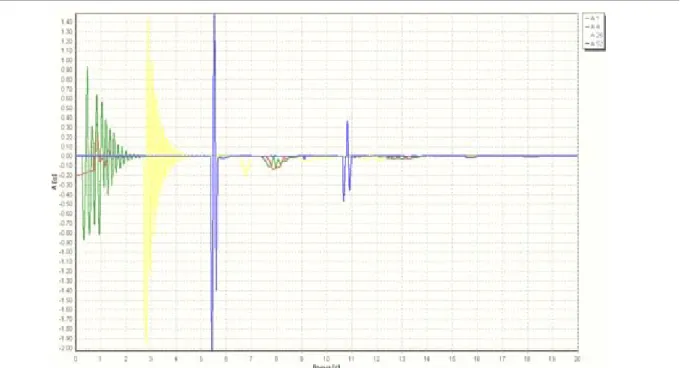
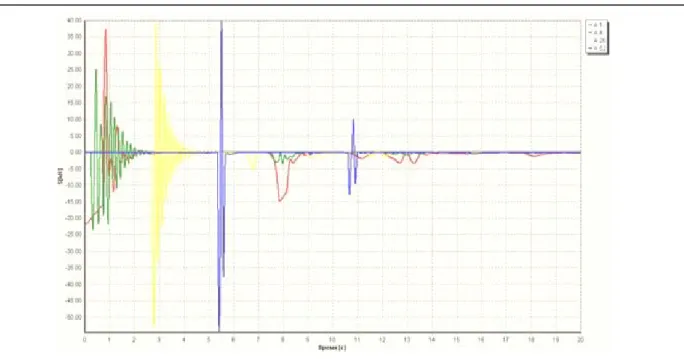
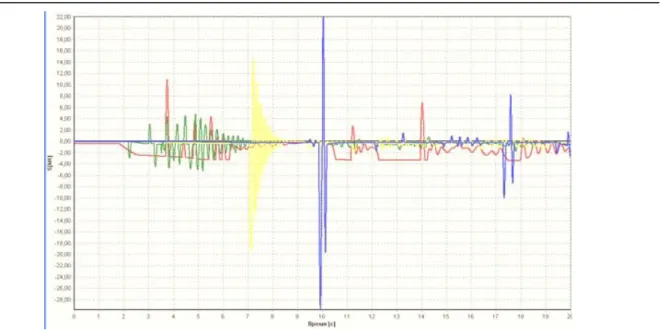
Below as an example the oscillographes chart of the longitudinal forces (Fig. 4−5) and accelera-tions (Fig. 6−7) are presented at regenerative brak-ing (all locomotives realize 24 position of electric
brake) in prior extended and pre-compacted trains. As one should expect, the highest level of lon-gitudinal forces and accelerations occur when re-generative braking of prior extended trains in the rear end sections of the train.
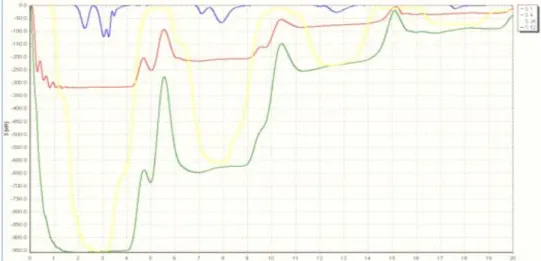
The dependences of the dynamic additives from motion time for the 1st, 4th, 26th and 52nd vehicles
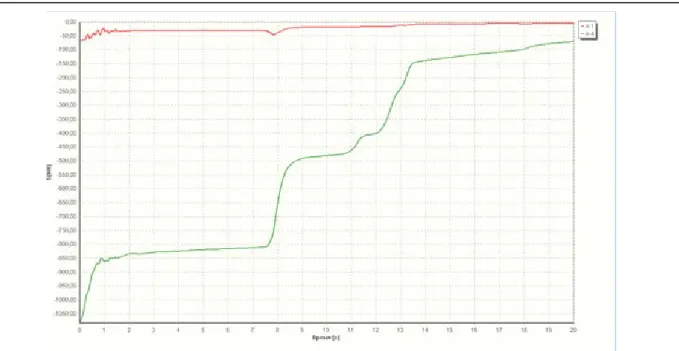
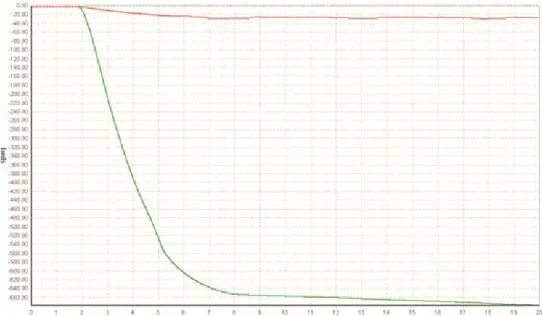
during regenerative braking in prior extended and pre-compacted trains correspondingly are shown in Fig. 8−9. The total dynamic additive curve (red line) and the braking force for the entire train are shown in Fig. 10−11.
Fig. 4. Oscillograms of longitudinal forces after the first locomotive, 4th, 26th and 52nd vehicles
at regenerative braking in prior extended train
Fig. 5. Oscillograms of longitudinal forces after the first locomotive, 4th, 26th and 52nd vehicles
Fig. 6. Oscillograms of longitudinal accelerations of the first locomotive, 4th, 26th and 52nd vehicles
at regenerative braking in prior extended train
Fig. 7. Oscillograms of longitudinal acceleratons of the first locomotive, 4th, 26th and 52nd vehicles
Fig. 8. Dependences of dynamic additives from motion time for the 1st, 4th, 26th and 52th vehicles
at regenerative braking in prior extended train
Fig. 9. Dependences of dynamic additives from motion time for the 1st, 4th, 26th and 52th vehicles
Fig. 10. Value change of the total dynamic additive (upper line) and the total braking force for the entire train, depending on the motion time
at regenerative braking movement in prior extended train
Fig. 11. Value change of the total dynamic additive (upper line) and the total braking force for the entire train, depending on the motion time
at regenerative braking in pre-compacted train
At braking in the prior extended train the high-est level of compressive longitudinal forces of shock behavior for examined sections of a train is about 1500 kN (Fig. 4) and the quasistatic ones -950 kN (Fig. 5).
The highest level of longitudinal accelerations is 20 m/s2 at shock transients (Fig. 6) and 2 m/s2
(Fig. 7) – in quasistatic ones.
The maximum level of total value additives for the train takes the value of 55 kN at shock processes (Fig. 8) and 21 kN – at quasistatic ones (Fig. 9).
the greatest value of the longitudinal acceleration occurs. Therefore, at regenerative braking the greatest value of dynamic addition in a prior ex-tended train 2.5 times more of that value which occurs than for pre-compacted train. At braking of the prior extended train the greatest value of dy-namic additive occurs in the rear end section, and at braking of the pre-compacted train occurs in
front of the train.
The total values of the dynamic additives and braking forces (Fig. 10−11) in the train do not de-pend on the initial state of the gaps in the intercar links.
Similar dependences during pneumatic braking by the Ist stage with discharging of
brake of 0.5 atm are presented in Fig. 12−19.
Fig. 12. Oscillograms of longitudinal forces after the first locomotive, 4th, 26th and 52nd vehicles at pneumatic
braking by the 1st stage in prior extended train
Fig. 13. Oscillograms of longitudinal forces after the first locomotive, 4th, 26th and 52nd vehicles at pneumatic braking
Fig. 14. Oscillograms of longitudinal accelerations of the first locomotive, 4th, 26th and 52nd vehicles at pneumatic braking
by the 1st stage in prior extended train
Fig. 15. Oscillograms of longitudinal accelerations of the first locomotive, 4th, 26th and 52nd vehicles at pneumatic braking
Fig. 16. Dependences of dynamic additives from motion time for the 1st, 4th, 26th and 52nd vehicles
at pneumatic braking by the 1st stage in prior extended train
Fig. 17. Dependences of dynamic additives from motion time for the 1st, 4th, 26th and 52nd vehicles
Fig. 18. Value change of the total dynamic additive (upper line) and the total braking force for the entire train, depending on the motion time
at pneumatic braking by the 1st stage in prior extended train As can be seen from the graphs shown in
Fig. 12−17, oscillograms behavior of longitudinal forces and accelerations essentially depends on the initial state of gaps in the intercar links. At braking of the prior extended train the greatest value of dynamic additive occurs in the rear end section, as the greatest acceleration arises there. At braking of the pre-compacted train the greatest value of dy-namic additive occurs in the frontof the train, as in this case due to lack of shock loads, acceleration of
a locomotive substantially exceeds longitudinal acceleration of other vehicles.
Comparison of the results presented in Fig. 8−9 and 16−17, showed that the greatest value of the dynamic additive of the regenerative braking is almost 2 times higher than similar value, obtained during braking by the 1st stage of the prior
ex-tended train and almost 6 times higher at regenera-tive braking of the pre-compacted trains.
Fig. 19. Value change of the total dynamic additive (upper line) and the total braking force for the entire train, depending on the motion time at
The highest total value of dynamic additive at braking by the 1th stage occurs in the rear end of the train regardless from the initial state of train set.
When comparing the results in Fig.10−11 and Fig. 18−19 it is clear that the greater value of total dynamic additive to longitudinal forces of interac-tion between a track and rolling stock for the entire train occurs during regenerative braking, and 2 times higher than similar value arising at pneu-matic braking. It is evidence that the regenerative braking is more dangerous for track displacement.
It should be also noted that regardless of the braking type (regenerative or pneumatic) and initial state of gaps in intercar links, dynamic additive value was much less than arising braking forces. That is why the level of longitudinal forces arising in intercar links at the considered modes of movement has little effect on the track displacement.
Originality and practical value
The longitudinal loading of freight trains with regenerative braking and pneumatic one was inves-tigated. The impact of initial state of the train and the different modes of braking on the dynamic ad-ditive to the longitudinal forces of interaction be-tween a track and rolling stock was estimated. It may affect the assembled rails and sleepers. Ob-tained results can be used to select the rationale braking modes of freight trains, especially down-hill length, from a position to prevent possible track displacement.
Conclusions
Obtained results show that the dynamic addi-tive to longitudinal forces in the wheel and rail in-teraction depends on the occurring accelerations.
The total value of the dynamic additive was greater at the regenerative braking and does not depend on the initial state of a train set. The level of total dynamic additive in the train was much less than the level of resulting braking forces. Therefore, the level of longitudinal forces in inter-car links has little effect on the track displacement.
LIST OF REFERENCE LINKS
1. Блохин, Е. П. Вычислительный комплекс для решения задач безопасности и устойчивости движенияподвижногосоставажелезныхдорог
/ Е. П. Блохин, К. И. Железнов, Л. В. Урсуляк //
Вісн. Дніпропетр. нац. ун-тузалізн. трансп. ім.
акад. В. Лазаряна. – Дніпропетровськ, 2007. –
Вип. 18. – С.113–114.
2. Блохин, Е. П. Динамикапоезда / Е. П. Блохин,
Л. А. Манашкин. − Москва : Транспорт, 1982.
− 222 с.
3. Вериго, М. Ф. Взаимодействиепутииподвиж
-ного состава / М. Ф. Вериго, А. Я. Коган. –
Москва : Tранспорт, 1986. – 558 c.
4. Гребенюк, П. Т. Динамика торможения грузо
-вых поездов / П. Т. Гребенюк // Вестн.
ВНИИЖТа. – 2002. −№ 1. −с. 23−27.
5. Даніленко, Е. І. Правиларозрахунківзалізнич
-ноїколіїнаміцністьі стійкість / Е. І. Данілен
-ко, В. В. Рибкін. – Київ : ТранспортУкраїни, 2006. – 168 с.
6. Желнин, Г. Г. Устойчивость рельсошпальной решеткисдвигупривысокихскоростяхдвиже
-ния / Г. Г. Желнин, А. А. Верхотин, Б. С. Шин
-карев // Тр. ЦНИИ МПС. – Москва, 1978. –
Вып. 592. – С. 106–114.
7. Коган, А. Я. Продольныесилывжелезнодоро
-жном пути / А. Я. Коган // Тр. ЦНИИ МПС. –
Москва, 1967. – Вып. 332. – С. 3–165.
8. Меньшикова, В. И. Динамическиепродольные силыиперемещениярельсовжелезнодорожно
-гопути / В. И. Меньшикова // Тр. ЦНИИМПС. – Москва, 1972. – Вып. 466. – С. 83–187.
9. О вождении длинносоставных поездов /
Е. П. Блохин, Л. В. Урсуляк, К. И. Железнов,
Я. Н. Романюк // Вісн. Дніпропетр. нац. ун-ту залізн. трансп. ім. акад. В. Лазаряна. – Дніпро
-петровськ, 2009. – Вип. 30. – С. 48–55.
10. Расчеты и испытания тяжеловесных поездов /
Е. П. Блохин, Л. А. Манашкин, Е. Л. Стамблер
[идр.]. −Москва : Транспорт, 1986. − 264 с. 11. Esveld, C. Modern railway track / C. Esveld. –
Zaltbommel. The Netherlands : MRT-Productions, 2001. – 632 с.
12. Mohammadi, S. Effects of the power unit location on in-train longitudinal forces during brake appli-cation. / S. Mohammadi, A. Nasr // Intern. J. of Vehicle Systems Modelling and Testing. – 2010. –
№ 5 (2−3). P. 176–196. doi: 10.1504/ijvs-mt.2010.037125.
14. Tournay, H. Railwheel interaction from a track and vehicle design perspective / H. Tournay // Proc. of Intern. Heavy Haul Association's Conf. on wheelrail interaction (14.06-17.06.1999). – Mos-cow, 1999. – P. 54–55.
15. Zhao, X. Influence of locomotive wireless sync control technology on the longitudinal force of 20000 t heavy haul combined train / X. Zhao, C. Wang, D. Ma // China Railway Science. – 2008. –
№ 29 (3). – P. 78–83.
В
.
Л
.
ГОРОБЕЦЬ
1,
Л
.
Г
.
МАСЛЄЄВА
2,
Л
.
В
.
УРСУЛЯК
3*,
В
.
В
.
АРСОНОВ
41ГНДЛДМРС, Дніпропетровськийнаціональнийуніверситетзалізничноготранспоруіменіакадеміка
В.Лазаряна, вул. Лазаряна, 2, Дніпропетровськ, Україна, 49010, тел. +38 (056) 776 72 44, факс+38 (056) 776 72 44,
ел. пошта [email protected], ORCID 0000-0002-6537-7461
2Каф. «Теоретичнамеханіка», Дніпропетровськийнаціональнийуніверситетзалізничноготранспоруіменіакадеміка
В. Лазаряна, вул. Лазаряна, 2, Дніпропетровськ, Україна, 49010, тел. +38 (056) 776 72 44, факс+38 (056) 776 72 44,
ел. пошта [email protected], ORCID 0000-0002-5128-0095
3*Каф. «Будівельнамеханіка», Дніпропетровськийнаціональнийуніверситетзалізничноготранспоруіменіакадеміка
В. Лазаряна, вул. Лазаряна, 2, Дніпропетровськ, Україна, 49010, тел. +38 (056) 776 72 44, факс+38 (056) 776 72 44,
ел. пошта [email protected], ORCID 0000-0001-5957-6926
4СтраховакомпаніяПАО «Тасо – гарантія», вул. Транспортна, 3, Одеса, Україна, 65039, тел. раб.+38 (048) 267 77 10,
факс +38(048) 264 54 56, ел. пошта [email protected], ORCID 0000-0002-6202-2657
ПРО
ОЦІНКУ
РІВНЯ
ПОЗДОВЖНІХ
СИЛ
,
ЩО
ВПЛИВАЮТЬ
НА
УГОН
КОЛІЇ
,
ПРИ
ПЕРЕХІДНИХ
РЕЖИМАХ
РУХУ
ПОЇЗДА
Мета. В статтіпередбачаєтьсявивчити впливперехіднихрежиміврухунаугон коліїдля забезпечення безпекирухувантажнихпоїздів. Дляцьогонеобхіднодослідитивпливпоздовжньоїдинамікипоїзданаугон колії, оцінившиприцьомурівеньпродольнихсилвзаємодіїколіїтарухомогоскладу. Методика. Рівеньпо
-здовжніхсил, щовпливаютьнаугоншляху, оцінювавсязадопомогоюматематичногомоделюванняпоздов
-жніхколиваньпоїзда приперехіднихрежимах руху, викликаних різнимивидамигальмування. При цьому передбачалось, щокожен екіпаж поїзда складаєтьсяз кузова (тверде тіло) та колісних пар, сполучених із кузовомпідшипникамиковзання (зв'язокнепружний). Вважалося, щовпроцесірухукожногоекіпажупоїзда вертикальнаплощинайогосиметріїзбігаласязвертикальноюплощиноюсиметріїрельсошпальноїрешітки.
Примоделюваннівважалосьтакож, щовпроцесіпоступальногорухукузоваекіпажуколеса роблятьчисте коченняпорейцібезпрослизаннящодонього. Результати. Урезультатірозрахунківбулиотриманізначен
-няпоздовжніхсилприрізнихвидахгальмування (рекуперативнихіпневматичних) уквазістатичнихтауда
-рнихперехіднихпроцесах. Дляцьогорозглядавсярізнийпочатковийстанзазорівуміжвагоннихз'єднаннях допочатку перехідного процесу. Оціненийтакож рівеньдинамічних добавок допоздовжніх силвзаємодії колесатарейки, істотнозалежних відприскореньекіпажів. Наукова новизна. Дослідженовпливперехід
-нихрежиміврухупоїздів, викликанихгальмуванням, нарівеньпоздовжніхсилвзаємодіїколії тарухомого складу. Дослідженапоздовжнянавантаженістьвантажнихпоїздів прирекуперативнихтапневматичнихга
-льмуваннях. Оцінено впливпочатковогостану поїздата різнихрежимів гальмуваньнадинамічнудобавку допоздовжніхсил взаємодіїколіїйрухомогоскладу, якаможевпливатинаугонрельсошпальноїрешітки.
Практичназначимість. Отримані результатиможутьбутивикористані длявиборураціональних режимів гальмування вантажних поїздів, особливо на затяжних спусках, із позицій запобігання можливого угону шляху.
Ключові слова: математичне моделювання; перехідні режими руху поїзда; гальмування пневматичне;
гальмуваннярекуперативне; силивзаємодіїколіїтарухомогоскладу
В
.
Л
.
ГОРОБЕЦ
1,
Л
.
Г
.
МАСЛЕЕВА
2,
Л
.
В
.
УРСУЛЯК
3*,
В
.
В
.
АРСОНОВ
41ОНИЛДППС, Днепропетровскийнациональныйуниверситетжелезнодорожноготранспораимениакадемика
В.Лазаряна, ул. Лазаряна, 2, Днепропетровск, Украина, 49010, тел. +38 (056) 776 72 44, факс+38 (056) 776 72 44,
эл. почта [email protected], ORCID 0000-0002-6537-7461
академикаВ. Лазаряна, ул. Лазаряна, 2, Днепропетровск, Украина, 49010, тел. +38 (056) 776 72 44,
факс+38 (056) 776 72 44, эл. почта [email protected], ORCID 0000-0002-5128-0095
3*Каф. «Строительнаямеханика», Днепропетровскийнациональныйуниверситетжелезнодорожноготранспораимени
академикаВ. Лазаряна, ул. Лазаряна, 2, Днепропетровск, Украина, 49010, тел. +38 (056) 776 72 44,
факс+38 (056) 776 72 44, эл. почта [email protected], ORCID 0000-0001-5957-6926
4СтраховаякомпанияЧАО «Тасо – гарантия», ул. Транспортная, 3, Одесса, Украина, 65039, тел. раб.+38 (048) 267 77 10,
факс +38(048) 264 54 56, эл. почта [email protected], ORCID 0000-0002-6202-2657
ОБ
ОЦЕНКЕ
УРОВНЯ
ПРОДОЛЬНЫХ
СИЛ
,
ВЛИЯЮЩИХ
НА
УГОН
ПУТИ
,
ПРИ
ПЕРЕХОДНЫХ
РЕЖИМАХ
ДВИЖЕНИЯ
ПОЕЗДА
Цель. В статье предполагается изучить влияние переходных режимов движения на угон пути для обеспечения безопасности движения грузовых поездов. Для этого необходимо исследовать влияние продольнойдинамикипоезданаугонпути, оценивприэтомуровеньпродольныхсилвзаимодействияпути и подвижного состава. Методика. Уровень продольных сил, влияющих на угон пути, оценивался
с помощью математического моделирования продольных колебаний поезда при переходных режимах движения, вызванныхразличнымирежимамиторможения. Приэтомполагалось, чтокаждыйэкипажпоезда состоитизкузова (твердоетело) иколесныхпар, соединенныхскузовомподшипникамискольжения (связь неупругая). Считалось, что в процессе движения каждого экипажа поезда вертикальная плоскость его симметриисовпадаласвертикальнойплоскостьюсимметриирельсошпальнойрешетки. Примоделировании полагалось также, что в процессе поступательного движения кузова экипажа колеса совершают чистое качение по рельсу без проскальзывания относительно него. Результаты. В результате расчетов были полученызначения продольныхсилприразличныхвидахторможения (рекуперативныхипневматических)
вквазистатическихиударныхпереходныхпроцессах. Дляэтогорассматривалосьразличноеначальноесос
-тояние зазоров в межвагонных соединениях к началу переходного процесса. Оценен также уровень динамических добавок к продольным силам взаимодействия колеса и рельса, существенно зависящих от ускорений экипажей. Научная новизна. Исследовано влияние переходных режимов движения поездов,
вызванных торможением, на уровень продольных сил взаимодействия пути и подвижного состава.
Исследована продольная нагруженность грузовых поездов при рекуперативных и пневматических торможениях. Оценено влияние начального состояния поезда и различных режимов торможений на динамическую добавку к продольным силам взаимодействия пути и подвижного состава, которая может влиятьнаугонрельсошпальнойрешетки. Практическаязначимость. Полученныерезультатымогутбыть использованы для выбора рациональных режимов торможения грузовых поездов, особенно на затяжных спусках, спозицийпредотвращениявозможногоугонапути.
Ключевые слова: математическое моделирование; переходные режимы движения поезда; торможение пневматическое; торможениерекуперативное; силывзаимодействияпутииподвижногосостава
REFERENCES
1. Blokhin Ye.P., Zheleznov K.I., Ursulyak L.V. Vychislitelnyy kompleks dlya resheniya zadach bezopasnosti i ustoychivosti dvizheniya podvizhnogo sostava zheleznykh dorog [Computing system for solving problems of security and stability of railway rolling stock]. Visnyk Dnipropetrovskoho natsionalnoho universytetu
zal-iznychnoho transportu imeni akademika V. Lazariana [Bulletin of Dnipropetrovsk National University of
Railway Transport named after Academician V. Lazaryan], 2007, issue 18, pp. 106-114.
2. Blokhin Ye.P., Manashkin L.A. Dinamika poyezda [Dynamics of a train]. Moscow, Transport Publ., 1982. 222 p.
3. Verigo M.F., Kogan A.Ya. Vzaimodeystviye puti i podvizhnogo sostava [Track and Rolling stock Interaction]. Moscow, Transport Publ., 1986. 558 p.
4. Grebenyuk P.T. Dinamika tormozheniya gruzovykh poyezdov [The braking dynamic of freight trains]. Vestnik
Vserossiyskogo nauchno-issledovatelskogo instituta zheleznodorozhnogo transporta [Bulletin of All-Russian
Research Institute of Railway Transport], 2002, no. 1, pp. 23-27.
6. Zhelnin G.G., Verkhotin A.A., Shinkarev B.S. Ustoychivost relsoshpalnoy reshetki sdvigu pri vysokikh skorostyakh dvizheniya [Track panel stability of displacement at high speeds]. Trudy Tsentralnogo nauchno issledovatelskogo instituta Ministerstva putey soobshcheniya [Proc. of Central Scientific Research Institute of the Railways Ministry]. Moscow, Transport Publ., 1978, issue 592, pp. 106-114.
7. Kogan A.Ya. Prodolnyye sily v zheleznodorozhnom puti [Longitudinal forces in the railway track]. Trudy
Tsentralnogo nauchno issledovatelskogo instituta Ministerstva putey soobshcheniya [Proc. of Central
Scientific Research Institute of the Railways Ministry]. Moscow, Transport Publ., 1967, issue 332, 168 p. 8. Menshikova V.I. Dinamicheskiye prodolnyye sily i peremeshcheniya relsov zheleznodorozhnogo puti
[Dynamic longitudinal force and rails moving of the railway track]. Trudy Tsentralnogo nauchno issledovatelskogo instituta Ministerstva putey soobshcheniya [Proc. of Central Scientific Research Institute of the Railways Ministry]. Moscow, Transport Publ., 1972, issue 466, pp. 83-187.
9. Blokhin Ye.P., Ursulyak L.V., Zheleznov K.I., Romanyuk Ya.N. O vozhdenii dlinnosostavnykh poyezdov [About driving of long compound trains]. Visnyk Dnipropetrovskoho natsionalnoho universytetu
zal-iznychnoho transportu imeni akademika V. Lazariana [Bulletin of Dnipropetrovsk National University of
Railway Transport named after AcademicianV. Lazaryan], 2009, issue 30, pp. 48-56.
10. Blokhin Ye.P., Manashkin L.A., Stambler Ye.L. Raschety i ispytaniya tyazhelovesnykh poyezdov [Calculations and tests of heavy trains]. Moscow, Transport Publ., 1986. 264 p.
11. Esveld C. Modern railway track. Zaltbommel. The Netherlands, MRT-Productions, 2001. 632 p.
12. Mohammadi S., Nasr A. Effects of the power unit location on in-train longitudinal forces during brake applica-tion. Intern. Journal of Vehicle Systems Modelling and Testing, 2010, no. 5 (2-3), pp. 176-196. doi: 10.1504/ijvsmt.2010.037125.
13. Sun Y.Q., Dhanasekar M. A dynamic model for the vertical interaction of the railtrack and wagon system.
Intern. Journal of Solids and Structures, 2002, vol. 39, pp. 1337-1359. doi: 10.1016/s0020-7683(01)00224-4. 14. Tournay H. Railwheel interaction from a track and vehicle design perspective. Proc. of Intern. Heavy Haul
Association's Conf. on wheelrail interaction (14-17 June 1999). Moscow, 1999, pp. 54-55.
15. Zhao X., Wang C., Ma D. Influence of locomotive wireless sync control technology on the longitudinal force of 20000 t heavy haul combined train. China Railway Science, 2008, no. 29 (3), pp. 78-83.
Ph.D. N. Yu. Naumenko, Senior Researcher (Tech.) (Ukraine); Ph.D. O. M. Patlasov, Associate Professor, (Tech.) (Ukraine) recommended this article to be published