TECHNICAL UNIVERSITY OF CLUJ-NAPOCA
ACTA TECHNICA NAPOCENSIS
Series: Applied Mathematics, Mechanics, and Engineering Vol. 63, Issue II, June, 2020
MECHANICAL AND TRIBOLOGICAL CHARACTERIZATION OF
TUNGSTEN-TITANIUM THIN FILM COATINGS DEPOSITED BY DC
MAGNETRON SPUTTERING
Fahima INNAL, Fouaz LEKOUI, Mouhamed OUCHABANE, Messaoud LEGOUERA, Salim MECHACHTI, Laid HENNI
Abstract: Our work consists in depositing a titanium-tungsten (TiW) thin film on AISI 420 stainless steel (SS) of different thicknesses by DC magnetron sputtering technique. Microstructural (XRD, SEM, Raman), mechanical (nanoindentation) and tribological tests were performed on the coated stainlesssteel substrates. Discussion on the obtained results shows that TiW layer improves the tribological and mechanical properties of the samples compared to those without TiW layer. A correlation between layer thickness, hardness, coefficient of friction and wear resistance has been done along the discussion.
Key words: Thin film, DC magnetron sputtering, friction, wear.
1. INTRODUCTION
Material’s degradation caused by tribological phenomena generates serious problems in mechanical industry that often involves replacing the systems or improving its wear resistance. However, wear behaviour is a science such as contact mechanics, physics and chemistry [1]. The main methods used to elaborate thin-film coatings are cathodic sputtering [2], vapor deposition [3], chemical vapor deposition [4], electron beam deposition [5], pulsed spray pyrolysis [6] and spin coating [7]. Physical vapor deposition (PVD) is largely used as a process to coat any kind of materials since it allows the possibility to grow thin films with two or more elements such as TiW, TiCW and TiCN Moreover, the realization of thin films by PVD may lead towards coatings with excellent properties, in particular a low coefficient of friction, a high hardness and a low microporosity [11-12]. Those properties and others are affected by the input parameters as well as the substrate material and the thickness of the film. Stainless steels are widely used in harsh environment where high corrosion resistance is required; however, their properties
such as hardness and resistance to friction wear are not always satisfactory. Besides, a protective layer with high hardness and still sufficient ductility on a metallic material makes it possible to improve the surface properties of the coated material. In this context, pure or alloyed tungsten such as TiW as a solid solution of titanium in a tungsten matrix with exhibits wear resistance and a low coefficient of friction [8-9]. The present work is a contribution towards understanding the structural, mechanical and tribological properties of TiW thin film coatings deposited by DC magnetron sputtering technique.
2. EXPERIMENTAL PROCEDURE
with compressed air. Argon as a feedstock gas is introduced after reaching a minimum of 1.4x10
-Torr of residual pressure through a pumping system that works to evacuate the chamber to avoid a minimum contamination of the deposited layers. The sputtering conditions were adjusted at a working pressure of 1.2 × 10⁻² Torr
and an input power fixed at 75W for all deposition experiments. For all deposited layers the substrate is at room temperature while the deposition duration was for different periods of time 10 min, 30 min and 50 min.
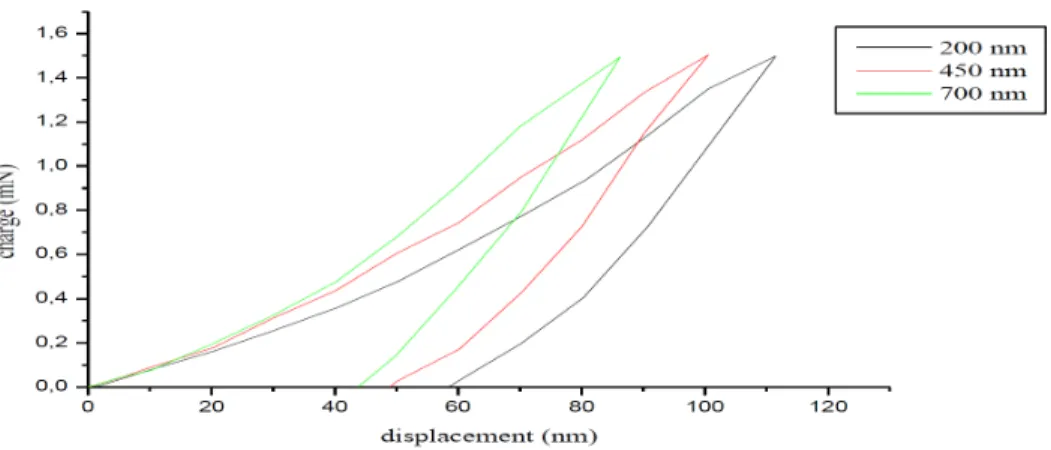
A scanning electron microscope (SEM) was used to determine the thickness of the film according to the deposition time. The three thicknesses corresponding to the three deposition times (10 min, 30 min and 50 min) are respectively 200 nm and 450 nm and 700 nm. To understand the effect of thickness, we performed several characterizations on layers deposited on Si and glass substrates, including RX diffraction, Raman, SEM and nano indentation tests to study the hardness and modulus of elasticity of the layer. To carry out the Vickers indentation tests, we applied the method of Oliver and Pharr [13]. During the tests, the depth of penetration the applied force of the tip are recorded during the depression. The loading/displacement curves plotted by the software and the identification of the mechanical properties (hardness and modulus of elasticity) are based on the inverse analysis of the discharge data and the knowledge of the characteristics (mechanical and geometrical) of
the indenter.
In our work, the applied tip load is 1.5 mN and the load and discharge rate is 3 mN / min and the wait time on the tip is 80 s. The tribological behavior of uncoated and coated steel at different thicknesses was characterized by the determination of the coefficient of friction. Thanks to a CSM tribometer where the pin is a 100Cr6 steel ball with a diameter of 6 mm he friction tests are carried out dry for 30 minutes over a sliding distance of 50 m with a sliding speed of 5.5 m / min and a load of 10 N. Following the dry friction test in the room temperature, a morphological analysis was carried out on the traces of frictional wear. Wear resistance of coated and uncoated steel is characterized by mass loss during the friction
test the weighing of the samples before and after each friction test is carried out by a
microbalance (KERN).
3. RESULTS AND DISCUSSION
3.1 Microstructural characterization
The deposited TiW layers were investigated by X-Ray diffraction, Raman spectroscopy and Scanning Electron Microscopy (SEM). Figure 1 shows the X-ray spectra of the thin layers. It appears from this figure the presence of an amorphous character represented by the appearance of diffraction domes that reflect an atomic disorder as fingerprint of amorphous structure. However, one can see an increase in the intensity of the X-ray dome with the an increase in the thickness of the TiW layer.
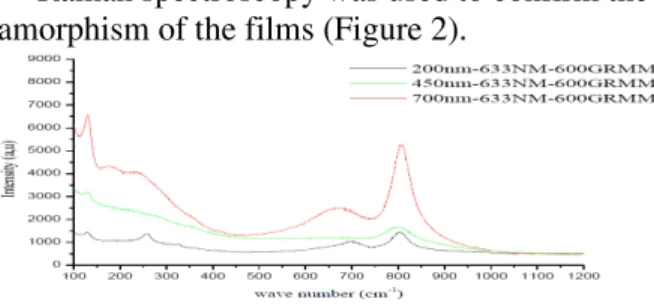
Raman spectroscopy was used to confirm the amorphism of the films (Figure 2).
Fig. 2. Raman spectra of TiW films as a function of thickness
The Raman spectrum obtained clearly demonstrates that the W-Ti layer has an amorphous structure. Note that these three spectra are similar, have the same appearance and the same ranges. It also seems that the thicker the layer, the more visible the bands. This observation is clearly apparent in the film at 700 nm thick where the bands are well pronounced. This is explained by the fact that the
more the amount of material deposited is increased the greater the Raman Effect.
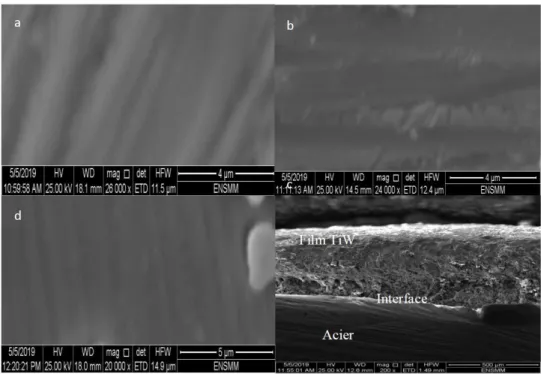
Fig. 3. SEM images of the TiW layer deposited by magnetron PVD on the steel at different thicknesses A) Thickness 200 nm, B) thickness 450 nm, c) thickness 700 nm, d) cross- sectional.
Figure 3 represent the surface morphology observed at SEM for the three layers deposited on our steel. Figure 3 shows the SEM micrographs of the cross - sectional (Figure 3.d) and of the surface figure3.a, b and c) of the TiW coatings produced by PVD dc magnetron on the steel the coatings have a homogeneous, very dense or amorphous microstructure, of the columnar type (Figure 3.d). These images are characteristic of PVD deposits [14], and especially the TiW layers [15]. There is a smooth surface where there is no structure; no surface defects were observed. Note that, some roughness is distributed randomly over the surface (figure3.d). These asperities probably formed during the growth of the deposit, a phenomenon typical of PVD deposits [16]. The interface between this film and its substrate also seems to be clear without any particular defect. We also note the size of the very fine and barely visible grain (nanometric size), and the size of
these grains more and more important when the thickness of the layer increases.
3.1 Nano indentation
The mechanical properties of the coating are determined by nano-indentation.
Fig. 5. Evolution of the hardness and modulus of elasticity obtained in indentation mode of the TiW layer as a function of the thickness.
The bars on each histogram indicate that the average value of ten measurements realized on the titanium - tungsten layer under a load of 1.5 mN. In the case of the TiW layer with a low thickness, the hardness and modulus of elasticity have a lower values than those of the layers with a large thickness; this can be explained by the presence of a less hard and less rigid film than the thick layer. The influence of the thickness of the TiW film is shown in Figure 5, the hardness decreases due to the thin film thickness. The coating with a thickness of 700 nm has a hardness of 1318 Hv and a modulus of elasticity of 154 GPa higher than the coating with a thickness of 450 and 200 nm, from these results, we can conclude that steel coated with TiW alloy has a better mixture of hardness and ductility than the bare substrate.
3.3 Tribological study
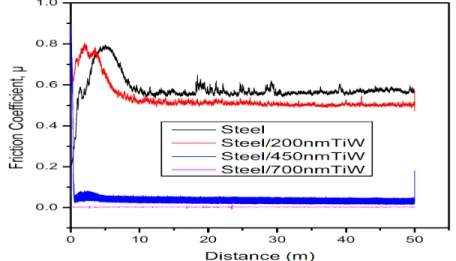
The evolution of the coefficient of friction as a function of the distance run through for steel with and without TiW coating at different thicknesses is presented in figure 6 and 7. It is remarkable to note that at the beginning of the test on bare steel, the coefficient of friction is more disturbed during the first cycles, it starts at 0.2 but it is increased quickly to 0.8 and stabilizes over time total of the test at a value of 0.589.
For steel coated with a thin layer (200 nm), it exhibits the same behavior as uncoated steel, starting from the value 0.6 then increasing to the value 0, 8. And at the end the coefficient of friction is stabilized at the value of 0.469.
For coated steel with a thickness of 450 nm and 700 nm, the two layers behave in the same way, where the coefficient of friction is slightly stable during the first cycles. And finally the coefficient of friction is stabilized respectively at the values 0.094, 0.002, corresponding to the thickness of 450 nm and 700 nm. Table 1.
The coefficient of friction for an uncoated substrate is higher compared to a coated substrate. From these results we can say that increasing the thickness of the coating decreases the coefficient of friction.
Fig. 6. Evolutions of friction Coefficient of uncoated steel as a function of distance run through
Fig. 7. Evolution of friction Coefficient of uncoated steel, coated with TiW at different thicknesses (200, 450 and 700 nm) depending on the distance run through.
Table 1
Measurements of mechanical and tribological properties.
steel steel /TiW 200nm steel /TiW 450nm steel /TiW 700nm average coefficient of friction 0.589 0.469 0.049 0.002
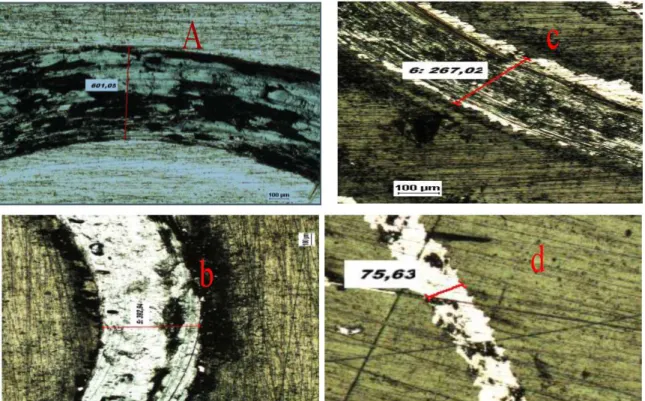
wear width (μm) 601.05 392.40 267.01 75.63
Table 1 shows the measurements of the tribological properties of steel with and without TiW layer at different thicknesses and under a 10 N load for 50 m.
In order to complete these results, and to understand the physical mechanisms that manage this evolution of the coefficient of friction of steel with and without coating, we conducted a characterization by optical microscopy. The morphologies of worn surfaces taken at the substrate / ball contact region are shown in Figure 8.
It is observed that for bare steel the trace is of a width of (601.05 μm) where greater wear compared with coated steel with a 700 nm thick layer that has the low width. Wear was manifested at the level of the trace of friction on the 200nm and 450nm flaking films. The presence of wear striations and debris around the friction marks illustrates the abrasion wear that occurs during the test. Damage to the TiW layers
decreases and their wear resistance improves as the thickness of the layer increases (Table 1).
The weakest damage is observed for steel with a 700nm layer which its hardness is maximum. It would appear that increasing the thickness will reduce the width of the wear of approximately 75.63 μm, compared with 450 and 200 nm films. As a result, mass loss during the dry friction test decreases with increasing layer thickness (Table 1). The histograms in Figure 9 show the results of the wear behavior after the friction test under a load of 10 N for 15 s. These results give the amount of mass in (mg) lost during the friction test : ΔM = M initial- M final
The most resistant steel to dry rubbing seems again to be that of steel coated with a thickness layer of 700 nm, this film is harder than the film with a thickness of 450 and 200 nm and has the best mechanical and tribological properties.
Fig.9. Evaluation of mass loss of coated and uncoated steel during the friction test.
4. CONCLUSION
The present work consists of studying the deposition of a titanium - tungsten thin film on AISI 420 nuance stainless steel by the magnetron sputtering technique (PVD cd). Indeed, for improve the mechanical and tribological properties of stainless steel and to predict the effect of the thickness of the coating layer, we used several characterization techniques. According to the characteristics of the layer by XRD, SEM, Raman, and nano indentation measurements we have achieved the following results:
-The X-ray diffraction shows that the deposited coatings are amorphous nano-layers. These results are confirmed by Raman spectrometry.
-The SEM observation shows that the morphology of deposit varied with the thickness of deposit.
-Nanoindentation tests were performed and the corresponding results indicate that hardness and rigidity increase with increasing layer thickness. It is noted that the thick layer (700 nm) has a hardness of 1318.03 Hv and a modulus of elasticity of 153.909 Gpa.
For the tribological properties, the results obtained show that the coated steel has a low coefficient of friction and good wear resistance compared to uncoated steel.
5. REFERENCES
[1] Tomasz Lioekiewicz MSc, hard coatings durability under variable fretting wear conditions, Thèse de doctorat en Cotutelle Ecole Centrale de Lyon – Université Polytechnique de Lodz, spécialité matériaux, 2004.
[2] Karuppasamy, A. and Subrahmanyam, A.
Studies on electrochromic smart windows based on titanium doped WO3 thin films. In Thin Solid Films. 516 : 175–178, 2007. [3] Garga, D. Henderson, P.B., Hollingsworthb,
R.E. and Jensen, D.G. An economic analysis of the deposition of electrochromic WO3 via sputtering or plasma enhanced chemical vapor deposition. In Materials Science and Engineering. 119 : 224–231,2005.
[4] Ph. Lami et Y. Pauleau, J. Electrochem. Soc.: "Solid-State Science and Technology"135 (1988) 980.
[5] Joraid, A. Comparison of electrochromic amorphous and crystalline electron beam deposited WO3 thin films. In Current Applied Physics. 9 : 73–79, 2009.
[6] Patil, P.S., Mujawar, S.H., Inamdar, A.I. and Sadale, S.B. Electrochromic properties of spray deposited TiO2-doped WO3 thin films. In Applied Surface Science. 250 : 117–123, 2005.
[8] K.A. Taylor, Thin Solid Films, 40 (1977) 189.
[9] E. Eser, R.E. Ogilvie, K.A. Taylor, J. Vac. Sci. Technol., 15 (1978) 396.
[10] Yan.Mei Jiang, "Pulvérisation cathodique assistée par ordinateur", Thèse de doctorat, Université de Paris-Sud Centre d'Orsay (1992).
[11] Rointan, F. B.; Handbook of Deposition Technologies for Films and Coating; University of California at Los Angeles, 2000.
[12] Liu, C.; Bi, Q.; Leyland, A.; Matthews, A. Corrosion Science. 2003, 54, 1243-1256. [13]. Oliver, W.e.P., G. (1992).7:1564(1583),
An improved technique for determining hardness and elastic modulus using load
displacement sensing indentation experiments. Materials Research Society, 1992: p. 1564-1583. [14] L.Cunha, M.Andrischky, L.Rebouta, R.Silva, Thin Solid Films, 317(1998)351-355.
[15] A. Roshangiasa, R. Pelzerb, G. Khatibic, J.Steinbrennerb. , “Thickness Dependency of Adhesion Properties of TiW Thin Films”, IEEE 16th Electronics Packaging Technology Conference (EPTC), 2014. [16] P.M. Martin, Handbook of Deposition
Technologies for Films and Coatings, Third Edition: Science, Applications and Technology, 3rd Edition, ISBN-13: 978-0815-5203-13, William Andrew, 2009.
Caracterizarea mecanicăși tribologică a acoperirilor cu peliculă subțire de tungsten-titan depuse de sputteringul cu magnetron continuu
Rezumat: Lucrarea noastră constă în depunerea unui film subțire de titan-tungsten (TiW) pe oțel inoxidabil AISI 420 (SS) de diferite grosimi prin tehnica de sputtering cu magnetron continuu. Au fost efectuate teste microstructurale (XRD, SEM, Raman), mecanice (nanoindentare) și tribologice pe substraturile din oțel inoxidabil acoperit. Discuțiile privind rezultatele obținute arată că stratul de TiW îmbunătățește proprietățile tribologice și mecanice ale eșantioanelor în comparație cu cele fără
stratul de TiW. De-a lungul discuției a fost realizată o corelație între grosimea stratului, duritatea, coeficientul de frecare și rezistența la uzură
Cuvinte cheie: Peliculă subțire, sputtering magnetron continuu, frecare, uzură
Fahima INNAL, Department of Mechanical Engineering, Faculty of Technology, the 20 August 1955- University of, Skikda, Algeria. Email: [email protected],office phone: 0659484057
Messaoud LEGOUERA, Mechanical and Materials Engineering Laboratory (LGMM), Faculty of Technology, the 20 August 1955- University of, Skikda, Algeria. Email: [email protected], office phone: 0673447139
Fouaz LEKOUI, Mouhamed OUCHABANE, Laid HENNI, Center for Development of Advanced Technologies (CDTA) Division of Ionized Media & Laser, City August 20, 1956, Baba Hassen, Algiers, Algeria